International Research Journal of Natural and Applied Sciences Vol. 3, Issue 9, September 2016 IF- 3.827 ISSN: (2349-4077)
© Associated Asia Research Foundation (AARF)
Website: www.aarf.asiaEmail : [email protected] , [email protected]
GLUT CLASSIFICATION (SLC2A, SLC5A)
Ana María Sánchez Peralta
University of Granada, Pharmacy Faculty, Department of Food Science and Physical Chemistry, Campus Universitario de Cartuja S/N 18071 Granada, Spain.
RESUME
Because SLC2A (Soluto Carrier 2 A) and SLC5A (SolutoCarrier 5 A) transporters are
being studied without a normalized criteria before, this work make a grouping of all them
and their nomenclatures used. They are known as SGLT (Sodium/Glucose Transporter)
and GLUT (Glucose Transporter). We want to help in the knowledge about their properties
in the different papers made about them. Old GLUT name was referring only on Glucose
transporter, but all this related transporters not only carried Glucose, but also other sugars
like Galactose, Fructose, Mannose, and inclusiveMyo-inositol andUric acid.
In Spanish language exist the word “glúcido” (“glucid” translated in English) whose
reference all carbohydrates, and for that is possible continuous use the word GLUT
referencing all the “Glucid” transporters. To avoid misidentifications we must use the
official symbols (by genetic origin)of solute transporters which are SLC2A and SLC5A.
KEY WORDS: GLUT, SGLT, SLC5A, SLC2A
GLUCID TRANSPORTERS
Glucose is a monosaccharide of large size which cannot diffuse well through the channels of
the plasma membrane, and it is insoluble in lipids, and so it cannot diffuses through the layer
of phospholipids. Therefore facilitated diffusion is necessary.
It has high solubility in polar solvents such as water because the hydroxyl groups (OH) make
partial loads capable of establishing hydrogen bonds. It is mainly dissolved in blood and
To traverse the plasma membrane of every cell requires the intervention of carrier proteins.
These are known by the acronym SGLT (Sodium / Glucose Transporter) and GLUT (Glucose
Transporter). All cells have specific transporters of glucose and other carbohydrates to speed
their transit through their membranes. These conveyors may be dependent upon insulin or
not. The transporters activity dependent by insulin are GLUT 4, also are being studied GLUT
6, GLUT 8, GLUT 10 and GLUT 12. GLUT 6 has great similarity with GLUT 8 (44.8 %
homology).
The GLUT 9 was studied in principle with this name, which has now been renamed GLUT 6,
thus identifying errors in relatively recent works in which it is not clear which of the GLUT
are referring . We should note that the official nomenclature used abbreviations SLC2A
(Solute Carrier 2 A) that take into account the genetic origin of each GLUT avoiding
misidentification. In this case it is SLC2A6.
GLUT 13 transports myo-inositol, not glucose, so some papers doesn’tdesignit with the name
GLUT, but with this other, HMIT (H + / inositol transporter). It is SLC2A13.
Others carriers not only transport glucose, they may also carry others carbohydrates with
varying affinity, as galactose, fructose and mannose. Even others transport uric acid.
Acronyms GLU initially made only glucose reference, but because in Spanish language we
use the word “glúcidos” (carbohydrates or glucids) referring to all kind of sugar (i.e.
carbohydrates) we can continue use the acronym GLUT, in my opinion, as "Carbohydrate
transporter" or “Glucid transporter”.
There are twotypes of families of Glucose transporters of membrane proteins, the
sodium-coupled glucose transporters (SGLT) and the facilitative glucose transport proteins (GLUT).
SGLT (SGLTs) are responsible of the absorption and reabsorption of sugars at the intestinal
epithelium and glomerulus on their way into the bloodstream. They belong to the family of
solute carrier 5 A (SLC5A1), and they are sodium / glucose carriers.
GLUT (GLUTs) are responsible of the entry of sugars into the different cell tissues through
the plasma membrane. They belong to the family of solute carrier 2 A (SLC2A), making the
facilitated transport of glucose and other carbohydrates.
The entry of glucose across the cell membrane may be insulin dependent, as the case of the
insulin receptor, making the uptake of the glucose from the bloodstream into the cell; or may
not be insulin dependent.
GLUT 4 is in cells of striated and cardiac muscle, in adipocyte, and in granulocyte in patients
with DM. It is widespread in human body.
GLUT 1 was studied initially in cells of brain and erythrocyte, not request insulin for the
entry of glucose. But we found in fetus, endothelium, neuron, placenta, leukocyte, retinal,
kidney and adipocyte. This GLUT has high affinity of Glucose carrying inside the cell. It is
the basic entry of glucose.
GLUT 12 was found in breast cancer cells, apart the other physiological places.
(1-5)
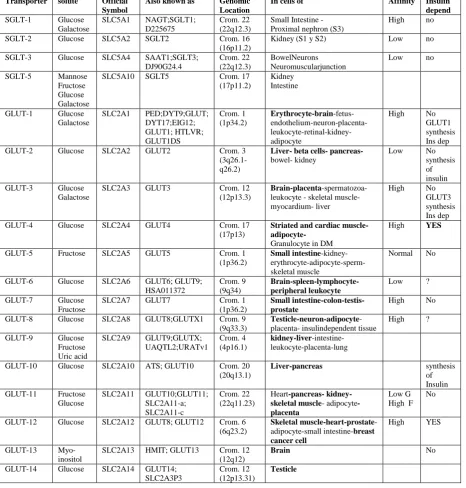
In Table 1, "Insulin depend" indicates access of carbohydrate to the cell interior, depending
of cell activation by insulin. (1-5)
ABBREVIATIONS:
SGLTs: Sodium/Glucose Transporters
GLUTs: Glucose Transporters
SLC5As: Solute Carrier 5 A (Solute Carrier Family 5, sodium/glucose transporter)
SLC2As: Solute Carrier 2 A (Solute Carrier Family 2, facilitated glucose/ transporter)
Akt: PKB: Protein Kinase B
REFERENCES:
(1) Human SLC2A and SLC5A classification PubMed. *
(2) Molecular biology of glucose transporters: classification, structure and distribution.
Valmore Bermúdez, Fernando Bermúdez, NailetArraiz, Elliuz Leal, Sergia Linares,
Edgardo Mengual, LisneyValdelamar, Moisés Rodríguez, Hamid Seyfi, AnilsaAmell,
Marisol Carrillo, Carlos Silva, Alejandro Acosta, Johnny Añez, Carla Andara,
Verónica Angulo, Gabriela Martins. Venezuelan Archives of Pharmacology and
Therapeutics. Vol.26, N:2, 2007.
(3) Molecular mechanisms involved in the transport of glucose. Vicente Castrejón,
(4) How glucose is transported across the cell membrane?Diana P. Díaz Hernández, Luis
Carlos Burgos Herrera. IATREIA, Vol. 15, N:3, Sept. 2002.
(5) Seldin and Giebisch’s The Kidney: Phisiology and Pathophysiology,vol 1. 4º edition.
Edited by Robert J. Alpern, Steven C. Hebert. Academic Press, 2007.
(1)*http://www.ncbi.nlm.nih.gov/gene/6523 , http://www.ncbi.nlm.nih.gov/gene/6524 ,
http://www.ncbi.nlm.nih.gov/gene/6527 , http://www.ncbi.nlm.nih.gov/gene/125206 ,
http://www.ncbi.nlm.nih.gov/gene/6513 , http://www.ncbi.nlm.nih.gov/gene/6514 ,
http://www.ncbi.nlm.nih.gov/gene/6515 ,http://www.ncbi.nlm.nih.gov/gene/6517 ,
http://www.ncbi.nlm.nih.gov/gene/6518 , http://www.ncbi.nlm.nih.gov/gene/11182 ,
http://www.ncbi.nlm.nih.gov/gene/155184 , http://www.ncbi.nlm.nih.gov/gene/29988 ,
http://www.ncbi.nlm.nih.gov/gene/56606 , http://www.ncbi.nlm.nih.gov/gene/81031 ,
http://www.ncbi.nlm.nih.gov/gene/66035 , http://www.ncbi.nlm.nih.gov/gene/154091 ,
TABLE 1 (1-5) GLUT CLASSIFICATION
Transporter solute Official Symbol
Also known as Genomic Location
In cells of Affinity Insulin
depend
SGLT-1 Glucose
Galactose
SLC5A1 NAGT;SGLT1;
D225675
Crom. 22 (22q12.3)
Small Intestine - Proximal nephron (S3)
High no
SGLT-2 Glucose SLC5A2 SGLT2 Crom. 16
(16p11.2)
Kidney (S1 y S2) Low no
SGLT-3 Glucose SLC5A4 SAAT1;SGLT3;
DJ90G24.4
Crom. 22 (22q12.3)
BowelNeurons Neuromuscularjunction
Low no
SGLT-5 Mannose
Fructose Glucose Galactose
SLC5A10 SGLT5 Crom. 17
(17p11.2)
Kidney Intestine
GLUT-1 Glucose
Galactose
SLC2A1 PED;DYT9;GLUT;
DYT17;EIG12; GLUT1; HTLVR; GLUT1DS Crom. 1 (1p34.2) Erythrocyte-brain-fetus- endothelium-neuron-placenta- leukocyte-retinal-kidney-adipocyte
High No
GLUT1 synthesis Ins dep
GLUT-2 Glucose SLC2A2 GLUT2 Crom. 3
(3q26.1- q26.2)
Liver- beta cells- pancreas- bowel- kidney
Low No
synthesis of insulin
GLUT-3 Glucose
Galactose
SLC2A3 GLUT3 Crom. 12
(12p13.3)
Brain-placenta-spermatozoa- leukocyte - skeletal muscle- myocardium- liver
High No
GLUT3 synthesis Ins dep
GLUT-4 Glucose SLC2A4 GLUT4 Crom. 17
(17p13)
Striated and cardiac muscle-adipocyte-
Granulocyte in DM
High YES
GLUT-5 Fructose SLC2A5 GLUT5 Crom. 1
(1p36.2)
Small intestine-kidney- erythrocyte-adipocyte-sperm-skeletal muscle
Normal No
GLUT-6 Glucose SLC2A6 GLUT6; GLUT9;
HSA011372
Crom. 9 (9q34)
Brain-spleen-lymphocyte-peripheral leukocyte
Low ?
GLUT-7 Glucose
Fructose
SLC2A7 GLUT7 Crom. 1
(1p36.2)
Small intestine-colon-testis-prostate
High No
GLUT-8 Glucose SLC2A8 GLUT8;GLUTX1 Crom. 9
(9q33.3)
Testicle-neuron-adipocyte-placenta- insulindependent tissue
High ?
GLUT-9 Glucose
Fructose Uric acid
SLC2A9 GLUT9;GLUTX;
UAQTL2;URATv1
Crom. 4 (4p16.1)
kidney-liver-intestine-leukocyte-placenta-lung
GLUT-10 Glucose SLC2A10 ATS; GLUT10 Crom. 20
(20q13.1)
Liver-pancreas synthesis
of Insulin
GLUT-11 Fructose
Glucose
SLC2A11 GLUT10;GLUT11;
SLC2A11-a; SLC2A11-c
Crom. 22 (22q11.23)
Heart-pancreas- kidney- skeletal muscle- adipocyte-placenta
Low G High F
No
GLUT-12 Glucose SLC2A12 GLUT8; GLUT12 Crom. 6
(6q23.2)
Skeletal muscle-heart-prostate-adipocyte-small intestine-breast cancer cell
High YES
GLUT-13
Myo-inositol
SLC2A13 HMIT; GLUT13 Crom. 12
(12q12)
Brain No
GLUT-14 Glucose SLC2A14 GLUT14;
SLC2A3P3
Crom. 12 (12p13.31)
Testicle
Ana María Sánchez Peralta.
[image:5.595.67.534.71.560.2]