223
THE RELATIOEENSHIP BEETWEEN CREATIVITY IN THINKING AND
WRITING PERFORMANCE OF IRANIAN EFL LEARNRS ON COMPARISON / CONTRAST
Hassan Soleimani
Department of Applied Linguistics, Payame Noor University, Tehran, Iran
Sara Najafgholian
Payame Noor University, Tehran, Iran
ABSTRACT
The main purpose of the present study was to determine whether creativity in thinking is significantly related to Iranian EFL learners’ writing performance in comparison-and-contrast type of writing. Besides, the researchers attempted to investigate the difference between male and
female participants as far as writing and creativity is concerned. One hundred and seven Iranian
EFL learners were selected from three universities in Tehran based on availability sampling
technique. All the students who were in intermediate level of proficiency were asked to respond to
the creative thinking questionnaire and write an essay with a selected topic. Three experienced and
trained teachers were asked to rate the essay writing papers of participants analytically. The result
of the statistical analysis revealed a significant positive relationship between creativity in thinking
and both total and components of writing performance in comparison-and-contrast. Moreover, the
findings indicated no significant difference between female and male participants as far as writing
and creativity were concerned.
© 2014 AESS Publications. All Rights Reserved.
Keywords: Creative thinking, Comparison, Contrast, Creative ability, Writing performance, Foreign language learning.
Received: 26 April 2014/ Revised: 9 September 2014 / Accepted: 12 September 2014 / Published: 15 September 2014
Contribution/ Originality
This study contributes in the existing literature area of foreign language learning in which it is attempted to investigate the relationship between creativity and writing performance of EFL learners on comparison and contrast. This study uses new estimation methodology to probe the
International Journal of English Language and
Literature Studies
224 degree of relationship between two variables. Moreover, this study organizes more attention to
investigate the difference between male and female for the purpose of more detailed results.
1. INTRODUCTION
It is generally recognized that many EFL learners have difficulties with writing skill in English language. They have big challenges in their writing performance; sometimes these challenges change their writing to a very problematic issue. The difficulty of learners lies not only in generating and organizing ideas, but also in translating these ideas in to readable text (Richards, 2002 as cited in Kaufman (2009)), so that a teacher should implement a flexible program to cater to different learners' needs, and help them to know their abilities and their differences to be able to improve their weak points in the field of writing skill.
Individuals’ differences in their abilities and thinking process make them completely different in their writing. In other words, the differences between performances of learners in writing skills might be the result of differences between their levels of creative thinking which should be enhanced in low creative thinkers by instructors through planning specific strategies. According to Pavies (1998 as cited in Runco (2004)), when writing is taught to second language learners, it is generally restricted to fill-in-blank exercises which focus on accuracy rather than composing process. He notes that writing which involves creative thinking process with focuses on communication and self-expiration carries many other benefits. Brown (2001) also believes that creative writers want their readers to think about the words they have penned. Directly stated pointes usually do not require much thought. However, implied meaning demands critical thinking about the ideas penned by the writer. Writing is seen as springing from self-discovery guided by writing on topics of potential interest to writers and, as a result, the approach is likely to be most successful in hands of teachers who write creatively (Hyland, 2003). In this respect, (Kaufman, 2009) states that creative writers focus primarily on the art of writing, or the nature of what they write (the words). They are able to pen powerful words that trigger, in readers, affect (physiognomy), sensory under currents (synesthesia), picture in-the-head (imagine) and other evocative responses. It is worth recalling that in the field of second language writing, expressivism argues the importance of encouraging writers to explore their beliefs, engage with the ideas of others, and connect with readers in writing as a creative act of self-discovery. According to them, all writers have a similar innate creative potential and can learn to express themselves through writing if their originality and spontaneity are allowed to flourish (Hyland, 2003).
225
2. THEORICAL FRAMEWORK
Duffy (1998) believes that the concept of creativity involves the ability to see things in fresh way, learning from past experiences and relating this to new situations, thinking along unorthodox lines, using nontraditional approaches, going beyond the information provided, and create something unique and original. Torrence (1966) also defines creative thinking as the ability to sense problems, make guesses, generate new idea and communicate results. Following above claims, Albert and Kormos (2004) reveal that Guilford is among the first to put forward cognitive processes involved in creativity. According to Albert and Kormos (2004), Guilford (1950) has developed a comprehensive model of human intellect and started to focus on divergent thinking. Guilford (1950, as cited in Albert and Kormos (2004)) suggests that divergent thinking, which is the ability to produce many different ideas in response to a problem, is an operating complementary to convergent thinking, the ability to find the correct solution to a problem. Guilford (1967) relates the expiration divergent thinking to four relatively independent aspects including: fluency, flexibility, originality, and elaboration.
Fluency is the ease with which an individual use stored information when he needs it. In other words, the ability to use a large number of ideas.
Flexibility is the ability to produce a wide variety of ideas. In other words, it is the ability a person has to overcome mental blocks, to alter his approach to a problem.
Originality or novelty is shown by an unusual or rare response. It is the ability to produce unusual ideas.
Elaboration is shown by a number of additions that can be made to some simple stimulus to make it more complex (Torrance & Safter, 1999 as cited in Runco (2004)).In the educational domain, Ely (1980) investigated the influence of creativity in thinking on the use of the second language learning strategies among students of Spanish at the university level. In this study, it was theorized that students’ use of strategy is influenced by creative thinking process in the ways that lower creativity leads to relatively greater reliance upon the L1 when using the language and strategies that focus on specific details are used more by students low in creativity. In accordance with Ely (1980), Kazamia (1998) tried to assess the degree of tolerance of ambiguity as one significant aspect of creative thinking process that Greek Civil Servants demonstrated when learn English as a foreign language. The results indicated that because of differences between participants’ degree of creativity, their tolerance of ambiguity in all skills and in all language learning strategies was different.
In addition, in investigating the role of creativity in teaching and learning second language,
226 comparison–and contrast type. As Ally and Bacon (1999 as cited in Hyland (2003)) mention, in writing an effective comparison and contrast essay, the topic sentence should identify both items (subjects) to be compared or contrasted and tell the reader exactly what is going to say about these items. When writers decide on a good topic sentence, they should list all the points of comparison and contrast, organize all details in a logical sequence, and begins a rough draft. Finally, the most effective conclusion for this type of essay is a final sentence, which reinforces the controlling idea. Ally and Bocon (1999 as cited in(Hyland, 2003) also believe that ordering details in a compare-and-contrast essay requires some thought that is an evidence for the importance of creative thinking process in this type of writing. In the area of second language writing, Moore (1985) examined the problem solving process in a writing task with students. The study found that writing performance with more creative thinking process was associated with a number of objects explored, and the time spent in the prewriting phase. Albert and Kormos (2004) also examined how different moments of evaluation in the process of writing performance affected the creativity of the production among English learners. Finally, Allison (2004) explored what students and teachers in one setting had to say about creativity and related topics as they commented upon academic writing in a university English language degree program. He found that only a small number of comments included the word creative or a cognate term; this makes it possible to report all data selected on the key word basis. With a focus on previous studies, it can be understood that they expressed the impact of creative thinking process in the second language writing performance, but did not express the tendency of putting individuals’ different levels of creative thinking and its relationship with the writing performance to the test. Besides, another problem with the researches can be lack of attention to different types of writing performance for a researcher to examine the issue more precisely. In other words, to get a better picture of the relationship between creative thinking and second language writing, a researcher should extend his or her focus from mostly a general view to writing skill to a narrower view in writing.
The present study aimed to analyze the extent to which the amount of creativity integrated well with writing of EFL learners influence their writing performance in comparison-and-contrast type of writing performance.
To address the purpose of this study, our research questions were:
1. Is there any significant relationship between creativity in thinking and comparison-and-contrast paragraph writing performance of Iranian EFL learners?
2. Is there any significant difference between male and female learners as far as creativity and writing are concerned?
3. METHODOLOGY
227 3.1. Participants
To collect the needed data for this study, 190 intermediate students were selected based on their sores on Michigan test of proficiency from among BA students of different universities in Tehran, Iran. All 190 students were given a creativity questionnaire and a paragraph writing task, however, 107 subjects (48 male, 59 female) completed the writing performances successfully and were chosen for conducting the study.
3.2. Instruments
The following materials were used for the purpose of the study:
Proficiency test: The first testing instrument in this study was Egbert and Jessup (1991). Reviewing the related literature revealed the Cronboch's Alpha for this test was equal to 0.91 that shows a high reliability of this test.
Creativity Test: The standardized creativity test questionnaire (O'Neil and Abedi, 1996) which was used in this study is a questionnaire with 60 multiple-choice items with three choices. For scoring, 1, 2, and 3 points were allotted to the 3 choices of a, b, c respectively. The Torrance Test of Creative Thinking and Abedi Test of Creativity were administered simultaneously to the student of secondary schools in Tehran and the results showed a correlation of 0.46 between TTCT and ATC which reflects the plausible criterion-related validity of the test. Moreover, the Coronbach’s Alpha for total creativity was equal to 0.85 which showed a high reliability, besides reliability coefficient for creative fluency was 0.85,for creative originality it was 0.82, for creative flexibility 0.84, and for elaboration it was 0.80 (Auzmendi et al., 1996).
Writing task: Participants were asked to write a comparison-and-contrast writing using a prompt (Compare women and men as friends). The participants were required to generate, organize, and support their ideas, and use cohesive devices in appropriate way.
3.3. Research Procedure
First, a standardized Egbert and Jessup (1991)was administered to initial participants in order to classify them in terms of their general language proficiency. Then, a validated creativity questionnaire (O'Neil and Abedi, 1996) test of creativity was given to subjects in order to measure their level of creativity. In order to know and measure the ability of participants in writ ing performance, a comparison-and-contrast paragraph writing task was used as a prompt with a pre-selected topic: “Compare women and men as friends”. The participants were told to write at least 250 words for the writing activity and they were not allowed to use a dictionary during composition writing. Besides, the researchers answered the participant’s questions prior to administration of the writing tasks.
228 each of the components were the participants’ scare on that part. In order to ascertain the reliability
of composition scores, inter-rater correlation was computed for each section.
4. RESULTS
This study aimed at investigating the relationship between creativity and one type of writing task, i.e. comparison-and-contrast, and also probing any significant differences between male and female participants as far as their creativity and writing tasks were concerned. According to Filed (2009), in order to make any sound statistical conclusions, four assumptions must be met: interval data, independence, normality and homogeneity of variance. First, the present data were measured on an interval scale. The second assumption, independence of subjects, was also met because no treatments involving peer or group works were administered in this study. The assumption of normality was not met. The results of the Kolmogorov-Smirnov indicated that (except for creativity and organization section of comparison-and-contrast) none of the tests enjoyed normal distributions. As displayed in Table 1, the p-values for Kolmogorov-Smirnov tests were lower than .05. Thus, the non-parametric tests of Kendall correlation and Mann-Whitney tests were run to probe the research questions posed in this study.
Table-1.Normality Test
Kolmogorov-Smirnov Shapiro-Wilk
Statistic df Sig. Statistic df Sig. Creativity .067 107 .200 .990 107 .620 Content CC .109 107 .003 .940 107 .000 Organiz CC .083 107 .069 .943 107 .000 Vocab CC .110 107 .003 .954 107 .001 Lang CC .102 107 .008 .951 107 .001 Mech CC .203 107 .000 .893 107 .000 Total CC .128 107 .000 .943 107 .000 Note. The Shapiro-Wilk test is used for sample sizes below 50 (Filed, 2009).
4.1. Inter-Rater Reliability Indices
The Cronbach’s alpha reliability indices for probing the agreement between the three raters’ scorings of the writing tests all indices ranged from .91 for organization section of comparison-and-contras to 82 for vocabulary section of comparison-and-comparison-and-contrast.
Table-2.Reliability Statistics
Cronbach’s Alpha N of Raters
Compare And Contrast
Content .83 3
Organization .91 3
Vocab .82 3
Language .85 3
229 4.2. Investigating the First Research Hypothesis
Null hypotesis1: There is no significant relationship between creativity in thinking and comparison-and-contrast paragraph writing performance of Iranian EFL learners.
A Kendall correlation was run between scores of creativity in thinking and scores of writing performance in comparison- and-contrast in order to probe the degree of correlation between two types of variables among EFL learners. As displayed in Table 3, the creativity showed significant correlations with the components of compare-and-contrast writing tests;
a) Content (Kendall’s τ = .53, P < .05), b) Organization (Kendall’s τ = .62, P < .05), c) Vocabulary (Kendall’s τ = .65, P < .05), d) Language (Kendall’s τ = .62, P < .05), e) Mechanics (Kendall’s τ = .68, P < .05),
f) Total Compare-and-Contrast (Kendall’s τ = .72, P < .05). Thus the first hypothesis was rejected.
Table-3. Kendall Correlation; Creativity with Compare-and-Contrast Paragraph Writing Tests Creativity
Kendall Correlation
ContentCC Correlation Coefficient .53** Sig. (2-tailed) .000
N 107
OrganizCC Correlation Coefficient .62** Sig. (2-tailed) .000
N 107
VocabCC Correlation Coefficient .65** Sig. (2-tailed) .000
N 107
LangCC Correlation Coefficient .62** Sig. (2-tailed) .000
N 107
MechCC Correlation Coefficient .68** Sig. (2-tailed) .000
N 107
TotalCC Correlation Coefficient .72** Sig. (2-tailed) .000
N 107
**. Correlation is significant at the 0.01 level (2-tailed).
4.3. Investigating the Second Research Hypothesis
Null hypothesis 2: There is no significant difference between male and female learners as far as creativity and writing is concerned.
230 Table-4.Descriptive Statistics; Creativity by Gender.
Gender N Mean SD SEM
Creativity Male 48 80.50 10.78 1.55 Female 59 78.31 14.282 1.859
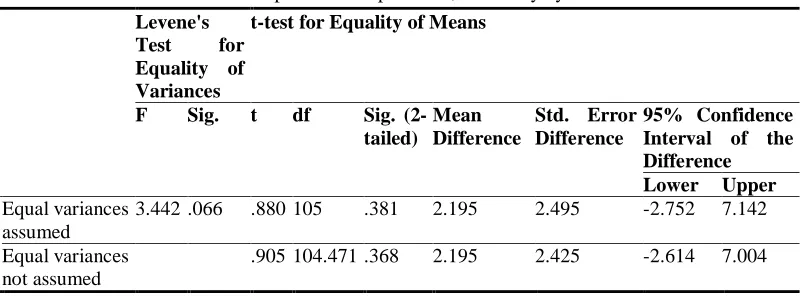
The results of the independent t-test (t (105) = .88, p > .05; R = .086) with a weak effect size) indicated that there was not any significant difference between male and female subjects’ means on creativity, so hypothesis was supported.
Table-5.Independent Samples Test; Creativity by Gender Levene's
Test for Equality of Variances
t-test for Equality of Means
F Sig. t df Sig. (2-tailed)
Mean Difference
Std. Error Difference
95% Confidence Interval of the Difference Lower Upper Equal variances
assumed
3.442 .066 .880 105 .381 2.195 2.495 -2.752 7.142
Equal variances not assumed
.905 104.471 .368 2.195 2.425 -2.614 7.004
It should be noted that the assumption of homogeneity of variances was met. As displayed in Table 5, the Levene’s f-value of 3.44 was not significant (p > .05). That is why the first row of Table 5, (i.e. Equal variances assumed) was reported.
Figer-1. Creativity by Gender
60.00 63.00 66.00 69.00 72.00 75.00 78.00 81.00 84.00 87.00 90.00
Male Female
231 4.4. Investigating the Third Research Hypothesis
Null hypothesis 3: There is no significant difference between male and female learners as far as comparison-and-contrast writing performance is concerned.
The Mann-Whitney test was run to compare the male and female subjects’ performance on the total compare-and-contrast writing test. As Table 6 displays, the median scores for male and female subjects on compare-and-contrast writing test were 62.38 and 58.42 respectively.
Table-6.Mean Ranks and Median Scores; Compare-and-Contrast Writing Test with Gender
Gender N Mean Rank Sum of Ranks Median
Total CC Male 48 59.44 2853.00 62.38 Female 59 49.58 2925.00 58.42 Total 107
The results of the Mann-Whitney test (Z = -1.63, P > .05) indicted that there was not any significant difference between the male and female subjects’ performance on the total compare-and-contrast writing test, hence the null-hypothesis was supported.
Table-7. Mann-Whitney Test Statistics: Compare-and-Contrast by Gender
40 43 46 49 52 55 58 61 64 67 70
Male Female
Series1 62.38 58.42
Total CC Mann-Whitney U 1155.000 Wilcoxon W 2925.000
Z -1.635
Asymp. Sig. (2-tailed) .102 a. Grouping Variable: Gender
232
5. DISCUSSION AND CONCLUSION
The research questions in this study were concerned with the significance of relationship between creativity in thinking and writing performance of Iranian EFL learners. According to the results obtained in this study, the relationship between the two different abilities involving creativity and overall section of writing performance in comparison-and-contrast shows a high degree of correlation between them. This result confirms that of Otto (1998) who found a significant positive relationship between creativity and second language learner performance in the way that in communicative tasks learners used their imagination to construct their own ideas.
In addition, the result reveals that not only learners’ overall section of writing performance was positively related to their creativity in thinking, but also all components of writing performance (content, organization, language use, vocabulary, and mechanics) were positively related to their creativity. Learners’ performance in all sections of writing was a determination of their degree of creativity. The more the learners were creative, the more familiarity they had with the language lexis and structures, and expression of idea in writing task; therefore, they were able to write a better essay. Moreover, attempts were made to probe the significant difference between male and female learners as far as creativity and writing is concerned. The results of independent t-test and Mann-Whitney test indicated that there was not any significant difference between male and female subjects’ means on creativity and writing performance in comparison-and-contrast. The finding of this study supports the notion that creativity has positive impact on learning second language especially on improving writing ability in comparison-and-contrast type of writing among Iranian EFL learners. This notion seems more acceptable as it can be claimed that language writing is a creative act.
REFERENCES
Albert, A. and J. Kormos, 2004. Creativity and narrative task performance: An exploratory study. Language
Learning, 54(2): 27-31.
Allison, J., 2004. Comments on writing in an english language degree program. Journal of English for
Academic Purpose, 3(3): 191-209.
Auzmendi, E., A. Villa and J. Abedi, 1996. Reliability and validity of a newly contrasted multiple- choice
creativity instrument. Creativity Research Journal, 9: 89-96.
Brown, H.D., 2001. Teaching by principles: An interactive approach to language pedagogy. 2nd Edn., New
York: Longman.
Burton, J. and K. Turvey, 2006. Developing conceptual frameworks for creativity. ICT and Teacher
Education, 1(1): 3–13. DOI 10.1016/j.tsc.2005.07.001.
Duffy, B., 1998. Supporting creativity and imagination in the early years. Milton Keynes: Open University
Press.
Egbert, J.L. and L.M. Jessup, 1991. Making difficult decisions: Can the michigan test help. Reports –
233
Ely, C.M., 1980. Tolerance of ambiguity and use of second language strategies. Foreign Language Annals, 22:
437- 445. DOI 10.1111/j.1944- 9720.1989.tb02766.x.
Filed, A., 2009. Discovering statistics using SPSS. 3rd Edn., London: SAGE Publications.
Guilford, J.P., 1967. Creativity: Yesterday, today and tomorrow. The Journal of Creative Behavior, 1(1): 3–
14. DOI 10.1002/j.2162-6057.1967 tb 00002.x.
Hyland, K., 2003. Second language writing. New York: Cambridge University Press.
Jacobs, H.L., S. Zingraf, D. Wormuth, V. Hartfield and J. Hughey, 1981. Testing ESL composition: A
practical approach. Rowley, MA: Newburg House.
Kaufman, J.C., 2009. The psychology of creative writing. New York: Cambridge University Press.
Kazamia, V., 1998. How tolerant are Greek learners of foreign language ambiguity. Department of linguistic
and phonetics. University of Leeds.
Mc-Lain, D.L., 1993. The MSTAT-1: A new measure of an individual tolerance for ambiguity. Educational
and Psychological Measurement, 53: 183 -189. DOI 10.1177/0013164493053001020.
Moore, M.T., 1985. The relationship between the originality of essays and variables in the problem
discovering process: A study of creative and non- creative middle school students. Research in the
Teaching of English 19(1): 84-95. Available from
http://www.eric.ed.gov/contentdelivery/servlet/ERICServlet?accno=ED258186.
O'Neil, F. and J. Abedi, 1996. Reliability and validity of a state metacognitive inventory. Potential for
Alternative Assessment, 89(4): 234-245. DOI 10.1080/00220671.1996.9941208.
Otto, I., 1998. The relationship between individual differences in learner creativity and language learning
success. TESOL Quarterly, 32(4): 763-773.
Runco, M.A., 2004. Creativity. Annual Review of Psychology, 55: 657-687. Available from
http://dx.doi.org/10.1146/annurevpsych.55.090902.141502.pdf.
Torrence, E.P., 1966. Torrance tests of creative thinking. Princeton, New Jersey: Personnel Press.
BIBLIOGRAPHY
Khajeh, A., 2002. Relationship between tolerance of ambiguity, gender, level of proficiency and use of second
language strategies. Unpublished M.A Thesis, Tarbiat Modares University. Tehran, Iran.
Kim, K.H., 2005. Learning from each other: Creativity in East Asian and American education. Creativity
Research Journal, 17(4): 337-347. DOI 10.1207/s15326934crj1704_5.
Marker, J., S. JO and O.M. Muamar, 2008. Development of creativity: The influence of vary level of
implication of the discover curriculum model, a non- traditional pedagogical approach. Learning &
Individual Differences, 18(4): 402-417.
Richardson, A.G., 1986. Sex differences in creativity among a sample of Jamaica adolescents. Journal of