R E S E A R C H
Open Access
A Hermite-Gauss method for the
approximation of eigenvalues of regular
Sturm-Liouville problems
Rashad M Asharabi
**Correspondence:
[email protected] Department of Mathematics, College of Arts and Sciences, Najran University, Najran, Saudi Arabia
Abstract
Recently, some authors have used the sinc-Gaussian sampling technique to approximate eigenvalues of boundary value problems rather than the classical sinc technique because the sinc-Gaussian technique has a convergence rate of the exponential order,O(e–(π–hσ)N/2/√N), where
σ
,hare positive numbers andNis the number of terms in sinc-Gaussian technique. As is well known, the other sampling techniques (classical sinc, generalized sinc, Hermite) have a convergence rate of a polynomial order. In this paper, we use the Hermite-Gauss operator, which is established by Asharabi and Prestin (Numer. Funct. Anal. Optim. 36:419-437, 2015), to construct a new sampling technique to approximate eigenvalues of regularSturm-Liouville problems. This technique will be new and its accuracy is higher than the sinc-Gaussian because Hermite-Gauss has a convergence rate of order
O(e–(2π–hσ)N/2/√N). Numerical examples are given with comparisons with the best sampling technique up to now,i.e.sinc-Gaussian.
MSC: 34L16; 65L15; 94A20
Keywords: sinc methods; Sturm-Liouville problem; error bounds; convergence rate
1 Introduction
LetEσ(ϕ),σ> , be the class of entire functions satisfying the following condition: f(ζ)≤ϕ|ζ|eσ|ζ|, ζ∈C, (.)
where ϕ is a non-decreasing, non-negative function on [,∞). On the class Eσ(ϕ),
Schmeisser and Stenger [] have introduced the so-called sinc-Gaussian operator
Gh,N[f](ζ) :=
n∈ZN(h–ζ)
f(nh)sinch–ζ–ne–Nα(h–ζ–n), (.)
where h∈(,π/σ],α:= (π– hσ)/,N∈N, and
ZN(ζ) :=
n∈Z:[ζ+ /] –n≤N.
Note that the summation in (.) depends on the real part ofζ. Here, the sinc function is defined as
sinc(t) :=
sin(πt)
πt , t= ,
, t= . (.)
The authors of [] investigated a bound of the approximating function from the classEσ(ϕ)
by the sinc-Gaussian operator. They proved that [], iff∈Eσ(ϕ), then we have forζ∈C, |ζ|<N
f(ζ) –Gh,N[f](ζ)≤sin
h–π ζϕ|ζ|+ h(N+ )EN
h–ζ e –αN
√
π αN, (.)
where
EN(t) :=cosh(αt) +O
N–/, asN→ ∞.
Annaby and Asharabi [] have constructed a new sampling technique to approximate eigenvalues of second order Birkhoff-regular eigenvalue problems using sinc-Gaussian op-erator. Then some authors have used this technique, which is called the sinc-Gaussian technique, to approximate eigenvalues of boundary value problems rather than the clas-sical sinc technique; see, for example, [–]. The convergence rate of sinc-Gaussian tech-nique is of orderO(e–(π–hσ)N//√N), whereσ,his defined above, which is highly better
than the speed of the classical sinc method. The classical sinc method was investigated by Boumenir and Chanane []. Then several studies appeared; seee.g.[, –], with different classes of boundary value problems.
For the classEσ(ϕ), Asharabi and Prestin [] defined another localization operatorHh,N,
which is called a Hermite-Gauss operator, as follows:
Hh,N[f](ζ) :=
n∈ZN(h–ζ)
+β(ζ–nh)
hN
f(nh) + (ζ–nh)f(nh)
×sinch–ζ–ne–Nβ(h–ζ–n), (.)
whereh∈(, π/σ] andβ:= (π–hσ)/. Forf∈Eσ(ϕ) andζ∈C,|ζ|<Nwe have [] f(ζ) –Hh,N[f](ζ)≤sin
h–π ζϕ|ζ|+h(N+ )EN
h–ζ e –βN
√
πβN, (.)
where
EN(t) :=
eβt/N
√
πβN( – (t/N))+
e–βt
( – e–π(N+t))+
eβt
( – e–π(N–t))
= cosh(βt) +ON–/, asN→ ∞. (.) The bound of (.) shows that the Hermite-Gauss operator has a higher accuracy than the sinc-Gaussian operator because it has a convergence rate of orderO(e–(π–hσ)N//√N).
This paper is concerned with constructing a new sampling technique to approximate eigenvalues of Sturm-Liouville problems with separate-type boundary conditions using Hermite-Gauss operatorHh,N. This sampling technique, which is called a Hermite-Gauss
technique, is new and it is expected to give us higher accuracy results. Since alternative samples will be used in our sampling operator, the amplitude error appears in our scheme. For this reason, we will derive estimates for the amplitude error associated with Hermite-Gauss operator,Hh,N. This will be done in the next section. Section contains the
tech-nique adopted and the associated error analysis. The last section involves numerical ex-amples and comparisons.
2 Amplitude error
In this section, we will investigate the amplitude error associated with the Hermite-Gauss operator (.). The amplitude error arises when the exact valuesf(i)(nh),i= , , of (.)
are replaced by closer approximate ones. We assume thatf(i)(nh) are close tof(i)(nh),i.e.
there isε> , sufficiently small such that
sup
n∈ZN(h–ζ)
f(i)(nh) –f(i)(nh)<ε, (.)
for alli= , . Now, we define the amplitude error as follows:
AN(ζ) :=Hh,N[f](ζ) –Hh,N[f](ζ)
=
n∈ZN(h–ζ)
f(nh) –f(nh) +β(ζ–nh)
hN
sinch–ζ–ne–Nβ(h–ζ–n)
+
n∈ZN(h–ζ)
f(nh) –f(nh)(ζ–nh)sinch–ζ–ne–βN(h–ζ–n). (.)
In the following theorem, we will estimate a bound for the amplitude errorAN(z) on
com-plex domainC. Unreservedly, in this paper we need the bound of amplitude error only on a real domain because the eigenvalues of Sturm-Liouville problem (.)-(.) are real numbers but in the general cases the eigenvalues are not necessarily real and this tech-nique will be used for approximating eigenvalues of different classes of boundary value problems.
Theorem . Letσ> ,h∈(, π/σ],andβ:= (π–hσ)/.Assume that(.)holds.Then we have forζ∈C,|ζ|<N
AN(ζ)≤ε
+ β
πN+ h π
( +N/βπ)e(π+βh–)h–|ζ|e–β/N. (.)
Proof From the definition of the amplitude error (.) and in view of (.), we get
AN(ζ)≤ε
n∈ZN(h–ζ)
sinc
h–ζ–n+β|sin
(h–ζ–n)| πN
e–Nβ(h–ζ–n)
+εh
π
n∈ZN(h–ζ)
sin
Sincesincandsinare entire functions of exponential type, we have
sinch–ζ–n≤eh–π|ζ|, sinh–ζ–n≤eh–π|ζ|.
Therefore
AN(ζ)≤ε
+ β
πN + h π
eh–π|ζ|
n∈ZN(h–ζ)
e–Nβ(h–ζ–n). (.)
Using the inequality
e–ζ≤e–(ζ)
e(ζ)
in (.) with the hypothesis|ζ|<Nimplies
AN(ζ)≤ε
+ β
πN + h π
e(π+βh–)h–|ζ|
n∈ZN(h–ζ)
e–Nβ(h–ζ–n). (.)
The summation in (.) is estimated [], Eq (), as follows:
n∈ZN(h–ζ)
e–Nβ(h–ζ–n)≤( +N/βπ)e–β/N. (.)
Combining (.) and (.) yields (.). In the real domain the bound of the amplitude error will be
A(ε,N) := ε
+ β
πN + h π
( +N/βπ)e–β/N, (.)
which is of the uniform type. This bound will be used when we investigate the error anal-ysis of this technique.
3 The technique and its error analysis
In this section, we discuss the technique and study its error analysis. The error analysis is derived with two types of errors. Now consider the regular Sturm-Liouville problem
–y(t) +q(t)y(t) =μy(t), t∈[,b],μ∈C, (.)
with separate-type boundary conditions
αy(,μ) +αy(,μ) = , (.) αy(b,μ) +αy(b,μ) = , (.)
whereαij∈R, ≤i,j≤ such that|αk|+|αk| = ,k= , , andq(·)∈L[,b] is a real
conditions:
y(,μ) :=α, y(,μ) := –α. (.)
From the theory of Sturm-Liouville problems,cf. e.g.[, ], the solutiony(x,μ) and its derivativey(x,μ) are entire functions inμfort∈[,b] and problem (.)-(.) has a count-able set of real and simple eigenvalues{μ
j}∞j=owhich can be ordered as an increasing
se-quence tending to infinity,
μ<μ<μ<· · · → ∞.
Moreover, the eigenvalues are the zeros of the characteristic function, which is defined by
D(μ) :=αy(b,μ) +αy(b,μ). (.)
The authors of [] used the successive iterations to prove thatD(·) can be written as
D(μ) = –ααμsin(μb) –ααcos(μb) +αα
∞
n=
Tncos(μb)
–αα
∞
n=
Tnsin(μb)
μ +αα
∞
n=
TTncos(μb)
–αα
∞
n=
TTnsin(μb)
μ , (.)
where the operatorsT andT are Volterra operators acting in the space of continuous functions,C[,b], which are defined, respectively, by
(Ty)(x,μ) :=
x
sinμ(x–t)
μ q(t)y(t,μ)dt, (.)
(Ty)(x,μ) :=
x
cosμ(x–t)q(t)y(t,μ)dt, (.)
andTis the identity operator. All series in (.) converge uniformly on [,b] for any
μ∈C. As i in [] we splitD(·) into parts via
D(μ) =Kk(μ) +Uk(μ), k∈N, (.)
whereKkis known,
Kk(μ) := –ααμsin(bμ) –ααcos(bμ) +αα
k
n=
Tncos(bμ)
–αα
k–
n=
Tnsin(bμ)
μ +αα
k
n=
TTncos(bμ)
–αα
k–
n=
TTnsin(bμ)
andUk(μ) involves the infinite sum of integral operators
Uk(μ) =αα
∞
n=k+
Tncos(bμ) –αα
∞
n=k
Tnsin(bμ) μ
+αα
∞
n=k+
TTncos(bμ) –αα
∞
n=k
TTnsin(bμ)
μ . (.)
Lemma . Assume that q(·)∈L[,b],then we haveUk(·)∈Eb(ϕ)for all k∈N.
Proof Sinceq(·)∈L[,b], the solutiony(b,μ) and its derivativey(b,μ) are entire
func-tions in μ and then D(μ) is an entire function. Therefore, Uk is also an entire
func-tion and then we will prove thatUksatisfies the condition (.) of the classEb(ϕ). Since
q(·)∈L[,b], we have,cf. e.g.[], Eq (.)-(.), for allk∈Nandμ∈C
∞
n=k
Tncos(tμ)(b)
≤ρkeb|μ|,
∞
n=k
TTncos(tμ)(b)
≤τρkeb|μ|,
(.) and ∞
n=k
Tn
sin(tμ)
μ
(b)
≤cbρkeb|μ|,
∞
n=k
TTn
sin
(tμ)
μ
(b)
≤cbτρkeb|μ|,
(.)
whereρk:=∞n=k(cb
τ)n
n! ,τ:= b
|q(t)|dt, andc:= .. Combining (.), (.), and (.),
we obtain for allk∈N
Uk(μ)≤Mkeb|μ|, (.)
and thusUk(·)∈Eb(ϕ) whereϕ:=Mkis a constant function which is given by
Mk:=|αα|ρk++|αα|cbρk+τ|αα|ρk++cbτ|αα|ρk. (.)
SinceUk(·)∈Eb(ϕ), we approximate the functionUkusing the Hermite-Gauss operator,
(.), whereh∈(, π/b] andβ:= (π–bh)/ and then, from (.), we obtain
Uk(μ) –Hh,N[Uk](μ)≤TN,h,k(μ), μ∈R, (.)
where the functionTk,h,N is defined as
TN,h,k(μ) := Mksin
h–π μ
+√
πβN
e–βN
√
In (.), we letμ∈Rbecause all eigenvalues of problem (.)-(.) are real. The samples
Uk(nh) =D(nh) –Kk(nh) andU
k(nh) =D
(nh) –Kk(nh),n∈ZN(h–μ) cannot be computed
explicitly in the general case, so we compute them numerically and this is the reason for the appearance of the amplitude error. According to (.), we have
D(nh) =αy(,nh) +α∂ty(,nh),
D(nh) =α
∂μy(,nh) +α∂μty(,nh).
The solution y(,nh) and its derivative with respect to t, ∂ty(,nh), can be computed
directly by solving the initial value problem defined by (.) and (.) at the nodes
{nh}n∈ZN(h–μ). Also, we can solve the initial value problem (.) and (.) approximately to
find the solutiony(,μ) and its derivative,∂ty(,μ), as a function of the parameterμand
consequently, we can easily calculate the derivatives of solution,∂μy(,nh) and∂μty(,nh)
at the nodes{nh}n∈ZN(h–μ). In all examples of Section , we use the code
‘ParametricND-Solve’ ofMathematicato compute these values numerically. Now letUk(nh) andUk(nh)
be the approximations of the samplesUk(nh) andUk(nh),n∈ZN(h–μ), respectively. Let
sup
n∈ZN(h–μ)
U(i)
k (nh) –U
(i)
k (nh)<ε, i= , .
Therefore we get,cf.Theorem .,
Hh,N[Uk](μ) –Hh,N[Uk](μ)≤A(ε,N), μ∈R, (.)
where A(ε,N) is defined in (.). Now letDN,k(μ) :=Kk(μ) +Hh,N[Uk](μ). Combining
(.), (.), and (.) implies
D(μ) –DN,k(μ)≤TN,h,k(μ) +A(ε,N), μ∈R. (.)
Now we determine enclosure intervals for the eigenvalues. Let (μ∗)be an eigenvalue, that is, letD(μ∗) = , and (μN,k)be its approximation,i.e.DN.k(μN,k) = . In view of (.), we
obtain
DN,k
μ∗≤TN,h,k
μ∗+A(ε,N), μ∈R.
SinceDN,k(μ∗) is given andTN,h,k(μ∗) +A(ε,N) is computable, we can define an enclosure
forμ∗, by solving the following system of inequalities: –TN,h,k
μ∗–A(ε,N)≤DN,k
μ∗≤TN,h,k
μ∗+A(ε,N).
Its solution in an interval will be denoted byIN,k,ε. In the following theorem, we find a
bound for the error|μ∗–μN,k|.
Theorem . Let(μ∗)be an eigenvalue of problem(.)-(.).For sufficiently large N,we have the following estimate:
μ∗–μN,k<TN,h,k
(μN,k) +A(ε,N)
infζ∈IN,k,ε|D(ζ)|
, (.)
Proof SinceD(μN,k) –DN.k(μN,k) =D(μN,k) –D(μ∗), then from (.) and after replacing
μbyμN,kwe get
D(μN,k) –D
μ∗≤TN,h,k(μN,k) +A(ε,N).
Using the mean value theorem yields
μ∗–μN,k
D(ζ)≤T
N,h,k(μN,k) +A(ε,N), ζ∈JN,k⊂IN,k,ε, (.)
for someζ∈JN,k:= (min{μ∗,μN,k},max{μ∗,μN,k}). Since the zeros ofD(μ) are simple, for
sufficiently largeNwe haveinfζ∈IN,k,ε|D
(ζ)|> and then we get (.). In view of (.)
and (.), the right hand-side of (.) goes to zero uniformly whenN→ ∞andε→, and therefore|μ∗–μN,k| → for allk∈N.
4 Examples and comparisons
This section includes three examples to illustrate our technique. All examples are com-puted in [] with the Hermite sampling technique and the authors compare their results with the results of the classical sinc technique. In our approximations,Kk of (.) has
fewer terms than is used in []. Note that the accuracy of any sampling technique increases whenN is fixed butkincreases. As is well known, the sinc-Gaussian is better than the other sampling techniques (classical sinc, generalized sinc, Hermite) because of the con-vergence rate of all these techniques being of polynomial order; seee.g.[, , , –]. As we mentioned before, the sinc-Gaussian has convergence rate of an exponential order. Therefore, we compare our results only with the results of the sinc-Gaussian technique. As predicted by the error estimates, the Hermite-Gauss technique gives us a higher accuracy result than the results of sinc-Gaussian technique and the accuracy increases whenNis fixed, buthdecreases without any additional cost except that the function is approximated on a smaller domain. Denote byEGandEHthe absolute errors associated with the results
of the sinc-Gaussian and Hermite-Gauss technique, respectively. We useMathematicato derive the following examples.
Example . Consider the Sturm-Liouville problem
–y(t) –y(t) =μy(t), t∈[, ], (.) with the separate boundary condition of the form
y(,μ) =y(,μ) = . (.) In this case, the characteristic function is
D(μ) :=cos +μ, (.)
and the exact eigenvalues are μl := (l+ )π/ – ,l∈Z. Takingk= in (.) and making some computations gives
K(μ) =cos(μ) – sin(μ)
μ +
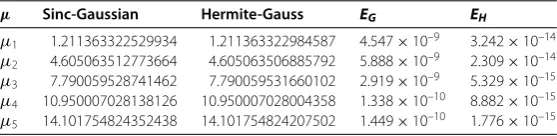
Table 1 Comparison of Hermite-Gauss and sinc-Gaussian,N= 7 andh= 1
μ Sinc-Gaussian Hermite-Gauss EG EH
[image:9.595.159.438.199.265.2]μ1 1.211363322529934 1.211363322984587 4.547×10⁻⁹ 3.242×10⁻¹⁴ μ2 4.605063512773664 4.605063506885792 5.888×10⁻⁹ 2.309×10⁻¹⁴ μ3 7.790059528741462 7.790059531660102 2.919×10⁻⁹ 5.329×10⁻¹⁵ μ4 10.950007028138126 10.950007028004358 1.338×10⁻¹⁰ 8.882×10⁻¹⁵ μ5 14.101754824352438 14.101754824207502 1.449×10⁻¹⁰ 1.776×10⁻¹⁵
Table 2 Comparison of Hermite-Gauss and sinc-Gaussian,N= 7 andh= 1
μ Sinc-Gaussian Hermite-Gauss EG EH
μ1 2.978188104491012 2.978188107069353 2.578×10⁻⁹ 3.553×10⁻¹⁴ μ2 6.203097476060051 6.203097420189766 5.587×10⁻⁸ 6.048×10⁻¹³ μ3 9.371576077716716 9.371576153977529 7.626×10⁻⁸ 2.114×10⁻¹³ μ4 12.526518591941482 12.526518687065739 9.513×10⁻⁸ 9.006×10⁻¹³ μ5 15.676099922268510 15.676099962274689 4.001×10⁻⁸ 1.741×10⁻¹³
and thenU∈B∞ . Table shows the first five approximate eigenvalues of problem
(.)-(.) using our techniques withN= andh= comparing with the results of the sinc-Gaussian technique.
Example . The boundary value problem
–y(t) –y(t) =μy(t), t∈[, ], (.)
y(,μ) =y(,μ) = , (.) is a special case of problem (.)-(.) whenα=α= andα=α= . The
character-istic function of this problem is
D(μ) := –sin(
+μ)
+μ , (.)
and the exact eigenvalues areμ
l := (πl)– ,l∈Z. Takingk= in (.), we have after
some calculations
K(μ) = – sinμ
μ +
sin(μ) –μcos(μ) μ .
Table lists the first five approximate eigenvalues using our technique withN= and
h= in comparison with the results of the sinc-Gaussian technique.
Example . In this example, we introduce the Sturm-Liouville problem
–y(t) +ty(t) =μy(t), t∈[, ], (.)
y(,μ) =y(,μ) = . (.) The characteristic function is
D(μ) := –F
–μ, ;
+ –μF
+
–μ, ;
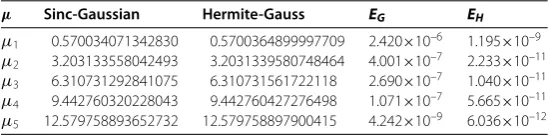
Table 3 Comparison of Hermite-Gauss and sinc-Gaussian,N= 5 andh= 1
μ Sinc-Gaussian Hermite-Gauss EG EH
μ1 0.570034071342830 0.5700364899997709 2.420×10⁻⁶ 1.195×10⁻⁹ μ2 3.203133558042493 3.2031339580748464 4.001×10⁻⁷ 2.233×10⁻¹¹ μ3 6.310731292841075 6.310731561722118 2.690×10⁻⁷ 1.040×10⁻¹¹ μ4 9.442760320228043 9.442760427276498 1.071×10⁻⁷ 5.665×10⁻¹¹ μ5 12.579758893652732 12.579758897900415 4.242×10⁻⁹ 6.036×10⁻¹²
whereFis the hypergeometric function. In this case, puttingk= in (.) implies after some calculations
K(μ) := –μsin(μ) +
μ( + μ)cosμ+ (μ– )sinμ
μ .
As in the last examples, we summarize our results of this example in Table . To compute the absolute error, the exact eigenvalues are computed approximately byMathematica.
Competing interests
The author declares that he has no competing interests.
Acknowledgements
The author would like to thank the anonymous referees for their constructive comments.
Received: 26 February 2016 Accepted: 1 June 2016 References
1. Asharabi, RM, Prestin, J: A modification of Hermite sampling with a Gaussian multiplier. Numer. Funct. Anal. Optim. 36, 419-437 (2015)
2. Schmeisser, G, Stenger, F: Sinc approximation with a Gaussian multiplier. Sampl. Theory Signal Image Process., Int. J. 6, 199-221 (2007)
3. Annaby, MH, Asharabi, RM: Computing eigenvalues of boundary-value problems using sinc-Gaussian method. Sampl. Theory Signal Image Process., Int. J.7, 293-311 (2008)
4. Annaby, MH, Tharwat, MM: A sinc-Gaussian technique for computing eigenvalues of second-order linear pencils. Appl. Numer. Math.63, 129-137 (2013)
5. Tharwat, MM, Al-Harbi, SM: Approximation of eigenvalues of boundary value problems. Bound. Value Probl. (2014). doi:10.1186/1687-2770-2014-51
6. Tharwat, MM, Bhrawy, AH, Alofi, AS: Approximation of eigenvalues of discontinuous Sturm-Liouville problems with eigenparameter in all boundary conditions. Bound. Value Probl. (2013). doi:10.1186/1687-2770-2013-132 7. Boumenir, A, Chanane, B: Eigenvalues of Sturm-Liouville systems using sampling theory. Appl. Anal.62, 323-334
(1996)
8. Annaby, MH, Asharabi, RM: On sinc-based method in computing eigenvalues of boundary-value problems. SIAM J. Numer. Anal.46(2), 671-690 (2008)
9. Annaby, MH, Asharabi, RM: Approximating eigenvalues of discontinuous problems by sampling theorems. J. Numer. Math.3, 163-183 (2008)
10. Annaby, MH, Tharwat, MM: On computing eigenvalues of second-order linear pencils. IMA J. Numer. Anal.27, 366-380 (2007)
11. Asharabi, RM: Generalized sinc-Gaussian sampling involving derivatives. Numer. Algorithms (2016). doi:10.1007/s11075-016-0129-4
12. Asharabi, RM, Prestin, J: On two-dimensional classical and Hermite sampling. IMA J. Numer. Anal.36, 851-871 (2016) 13. Levitan, BM, Sargsjan, IS: Introduction to Spectral Theory: Selfadjoint Ordinary Differential Operators. Translation of
Mathematical Monographs, vol. 39. Am. Math. Soc., Providence (1975)
14. Titchmarch, EC: Eigenfunction Expansions Associated with Second-Order Differential Equations, 2nd edn. Clarendon Press, Oxford (1962)
15. Annaby, MH, Asharabi, RM: Computing eigenvalues of Sturm-Liouville problems by Hermite interpolations. Numer. Algorithms60, 355-367 (2012)
16. Boumenir, A: The sampling method for Sturm-Liouville problems with the eigenvalue parameter in the boundary condition. Numer. Funct. Anal. Optim.21, 67-75 (2000)