E m e r g i n g c oll a b o r a tiv e r e s e a r c h
p l a tfo r m s fo r t h e n e x t g e n e r a ti o n
of p h y si c al a c tivity, sl e e p a n d
e x e r ci s e m e d i ci n e g u i d eli n e s :
t h e P r o s p e c tiv e P h y si c al Ac tivity,
Si t ti n g , a n d Sl e e p c o n s o r ti u m
(P r oPAS S)
S t a m a t a ki s, E , Kos t er, A, H a m e r, M , R a n g u l, V, L e e , I, B a u m a n , A,
Atki n, AJ, AsD a hl, M , M a t t h e w s , C E, M o r k , PJ, Aski e, L, Ci s t ulli, PA,
G r a n a t , M H , P al m , P, C r o wl ey, P, S t e v e n s , M , G u p t a , N, P ul a k k a , A,
S t e n h ol m , S, Arvi d s s o n , D, Mi s h r a , G, We n n b e r g , P, C h a s ti n , S,
E k el u n d , U a n d H ol t e r m a n n , A
h t t p :// dx. d oi.o r g / 1 0 . 1 1 3 6 / bj s p o r t s-2 0 1 9-1 0 0 7 8 6
T i t l e
E m e r g i n g c oll a b o r a tiv e r e s e a r c h p l a tf o r m s fo r t h e n e x t
g e n e r a ti o n of p h y si c al a c tivity, sl e e p a n d e x e r ci s e m e d i ci n e
g u i d eli n e s : t h e P r o s p e c tiv e P h y si c al Activity, Si t ti n g , a n d
Sl e e p c o n s o r ti u m (P r oPAS S)
A u t h o r s
S t a m a t a ki s, E, Kos t er, A, H a m e r, M , R a n g u l, V, L e e , I,
B a u m a n , A, Atki n, AJ, AsD a hl, M , M a t t h e w s , C E, M o r k , PJ,
Aski e, L, Ci s t ulli, PA, G r a n a t , M H , P al m , P, C r o wl ey, P,
S t e v e n s , M , G u p t a , N, P ul a k k a , A, S t e n h ol m , S, Arvi d s s o n ,
D, Mi s h r a , G, We n n b e r g , P, C h a s ti n , S, E k el u n d , U a n d
H ol t e r m a n n , A
U RL
T hi s v e r si o n is a v ail a bl e a t :
h t t p :// u sir. s alfo r d . a c . u k /i d/ e p ri n t/ 5 1 0 4 7 /
P u b l i s h e d D a t e
2 0 2 0
U S IR is a d i gi t al c oll e c ti o n of t h e r e s e a r c h o u t p u t of t h e U n iv e r si ty of S alfo r d .
W h e r e c o p y ri g h t p e r m i t s , f ull t e x t m a t e r i al h el d i n t h e r e p o si t o r y is m a d e
f r e ely a v ail a bl e o nli n e a n d c a n b e r e a d , d o w nl o a d e d a n d c o pi e d fo r n o
n-c o m m e r n-ci al p r iv a t e s t u d y o r r e s e a r n-c h p u r p o s e s . Pl e a s e n-c h e n-c k t h e m a n u s n-c ri p t
fo r a n y f u r t h e r c o p y ri g h t r e s t r i c ti o n s .
1
TITLE
Emerging collaborative research platforms for the next generation of physical activity, sleep
and exercise medicine guidelines: the Prospective Physical Activity, Sitting, and Sleep
consortium (ProPASS)
AUTHOR AND AFFILIATIONS:
Emmanuel Stamatakis
1, Annemarie Koster
2, Mark Hamer
3, Vegar Rangul
4, I-Min Lee
5, Adrian
Bauman
1, Andrew J Atkin
6, Mette Aadahl
7, Charles E. Matthews
8, Paul Jarle Mork
9, Lisa
Askie
10, Peter A. Cistulli
11, Malcom Granat
12, Peter Palm
13, Patrick Crowley
14, Matthew
Stevens
14, Nidhi Gupta
14, Anna Pulakka
15, Sari Stenholm
15, Daniel Arvidsson
16, Gita
Mishra
17, Patrik Wennberg
18, Sebastien Chastin
19, Ulf Ekelund
20, and Andreas Holtermann
141
Prevention Research Collaboration, Charles Perkins Centre, Faculty of Medicine and
Health, School of Public Health, University of Sydney, Australia
2
Department of Social Medicine, CAPHRI Care and Public Health Research Institute,
Maastricht University, Maastricht, The Netherlands.
3
School Sport Exercise Health Sciences, Loughborough University, UK
4
HUNT Research Centre, Department of Public Health and Nursing, Norwegian University of
Science and Technology, Levanger, Norway
5
Division of Preventive Medicine, Brigham & Women’s Hospital and Harvard Medical
School, Boston, MA, USA
6
School of Health Sciences, Faculty of Medicine and Health Sciences, University of East
Anglia, Norwich, UK.
7
Centre for Clinical Research and Prevention, Bispebjerg and Frederiksberg Hospital,
Frederiksberg, Denmark.
8
Metabolic Epidemiology Branch, Division of Cancer Epidemiology and Genetics, National
Cancer Institute, Rockville, MD USA
9
Department of Public Health and Nursing, Norwegian University of Science and Technology
(NTNU), Trondheim, Norway
10
NHMRC Clinical Trials Centre, University of Sydney, Australia
11
Sleep Research Group, Charles Perkins Centre, Faculty of Medicine and Health, University
of Sydney, Australia.
12
School of Health and Society Sciences, University of Salford, Salford, UK
13
Department of Medical Sciences, Occupational and Environmental Medicine, Uppsala
University, Sweden
14
The National Research Centre for the Working Work Environment, Copenhagen,
2
15
Department of Public Health, University of Turku and Turku University Hospital, Turku,
Finland
16
Center for Health and Performance, Department of Food and Nutrition and Sport Science,
University of Gothenburg, Sweden
17
School of Public Health, University of Queensland, Brisbane, Australia.
18
Department of Public Health and Clinical Medicine, Family Medicine, Umeå University,
Sweden
19
School of Health and Life Science, Glasgow Caledonian University, Glasgow, Scotland, UK
20
Department of Sport Medicine, Norwegian School of Sport Sciences, Oslo, Norway
CORRESPONDING AUTHOR
Emmanuel Stamatakis, 6th floor West, The Hub, Charles Perkins Centre, Building D17,
University of Sydney, Camperdown, NSW 2006, Australia
3 904 words
TEXT
Galileo Galilei’s quote “measure what is measurable, and make measurable what is not so”
has particular relevance to health behaviours, such as physical activity (PA), sitting and sleep, whose measurement during free living is notoriously difficult. To date, much of what we know about how these behaviours affect our health is based on self-report by
questionnaires which have limited validity, are prone to bias, and inquire about selective aspects of these behaviours. Although self-reported evidence has made great contributions
to shaping public health and exercise medicine policy and guidelines until now1, the ongoing
advancements of accelerometry-based measurement and evidence synthesis methods are
set to change the landscape. The aim of this editorial is to outline new directions in PA and sleep related epidemiology that open new horizons for guideline development and
improvement; and to describe a new research collaboration platform: the Prospective Physical Activity, Sitting, and Sleep consortium (ProPASS).
Feasible research technology at scale, big consortia
Measurement technology used in epidemiology has made measurable what was not so until recently. Several population-based studies have used accelerometers to wear for 24 hours a day for a whole week, offering unprecedented insights into the health attributes of PA, sitting
and sleep. One of the most exciting aspect of accelerometers is that they show great promise for capturing nearly-complete accounts PA, including posture and activity type detection2.
However, advanced measurement methods and optimal evidence synthesis are not synonymous. Individual accelerometry studies have limited generalisability beyond the
specific country, population, and setting, and usually have low statistical power to address detailed research questions. For example, none of the NHANES accelerometry studies3 has
been able to study potentially metabolic health-enhancing sporadic short (<2-3 minutes) bursts of higher intensity incidental PA4, likely because of the sparsity of such data. Classic
systematic reviews of accelerometry inherit the problems of source studies and their conclusions are often not robust5. We need to think differently when it comes to
consolidating, analysing, and interpreting new formats of accelerometry data. As John Ioannidis’ BJSM editorial succinctly put it, the next generation of evidence in exercise
medicine and PA involves large consortia that harmonise and pool existing studies.5
4
studies prior to data collection), in particular, is an extremely powerful tool as it can overcome heterogeneity, which is one of the largest obstacles for rigorous evidence synthesis5. The value of such consortia goes beyond producing more robust and
generalisable knowledge, there is also a strong economic argument. The value of every dollar, pound, or euro tax payers and research funders invested in the original studies is
maximised through further use of the data resources to inform better public health and clinical practice guidelines.
A new consortium
The momentum generated by successful accelerometry consortia (e.g. International Children’s Accelerometry Database6) and large epidemiological studies like NHANES3 and
the UK Biobank7 that used waist or wrist mounted accelerometers inspired the genesis of
the Prospective Physical Activity, Sitting, and Sleep consortium (ProPASS)8. ProPASS is a
research collaboration platform that aims to bring together existing and future observational
studies of thigh-worn accelerometry. Although each accelerometer placement site has both strengths and challenges, the ProPASS choice of site was far from accidental: the unique
appeal of the thigh-worn method is that it provides information not only on movement intensity (e.g. light, moderate and vigorous PA), but also on posture (e.g. sitting/lying, standing). Behaviours such as cycling, running, and stair-climbing can also be extrapolated
by thigh attached sensors2 and integration with other important behaviours such as sleep
(duration and timing) can provide unique insights on lifestyle and health9. Information about
such tangible aspects of behaviour has immediate relevance to people’s daily lives; and is easier for clinicians, policy makers, and the public alike to understand, “digest”, and
hopefully seek to improve.
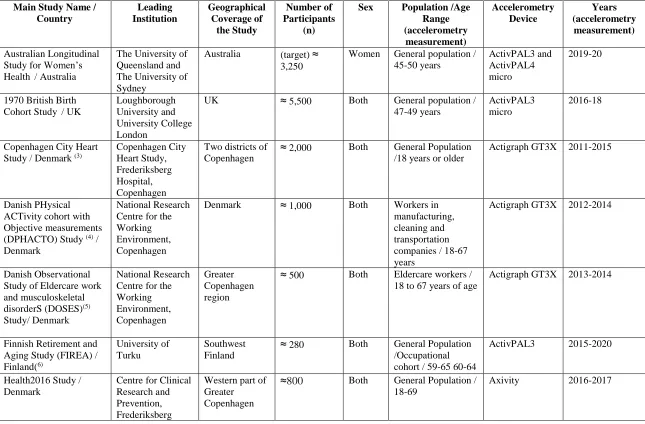
The ultimate scientific objective of ProPASS is to produce evidence on the associations of PA, sitting, and sleep and long-term health outcomes and longevity. As of February 2019,
ProPASS is supported by twelve international cohorts totalling over 70,000 participants (Table 1). To safeguard consortium feasibility, longevity and faster growth, ProPASS is not restricted to one specific model of accelerometer, but any tri-axial device that outputs raw
acceleration and is worn on the thigh is suitable- an approach we have validated
empirically10. The ProPASS cohorts are rich in health outcome data, many contain genotypic
5 Call for collaboration
New research collaboration platforms have paved the way for the next generation of
evidence on PA-related behaviours and health. Detailed and accurate objective accounts of
daily movement behaviour and posture are now feasible in large epidemiological studies. Meeting ProPASS’ objectives will be determined by at least two essential conditions:
breaking down the silos to integrate research paradigms across PA domains; and tight multidisciplinary collaboration.
In this editorial we invite researchers from any discipline who have collected or are
considering collecting thigh-worn accelerometry data in observational studies to contact us. We also invite, scientists with an interest in health related data consortia as well as health
professionals and policy makers, to help us form a ProPASS research agenda with maximal relevance to patients, the public, and health policy. There is no question in our mind that
such a research agenda is a prerequisite for the success of ProPASS and any other effort aimed at shaping the next generation of physical activity, sitting, sleep, and exercise
medicine guidelines.
Get in touch to discuss opportunities for current or future studies joining the consortium
(e-mail: [email protected]), and join our mailing list
(www.propassconsortium.org) to stay updated about future events and activities.
;
FINANCIAL DISCLOSURES AND COMPETING INTERESTS
The ProPASS consortium has received financial support by the following organisations: an unrestricted grant by PAL Technologies Ltd, Scotland, UK; a grant by the Worldwide Universities Network – Research Development Fund 2018; an internal seed grant by the University of Sydney; a National Health and Medical Research Council (Australia) equipment grant; in kind support by the National Research Centre for the Working Environment, Copenhagen; and financial support by Loughborough University. None of the authors has competing interests to declare.
6
1. 2018 Physical Activity Guidelines Advisory Committee. 2018 Physical Activity Guidelines Advisory Committee Scientific Report. Washington, DC: U.S. Department of Health and Human Services, 2018.
2. Skotte J, Korshoj M, Kristiansen J, et al. Detection of physical activity types using triaxial accelerometers. Journal of physical activity & health 2014;11(1):76-84. doi:
10.1123/jpah.2011-0347 [published Online First: 2012/12/20]
3. Fuzeki E, Engeroff T, Banzer W. Health Benefits of Light-Intensity Physical Activity: A Systematic Review of Accelerometer Data of the National Health and Nutrition Examination Survey (NHANES). Sports medicine (Auckland, NZ) 2017;47(9):1769-93. doi: 10.1007/s40279-017-0724-0 [published Online First: 2017/04/11]
4. Stamatakis E, Johnson NA, Powell L, et al. Short and sporadic bouts in the 2018 US physical activity guidelines: is high-intensity incidental physical activity the new HIIT?
British Journal of Sports Medicine 2019:bjsports-2018-100397. doi: 10.1136/bjsports-2018-100397
5. Ioannidis J. Next-generation systematic reviews: prospective meta-analysis, individual-level data, networks and umbrella reviews. British Journal of Sports Medicine
2017;51(20):1456-58. doi: 10.1136/bjsports-2017-097621
6. Sherar LB, Griew P, Esliger DW, et al. International children's accelerometry database (ICAD): design and methods. BMC public health 2011;11:485. doi: 10.1186/1471-2458-11-485 [published Online First: 2011/06/23]
7. Doherty A, Smith-Byrne K, Ferreira T, et al. GWAS identifies 14 loci for device-measured physical activity and sleep duration. Nature communications 2018;9(1):5257. doi: 10.1038/s41467-018-07743-4 [published Online First: 2018/12/12]
8. ProPASS consortium. Prospective Physical Activity, Sitting, and Sleep cosnsortium 2019 [Available from: www.propassconsortium.org.
9. van der Berg JD, Willems PJ, van der Velde JH, et al. Identifying waking time in 24-h accelerometry data in adults using an automated algorithm. Journal of sports sciences 2016;34(19):1867-73. doi: 10.1080/02640414.2016.1140908 [published Online First: 2016/02/04]
7
Table 1: Accelerometry studies supporting the Prospective Physical Activity, Sitting, and Sleep consortium (ProPASS)
Main Study Name / Country Leading Institution Geographical Coverage of the Study Number of Participants (n)
Sex Population /Age Range (accelerometry measurement) Accelerometry Device Years (accelerometry measurement) Australian Longitudinal Study for Women’s Health / Australia
The University of Queensland and The University of Sydney
Australia (target) ≈ 3,250
Women General population / 45-50 years
ActivPAL3 and ActivPAL4 micro
2019-20
1970 British Birth Cohort Study / UK
Loughborough University and University College London
UK ≈ 5,500 Both General population /
47-49 years
ActivPAL3 micro
2016-18
Copenhagen City Heart Study / Denmark (3)
Copenhagen City Heart Study, Frederiksberg Hospital, Copenhagen
Two districts of Copenhagen
≈ 2,000 Both General Population /18 years or older
Actigraph GT3X 2011-2015
Danish PHysical ACTivity cohort with Objective measurements (DPHACTO) Study (4) /
Denmark
National Research Centre for the Working Environment, Copenhagen
Denmark ≈ 1,000 Both Workers in
manufacturing, cleaning and transportation companies / 18-67 years
Actigraph GT3X 2012-2014
Danish Observational Study of Eldercare work and musculoskeletal disorderS (DOSES)(5)
Study/ Denmark
National Research Centre for the Working Environment, Copenhagen Greater Copenhagen region
≈ 500 Both Eldercare workers / 18 to 67 years of age
Actigraph GT3X 2013-2014
Finnish Retirement and Aging Study (FIREA) / Finland(6)
University of Turku
Southwest Finland
≈ 280 Both General Population /Occupational cohort / 59-65 60-64
ActivPAL3 2015-2020
Health2016 Study / Denmark
Centre for Clinical Research and Prevention, Frederiksberg
Western part of Greater Copenhagen
≈800 Both General Population / 18-69
8
The Nord-Trøndelag Health Study (HUNT 4)
(7) / Norway
Norwegian University of Science and Technology
Northern part of Trøndelag region
≈ 40,000 Both General Population / 18 years or older
Axivity 3 2017-19
The Maastricht Study (8)
/ The Netherlands
Maastricht University
South of The Netherlands
≈ 9,000 Both General Population (Oversampling of people with Type 2 Diabetes) / 40-75
ActivPAL3 2010-2019
Swedish
CArdioPulmonary bioImage Study (SCAPIS) (9) Ad-On
Gothenburg / Sweden
University of Gothenburg
Gothenburg region
≈ 500 Both General Population / 50-64
Axivity AX3 2017
Swedish
CArdioPulmonary bioImage Study (SCAPIS) (9) Ad-On
Umeå / Sweden
Umeå University Umeå region ≈ 2,500 Both General Population / 50-64
ActivPAL3 2016-2018
Swedish
CArdioPulmonary bioImage Study Ad- On Uppsala (SCAPIS) (9) /
Sweden
Uppsala University
Uppsala region ≈ 5,000 Both General Population / 50-64
Axivity AX3 2015-2018
1 McLaughlin D, et al. (2015) Cohort Profile Update: Australian Longitudinal Study on Women’s Health. International Journal of Epidemiology 44, 1547-1547f. 2 Elliott J, Shepherd P (2006) Cohort Profile: 1970 British Birth Cohort (BCS70). International Journal of Epidemiology 35, 836-843.
3 Aguib Y, Al Suwaidi J. The Copenhagen City Heart Study (Østerbroundersøgelsen). Global Cardiology Science & Practice 2015; 2015: 33-.
4 Jørgensen MB, et al. The DPhacto cohort: An overview of technically measured physical activity at work and leisure in blue-collar sectors for practitioners and researchers. Applied Ergonomics, 2019. 77, 29-39.
5 Karstad K, et al . Danish Observational Study of Eldercare work and musculoskeletal disorderS (DOSES): a prospective study at 20 nursing homes in Denmark. BMJ Open. 2018 Feb 28;8(2):e019670.
6 Pulakka A, Leskinen T, Koster A et al. (2019) Daily physical activity pattern among aging workers: the Finnish Retirement and Aging Study (FIREA). Occupational & Environmental Medicine 76, 33-39
7 Krokstad S, et al. (2013) Cohort Profile: the HUNT Study, Norway. Int J Epidemiol 42, 968-977.
8 Schram MT, et al. (2014) The Maastricht Study: an extensive phenotyping study on determinants of type 2 diabetes, its complications and its comorbidities. European Journal of Epidemiology 29, 439-451.