International Journal of Emerging Technology and Advanced Engineering
Website: www.ijetae.com (ISSN 2250-2459,ISO 9001:2008 Certified Journal, Volume 6, Issue 3, March 2016)
121
Comparative Study of the Performance Analysis of Multicast
Routing Protocol of MAODV and ODMRP in Mobile Ad-hoc
Networks Using QualNet.
Soamdeep Singha
1, Nirajan Kumar Mandal
21Department of Computer Science, Vidyasagar Universuty, Midnapur, India 2
University of Engineering and Management, Newtown, Kolkata, India
Abstract-- Simulation work has been carried out to study the performance analysis of Multicast Routing Protocol of MAODV and ODMRP in Mobile Ad-hoc Networks using Qualnet. Simulation results have been shown graphically for Average End to End delay and Through put with variation of note for different sender and reciver in each case. The result have been discussed.
Keywords-- MANET; Multicast; MAODV; ODMRP; Cluster.
I. INTRODUCTION
Multicast Routing Protocol in a mobile ad-hoc network (MANET) using qualnet has been given due importance for the last many years due to the following facts:
i) Multicasting is very important in group communication. ii) The multicasting in ad-hoc networks has some security issues, such as authentication, data integrity, access control, confidentiality etc. for secure communication. Hence key management is used in mobile ad-hoc networks (MANET) to achieve the reliable security. Clustering is very effective for key management in MANET.
For multicasting both MAODV and ODMRP are very useful.
From the literature survey following observations have been made related to work already done by researchers on multicast protocol in MANET. G. Usha Devi et.al proposed a multicast clusters based on hop factor using MAODV [2]. But in this paper, they did not compare the performance with other MANET protocols. In another paper, Natarajan Meghanathan compared the performance of minimum hop and minimum edge based multicast routing for MANETs [3]. But he did not discuss about the packet delay, throughput and the overheads of the protocols. D. Suganya Devi et.al. have discussed the performance of cluster based key distribution using Cluster Based Multicast Algorithm [4] but they did not compare the results with the MAODV and ODMRP.
In another paper, M.Balakrishna et,al have discussed about the performance of MAODV with MZRP (Multicast Zone Routing Protocol) [5] but they did not compare the results with the ODMRP.
In this paper ,an attempt has been made to make a comparative study of the performance of the Multicast Routing Protocol of MAODV and ODMRD in Mobile Ad-hoc network using QualNet network Multicast communication.
II. MULTICAST COMMUNICATION Requirement of Secure Multicast Communication:
The combination of multicast communication with ad-hoc network results new security challenges. To secure the multicast communication, authentication, privacy, data integrity, access control and group security etc. are needed [4]. Among these, group security is most important and can be achieved using key distribution as follows:
Forward secrecy: A node which leaves a group should not have any future access to it.
Backward secrecy:A new node which joins a group should not have access to the old data.
Group confidentiality: Nodes that are not a member of any group should not have access to any data.
Collision freedom: Any of the unauthorized users should not be able to deduce the currently used key. The two most important multicast routing protocols for ad-hoc network are Multicast Ad hoc On Demand Distance Vector (MAODV) and On Demand Multicast Routing Protocol (ODMRP).
2.1.Multicast Adhoc On Demand Distance Vector (MAODV)
International Journal of Emerging Technology and Advanced Engineering
Website: www.ijetae.com (ISSN 2250-2459,ISO 9001:2008 Certified Journal, Volume 6, Issue 3, March 2016)
122
It has following characteristics. It forms trees which connect multicast group members.
It maintains routes for as long as the route is active.
It uses sequence numbers to ensure the freshness of routes.
It is loop-free, self-starting, and scales to large numbers of mobile nodes.
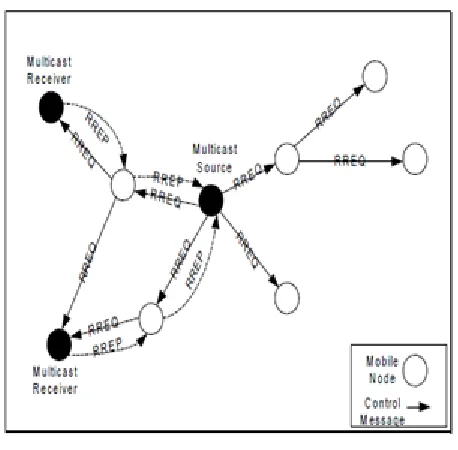
[image:2.612.325.558.134.355.2]The schematic diagram of a MAODV path discovery network is shown in Figure 1.
Figure 1: MAODV Path discovery
2.1.2. On Demand Multicast Routing Protocol (ODMRP): On Demand Multicast Routing Protocal(ODMRP) is a routing protocol which Provides a richer connectivity among multicast members using a mesh based app
It has following characteristics
It Supplies multiple routes for one particular destination.
It is a concept of Forwarding Group. It is more scalable for large networks. It is stable for MANET.
[image:2.612.54.283.276.501.2]The schematic diagram of an ODMRP Path discovery network is shown in Figure 2.
Figure 2: ODMRP Path discovery
III. THEORETICAL COMPARISONS BETWEEN MAODV AND ODMRP
Principally, both protocols find multicast routes in the presence of data packets which are to be delivered to multicast destination.
Similarly both are having significant differences. The differences are given below:
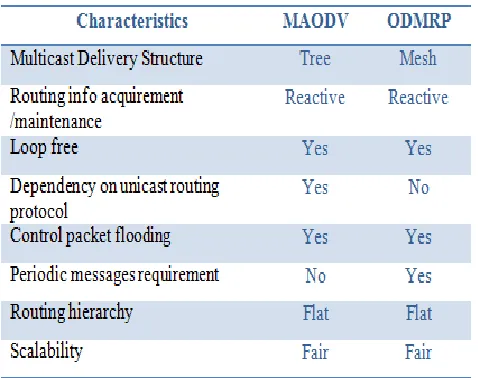
MAODV uses a shared bi-directional multicast tree while ODMRP maintains a mesh topology rooted from each source.
ODMRP broadcasts the reply back to the source while MAODV unicasts the reply.
By using broadcasts, ODMRP allows for multiple possible paths from the multicast source back to the receiver. Since MAODV unicasts the reply back to the source, so, if an intermediate node on the path moves away, the reply is lost and the route is also lost. However, a broadcasted reply requires intermediate nodes not interested in the multicast group to drop the control packets, resulting in extra processing overhead.
MAODV does not activate a multicast route immediately while ODMRP does unless mobility prediction is enabled.
International Journal of Emerging Technology and Advanced Engineering
Website: www.ijetae.com (ISSN 2250-2459,ISO 9001:2008 Certified Journal, Volume 6, Issue 3, March 2016)
[image:3.612.50.289.157.346.2]123
Table I.
Comparison of MAODV and ODMRP
IV. SIMULATION
The performance of cluster based on hop factor using MAODV is analysed against ODMRP using QualNet 5.0 network simulator. The performance is evaluated under packet delivery ratio, control overhead, forwarding efficiency, and end to end delay.
4.1. Performance Metrics
Throughput: The ratio of the number of packets received to the number of packets sent.
Packet delay: The difference between the time when the packet is sent by the source and when it is received by the receiver.
Transmission Overhead: It is the ratio of the number of data messages transmitted (originated or forwarded) to the number of data messages received. Control Overhead: The ratio of the number of control messages originated or forwarded over the combined total of data and control messages originated or forwarded.
4.2. Simulation Environment
Area : 2000 X 2000 meters
Altitude Range: Above sea level 1500 meters Number of nodes: 40
Duration:15 minutes
Network Diameter (Hops): 35 Node Traversal Time Interval: 40 ms Maximum number of buffered packets: 100 Traffic Type: MCBR
Mobility model: Random waypoint model Multicast Routing Protocol: MAODV, ODMRP
V. RESULTS
This section presents the simulation result to compare the performance of the MAODV and ODMRP.
The data obtained after simulation are plotted to obtain the graphs to provide the pictorial representation and to analyse the performance of the two protocols.
5.1 Graphs for Average End to End Delay:-
Fig3:-1 sender and 10 receivers
Fig4:-1 sender and 5 receivers
0 0.05 0.1 0.15
1 3 5 7 9
A
vg
E
n
d
t
o
E
n
d
Delay
(s)
Node(s)
MAODV
International Journal of Emerging Technology and Advanced Engineering
Website: www.ijetae.com (ISSN 2250-2459,ISO 9001:2008 Certified Journal, Volume 6, Issue 3, March 2016)
124
Fig5:-2 senders and 10 receivers
Fig6:-2 senders and 5 receivers
Fig7:-3 senders and 10 receivers
Fig8:-3 senders and 5 receivers
Fig9:-4 senders and 10 receivers
International Journal of Emerging Technology and Advanced Engineering
Website: www.ijetae.com (ISSN 2250-2459,ISO 9001:2008 Certified Journal, Volume 6, Issue 3, March 2016)
125
5.2 Graphs for Throughput (Bits per Second)Fig11:-1 sender and 10 receivers
Fig12:-1 sender and 5 receivers
Fig13:-2 sender and 10 receivers
Fig14:-2 senders and 5 receivers
Fig15:-3 senders and 10 receivers
International Journal of Emerging Technology and Advanced Engineering
Website: www.ijetae.com (ISSN 2250-2459,ISO 9001:2008 Certified Journal, Volume 6, Issue 3, March 2016)
126
Fig17:-4 senders and 10 receivers
Fig18:-4 senders and 5 receivers
From the figures 3 to18 it is clear that ODMRP performs better in case of average end-to-end delay in all the aspects i.e. when number of nodes are low or high.
In case of throughput when number of sender nodes is less, then ODMRP performs better than MAODV. But when number of sender nodes is increased, then performance of ODMRP and MAODV are almost same.
Hence, ODMRP is a better solution for multicasting of key distribution in wireless network.
VI. CONCLUSION
In this paper, we presented a qualitative comparison for delivery ratio, control overhead, forwarding efficiency and End-to-End delay of ad-hoc on-demand multicast routing protocols such as MAODV and ODMRP. Both, routing protocols works as on-demand route discovery but they use different routing mechanisms.From the analysis we can conclude that ODMRP has better throughput with higher overhead than MADOV. The above result may vary if use other types of protocol using same simulator
REFERENCES
[1] E. Royer, and C. E. Perkins “Multicast operation of the ad-hoc
on-demand distance vector routing protocol”, Proc. of the 5th ACM/IEEE Annual Conf. on Mobile Computing and Networking, pages 207-218 Aug 1999.
[2] Usha Devi G., WahidaBanu R. S. D. “Simulation of Multicast
Clusters Based on Hop factor in Mobile Ad-hoc Networks”, European Journal of Scientific Research, Vol.75 No.3, 2012.
[3] NatarajanMeghanathan, “PERFORMANCE COMPARISON OF
MINIMUM HOP AND MINIMUM EDGE BASED MULTICAST ROUTING UNDER DIFFERENT MOBILITY MODELS FOR MOBILE AD HOC NETWORKS”, International Journal of Wireless & Mobile Networks (IJWMN), Vol. 3, No. 3, June 2011
[4] D.Suganya Devi, Dr.G.Padmavathi, “Performance Characteristics of
Cluster –Based Multicast Key Distribution Scheme for Mobile Ad-hoc Networks”, International Journal of Computer Applications, Volume 1 – No. 23, 2010
[5] M. Bala Krishna, M. N. Doja, “Performance of Structure Based
Multicast RoutingProtocols in Wireless Ad hoc Networks”, 10th IEEE International Conference on Computer and Information Technology (CIT 2010), 2010
[6] R. Bagrodia, M. Gerla, J. Hsu, W. Su, and S.-J. Lee. “A performance