• No results found

Advanced Indexing Techniques for Achieving Concurrency in Multidimensional Data Sets

N/A
N/A
Protected

Academic year: 2020

Share "Advanced Indexing Techniques for Achieving Concurrency in Multidimensional Data Sets"

Copied!
6
0
0

Loading.... (view fulltext now)

Full text

(1)

Advanced Indexing Techniques for Achieving

Concurrency in Multidimensional Data Sets

N Krishna Kumari, Dr. M.H.M. Krishna Prasad

Department of Information Technology, University College of Engineering JNTU Kakinada, Vizianagaram Campus, Vizianagaram, India

Abstract: In multidimensional datasets concurrent accesses to data via indexing structures introduce the problem protecting ranges specified in the retrieval from phantom insertions and deletions. This paper proposes a novel approach for concurrency in multidimensional datasets using Advanced Indexing Technique like generalized search tree, R tree and its variants, constitutes an efficient and sound concurrency access model for multidimensional databases and it supports efficient operations with serializable, isolation, consistency and deadlock free.

Index terms: Concurrency Control, Locking Management, Phantom Problem.

1. INTRODUCTION:

Over the last decade (1988-98), the R tree has emerged as one of the most robust multidimensional access methods. However, before the R tree can be integrated as an access method to a commercial strength database management system, efficient techniques to provide transactional access to data via R trees need to be developed. Concurrent access to data through a multidimensional data structure introduces the problem of protecting ranges specified in the retrieval from phantom insertions and deletions (the phantom problem). Existing approaches to phantom protection in B trees (namely, key range locking) cannot be applied to multidimensional data structures since they rely on a total order over the key space on which the B tree is designed. The paper presents a dynamic granular locking approach to phantom protection in R trees. To the best of our knowledge, the paper provides the first solution to the phantom problem in multidimensional access methods based on granular locking.

The phantom problem is defined as follows (from the ANSI/ISO SQL-specifications Transaction T1 reads a set of data items satisfying some <search condition>. Transaction T2 then creates data items that satisfy T1’s <search condition> and commits. If T1 then repeats its scan with the same <search condition>, it gets a set of data items (known as “phantoms”) different from the first read. Phantoms must be prevented to guarantee serializable execution. Object level locking doesnot prevent phantoms since even if all objects currently in the database that satisfy the search predicate are locked, concurrent insertions into the search range cannot be prevented.

1.1. Modes of lock: Let me go ahead in explaining you the various modes available with a typical table as above: Modes of

Lock Comment

Shared

This is a typical mode of operation for Select statements where the resource can be shared by multiple users. Since you are just reading the data you can share the resource.

Modes of

Lock Comment

Exclusive

The next operation we can think of is to do an DML operation (Insert / Update / Delete). This lock ensures that two people do not do the modification on the same data at the same time.

Update This lock mode is used to mark an object for the update operation.

Intent

This mode establishes an locking tree mechanism wherein it can include an intent shared, intent exclusive and share with exclusive locks. This mode does stress the point that the data can be updated at any time. For example, this happens when you take a cursor for update.

Schema

This lock is taken when we do an DDL operation where the integrity of the database schema needs to be verified. This can include from creating a table, procedure, alter a column width, adding an column etc. Bulk

Update

This is taken when we do an Bulk-Upload of data or Bulk Copying of data into the system.

1.2. Approaches to Phantom Protection:

There are two general strategies to solve the phantom problem, namely predicate locking and its engineering approximation, granular locking. In predicate locking, transactions acquire locks on predicates rather than individual objects. Although predicate locking is a complete solution to the phantom problem, the cost of setting and clearing predicate locks can be high since (1) the predicates can be complex and hence checking for predicate satisfiability can be costly and (2) even if predicate satisfiability can be checked in constant time, the complexity of acquiring a predicate lock is proportional in the number of concurrent transactions which is an order of magnitude costlier compared to acquiring object locks that can be set and released in constant time [9]. In contrast, in granular locking, the predicate space is divided into a set of lockable resource granules. Transactions acquire locks on granules instead of on predicates. The locking protocol guarantees that if two transactions request conflicting mode locks on predicates p and p0 such that p^p0 is satisfiable, then the two transactions will request conflicting locks on at least one granule in common. Granular locks can be set and released as efficiently as object locks. For this reasons, all existing commercial DBMSs use granular locking in preference to predicate locking.

An example of the granular locking approach is the multigranularity locking protocol (MGL) [12]. MGL exploits additionallock modes called intention mode locks which represent the intention to set locks at finer

(2)

granularity (see Table 1). Applicationof MGL to the key space associated with a B-tree is referred to as key range locking (KRL) [12, 13]. KRL cannot be applied for phantom protection in multidimensional data structures since it relies on the total order over the underlying objects based on their key values which do not exist for multidimensional data. Imposing an artificial total order (say a Z-order [14]) over multidimensional data to adapt KRL would result in a scheme with low concurrency and high lock overhead since protecting a multidimensional region query from phantom insertions and deletions will require accessing and locking objects which may not be in the region specified by the query (since an object will be accessed as long as it is within the upper and the lower bounds in the region according to the superimposed total order). It would severely limit the usefulness of the multidimensional AM, essentially reducing it to a 1-d AM with thedimension being the total order.

1.2. Desiderate of the Solution:

Since KRL cannot be used in multidimensional index structures, new techniques need to be devised to prevent phantoms in such data structures. The principal challenges in developing a solution based on granular locking are: Defining a set of lockable resource granules over the multidimensional key space such that they (1) dynamically adapt to key distribution (2) fully cover the entire embedded space and (3) are fine enough to afford high concurrency. The importance of these factors in the choice of granules has been discussed in [9]. The lock granules (i.e. key ranges) in KRL satisfy these 3 criteria.

Easy mapping of a given predicate onto a set of granules that needs to be locked to scan the predicate. Subsequently, the granular locks can be set or cleared as efficiently as object locks using a standard lock manager (LM).

Handling overlap among granules effectively. This problem does not arise in KRL since the key ranges are always mutually disjoint. In multidimensional key space partitioning, the set of granules defined may be, in GiST terminology, “mutually consistent”. For example, there may be spatial overlap among R-tree granules.

This complicates the locking protocol since a lock on a granule may not provide an “exclusive coverage” on the entire space covered by the granule. For correctness, the granular locking protocols must guarantee that any two conflicting operations will request conflicting locks on at least one granule in common. This implies that at least one of the conflicting operations must acquire locks on all granules that overlap with its predicate while the other must acquire conflicting locks on enough granules to fully cover its predicate [5]. This leads to two alternative strategies:

Overlap-for-Search and Cover-for-Insert Strategy (OSCI) in which the searchers acquire shared mode locks on all granules consistent with its search predicate whereas the inserters, deleters and updators acquire IX locks on a minimal set of granules sufficient to fully cover the object being inserted, deleted or updated.

Cover-for-Search and Overlap-for-Insert Strategy (CSOI) in which the searchers acquire shared mode locks on a minimal set of granules sufficient to fully cover its search predicate whereas the inserters, deleter’s and updater’s acquire IX locks on all granules consistent with the object being inserted, deleted or updated.

While the former strategy favors the insert and delete operations by requiring them to do minimal tree traversal and disfavors the search operation by requiring them to traverse all consistent paths, the latter strategy does exactly the reverse. Intermediate strategies are also possible. For GL/GiST, we choose the OSCI strategy in preference to the rest. The OSCI strategy effectively does not impose any additional overhead on any operation as far as tree traversal is concerned since searchers in GiST anyway follow all consistent paths. The CSOI strategy may be better for index structures where inserters follow all overlapping paths and searchers follow only enough paths to cover its predicate. The R+-tree is an example of such an index structure [15]. We assume that the OSCI strategy is followed for all 1In this paper, we use the term “granules” to mean lock units – resources that are locked to insure isolation and not in the sense of granules in “granule graph” of MGL [9]. This is discussed in further detail in Section 4.1. discussions in the rest of the paper.

Preventing Phantoms

 Table locking prevents phantoms; row locking does not Predicate locking prevents phantoms

 A predicate describes a set of rows, some are in a table and some are not

 Every SQL statement has an associated predicate

 When executing a statement, acquire a (read or write) lock on the associated predicate

 Two predicate locks conflict if one is a write and there exists a row (not necessarily in the table) that is contained in both.

Terminology

In developing the algorithms, we assume, as in [12], that a transaction may request the following types of operations on GiST: Search, Insert, Delete, Read Single, Update Single and Update Scan. In presenting the solution to the phantom problem, we describe the lock requirements of each of these and present the algorithms used to acquire the necessary locks. The lock protocols assumes the presence of a standard LM which supports all the MGL locks modes (as shown in Table 1) as well as conditional and unconditional lock options [16]. Furthermore, locks can be held for different durations, namely, instant, short and commit durations [16]. While describing the lock requirements of various operations for phantom protection, we assume the presence of some protocol for preserving the physical consistency of the tree structure in presence of concurrent operations. The lock protocol presented in this paper guarantees phantom protection independent of the specific algorithm used to preserve tree consistency. In our implementation, we have combined the GL/GiST protocol with the latching protocol proposed in [10]. We do not describe the combined algorithms in this paper due to space limitations but can be found in the longer version of this paper [5].

2 RELATED RESEARCH AND MOTIVATION

In this section, we review the structure of the R-tree family, discuss some limitations that affect R+-trees, survey major concurrency control algorithms based on B-trees and R-trees, and summarize the challenges inherent in applying concurrency control to R+-trees.

(3)

2.1 R-Tree Index Structure:

An R-tree [2] is a height-balanced tree similar to a B-tree with index records in its leaf nodes containing pointers to data objects Nodes correspond to disk pages If the index is disk resident, and the structure is designed so that a spatial search requires visiting only a small number of nodes The index is completely dynamic; inserts and deletes can be inter- mixed with searches and no periodic reorganization is required.

2.2. R-Plus Tree:

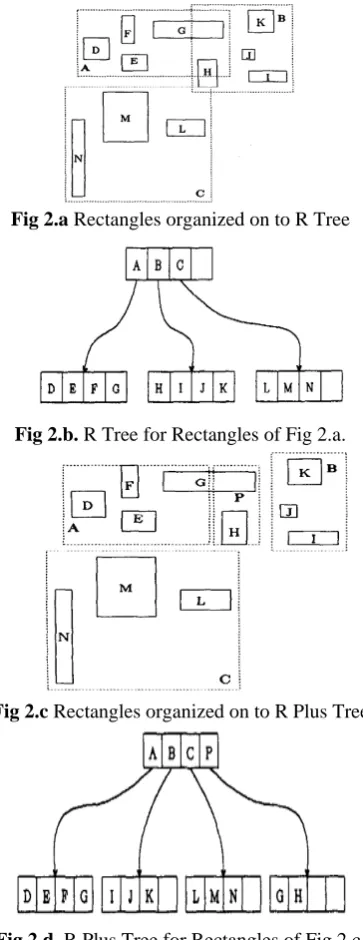
We move now to formally describe the structure of R+ Tree [3]. A leaf node is of the form (oil, RECT) where oil is an object identifier and is used to refer to an object in the database. RECT is used to describe the bounds of data objects. For example, in a 2-dimensional space, an entry RECT will be of the form (Xlow,Xhigh,YIow,Yhigh) which represents the coordinates of the lower-left and upper-right corner of the rectangle. An inter- mediate node is of the form where p is a pointer to a lower level node of the tree and RECT is a representation of the rectangle that encloses.

Fig 2.a Rectangles organized on to R Tree

Fig 2.b. R Tree for Rectangles of Fig 2.a.

Fig 2.c Rectangles organized on to R Plus Tree

Fig 2.d. R Plus Tree for Rectangles of Fig 2.c.

2.3 Concurrency Controls:

Several concurrency control algorithms have been proposed to support concurrent operations on multidimensional index structures, and they can be categorized into lock-coupling-based and link-lock-coupling-based algorithms. The lock coupling- lock-coupling-based algorithms [20], [21] release the lock on the current node only when the next node to be visited has been locked while processing search operations. During node splitting and MBR updating, these approaches must hold multiple locks on several nodes simultaneously, which may deteriorate the system throughput.

The link-based algorithms [29], [30], [31], [32], [26] were proposed to reduce the number of locks required by lock coupling- based algorithms. These methods lock one node most of the time during search operations, only employing lock coupling when splitting a node or propagating MBR changes. The link-based approach requires all nodes at the same level be linked together with right or bidirectional links. This method reaches high concurrency by using only one lock simultaneously for most operations on the B-tree. The link-based approach cannot be used directly in multidimensional data access methods as there is no linear ordering for multidimensional objects. To overcome this problem, a right-link style algorithm (R-link tree) [30] has been proposed to provide high concurrency control by assigning logical sequence numbers (LSNs) on R-trees. However, when a node splitting propagates and its MBR updates, this algorithm still applies lock coupling. Also, in this algorithm, additional storage is required to retain extra information for the LSNs of associated child nodes. To solve this extra storage problem, Concurrency on Generalized Search Tree (CGiST) [31] applies a global sequence number, the Node Sequence Number (NSN). The counter for NSN is incremented for each node split, with the original node receiving the new value and the new sibling node inheriting the previous NSN and its right-link pointer. In order for the algorithm to work correctly, multiple locks on two or more levels must be held by a single insert operation, which increases the blocking time for search operations.

Several mechanisms, such as top-down index region modification (TDIM), copy-based concurrent update (CCU), CCU with non blocking queries (CCUNQ) [29], and partial lock coupling (PLC) [26], have been proposed to improve the concurrency based on the above linking techniques. However, the link-based approach with these improvements is still not sufficient to provide phantom update protection. Phantom updating refers to updates that occur before the commitment, in the range of a search (or a following update), and are not reflected in the results of that search (or the following update). Concurrent data access through multidimensional indexes introduces the problem of protecting a query range from phantom updates. The dynamic granular locking approach (DGL) has been proposed to provide phantom update protection in the R-tree [5] and GiST [5].The DGL method dynamically partitions an embedded space into lockable granules that adapt to the distribution of objects. The leaf nodes and external granules of internal nodes are defined as lockable granules. External granules are additional structures that partition the non covered space in each internal node to provide protection. According to the principles of granular locking, each operation requests locks on sufficient

(4)

g r A p g c 2 T d r I c r T       C lo a h o o le b A to c u r e in a o a T tr r le u m b c lo D T o E granules such request conflic Although the protection fo granular lock complexity of

2.4 Isolation L

Transactions degree to wh resource or da solation lev concurrency s reads, are allow Transaction iso

 Whether lo type of lock

 How long t

 Whether a another tran

 Blocks unti

 Retrieves t at the time

 Reads the u Choosing a tr

ocks acquired always gets an holds that lock of the isolatio operations, tra

evel of protec by other transa A lower isolat o access data concurrency e users might en reduces the ty encounter, bu ncreases the another. Choo on balancing application ag The highest is ransaction wi repeats a read evel of lockin user systems. T may retrieve d by other trans can happen in

ocking or vers

Database Eng

The ISO stand of which are Engine:

 Read transac physica

 Read c

 Repeat

 Serializ are com

h that any tw cting locks on

DGL appro or multidime ks can be

DGL may im

Levels in Dat

specify an is hich one tran

ata modificatio els are des side-effects, s

wed.

olation levels ocks are taken

ks are request the read locks read operatio nsaction: il the exclusiv the committed the statement uncommitted d ransaction iso d to protect da n exclusive lo

k until the tr on level set ansaction isola ction from the actions. tion level incr

at the same ti effects (such ncounter. Con ypes of concu ut requires

chances tha osing the appr the data i gainst the ove

solation level ll retrieve exa d operation, b ng that is likely

The lowest iso data that has b

sactions. All o n read uncom sioning, so ov

gine Isolation

dard defines th e supported b

uncommitted ctions are isol

ally corrupt da committed (Da

table read zable (the hig mpletely isolat

wo conflictin n at least one oach provides nsional acce efficiently i mpact the degre

a Base Engin

solation level saction must ons made by scribed in uch as dirty

control: n when data ted.

s are held. on referencing

ve lock on the d version of th t or transaction data modifica lation level d ata modificati ock on any da ansaction com

for that tran ation levels pr e effects of m

reases the abi ime, but incre as dirty read nversely, a hig urrency effec more system at one transa

ropriate isolat integrity requ erhead of eac , serializable, actly the same ut it does thi y to impact ot olation level,

een modified of the concur mmitted, but verhead is min

n Levels:

he following i by the SQL

d (the low ated only eno ata is not read atabase Engin

ghest level, w ted from one a

ng operations e common gra s phantom up ess methods

implemented, ee of concurre

ne:

l that define be isolated other transact terms of w reads or pha

is read, and

g rows modifie

row is freed. he row that ex

n started. ation.

does not affec ions. A transa ata it modifies mpletes, regar nsaction. For

rimarily defin modifications

ility of many ases the numb ds or lost upd gher isolation cts that users

m resources action will b tion level dep uirements of ch isolation , guarantees t e data every ti is by perform ther users in m

read uncomm but not comm rrency side ef there is no nimized.

isolation level Server Data

west level w ough to ensure d)

ne default leve

where transac another). will anule. pdate and the ency. s the from tions. which antom what ed by xisted ct the action s, and rdless read ne the made users ber of dates) level may and block pends f the level. that a ime it ming a multi-mitted, mitted ffects read ls, all abase where e that l) ctions T insta the l Page Page show spec stora DBM Lock relat new disk Clus Clus contr locki page clust the c Clas Clas class one lowe of th

The amount of ance or group ock. The type  Page lock  Cluster lo  Class or t  Object or

e locking

e locking (or p wn in the figur ific page are age in compu MSs. In this f king for obje tional tuple’s to you, just t where multip

ster locking

ster locking rol is illustra ing, all data c es) will be loc ters of objects cluster of obje

ss or table loc

s or table loc s or table are l form of con er left. It repr he page where

f data that ca ps of instance es of granulari

king ocking table locking r instance lock

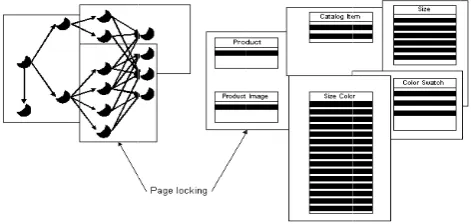
page-level loc re below. In th e locked. A p uter systems a figure, each r ects is on the is on the righ think of a pag ple data instan

or container ated in the fig clustered toge cked simultan s in ODBMSs ects spans port

cking

cking means t locked, as is i currency con resents all ins they are store

an be locked w es defines the

ity are illustrat

king

cking) concurr his situation, a page is a co and is used b rectangle repr e left and pa ht. If the conc ge as a unit o ces are stored

r locking fo gure below. I ether (on a pa neously. This

s. Note that in tions of three p

that all instan llustrated belo ntrol. Note th

tances of a cl ed.

with the sing e granularity o

ted here are:

rency control all the data on ommon unit o

by all types o resents a pag age locking fo

cept of pages of space on th d.

or concurrenc In this form o age or multip

applies only t n this exampl

pages.

(5)

O a c T d p R J p c th c e d tr R r A a Z d tr a th tr n c in T T e Z c tw p e le s q q u A th b p o

Object or inst

Instan an RDBMS or concurrency co

The experime desktop with platform unde R-tree, the R+ Java source p portal [26]. T construction a

hese experim construct the evaluating th determining fa ree does not i R+-tree. The recorded by Additionally, t accesses were ZR+-tree and different wind rees in order analysis of the

he point quer rees are expec number of di computed to b n order to redu

Throughput o The performa evaluated both ZR+-tree with compare these wo paramete probability we environments

evel is define simultaneously queries in the queries. The e used to represe According to t

he ZR+-tree better than the probability is only the outsta

tance locking

nce locking lo r a single obje ontrol is illust

3. EXPERIM

ents [1] were 512 Mbyte er windows X +-tree, and the package for R

The first set and query pe ments, differen

e ZR+-trees, he query pe actor, because introduce extr disk accesse

varying the standard d e calculated t d the R+-tree dow sizes we

r to record e algorithm giv

ry and window cted to be bett

sk accesses i be the average uce the impac

of Concurren

ance for con h for the R-tre h the propose e two multid ers, namely,

ere applied to on the three ed as the num y, and write p e whole simu execution time ent the throug the algorithm with concur e R-tree with g

low. This per anding query p

g

ocks a single ect in an ODB trated below.

MENTAL SETU

e conducted es memory, XP. The imple e ZR+-tree we R-tree obtaine of experime rformance of nt data sizes

R-trees, a erformance, e the query pr

ra computatio es of the po the number deviations of t to compare th

e. Consequen re executed o the execution ven in the pre w query perfo ter than those in this set of value for 1,0 ct of uneven d

ncy Control

ncurrent quer ee with granul ed GLIP pro imensional ac

concurrency o simulate di e data sets. H mber of queri probability de ultaneous que e measured in ghput of each analysis in th rrency contro granular locki rformance gai performance o

relational tup BMS. This ty

UP:

on a Pentiu running a J ementations o ere all based o ed from the R ents evaluated f the ZR+-tre

were selecte and R+-trees I/O cost is rocess on the on compared t

oint queries r of rectan the number of he stability o ntly, queries on the constr

n cost. From vious section, formances of of the R-trees f experiments 000 random qu data distributio

ry execution lar locking an

tocol. In ord ccess framew level and fferent applic Here, concurr ies to be exe escribes how m ery set are u n milliseconds

of the approa he previous sec ol should per

ing when the in comes from of the ZR+-tre

ple in ype of um 4 Java2 of the on the R-tree d the ee. In ed to s. In s the ZR+-to the were ngles. f disk of the with ructed m the , both ZR+-s. The s was ueries on. was nd the der to works, write cation rency cuted many update s was aches. ction, rform write m not ee but also The expe the expe was relat Fig 3 three write data 30 prob in th conc of u term throu Com prob gran smal of th exce conc bette data conc tree perc readi prov on th the w Fig. Fig. on S

the finer gra size of the qu eriments. The same as th eriments, exce reduced to 5 tively small da

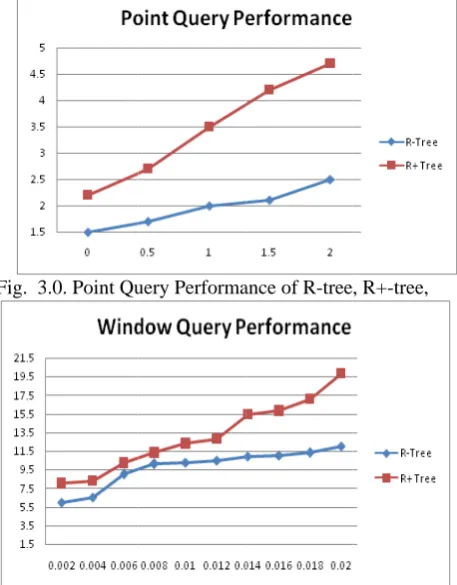
3.0 and Fig 3 e data sets wit e probabilities space. The c and 50 as bability varied hese figures current operati update operati ms of percen ughput whe mparing the babilities, GLI nular locking o ll. When the w he concurrency eeds that of currency level er with a write

sets. When t currency contr

in cases whe ent. From this ing predomin vided better th

he Rtree, altho write probabili

3.0. Point Qu

3.1. Window ynthetic Data

anules of the ueries execute

data sets use hose used in ept that the si

,000 in order ata sets compa .1 shows the th a fixed con s when the qu concurrency le representative d from 5 perce

shows the t ions, and the ions in all th ntages. Both en the wri performance IP on the ZR on the R-tree w write probabil

y control on th the ZR+-tre l is 30, the thr e probability l the concurren rol on the ZR ere the write s set of figure nant environm hroughput tha ough this adv ity increased.

uery Performa

w Query Perf a

leaf nodes in ed was tunabl d in these exp n the query ize of the syn r to assess the ared to the rea execution tim ncurrency leve uery range is 1 evel was fixed e levels, wh ent to 40 perc

time taken t x-axis indicat he concurrent h approaches ite probabili

from the d R+-tree perfor

when the writ lity increases, he R-tree com ee. Specifica roughput of th lower than 30 ncy level is ra R+-tree outpe probability i s, it can be co ments, GLIP o an dynamic gr

antage tended

ance of R-tree

formance of R

n the ZR+-tre le in this set o periments wer y performanc nthetic data s e throughput i al data sets. me costs for th

el and changin 1 percent of th d at two leve hile the wri ent. The y-ax to finish thes

tes the portion t operations i degrade th ity increase different wri rms better tha te probability the throughpu mes close to an

ally, when th he ZR+- tree

percent in re aised to 50, th

erforms the R is less than 3 oncluded that i n the ZR+-tre ranular lockin d to decrease a

(6)

CONCLUSION

This paper proposes a new concurrency control protocol, GLIP, with an improved spatial indexing approach, the ZR+-tree. GLIP is the first concurrency control mechanism designed specifically for the R+-tree and its variants. It assures serializable isolation, consistency, and deadlock free for indexing trees with object clipping. The ZR+-tree segments the objects to ensure every fragment is fully covered by a leaf node. This clipping-object design provides a better indexing structure. Furthermore, several structural limitations of the R+-tree are overcome in the ZR+-tree by the use of a non-overlap clipping and a clustering-based reinsert procedure. Experiments on tree construction, query, and concurrent execution were conducted on both real and synthetic data sets, and the results validated the soundness and comprehensive nature of the new design. In particular, the GLIP and the ZR+-tree excel at range queries in search-dominant applications. Extending GLIP and the ZR+-tree to perform spatial joins, KNN-queries, and range aggregation offer further attractive possibilities.

REFERENCES:

[1].GLIP: A Concurrency Control Protocol for Clipping Indexing by Chang-Tien Lu, Member, IEEE , JingDai, Student Member, IEEE, Ying Jin, and Janak Mathuria, IEEE TRANSACTIONS ON KNOWLEDGE AND DATA ENGINEERING, VOL. 21, NO. 5, MAY 2009

[2]R-TREES. A DYNAMIC INDEX STRUCTURE FOR SPATIAL SEARCHING Antomn Guttman University of Cahforma Berkeley [3]THE R+-TREE: A DYNAMIC INDEX FOR MULTI-DIMENSIONAL

OBJECTS Timos Sellis, Nick Roussopoulosand Christos Faloutsos2 Department of Computer Science University of Maryland College Park, MD 20742Conf. Principles of Database Systems (PODS ’87), pp. 159-169, 1987.

[4]K. Chakrabarti and S. Mehrotra, “Dynamic Granular Locking Approach to Phantom Protection in R-Trees,” Proc. 14th IEEE Int’l Conf. Data Eng. (ICDE ’98), pp. 446-454, 1998.

[5]K. Chakrabarti and S. Mehrotra, “Efficient Concurrency Control in Multi-Dimensional Access Methods,” Proc. ACM SIGMOD ’99, pp. 25-36, 1999.

[6] J.K. Chen, Y.F. Huang, and Y.H. Chin, “A Study of Concurrent Operations on R-Trees,” Information Sciences, vol. 98, nos. 1-4, pp. 263-300, May 1997.

[7] V. Gaede and O. Gunther, “Multidimensional Access Methods,” ACM Computing Surveys, vol. 30, no. 2, pp. 170-231, June 1998. [8] D. Greene, “An Implementation and Performance Analysis of Spatial

Data Access Methods,” Proc. Fifth IEEE Int’l Conf. Data Eng. (ICDE ’89), pp. 606-615, 1989.

[9] J. Hellerstein, J. Naughton, and A. Pfeffer. Generalized search trees in database systems. In Proceeding of VLDB, pages 562573, September 1995.

[10] M. Kornacker, C. Mohan, and J. Hellerstein. Concurrency and recovery in generalized search trees. In Proc. of SIGMOD, 1997. [11]D. Lomet. Key range locking strategies for improved concurrency. In

VLDB Proceedings, August 1993.

[12].J. Melton and A. R. Simon. Understanding the new sql: A complete guide. Morgan Kauffman, 1993.

[13].C. Mohan. ARIES/KVL: A key value locking method for concurrency control of multiaction transactions operating on btree indexes. In Proceeding of VLDB, August 1990.

[14]A transaction recovery method supporting fine-granularity locking and partial rollbacks using write-ahead logging. ACM TODS, Vol. 17, No. 1:94–162, March 1992.[15] B. Nichols, D. Buttlar, and J. P. Farrell. Pthreads Programming. O’Reilly & Associates, 1996 [15] M. Kornacker, C. Mohan, and J. Hellerstein, “Concurrency and

Recovery in Generalized Search Trees,” Proc. ACM SIGMOD ’97, pp. 62-72, 1997.

[16] P. Lehman and S. Yao, “Efficient Locking for Concurrent Operations on B-trees,” ACM Trans. Database Systems, vol. 6, no. 4, pp. 650-670, Dec. 1981.

[17] D. Lomet, “Key Range Locking Strategies for Improved Concurrency,” Proc. 19th Int’l Conf. Very Large Data Bases (VLDB ’93), pp. 655-664, 1993.

[18] C. Mohan and F. Levin, “ARIES/IM: An Efficient and High Concurrency Index Management Method Using Write-Ahead Logging,” Proc. ACM SIGMOD ’92, pp. 371-380, 1992.

[19] V. Ng and T. Kamada, “Concurrent Accesses to R-Trees,” Proc. Third Symp. Advances in Spatial Databases (SSD ’93), pp. 142-161, 1993.

[20] J. Nievergelt, H. Hinterberger, and K.C. Sevcik, “The Grid File: An Adaptable, Symmetric Multikey File Structure,” ACM Trans. Database Systems, vol. 9, no. 1, pp. 38-71, Mar. 1984.

[21] J.A. Orenstein and T.H. Merrett, “A Class of Data Structures for Associative Searching,” Proc. Third Symp. Principles of Database Systems (PODS ’84), pp. 181-190, 1984.

[22] J.T. Robinson, “The K-D-B-Tree: A Search Structure for Large Multidimensional Dynamic Indexes,” Proc. ACM SIGMOD ’81, pp. 10-18, 1981. Conf. Very Large Data Bases (VLDB ’87), pp. 507-518, 1987.

[23] M. Abdelguerfi, J. Givaudan, K. Shaw, and R. Ladner, “The 2-3TRTree, a Trajectory-Oriented Index Structure for Fully Evolving Valid-Time Spatio-Temporal Datasets,” Proc. 10th ACM Int’l Symp. Advances in Geographic Information System (ACMGIS ’02), pp. 29-34, 2002.

[24] L. Shou, Z. Huang, and K.-L. Tan, “The Hierarchical Degree-ofVisibility Tree,” IEEE Trans. Knowledge Data Eng., vol. 16, no. 11, pp. 1357-1369, Nov. 2004.[25] S.I. Song, Y.H. Kim, and J.S. Yoo, “An Enhanced Concurrency Control Scheme for Multidimensional Index Structure,” IEEE Trans. Knowledge Data Eng., vol. 16, no. 1, pp. 97-111, Jan. 2004.

[26] Y. Theodoridis, “The R-Tree Portal,” http://www.rtreeportal.org, 2005.

[27] P.S. Yu, K.-L. Wu, K.-J. Lin, and S.H. Son, “On Real-Time Databases: Concurrency Control and Scheduling,” Proc. IEEE, vol. 82, no. 1, pp. 140-157, Jan. 1994.

[28] D. Zhang and T. Xia, “A Novel Improvement to the R-Tree Spatial Index Using Gain/Loss Metrics,” Proc. 12th ACM Int’l Symp. Advances in Geographic Information Systems (ACMGIS ’04), pp. 204-213, 2004.

[29] K.V.R. Kanth, D. Serena, and A.K. Singh, “Improved Concurrency Control Techniques for Multi-Dimensional Index Structures,” Proc. Ninth Symp. Parallel and Distributed Processing (SPDP ’98), pp. 580-586, 1998.

[30] M. Kornacker and D. Banks, “High-Concurrency Locking in R-Trees,” Proc. 21st Int’l Conf. Very Large Data Bases (VLDB ’95), pp. 134-145, 1995.

[31] M. Kornacker, C. Mohan, and J. Hellerstein, “Concurrency and Recovery in Generalized Search Trees,” Proc. ACM SIGMOD ’97, pp. 62-72, 1997.

[32] P. Lehman and S. Yao, “Efficient Locking for Concurrent Operations on B-trees,” ACM Trans. Database Systems, vol. 6,no. 4, pp. 650-670, Dec. 1981.

[33] D. Lomet, “Key Range Locking Strategies for Improved Concurrency,” Proc. 19th Int’l Conf. Very Large Data Bases (VLDB ’93), pp. 655-664, 1993.

Authors Biography

N Krishna Kumari, pursuing M.Tech. (I.T.) in Dept. of Information Technology, University College of Engineering, JNTUK - Vizianagaram Campus, VIZIANAGARAM, Andhra Pradesh, India. Participated and Presented papers at National Level, Seminars and Technical Symposiums.

Dr MHM Krishna Prasad is working as an Associate Professor and Head, Dept. of Information Technology, University College of Engineering, JNTUK- Vizianagaram Campus, VIZIANAGARAM, Andhra Pradesh, India. Received PhD from JNTU Hyderabad and M. Tech from SIT, JNTU, Hyderabad. Had vast Experience in industry and academics, and published papers in various International Conferences and Journals

Figure

Fig 2.d.  R Plus Tree for Rectangles of Fig 2.c.
figure, each rage locking fois on the righresents a paght. If the conce left and parectangle reprects is on thecept of pages
Fig.  3.0. Point Qu

References

Related documents

In particular, we have an additional self-selection constraint (the µ-constraint) requiring that the lifetime expected utility of a mimicker must be lower or equal to the one of

A Mass intention is said when a person requests that the priest remember a particular person living or dead at Mass.. It can also be for a special intention and this may be stated

Yet, to the best knowledge of the researcher, no event-related research study has evaluated the impact of brand orientation and organisational innovativeness on brand and

Therefore, the objective of this systematic review and meta-analysis is to estimate the pooled recovery rate and its determinants among children with severe acute malnutrition

cirrhosis, hepatocellular carcinoma, hereditary haemochromatosis, palliative care, Scotland, type 2 diabetes..

Introduction:   This article describes the implementation of a novel technology tool to capture demographic distribution and clinical presentation of patients in rural vision

1 december 2015, The new Portuguese online gambling tax regime in a constitutional context. General income tax

This study sought to measure the perceptions of the community on the prevalence of police corruption and its impact on service delivery in the Pretoria Central area.. Using a