STRATEGIC REALIGNMENT OF THE
POST-CONTRACT COST CONTROL
PROCESS IN THE NIGERIAN
CONSTRUCTION INDUSTRY USING
KAIZEN
Temitope S. OMOTAYO
STRATEGIC REALIGNMENT OF THE
POST-CONTRACT COST CONTROL
PROCESS IN THE NIGERIAN
CONSTRUCTION INDUSTRY USING
KAIZEN
Temitope S. OMOTAYO.
School of the Built Environment
University of Salford, Manchester, UK.
Submitted in Partial Fulfilment of the Requirements of the
Degree of Doctor of Philosophy
I
TABLE OF CONTENTS
Table of Contents ... I
List of tables ... IX
List of Figures ... XI
List of Abbreviations ... XIII
Acknowledgement ... XIV
DEDICATION ... XV
ABSTRACT ... XVI
CHAPTER ONE (INTRODUCTION) ... 1
1.0 Research Backgorund ... 1
1.1 Research Justification ... 3
1.2 Research Aim and Objectives ... 5
1.2.1 Research Objectives ... 5
1.3 Scope and Limitations of this research ... 5
1.4 Exclusions ... 6
1.5 Reservations ... 7
1.6 Constriants ... 7
1.7 Structure of the Thesis ... 8
CHAPTER TWO (LITERATURE REVIEW) ... 10
2.0 Introduction ... ….10
2.1 The significance of post-contract cost control over the pre-contract phase in project delivery ... 11
2.1.1 Importance of post-contract cost control ... 17
2.2 Construction Cost Management Systems ... 17
II
2.2.2 Stages in cost management... 19
2.2.3 Delineating Systems, method and techniques in construction cost management... 20
2.3 Traditional costing system in construction ... 31
2.4 Modern methods of post-contract cost control ... 32
2.4.1 Target value design ... 32
2.4.2 Activity based costing ... 34
2.4.3 Value engineering ... 35
2.4.4 Life cylce costing ... 36
2.4.5 Earned value analysis ... 36
2.4.6 Kaizen costing ... 37
2.5 Kaizen in the construction industry and lean construction ... 41
2.5.1 Incremental waste reduction process in kaizen costing: Overhead cost reduction of non-value adding activities ... 44
2.6 How kaizen costing works: The process of incremental reduction of activities on construction sites for kaizen costing ... 46
2.7The need for kaizen and kaizen costing in small and medium scale construction companies in Nigeria ... 49
2.8 The organisational culture of small and medium scale construction companies in Nigeria ... 50
2.9 Critical success factors for implementing kaizen in SMSCC in the construction industry ... 53
2.10Summary of identified gaps for post-contract cost control in the Nigerian construction industry and the possible influene of kaizen ... 60
CHAPTER THREE (RESEARCH METHODOLOGY) ... 62
3.0 Introduction ... ….62
III
3.2 Research Philosophy ... 64
3.2.1Ontology ... 64
3.2.2 Epistemology ... 64
3.2.3 Axiology ... 65
3.2.4 Justification for the research philosophical stands... 65
3.3 The research approach ... 69
3.4 The research strategy ... 70
3.4.1 Justification for survey strategy over other strategies... 72
3.4.2 Survey research strategy ... 73
3.4.3 Literature review synthesis ... 73
3.5 The research choice... 75
3.6 Time horizon ... 76
3.7 Research Techniques ... 76
3.7.1 Semi-structured interviews ... 77
3.7.2 Survey Questionnaire design ... 77
3.7.3 Pilot study for the research ... 78
3.7.4 Research method and analysis ... 78
3.7.5 The research sample ... 79
3.7.5.1 Purposive sampling ... 80
3.7.6 Random sampling technique ... 81
3.7.7 Paramteric and non-parametric tests ... 84
3.7.7.1 Ch-square test for the background of the respondents ... 85
3.7.7.2 Data analysis for the first objective ... 85
3.7.7.3 Data analysis for the second objective ... 86
3.7.7.4 Data analysis for the third objective ... 86
3.7.7.5 Data analysis for the fourth objective ... 87
IV
3.7.7.7 Framework Validation………..96
3.7.8 Triangulation of data analysis ... 97
3.8 Research validity ... 98
3.8.1 Criterion-related validity ... 99
3.8.2 Content validity ... 99
3.8.3 Construct validity ... 100
3.8.4 Face validity ... 100
3.8.5 Translation validity ... 100
3.8.6 Internal validity ... 101
3.8.7 External validity ... 101
3.9 Research reliability ... 101
3.9.1 Inter-rater reliability ... 102
3.9.2 Test-Retest reliability ... 102
3.9.3 Parallel-forms reliability ... 102
3.9.4 Internal consistency reliability ... 102
3.10 Ethical considerations ... 103
3.11 Summary of the research methodology ... 103
CHAPTER FOUR (DATA ANALYSIS) ... 105
4.0 Introduction to data analysis ... 105
4.1 Professional summary of the respondents... 105
4.1.1 Scaling the respondents’ organisation ... 107
4.1.2 Analysis for post-contract cost controlling methods in Nigerian SMSCC ... 108
4.2 Research objective two: Establishing and evaluating the techniques used in post- contract cost control in SMSCC in Nigeria ... 109
V
4.2.1.1 Monitroing material cost ... 110
4.2.1.2 Monitoring subcontractor’s activities ... ….111
4.2.1.3 Monitroing cash-inflow and out-flow ... 112
4.2.1.4 Interim valuations ... ….112
4.2.1.5 Regular site meetings ... 112
4.2.1.6 Challenges post-contract cost controlling techniques have during utilisation... 113
4.2.2 Quantitative analysis of post-contract cost controlling techniques using Kendall’s coefficient of concordance ... ….114
4.2.2.1 Reliability test for the background of post-contract cost controlling techniques used in SMSCC in Nigeria ... 1145
4.2.2.2 Effectiveness of indentified post-contract cost controlling techniques using Kendall;s coefficent of concordance ... 116
4.2.2.3 Kendall’s coefficient of concordance for the most important post-contract cost controlling techniques ... 118
4.2.3 Summary and trainagulation of findings for objective two: establishing and evaluating post-contract cost conbtrolling techniques used in SMSCC in Nigeria ... 120
4.3 Research objectives three: Identifying and assessing the most critical activities requiring incremental cost reduction for kaizen costing implementation ... 121
4.3.1 Correlation between the critical activities required for the incremental cost reduction for kaizen costing implementatiion ... 123
4.3.2 Summary of findings for resarch objective three: Most critical activities requiring continaul reduction ... 125
4.4 Research objectives four: Analysing the critical success factors for kaizen and kaizen implementation ... 126
4.4.1 Qualitative findings for critical success factors for kaizen implementation in Nigerian SMSCC... 127
VI
Theme 2 Communication approach ... 128
Theme 3 Waste reduction policy ... 129
Theme 4 Post-contract cost controlling techniques involving kaizen costing 129 Theme 5 Post-project reviews ... 130
4.4.2 Qualitative analysis for research objective four involving critical success factors for the implementation of kaizen in Nigerian SMSCC ... 131
4.4.2.1 Availability of post-contract cost control template ... 131
4.4.2.2 Openness to new ideas within the organisation... 134
4.4.2.3 Encouragement of a new form of post-contract cost controlling method… ... 137
4.4.3 Quantitative analysis of the critical success factors for implementing kaizen in SMSCC in Nigeria ... 140
4.4.3.1 Assessing the drivers for the management function critical success factors ... 146
4.4.3.2 Assessing the drivers for operational efficient crtical success factors ... 147
4.4.3.3 Assessing the drivers for construction business management and ethics critical success factor ... 148
4.4.3.4 Assessing the drivers for construction cost management ... 149
4.5 Summary of data analysis ... 150
CHAPTER FIVE (DISCUSSION OF FINDINGS) ... 153
5.0 Introduction to discussion of findings... ….….153
5.1 Research objective two: Post-contract cost control in the Nigerian construction industry ... 153
5.2 Research objective three: Crucual activities which kaizen costing require on construction sites in Nigeria ... 156
VII
5.3.1 Management function ... ….….161
5.3.2 Operational efficieny ... 162
5.3.3 Construction business mangement and ethics... 163
5.3.4 Construction cost management ... 165
5.4 Summary of disucssion ... 166
CHAPTER SIX (FRAMEWORK AND VALIDATION) ... 168
6.0 Introduction to framework development and validation ... ….….168
6.1 Stage one: Improving construction activities within the office ... ….….168
6.2Stage two: Improving post-contract cost control activities and techniques ... 174
6.3Framework for kaizen and kaizen costing with implementation using capability maturity model for small and medium scale construction companies ... 177
6.4 Framework validation ... ….….180
6.5 Summary of framework development ... 186
CHAPTER SEVEN (RESEARCH CONCLUSION, CONTRIBUTIONS AND RECOMMENDATIONS) ... 187
7.0Introduction to conclusion, contributions and recommendations of the study ... 187
7.1 Synthesising the research objectives ... 187
7.2
Research o
bjective 1: The critical review of the post-contract cost controlling techniques used in the construction industry ... 1887.3
Research
o
bjective 2: The review and critically evaluate the techniques used in post-contract cost controlling management in small and medium scale construction companies in Nigeria ... 1897.4 Research objective 3: To identify and evaluate the critical post-contract cost controlling activities for incremental cost reduction in small and medium scale construction companies in Nigeria... 190
VIII
7.6 Objective 5: Developing and validating the framework based on kaizen philosophy and kaizen costing, which can be integrated into the post-contract cost control practices in
small and medium scale construction companies in Nigeria ... 193
7.7 Contribution to theory ... 194
7.7.1Delineating cost management systems methods and techniques ... 194
7.7.2Important post-contract cost control techniques in the Nigerian construction industry ... 195
7.7.3 Critical success factor for implementing kaizen and kaizen costing in the Nigerian construction industry ... 195
7.7.4 Capability maturity model in the framework for kaizen and kaizen costing in the construction industry ... 196
7.8 Contribution to practice ... 196
7.8.1 Combining kaizen and kaizen costing with traditonal costing ... 196
7.8.2 Kaizen in the Nigerian construction industry ... 197
7.8.3 kaizen costing in post-contract cost control for the construction industry ... 197
7.9 Further research recommendations ... 197
7.9.1The cost implementation of kaizen and kaizen costing in the Nigerian construction industry ... 198
7.9.2 Crtical success factors for implementing kaizen in the UK construction industry ... 198
7.10Limitations of the study ... 198
7.11Summary of contribution to knowledge and practice ... 199
PUBLICATIONS ... 200
REFERENCES ... 201
APPENDICES ... 212
Appendix A -Ethical Approval ... 213
Appendix B -Participant information sheet ... 214
Appendix C - Suvey interview ... 216
Appendix D -Survey Questions ... 218
IX
Appendix F -Data tables ... 228
List of Tables
Table 2.1. Cost control systems, methods and techniques ... ….….23Table 2.2. Benefits of kaizen costing ... ….….39
Table 2.3. The Merits and drawback of post-contract cost controlling techniques . ….….40 Table 2.4. Activities relating to overhead cost ... ….….45
Table 2.5.The critical success factors for the adoption of kaizen and kaizen costing ... ….….56
Table 3.1. The philosophical stands with justification adopted for each objective . ….….66 Table 3.2. Comparing the different types of research strategies which can be used for this study ... ….….70
Table 3.3. The research strategy and purpose adopted for each research objectives and questions ... ….….74
Table 3.4. Phases in data collection process for qualitative and quantitative research ... ….….80
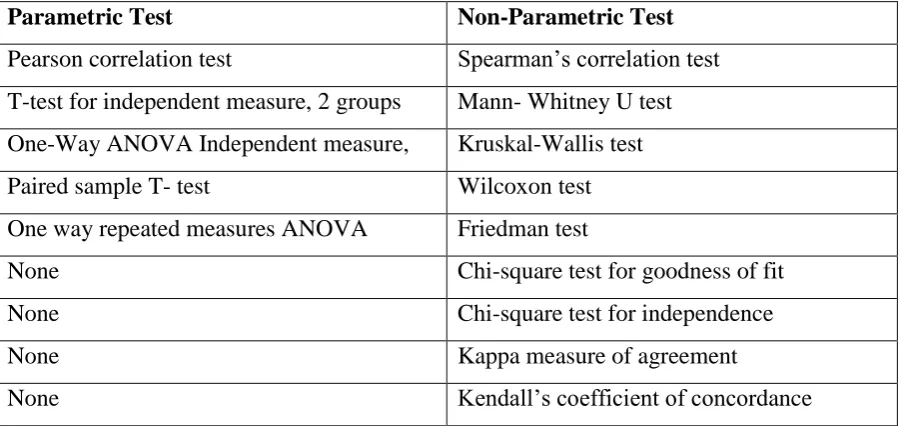
Table 3.5. Parametric tests and their non-parametric alternative ... ….….84
Table 3.6. List of Interviewees for the study ... ….….88
Table 4.1. Reliability test for the background of the study ... ….….109
Table 4.2. Case summary for the background of the investigation ... ….….116
Table 4.3. Kendall’s W test for effectiveness of post-contract cost control techniques ... ….118
Table 4.4. Kendall’s W test for important post-contract cost control technique ... ….119
Table 4.5. Abbreviations for the activities all the captions should give a proper meaning ... ….121
Table 4.6. Kendall’s W test for the most critical activities ... ….….123
X
Table 4.8: Job and Availability of a template for PC3 cross tabulation ... ….….132
Table 4.9. Chi-Square Tests for the response to availability of Post-contract cost control template ... ….….133
Table 4.10. Symmetric Measures table for the response to availability of Post-contract cost control template ... ….….133
Table 4.11. Job and Openness to new ideas and innovation cross tabulation ... ….….135
Table 4.12. Chi-Square Tests for Job and Openness to new ideas and innovation ….….136 Table 4.13: Symmetric measures for Job and Openness to new ideas and innovation ... ….….136
Table 4.14. Cross tabulation for job and encouragement for new form of post-contract cost control ... ….….138
Table 4.15. Chi-Square Tests for job and encouragement of new form of post-contract cost controlling method ... ….….139
Table 4.16. Symmetric measures table for the encouragement of a new form of post-contract cost control... ….….140
Table 4.17. Reliability statistics for the critical success factors ... ….….141
Table 4.18. KMO and Bartlett’s test after the second iteration ... ….….142
Table 4.19. Component transformation matrix ... ….….143
Table 4.20. Rotated matrix table for the factors ... ….….143
Table 4.21. Categorisation of the drivers into factors ... ….….145
Table 4.22. Significance and mean values for the first critical success factors ... ….….146
Table 4.23. Ranking of the factors for operational efficiency ... ….….148
Table 4.24. Ranking of factors for construction business management and ethics ….….149 Table 4.25. Ranking of factors for construction cost managemement ... ….….150
Table 6.1. Summary of the interview transcripts for the important variables for implementation ... ….….181
XI
List of Figures
Figure 2.1 Literature review structure ... ….….10
Figure 2.2 stages of cost planning and control ... ….….12
Figure 2.3 The traditional cost management system, methods and techniques ... ….….21
Figure 2.4. Summary of Cost management, systems, methods and techniques………….22
Figure 2.5 Improving cost management progressively during the construction phase ... ….….37
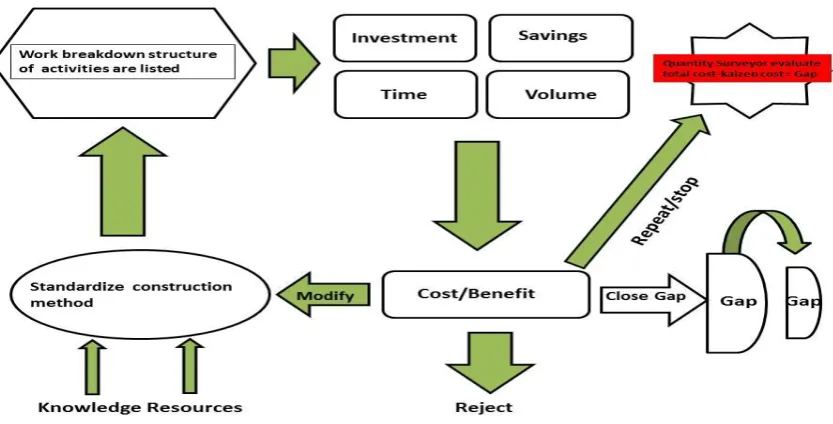
Figure 2.6 Kaizen costing process during construction ... ….….47
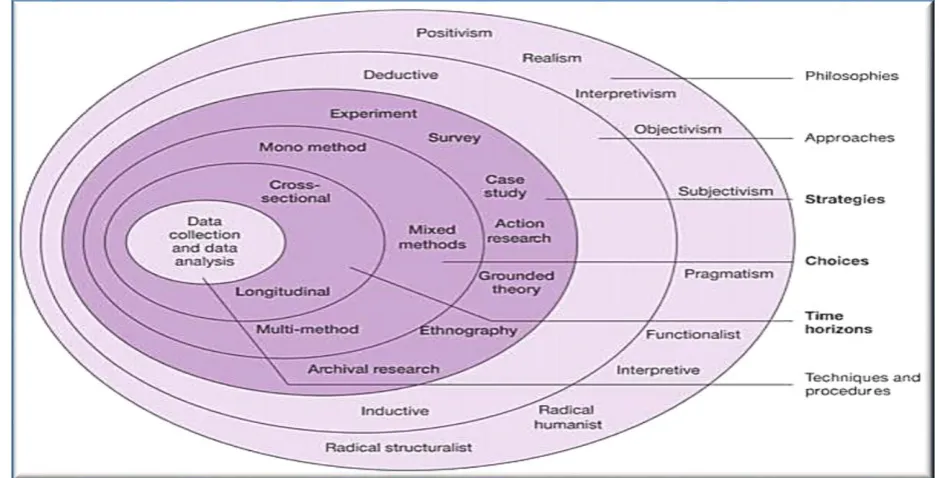
Figure 3.1 The research onion ... ….….62
Figure 3.2 Nested Model... ….….63
Figure 3.3 Research philosophy choice for this study ... ….….69
Figure 3.4 Conceptual framework for the research methodology ... ….….83
Figure 3.5 BPMN symbols ... ….….92
Figure 3.6 The IDEF0 process, derived from Soung-Hie and Ki-Jin (2000) ... ….….96
Figure 3.7 Research Onion showing the adopted philosophies, and other layers.. ….….104
Figure 4.1 Pie chart showing the number of respondents ... ….….106
Figure 4.2 Graph showing the linear years of experience of the respondents ... ….….106
Figure 4.3 Graph showing the type of organisation ... ….….107
Figure 4.4 Pie chart showing the type of post-contract cost control methods used ….….108 Figure 4.5 NVIVO themes for the interviews on post-contract cost control ... ….….110
Figure 4.6 Effectiveness of post-contract cost controlling techniques ... ….….117
Figure 4.7 Important post-contract cost control techniques presented in bar chart ….….119 Figure 4.8 Bar chart for the most critical post-contract cost control activities .... ….….122
XII
Figure 4.10 Pie chart showing the response to availability of Post-contract cost control
template ... ….….132
Figure 4.11 Bar chart showing the level of openness to new ideas ... ….….135
Figure 4.12 Bar chart illustrating the response to encouraging new form of post-contract cost controlling method ... ….….138
Figure 4.13 Scree plot showing the eigenvalues ... ….….142
Figure 6.1 BPMN for kaizen process for a hypothetical SMSCC ... ….….170
Figure 6.2 Knowledge about kaizen and CSF for continuous improvement ... ….….172
Figure 6.3: IDEF0 process for post-contract cost control of a hypothetical building construction ... ….….176
Figure 6.4 Framework for kaizen and kaizen costing in SMSCC ... ….….178
XIII
List of Abbreviations
BPMN - Business Process Model and notation CMM- Capability maturity model
IDEF0- Icam Definition Fuction Zero
Nigerian Institute of Quantity Surveyors- NIQS
XIV
Acknowledgment
I am immense grateful to my creator for giving me this opportunity to reach this level in my career. Dreams come through with action and the right people. I started this journey after my MSc when Dr Kaushal Keraminiyage advised me to try this Ph.D. program. He was my first supervisor and a mentor. I would not have met Dr Udayangani Kulatunga without knowing Dr Keraminiyage.
Dr Keraminiyage left University of Salford and left me in the capable hands of Dr Kulatunga in August 2014. I thought things would be difficult after his departure but I was wrong. Dr Kulatunga made me a better students, mentored me as a colleague and developed my administrative skills within a very short period. She also gave me the opportunity to develop my teaching career as a lecturer in Quantity Surveying. Saying a thank you to her is an understatement. I am forever indebted.
I am also grateful for the contributions made by my co-supervisor, Prof Vian Ahmed. She was very helpful every time we had a discussion about writing up this thesis. In the past three years, I have met a number of academic staff in the school of the built environment
who have changed my orientation about built environment research and academia. The lecturers are Dr Chaminda Pathirage, Mr David Baldry and Professor Bingunath Ingirige.
As a self-sponsored studenI had financial difficulties during my second and third year. I almost dropped out of this program due to the tuition fees. A family friend and father Dr Olajide Ijaola gave me a loan to support me with the tuition fees. I would not writing this without his help.The motivational words of my fiancée Barrister Linimose Anyiwe, kept me above the waters.
XV
Dedication
XVI
Abstract
Small and medium scale construction companies in Nigeria have many challenges such as management of construction works, employee management, competition in the
construction industry and financial management of construction projects. New techniques emanating from lean thinking have helped to reduce cost during manufacturing. Continuous cost reduction or kaizen costing during the construction phase stems from kaizen, which is a sub-set of lean production. Kaizen is the Japanese word for continuous improvement, which has the proven benefits to reduce construction cost, provide quality products, increase profitability, enhance employee-employer relationship and competitiveness.
The research methodology for this study involved literature review and surveys (quantitative and qualitative). The surveys involved questionnaires and semi-structured interviews. Quantitative data was obtained from one hundred and thirty-five (135) respondents in Small and medium scale construction companies in Nigeria. Eleven (11) executives of small and medium scale construction firms were interviewed. The qualitative data were be analysed using NVIVO 10, while descriptive statistics, pie charts, graphs, Kendall’s W test, Spearman rho’s correlation, and factor analysis were used to analyse the
quantitative data.
The critical success factors for kaizen costing implementation identified management function; operational efficiency; construction business and ethics; and construction cost management as the major implementation factors. The critical success factors, effective post-contract cost controlling techniques and crucial activities for cost reduction during construction were used to produce the kaizen framework. The kaizen framework focused on activities before the construction phase required for effective post-contract control. The kaizen framework was developed using IDEF0, business process model and notation and capability maturity model.
1
Chapter One
Introduction
1.0
Research background
The successful management of construction projects depends on the cost management systems, methods and techniques (Nasina & Nallam, 2016; Jayaraman, 2016; Haupt & Pillay, 2016; Potts, 2008; Guo et al., 2016). The accuracy of construction cost estimates is vital for organisational financial planning, project financing and viability (Ahiaga-Dagbui & Smith, 2014). Therefore, construction companies thrive on project cost control for financial growth, and this is not dependent on the scale of the construction company. There are a lot of small and medium scale construction companies (SMSCC) around the world, and they are the major drivers of the construction economy (Ugochukwu & Onyekwena, 2014; Bilau & Sholanke, 2015). Some internal and external factors determine project cost. These factors are the involvement of stakeholders, project finance, government regulations, risk, communication,
organisational culture, the price of construction materials, and the control of project cost (Ogwueleka & Maritz, 2016; Nasina & Nallam, 2016; Oladapo, 2007; Olatunji, 2008; Treacy et al., 2016). Cost control in construction projects may be influenced by the type of construction industry and the nature of the construction company (Haupt & Pillay, 2016; Jayaraman, 2016; Lee & Migliaccio, 2016; Nasina & Nallam, 2016; Rezania et al., 2016). Regarding cost control, SMSCC have been experiencing poor project performance (Odediran et al., 2012; Odediran et al., 2013). Cost control in projects has been linked to cost overruns (Jayaraman, 2016; Koushki & Kartam, 2004; Le‐Hoai & Lee, 2009; Nasina & Nallam, 2016). Studies on cost control have been
conducted over the years with very limited practical impact on the performance of SMSCC. One of the other main successful factor for any project is funding and government influence.
Government’s funding for SMSCC may stimulate the growth of these companies, but
2
The performance and growth of SMSCC around the world have been a challenge in many construction industries (Abe et al., 2015; Lui and Skerratt, 2014; Rostami et al., 2015). Hence, there has to be focus on improving the performance of SMSCC. Cost overrun has plagued many construction projects. Cost overruns are experienced where there is final construction cost is much higher than the budgeted cost. Cost overruns have also led to construction disputes and litigations. Enhancing cost control processes of construction projects through overhead cost reduction and elimination of waste have been identified to provide further profit and competitiveness for SMSCC (Stålberg &
Fundin, 2016; Shang & Pheng, 2013). The need to improve post-contract cost controlling techniques has now become paramount because his requirement is based on
the problems facing the traditional costing system for post-contract cost control.
Within the context of Nigeria, SMSCC has a huge market share in the economy (Yahaya et al., 2015; Kehinde, 2016; SMEDAN, 2013; Ezekiel et al., 2016). However, similar to the global context, Nigerian SMSCC is underperforming. Onugu, 2005; Bala et al., 2009; & Agundu et al., 2016 highlighted the factors for the underperformance of SMSCC as being resources, capabilities and management of project cost; these are all related to construction cost management. The traditional construction cost management system in Nigeria has been criticised for its ineffectiveness, due to errors in the traditional cost estimating, cost control, information management and lack of coherence between cost, administration and production management (Dikko, 2002, Olusegun and Alabi, 2011, Sanni and Hashim, 2013). The problem with construction cost controlling in Nigeria has been the involvement of inexperienced construction professionals, quantity surveyors, fluctuation of building material prices, increasing complexity in projects, volatile regulatory system or government policies and lack of innovation and research (Sanni and Hashim, 2013). Innovation in managing construction cost most especially, complex projects is required in developing economies at the moment (Dada, 2014; Emuze et al., 2014). One of such technique is kaizen costing.
3
Vliet, 2008; Higuchi et al., 2015; Singh and Singh, 2015). Kaizen costing has been used in Toyota since 1960 as a cost management technique. The automobile manufacturing industry in Japan has since been using kaizen to improve product cost and profit (Kaur and Kaur, 2013). Kaizen costing benefits have been reflected in the profit margin of most organisations, this is because kaizen costing monitors construction firms’ relationship with the supplier’s selling price, this becomes a
benchmark for cost improvement (kaizen) and the value of product produced (Martin, 1993). Kaizen costing tries to reduce overhead costs and any other areas where waste
may arise.
Kaizen costing which is a form of lean construction is beneficial to the construction sector because it will create more value for money, improve project delivery, maximise profit for the contractor, expand construction activities and also improve the economy in the long-run (Kaur and Kaur, 2013; Singh and Singh, 2015; and Vivan et al, 2015). Therefore, the use of kaizen can be identified as a way to improve the competitiveness of Nigerian SMSCC.
1.1
Research Justification
The challenges facing SMSCC in Nigeria has led to the bankruptcy of many construction companies in Nigeria (Polytechnic 2015; Bilau & Sholanke 2015; Ugochukwu & Onyekwena 2014). Ugochukwu & Onyekwena (2014) noted that SMSCC in Nigeria has not been able to compete with large-scale construction companies for government projects. The construction industry in Nigeria is dominated by foreign construction organisations which have suppressed the rise of local firms for several years (Odediran et al., 2012a). Furthermore, Oyedele (2015); Olanrewaju &
Anavhe (2014) and Dada (2014) identified the lapses in the cost control methods used in SMSCC in Nigeria. Cost overruns emanated from inaccuracies in the bill of quantities (Oyedele, 2015). Improving the competitiveness of construction projects will influence the growth of SMSCC and also the construction industry in Nigeria (Suárez‐ Barraza et al. 2011; Choomlucksana et al. 2015). The economy of Nigeria depends on infrastructure development (Inuwa et al., 2014) and the requirement to attain this height depends on the construction industry. Developing economies have to give more
4
In additional to this, the post-contract cost control process requires detailed control and monitoring. Hence, the post-contract cost control phase is vital for project success and performance of construction projects (Please refer to section 2.3 for detailed explanation). SMSCC in Nigeria has been experiencing cost overruns and funding challenges during construction activities (Bala et al. 2009; Bilau & Sholanke 2015; Agundu et al. 2016; Abdullah et al. 2011). The occurrence of cost overrun is usually predominant during the construction phase. Therefore, post-contract cost control goes
a long way in determining the performance of SMSCC in Nigeria regarding project delivery, client satisfaction, and competitiveness. As a result of the importance of
post-contract cost control during construction projects, certain techniques such as interim valuations, cashflow calculations, monitoring of overheads, monthly financial statements have been employed during construction (Please refer to section 2.1). Post-contract cost controlling techniques may not be effective enough to handle complex projects handled by Nigerian SMSCC.
The complexity of projects in Nigeria requires new post-contract cost controlling methods and techniques. Kaizen costing has the benefit of easy combination with the traditional construction cost management system, and it has a focus on profitability and client satisfaction as opposed to earned value analysis; value engineering; activity based costing; and traditional cost controlling (please refer to Table 2.3). The choice of kaizen costing over other methods such as earned value analysis; life cycle costing; activity based costing; and value engineering has been highlighted in sections 2.4.1 to 2.4.5 and table 2.3. Table 2.3 in section 2 provided a detailed explanation on the merits and demerits of the various post-contract cost controlling methods. The benefits of Kaizen costing were highlighted in section 2.4.5 and in table 2.2 in section 2 specifies the potentials for SMSCC in Nigeria to enhance their performance for improved profitability and competitiveness in the Nigerian construction industry.
5
Kaizen costing is used during post-contract cost control for cost reduction and final delivery of quality construction products.
Post-contract cost control is the focus of this study because of the number of complex construction activities which takes place during this phase compared to pre-contract phase. These complex construction activities during the post-contract phase pertain, to the interpretation of construction method statements, bill of quantities and programme of works, which may be subject to inevitable changes. These changes or variations
during construction may lead to cost overrun.
1.2
Research Aim and Objectives
The aim of this study is to develop a strategy for conducting post-contract cost control in Nigerian small and medium scale construction companies based on kaizen.
1.2.1 Research Objectives
The research objectives of this investigation are:
a) To critically review the post-contract cost controlling techniques used in the construction industry.
b) To establish and evaluate the techniques used in post-contract cost controlling management in small and medium scale construction companies in Nigeria. c) To identify and evaluate the critical post-contract cost controlling activities for
incremental cost reduction in small and medium scale construction companies in Nigeria.
d) To review and evaluate the critical success factors of adopting kaizen in small and medium scale construction companies in Nigeria.
e) To develop and validate a framework based on kaizen, which can be integrated into the post-contract cost control practices in small and medium scale construction companies in Nigeria.
1.3
Scope and limitations of this research
6
overrun. This is because cost factors have more implications on time compared to time on cost. Therefore, if a project has the right financial resources, time overrun will not be an issue. The benefit of cost overruns over time overruns have been proven in studies by (Aibinu and Jagboro, 2002, Odeh and Battaineh, 2002). In a developing economy such as Nigeria, availability of finance is a major issue which has a direct effect on time. Also, since it has been noted by (Sanni and Hashim, 2013) that the major challenge facing most construction companies in Nigeria has to do with cost management. Post-contract cost control is a major focus in this study. This is because
cost factors during the estimation process (at the planning face) are faced with errors, design changes, market conditions and other external factors which may lead to cost
overrun (Ashworth and Perera, 2015; Oyedele, 2015) Traditional cost management system in construction has a lot of imperfections which can only be managed during construction. The justification for this scope will be discussed further in section 2.3. Kaizen is required in the office before implemented on the site. Therefore, the critical success factors include factors which are associated with the working environment, remuneration and required skill for kaizen framework.
Nigeria is a good example of a developing country and the largest economy in Africa with a gross domestic product of over $500 billion (JIL, 2016; Oteri & Ayeni, 2016). Lagos state is the largest city is Nigeria and this city produces one-quarter of Nigeria’s gross domestic product (Oteri & Ayeni 2016). Lagos state is a mega city which accounts for 93.3% of the residential building construction in Nigerian and 4.6% of non-residential buildings (Adelekan, 2013). Construction activities in Lagos state has increased with the development of the Eko Atlantic city in the past five years. This has created opportunities for SMSCC. The prevailing opportunities in Lagos state for SMSCC has created an opportunity for this study to explore the on-going perception of innovation, change and kaizen in Nigerian SMSCC.
1.4
Exclusions
7
being extracted. This study will not involve the details of building activities on the site. Therefore, a case study was not be applied. New concepts such as BIM is not part of this study because it is not in use in Nigerian construction companies. The estimating methods for quantities will not be considered. Hence, the focus will be on the construction stage. The various types of costs in construction are not parts of this investigation. Consultants will not be parts of the data collection because of the scope which is based on construction companies. The contractor architect and quantity surveyors will be part of the study. The cost of implementing the framework will not
be part of this study. Detailed studies about change management for the framework implementation is beyond the scope of this study.
1.5
Reservations
The scarcity of articles on post-contract cost controlling techniques around the world and in Nigeria was recognised. This formed a research gap that this study intends to fill. The dearth of materials on kaizen in Nigerian was also put into considerations. The current publications on kaizen, post-contract cost control and other aspects of this study as small and medium enterprises in the Nigerian construction industry limited the search to what is available. The robustness of literature on the financial performance of SMSCC in Nigeria created an opening for an investigation into their current financial performance.
1.6
Constraints
8
1.7
Structure of the thesis
This subjection summarised the eight chapters in this thesis. This is based on the logic of the research objectives and the build-up of the research methodology. The literature review provided grounds for discussing the findings after the analysis. The chapters are
summarised as follows.
Chapter 1- Created a background of the study. The justification of the research looked the reason for choosing kaizen costing over other forms of costing techniques such as activity base costing, life cycle costing, earned value analysis and value management. The justification for choosing kaizen is also based on the benefits in other sectors such as automobile manufacturing and in developed countries. The research aims and objectives were coned based on the research background and justification. The scope of the study was also stated.
Chapter 2- This chapter focused on articles related to cost management, the justification for post-contract cost control, latest studies on post-contract cost control, lean construction, kaizen and kaizen costing. The need for kaizen and kaizen costing in Nigeria was well expressed along with the background of SMSCC in Nigeria.
Chapter 3- Designing the research methodology created an opportunity to understand how the research objectives would be resolved. The research onion was chosen because of its meticulous nature. This provided a philosophical basis for the approach, which is mixed, and strategy. The research strategy was chosen based on the needs of the research objectives. Therefore, surveys strategy covered the interviews and quantitative questionnaire. The statistical tests for each of the research objectives were highlighted.
The data analysis made use of NVIVO 10 and SPSS 23.
9
implementation of kaizen costing in Nigerian construction industry identified organisational culture; communication approach; waste reduction policy; post-contract cost controlling techniques involving kaizen costing; and post-project reviews.
Quantitative findings made use of factor analysis and descriptive statistics for the background of SMSCC in Nigeria. Chi-Square and cross tabulation was used for the background of the respondents and perception towards change and kaizen. Kendall’s
coefficient of concordance was used to test the findings of the post-contract cost
controlling techniques and the crucial activities for incremental cost reduction. Spearman correlation was a testing process for the crucial activities to form links
between the factors.
Chapter 5-The discussion of the findings from section 4 and 5 was carried out in this section. The background of SMSCC, respondents and interviewees perception towards improving the existing contract system and change were addressed. The post-contract cost is controlling techniques evaluation, critical success factors and activities were discussed using relevant literature.
Chapter 6-The final objective if the framework design. These findings discussed in section 5, were used to create the models based on BPMN, IDEF0 and CMM. The final framework contained the CMM. The framework was validated with four experts in the Nigerian construction industry having over twenty-one years’ experience.
Chapter 7-Provided the conclusion, recommendations, and contributions to knowledge and practice. The contribution to knowledge and covered the keywords of kaizen, post-contract cost control and the framework. Recommendations for further research covered some of the exclusions in chapter one such as detailed cost implications and planning phase of construction.
10
Chapter Two
Literature review
2.0 Introduction
This chapter includes the comprehensive literature review related to the research objectives in section 1.2.1. Articles related to post-contract cost control techniques; detailed cost controlling systems, methods and techniques; traditional and modern cost controlling approaches, kaizen; and SMSCC organisations culture were discussed. The position of kaizen philosophy and kaizen costing in improving the competitive advantage of small and medium scale construction companies were highlighted. The
[image:28.595.97.542.362.728.2]structure of the literature review by the research objectives has been illustrated in figure 2.1.
Figure 2.1. Literature review structure
2.1 The significance of post-contract cost control over the pre-contract phase in project delivery
2.2 Construction Cost management systems
2.3 Traditional costing system in construction
2.4 modern methods of post-contract cost control
2.5 Kaizen in the construction industry and lean construction
2.6 How kaizen costing works: The process of incremental reduction of activities on
construction sites for kaizen costing
2.7 The need for kaizen and kaizen costing in small and medium scale construction
companies in Nigeria.
2.8 The organisational culture of SMSCC in
Nigeria
2.9 CSF for implementing kaizen costing in
SMSCC in the construction
11
In figure 2.1, the format of the literature review covers the research objectives from section 1.2.1. The research gap is summarised at the end of the literature review providing justification for the choice of kaizen for post-contract cost control in Nigerian SMSCC. Post-contract cost control is the main focus of this study. The structure of the literature review in figure 2.1 has been designed to answer the pertinent question of the choice of post-contract cost control over the planning phase in this study. The detailed discussions of the figure 2.1 begins below in section 2.1.
2.1 The significance of post-contract cost control over the
pre-contract phase in project delivery
Post-contract cost control is the subsequent stage after the award of a contract which marks the end of the pre-contract phase. Post-contract cost control refers to the management and monitoring of available resources during construction stage with available methods and techniques for delivery of the project within the budget (Potts, 2008). This stage of construction requires a lot of expertise and management of cost information and data. Managing cost during construction involves making the right decisions at the right time and ensuring the cost of each activity does not go beyond the projected cost.
Cost control of any project starts from inception and ends at the completion with the issuing of final certificates (Ashworth & Perera, 2015). Ashworth & Perera, (2015) noted that the post-contract stage of a project begins from when the contract is signed to the final account and certificate. The process of controlling cost in the post-contract
stage according to Ashworth & Perera (2015) is detailed as follows:
a) “Interim valuations and payment certificate
b) Cashflow and forecasts through budgetary control
c) Financial statements showing the current and expected final cost for the project
d) Final account, the agreement of final certificate and the settlement of claims.”
The choice of a method for controlling the cost of a project during the post-contract stage depends on the contractor’s selection method; price determination method for
12
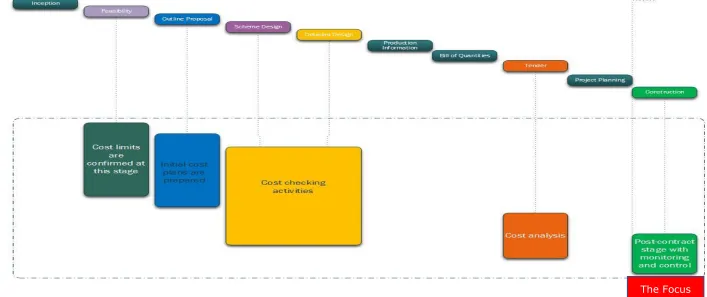
[image:30.842.65.772.156.453.2]Every construction project and the teams involved in any construction project are unique. Therefore, the method used in controlling cost during a project will also be exclusive.
Figure 2.2. stages of cost planning and control
The Focus of this
13
In the UK, the cost control practice during construction was evaluated by Olawale and Sun (2010). Their findings show that design changes, project complexities and performance of sub-contractors are some of the inhibiting factors leading to cost overrun in projects. Olawale and Sun (2010) noted that the inaccurate evaluation of project duration, the conflict between project parties, errors in contract, risk and uncertainty associated with projects are the main inhibitors of projects success during the post-contract stage.
Post-contract cost control starts from the initial budget that has been planned. Post-contract
cost control pertains to controlling changes in cost during construction. Interim valuations are carried out at regular interval during construction. Contractor or client’s cashflow is prepared
to monitor the project finances to ensure profitability (Sanni and Hashim, 2013). Other techniques used in monitoring construction cost during execution are earned value analysis (Hunter et al., 2014). New techniques involving intranet-based cost controlling system has also been proposed by Abudayyeh et al. (2001). Measuring work on the site can also involve methods such as cost ratio calculation, incremental milestone, units completed and weighted units (CII, 2000). This implies that the available software and tools used in the UK such as Microsoft project professional; earned value analysis calculation; cost record keeping; work programming; material scheduling; variation management; re-measuring of work on site; adjustment of prime cost sums management of inflation; day work accounting and management of claims (Ashworth & Perera, 2015; Potts, 2008, Olawale and Sun, 2010, Otim et al., 2007), has not been sufficient in managing cost overrun. The aforementioned are examples of post-contract cost controlling techniques and tools. The available expertise in the construction industry in the UK has not led to better contract cost control practices. The use of post-contract cost controlling techniques in construction requires much evaluation for effectiveness. The evaluation of post-contract cost controlling techniques will provide detailed evidence of the problems with the existing post-contract cost controlling system. An extract of the techniques used for post-contract cost controlling has been explained in Table 2.1
14
of cost control. Initial cost plans involve estimates. Cost estimation is the bedrock of cost management system. The cost estimate is the amount projected to finish the construction project (Oyedele, 2015). Cost estimating involves developing the cost data for the accomplishment of a construction project through the allocation of resources to various activities (Kern and Formoso, 2004, Owens et al., 2007). The Business dictionary (2013) as cited by Oyedele (2015) also noted that the cost estimated can be planning estimates, budget estimates, companies estimates and not-to-exceed estimates. The estimates are for information purposes only. This is gathered at the early stage of cost planning. The budget estimate is based
on well-established budget data which can be historical (this involves taking–off process). Firm estimates are reliable enough for the bidding process, and not-to-exceed estimates are based on
firm estimates, and it gives an upper and lower limit for the project cost. Ashworth & Perera (2015) categorised cost estimating into Initial estimate which involves preliminary feasibility and consultations, a firm estimate which assesses the brief for feasibility and viability studies, preliminary cost plan, final cost plan and cost checking stage which uses the working drawing and taking-off techniques to prepare the final budget.
Kern and Formoso (2004) and Samphaongoen (2010) also corroborated this statement by noting that cost estimates are meant to produce a working budget which is used for the tendering process and construction activities. Rad (2002) further highlighted the process of cost estimation as involving historical data, professional expertise, heuristics, and client’s
requirements to forecast the required financial expenses for the completion of a construction project at the right time. The activities which will be carried out during the execution phase is broken down into work breakdown structures (WBS), this provides a guide for defining the activities, cost estimation, budgeting, scheduling, expenditure, resource allocation, variation management and performance measurement (Rad, 2002). The challenge with these processes is that historical data usually contains errors of previous construction projects which can cause much setback during a new project. Personal experience can also contribute immensely to the success of cost estimation; however, there are innovations in technology coupled with project
15
aided estimation will also involve the cost estimation of materials, labour, plants or equipment and overheads (Oyedele, 2015). Other factors which can affect cost information for the post-contract phase have were highlighted by Ashworth & Perera (2015) the factors that can influence the accuracy of cost estimates are:
a) Design information which can differ
b) Access to historical cost data which cannot be of the right quality and quantity or related to the project context.
c) The size of the project can influence the number of errors in the cost estimates d) The number of competitors
e) Market conditions which can arise from the exchange rate, inflation, and import duties and so on.
f) Quantity surveyor’s heuristics which can influence the nature of the project, improvements and forecasting skills
g) The experience of the project manager or quantity surveyor can influence the overall cost estimates.
These factors are general factors which affect cost estimates, and they are universal according to Ashworth & Perera (2015). However, in less developed construction industries such as Nigeria’s, the factors which affect the accuracy of cost estimates are different. Oyedele (2015)
highlighted the various major influencing factors as:
a) Political situation: Most cost estimates are accurate during stable political times. b) Government policy: Influence of local content investment policies, importation
policies, taxes, a method of procurement, the number of foreign contractors or expatriates are some of the policies which can affect the accuracy of cost estimates at a point in time.
c) An Economic condition such as inflation, monetary rate, the interest rate on lending. d) The construction season such as rainy season and dry season can affect on-going
construction work
16
f) Risk emanating from a security can also have a drastic effect on the accuracy of construction cost estimates, especially in the Northern parts of Nigeria where there is a high level of Islamic insurgency. Other types of risk during construction in Nigeria are a financial risk which is related to claims, sub-contractors’ cost, disputes and litigations (Lingard et al. 2015).
g) Years which are close to the general elections in Nigeria have much influence on the cost estimates because prices of building materials are lower and there are much procurement activities and award of contracts.
h) Corruption is a factor which affects cost estimates in Nigeria. Most cases of kickback during procurement have led to inflated cost estimates.
The enormity of negative factors influencing cost estimates at the pre-tender phase as stated by Ashworth & Perera (2015); Oyedele (2015) and Samphaongoen (2010), cost estimates will always have latent errors which arise during the construction phase. Zwikael (2009) opined that construction project managers do not critically evaluate project plan development and activity definition. Project plan development determines the overall success of the construction project. This contains the method statement for construction and the activities during construction. Zwikael’s statement is very relevant to the Nigerian construction industry. In considering these unavoidable factors which can influence the final construction cost, monitoring and controlling cost during the construction phase is essential. Construction project managers and quantity surveyors during a construction project are imperative because estimating errors and other external and internal influences mentioned above can be monitored. The monitoring process is part of post-contract cost control.
The post-contract cost control techniques used for this process range from interim valuations, to cashflow forecasting and taking corrective actions for the financial statements. In additional to this there are very few articles on post-contract cost control compared to the pre-tender cost control phase (Cunningham, 2015; Potts, 2008; Oyedele, 2015; Watkins, 2014; and Burke, Krynovic and Mance, 2007). Post-contract cost control stems from the traditional system,
17
2.1.1 Importance of post-contract cost control
Based on the articles reviewed in section 2.1, post-contract cost control has a huge importance over pre-contract cost control. Post-contract cost control ensures that the resources of construction projects are kept within the budget for timely delivery of construction projects
(Potts, 2008). The resources used during construction projects are plant and equipment, building materials, labour, professional expertise from skilled workers, finance, information
technology and finance (Asiedu et al. 2016; Ameyaw et al. 2015; Amoatey et al. 2015; Broft et al. 2016; Emuze et al. 2014). These resources are limited. Therefore, the quantity surveyor who is the quantity surveyor has the prerogative to manage the available resources with the required techniques and expertise. Post-contract cost control is used at this stage. The use of cashflow provides and opportunity for the contractor to assess the cash inflow and expenses (Ashworth and Perera, 2015). Cashflows are used during post-contract cost control to keep the project within budget. Therefore, post-contract cost control determines the profitability of a contractor and also the construction company. If the final account calculated is over the project cost, then the cost overruns and possible delays can occur. The available finances for construction projects have to be managed effectively for the construction company to gain without reducing the quality. Post-contract cost control can affect the growth and sustainability of a construction company. In addition to this, the quality of construction projects delivered by contractors determines the overall level of competitiveness afterwards. The background of post-contract cost control depends on understanding and reviewing the construction cost management system.
2.2 Construction Cost management systems
The significance of post-contract phase over the pre-contract phase has been discussed in section 2.1; this has provided a focus on the processes involved in construction post-contract cost control. For a comprehensive focus on post-contract cost control, there has to be an understanding of the cost management process in construction.
18
harnessing the decision making principles, pro-activeness and environmental supra system affecting construction business. Cost management systems are also influenced by the nature of the procurement system. Nonetheless, cost management systems vary and evolve during the course of a construction project.
Construction cost management involves processes which include estimating, budgeting and controlling project cost for effective project delivery within budget (Jainendrakumar, 2015). Construction cost management has been described by the Project Management Body of
Knowledge (PMBOK) as a system which allows the quantity surveyor plans, estimate, budget and control the expenditure for a project by preparing a budget (FME, 2014, Owens et al.,
2007). Cost management can also be viewed as the process which ensures that the client’s requirements for a project are met within a standard quality while reducing the cost of construction (Rad, 2002, Robert and Tichacek, 2005, Venkataraman and Pinto, 2008). Rad (2002) and Venkataraman and Pinto (2008) further noted that cost management is aimed at monitoring the progress of work and juxtaposing the present progress with the planned activities, thereby analysing the differences. This process involves articulating the client’s requirements and quality with the available resources. The stakeholders involved in the construction process also safeguard the acceptable cost and delivery date. Cost management in construction is a highly tedious process which begins at the early phase of a construction project (Venkataraman and Pinto, 2008). The challenges faced by quantity surveyors at the initial stages of cost planning can eventually lead to cost and time overruns.
Robert and Tichacek (2005) opined that cost management starts by identifying activities which can generate cost during a construction project. The awareness of limited resources which are necessary for a construction project also influences the cost management. These resources can be material, labour or time. The risks involved in a construction project also influences construction cost. Potts (2008) also noted that cost management evolves throughout the phase of a project as a result of inflation, technological changes, the effect of supply and demand,
19
2.2.1 Forms of construction cost management
The three categories of cost management as noted by Groth and Kinney (1994) are cost containment, cost avoidance and cost reduction. Groth and Kinney (1994), further pointed out that cost containment avoids any further increase in fixed and variable cost, cost avoidance
assesses the cost and benefits of each activity by removing any unproductive activity, while cost reduction lowers the fixed and variable cost of necessary activities. These strategies of
cost management depend on the type of project, procurement approach, construction approach, client’s requirements, the decision of stakeholders in most cases quantity surveyor and project
manager. These forms of cost management also depend on the stage of project implementation.
2.2.2 Stages in cost management
The forms of cost management explained in section 2.2.1 depend on the stages. Knowledge about the stages is required because of the existing standards for construction cost management. The Royal Institute of British Architects Plan of Work (RIBA, 2013) has seven stages, the second, third and fourth stages which are concept design, design development and technical design include cost plan, cost information and cost checking (Bill of Quantity and tender analysis). The stages five, six and seven are the construction, handover and in use stages. These stages involve cost control, financial and final account. At second phase the approximate estimates and cost estimation activities begin. This is the cost planning or pre-tender phase. Cost control phase commences in the fifth phase (construction) is the post-tender cost management phase. Therefore, cost management can be categorised into the pre-tender phase
20
2.2.3. Delineating Systems, method and techniques in construction
cost management
Construction cost management is different from cost control and monitoring. Many academics
in the built environment confuse cost management system with methods and techniques. This topic has been highlighted wrongly in many cost management textbook and articles. There is a need to understand the meaning of these terminologies to effectively address the challenges facing cost management in the construction industry.
The Business Dictionary (2015) defined the system as “a set of detailed methods, procedures
and routines created to carry out a specific activity, perform a duty or solve a problem”. It further explained that a system has an input, output and feedback mechanism. A system is a set of complex interrelated methods and procedures which have a boundary maintained by processes (Harary and Batell, 1981, Hoyle, 2009, Laszlo and Krippner, 1998). The process involved in the interaction of the methods and the techniques which are used to carry out specific activities in the system. A system encompasses a method and techniques. An example of systems in cost management can be the traditional system, earned value management system (EVMS), or value management.
A method as defined by Free dictionary (2015) is “a means or manner of procedure, especially
a regular and systematic way of accomplishing something or an orderly arrangement of parts
or steps to accomplish an end”. In other words, a method is a group of procedures or an
arrangement for specific activities. This definition is also supported by The Business Dictionary (2015) which stated that a method is “an established habitual, logical or prescribed practice or systematic process of achieving certain ends with accuracy and efficiency, usually
in an ordered sequence of fixed steps”. Based on these definitions, examples of methods in
cost management are target costing or target value design, kaizen costing; activity based costing, value engineering or analysis and earned value analysis. These methods have internal process structured processes which are used to accomplish their objectives. These processes or activities are known as techniques.
According to The Business Dictionary (2015) technique is “a systematic procedure, formula,
21
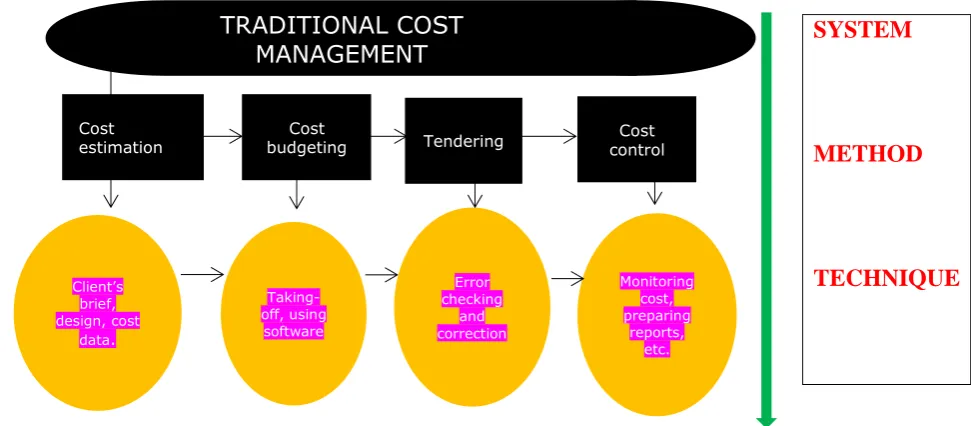
[image:39.595.75.561.199.412.2]management the Quantity Surveyor is trained in cost management activities such as preparing cashflow, monitoring and reporting of activities on site, preparing the cost plan and budget. These activities are the techniques which are used based on a prescribed method of doing things. There are various methods and techniques used in traditional cost management, and some of these have various techniques or processes under them. This is illustrated in the below.
Figure 2.3. The traditional cost management system, methods and techniques
The illustration above represents a possible structure of traditional cost management. The main model can not accurately depict how the construction companies and the quantity surveyor carry out cost planning and control process, but it provides an understanding of what cost management system, methods and techniques are. The traditional system of cost management in figure 2.3 above is also widely used. The difference will be the stakeholders who will be involved in the planning phases.
The cost management systems, methods and techniques used in the construction industry around the world have been reviewed in the table below. Some of these systems, methods and
techniques appear to have been categorised wrongly by most researchers and academics in many articles and books. With a proper understanding of cost management, systems, methods and techniques, it is, therefore, paramount to identify the various forms of construction cost management systems, methods and techniques.
SYSTEM
METHOD
TECHNIQUE
TRADITIONAL COST MANAGEMENT
Cost
estimation budgeting Cost Tendering control Cost
Client’s brief, design, cost
data.
Taking-off, using
software
Error checking
and correction
Monitoring cost, preparing
22
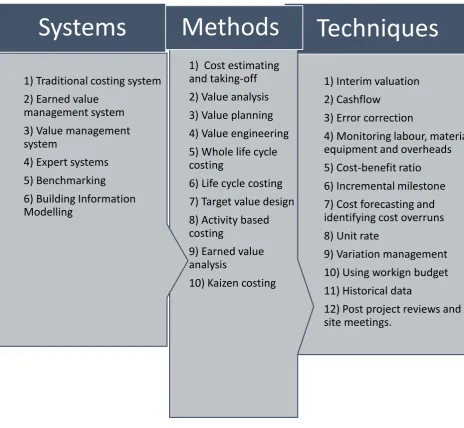
[image:40.595.73.538.113.541.2]In table 2.1, the systems, methods and techniques have been summarised in the figure below. The figure below
Figure 2.4. Summary of Cost management, systems, methods and techniques.
Table 2.1 below also highlights the merits and challenges of the cost management systems,
methods and techniques. The cost management systems, methods and techniques identified in this study were also categorised according to the usage on the path of the consultant quantity surveyor and contractor.
1) Interim valuation 2) Cashflow
3) Error correction
4) Monitoring labour, material, equipment and overheads 5) Cost-benefit ratio 6) Incremental milestone 7) Cost forecasting and identifying cost overruns 8) Unit rate
9) Variation management 10) Using workign budget 11) Historical data
12) Post project reviews and site meetings.
Techniques
1) Cost estimating and taking-off 2) Value analysis 3) Value planning 4) Value engineering 5) Whole life cycle costing
6) Life cycle costing 7) Target value design 8) Activity based costing
9) Earned value analysis
10) Kaizen costing
Methods
1) Traditional costing system 2) Earned value
management system 3) Value management system
4) Expert systems 5) Benchmarking 6) Building Information Modelling
23
Table 2.1. Cost control systems, methods and techniques
COST MANAGEMENT DESCRIPTION STRENGTH WEAKNESS REFERENCE
SYSTE
M
Traditional costing system in construction (used by consultants quantity surveyors)The conventional system which has been used by quantity surveyors since the 1920s for managing construction cost. It is widely used in the
construction process around the world.
Cost planning cost monitoring and control.
Cost and time overrun, inaccurate costs are provided, challenges with the estimating system.
Ashworth & Perera 2015; Kern and Formoso 2006; Koskela 2002;Eshofonie 2008;Mansfield et al. 1994
Earned value management system (used by consultant quantity surveyors and contractors)
Introduced by the U.S department of defence in 1963. Uses Earned value analysis method to measure the performance of a project in terms of cost, time and scope against a baseline.
Starts from the planning phase throughout the project, used for forecasting, integrates time, cost and scope, Gives more accurate estimates for complex projects
Involve a lot of calculations from a large amount of data. Depends on available knowledge of software packages.
24 Value
management system (Used by consultant quantity surveyors and contractors)
Originated in the US after World War II but became popular in the 1990s. Based on the benefits of value systems on a project as defined by client and stakeholders’ requirements. Include value analysis, engineering and planning.
Starts from the planning phase of the project up until the completion. Involve stakeholders in reducing cost, improved value and better resource allocation.
The cost of the study, involve broad representation of stakeholders in the study, has to be combined with other cost management systems such as life-cycle costing. The scope can change often.
Ashworth & Perera 2015; Kelly et al. 2004; Coetzee 2009; Mlybari 2011; Rangelova and Traykova 2014
Expert systems (Used by contractors and non-estimators)
Also known as expert judgement. This involves algorithm and non-algorithm cost models.
Used by non-cost estimators
They are usually inaccurate Rush and Roy 2001; Rosqvist 2003
Benchmarking (Used by consultant quantity surveyorsand contractors)
It became popular in the early 2000s The system involves adopting a general approach for measuring construction cost and value by gathering cost data from previous projects and comparing the present performance to the industry’s best practices in terms of cost.
More value for money, improved quality. Waste reduction during the construction process is also achieved.
Requires huge database which has to be updated regularly and adequate industry analysis to establish key performance indicators KPIs.
Michel and Naomi 2004;Love et al. 1999; Suresh and Jayavel 2004
Building information modelling (Used by consultants
Building information modelling is a system which has become more relevant in recent times. The system integrates construction professionals
Improved
communication, easier cost management from the design, improved profit, quality, and client
Expensive for most construction companies in developing countries because of the cost of software. Requires training and retraining of staff.
25 quantity surveyors
and contractors)
involved in a project in multi-facet computer software which complies the construction data (design, cost and other relevant information) in a single platform thereby making the project easier.
satisfaction.BIM also ensures sustainability in construction.
METHO
D
S
Cost estimating and taking-off (Used by consultant quantity surveyors)This method has been in existence ever since cost management started. The method is under the traditional system of cost management. It involves processes which identify the quantity of the work to be done on site from the drawings and multiplying it by the cost of individual rates.
Gives the required cost data to prepare the bill of quantities.
Easily subject to cost and time overrun. This method can have latent errors in them.
Samphaongoen 2010; Ashworth & Perera 2015; Oyedele 2015.
Value analysis (Used by contractors)
This is a method from the value management system. This method is used for existing building. The main object is
Value analysis is also used in cost reduction activities. This also affects the value
The basic challenge with value analysis is that has to depend on the whole-life cycle costing data and