i
DEVELOPMENT OF A FLEXIBLE AND ADAPTABLE
OPERATIONAL
PROPERTY
ASSET
MANAGEMENT
FRAMEWORK FOR LOCAL AUTHORITIES
Malawi Makaranga NGWIRA
ii
DEVELOPMENT OF A FLEXIBLE AND ADAPTABLE
OPERATIONAL PROPERTY ASSET MANAGEMENT
FRAMEWORK FOR ENGLISH AND SCOTTISH LOCAL
AUTHORITIES
Malawi Makaranga NGWIRA
MSc MBA MRICS
School of the Built Environment, College of Science and
Technology, University of Salford, Salford, UK
iii
TABLE OF CONTENTS
TABLE OF CONTENTS...i
LIST OF FIGURES...vi
LIST OF TABLES...vii
ACKNOWLEDGEMENTS...xiii
DECLARATION...xiv
ABSTRACT...xv
PUBLICATIONS ARISING...xvi
CHAPTER ONE ... 1
RESEARCH BACKGROUND ... 1
1.0 INTRODUCTION ... 2
1.1 BACKGROUND TO THE RESEARCH ... 2
1.2 CURRENT STATUS OF RESEARCH AND PRACTICES ... 4
1.3 RESEARCH RATIONALE ... 9
1.4 RESEARCH QUESTION ... 11
1.5 AIM AND OBJECTIVES OF THE STUDY ... 11
1.6 RESEARCH METHODOLOGY ... 12
1.7 SCOPE OF RESEARCH STUDY ... 13
1.8 ORGANISATION OF THE THESIS ... 15
CHAPTER 2 ... 19
ASSET MANAGEMENT STATUS, THEORETICAL CLARIFICATION AND ASSET MANAGEMENT DEVELOPMENT TRENDS ... 19
2.2 REVIEW OF EXISTING PROPERTY MANAGEMENT PRACTICE ... 20
2.3 THE CONCEPT OF ASSET MANAGEMENT ... 28
2.4 ASSET MANAGEMENT: THEORETICAL CLARIFICATION ... 32
2.4.1 Relationship Between Asset Management And Organisational Management Theory ... 34
2.5 BENEFITS OF ASSET MANAGEMENT ... 40
2.6 ASSET MANAGEMENT DEVELOPMENT: TRENDS AND INFLUENCES... 41
2.6.1 Origins of Asset Management ... 42
2.6.2 Internal and External Drivers of Asset Management Development ... 45
2.6.3Asset Management Development in the UK ... 46
iv
2.7 CHAPTER SUMMARY ... 54
CHAPTER THREE ... 56
CURRENT STATUS OF ASSET MANAGEMENT PRACTICE... 56
3.1 INTRODUCTION ... 57
3.2 RAISING AWARENESS ABOUT SCALE AND STRUCTURE OF ... 57
OPERATIONAL PROPERTY ASSETS ... 57
3.2.1 Structure and Scale of Operational Property Assets in Local Authorities ... 57
3.2.2 Role of Property Assets ... 59
3.3 PROPERTY MANAGEMENT PERFORMANCE AND MONITORING ... 61
3.4 QUANTIFICATION OF GAINS ... 69
3.5 ASSET MANAGEMENT FRAMEWORKS AND GUIDELINES ... 69
3.6 SUMMARY OF ASSET MANAGEMENT IMPLEMENTATION AND ... 73
PRACTICE LIMITATIONS ... 73
3.7 CHAPTER SUMMARY ... 74
CHAPTER FOUR ... 76
IDENTIFICATION AND DEFINITION OF ASSET MANAGEMENT CONCEPTS ... 76
4.1 INTRODUCTION ... 77
4.2 CONCEPTUAL FRAMEWORK CLARIFICATION ... 77
4.3 ROLE OF FRAMEWORKS ... 78
4.4 STRATEGIC MANAGEMENT THEORY AND ASSET MANAGEMENT FRAMEWORK ... 79
4.5 RELATIONSHIP BETWEEN ASSET MANAGEMENT AND ORGANISATIONAL MANAGEMENT THEORY 81 4.6 EXAMININATION OF EXISTING FRAMEWORKS ... 82
4.6.1 The Total Asset Management Process ... 82
4.7 REVIEW OF LITERATURE ... 84
4.7.1 Strategic Planning ... 85
(i) Development of Vision, Mission Goals and Objectives ... 86
(iii) Asset Information, Data Collection and Asset Knowledge ... 90
4.7.2 Asset Management Planning ... 94
4.8 TOOLS AND TECHNIQUES ... 100
4.9 ASSET MANAGEMENT OUTCOMES ... 101
4.10 CONSOLIDATION OF IDENTIFIED AND DEFINED CONCEPTS ... 104
4.11 CHAPTER SUMMARY ... 107
v
CONCEPTUAL FRAMEWORK DEVELOPMENT: OPERATIONALISATION AND EXAMINATION OF
RELATIONSHIPS BETWEEN ASSET MANAGEMENT CONCEPTS ... 109
5.1 INTRODUCTION ... 110
5.2 EXPLORATION AND EXAMINATION OF RELATIONSHIPS ... 110
BETWEEN CONCEPTS ... 110
5.2.1 Strategic Planning ... 111
5.2.2 Asset Management Planning ... 111
5.2.3 Asset Management Outcomes ... 113
5.2.4 Tools and Techniques ... 113
5.3 OPERATIONALISATION THE FRAMEWORK CONCEPTS ... 113
5.3.1 Definitions Terms ... 114
5.3.2 Robust And Dynamic Performance Measurement Methodology ... 116
5.3.3 Benchmarking ... 120
5.4 DESCRIPTION OF THE DEVELOPED CONCEPTUAL ... 123
FRAMEWORK ... 123
5.4.1 Developed Conceptual Framework ... 126
5.5 CHAPTER SUMMARY ... 128
CHAPTER SIX ... 129
RESEARCH DESIGN AND METHODLOGY ... 129
6.1 INTRODUCTION ... 130
6.2 RESEARCH PHILOSOPHY ... 130
6.2.1 Introducing Positivist, Naturalistic and Pragmatic Paradigms ... 130
6.2.2 Philosophical Paradigm Adopted ... 135
6.3 RESEARCH APPROACH ... 136
6.3.1 Qualitative, Quantitative and Mixed Method Approaches ... 136
6.3.2 Choice of Research Approach ... 138
6.4 THE RESEARCH METHOD ... 143
6.4.1 Available Research Methods ... 143
6.4.2 Choice of Research Strategy / Method ... 146
6.4.3 Survey Method ... 151
6.5 ETHICAL CONSIDERATIONS ... 158
6.6 PILOT STUDY ... 159
6.7 DATA COLLECTION... 161
vi
6.7.2 Nature and Type of Data Collected ... 162
6.7.3 Available Data Collection Methods ... 162
6.7.4 Choice of Data Collection Methods ... 166
6.8 DESCRIPTION OF STUDY SUBJECTS ... 172
6.9 CHAPTER SUMMARY ... 172
CHAPTER SEVEN ... 174
QUALITATIVE DATA ANALYSIS ... 174
7.1 INTRODUCTION ... 175
7.2 QUALITATIVE METHOD ... 177
7.2.1 The Sampling Frame and Sample Selection ... 177
7.2.2 Purpose of the Researched Local Authorities ... 179
7.2.3 Semi-Structured Interview ... 179
7.2.4 Method of Analysis ... 183
7.3 RESULTS AND ANALYSIS ... 185
7.4 SUMMARY OF FINDINGS... 227
7.5 CHAPTER SUMMARY ... 235
CHAPTER EIGHT ... 238
QUANTITATIVE DATA ANALYSIS ... 238
8.1 INTRODUCTION ... 239
8.2 THE SURVEY ... 239
8.2.1 The Sampling Frame and Selecting an Appropriate Sample Size ... 239
8.2.2 Sample ... 241
8.2.3 The Questionnaire ... 242
8.3 THE ANALYSIS ... 248
8.4 IDENTIFYING THE UNDERLYING FACTORS ... 289
8.4.1 Introduction ... 289
8.4.2 Factor Analysis Steps ... 290
8.5 SUMMARY AND MAIN FINDINGS ... 306
8.6 CHAPTER SUMMARY ... 310
CHAPTER NINE ... 314
DISCUSSION AND VALIDATION OF RESULTS ... 314
9.1 INTRODUCTION ... 315
9.2 RESULTS DISCUSSION ... 315
vii
9.2.2 Contextual Interpretation of The Findings ... 316
(a) ENABLING ENVIRONMENT... 316
9.3 DEVELOPMENT OF THE FRAMEWORK ... 330
9.4 VALIDATION ... 332
9.4.1 Concept of Validation ... 333
9.4.2 External Validation ... 333
9.4.3 Internal Validation ... 341
9.4.4 Research Reliability ... 342
9.5 CHAPTER SUMMARY ... 344
CHAPTER TEN ... 346
CONCLUSIONS AND RECOMMENDATIONS ... 346
10.1 INTRODUCTION ... 347
10.2 DISCUSSION ... 347
10.3 OBJECTIVE 1 – to undertake a critical review of literature on the concept of asset management, its development and implementation ... 347
10.4 OBJECTIVE 2 - to undertake a critical review of literature on property management in the public sector. ... 349
10.5 OBJECTIVE 3 – to develop a conceptual framework of operational property asset management for English and Scottish local authorities ... 350
10.6 OBJECTIVE 4 – to develop a methodology for the application of an asset management framework for local authorities in England and Scotland ... 352
10.6.1 Developing The Research Methodology ... 352
10.6.2 Findings from Qualitative Analysis of the Data ... 353
10.6.3 Findings from Quantitative Analysis and Factor Analysis... 355
10.7 VALIDATION OF THE FRAMEWORK ... 357
10.7.1 External Validity of the Results ... 358
10.7.2 Internal validity of the Results ... 358
10.7.3 Reliability ... 358
10.8 RESEARCH LIMITATIONS ... 359
10.9 RECOMMENDATIONS FOR FURTHER RESEARCH ... 359
10.10 ORIGINAL CONTRIBUTION TO KNOWLEDGE OF THIS RESEARCH ... 360
10.11 CONCLUSIONS ... 361
APPENDICES ... 363
viii
LIST OF FIGURES
Page
Figure 1.1: The Breakdown of the Value (£bn) of Operational Properties in England
3 Figure 1.2: The Value of Property Assets held by Scottish Local Authorities 3
Figure 1.3: The Research Process 17
Figure 2.1: Lack of strategic approach and the resultant problems 24 Figure 2.2: Strategic Property Considerations and Property Services 28 Figure 2.3: Asset Management, FM and Property Management Activities 31 Figure 2.4: How organisations create value 38 Figure 2.5: The Evolution of Asset Management 42 Figure 3.1: The Breakdown of the Value of Operational Properties in England 57 Figure 3.2: The Value of Property Assets held by Scottish Local Authorities 58 Figure 4.1:The Total Asset Management Process 82
Figure 4.2: SWOT Analysis 89
Figure 4.3: Key Drivers of Asset Management 92 Figure 4.4: The Process for Establishing Levels of Service 93 Figure 4.5: Demand Management options 97 Figure 5.1: Strategic Planning and Derivation of Strategic Task 111 Figure 5.2: Asset Management Planning Process Elements and their inter-
relationship
112
Figure 5.3: Asset Management Outcomes 113 Figure 5.4: Efficiency and Effectiveness 115 Figure 5.5: Asset Management Conceptual Framework 125 Figure 5.6: Conceptual Asset Management Framework showing Limitations 127
Figure 6.1: Deductive Process 137
Figure 6.2: The Inductive Process 138 Figure 6.3: Four Major Mixed Methods Designs 140 Figure 6.5: Mixed methods design matrix 143 Figure 7.1: Geographical representation of the Local Authorities 186
Figure 8.3a Position 252
ix
Figure 8.3d: Age 254
Figure 8.3e: Experience in the organisation 255 Figure 8.3f: Experience outside the organisation 255 Figure 8.4: Scree plot for component extraction criterion 299 Figure 9.1: Asset Management Process Framework. 338 Figure 9.2: Asset Management Conceptual Framework 379 Figure 9.3: Asset Management Process Model. 382 Figure 9.4: Strategic Planning and Derivation of Strategic Task 384 Figure 9.5: Asset Management Planning Process Elements and their inter-
relationship
387
Figure 9.6: Asset Management Outcomes 402
LIST OF TABLES
Page Table 1.1: Issued Asset Management Frameworks 8 Table 2.1: Asset Management Benefits 40 Table 3.1: Value of Operational Property Assets of Local Authorities in Scotland 58 Table 3.2: Summary of ‘Best Practice’ Guidance in Asset Management 70 Table 3.3: Limitations of Asset Management Implementation 73 Table 4.1: Good Practice Arrangements at Corporate Level 98 Table 4.2: Identified and Defined Asset Management Concepts 106 Table 5.1: Summary of the Strategic Measurement Systems and Tactical Tools
used in CREM
118 Table 6.1: Major Assumptions of the Positivist and Naturalistic Paradigms 134 Table 6.2: Contrasting Characteristics of the Qualitative Approaches 145 Table 6.3: Perception of Importance of Factors Influencing Asset Management
Performance
153
Table 6.4: Strategic Planning 155
Table 6.5: Asset Management Planning – processes and practices 157 Table 6.6: Asset Management Outcomes 158 Table 6.7: Qualitative and Quantitative Data Collection Types, Options,
Advantages and Limitations
x
Table 6.9: Distribution of Scales within Each Local Authority 169 Table 7.1: Types of Local Authorities 176 Table 7.2: Summary of the Interviewees 185 Table 7.3: Structure of Asset Management 188 Table 7.4: Corporate Landlord Approach in Local Authorities 188 Table 7.5: Linkage between Corporate Objectives and Asset Management
Objectives
191 Table 7.6 Availability of Property Management Information Systems and
Capabilities
197 Table 7.7: Embedding of Asset Management in Local Authorities 198 Table 7.8: Type of Data Captured by Local Authorities 200 Table 7.9: Management Information System: Decision Making and Assessment of
Property Performance
201
Table 7.10: Strategy Implementation Arrangements 207 Table 7.11: Benchmarking Arrangements 211 Table 7.12: Efficient and Effective use of Operational Property Assets 217 Table 7.13: Introduction of New Work Practices, Cross Service, Co-location and
Environmental Improvements
220
Table 8.1: List of Statistical Tests 248 Table 8.2: Kurtosis and Skewness Values 249 Table 8.3: Frequency of scoring to the importance of Including Enablers of Asset
Management for asset management implementation
256
Table 8.4: Summary of the level of significance from the Chi-square test 257 Table 8.5: Kruskal Wallis Analysis of Variance for the Enablers of Asset
Management
257
Table 8.6: Frequency of scoring to the importance of Vision, Mission and Objectives and their Asset Management Implications
258
xi
for Asset Management Implementation
Table 8.10: Summary of the level of significance from the Chi-square test 260 Table 8.11: Kruskal Wallis Analysis of Variance for Asset Knowledge 261 Table 8.12: Chi-square Crosstabs analysis of frequencies for the importance of
including suitability asset management within asset knowledge in relation to Position
262
Table 8.13: Chi-square Crosstabs analysis of frequencies of participants for the importance of including asset costs tracking in relation to Type of authority
262
Table 8.14: Chi-square Crosstabs analysis of frequencies of participants for the importance of including suitability assessment and property information system in relation to age
263
Table 8.15: Importance of SWOT Analysis 264 Table 8.16: Summary of the level of significance from the Chi-square test 264 Table 8.17: Kruskal Wallis Analysis of Variance for SWOT Analysis 265 Table 8.18: Chi-square Crosstabs analysis of frequencies for the importance of
including Colocation and joint service delivery asset management within SWOT analysis in relation to Position
266
Table 8.19: Chi-square Crosstabs analysis of frequencies of participants for the importance of including Benchmarking Arrangements within SWOT Analysis in relation to Experience in the Organisation
267
Table 8.20: Frequency of Scoring to the Importance of Establishing Performance / Service Level Gap for Asset Management Implementation
268
Table 8.21: Summary of the level of significance from the Chi-square test 268 Table 8.22: Kruskal Wallis Analysis of Variance for Service Level Gap 269 Table 8.23: Chi-square Crosstabs analysis of frequencies of participants for the
importance of including Asset management capabilities and Service statements in relation to Type of authority
xii
Table 8.24: Frequency of Scoring to the Importance of Asset and Non Asset Strategy Formulation for Asset Management Implementation
271
Table 8.25: Summary of the level of significance from the Chi-square test 271 Table 8.26: Kruskal Wallis Analysis of Variance for Strategy Formulation 272 Table 8.27: Frequency of Scoring to the Importance of Option Appraisal for
Asset Management Implementation
273
Table 8.28: Summary of the level of significance from the Chi-square test 273 Table 8.29: Kruskal Wallis Analysis of Variance for Option Appraisal 274 Table 8.30: Frequency of Scoring to the Importance of Strategy Implementation
Arrangements for Asset Management Implementation
275
Table 8.31: Summary of the level of significance from the Chi-square test 276 Table 8.32: Kruskal Wallis Analysis of Variance for Strategy Implementation 277 Table 8.33: Chi-square Crosstabs analysis of frequencies of participants for the
importance of including Senior management asset champion’ and ‘Specialised project management team in relation to Type of authority
279
Table 8.34: Frequency of Scoring to the Importance of Performance Monitoring and Control for Asset Management Implementation
280
Table 8.35: Summary of the level of significance from the Chi-square test 280 Table 8.36: Kruskal Wallis Analysis of Variance for Asset Monitoring and
Control
281
Table 8.37: Chi-square Crosstabs analysis of frequencies for the importance of including Continuous asset management performance review asset management within performance monitoring and control in relation to Position
282
Table 8.38: Chi-square Crosstabs analysis of frequencies of participants for the importance of including Comprehensive property review programme within performance monitoring and control in relation
xiii
to age
Table 8.39: Chi-square Crosstabs analysis of frequencies of participants for the importance of including continuous asset management performance review within performance monitoring and control in relation to Experience Outside the Organisation
284
Table 8.40: Frequency of Scoring to the Importance of efficient and effective use of property assets for Asset Management Implementation
285
Table 8.41: Summary of the level of significance from the Chi-square test 285 Table 8.42: Kruskal Wallis Analysis of Variance for Efficient and Effective Use
of Property Assets
286
Table 8.43: Chi-square Crosstabs analysis of frequencies of participants for the importance of including Recycled capital receipts in relation to Type of authority
287
Table 8.44: Frequency of Scoring to the Importance of efficient and effective use of property assets for Asset Management Implementation
288
Table 8.45: Summary of the level of significance from the Chi-square test 288 Table 8.46: Kruskal Wallis Analysis of Variance for improvements in service
delivery
289
Table 8.47: Chi-square Crosstabs analysis of frequencies of participants for the importance of including ‘increased cross service working’ in relation to Experience Outside Organisation
290
Table 8.48: Analysed Questionnaire Variables 291
Table 8.49: Communalities 294
xiv
Table 8.54: Analysis of Variance (ANOVA) 306 Table 9.1: Profile of the Validation Experts 339 Table 9.2: Summary of Responses from Experts 339 Table 9.3: Summary of Asset Management Problems 380
APPENDIX
Page
Appendix A: Published sources of Asset Management Guidelines in the UK 362
Appendix B: Published sources of Asset Management Guidelines in Australia 363
Appendix C: A sample of Asset Management Guidelines 364
Appendix D: Profile of Interviewees 366
Appendix E: Strategic Planning Interview Questions 367
Appendix F: Asset Management Planning Interview Questions 370
Appendix G: Survey Questionnaire 372
xv
ACKNOWLEDGEMENTS
I would like to express my utmost gratitude to my supervising team David Baldry, Dr David Manase, Professor Vian Ahmed and Professor Ali Parsa for their assistance, advice, constant encouragement, support, and supervision throughout the lengthy process of doing the research and writing the thesis. Had it not been for their able and professional guidance, it could not be possible to complete the research presented in this thesis.
I am grateful to the various local authorities and their respective teams for giving up their valuable times to fill in questionnaires and take part in face to face interviews. Special thanks are also due to my current employer, Glasgow Caledonian University, for their financial and moral support. My study would not have been possible without such commitment and support.
While studying for the PhD, I have met many interesting individuals (both students and staff) and would like to thank them all for their support and friendship. More especially I would like to particularly thank Harris Kamanga, Dr Matthews Mtumbuka and my many other students and colleagues, for their advice and encouragement.
xvi
DECLARATION
xvii
ABSTRACT
xviii
PUBLICATIONS ARISING
The process of reviewing the literature culminated in the write-up of a total of the following four papers which were presented at a number of major international conferences and published in a real estate journal.
(1) Ngwira, M.M., Parsa, A., and Manase, D (2011). An effective framework for strategic asset management: the case for local authorities in Scotland and England. Salford Postgraduate Annual Research Conference (SPARC), University of Salford. 10-11
June, 2011
(2) Ngwira, M.M., Parsa, A., and Manase, D (2011). Effectiveness of Asset Management Processes in Scottish Councils: Property Management Information Systems and Capacity Building. COBRA,University of Salford, 12-13 September 2011
(3) Ngwira, M.M., Parsa, A., and Manase, D (2012). Evaluation of Effectiveness of Operational Property Asset Management Processes in Scottish Local Authorities.
European Real Estate Society (ERES), Edinburgh, Scotland. 13-16 June, 2012
(4) Ngwira, M.M., Parsa, A., and Manase, D (2012). Effectiveness of Property Asset Management in Scottish Councils. Journal of Corporate Real Estate, 2012, Vol. 14, Number 2, pp106-120
(5) Ngwira, M.M., and Manase, D (2015). Public Sector Property Asset Management. Oxford, Wiley Blackwell: ISBN: 978-1-119-08576-8 (Book due to be published in July
1
CHAPTER ONE
2
1.0 INTRODUCTION
This chapter provides an overview of the study and presents the research context. It presents the background of the study and statement of the research problem to be addressed. In addition, the justification and scope of the research and the main research question posed is also stated. Thereafter, the aim and objectives are outlined including a summary of the research methodology adopted. The chapter concludes with an explanation of the organisation of the thesis.
1.1 BACKGROUND TO THE RESEARCH
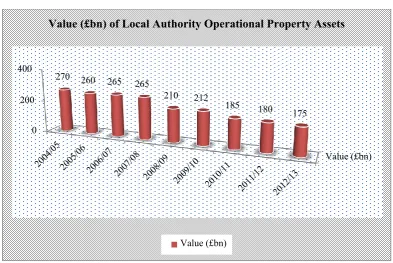
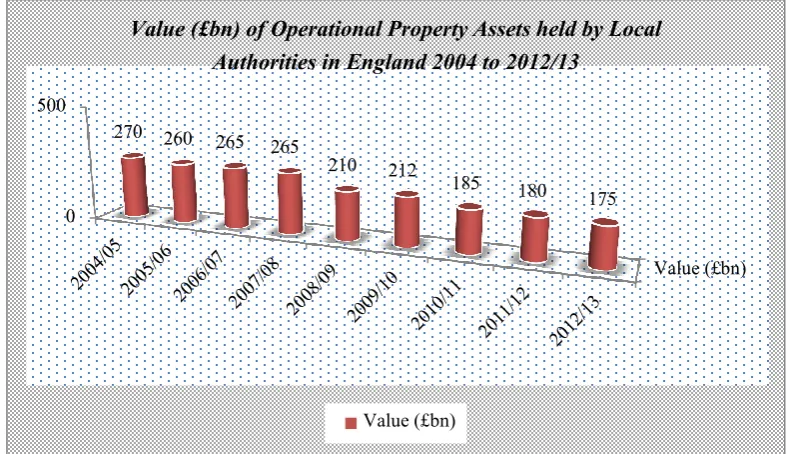
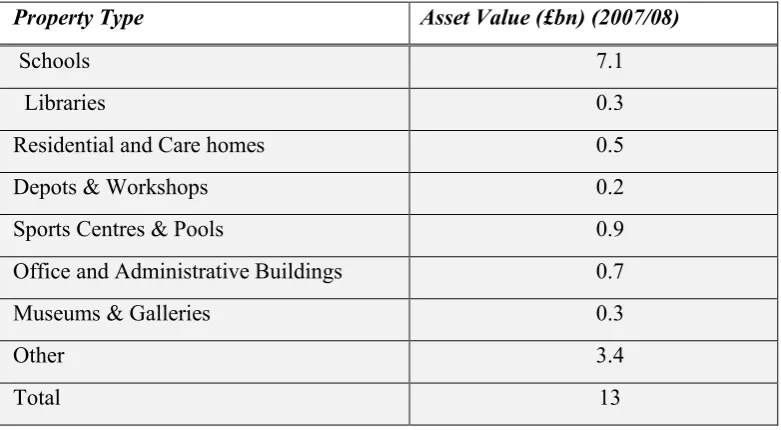
Local authorities in England and Scotland own and control a significant operational property asset base. As at 2013 for example, local authorities in England held operational property assets with a book value estimated at more than £170 billion (Figure 1.1). This represented an increase from £70 billion in 1999. Despite slight loss in value of the portfolio in recent years due to the economic recession, the asset base still represents a very large property portfolio base. The size of operational property assets in the hands of Scottish local authorities is equally significant. In terms of value, this was estimated at £13 billion in 2007/08 (Figure 1.2) (Audit Scotland, 2009; RICS and ODPM, 2005).
3
Figure 1.1: The Breakdown of the Value (£bn) of Operational Properties in England
[image:21.595.105.499.63.326.2]Source: Audit Commission (2014)
Figure 1.2: The Value of Property Assets held by Scottish Local Authorities
Source: Audit Scotland (2009)
The size of the asset base that is in the hands of local authorities underlies the important role property assets perform in supporting local authority functions. According to Kaganova, McKellar and Peterson (2006) government land and property assets can be very important for many public management objectives. For instance, operational properties are important
Value (£bn) 0
200 400
270 260 265 265
210 212
185 180
175
Value (£bn) of Local Authority Operational Property Assets
4
as assets on the balance sheet which can be used to collaterise borrowing. Such funding sources are often critical to financing local government operations.
Property belonging to local authorities is also important as is often used as a physical platform on which to carry out its activities (Megan, 1999). Activities typically include service delivery and discharging of a range of crucial policies. The policies range from planning policies to facilitate spatial development of cities, regeneration and local economic development, local housing policies, as well as a variety of enforcement policies. All of these take place from land and buildings owned and controlled by local authorities (Kaganova, et al, 2006). Apart from service delivery and execution of policy,local authority operational property assets such as parks and open spaces provide recreation opportunities. Buildings provide communities with places to meet and celebrate, to obtain information and access to enjoy the arts and cultural activities (Vermiglio, 2011; IIMM, 2006).
1.2 CURRENT STATUS OF RESEARCH AND PRACTICES
Despite the important role that operational properties play in supporting local authority objectives, they have not always been effectively managed. Historically, the management of operational property asset base adopted a reactive management approach. The approach is fragmented and narrowly focused principally targeted only at those responsible for managing properties but ignoring users.
5
fragmentation means that local authorities in the UK and elsewhere are unable to promote and implement policies that encouraged joint occupancy of properties with partners or other public agencies. In addition, inefficient property management practices also means that local authorities are unable to readily exploit surplus or under-utilised property as there are no mechanisms to transfer property between local authority committees who are entrusted with the legal ownership of properties. Moreover, as a result of inefficient management approach local authorities have no mechanism for encouraging the identification of surplus property for disposal (Audit Commission, 1988a, 2000; Avis et al., 1989; Veale, 1989; Bon, 1992; Joroff, 1992; Bon, McMahan, Carder and 1994; Gibson, 1994; Bond and Dent, 1998; Tanzi and Prakash, 2000; Kaganova, Nayyar-Stone, and Peterson, 2000; Hentschel and Utter, 2006; CIPFA, 2008; Arnaboldi and Lapsley, 2010).
Local authorities in the UK and elsewhere came to recognise that improving operational property asset management through the implementation of an appropriate asset management framework is a critical component of better asset management (Office of Government Commerce, 2008; Department for Communities and Local Government (DCLG), 2007; Brackertz and Kenley, 2002; Bon et al., 1994; Fryer, Antony and Ogden, 2009). The RICS (2008) define asset management as: ‚a structured process that seeks to ensure best value for money from property assets in serving the strategic needs of local authority organisations‘.
6
The definition recognises the distinction between the strategic asset management and operational property management components of land and buildings. An appropriate asset management framework is one that integrates the strategic asset management and operational property management components (Accounts Commission for Scotland, 1999; Audit Commission and IDeA, 2002; Department for Communities and Local Government, 2007; Stoy, 2007; Tucker and Pitt, 2008; Fryer, Antony and Ogden, 2009; Office of Government Commerce (OGC), 2008; RICS & ODPM, 2005; CIPFA, 2014; CIPFA, 2008; IAM, 2006).
The beneficial effects of asset management approach in promoting service improvement objectives are recognised by OGC (2003) who stated that:
‗the appropriate use of assets in the right location can make the difference
between good and poor service delivery. The whole point of asset
management is to ensure that the front line services provided by the public
sector organisation are done so via the most effective and efficient property
portfolio‘.
7
management in the UK in particular has been aided by a combination of initiatives. Some of these initiatives include development of asset management frameworks with associated guidelines. The initiatives have also included government commissioned research reports urging local authorities to improve property management by adopting asset management practices (Department of the Environment Transport and the Regions (DETR) / Pieda Consulting, 1999; Department for Communities and Local Government (CLG), 2001, 2007). Unlike England, in Scotland the Local Government in Scotland Act (2003) has imposed a legal duty on councils to adopt an asset management approach (Scottish Executive, 2003). The growing interest to embrace asset management practices in the UK has also been influenced by budgetary pressures on the part of councils. Councils have come to realise that there is a lot of wealth tied in operational property assets and that improvements in the management of these assets could have a real impact on the financial resources available to them (Audit Commission, 2009).
8
Table 1.1: Issued Asset Management Frameworks
The Total Asset Management Process (IIM, 2006) PASS 55 Asset Management Process Model (BSI, 2008) The Property Asset Management Process (IAM, 2006)
The RICS Detailed Property Asset Management Process Model (RICS, 2005; 2008) Consortium of Local Authorities in Wales (CLAW) (2003)
Chartered Institution of Public Finance and Accounts (CIPFA) (2008) Scottish Executive (2003)
Audit Commission (1988a; 2000; 2009) Audit Scotland (2007)
Department for Communities and Local Government (2001; 2007) RICS / office of The Deputy Prime Minister (2005)
Asset Management Excellence Model (AMEM) (AMCL, 2010)
The verification of the extent to which local authorities have developed, adopted and successfully implemented asset management practice was undertaken. This was aimed at establishing the current status of asset management practice in English and Scottish local authorities. The evidence suggests that despite increased adoption of asset management, aided by a range of asset management frameworks, many authorities in England and Scotland are not achieving best practice in the way they manage their operational property assets. There are a number of limitations that still hinder attainment of asset management best practice. These include:
limited awareness about the role of property as a strategic asset;
ineffective performance management framework;
lack of corporate culture to asset management;
asset management function not at board level structure;
lack of corporate approach to property ownership;
undeveloped joint working and co-location;
9
lack of culture of property challenge to rationalise property portfolio;
ineffective asset management plans; and
minimal improvements to portfolio in terms of condition, suitability, sufficiency, accessibility and running and operating costs
(Audit Commission, 2000; 2009; Lyons, 2004; RICS and ODPM, 2005; 4Ps, 2007; York Consulting, 2007; Department for Communities and Local Government, 2008; Audit Scotland, 2009; Gibson, 1994; Gershon, 2004; Office of Government Commerce, 2006; National Audit Office, 2006; Harris, 2010; Phelps, 2009).
These limitations arise because asset management processes are not effectively implemented. An effective asset management framework should be capable of translating the Strategic Planning and Asset Management Planning into asset management processes covering asset management policy and asset management practice. Once asset management processes are properly undertaken on property assets and throughout the local authority organisation, this will reflect on asset and organisational performance results or outcomes. Improved asset management results should affect service users, practitioners and other stakeholders’ satisfaction on the organisational level, which would result in improved service provision.
This makes it clear, therefore, that there is an asset management problem. The available asset management frameworks which guide asset management implementation are preventing the realisation of having a property portfolio that is efficiently managed and fit for purpose to support local authority objectives including the principal aim of service delivery.
1.3 RESEARCH RATIONALE
10
in English and Scottish local authorities; a framework is required that provides sufficient understanding of local authorities’ circumstances when implementing efforts to improve asset management effectiveness. A framework that takes into account different local authority circumstances is flexible and adaptable to reflect differences across local authorities. Differences across organisations which call for the need for an adaptable and flexible asset management framework have been emphasised by researchers. For instance, Woodhouse (2010b) argues that existence of a variety of asset management frameworks is evidence that there is no ideal model. Many of the requirements for good asset management are independent of asset type, industry, geography, or the regulatory framework within which an organisation operates. However, every organisation has a different mix of business goals, priorities, strengths, weaknesses and constraints. As such every asset management road map is different. Differences between organisations equally apply to local authorities. It is the case, therefore, that property asset management practices differ across local authorities given differences in organisational culture; leadership; size; social, economic and cultural composition of the communities they serve; geographical and political differences. The lack of recognition and failure to embed an appropriate asset management framework that is flexible and adaptable as core property management activity has the potential of hindering the development and advancement of effective asset management practices.
On the basis that the development of an adaptable and flexible operational property asset management framework represents a significant step for aiding improvements in operational property asset management practice, there is therefore the need for local authorities to adopt such an approach towards the management of operational properties. For instance Lyons (2004); (Male, 2006); and NAMS (2006b) have emphasised the contributory role of an appropriately developed and applied asset management framework towards achieving effective and efficient management of operational property assets.
11
operational property asset management arrangements (Audit Scotland, 2009; Department for Communities and Local Government, 2007; Ngwira, Manase, and Parsa, 2012). Therefore, this research is founded on the premise that, if asset management is to be relevant in Scottish and English local authorities, then an appropriate framework that would help local authorities to realise improvements in operational property asset management need to be developed. Accordingly, while the study focuses on operational property management, it is hoped that the findings would be beneficial to the management of other property types owned and controlled by public sector organisations including those in England and Scotland and elsewhere in the developed economies particularly in respect to the future development of asset management performance.
1.4 RESEARCH QUESTION
From the foregoing, the following research question was proposed:
Is there an effective asset management framework that fits the management of
operational properties in English and Scottish local authorities?
1.5 AIM AND OBJECTIVES OF THE STUDY
The question posed (in section 1.4) assisted in setting the key research aim. The aim of this study, therefore was: ‗to develop an adaptable and flexible operational property asset management framework for local authorities in England and Scotland‘. To realise this aim, the research sought to undertake the following specific objectives:
(i) to undertake a critical review of literature on the concept of asset management, its development and implementation. This enables the development of a clearer understanding of key asset management processes and performance outcome indicators.
12
(iii) to develop a framework of operational property asset management for English and Scottish local authorities.
(iv) to develop a methodology for the application of an asset management framework for local authorities in England and Scotland.
1.6 RESEARCH METHODOLOGY
It was necessary to adopt an appropriate ontological, epistemological and axiological philosophical paradigm that formed the basis of the study in order to address the research aim and question identified above. The identification of the appropriate paradigm for the study influenced appropriate choice of research methods, data collection, analysis and interpretation of the findings. The study started with an extensive review of literature to provide a thorough understanding of the recent developments in the frameworks used for asset management practice of operational property asset management in local authorities. Review of literature also enabled the identification of an appropriate theoretical framework for the study.
13
the framework. The adopted research paradigm also facilitated the use of statistical tools such as factor analysis and various statistical tests of independence of variables in the interpretation of the data and discussion of the findings. A detailed discussion of the research methodology is presented in chapter six.
1.7 SCOPE OF RESEARCH STUDY
The research focused on practices relating to operational property assets occupied by local governments in England and Scotland. Operational property assets, as defined by Audit Commission (2000), can be either direct or non-direct. Direct operational property assets include land and buildings used to deliver a direct service to the public. Examples of direct properties include schools, community centres, parks, libraries, museums and so on. Non-direct operational assets, on the other hand, include those operational assets that support service delivery such as administrative offices. The study focused on both direct and non-direct property assets.
14
properties on the same basis as operational properties. For instance, crucial factors for evaluating operational property asset performance such as accessibility, suitability, sufficiency, condition, operating costs might not necessarily be regarded in the same way by commercial tenants as in the case of those who access or deliver local authority services from such properties. This is because the property performance expectations of tenants who occupy commercial properties might not necessarily be the same as of those who occupy, deliver or access services from operational properties. Non-operational properties were also excluded from this research because of the potential problems of eliciting data due to data protection issues. The data about these properties is often deemed commercially sensitive. In addition, because the properties are leased the transaction therefore involves third parties potentially making it difficult to secure agreement to use needed data.
The research focused on local authorities in England and Scotland. Even though Wales and Northern Ireland are also part of the United Kingdom, both were excluded from this research. Northern Ireland and Wales are, in terms of population size, very similar to Scotland. Therefore, on this basis potentially very little would have been learnt by comparing asset management parctices in Scotland with those of either of these two nations. The legal framework in Wales, notwithstanding the fact it has its own devolved administration, is generally similar to that of England. Therefore, there was little merit in including Wales as well as England. In addition, the resource constraint was also a factor that was taken into consideration in limiting the study to Scotland and England alone. The amount of time and finacial resources involved in identification of study cases, travelling to generate data influenced the decision to limit the study to England and Scotland.
15
geographical and cultural ones. For instance, Scotland has its own Parliament with full responsibilities in certain matters including local government administration. At the same time the West Minister Parliament has jurisdiction over both England and Scotland in certain matters such as Defense and Foreign Affairs. This means that there could be similarities and differences in the development of public services in these two countries. Therefore, developed public policies have to be flexible and adaptable to conform to any differences in political, cultural, social and geogrqaphical settings. The two countries can also be regarded as case studies as regards focus of the study, the type of problem being studied and the unit of analysis. Relating to problem focus, the study sought to develop an indepth description, analysis and understanding of multiple of cases of local authorities in both England and Scotland regarding their asset management arrangements. The unit of analysis being studied related to the effectiveness with which local authorities in these two countries implemented their operational property asset management arrangements (Creswell, 2007).
1.8 ORGANISATION OF THE THESIS
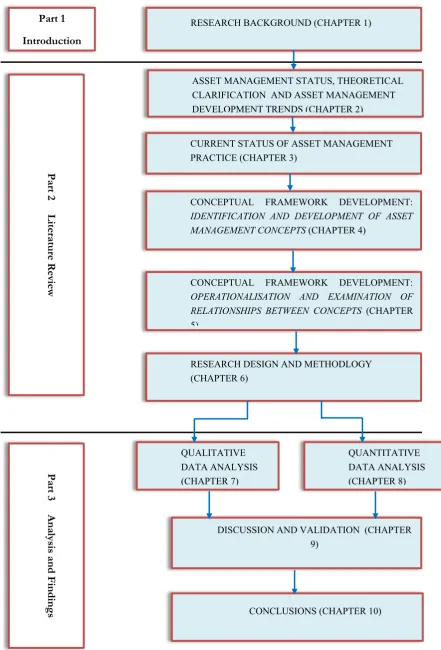
The thesis comprises of ten chapters organised as follows:
Chapter One: deals with the background to the research. This includes justification, the problem statement, research questions, aims and objectives, study scope and research methodology.
16
particular the management of the operational property properties prior to adoption of asset management is provided.
Chapter Three: focuses on the contribution, or otherwise, that asset management approach has made towards engendering effective and efficient operational property management performance is emphasised. The critical review of property asset management practices was in terms of identifying the limitations associated with current asset management practice and therefore establish the rationale for this research study. Against this background, the justification for the research in the English and Scottish local authority context is re-emphasised.
Chapter Four: deals with the first stage of conceptual framework development, namely the identification and definition of asset management concepts. The identification and definition of concepts was based on consideration of three aspects. These are the theory underlying the framework, examination of existing frameworks and a review of relevant literature.
Chapter Five: deals with the remaining three steps associated with conceptual framework development. The steps are exploration and examination of relationships between concepts; description of the developed framework; and operationalisation of the concepts. The exploration and examination of identified concepts was aimed at preparing a causal or concept map and to identify the causal logic of the framework. Follo
w
ing description of the developed framework, the concepts were then operationalised. The operationalisation of the identified and defined concepts involved developing a system for measuring performance of these concepts that can indicate asset management improvement in local authorities.17
Chapter Seven: addresses the qualitative analysis of the data collected by face to face interviews.
Chapter Eight: the follow-up quantitative data gathered through large scale survey questionnaire was analysed involving a three stage process and this is dealt with in this chapter. This three stage process included data description through use of descriptive statistics; testing the data for normality by carrying out kurtosis and skewness statistical tests; and by testing the reliability and validity of the measuring instrument. Factor analysis was used to reduce the large number of variables measuring aspects of asset management performance to a manageable size for the subsequent development of the framework.
Chapter Nine: is devoted to the development of the substantive framework including discussions of the findings and the potential recommended application. The chapter describes the validation process and the methodology adopted in the validation procedure. Results of the validation process are meant to verify the extent to which they lend support to the reliability and robustness of the asset management framework.
18
Figure 1.3: The Research Process Part 1
Introduction
RESEARCH BACKGROUND (CHAPTER 1)
CURRENT STATUS OF ASSET MANAGEMENT PRACTICE (CHAPTER 3)
CONCEPTUAL FRAMEWORK DEVELOPMENT:
IDENTIFICATION AND DEVELOPMENT OF ASSET MANAGEMENT CONCEPTS (CHAPTER 4)
CONCEPTUAL FRAMEWORK DEVELOPMENT:
OPERATIONALISATION AND EXAMINATION OF RELATIONSHIPS BETWEEN CONCEPTS (CHAPTER 5)
RESEARCH DESIGN AND METHODLOGY (CHAPTER 6) QUALITATIVE DATA ANALYSIS (CHAPTER 7) QUANTITATIVE DATA ANALYSIS (CHAPTER 8) P ar
t 3 A
na lys is a nd F in di ng s P ar
t 2 L
it er at ur e R ev ie w
DISCUSSION AND VALIDATION (CHAPTER 9)
19
CHAPTER 2
ASSET MANAGEMENT STATUS, THEORETICAL
CLARIFICATION AND ASSET MANAGEMENT
20
2.1 INTRODUCTION
In recent years local authorities, like many other public bodies, have had to respond to changes that have affected public services in the wake of rising public expectation. Public services have had to evolve as a result of such expectation and which in turn has led to the pressures for substantive changes in the funding and delivery of public services. Such changes are intended to increase efficiency, effectiveness and responsiveness of service delivery to users (Crawford, 2003; Baldry, 1998; Hood, 1991). The initiatives to improve efficiency and effectiveness of service delivery have also affected property management (Kaganova and McKellar, 2006).
In response, public sector organisations including local authorities, have been advocating that property assets be managed in a strategic way similar to other assets such as human and finance. Asset management is the strategic framework that the public sector advocate as the means by which property assets could effectively support efficient and effective service delivery (CIPFA, 2008). Various initiatives have been employed in recent years to encourage public bodies to adopt asset management and its associated processes.
The focus of this chapter, therefore, is threefold. Initially, literature is reviewed to examine existing property management practice. Secondly, the concept of asset management including its theoretical underpinning is explained. Finally, the development of asset management is reviewed. The review examines the origins of asset management, its development, and trends both in the UK and internationally.
2.2 REVIEW OF EXISTING PROPERTY MANAGEMENT PRACTICE
21
Local authorities and other public organisations have only recently come to recognise and appreciate the significance and value of adopting strategic property management practices. For instance Kaganova, et al., (2006) point out that only in the past two decades or so have local authorities begun to understand the full implications of managing their property assets. Up until the late 1980s and prior to the adoption of asset management approaches to property management, local authority focus on property management was principally targeted at those responsible for managing properties. This was a relatively small group of staff relative to the overall local authority organisation machinery and its associated range of activities. Only recently have governments, including local authorities, begun to realise the usefulness of implementing broad policies that address the users as well as the managers of these assets. Such a framework is typified by asset management approach to managing property assets (Kaganova et al, 2006).
The appreciation by local authorities of the value of implementing such broad policies is as a result of the problems they encounter in managing property assets based on reactive management practices which are narrowly focused in their approach. As observed by CIPFA (2008) who state that: ‚in the past local authorities did not in any systematic way consider how property assets had been used and deployed. Issues about asset condition,
asset fitness for purpose, long term sustainability of assets, delivery outcomes, and how
assets were positioned relative to service user needs were hardly considered‛. The absence of a strategic focus in local authorities is emphasised by Gibson (1994) following a study reviewing reports highlighting the inadequacies associated with local authority property asset management. Gibson (1994) concluded that the main criticism of these reports was that there had been lack of a strategic approach to management of public property assets. Such a lack of strategic approach was further observed by the Audit Commission (2000), commenting that:
22
alongside others such as ICT and staff, needs to be actively managed at both service and corporate
levels‛.
Recognition grew that effective management of local authority properties involves developing a broad policy framework, typically asset management, for managing property assets that address asset users as well as property manager’s needs. According to Kaganova,
et al., (2006) an asset management framework for managing local authority organisation assets helps to achieve efficiency and effectiveness through increasing the efficient use of facilities; minimising operating costs; locating offices and services in functional and not necessarily in prime areas; and by knowing the highest and best use of assets amongst other benefits.
23
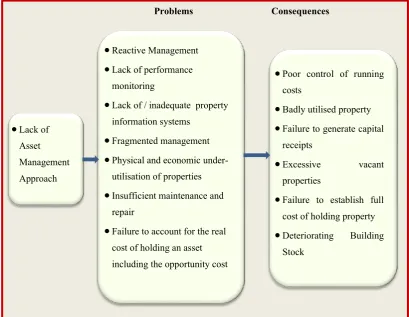
included physical and economic underutilisation as well as insufficient maintenance and repair associated with local authority organisation property assets. Worse still, as a result of fragmented management, local authorities could not promote and implement policies that encouraged joint occupancy of properties with partners or other public agencies. Furthermore, local authorities could not readily exploit surplus or underutilised property as there were no mechanisms to transfer property between committees or to encourage the identification of surplus property for disposal. This was due to lack of asset management approach. The weaknesses that emerged as a result of the fragmented management manner in which local authorities managed their property assets were compounded by a number of specific problems. According to the Audit Commission (1988a; 2000) these specific problems included:
a) not having adequate information about property as such they could not make informed property management decisions.
b) there were no incentives to users to efficiently and effectively manage the properties they occupy as they perceived little benefit in surrendering ‚their‛ vacant or underused properties either for disposal or use by other service areas.
c) failure to carry out regular property reviews which are necessary if property is to be managed as a dynamic rather than as a static resource.
d) the opportunity costs of holding property were not recognised meaning that properties were not put to their highest and best use.
e) there was lack of coordinated maintenance strategy resulting in maintenance budgets being used for what they saw to be more pressing needs, with few local authorities carrying out full condition survey of buildings to assess the scale of their maintenance backlog.
24
g) political apathy and opposition to change property management practices.
h) Lack of challenge of the need for owning property or did not review the manner in which property services were organised and obtained. As a consequence, most local authorities retained and maintained buildings that were in the wrong place, of the wrong size, or were otherwise unsuitable for their existing use.
According to the Audit Commission (1988a; 2000) the property management problems identified and highlighted had unwelcome consequences. The consequences included:
a) poor control of running costs;
b) badly utilised property tying up capital resources and diverting revenue resources from areas of more immediate use;
c) failure to generate capital receipts as resources were unnecessarily tied up in property which could be released to generate capital receipts;
d) holding of excessive vacant property; and
e) deteriorating building stock due to the accumulation of backlog maintenance.
25
Consequences of a Lack of Asset Management Approach to Management of
[image:43.595.98.508.120.437.2]Operational Properties
Figure 2.1: Lack of strategic approach to property management and the resultant problems and consequences
Source: Audit Commission (2000)
The lack of a strategic approach to the way local authorities managed their property assets and the resultant management problems and consequences meant that property management introduced economic inefficiencies. Economic inefficiencies included poor control of running costs; failure to put properties to highest and best use through poor utilisation; and deteriorating building stock. According to Kaganova (2006) such inefficiencies persisted in most local authorities and led to an established belief, common amongst public bodies, that property held by a government was a ‚free good‛, owned by the taxpayers and not subject to economic rationalisation. The failure to rationalise their property asset holding had consequences. The consequences included firstly, that organisations seldom accounted for the real cost of holding a property asset and the opportunity cost. Secondly, organisations
Problems Consequences
Lack of Asset Management Approach
Reactive Management
Lack of performance monitoring
Lack of / inadequate property information systems
Fragmented management
Physical and economic under-utilisation of properties
Insufficient maintenance and repair
Failure to account for the real cost of holding an asset including the opportunity cost
Poor control of running costs
Badly utilised property
Failure to generate capital receipts
Excessive vacant properties
Failure to establish full cost of holding property
26
incurred opportunity losses stemming from economic underutilisation. Economic underutilisation relates to the failure to capture the property’s highest and best use. Apart from economic underutilisation, there was also physical underutilisation where vacant or underutilised properties were unnecessarily retained. Opportunity losses also stemmed from deferring maintenance and repair of properties leading to accumulation of deteriorated stock.
The struggle to control property running costs could have been as a result of the ineffective property information management systems maintained by most local authorities. Using statistical data to reinforce the point, Bond and Dent (1998) state that as of 1996 only 66% of all local authorities in in England had their property records computerised. The situation was not any different at the world stage. Grubisic, et al (2009) for instance remark that: ‚despite the age of information technology and worldwide computer use, many local authorities still did not have asset registers that would enable them to have a true reflection
of the total value of assets owned, or their public asset registers were incomplete making it
difficult to monitor and control the way public assets are used or misused‛. Kaganova and McKellar (2006), cite the research by Bond and Dent (1998) who state that as of 1996 only 65% % of all local authorities in New Zealand had their property records computerised. In the USA for instance, as of 1997, Washington D.C. had duplicative and inconsistent inventory records of buildings that the city owned and a substantial incomplete inventory of in and out-leases. The situation was no different in the case of the USA federal government. In the case of the federal government the situation was that in early 2002, there was no reliable government-wide data on property holdings. For example, Ungar (2003) states that the USA federal government’s worldwide asset register lacked such key data as space utilisation, and facility condition.
27
property basis mainly because this information is not collected within local authorities’ budgeting systems. Furthermore, the potential market value of operational property assets is also frequently unknown or that bookkeeping values for property are often outdated as to be meaningless. Kaganova and Mckellar (2006) argue that where information management systems do not have information about lease arrangements or access to the information that a lease document provides, effective property management practices cannot be instituted. Since leases record space utilisation as well as operating costs, detailed record keeping is essential to cope with owner tenant disputes, ascertain market trends, set prices, determine values, and compare performance against industry standards and benchmarks (Kaganova and Mckellar, 2006).
Furthermore, Tanzi and Prakash (2000) argue that having reliable information in asset registers, would increase local authority efficiency, and could serve a number of other useful purposes. These purposes include:
providing the value of the assets owned by a local authority organisation or indeed central government that could help rating agencies in determining the credit rating;
facilitating the calculation of the balance sheet or the net worth of the local authorities;
reducing the possibility that some public assets ‚disappear‛; and
permitting a public body to impute capital charges to public agencies, institutions or other local authority organisation departments that use these assets and force them to use these assets efficiently.
28
included suspect dealings; ‚insider‛ transfers and other abuses. The pressures for transparency reforms in public property asset transactions therefore took momentum requiring that property asset management practices be subject to codified procedures and processes.
Local authorities came to recognise that these property management problems could be addressed by adopting asset management as a strategic framework for managing their operational property asset base.
2.3 THE CONCEPT OF ASSET MANAGEMENT
This section explains the concept of asset management by defining and identifying its components. Different sources variously describe and define the term asset management. For instance, the Royal Institute of Chartered Surveyors (RICS) (2008) settled on the definition and description of the term asset management as it applies to local authorities after evaluating a number of published definitions from various sources such as those by RICS/Office of the Deputy Prime Minister (ODPM) (2005), Male (2006), and Lyons (2004). Thus, the RICS (2008) define asset management as ‚a structured process that seeks to ensure best value for money from property assets in serving the strategic needs of local
authorities‘. In considering this definition and other definitions of asset management, the RICS (2008) conclude that ‗there appears to be considerable consensus over the basic characteristics of strategic asset management for land and buildings and a distinction
between strategic asset management and operational property management.‖‖ Asset management is characterised by:
the adoption of an integrative approach (Institute of Asset Management 2006; British Standard Institution (BSI) 2008; Edwards,2010);
defining service levels and performance standards and limiting them to strategic planning objectives;
29
adopting a long-term (lifecycle) approach to asset management (Worley, 2000);
demand management, and risk management (Department of Provincial and Local authority , 2010).
The integrative role of asset management relates to the fact that the approach combines management, financial, economic and other activities and practices applied to the
management of property assets (Institute of Asset Management (2006); in a systematic and coordinated manner (British Standard Institution, 2008). The Audit Commission (2000) states that the strategic approach to managing local authority organisation property portfolio involves two broad strands of activities as illustrated in Figure 2.2. The strands are Strategic Property Considerations and Property Services.
Property Services
Strategic Property Considerations
Facilities Management
Services Estate Management
Services
•Accommodation review and space management
•Property Information •Contract and budget management •Energy management
•Acquisition and disposals •Valuation, rating and planning •Lease and rental management •Building maintenance Where?
[image:47.595.108.513.333.712.2]Why? What?
30
Strategic Property Considerations includes decisions about the number, type, and location of assets required to meet the organisation’s objectives. It is the activity that ensures that the land and building asset base of a local authority, for instance, is optimally structured and aligned with its corporate goals and objectives (RICS, 2008). Strategic Property Considerations asks the questions such as: where should the property be located?; why should the property be sited in a particular location?; and what size of property is needed to support a service?
Property Services delivers the strategic asset management objectives by undertaking the professional and technical and management work necessary to ensure that property is in the condition, form, layout and location desired. It includes ensuring that property is supplied with the services required; surplus property is disposed of and new property acquired and constructed; property is valued; property rates are catered for, and all this in cost-effective manner. It also involves offering advice to decision makers on best way of managing operational property assets (RICS, 2008). What can be discerned from the various activities associated with property services is that it comprises two elements namely Estates Management and Facilities Management (FM).
31
Gibson (1994), is concerned with the care of buildings to tenants or owner occupier’s satisfaction.
Both, FM and PM, have a responsibility for premises although the focus of activities for meeting those responsibilities are different. The core of estate management activities involve valuation of property, acquisition and disposal of buildings; provision of advice on property investment; administration of leases, administration and accounting for service charges, supervision of building repairs; rent reviews and rating advice, strategic reviews of property and accommodation, and sales of surplus space (Stansall, 1994; Balch, 1994).
Conversely, activities associated with FM include control of operating budgets and occupancy costs, management and maintenance of building services, planning and management of moves, selection of furniture, management of space allocation and use, supervision of cleaning, security, IT/communication and telecommunications services; catering and office support services; materials and equipment purchase management; office equipment and furniture purchase and management, as well as maintenance of the building itself (cleaning, heating and lighting); and maintenance of all mechanical and electrical equipment and building fabric in terms of decoration and repair of internal and external equipment (Stansall, 1994; Balch, 1994).
32
Strategic Property Management Activities: FM and EM
Estate Management (EM) Activities
FM Activities
Facilities or property provision
Provision of satisfactory workplace
Building maintenance; Record Keeping; Landlord advice
Figure 2.3: Asset Management, FM and Estates Management Activities Source: Adapted from Ali (2007)
2.4 ASSET MANAGEMENT: THEORETICAL CLARIFICATION
33
Within the organisational management framework, there are various theories that seek to explain how various influences operate and how they can be channelled to positively impact on organisational performance. However, the strategic management theory is most pertinent in explaining the operation of influences affecting asset management.
Strategic management has been variously defined. For instance, Mintzberg (1994) defines strategic management as: ‚ a system for producing strategies within an organisational infrastructure responding to an environmental context‘. Strategies are actions, often planned, for responding to environmental influences. The processes undertaken in formulating strategies, according to French (2009) include: (i) establishing vision and mission; (ii) objective setting; (iii) external environment scanning; (iv) internal environmental scanning; (v) formulating strategic alternatives; (vi) strategy selection; (vii) strategy implementation; and (viii) control.
34
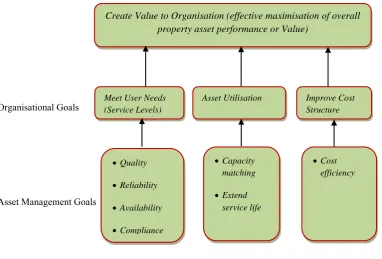
real properties is to support the organisation’s core objectives. Consequently, Too (2008) states that those charged with the responsibility of managing such assets have come to view them as an important organisational resource. Perceiving assets as important resource entails managing them as a total enterprise rather than from a traditional functional approach since they are strategic resources at par with other important assets such as finance, ICT and people. The argument that asset management has a strategic focus has been advocated by other commentators. For instance the Audit Commission (1988b; 2000) argued that best practice property asset management arrangement has a strategic focus.
2.4.1 Relationship Between Asset Management And Organisational Management Theory