Understanding Tourism Development: A
Representational Approach
Meliou, Elina and Maroudas, Leonidas
University of the Aegean, University of the Aegean
6 September 2009
Online at
https://mpra.ub.uni-muenchen.de/25318/
115
UNDERSTANDING TOURISM DEVELOPMENT: A
REPRESENTATIONAL APPROACH
Elina Meliou1
University of the Aegean
Leonidas Maroudas
University of the Aegean
The article investigates hotel employees and postgraduate students’ representations of “tourism development”, using social representations theory. Data from a sample of eighty participants were collected on Chios Island, Greece. To reveal social representations a word association procedure was applied followed by a correspondence analysis. The analysis attempts to map the meanings associated with “tourism development” and to pinpoint the links between those meanings. Results highlight differences and similarities in the representation of “tourism development” according to individuals’ social membership, offering an interesting insight for employers and educators.
Keywords: tourism development, social representations, word associations, hotel employees, tourism education
JEL Classification: L83, M1, O1
INTRODUCTION
Throughout the world, tourism development is considered to have significant social and economic impact and implications, encompassing the links between people and institutions that are involved in this development (Pearce and Butler, 1999). In literature, a lively discussion exists on the development of tourism, its rapid and continuing growth, its processes and consequences. However, little attention has been paid to the meaning and symbolism of that development. According to Sharpley and Talfer (2002) tourism development seems to be an “ambiguous concept” both semantically and in terms of its means and objectives. Such an ambiguity implies that “tourism development” does not have a universally agreed definition (Gartner, 1996). In this sense, investigating how people
116
make sense of “tourism development” especially those who are actively involved with it, such as hotel employees and tourism students, is of particular interest. In order to grasp a picture on meanings and beliefs of hotel employees and tourism students and how those meanings are applied in social reality, a socially oriented approach is required. The study reported here describes the social representations of “tourism development”.
The phenomenon of tourism has long been examined by various writers and has been defined differently by different theoretical disciplines.The importance and value of social representation theory in tourism studies has been outlined in previous research (i.e Pearce, Moscardo and Ross, 1996; Andriotis and Vaughan, 2003). According to Pearce et al (1991) social representations can be used to understand how different groups think about tourism and the results can be taken into account in the tourism planning process. Thus, adopting a social representation approach indicates that psychologists can contribute to a better understanding of what tourism development really implies, by providing a theoretical and interpretive framework to examine individuals’ responses to tourism proposals.
117 The article starts by outlining the key points of social representation theory. The second part presents the methodological principles and procedure that leads to the empirical results. Finally, conclusions are drawn which consider both the implications of the similarities and differences between hotel employees and students. In depth understanding of the lay discourse on “tourism development” sheds light on the construction of a worldview of the study populations, helping educators and employers to identify real concerns and issues.
THEORY OF SOCIAL REPRESENTATIONS
Drawing on the work of Serge Moscovici (1963), social representations are built on shared knowledge and understanding of common reality. Social representation theory developed for the study of lay knowledge (Moscovici, 1961), addresses issues which are also of concern to other theoretical framework and research traditions, such as culture, common sense and shared cognition. But the theory is especially relevant for understanding new societal events in rapid change (Lahlou, 1996). Tourism development appears to be an interesting topic for the attention of a social representations framework.
The key point is that social representations constitute collective systems of meaning which may be expressed, or whose effects may be observed in values, ideas and practises (Duveen and Lloyd, 1993). Social representation theory specialised on a crossroads, at the articulation between individuals and social, and between symbolic and real (Moscovici, 1982). They are embodied in habitual behaviour, in formal and informal communication, allowing us to construct a framework of references that facilitates our interpretations of reality and guides our relations to the world around us. In other words, social representations are products of interconnectedness between people and processes of references through which we conceive the world (Deaux and Philogène, 2001).
118
for the group and, hence, the object itself takes on group specific social characteristics. Talk and overt action provide the frame of description of these characteristics. Images, and verbal metaphors, as they are used in everyday life, are the basic means for understanding and grasping of the world (Bauer and Gaskel, 1999). As a consequence, social representation theory is a “constructivist as well as a discursively oriented approach” (Wagner et al, 1992: 96). In order to understand tourism development the current study adopts the word association method. Exploring social representations and how and why these may differ when we locate social actors by taking into account their social positioning, offers an understanding for the development of better educational and managerial approaches.
WORD ASSOCIATIONS
To elicit social representations of hotel employees and tourism students, linguistic material, such as the free associations of words method, was used. This technique is considered to minimise the researcher bias typically created by closed questionnaires, as the answers produced are unfiltered and spontaneous. It is based on the assumption that giving a stimulus word and asking the respondent to freely associate what ideas come to his or her mind gives relatively unrestricted access to mental representations of the stimulus term (Wagner, Valencia and Elejabarrieta, 1996; Hirsh and Tree, 2001; Hovardas and Korfiatis, 2004). The resulting free associations data has the benefit that it can be relatively easy formalised and utilised in a wide range of ways. Free association tasks have frequently been used for the study of social representations and it is also considered to be a very useful technique to use at the beginning of an empirical research on social representations (De Rosa, 198). By viewing tourism development in the context of other reference points, it is possible to see likely anchors and frames people used to make and thus understand the reality of the social actor.
METHODOLOGY
Participants
119 postgraduate course on tourism management participated in the study. A convenience sample of eighty participants completed the survey. Respondents aged from 20 to 57 years old with females making up 68% of the sample. 45% of students reported having work experience in the hospitality industry and 47% of hotel employees had been educated in tourism management. Taking that into account and in accordance with the theory of social representations, respondents were divided in four more or less equally balanced groups for further analysis, according to their education and work experience, the general hypothesis being that shared social insertions lead to specific interactions that modulate social representations. Thus, group 1 consists of students who have work experience (45%), group 2 refers to students with no work experience (55%), group 3 consists of educated hotel employees (47%) and finally 53% of the hotel employees had no education (group 4).
Procedure
To elicit free associations, hotel employees, contacted in their workplace, were invited to participate in the study and to complete a word association task anonymously, after the agreement of the hotel manager. Students’ responses were collected as a classroom exercise. The survey was run during November 2008. Each participant was asked to provide the first five thoughts or images coming to his/her mind when thinking about “tourism development”. To secure as many responses as possible, instructions and the survey were kept short.
Data analysis
Respondents’ associations generated by this technique took the form of either single word responses or short statements. Before running the statistical analysis, the responses were slightly simplified. The associations freely provided by participants were reduced to synonyms. Lengthy associations were reduced to their keywords. Also to have a more manageable number of associations, data were further coding keeping the most frequently and all-encompassing associated words, providing thematic categories.
120
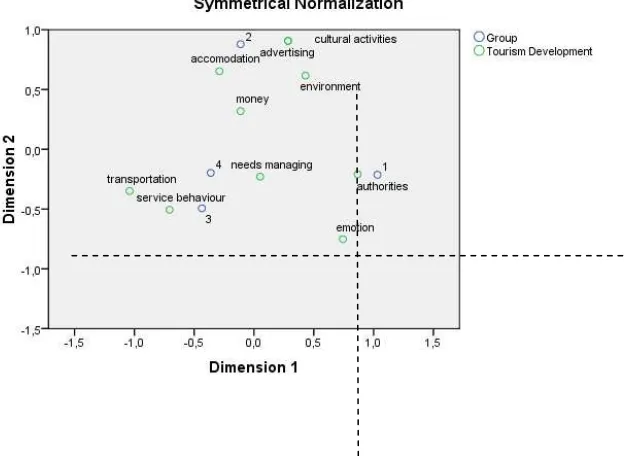
p<0, 0001, level of significance 0, 05). The relation was afterwards visualized using Correspondence Analysis. The technique aims to convert a table of numbers into a plot of points, usually on two dimensions. The proximity between a pair of points is used to interpret the underlying relationship between the points. For instance, the closely aligned points reveal a strong relationship (Chen, 2001). Reading such a data table provides information on the relations between individual’s group membership and their responses to the stimulus word “tourism development”. In this case, CORA
“not only detects a link between various social representations components but also sheds light on the relationship between these representational components and individual integration into groups” (Doise, Clemence and Lorenzi-Cioldi, 1993:113).
RESULTS AND DISCUSSION
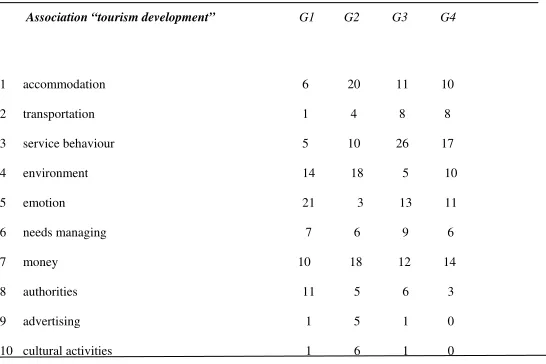
[image:7.420.80.353.310.492.2]Frequencies of appearance of associations to the stimulus word “tourism development” provided by each group are presented in table 1.
Table 1. Top 10 respondents’ free associations
Results show that “tourism development” is not only represented in material and economic terms but rather that the concept has important cultural, moral and political dimensions for participants.
Association “tourism development” G1 G2 G3 G4
1 accommodation 6 20 11 10
2 transportation 1 4 8 8
3 service behaviour 5 10 26 17
4 environment 14 18 5 10
5 emotion 21 3 13 11
6 needs managing 7 6 9 6
7 money 10 18 12 14
8 authorities 11 5 6 3
9 advertising 1 5 1 0
121 Tourism development was anchored in images of accommodation and transportation, indicating a material dimension of the concept. However, one may think, that this instrumental aspect of the term also reflects a local problem fro residents of Chios about the future of tourism in the area. Chios is not one of the most popular destinations, compared to other Greek islands. Thus, the development of infrastructures and facilities appears to be of great importance for the locals and a priority closely linked to tourism planning.
Moreover, “money” was amongst the most important issues, indicating the significance that participants attribute to the economic impacts of tourism. The contribution of tourism development to the economic growth of a country or region is outlined in several studies (i.e Sinclair 1998; Coccosis and Tsartas, 2001; Chi-ok-oh, 2003). Important economic benefits are derived from tourism development. In this sense, tourism represents for participants a source of regional and personal development.
The association “authorities”, including national and local, implies the role and actions of the state and underlines the need for improving policy and planning (i.e. authorities should act, female respondent, 25 years old). Participants attribute an important role to government, which has a central-planning and co-ordinating responsibility in encouraging input from industry representatives and the general public. In this sense the association “authorities” is counter to a framework of beliefs and expectations of how things ought to be. Hence tourism development is a political issue symbolising a broad range of societal concerns.
The concept also evoked emotive associations not only directed mentioned as “emotions” but equally in respondent’s description of the meanings of their association such as hope, joy (male respondent, 27 years old). Here it is evident that the concept has also an affective dimension for participants, who represent tourism development in a set of values. However, respondents were able to see that tourism development “needs managing” indicating the lacking of adequate management measures. In this sense the process of development is associated with managed changes that create conditions for the improvement of those concerned with such development (Zhenhua-Liu, 2003).
122
Greece since the 1990s, which has led to the effort to promote practices aiming at sustainable tourism development (Andriotis, 2001; Tsartas 2003). “Environment” reflects this ecological aspect of tourism development and in a more accurate way it may be seen as a way of expressing ideals, associated with health and freedom. In this sense, the concept implies a human-nature relationship and has a moral dimension for participants.
An opposition is found between a more materialistic view of tourism development, on the one hand, and “service behaviour”, on the other, which indicates the human aspect of tourism development. This implies that participants see themselves as potential actors, involved in the process of development. Lastly, respondents’ answers had references to the objectives (cultural activities, sustainability) and the means (advertising) of achieving development, signifying that participants are aware of critical factors and issues at stake in the development of tourism. In summary “tourism development” besides being associated to instrumental values, it was also associated to other items designating intrinsic values, which are not less trivial. Interestingly enough, with the exception of a few, no negative associations seem to appear in the content of tourism development representation. According to Tsartas (2003) views about tourism differ among residents of islands where tourism has already been developed such as Myconos, Santorini or Corfu and among residents of islands in the initial stages of tourism, where more positive views towards tourism development are registered. As mentioned earlier, Chios is not one of the most popular destinations for tourists, compared to other Greek islands. In this sense “development” is conceptualised in a positive manner as it appears to be synonymous with progress.
123 these associations. Hence, representations of group 3 and group 4 seem to take into account many competing anchorings other than education. Close to group 2 there is a strong clustering of associations centring around the sociocultural and the environmental significance of “tourism development”. These associations of current societal issues related to tourism development show that participants of group 2 are highly influenced by the educational context, as they associate tourism development with current societal issues, underlying the importance of alternative forms of tourism and adopting a more collective point of view. The last group, consisting of students having working experience, falls into the right-hand side of the axis. Individuals in group 1 are concerned with the political dimension of the concept, of how things ought to be. In this sense they distinguish themselves from others.
124
CONCLUSIONS
The current study investigated hotel employees’ and tourism students’ representations of “tourism development” using an associative imagery task. The results show that hotel employees and tourism students share a common representational field that moves from an economic dimension to a more holistic approach of tourism development, taking in a wider range of variables. Tourism development is not only associated with economic growth but also has social, cultural, political and ecological implications for respondents. Recognising the validity of these perceptions of which ethical and moral dimensions are an integral part, highlights the necessity of taking into account social values and practices when planning.
However, differences appear among groups of participants as diverse sets of responsibilities are established and shape which representation people favour for their system of knowledge about tourism development
(Pearce and Mosacndo, 1999). Representations can never be neutral. They are intertwined in a circuit of culture in which identity, meaning and behaviour are constructed and continually produced (Buzinde, Santos and Smith, 2006). In other words, professional practices and goals and educational background influence the way individuals are located in relation to the peripheral components of the representation of “tourism development”. In an environment of increasing complexity (Tas, 1988), as the tourism industry and specifically the hotel sector, individuals’ social insertion influence the way they see the world. Their concerns and preoccupations should be taken into account in tourism policy and planning.
125 also a change in the organisational culture, since successful development doesn’t depend only on isolated training programmes. Educators should motivate students to contribute to an improvement in industry practices (Amoah and Baum, 1997).There are now a number of enterprises using quality management standards and these standards are also related to the management and protection of environment (Tsartas, 2003).
Successful tourism development is thus the outcome of a complete appreciation of these perceptions and the way in which they are incorporated in the development process. Policy makers should match the preferences of actual and potential actors that are involved in the process of development. Collaborative structures between policy makers, educators, employers and local authorities should be created, allowing the participation of representatives of different interests in the decision-making processes. If tourism development is handled appropriately broader social goals can be achieved that contribute to the overall well-being of society.
Social representation theory appears therefore to be particularly challenging and instrumental in the study of tourism. It offers an in depth understanding of social thinking enabling privileged relationships to be revealed. However, the study described here, is only a lexical projection of social representations limited by the linguistic investigation method and the small sample. In an attempt to offer some possible directions for research, individuals’ common representational field as well as the interrelation between individual differences (in terms of membership and practices) should be the object of further study.
REFERENCES
Amoah, V.A. & Baum, T. (1997). Tourism education: policy versus practice. International Journal of Contemporary Hospitality Management, Vol. 9, No.1, pp.5-12.
Andriotis, K. & Vaughan, R. (2003). Urban Residents’ Attitudes toward tourism development: The Case of Crete. Journal of Travel Research, Vol. 42, pp.172-185.
Andriotis, K. (2001). Tourism planning and development in Crete: Recent tourism policies and their efficacy. Journal of Sustainable Tourism, Vol. 9, No.4, pp.298-316.
Bauer, M.W. & Gaskell, G. (1999). Towards a paradigm for research on social representations. Journal for the Theory of Social Behaviour, Vol. 29, No.2, pp. 163-186.
126
Chen, J. (2001). A case study of Korean outbound travellers’ destination images by using correspondence analysis. Tourism Management, Vol. 22, No.4, pp.345-350.
Christou, E. (1999). Hospitality management education in Greece. An exploratory study. Tourism Management, Vol. 20, No.6, pp.683-691.
Cocossis, H.N. & Tsartas, P. (2001). Sustainable Tourism Development and Environment (in Greek). Athens, Kritiki.
De Rosa, A. (1988). Sur l’usage des associations libres dans l’étude des représentations sociales de la maladie mentale. Connexions, Vol. 5, pp.27-50.
Deaux, K. & Philogene, G. (Eds.) (2001). Representations of the social. Oxford, Blackwell Publishers.
Doise, W., Clemence, A. & Lorenzi-Cioldi, F. (1993). The quantitative analysis of social representations. London: Harvester Wheatsheaf.
Duveen, G. and Lloyd, B. (1993). An ethnographic approach to social representations. In G. Breakwell and D. Canter (Eds.) Empirical approaches to social representations, Oxford: Clarendon Press.
Eccles, G. & Costa, J. (1996). Perspectives on tourism development. International journal of Contemporary Hospitality Management, Vol. 8, No.7, pp.44-51.
Gartner, W. (1996). Tourism Development. Principles, processes and policies.
New York, John Wiley.
Hirsh, K.W. & Tree, J.J. (2001). Word association norms for two cohorts of British adults. Journal of Neurolinguistics, Vol. 14, No.1, pp.1-44.
Hovardas, T. & Korfiatis, K. (2006). Word association as a tool for assessing conceptual change in science education. Learning and Instruction, Vol. 16, No.5, pp.416-432.
Korfiatis, K., Stamou, A.G. & Paraskevopoulos, S. (2004). Images of Nature in Greek primary school textbooks. Science Education, Vol. 88, pp.72-89. Knowles, T., Macmillan, S., Palmer, J., Grabowski, P. & Hashimoto, A. (1999).
The development of environmental initiatives in tourism: Responses from the London hotel sector. International Journal of tourism research, Vol. 1, pp.255-265.
Lahlou, S. (1996). The propagation of social representations. Journal for the Theory of Social Behaviour, Vol.26, No.2, pp.157-175.
May, V. (1991). Tourism, environment and development. Values, sustainability and stewardship. Tourism Management, Vol. 12. No.2, pp.112-118. Moscovici, S. (1982). The coming era of representations. In J.P. Forgas (Eds.)
Social Cognition: Perspectives on Everyday Understanding, pp. 181-209. London, Academic Press.
Moscovici, S. (1961). La psychanalyse: son image et son public. Paris, Presses Universitaires de France.
127
Pearce, P.L. & Moscardo G. (1999). Tourism Community Analysis. In D. Pearce and R. Butler (Eds.) Contemporary Issues in Tourism Development, London: Routledge.
Pearce, P.L., Moscardo, G. & Ross, G.F. (1996). Tourism Community Relationships. Oxford, Pergamon.
Pearce, P.L., Moscardo, G. & Ross, G.F. (1991). Tourism impact and community perception: An equity social representational perspective. Australian Psychologist, Vol. 26, No.3, pp.147-152.
Ryan, C. (2002). Equity, Management, powersharing and sustainability – issues of the “new tourism”. Tourism Management, Vol. 23, pp.17-26.
Sharpley, R. & Talfer, D. (2002). Tourism and Development. Concepts and Issues. London, Channel View Publications.
Tsartas, P. (2003). Tourism Development in Greel Insular and Coastal Areas: Sociocultural Changes and crucial Policy Issues. Journal of Sustainable Tourism, Vol. 11, No.2&3, pp.116-132.
Wagner, W., Valencia, J. & Elejabarrieta, F. (1996). Relevance, discourse and the “hot” stable core of social representations. A structural analysis of word associations. British Journal of Social Psychology, Vol. 35, pp.331-352. Wagner, W., Duveen, G., Farr, R., Jovchelovitch, S., Lorenzi-Cioldi, F., Marcova,
I. & Rose, D. (1999). Theory and Method of Social Representations.
Asian Journal of Social Psychology, Vol. 2, pp.95-121.
Zhenhua, L. (2003). Sustainable Tourism Development: A Critique. Journal of Sustainable Tourism, Vol. 11, No.6, pp.459-475.
SUBMITTED: SEPTEMBER 2009
REVISION SUBMITTED: DECEMBER 2009 ACCEPTED: JANUARY 2010
REFEREED ANONYMOUSLY
Elina Meliou ([email protected]) is a Lecturer of Organisational Behaviour at the University of the Aegean, Department of Business Administration, Chios, Greece