Yves LEPAGE and Chooi Ling GOH1 GREYC, University of Caen F-14032 Caen cedex, France
{yves.lepage,chooiling.goh}@info.unicaen.fr
Abstract
This paper proposes a method to acquire linguistic features from a corpus of short sentences by extracting analogous sen-tences like what ’s the next station ? :
where ’s the bus station ? :: what is the next stop ? : where is the bus stop ? The procedures used to construct clusters of analogous sentences are presented. Exper-iments performed on roughly 40,000 short sentences from the tourism domain in En-glish and Japanese are reported, and the clusters produced are analyzed and inter-preted in terms of linguistic features.
1 Introduction
1.1 Linguistic features as dimensions in a
vectorial space
To explain the ultimate goal of the research pre-sented in this paper, let us consider an elementary sentence, like:Can I have a blanket?and let us an-alyze it using standard linguistic terminology. We can say that this sentence is interrogative, that its main verb isto have, that the nounblanketis sin-gular, etc. Many other linguistic characterizations or features of the sentence or of elements in the sentence can be suggested in this way, and the sum of all these characterizations constitutes an analy-sis of the sentence.
Any such linguistic characterization, i.e., lin-guistic feature in the sentence can be seen in oppo-sition to other linguistic features that may be real-ized to produce a different sentence. For instance, the previous sentence is interrogative by opposi-tion to its affirmative form: I can have a blanket.
Its main verb could be different, like in:Can I get a blanket? The nounblanketis singular, in oppo-sition to its plural form:Can I have blankets?Etc.
1This author is now with ATR-NiCT, Kyoto 619-0288, Japan. New e-mail:[email protected].
Thus, the example sentence forms a pair of
analogous sentences with any sentence that can be produced by changing any of the linguistic fea-tures of the sentence. In this way, we have a pair of analogous sentences with the interrogative and affirmative forms: Can I have a blanket? : I can have a blanket. We also have a pair of analogous sentences whento have is exchanged for to get:
Can I have a blanket?:Can I get a blanket?And so on.
The final goal of this research is to leverage on large corpora of sentences to automatically per-form linguistic analysis, i.e., to characterize any new sentence by its linguistic features. A linguis-tic feature may be characterized by an example of a pair of sentences, but not any pair of sentences illustrates a linguistic feature. Only if one can find a number of different pairs of analogous sentences can the opposition be thought as reflecting a lin-guistic feature. For instance,Can I have a blanket.
:I can board on the next flight.does not reflect any linguistic feature, but the following series does.
Can I have a
blan-ket? :
I can have a blan-ket.
Can I get some small change? :
I can get some small change.
Can I board on the next flight? :
I can board on the next flight.
Can I have a blanket? I can have a blanket.
Can I have a blanket?
Can I have blankets? Can I have a blanket?
Can I get a blanket?
(+1,0,+1)Can I have some coffee?
(+1,0,-1)Can I get some coffee?
[image:2.612.110.506.63.294.2](+1,+1,-1)Can I get a seat?
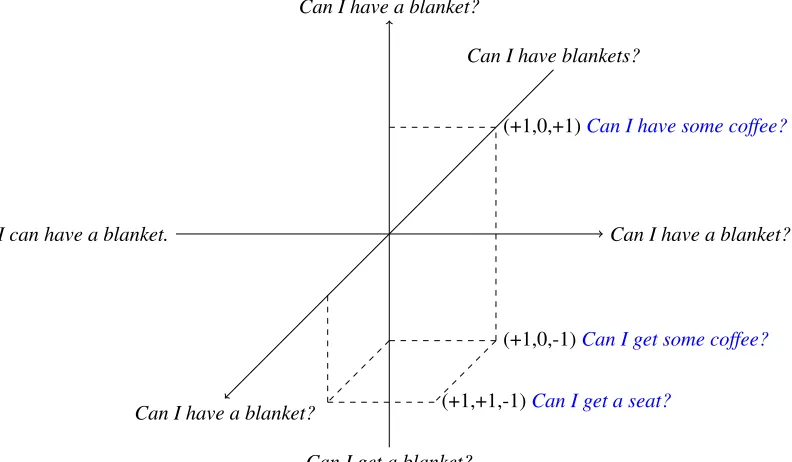
Figure 1: A three-dimensional vectorial space of linguistic features. Each axis stands for the opposition between the two sentences written at both ends.
define three dimensions. Other sentences may be projected in this space according to the possibility for them to enter or not in a series of analogous sentences along any of the dimensions thus taking one of three values:−1 (left),+1 (right) or 0 (not relevant) along this dimension.
Such a vectorial space captures those opposi-tions that are relevant to the sentences of a corpus, thus revealing the linguistic features concealed in that corpus. Such a representation enables the use of any standard vectorial technique for any fur-ther desirable computation. The goal of this pa-per, and the object of the next sections, is not to present such further computations, but to show how it is possible to extract the dimensions defin-ing the space from a corpus of short sentences.
2 Basic Notions
2.1 Analogous Sentences
We follow (Turney, 2006) for the basic notions used in this work:
Verbal analogies are often written
A: B::C :D, meaning Ais toB as C is toD, for example traffic : street :: water : riverbed.
Following this author, when the relational similar-ity between two pairs of words is high, we say that
the two pairs of words areanalogous.2 In this pa-per, we concentrate on sentences and extend the notion of analogous pairs of words to analogous pairs of sentences. For instance, the two following pairs of sentences are said to be analogous:
Do you have this in darker green?
:
Do you have this in dark green?
::Smaller,
please. : Small, please.
because the relational similarity between the first sentence and the second one is the same as be-tween the third sentence and the fourth one. Log-ically, following the term verbal analogies, we shall call any such two pairs of sentences sen-tential analogies. Here, the relational similarity consists in opposing the positive and comparative forms of two different adjectives: dark : darker :: small : smaller constitute a verbal analogy that sustain the sentential analogy. However, the sole verbal analogy does not imply the sentential anal-ogy because the context in which the words appear constitutes a part of the sentential analogy.
2.2 Series of analogous sentences
When several sentential analogies involve the same pairs of sentences, they form a series of anal-ogous sentences and they can be written on a line like in:
A1:B1::A2:B2::A3:B3:: . . .
or, in a more convenient way, on a kind of ladder extending over several lines like:
A1: B1
A2: B2
A3: B3 . . . : . . .
A requirement would be that, in such a series of analogous sentences, any two pairs of sentences form a sentential analogy. This is the case in the following example where all the three possi-ble sentential analogies hold (see also Tapossi-ble 2):
Do you have this in darker green? :
Do you have this in dark green?
Smaller, please. :Small, please.
I’ll take the longer
one. :
I’ll take the long one.
3 Formalization of Verbal and Sentential analogies
3.1 Previous works on verbal analogies
Measuring the degree of relational similarity be-tween words has received much attention in psy-chology. Gentner (1983) proposed a model called Structure Mapping Theory (SMT) that has been further elaborated until the present days. Hofs-tadter and his group have also put forward differ-ent proposals, among which the CopyCat model (Hofstadter and the Fluid Analogies Research Group, 1994).
The impact of semantics or pragmatics on ver-bal analogies may lead to situations where a range of different sources of knowledge may be called upon for the interpretation of specific analogies, leading to quite complex situations like the ‘mon-ster analogies’ listed by Hoffman (1995). For more standard situations like those found in SAT tests,3 modern NLP techniques have proved to reach the level of the performance of human beings to identify verbal analogies (Turney and
3Scholastic Aptitude Test or Scholastic Assessment Test used in US colleges.
Littman, 2005). Turney (2008) extends and sim-plifies the previous techniques to propose a uni-form approach to synonyms, antonyms, and word associations, through analogies, an approach that could extend to hypernyms/hyponyms, holonyms,
etc.
Referring to early but fundamental works in lin-guistics, linguists like de Saussure (1995) or Paul (1920) considered the role of relational similarity,
i.e., analogies, in derivational or flexional mor-phology and even in syntax, from a purely for-mal point of view. In this way, they justify both the creation of improper, but regular, morpholog-ical forms and the production of correct phrasal units.4 In this trend, we use a definition of anal-ogy between strings of characters that is based on form only, with the risk of capturing meaningless analogies. This formalization is taken from (Lep-age, 2004) where the reported measures show that meaningless analogies represent less than 4% of the analogies captured, on the same kind of data that we use in our experiments.
3.2 Measuring relational similarity for
sentential analogies
Lepage (2004) measures relational similarity be-tween two pairs of strings(A, B) and(C, D)by verifying the following constraints:
(
|A|x− |B|x = |C|x− |D|x
d(A, B) = d(C, D)
|A|xis the number of occurrences of characterx
in stringA. d is the canonical edit distance that involves only insertion and deletion with equal weights.5 As B andC may be exchanged in an analogy, the two constraints above have also to be verified for(A, C)and(B, D). With the previous example, where:
A = Do you havethis in darker green?
B = Do you havethis in dark green? C = Smaller, please.
D = Small, please.
one verifies d(A, B) = d(C, D) = 2 and
d(A, C) = d(B, D) = 36. The relation on the number of occurrences of characters, which is
valid for each character, may be illustrated as fol-lows for the charactere:6
|A|e− |B|e = |C|e− |D|e
4 − 3 = 3 − 2
The previous characterization of analogies be-tween strings of characters can be expanded in the following way
d(A, B) = d(C, D) (i)
|A| − |B| = |C| − |D| (ii)
|A|a− |B|a = |C|a− |D|a (iii.a)
|A|b− |B|b = |C|b− |D|b (iii.b)
|A|c− |B|c = |C|c− |D|c (iii.c)
|A|x− |B|x = |C|x− |D|x,∀x (iv)
where(ii)–(iii.c)are all logically implied by(iv). |A|denotes the length ofA.(ii)expresses the fact that the difference in lengths must be the same for the two pairs of sentences.7 Conditions (iii.a)– (iii.c) are just condition (iv) for three specific charactersa, bandc. These three characters are computed over a sample of the sentences of the corpus. They are those characters that exhibit the worst correlations among themselves for all possi-ble values of|A|x− |B|x. The reason for this is
to group pairs of sentences into groups as small as possible.
3.3 Non-transitivity and quality of series of
analogous sentences
Notwithstanding, the previous formalization has a deceiving aspect. In this setting, analogy is not a transitive relation,i.e., in the general case,
A:B :: C:D and C :D :: E:F do not im-ply A:B :: E :F. An example of such a case is given by the following group of three pairs of sentences:
I prefer the longer
one. :
I prefer the long one.
Do you have this in darker green? :
Do you have this in dark green?
Smaller, please. :Small, please.
where the constraint on distances does not hold between the first and the third pairs of sentences (respective distances 25 and 27).
6Trivially,|A|
a− |B|a=|C|a− |D|a⇔ |A|a− |C|a=
|B|a− |D|a.
7This property obviously holds because the equality in difference of number of occurrences holds for all the char-acters in the alphabet.
To compromise with the absence of transitivity when building series of analogous sentences, we shall set a minimal threshold,i.e., thequalityof a series of pairs of analogous sentences will be de-fined as the number of actual analogies over the total number of possible analogies. In our experi-ments, we arbitrarily set this quality level to 90%. We shall refer to series of analogous sentences that exceed this quality level asanalogy clusters.
4 Automatic Construction of Clusters of Analogous Sentences
4.1 The overall process
In order to automatically build analogy clusters from a corpus of sentences, our method proceeds in several steps:
1. for each sentence of the corpus compute its length and the number of occurrences of the three specific characters. This step is linear in the size of the corpus;
2. for each pair of sentences in the corpus, com-pute their distance. This step is quadratic in the size of the corpus. Previously sorting the sentences by lengths and imposing|A| ≤ |B| reduces the computation by half;
3. for each pair of sentences in a group with the same distance, first compute their difference in lengths and in number of occurrences for the three specific characters and then group pairs of sentences with the same difference in lengths and in number of occurrences of the three specific characters, by applying succes-sive sorts. Distribution sort (or bucket sort) ensures a very fast computation;8
4. for each group of pairs of sentences, clus-ter into analogy clusclus-ters by using a greedy method.
4.2 Computing distances between sentences
A very efficient way to compute the distance be-tween two sentences seen as strings of charac-ters is to compute their similarity using the fast bit string algorithm described in (Allison and Dix, 1986) and then derive the value of the canonical
distance.9 The above-mentioned algorithm pro-ceeds in two steps, where the first step consists in compiling the first string and the second step computes the similarity. The first step can thus be factored for the computation of the distance be-tween a sentence and all sentences that follow it in increasing lengths, leading to a large speed im-provement and to tractable processing time. On a machine with a 2.16 GHz processor, the com-putation of the distances for 40,000 sentences is achieved in 30 minutes.
4.3 Building analogy clusters
The result of the third step of the process is many groups of pairs of sentences, in which all pairs of sentences share the same distance, the same differ-ence in length and the same differdiffer-ence in number of occurrences for the three specific characters.
Condition (iv) can ultimately be verified be-tween any two pairs of sentences, so as to know whether the analogy holds. For each pair of sen-tences, the set of other pairs of sentences that form analogies, its analogy set, can be computed and known, so as to know its cardinality.
The clustering process considers the pair of sen-tences with the largest number of analogies and its analogy set. It successively deletes the pairs of sentences with the least number of analogies from the analogy set until the analogy rate be-comes larger than a threshold, 90% in our experi-ments. The analogy rate is computed as the num-ber of analogies that really exist between all pos-sible pairs of sentences remaining in the analogy set, divided by the square of its cardinality. When the threshold is reached, the cluster is saved and the clustering process proceeds with the next pair of sentences with the largest number of analogies.
5 Experiments
5.1 Corpus used
For experiments, we use an excerpt of the BTEC corpus (Basic Traveling Expressions Corpus). The BTEC corpus is jointly developed by the partners of the C-STAR project.10 It is a collection of sen-tences that bilingual travel experts consider useful for people going to or coming from another coun-try. This corpus is widely used in the community of machine translation as it provides translation
9d(A, B) =|A|+|B| −2×s(A, B). 10www.c-star.org
equivalents in English, Japanese, Chinese, Arabic
etc.
The excerpt we use is the part that has been re-leased during the international campaign of eval-uation of machine translation systems IWSLT 2007 (International Workshop on Spoken Lan-guage Translation) (Fordyce, 2007). The follow-ing table summarises some statistics about these data.11
English Japanese total number of sentences 39,754 36,774 lengths in characters
shortest sentence: 4 2
longest sentence: 481 234
5.2 Statistics on the clusters produced
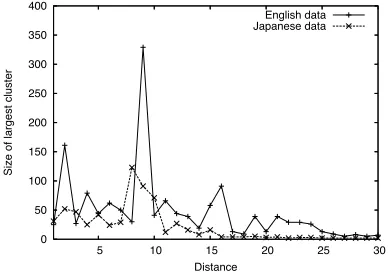
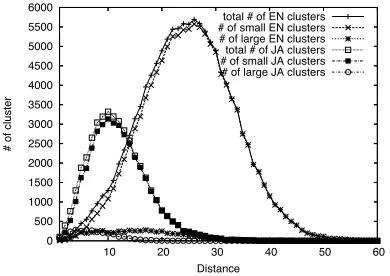
The clustering process could build 123,926 En-glish clusters (42,169 for Japanese; in the sequel, the figures in parentheses are for Japanese), of which 118,386 (39,410). contain only two pairs of sentences (called small clusters in Figure 3). The remaining 5,540 (2,759) clusters contain more than 3 pairs of sentences (called large clusters in Figure 3). After distance 40 for the English data and 20 for the Japanese data, large clusters are al-most absent. The maximum size of a cluster is 329 (123), obtained with distance 9 (8). Figure 2 plots the sizes of the largest clusters for each distance value.
0 50 100 150 200 250 300 350 400
5 10 15 20 25 30
Size of largest cluster
Distance
[image:5.612.318.512.433.569.2]English data Japanese data
Figure 2: Size of the largest clusters for each dis-tance.
In terms of oppositions, and thus linguistic fea-tures, the previous results mean that, for almost
0 500 1000 1500 2000 2500 3000 3500 4000 4500 5000 5500 6000
10 20 30 40 50 60
# of cluster
Distance
[image:6.612.97.292.62.200.2]total # of EN clusters # of small EN clusters # of large EN clusters total # of JA clusters # of small JA clusters # of large JA clusters
Figure 3: Number of clusters built for each dis-tance.
40,000 English sentences, three times more oppo-sitions could be found that are present in at least two pairs of sentences. However, only 5,500 op-positions are present in more than two pairs of sen-tences. This leads to a vectorial space of around 5,500 useful dimensions for this corpus.
6 Analysis of the Clusters Produced In this section, we report on the English data only. Similar trends and explanations can be formulated for the Japanese data.
The largest cluster in our experiment contains 329 pairs of sentences. The interpretation of each cluster has to be made by looking at the opposition between the sentences on the left and the sentences on the right. In this cluster, the pairs of sentences are opposed by the deletion of the ending phrase
, please. In terms of linguistic feature, one can say that the opposition lies between a neutral and a more polite form of expression. The size of the cluster reflects the optional character of this end-ing phrase, as one could expect in a corpus that heavily contains expressions of requests.
The next largest cluster contains 161 pairs of sentences. It shows the colloquial use of the con-tracted form’sin place ofis. One can thus speak about a language level linguistic feature (collo-quial vs formal). Again, this is natural in a corpus that necessarily contains traits of oral language.
The third largest cluster contains 91 pairs of sentences. It illustrates the possibility of antepos-ingplease at the beginning of a sentence as in:
help me , please .:please help me .
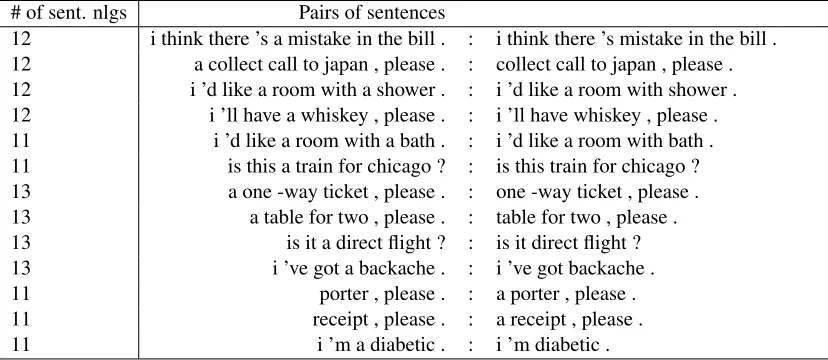
Table 1 shows an example of a cluster where the sentences on the left have the same meaning as the sentences on the right,i.e., they are
para-phrases. The linguistic interpretation of this clus-ter is that the undefinite articleacan be dropped in certain contexts, especially when expressing a request (sentences ending with:, please .)
Table 2 shows another example of a cluster con-taining sentences with very similar meaning that show that the phrasewhere is the can be substi-tuted foris there a.
Other clusters exhibit similar phenonena. Affir-mative sentences introduced byi ’d like to, are op-posed with interrogative sentences introduced by
can iended with a circumstancial here ?. This may be seen as a structural transformation for near paraphrasing.
Tables 4 and 5 are clusters in which places ( sub-way stationandyouth hostel) or predicates (keep this baggageanddraw me a map) are exchanged in similar situational or illocutionary contexts. Such examples, where left and right sentences are not paraphrases, very frequent with smaller clus-ters, contradicts the impression of paraphrases that one could get by looking too fastly at larger clus-ters only (see also the remark at the end of Sub-section 2.1 and the footnote there). These kinds of clusters do not reflect an opposition in linguistic features but rather show instantiations of semantic features that would be noted like LOC or PRED.
Other clusters make clear some orthographical variations, like the optional use of an hyphen in compound wordscheck-out,take-out etc. or En-glish vs American writing (colourvscolor), thus reflecting a dialect feature.
Many pairs of sentences appearing in smaller clusters of higher distances appear also in larger clusters with a lower distance. For example, the two pairs of sentences below form one of the small clusters (containing only one sentential analogy).
can i borrow an iron ? :can i have a blanket ? may i borrow an iron ?:may i have a blanket ?
But they also appear in a different configuration in a cluster that contains 79 pairs of sentences.
can i borrow an iron ?:may i borrow an iron ? can i have a blanket ?:may i have a blanket ?
..
. : ...
The first cluster with only one sentential anal-ogy shows the commutation of the phrasean iron
# of sent. nlgs Pairs of sentences
12 i think there ’s a mistake in the bill . : i think there ’s mistake in the bill . 12 a collect call to japan , please . : collect call to japan , please . 12 i ’d like a room with a shower . : i ’d like a room with shower . 12 i ’ll have a whiskey , please . : i ’ll have whiskey , please . 11 i ’d like a room with a bath . : i ’d like a room with bath . 11 is this a train for chicago ? : is this train for chicago ? 13 a one -way ticket , please . : one -way ticket , please . 13 a table for two , please . : table for two , please .
13 is it a direct flight ? : is it direct flight ?
13 i ’ve got a backache . : i ’ve got backache .
11 porter , please . : a porter , please .
11 receipt , please . : a receipt , please .
[image:7.612.94.508.59.239.2]11 i ’m a diabetic . : i ’m diabetic .
Table 1: A cluster that illustrates the possible deletion of the undefinite articleain some context. One can form only 159 analogies among the13×13possibilities. The analogy rate of the cluster is thus: 155/(13×13) = 91.72%.
# of sent. nlgs Pairs of sentences
11 where is the main area for restaurants ? : is there a main area for restaurants ? 11 where is the department store ? : is there a department store ? 11 where is the duty -free shop ? : is there a duty -free shop ? 11 where is the changing room ? : is there a changing room ? 11 where is the sleeping car ? : is there a sleeping car ? 11 where is the barber shop ? : is there a barber shop ?
11 where is the dining car ? : is there a dining car ?
11 where is the restaurant ? : is there a restaurant ?
11 where is the gift shop ? : is there a gift shop ?
11 where is the telephone ? : is there a telephone ?
11 where is the pharmacy ? : is there a pharmacy ?
Table 2: A cluster that illustrates a substitution pattern ofwhere is thewithis there a. Its analogy rate is 100%.
# of sent. nlgs Pairs of sentences
10 i ’d like to cash this traveler ’s check . : can i cash this traveler ’s check here ? 10 i ’d like to make a hotel reservation . : can i make a hotel reservation here ? 10 i ’d like to make a reservation . : can i make a reservation here ? 10 i ’d like to check my baggage . : can i check my baggage here ? 10 i ’d like to leave my baggage . : can i leave my baggage here ? 10 i ’d like to leave my luggage . : can i leave my luggage here ? 10 i ’d like to reserve a room . : can i reserve a room here ? 10 i ’d like to have dinner . : can i have dinner here ?
10 i ’d like to check in . : can i check in here ?
10 i ’d like to swim . : can i swim here ?
[image:7.612.94.523.317.472.2]# of sent. nlgs Pairs of sentences
4 is there a subway station around here ? : is there a youth hostel around here ? 4 how can i get to the subway station ? : how can i get to the youth hostel ? 4 is there a subway station near here ? : is there a youth hostel near here ? 4 is there a subway station nearby ? : is there a youth hostel nearby ?
Table 4: A cluster that examplifies the exchange of place names:subway stationvsyouth hostel.
# of sent. nlgs Pairs of sentences
[image:8.612.94.521.59.125.2]4 could you keep this baggage ? : could you draw me a map ? 4 keep this baggage , please . : draw me a map , please . 4 will you keep this baggage ? : will you draw me a map ? 4 please keep this baggage . : please draw me a map .
Table 5: A cluster that examplifies the exchange of predicates:keep this baggagevsdraw me a map.
In terms of vectorial space, this confirms the fact that the same sentence may be characterized along several dimensions.
7 Conclusion
We have presented a method that clusters analo-gous sentences from a corpus of short sentences and helps highlight the linguistic features con-cealed in a corpus. Such clusters of analogous sentences allow us to build a vectorial space asso-ciated with the sentences of a corpus. In an exper-iment on a corpus of 40,000 English sentences in the tourism domain, we could automatically col-lect more than 5,000 significant dimensions that represent linguistic oppositions or features. The ones observed on our data extend over a range of linguistic phenomena:
• orthographical variations; • fronting of interjections;
• exchange of place names, document names, item names etc.;
• normal vs comparative forms of adjectives; • structural transformations like interrogative
vs affirmative;
• exchange of predicates in the same grammat-ical subject and object context;
• questions in different levels of politeness; • etc.
References
Lloyd Allison and Trevor I. Dix. 1986. A bit string longest common subsequence algorithm. Informa-tion Processing Letter, 23:305–310.
Ferdinand de Saussure. 1995. Cours de linguistique g´en´erale. Payot, Lausanne et Paris, (1st ed. 1916).
Cameron Shaw Fordyce. 2007. Overview of the iwslt 2007 evaluation campaign. In Proceedings of IWSLT 2007 (International Workshop on Spoken Machine Translation), pages 1–12, Trento.
Dedre Gentner. 1983. Structure mapping: A theoreti-cal model for analogy.Cognitive Science, 7(2):155– 170.
Robert R. Hoffman. 1995. Monster analogies. AI Magazine, 11:11–35.
Douglas Hofstadter and the Fluid Analogies Research Group. 1994. Fluid Concepts and Creative Analo-gies. Basic Books, New York.
Philippe Langlais and Franc¸ois Yvon. 2008. Scaling up analogical learning. InProceedings of the22nd International Conference on Computational Lin-guistics (COLING 2008), pages 51–54, Manchester, August.
Yves Lepage. 2004. Analogy and formal languages.
Electronic Notes in Theoretical Computer Science, 53:180–191.
Hermann Paul. 1920. Prinzipien der
Sprachgeschichte. Niemayer, T¨ubingen, (1st ed. 1880).
Peter D. Turney and M.L. Littman. 2005. Corpus-based learning of analogies and semantic relations.
Machine Learning, 60(1–3):251–278.
Peter D. Turney. 2006. Similarity of semantic rela-tions.Computational Linguistics, 32(2):379–416.