European Atomic Energy Community EURATOM /
Brown Boveri/Krupp Reaktorbau GmbH, Düsseldorf /
DEVELOPMENT OF HIGH TEMPERATURE
H i f T H E R M A L REACTORS IN GERMANY¡¡|
»IP
HECKER, W. RAUSCH and R. SCHULTEN
7-\- if llihffl
M i
Al
Irli!"KW
^■føtøirS
Τ Η T R 32
Report prepared at KFA
Kernforschungsanlage Jülich des Landes NordrheinWestfalen e.V.
Jülich, Germany
Association N o . 003631 RGAD
Paper presented at the Nuclear Energy Meeting 1966,
Milan (Italy) December 1517, 1966
information contained in this document, or t h a t t h e use of a n y information, apparatus, method, or process disclosed in this document m a y not infringe privately owned rights ; o r
Assume a n y liability with respect t o t h e use of, or for damages resulting from t h e use of a n y information, apparatus, method
sit
When ordering, please quote the EUR number and the title, which are indicated on the cover of each report.disili!!! *?P1
:
!¿!£ #1
Il IliåtPl
m
Printed by L. Vanmelle N " Brussels, A u g u s t 1967
This document was reproduced on the basis of the best available copy.
æMÉlligSHR« å t 48™
mmamm
¡j¡|
m'
¿ffj
¡IlliipiieS·: If®*
BiiiiîsE
mm
»&$wm
m
M
Mi
4*i;H*ïï*«i
mm,itm
mm
EUR 3493e
DEVELOPMENT OF HIGH TEMPERATURE THERMAL REACTORS IN GERMANY by R. HECKER, W. RAUSCH and R. SCHULTEN Association : European Atomic Energy Community ■— EURATOM/ Brown Boveri/Krupp Reaktorbau GmbH, Düsseldorf/ Kernforschungsanlage Jülich des Landes NordrheinWest falen e.V.
THTR 32 Report prepared a t KFA — Kernforschungsanlage Jülich des Landes NordrheinWestfalen e.V., Jülich (Germany)
Association No. 003631 RGAD
Paper presented a t the Nuclear Energy Meeting 1966, Milan (Italy) December 1517, 1966
Brussels, August 1967 — 32 Pages — 10 Figures — FB 50
The first efforts for the development of high temperature thermal reactors in Germany started about 10 years ago. Since that time many important results have been obtained. The success of these efforts is best being reflected in the actual projects :
EUR 3493e
DEVELOPMENT OF HIGH TEMPERATURE THERMAL REACTORS IN GERMANY by R. HECKER, W. RAUSCH and R. SCHULTEN Association : European Atomic Energy Community — EURATOM/ Brown Boveri/Krupp Reaktorbau GmbH, Düsseldorf/ Kernforschung sanlage Jülich des Landes NordrheinWest falen e.V.
THTR 32 Report prepared at KFA — Kernforschungsanlage Jülich des Landes NordrheinWestfalen e.V., Jülich (Germany)
Association No. 003631 RGAD
Paper presented a t the Nuclear Energy Meeting 1966, Milan (Italy) December 1517, 1966
Brussels, August 1967 — 32 Pages — 10 Figures — FB 50
— The AVR pebble bed reactor has been completed and the critical experiments have been performed ;
— The work for the development of gas turbines for use with high temperature reactors reached a point where tenders have been submitted for a 25 MWe closed-cycle gas turbine prototype plant ; — The THTR-Project for the development of a 300 MWe prototype
reactor representative of full-scale power plants up to 1200 MWe shall provide final design documents by the end of 1967.
Detailed results of these three projects will be transmitted and an outlook on the further development with special regard to the potential for conversion and breeding will be given.
— The AVR pebble bed reactor has been completed and the critical experiments have been performed ;
— The work for the development of gas turbines for use with high temperature reactors reached a point where tenders have been submitted for a 25 MWe closed-cycle gas turbine prototype plant ; — The THTR-Project for the development of a 300 MWe prototype
reactor representative of full-scale power plants up to 1200 MWe shall provide final design documents by the end of 1967.
EUR 3493e
ASSOCIATION
European Atomic Energy Community - EURATOM /
Brown Boveri/Krupp Reaktorbau GmbH, Düsseldorf/
Kernforschungsanlage Jülich des Landes Nordrhein Westfalen e.V.
DEVELOPMENT OF HIGH TEMPERATURE
THERMAL REACTORS IN GERMANY
by
R. HECKER, W. RAUSCH and R. SCHULTEN
1967
T H T R 32
Report prepared at KFA
Kernforschungsanlage Jülich des Landes Nordrhein-Westfalen e.V.
Jülich, Germany
Association No. 003-63-1 RGAD
SUMMARY
The first efforts for the development of high temperature thermal reactors in Germany started about 10 years ago. Since that time many important results have been obtained. The success of these efforts is best being reflected in the actual projects :
— The AVR pebble bed reactor has been completed and the critical experiments have been performed ;
— The work for the development of gas turbines for use with high temperature reactors reached a point where tenders have been submitted for a 25 MWe closed-cycle gas turbine prototype plant ; — The THTR-Project for the development of a 300 MWe prototype
reactor representative of full-scale power plants up to 1200 MWe shall provide final design documents by the end of 1967.
D e v e l o p m e n t o f H i g h T e m p e r a t u r e T h e r m a l
R e a c t o r s i n G e r m a n y ' * '
I . I n t r o d u c t i o n
It is now l i t t l e more than 10 years ago that a group of physicists and engineers started
work on the development of High Temperature Gas-Cooled Reactors in Germany. Even at
this very early stage their concept differed considerably from the ideas of other groups: the
core was not to consist of prismatic fuel elements as in most other reactors; instead i t was
to be made up of a pebble-bed of individual mobile fuel b a l l s . This meant that the
advan-tages of both a heterogeneous and a homogeneous core could be combined by the adoption
of differential fuel elements, namely
fuel elements, the reactivity of which is small compared to that of the total
reactor, and
the dimensions of which are so small that bum-up variations in individual fuel
elements are neglegible.
The advantages of this concept are very obvious:
the exchange of fuel elements can be performed under all operating conditions;
optimum burn-up can be achieved for each differential fraction of the fuel by
continuous burn-up control;
the mechanical integrity of the fuel elements can be determined regularly, and
no excess reactivity is needed to compensate burn-up with the consequence of
lower fuel inventory and better neutron economy.
The idea was fascinating, but the work taken up by the BROWN BOVERI/KRUPP
Reak-torbau G m b H , for the realisation of this idea was not an easy one: to start a new line of
power reactors in a country where experience in reactor development was close to zero at
that t i m e .
In 1958 a group of u t i l i t y companies, now united as ARBEITSGEMEINSCHAFT
VERSUCHS-REAKTOR G m b H . - AVR - became interested in the project and at the end of 1959 a decision
was taken for the construction of a 15 MWe Experimental Power Station, the AVR Reactor.
This first power reactor to be developed entirely in Germany became c r i t i c a l for the first
time on August 2 6 , 1966, and is now being prepared for operation under power.
A direct consequence of the work being done for the development and construction of
the AVR Reactor is the Thorium High Temperature Reactor Project - THTR - which unites
EURATOM, the KERNFORSCHUNGSANLAGE JÜLICH des Landes Nordrhein-Westfalen e . V . ,
and BROWN BOVERI/KRUPP Reaktorbau G m b H , in a common effort to extend the
pebble-bed concept to a full scale power reactor prototype. By the end of next year design documents
for a 300 MWe THTR w i l l be completed with sufficient information to permit extrapolation
to plant sizes up to 1200 M W e .
The idea to use gas-turbines in conjunction with high temperature reactors is as old
as the idea of the high temperature reactor itself - this for the very simple reason that
suf-ficiently high gas temperatures for the economic operation of gas turbines are available
with these reactors. In the past few years, GUTEHOFFNUNGSHÜTTE STERKRADE A G .
- GHH - was engaged in several studies on the combination of gas-cooled high
tempera-ture reactors and gas turbines. A t present, GHH has finished project work for a 25 MWe
closed-cycle-gas turbine prototype plant using a helium cooled high temperature reactor
In Part II of this paper a survey w i l l be given of the actual state of these three
high temperature reactor projects currently being under development in Germany. In
Part III the economical aspects w i l l be presented and an outlook w i l l be given on further
possibilities with special regard to the potential for high conversion factors, a n d , u l t i
-mately, breeding.
I I . A c t u a l S t a t e o f H T G R D e v e l o p m e n t
A . The AVR Project
The main purpose of the AVR power plant which has been b u i l t by Brown Boveri/Krupp
in Jülich was:
to yield design, construction, and operating experience for high temperature
reactors;
to prove the feasibility and the special merits of the pebble-bed concept;
to test different pebble-type fuel elements;
and in this way
to serve as a tool for the future development of high temperature thermal reactors
in Germany.
The general reactor arrangement is shown in Figure 1 which demonstrates one of the
particular features of the AVR reactor, the integrated design. The entire primary c i r c u i t
including steam generators, circulators, gas ducting, and flow control mechanism is a c c o
modated inside a common pressure vessel. Today, nearly all known gascooled reactor p r o
jects have adopted the integrated design: a confirmation that Brown Boveri/Krupp's d e
-cision of 1958 was the right extrapolation to the future.
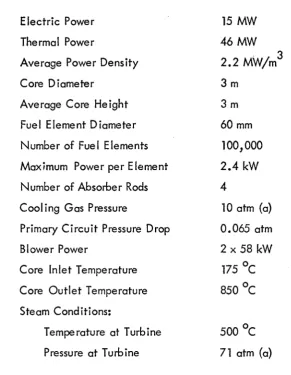
Table I
General Lay-out Data of the AVR Reactor
Electric Power 15 MW
Thermal Power 46 MW 3 Average Power Density 2 . 2 M W / m
Core Diameter 3 m
Average Core Height 3 m
Fuel Element Diameter 60 mm
Number of Fuel Elements 100,000
Maximum Power per Element 2 . 4 kW
Number of Absorber Rods 4
Cooling Gas Pressure 10 atm (a)
Primary Circuit Pressure Drop 0.065 atm
Blower Power 2 χ 58 kW
Core Inlet Temperature 175 C
Core Outlet Temperature 850 C
Steam Conditions:
Temperature at Turbine 500 C
Pressure at Turbine 71 atm (a)
The safety of the whole system is mainly determined by its capability to prevent fission
products from escaping out of controlled areas. O r i g i n a l l y , before fission product retaining
fuel was available the inner pressure vessel of the AVR reactor was considered a barrier for
gaseous a c t i v i t y . This vessel which has various penetrations for equipment, was leak controll
ed by a second container surrounding the inner one completely and forming an interspace as
controllable area.
Since in the actual design coated particles are used in the fuel elements, the outer
pressure vessel and the sealing gas interspace are much less important for the safety and
The design features of the reactor system place very specific requirements on the
sphe-rical fuel elements. The dominating specifications are:
(a) Irradiation stability to less than 3 % dimensional changes;
(b) High t hernial conductivity to avoid excessive temperature gradients in the element;
(c) Impact resistance to drops from 4 m high on a pebble-bed combined with abrasion
resistance;
(d) Limited oxidation rate in the presence of certain impurities contained in the c o o l
-ing gas; and
- 4
(e) A release to birth rate (R/B value) of less than 5 x 1 0 for Xe133 after a b u r n
-up of 4 % f i f a .
Figure 2 shows a section of the AVR fuel elements.
Comparison of various manufacturing techniques for the fuel element led to the design
of a hollow graphite shell of 60 mm diameter with a wall thickness of 10 mm. This shell
contains a graphite matrix with uniformly dispersed coated particle fuel and is closed by a
threaded p l u g .
Contrary to reactors with prismatic fuel elements the pebble-bed concept is suited to
avoid any fue Ihand I ing machinery inside the core. Gravity is made use of for the e x t r a c
tion of fuel elements and pneumatic energy with the coolant astransfer medium for the l o a d
-ing of recirculated or new elements. Thus, only pipes are required inside the pressure vessel,
the necessary components for handling operations as for example singulizer,
scrap-separa-tor, burn-up measuring device and pneumatic elevator being located in accessible areas.
The following functions have to be f u l f i l l e d by the fuel handling system:
1 . Loading of new fuel elements to keep the reactor c r i t i c a l at the predetermined
average core temperature. A t full power less than three new fuel elements per hour
2 . Unloading of unfueled or depleted spheres to control the core height. The
spheres are selected for extraction by a % a c t i v i t y detector to discriminate b e t
ween fueled and unfueled balls and a neutron absorption measurement for the d e
-termination of burn-up.
3. To achieve a flat characteristic of coolant temperature at the core surface a d e f i
-nite distribution of fuel in two radial zones has to be established. This can be done
by simply varying the ratio of fueled balls of different burn-up to be loaded by the
central or one of the four peripheric charge tubes.
Practical experience has proved that in spite of the ideal shape of a spherical
fuel element particular requirements have to be met in respect to its handling.
One of the unexpected effects that arose was the tendency of the pebble-bed core
to orientate if circulated close to a flat w a l l . This "crystallization effect" is shown in
Fig. 3 . After circulation of some 500,000 spheres in a perspex model a systematic and
almost densest packing formed in the outermost layers close to the c o r e - w a l l . As the
v e l o c i t y profile over the cross section of the core is severely influenced by this effect
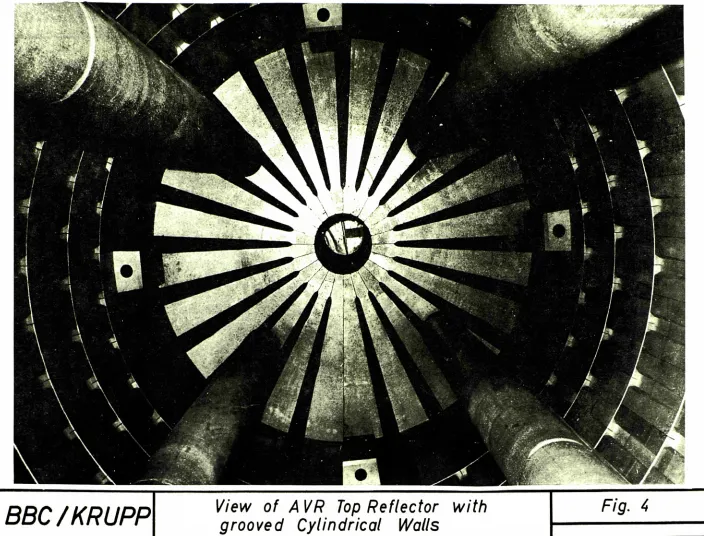
it had to be prevented. F i g . 4 shows the grooves that were machined into the graphite
wall of the AVR core and by which the orientation of spheres was completely e l i m i n a t e d .
The overall negative temperature coefficient in conjunction with the size of the
AVR reactor core and the possibility of controlling reactor power by circulator speed
simplifies the problems of reactor control considerably.
The four absorber rods which are installed in special graphite "noses" protruding
into the pebble-bed core are only needed for start-up and shut-down purposes and for
emer-gency conditions.
The start-up experiments for the AVR reactor began on July 14, 1966, with the
load-ing of the first fuel element. Due to a number of unsatisfactory valves in the helium system
these experiments were performed under a nitrogen atmosphere. The buildup of the c r i
-tical core configuration was continuously controlled by simultaneous experiments in a
outlet showed surprisingly well agreement with predictions. C r i t i c a l i t y was achieved
about six weeks later on August 2 6 , 1966. The great number of zero-energy experiments
that followed gave first valuable information on the physical and technical behavior of
a pebble-bed reactor. The critical experiment itself made possible a better evaluation of
the different effects that could not be taken proper account of in early calculations, and
which w i l l furnish a checkpoint for further calculational methods.
The temperature coefficient was determined in the range from 25 to 100 C in e x c e l
-lent agreement with calculated values at
The same holds for the reactivity coefficient of core height and the reactivity change
per added fuel ball as w e l l as for the pressure coefficient for nitrogen and the
determina-tion of the absorber rod worth. Reactivity changes due to recirculadetermina-tion of elements, an
effect only to be found in a pebble-bed core, were registered and gave proof of the
repro-d u c i b i l i t y of the core configuration. The pebble-berepro-d core has an extremely stable
reacti-v i t y characteristic which due to statistics can only improreacti-ve in larger reactors. The fuel
hand-ling system including the pneumatic elevators performed extremely well during this first
phase. Up t i l l now more than 60,000 spheres have been circulated corresponding to
seve-ral weeks of full power operation without major incidents.
The further programme for the AVR reactor foresees the approach to power by the
middle of next year. The remaining time w i l l be used to prepare the gas circuits for
operation under 10 atmospheres of helium. From the power opeoperation of the AVR one can e x
-pect further important results on the behavior of the system and for extrapolation to bigger
units. This holds especially for the performance of so important components as the fuel
elements, the gas circulators, the steam generator, gas p u r i f i c a t i o n , and the fuel handling
system. The makeup charge w i l l possibly consist of different fuel elements so that a d d i
Β . T h e T H T R P r o j e c t
The Thorium High Temperature Reactor Project THTR is the direct consequence of the knowledge gained and the encouraging results obtained during the development of the high temperature pebblebed reactor c o n c e p t , including the construction and o p e r a tion of the AVR reactor.
The main objectives of the project are:
to design a power reactor prototype and secondary steam c i r c u i t which is repre sentative of a f u l l scale power plant;
to perform the necessary research and development programme for the advancement of high temperature pebblebed thermal reactors u t i l i z i n g the thoriumuranium c y c l e ; and
to gain operating experience by participating in the operation of the AVR reactor and furthermore to be responsible for the selection of the makeup and e x p e r i m e n tal fuel charges of the A V R .
EURATOM, Kernforschungsanlage J ü l i c h , and Brown Boveri/Krupp entered into an association to accomplish this programme. When the association was founded in 1962 by the three partners i t was planned to last a period of 5 years until the end of 1967. It can then be extended for the construction of the THTR prototype i f the work performed and the results obtained justify such a decision.
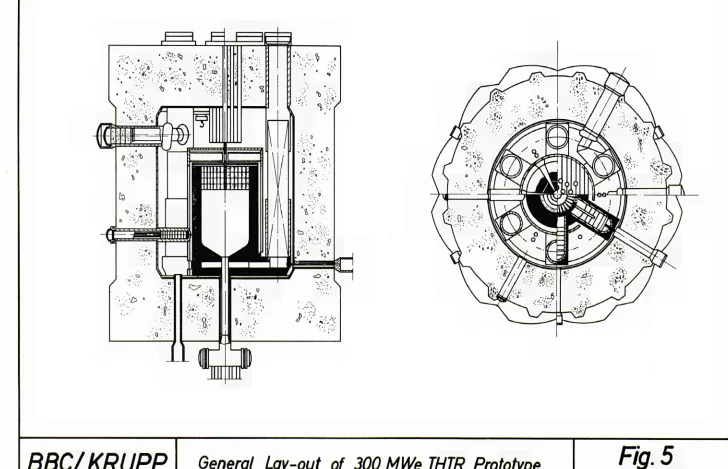
F i g . 5 shows the general l a y o u t of the THTR p r o t o t y p e . A power of 300 MWe has been selected as a compromise between cost and the possibilities for e x t r a p o l a t i o n . As in the AVR reactor the pebblebed core is of c y l i n d r i c a l shape and w i t h a 3 0 ° bottom cone.
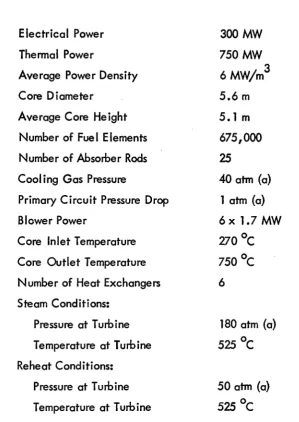
Table II
General Lay-out Data of THTR Prototype
Electrical Power
Thermal Power
Average Power Density
Core Diameter
Average Core Height
Number of Fuel Elements
Number of Absorber Rods
Cooling Gas Pressure
Primary Circuit Pressure Drop
Blower Power
Core Inlet Temperature
Core Outlet Temperature
Number of Heat Exchangers
Steam Conditions:
Pressure at Turbine
Temperature at Turbine
Reheat Conditions:
Pressure at Turbine
Temperature at Turbine
300 MW
750 MW
6 MW/m3
5.6 m
5.1 m
675,000
25
40 atm (a)
1 atm (a)
6 χ 1.7 MW
270 °C
750 °C
6
180 atm (a)
525 °C
50 atm (a)
525 °C
Four possible fuel elements are presented in F i g . 6 . Their outer diameter amounts
again to 60 mm and all of them are provided with a fuel-free zone of about 10 mm thick
ness. The first of these elements has been discussed already. It has been furnished by
Union Carbide Corporation for the AVR reactor and is characterised by a homogeneous
Type I I , the so-called "hollow-sphere element" is similar to the Union Carbide
element but has the advantage of lower central temperatures as the fuel particles are
dis-tributed on a spherical surface of about 40 mm diameter. This element has been developed
by N U K E M , one of THTR's subcontractors for fuel element development, and may be
used for the AVR make-up charge.
Type I I I , called " r i n g - g a p " element, consists of a graphite sphere having a free
space to house loose coated particles. The gap can be made wide enough to contain up
to 15 g of heavy metal. This type of fuel element combines the advantage of easy
repro-cessibility with the disadvantage of higher fuel temperatures.
The most interesting variant for further development is the pressed element, type I V .
Here, the particles are distributed similarly to type 1 in a graphite matrix, but the whole
element is pressed semihydrostatically from graphite powder, a process particularly suited
for mass production. The advantages of this element are: low production cost, good
mecha-nical behavior and the possibility for higher heavy metal content than with any other variant.
There are two main points where the THTR concept differs markedly from that of the
AVR reactor: absorber rods and the fuel handling system. In the AVR reactor absorber rods
were inserted into an in-core graphite structure. For THTR due to the larger core diameter,
a solution had to be taken which seems very specific for the pebble-bed core: the insertion
of free control rods into the pebble bed itself without any in-core structure.
Fig. 7 shows photographs of an experimental control rod being dropped into a bed of
60 mm diameter graphite pebbles. Upon release this rod entered in about one second by its
own weight of 500 kg more than 3 m deep. The total force required for insertion of the
rod has been determined for different depths and at the same time the force excerted on the
Extensive experiments have been conducted also with smaller models to study the i n
-fluence of other parameters. It has been found that the required forces depend on friction
between pebbles, the specific weight of the bed including its virtual increase by the
pressure drop of the cooling gas a n d , to a less extent, on the total number of rods being i n
-troduced .
Much development work has been done to simplify the different components of the
fuel handling system to achieve the higher circulation frequency of up to 500 balls per
hour as compared to only about 50 balls per hour in AVR. Important components have a l
-ready undergone long-term testing. Perhaps, one of the most interesting components of the
fuel handling system is the burnup measurement f a c i l i t y . With THTR burnup of fuel e l e
-ments w i l l be determined by passing the fuel balls through a special zero power reactor
and analysing the respective power signals as presented in Figure 8 . Here, reactor power
versus time is given for a pure graphite sample above and for the same sample plus 0 . 3 g
U-235 b e l o w . These two signals correspond in a qualitative manner to signals from a new
fuel ball and from a completely burnt-up fuel element.
The difference between both signals is easily measurable. The length of the signals,
about 2 / 1 0 sec in this instance, corresponds to the t i m e , the fuel element needs to pass
through the burn-up measurement reactor and can be increased for greater accuracy.
For further development of the method, a small zero power reactor is actually being i n
-stalled in Jülich to go into operation some weeks from now.
The main problems connected to the step in development from the 15 MWe AVR
reac-tor to the 300 MWe THTR prototype were
the necessity for a pressure vessel of greater dimensions and for a higher cooling
gas pressure,
a problem common to all high temperature reactor projects and which is overcome
by the progress in prestressed concrete pressure vessel construction, and, in a d d i
the necessity for quicker circulation of fuel elements including burn-up
measure-ment
plus the need for a workable control rod concept not based on the solution for AVR.
These specific problems have been overcome
by the development of a quick burn-up measurement by means of a c r i t i c a l f a c i l i t y
and
by the adoption of the free control rod concept.
The THTR project thus appears to rest on a sound technical basis and presents many
interesting advantages as well as potential for further development.
C . Gas Turbines for High Temperature Reactors
Gas cooled high temperature reactors mean an important progress also because the
temperature level attained by the cooling gas permits for the first time the direct coupling
of a nuclear reactor with a gas turbine.
Because of the well known dependency of plant efficiency on turbine inlet
temperature as given in Fig. 9 already at helium tempetemperatures around 750 °C the plant e f f i c i e n
-cy is that of a modern steam -cycle of 40 % . A t 950 C , a gas temperature that seems
pos-sible in the not too distant future, the efficiency goes up to 50 % .
In the last decade a number of fossil fueled gas turbine plants have been b u i l t . Some
of those plants are now in operation for more than 50,000 hours. GHH has had a decisive
share in the development and construction of such plants in Germany and during the past
few years GHH has made some studies on the combination of gas-cooled high temperature
reactors and gas turbines. The main object of these studies was the development of heat
In this connection GHH carried out work for a 25 MWe closed-cycle gas turbine
pro-totype plant u t i l i z i n g a helium-cooled high temperature reactor. The project work on the
prototype nuclear power station has meanwhile progressed to a point that design documents
are available and tenders have been submitted for a power-station in Schleswig-Holstein,
Germany.
Should a decision be taken to accept the GHH proposition, construction work could
be started early next year and the plant could be put in operation about 4 years later.
The system is powered by a high temperature reactor similar in design to General
A t o m i c ' s Peach Bottom f a c i l i t y with prismatic fuel elements. Characteristic lay-out data
are given in Table I I I .
T a b l e I I I
General Lay-out Data of GHH Gas-Turbine Prototype Plant
Reactor Thermal Power
Power at Terminals
Power Density
Number of Fuel Elements
Number of Absorber Rods
Equivalent Core Diameter
Height of Active Core
Reactor Inlet Temperature
Reactor Outlet Temperature
System Pressure
Speed of Turbine
Number of Stages
Turbine
LP/IP/HP Compressors
66.6 M W
25 MWe
7.5 M W / m3
624
37
244 cm
190 cm
425
°C
740
°C
25 ata10,000 rpm
8
The heat exchanger design proposed for the prototype plant already has successfully
been applied in conventional gas turbine plants b u i l t by G H H .
From the point of view of HTGR development in Germany a positive decision for the
construction of a high temperature reactor coupled to a gas turbine would be very favourable
for it is clear that this would bring about valuable information on the potential of HTGRs
for better economy of the cycle with the result of lower energy cost.
I V . E c o n o m i c A s p e c t s a n d F u r t h e r P o s s i b i l i t i e s
This brings us to the second part of our paper: economic aspects and further
possibi-lities. The question is: what can we expect for the future from the high temperature reactor
systems under development in Germany? To come back to the general theme of this meeting:
this is the question of competitivity, in other words the question of cost per kilowatt hour (kWh)
and as well all know the potential of a reactor system for conversion or breeding can have a
strong bearing on the answer to these questions. The cost per kWh is made up of two parts:
capital cost including fuel inventory and
fuel costs.
While capital cost is responsible for between 60 and 70 % of total power generating cost,
fuel costs make up for the resting 30 to 40 % and only 5 to 10 % of total power generating
costs go into fuel fabrication.
A . Capital Cost
There seem to be two normal ways to reduce capital cost for power reactor systems:
one is to go to bigger units. The other way is to use standardized equipment for a whole
line of plant sizes and with growing experience to simplify the design in the direction of
pres-sure vessels are presented for a 300, a 600 and a 1200 MWe pebble-bed reactor. It is
rather surprising to see that for a power increase by a factor of 4 the outer volume of the
concrete pressure vessel only increases by little more than a factor of t w o .
The horizontal sections in the lower half show that especially the arrangement of
heat exchangers becomes more and more compact: for the 300 MW prototype they are d e
signed to be exchangeable, for the 600 MW plant there are twice as much heat e x c h a n
-gers as penetrations so to exchange one of them in some cases two would have to be
re-moved. For the 1200 MW plant sufficient experience is expected that heat exchangers
can be made nonexchangeable.
The general tendency is the same for both reactors with pebble-type and prismatic
f u e l . The actual price estimates for capital cost per installed kW as given by GHH and
Brown Boveri/Krupp are
135 to 150 Dollars/kW for a plant size of about 600 M W e ,
and approaching
100 D o l l a r s A W for a plant size of 1200 M W e .
There is still another way to decrease capital cost which is specific for high
tempe-rature reactor systems: the use of gas-turbines in the primary c i r c u i t instead of a
seconda-ry steam c i r c u i t with steam generator and steam turbine. It is obvious that the adoption
of gas turbines w i l l lead to an even more compact arrangement and the estimates are that
this would result in a further considerable reduction in capital cost of up to 20 % for a
plant of about 600 M W e . An additional advantage that may have a strong influence on
site requirements seems to be the fact that for a reactor with a gas turbine cooling water
consumption is reduced by a factor of 4 as compared to a reactor with a steam c y c l e . It
seems important to note that plans for gas turbines are now available up to an output of
Β. Fuel Costs
Extensive calculations have been performed for the determination of fuel costs for
pebble-bed reactors. Results are given in Table I V . Three different cycles have been c o n
sidered: two once-through cycles with one type of fuel element only and uranium/thorium
or low-enriched uranium as fuel and furthermore a feed-and-breed cycle with two types
of fuel elements. The feed elements contain only fissile material and are used as
once-through fuel while the breed elements contain mostly fertile material and only a small
amount of fissile, corresponding to the equilibrium of Th-232 to U-233 and may be repro
cessed .
T A B L E I V
Fuel Cycle Costs for High Temperature Reactors with
Pebble Type Fuel Elements
Fuel Cycle once-through once-through feed-and-breed Element feed feed feed breed U-235 En richment
9 3 %
7 . 6 %
9 3 %
1 U-235 g 1.04 0.65 1.09 0.56 "ue 1 U-238 Th-232 9 0.07 7.9 0.08 0.04 g 10.5 -_ 19.15 Resi- Plant dence Size Time MWe
3.5 a 300
2.0 a 300
2.5 αΊ
6.0 Í (4.0 a)
++
JÍ300
[1200
Fuel Cost (m without
ilsAWh)
with Reprocessing 1.6 1.4 1.4 — -1.3 ^ 1.0+ without reprocessing + + with reprocessing
The last figure given of less than one m i l / k W h agrees well with the figures given
One reason for the low fuel costs with U/Th fuel is the fact that conversion ratios
up to 0.8 can be achieved. For high temperature pebble-bed reactors considerable
fur-ther savings in fuel costs are to be expected.
With the pressed element it seems now possible to increase the heavy metal content
per fuel ball to 40 g or even more. This means that for every fueled ball two or more u n
fueled graphite balls could be used. Because of the much lower fabrication cost of u n
-fueled balls and because for these balls an in-core residence time of up to 20 years seems
feasible, a noteworthy reduction in fuel fabrication cost could be obtained. A d d i t i o n a l
-l y , the presence of unfue-led ba-l-ls in the core resu-lts in a higher degree of heterogeneity
with the effect of lower neutron losses by resonance absorption in U-238 or Pa-233
respec-t i v e l y .
A still more interesting possibility for the realization of lower fuel costs is given by
the use of beryllium in the core. A practicable solution for pebble-bed reactors would be
the replacement of unfueled graphite balls by beryllium oxide balls. The use of beryllium
as moderator material has two favourable effects on neutron economy:
1 . Neutron leakage is reduced because of the higher moderating power of b e r y l l i u m , and
2 . the production of neutrons is increased by the (n,2n)-reaction.
While the expected gain by reduced neutron leakage is of the order of 1 % , the gain
in neutrons as possible because of the fast fission factor for beryllium oxide may be as high
as 5 % . The d i f f i c u l t y is that the value of the fast fission factor is not very exactly known,
calculated values ranging from 1.035 to 1.10, the latest value by Zhezherun being given
at 1.08. Because of the importance of this value for the further development of thorium
reactors, experiments are actually conducted at J ü l i c h . First results indicate that the fast
fission factor is definitely higher than 1.05 and it seems possible that the value of 1.08
Parallel to the (n,2n)-reaction takes place another reaction that is less favourable
for neutron economy: an ( n , ^ ) - r e a c t i o n producing Li and which has a very high absorption
cross section for thermal neutrons. Experiments indicate that at temperatures in the range
of 1500 C lithium can be driven out of beryllium oxide in a relatively short t i m e .
In practice, a special feature of pebble-bed reactors can be made use of. Due to
the continuous circulation of elements every f u e l - or moderator-ball passes the fuel
hand-ling system after less than 6 months in the average. This means, that beryllium oxide balls
could be separated and heated up to drive out l i t h i u m , before they are recycled through
the core. Considering radiation damage of beryllium oxide a temperature cycle to 1500 C
would have the additional advantage of healing out some of the defects and thus admitting
higher residence times. Taking into account the improvement in neutron economy to be
expected for such an advanced high temperature thorium reactor, conversion factors up to
and even greater than one seem possible.
V . C o n c l u s i o n
To conclude we may say that of the two lines being followed of high temperature
thermal reactor development in Germany each has its special merits and potential to lower
power generating cost. As we have seen, the direct coupling of gas turbine and high
tem-perature reactor can lower capital cost by a remarkable fraction and also fuel cost due to
higher e f f i c i e n c y . The pebble-bed high temperature reactor on the other hand demonstrates
an optimum f l e x i b i l i t y for fuel management. Any high-temperature reactor fuel or
modera-tor that can be accomodated into a 60 mm solid sphere can be used and fuel cycles can be
changed continuously according to the demands of the fuel market.
The fact that the spherical elements automatically appear in the fuel handling system
after less than 6 months greatly facilitates the regeneration of fuel as well as moderator,
as for instance b e r y l l i u m . This appears to be the best basis for the achievement of
The question of how good α breeder can be made of i t or in other words the question of doubling t i m e , a c t u a l l y seems to be of less importance. This because at the high s p e c i fic power possible w i t h advanced high temperature thorium converters the amount of natural uranium necessary for the next 60 years appears to be lower than w i t h any other converter reactor system and not higher than w i t h fast breeders.
Re f e r e n c e s :
H . W . M ü l l e r , C . B . v . d . D e c k e n , U . Hennings, and W . Stürmer, "The AVR Pebble Bed Reactor"
The Journal of the British N u c l e a r Energy Society, J u l y 1966, V o l . 5 N o . 3; 319 3 3 1 , and
October 1966, V o l 5 N o . 4 ; 516 5 1 9 .
E. Böhm,
"Project for a high temperature reactor w i t h a gas turbine" The Journal of the British N u c l e a r Energy Society,
J u l y 1966, V o l . 5 N o . 3; 332 344, and October 1966, V o l 5 N o . 4 ; 519 522 .
P. J e l i n e k F i n k , W . Rausch, H . G . Schafstall, R. Schulten, and L. V a l e t t e , "The Thorium High Temperature Reactor Project"
The Journal of the British N u c l e a r Energy Society, J u l y 1966, V o l 5 N o . 3 , 383 395,and
1 Steam Header 2 Containment
Outer Pressure Vessel Inner Pressure Vessel Steam Generator Quench Tank Upper Reflector β First Biological Shield 9 Pebble bed Core
10 Lateral and Bottom Reflector 11 Fuel Discharge Pipe 12 Gas Purification System
Dismantling Machinery Second Biological Shield 15 Charge room for Fuel Elements IS Cooling Gas Circulators
17 Dismantling Machinery for Circulators Id Components of Fuel-handling System 19 Material Lock
20 Heavy Load Elevator 21 Circuler Bottom Support 22 Storage Channel for Spent
Fuel Elements
Fig.1
Sectional View of
AVR-Reactor, Jülich
SHELL PLUG WITH CARBON
CEMENTED JOINT
MACHINED AT J GRAPHITE
SHELL-COATED FUEL
PARTICLES IN
GRAPHITE MATRIX
Fig.2
Section of AVR-Fuel·
Element
, Tp
[image:31.842.56.784.72.541.2]Type I
Type II
Type ΠΙ
Type Ν
UCC -Element Hollow-Sphere Element Ring-Gap Element Pressed Element
Lower Tip of Rod Before Drop
After Drop into the Pebble Bed
Fig.e
Dynamical measure?
ments at Risø
Upper sample:
10Ag graphite
Lower sample:
0.33g U
2350.79 g Th
23211.2 g graphite
Maximum
Helium
Cycle
Efficiency
(η)
co
-Ρ
* e
n
σ
ο
ο
Ο
C
rv
tOO 8 0 0 120
Gas-in let Tei nperat ureCX J
0
Fig.9
Maximum Helium Cycle
Efficiency as Function
of Turbine Inlet Tempe
rature
300
M We
BBC/KRUPP
I
M l i
ftffWMI
!¡
!¡π'!
h1 MlMim
i4i <»w ijiij^j^i^ji* rr_T*f
600 MWe
Comparison of General Lay-out for
300MWe
J
eOOMWe and 1200MWe Pebble-bed Reactor
m
w
üm¡
m
Mm
NOTICE TO THE READERIÏ1
E
S ^ ^ f e i r «
B
Ail Euratom reports are announced, as and when they are issued, in the monthly periodical EURATOM INFORMATION, edited by the Centre for Information and Documentation (CID). For subscription (1 year : US$ 15, £ 5.7) or free specimen copies please write to :
¡llfflB
Handelsblatt GmbH
: ; 3 j
:!Ν!!ΝΙΗ;Η!Ι!!ΙΝΞ;Φ=Φ^=ΙΙ T O disseminate knowledge is t o disseminate prosperity — I mean
üír il Ϊ'Μ
ΞΙΠΙΝΙΠΙΠΙΠΗΗΗΠΙΠΠΙΙΗΙΝΗ ge n e r al prosperity and not individual riches — and with prosperity
|{ disappears the greater part of the evil which is our heritage from
tøs ·^
''oí!«
ΡΙΑΙΪΪΙΙΚΙ
i!.r*HIV*f'i<ȓwW' maidici il'
ΒψΜ
f u l »
" T S R J Î1^ » ' * Alfred NfAel
:i.t;,: L··.' _ÏL_d; ;4ι^«ϊιι KBjttíi'Aii:· *3iB^>r#}»IflW:)L
i Ρ β P i HM I E Wffi
fl'F 'It ν . ' ·.', íiJiTlf '
■ M M
ALES OFFICES
AH Euratom reports are on sale at the offices listed below, at the prices given on the back of the front cover (when ordering, specify clearly the EUR number and the title of the report, which are shown on the front cover)
wmamm
if
•fais
. -TW
fia*
i
»»'Vil.:,
OFFICE CENTRAL DE VENTE DES PUBLICATIONS DES COMMUNAUTES EUROPEENNES
2, place de Metz, Luxembourg (Compte chèque postal N° 19190)
»fi IM tints'?■·, <·ΜΙ!3Β}! AtflPiî Uu RiypnW ■'i,PUi!.|i!iiñsiíilt;iui)rt .vm C
¡UM.: HHÄ WÄSufiÄ h f:i :
wil
iii™
- X E M B O U R G
OFFICE CENTRAL DE VENTE DES PUBLICATIONS DES COMMUNAUTES EUROPEENNES 9, rue Goethe Luxembourg
iy«|^B6ii¡
mBaÊmStmÊsà
NEDERLANDSTAATSDRUKKERIJ ^hristoffel Plan*
ISÉilll
Christoffel Piantijnstraat Den Haag
^JNHHB*'S4CBR!ÍKÍ »IMI : f e ç;~ *"Ί \*\'·&Λ
UNITED KINGDOM
Η. Μ. STATIONERY OFFICE
Ρ. Ο. Box 669 - London S.E.I