http://dx.doi.org/10.4236/ojfd.2016.62010
Radiative Effect on Flow and Heat Transfer
over a Vertically Oscillating Porous Flat
Plate Embedded in Porous Medium with
Oscillating Surface Temperature
Monika Miglani1, Net Ram Garg2, Mukesh Kumar Sharma3
1Department of Mathematics, Haryana College of Technology & Management, Kaithal, India 2Department of Mathematics, Maharshi Dayanand University, Rohtak, India
3Department of Mathematics, Guru Jambheshwer University of Science & Technology, Hisar, India
Received 2 March 2016; accepted 24 June 2016; published 27 June 2016
Copyright © 2016 by authors and Scientific Research Publishing Inc.
This work is licensed under the Creative Commons Attribution International License (CC BY).
http://creativecommons.org/licenses/by/4.0/
Abstract
The effect of radiation on flow and heat transfer over a vertically oscillating porous flat plate em-bedded in porous medium with oscillating surface temperature is investigated. The analytic solu-tions of momentum and energy equasolu-tions are obtained. The velocity and temperature profiles are computed. The frictional force at the plate due to viscosity of fluid is estimated in terms of non di-mensional skin friction coefficient and heat convection at the plate is estimated in the form of Nusselt number. The effects of physical parameters Prandtl number Pr, Grashof number Gr, Suc-tion parameter S and radiative parameter R on velocity and temperature profiles are analyzed through graphs. The effects of oscillation on the velocity and temperature profiles are shown through 3-D surface plot.
Keywords
Radiation, Suction, Heat Flux, Oscillating Porous Plate
1. Introduction
transfer plays an important role in manufacturing industries for the design of reliable equipment. Nuclear power plants, gas turbines and various propulsion devices for aircraft, missiles and satellites are examples of such en-gineering applications.
Magneto hydrodynamic free convection flow past an infinite vertical plate oscillating in its own plane was first studied by Soundalgekar [1] in case of an isothermal plate. Mansour [2] has studied the interaction of free convection with thermal radiation of the oscillatory flow past a vertical plate. Soundalgekar and Takhar [3] have considered radiation effects on free convection flow past a semi-infinite vertical plate. Helmy [4] has investi-gated MHD unsteady free convective flow past a vertical porous plate. Hossain et al. [5] have analyzed the heat transfer response of MHD free convective flow along a vertical plate to surface temperature oscillations. Radia-tion and free convecRadia-tion flow past a moving plate was considered by Raptis and Perdikis [6]. Hossain et al. [7]
have described the effect of radiation on free convection from a porous vertical plate. Kim [8] has founded an unsteady MHD convective heat transfer past a semi-infinite vertical porous moving plate with variable suction. Radiation effects on the free convection over a vertical flat plate embedded in porous medium with high porosity have been studied by Hossain and Pop [9]. El-Arabawy [10] studied the effect of suction/injection on a micro polar fluid past a continuously moving plate in the presence of radiation. The effects of thermal radiation on the flow past an oscillating plate with variable temperature have been studied by Pathak et al. [11]. Chandrakala and Raj [12] have studied the effects of thermal radiation on the flow past a semi infinite vertical isothermal plate with uniform heat flux in the presence of transversely applied magnetic field. Das [13] has analyzed the exact solution of MHD free convection flow and mass transfer near a moving vertical plate in the presence of thermal radiation. Chandrakala [14] have studied the radiation effects on flow past an impulsively started vertical oscil-lating plate with uniform heat flux. Ibrahim and Makinde [15] have studied the radiation effect on chemically reacting MHD boundary layer flow of heat and mass transfer through a porous vertical flat plate. Radiation ef-fect on natural convection near a vertical plate embedded in porous medium with ramped wall temperature has been studied by Das et al. [16]. Chandrakala [17] studied the effects of thermal radiation on the flow past an in-finite vertical oscillating plate with uniform heat flux. Janaand Manna [18] studied the effects of radiation on unsteady MHD free convective flow past an oscillating vertical porous plate embedded in a porous medium with oscillatory heat flux. Vidyasagar and Ramana [19] studied the radiation effect on MHD free convection flow of Kuvshinshiki fluid with mass transfer past a vertical porous plate through porous medium. Radiation effects on mass transfer flow through a highly porous medium with heat generation and chemical reaction has studied by Mohammed Ibrahim [20].
The aim of the present study is to investigate the radiative effect on flow and heat transfer over a vertically oscillating porous flat plate with oscillating surface temperature.
2. Formulation and Solution
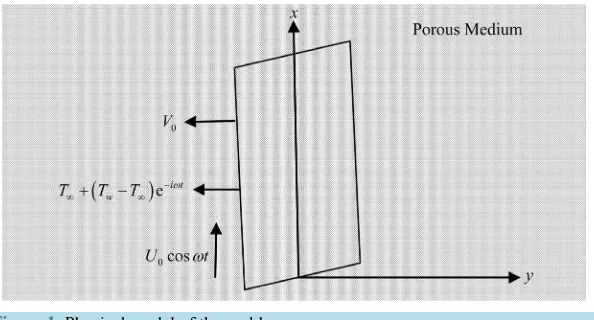
2.1. Mathematical Model of FlowTo study free convective flow and heat transfer through a vertical porous flate plate in the influence of radiative heat flux is considered (Figure 1). The axis of x is taken along the vertical plate and the axis of y is normal to the plate.The plate is oscillating in its own plane with a frequency of oscillation ω and mean velocity U0.
The temperature at the plate is also oscillating and the free stream temperature is constant T∞. A constant
suc-tion velocity V0 is applied at the oscillating porous plate. Since the plate is of semi infinite length therefore the
variation along x-axis will be negligible as compared to the variation along y-axis so
( )
. 0x ∂
= ∂
In view of the physical description the governing equations are defined as follows: The equation of continuity
0
u v
x y
∂ ∂
+ =
∂ ∂
reduces into
0
v y ∂
=
Figure 1. Physical model of the problem.
⇒v, is independent of y and v= −V0 (constant) is suction normal to the plate.
The momentum equation for the prescribed geometry is given by
2
2 0 2
1
u u p u
v u B u
t y x y
ν
ν σ
ρ κ
∂ + ∂ = − ∂ + ∂ − −
∂ ∂ ∂ ∂ (2)
Under usual Boussinesq’s approximation the Equation (2) becomes
(
)
2 20 2 0
u u u
V g T T u B u
t y y
ν
β ν σ
κ ∞
∂ − ∂ = − + ∂ − −
∂ ∂ ∂ (3)
The energy equation is given by
2
0 2
r
q
T T T
V
t y y y
α α
κ ∂
∂ − ∂ = ∂ −
∂ ∂ ∂ ∂ (4)
The associated boundary conditions are
(
)
0
0 : cos , e : 0,
i t w
y u U t T T T T
y u T T
ω
ω −
∞ ∞
∞
= = = + −
→ ∞ → → (5)
where u the flow velocity component in the x-direction, ν the kinematic viscosity, g the acceleration due to grav-ity, β the volumetric expansion coefficient, α the thermal diffusivity, κ the thermal conductivity, qr the
ra-diative heat flux, T the fluid temperature, T∞ the ambient temperature and U0 the amplitude of oscillation of
the plate.
The Roseland approximation for radiative heat flux [Brewster, 1992] is given by
4 4 3 r T q y σ δ ∂ = − ∂
where σ is Stefan – Boltzmann constant and δ is the mean absorption coefficient.
Taking the Taylor series expansion of T4 and neglecting terms with higher powers, we have
4 3 4
4 3
T ≈ TT∞ − T∞
2.2. Mathematical Formulation
Introducing following dimensionless quantities
(
)
2
* * 0 * * 0
2 0 0 3 3 0 , , , , , , , 4 w p w
tU T T yU
u
u t y
U T T U
C
g T T
Gr Pr R
Equations (3), (4) and the associated boundary conditions (5) reduces into
2
2 2
1
u u u
S Gr M u
Da
t y θ y
∗ ∗ ∗
∗
∗ ∗ ∗
∂ − ∂ = +∂ − +
∂ ∂ ∂ (6)
2
2
S
t y y
θ θ θ
α ∂∗− ∂∗ = ∂ ∗
∂ ∂ ∂ (7)
where, 0 0
V S
U
= is suction parameter, Gr the Grashof number, M the magnetic parameter, Da the Darcy
number, R the radiative parameter, Pr the Prandtl number, and 3
3 4
RPr R
α =
+
The corresponding boundary conditions are
0; cos ; e ; 0; 0
i t
y u t
y u ω ω θ θ ∗ ∗ ∗ ∗ ∗ ∗ − ∗ ∗ = = =
→ ∞ → → (8)
There is no loss of generality in omitting the asterisk from (6) to (8).
2.3. Numerical Solution
To solve the coupled nonlinear partial differential Equation (6) and (7) along with the boundary conditions (8), the solution for u and θ (after dropping *) the following form will be suitable
( )
, 1( )
e 1( )
ei t i t
u y t = f y ω + f y −ω (9)
( )
, 1( )
e 1( )
ei t i t
y t g y ω g y ω
θ = + −
(10) where f1
( )
y , f1( )
y , g1( )
y and g1( )
y are unknown to be determined.Invoking the Equations (9) and (10) in the Equations (6) and (7) and equating harmonic and non harmonic terms, the set of ordinary differential equations are given as
( )
( )
2( )
( )
1 1 1 1
1
f y Sf y i M f y Grg y
Da ω
′′ + ′ − + + =
(11)
( )
( )
2( )
( )
1 1 1 1
1
f y S f y i M f y Gr g y
Da ω
′′ + ′ + − + =
(12)
( )
( )
( )
1 1 1 0
g′′ y +Sg′ y −α ωi g y = (13)
( )
( )
( )
1 1 1 0
g′′ y +S g′ y +α ωi g y = (14) where, primes denote derivative with respect to y
The corresponding boundary conditions are
1 1 1 1
1
0; ; 0; 1 2
y= f = = f g = g = (15)
1 1 1
; 0; 0; 0
y→ ∞ f → g → g → (16) The Equations (13) and (14) are ordinary differential equations with prescribed boundary conditions as given in (15) and (16), therefore their solutions are straight forward are given by
( )
1 0
g y = (17)
( )
(
)
1 exp 1
g y = −λy (18)
where
(
)
2
1
4 2
S S α ωi
Now using expression of g1
( )
y and g1( )
y in the Equations (11) and (12) we get second order ordinarydifferential equations in f1
( )
y and f1( )
y given by( )
( )
2( )
1 1 1
1
0
f y Sf y i M f y
Da ω
′′ + ′ − + + =
(19)
( )
( )
2( )
( )
1 1 1 1
1
f y S f y i M f y Gr g y
Da ω
′′ + ′ + − + = −
(20)
In view of the boundary conditions associated with f1
( )
y and f1( )
y , the solution of the Equations (19)and (20) are known and given by
( )
(
)
1 2
1 exp 2
f y = −λ y (21)
( )
(
)
(
)
1 4 3 4 1
1
exp exp 2
f y = +λ −λ y −λ −λy
(22)
where 2 2 2 1 4 2
S S i M
Da ω λ + + + + = , 2 2 3 1 4 2
S S i M
Da ω λ + − − +
= and 4 2
1 1
Gr
S i
λ
λ λ ω
=
− +
are constant quantities.
Now substituting expression of f1
( )
y , f1( )
y , g1( )
y and g1( )
y in the Equations (9) and (10)( )
(
2)
4(
3)
4(
1)
1 1
, exp e exp exp e
2 2
i t i t
u y t = −λ y ω + +λ −λ y −λ −λy −ω
(23)
( )
, exp(
1)
ei t
y t y ω
θ = −λ −
(24)
3. Skin Friction
The skin-friction at the plate, which in the non-dimensional form is given by
2 3 4 1 4
0
1 1
e e e
2 2
i t i t i t
f
y
u C
y
ω ω ω
λ λ λ − λ λ −
=
∂
= = − − + +
∂
(25)
and computed values are given in Table 1.
4. Nusselt Number
The non dimensional coefficient of heat transfer defined by Nusselt number is obtained and given by
1 0
e i t
y
Nu y
ω
θ λ −
=
∂
= − =
∂
(26)
and computed values are given in Table 2.
5. Results and Discussion
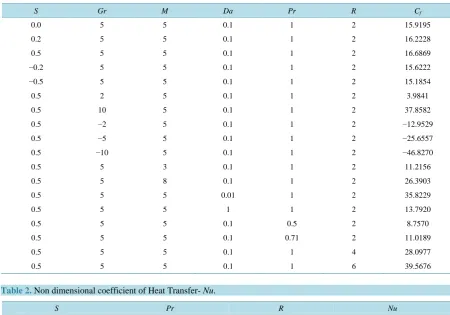
Table 1. Non dimensional coefficient of Skin Friction-Cf.
S Gr M Da Pr R Cf
0.0 5 5 0.1 1 2 15.9195
0.2 5 5 0.1 1 2 16.2228
0.5 5 5 0.1 1 2 16.6869
−0.2 5 5 0.1 1 2 15.6222
−0.5 5 5 0.1 1 2 15.1854
0.5 2 5 0.1 1 2 3.9841
0.5 10 5 0.1 1 2 37.8582
0.5 −2 5 0.1 1 2 −12.9529
0.5 −5 5 0.1 1 2 −25.6557
0.5 −10 5 0.1 1 2 −46.8270
0.5 5 3 0.1 1 2 11.2156
0.5 5 8 0.1 1 2 26.3903
0.5 5 5 0.01 1 2 35.8229
0.5 5 5 1 1 2 13.7920
0.5 5 5 0.1 0.5 2 8.7570
0.5 5 5 0.1 0.71 2 11.0189
0.5 5 5 0.1 1 4 28.0977
[image:6.595.86.537.98.413.2]0.5 5 5 0.1 1 6 39.5676
Table 2.Non dimensional coefficient of Heat Transfer- Nu.
S Pr R Nu
0.0 1 2 0.0004
0.2 1 2 0.0757
0.5 1 2 0.2058
−0.2 1 2 −0.0657
−0.5 1 2 −0.1479
0.5 0.5 2 0.2174
0.5 0.71 2 0.2110
0.5 1 4 0.2028
[image:6.595.105.538.390.700.2]0.5 1 6 0.2018
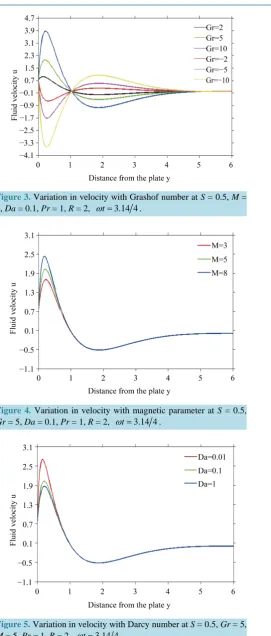
Figure 3. Variation in velocity with Grashof number at S = 0.5, M = 5, Da = 0.1, Pr = 1, R = 2, ωt=3.14 4.
Figure 4. Variation in velocity with magnetic parameter at S = 0.5, Gr = 5, Da = 0.1, Pr = 1, R = 2, ωt=3.14 4.
[image:7.595.197.433.468.686.2]Figure 6. Variation in velocity with Prandtl number at S = 0.5, Gr =
[image:8.595.199.433.288.468.2]5, M = 5, Da = 0.1, R = 2, ωt=3.14 4.
Figure 7. Variation in velocity with radiation parameter at S = 0.5, Gr = 5, M = 5, Da = 0.1, Pr = 1, ωt=3.14 4.
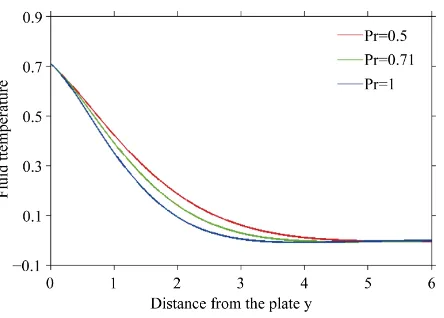
[image:8.595.198.433.505.685.2]Figure 9. Variation in temperature with Prandtl number Pr at S = 0.5, R = 2, ωt=3.14 4.
Figure 10.Variation in temperature with radiation parameter at S =
0.5, Pr = 1, ωt=3.14 4.
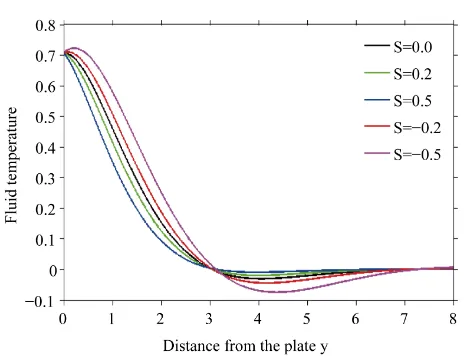
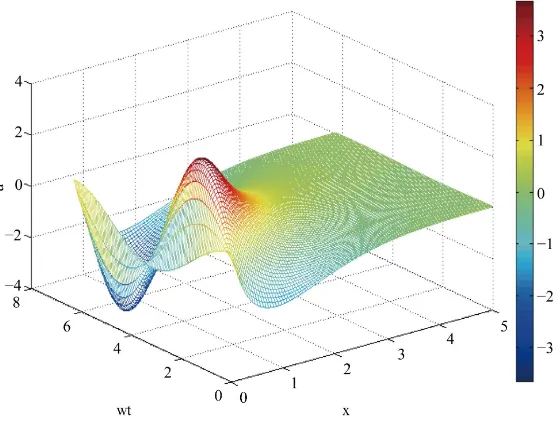
R is increased, velocity increases in the vicinity of the permeable plate while decreases in region close to non permeable wall. In Figure 8, the positive values of S correspond to cooling of the plate increases temperature decreases and the negative values of S correspond to heating of the plate decreases temperature increases. Fig-ure 9 and Figure 10 represent that temperature decreases when Prandtl number and radiation parameter R in-creases. The variation in fluid velocity and temperature in the porous medium through the one period of oscilla-tion is demonstrated by Figure 11 & Figure 12. The fluid velocity and temperature oscillates up to a certain distance from the plate while this oscillation diminishes at large distance from the plate.
Table 1 represents the values of skin friction. The positive values of S correspond to cooling of the plate in-creases skin friction inin-creases and the negative values of S correspond to heating of the plate decreases skin fric-tion decreases. The positive values of Gr correspond to cooling of the plate increases skin friction increases and the negative values of Gr correspond to heating of the plate decreases skin friction decreases. When M is in-creased the skin friction increases and when Da is increased skin friction decreased. When Pr and R is increased the skin friction increases.
The values of Nusselt number is given in Table 2. The positive values of S correspond to cooling of the plate increases Nusselt number increases and the negative values of S correspond to heating of the plate decreases Nusselt number decreases. When R and Pr are increased the Nusselt number decreases.
6. Conclusions
Figure 11.Variation in velocity with ωt and distance from the plate at S = 0.5, Gr = 5, M = 5, Da = 0.1, Pr = 1, R = 2.
Figure 12. Variation in temperature with ωt and distance from the plate at
S = 0.5, Pr = 1, R = 2.
wall on increasing suction parameter correspond to cooling of the plate.
• Fluid velocity profiles increase in the vicinity of the permeable plate while decrease in region close to non permeable wall with the increase in Grashof number correspond to cooling of the plate
• Fluid velocity profiles increase in the vicinity of the permeable plate while decrease in region close to non permeable wall when Prandtl number and radiation parameter is increased.
• Fluid velocity and temperature in the porous medium through the one period of oscillation oscillates up to a certain distance from the plate and this oscillation disappears far away from the plate.
• The values of skin friction increase when magnetic parameter, Prandtl number and radiation parameter are increased while the values of skin friction decrease when Darcy number is increased.
[image:10.595.175.456.342.552.2]References
[1] Soundalgekar, V.M. (1979) Free Convection Effects on the Flow Past an Infinite Vertical Oscillating Plate. Astrophys-ics and Space Science, 64, 165-171. http://dx.doi.org/10.1007/BF00640038
[2] Mansour, M.A. (1990) Radiation and Free Convection Effects on the Oscillatory Flow past a Vertical Plate. Astro-physics and Space Science, 166, 269-275. http://dx.doi.org/10.1007/BF01094898
[3] Soundalgekar, V.M. and Takhar, H.S. (1993) Radiation Effects on Free Convection Flow past a Semi-Infinite Vertical Plate. Modelling, Measurement and Control, B51, 31-40.
[4] Helmy, K.A. (1998) MHD Unsteady Free Convective Flow Past a Vertical Porous Plate. Journal of Applied Mathe-matics and Mechanics, 78, 255-270.
http://dx.doi.org/10.1002/(SICI)1521-4001(199804)78:4<255::AID-ZAMM255>3.0.CO;2-V
[5] Hossain, M.A., Das, S.K. and Pop, I. (1998) Heat Transfer Response of MHD Free Convective Flow along a Vertical Plate to Surface Temperature Oscillation. International Journal of Non-Linear Mechanics, 33, 541-553.
http://dx.doi.org/10.1016/S0020-7462(96)00151-5
[6] Raptis, A. and Perdikis, C. (1999) Radiation and Free Convection Flow past a Moving Plate. International Journal of Mechanical Engineering, 4, 817-821.
[7] Hossain, M.A., Alim, M.A. and Rees, D.A.S. (1999) The Effect of Radiation on Free Convection from a Porous Ver-tical Plate. International Journal of Heat and Mass Transfer, 42, 181-191.
http://dx.doi.org/10.1016/S0017-9310(98)00097-0
[8] Kim,Y. J. (2000)Unsteady MHD Convective Heat Transfer Past a Semi-Infinite Vertical Porous Moving Plate with Variable Suction. International Journal of Engineering Science, 38, 833-845.
http://dx.doi.org/10.1016/S0020-7225(99)00063-4
[9] Hossain, Md. Anwar and Pop, I. (2001) Radiation Effects on Free Convection over a Vertical Flat Plate Embedded in a Porous Medium with High Porosity. International Journal of Thermal Sciences, 40, 289-295.
http://dx.doi.org/10.1016/S1290-0729(00)01210-2
[10] El-Arabawy, H.A.M. (2003) Effect of Suction/Injection on the Flow of a Micro Polar Fluid past a Continuously Mov-ing Plate in the Presence of Radiation. International Journal of Heat and Mass Transfer, 46, 1471-1477.
http://dx.doi.org/10.1016/S0017-9310(02)00320-4
[11] Pathak, G.C., Maheshwari, H. and Gupta, S.P. (2006) Effect of Radiation on Unsteady Free Convection Flow Bounded by an Oscillating Plate with Variable Wall Temperature. International Journal of Applied Mechanics and Engineering,
11, 371-382.
[12] Chandrakala, P. and Antony, R.S. (2008) Radiation Effects on MHD Flow Past an Impulsively Started Vertical Plate with Uniform Heat Flux. Indian Journal of Mathematics, 50, 519-532.
[13] Das, K. (2010) Exact Solution of MHD Free Convection Flow and Mass Transfer near a Moving Vertical Plate in Presence of Thermal Radiation. African Journal of Medical Physics, 8, 29-41.
[14] Chandrakala, P. (2011) Radiation Effects on Flow past an Impulsively Started Vertical Oscillating Plate with Uniform Heat Flux. International Journal of Dynamics of Fluids, 7, 1-8.
[15] Ibrahim, S.Y. and Makinde, O.D. (2011) Radiation Effect on Chemically Reacting MHD Boundary Layer Flow of Heat and Mass Transfer through a Porous Vertical Flat Plate. International Journal of Physical Sciences, 6, 1508-1516. [16] Das, S., Jana, M. and Jana, R.N. (2011) Radiation Effect on Natural Convection Near a Vertical Plate Embedded in
Porous Medium with Ramped Wall Temperature. Open Journal of Fluid Dynamics, 1, 1-11.
http://dx.doi.org/10.4236/ojfd.2011.11001
[17] Chandrakala, P. (2011) Radiation Effects on Flow Past an Impulsively Started Vertical Oscillating Plate with Uniform Heat Flux. International Journal of Dynamics of Fluids, 7, 1-7.
[18] Manna, S.S., Das, S. and Jana, R.N. (2012) Effects of Radiation on Unsteady MHD Free Convective Flow Past an Os-cillating Vertical Porous Plate Embedded in a Porous Medium with Oscillatory Heat Flux. Advance in Applied Science Research, 3, 3722-3736.
[19] Vidyasagar, G. and Ramana, B. (2013) Radiation Effect on MHD Free Convection Flow of Kuvshinshiki Fluid with Mass Transfer Past a Vertical Porous Plate through Porous Medium. Asian Journal of Current Engineering and Ma-thematics, 2, 170-174.