The Feature-Based a New Object Coding Approach for
Prismatic Parts at the Part Modeling
Ismet Celik1*, Ali Unuvar2
1Mechanical Engineering Department, Dumlupınar University, Kutahya, Turkey 2Mechanical Engineering Department, Selcuk University, Konya, Turkey
Email: *[email protected]
Received July 25, 2013; revised August 26, 2013; accepted September 3,2013
Copyright © 2013 Ismet Celik, Ali Unuvar. This is an open access article distributed under the Creative Commons Attribution Li-cense, which permits unrestricted use, distribution, and reproduction in any medium, provided the original work is properly cited.
ABSTRACT
Use of features in order to achieve the integration of design and manufacture has been considered to be a key factor recent years. Features such as manufacturing properties form the workpiece. Features are structured systematically through object oriented modeling. This article explains an object coding method developed for prismatic workpieces and the use of that method in process planning. Features have been determined and modeled as objects. Features have been coded according to their types and locations on the workpiece in this given method. Feature codings have been seen to be very advantageous in process planning.
Keywords: Feature; Feature Based Modeling; Object Oriented Modeling; Process Planning
1. Introduction
CAPP is a function which determines manufacturing pro- cedures systematically by using computers for the gen- eration of a functional, economical and acceptable pro- duct with lasting quality [1]. CAPP, within CIM func- tions, is in a priority position which affects the whole manufacturing dominantly [2].
There are great difficulties in the integration of CAD/ CAPP/CAM systems in two stages. These are: 1) mo- deling the workpiece and 2) the representation and trans- fer of workpiece product data [3]. Feature and object based approaches are used to overcome these difficulties. CAPP systems include intense and complex information. It is advised to build CAPP systems as object oriented and workpiece models as workpiece and feature based. This approach is compatible with STEP standards that ISO is still working on. Current CAD systems can form workpiece models as parameters, restrictions and par-tially features. STEP (ISO 10303) standards aim work-piece modeling to be completely feature and object based. Again, recently developing STEP NC (ISO 14649) stan-dards include manufacturing information in an object- orientedly developed workpiece model.
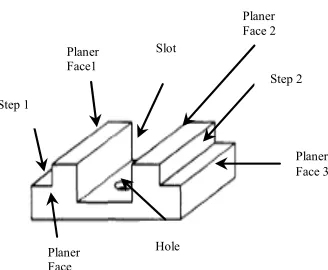
Features are a shape & form which allows the production of manufacture methods. All forms come together to
con-stitute the workpiece (Figure 1). Workpieces let the de-signer and CAPP systems to present high level informa-tion instead of low level informainforma-tion such as line, circle, point and vertex. The ability of the designer to choose parameters, features and restrictions is the most impor-tant stage of design stage [4].
The development of CAPP and computer systems to assist the process planner has started in 1960s [5]. These studies, together with the research efforts in subsequent years, resulted in two approaches for the development of computer-aided process planning systems, namely, the variant process planning systems, and the generative process planning systems [6-8]. One major reason is the lack of an effective method to represent the entire infor- mation needed for CAPP, and also to unify such infor- mation with that of other systems in the CIM environ- ment. Even the fewer CAPP practices could bring about substantial enhancement to manufacturing practices [9].
Step 2 Slot
Hole Step 1
Planer Face 3 Planer Face 2 Planer
Face1
[image:2.595.91.255.81.216.2]Planer Face
Figure 1. The features on the workpiece.
proach is becoming a very important tool for information representation in design operations. Object oriented rep- resentation is used to constitute a presentation chain, and objects are interacting on knots of that chain [11].
2. Literature Review
Eversheim and Marczinski formed a structural model designed for manufacture preparation operations [3]. Gindy and his friends presented feature based method regarding design issues as a workpiece of a CAPP system [12]. Zhang and Alting presented a product model in CIM, but that could not fully meet requirements of CAPP [1]. Need for an effective information model has been revealed as a result to be able to achieve a CAPP system which can be integrated in other systems and can fulfill its function in CIM [13]. The object paradigm enhances the expressive power of conventional database systems by providing an abstract model called a class, which de-scribes the structure and behaviour of its instances [14]. ISO started to develop standards which include common data structures and application models for integration of CAD-CAM systems [15-19]. Studies are being carried out to develop some CAD, CAPP and CAM systems based on this approach and standards. Chep and his friends worked on an object oriented system generating a proc- ess plan for machining process of prismatic features. It was constituted from three sections as system workpiece model, information model technologic database model. While workpiece model was defining workpiece entities which form the workpiece, information model defined specialist information. Technological database defined data for the bench, tools, processability and fixture [20].
Usher and Fernandes worked on an object oriented process planning system which selects tools in process planning. They generated object models including a cut-ting tools database for each workpiece [21]. Hang and his friends developed an object oriented system generating a process plan for manufacturing electrical circuit cards. Processes such as Cu coating, NC processing and sol-dering took place as operational database objects in this system. Each module was independent and had a feature
to be able to interact with each other when needed [22]. Ma and Tong proposed an object oriented system for plastic injection molding. They formed objects as chan-nels in the injection mould [23]. Hvam and his friends worked on an object oriented system named as CRC (class, responsibility, cooperation) cards which could be used in design operations. These cards ensured the objec-tification of system components. System component ob-ject information was written on these cards, and compo-nents were objectified. CRC cards are being used in the design of solid liquid separation equipment by Alfa La-val Separation Company [24].
Amaitik developed a feature based, object oriented process planning system called STEP-FM for prismatic workpieces. System is composed of selection, feature generation and addition, feature specification definition and feature STEP data generation processes. Each basic shape in the system is defined by name, shape, size pa-rameters, location and direction. Features are defined in accordance with STEP-AP standard, and workpiece is composed of these features [25]. An feature based me- thod for design in another study. Material management features were defined to be able to control material structure in object structure. That model was developed for not only geometric features, but also for structural requirements of each feature [26]. Hybrid 3D design ap-proach was defined by Luca and his friends. Predefined features in shape library were used to generate a template [27]. Van der Maiden and Bronsvoort developed a model for object families which they named Declarative Family of Object Models (DFOM). In this model, both geometry and topology was specified declaratively. Object family relations were modeled in DFOM [28].
Modelica is an object oriented language which is used for modeling of complex physical system components such as mechanical, electrical, electronical, hydraulic, thermal or automated control [33]. Santos and his friends pre-sented a new approach, Domain Specific Modeling Lan-guage (DMSL), to be used and applied in current object oriented structures. That approach is based on extension of the framework by coding layers added in framework based applications with DSML [34].
Recently, a new ISO standard called STEP NC (Stan-dards for Exchange of Product Data for Numerical Con-trol) is being tried to be developed to provide information model for CNC control units. These new standards are feature based and object oriented and described as ISO 10303 AP-238 and ISO 14649. These standards which also include manufacturing operations in feature and ob-ject structures provide high level information [19,35]. The goal at the end of these studies is to provide direct and complete information flow from design environment to CNC control unit (without the need to NC codes). Rameshbabu and Shunmugam developed a planning sys-tem which orders machining process for features forming a workpiece. They suggested a hybrid method including volume reduction and topologic relations on neighbor-hood surfaces for feature definitions. CAD data used for that study was STEP AP-203 interface file [36].
In the study, presented in this article, objectification of features forming a prismatic workpiece and coding of objects by using feature based and object oriented ap-proaches have been achieved. CAD data used for that study was STEP AP-203 interface file [36]. Features for- ming the workpiece have been extracted based on data taken from STEP AP203. Then, workpieces have been objectified through classification. Objects were defined by their variables and methods. One code has been assigned to each feature object. Developed method is important by these means. Objects were classified and codes were as-signed by taking the type of features and their locations on the workpiece into account. It was thought that object codes would simplify process planning significantly. Process planning can be done quite easily due to object codes [37]. Developed method was only explained for channel features in this article. Method also includes other features like hole, step and plane surface.
3. The Developed Method
Conducted study comprises the feature based-object ori-ented formation of geometric entities which forms pris-matic workpieces and coding of objects. The approach has been based on that the workpiece generated in CAD environment consists of features. Each geometric entity forming the workpiece is a feature. The feature can also be defined as an entity which can be generated by a spe-cific machining method. Features such as hole, layer,
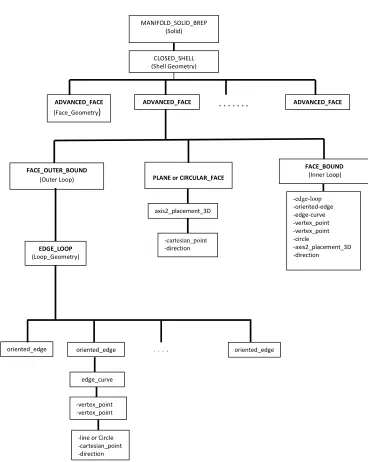
channel, level surface, cylindrical surface, screw, pocket, bill and radius are determined by the interpretation of STEP AP-203 CAD interface data. STEP AP-203 file generates 3D workpiece data in B-rep format, and the structure of this file is given in Figure 2 [37].
Geometric and topologic representation of Manifold solid B-rep in the structure of file has been defined in B-rep format. Outer extent of the solid is defined by closed shell. Closed shell is composed of surfaces de-fined by advanced faces. Each surface is represented by outer loops and inner loops where face outer bounds and face bounds are defined. Face bounds are composed of edge loops which are bounding surfaces. An edge loop is composed of directed edges. Edges respectively contain vertex points. So, geometric and topologic information can be obtained from STEP file defining 3D model. The extraction of features can be done by means of geometric information in workpiece model [17].
The scope of study covers the definition and coding of features according to their types and locations on the workpiece. The type of the feature is its geometrical sha- pe (channel, layer, hole, level surface, radius, pah, etc.). The location of the feature is the definition of feature sur- face normal and feature axis direction on the workpiece.
Feature recognition process is the extraction of current features through the interpretation of STEP AP-203 file of the workpiece designed in CAD environment. This is one of the most important stages of process planning operation. Features are extracted, and raw workpiece sizes are determined through the interpretation of STEP AP-203 file structure given in Figure 2.
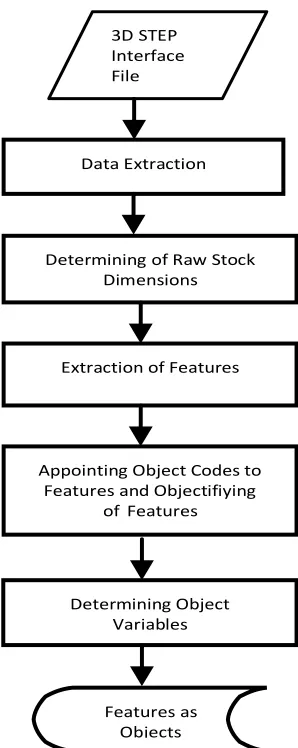
Topologic relations between surfaces are analyzed while features are being extracted, and type of the feature is assigned. Extracted feature are coded as their locations are interpreted. General algorithm of the developed method has been given in Figure 3.
In feature based modeling, features are structured in a class systematically according to their SUPER and SUB specifications. Developed method includes general defi-nitions for entities like channel, hole, pocket, bill and level surface on the highest level of SUPERTYPE fea-tures. General entity definitions at the highest level have SUPTYPE features on subsequent lower levels. For ex-ample; a channel SUPERTYPE feature has open and/or pocket shaped SUBYPE feature levels.
MANIFOLD_SOLID_BREP (Solid)
CLOSED_SHELL (Shell Geometry)
ADVANCED_FACE . . . . ADVANCED_FACE
(Face_Geometry)
ADVANCED_FACE
FACE_BOUND
(Inner Loop)
FACE_OUTER_BOUND
(Outer Loop) PLANE or CIRCULAR_FACE
axis2_placement_3D
-cartesian_point
-direction
EDGE_LOOP
(Loop_Geometry)
oriented_edge oriented_edge
edge_curve
. . . . oriented_edge
-edge-loop
-oriented-edge -edge-curve -vertex_point -vertex_point -circle
-axis2_placement_3D -direction
-vertex_point -vertex_point
[image:4.595.113.481.71.533.2]-line or Circle -cartesian_point -direction
Figure 2. The file structure of STEP AP-203.
3.1. Object Modeling and Coding of Channel Feature
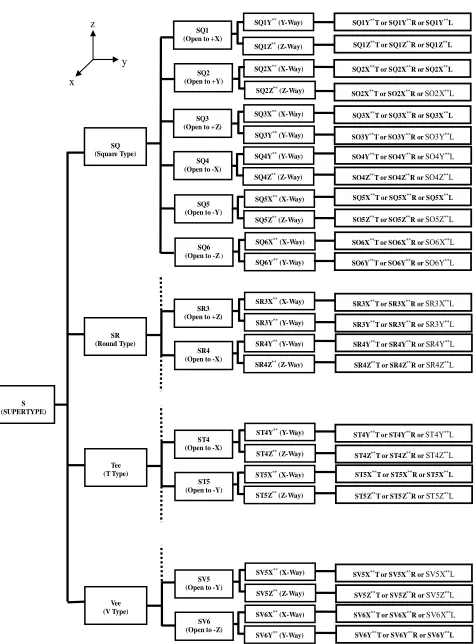
In this section, feature and object based generation and coding of a channel feature has been explained as an example. Figure 4 demonstrates the definition of channel feature. The highest object class level is the highest class for channels, and represented by code S (Slot). When manufacturing technologies are considered, it can be seen that one channel has four types on its first sub level. These are square, round, V (Vee) and T (Tee) channel types. This class level is the first SUBTYPE class level of highest SUPERTYPE class of channel feature accord-ing to object oriented definition. Channel classes at this level are represented by SQ for square channel, SR for
round channel, SV for V channel and ST for T channel. Second SUBTYPE class level is assigned according to the direction of channel base surface normal in Cartesian coordinate system. These can be in six directions as +X, +Y, +Z, –X, –Y and –Z. Numbers 1, 2, 3, 4, 5 and 6 con-secutively represent these directions. The axis direction of the channel is considered for the third SUBTYPE class level.
Data Extraction
Determining of Raw Stock Dimensions
Extraction of Features
Appointing Object Codes to Features and Objectifiying
ofFeatures
Determining Object Variables
[image:5.595.97.246.80.454.2]Features as Objects 3D STEP Interface File
Figure 3. Recognizing, coding and objectifiying of the fea-tures.
For example; a channel which is open at +Z direction at the second class level can have an axis in Y or X di-rection. Of course, it is possible that channel axis can have an angled value in X or Y direction. That is why channels at the third level are defined by 3 characters. While the first character represents the base axis direc-tion that is related to channel axis, other two characters represent the angle between the channel and the base axis. The consideration for the fourth class level is states of channel as open throughout, right closed and left closed. Channels which are closed from both right and left are pocket features, and defined in a different feature class. At that class level, (R) character shows that the axis di-rection is closed from positive side, and (L) character shows that the axis direction is closed from negative side. Open throughout channel is represented by code T.
Channel feature given in Figure 5 as an example has been coded with SQ3Y00L according to object structur-ing and codstructur-ing logic. The evaluation of this object in process planning will be like that. Code S of the object
shows that the feature is a channel, and code Q tells that the channel is square type. The third character of code chain which is 3 states that the channel is open at +Z direction in Cartesian coordinate system and the fourth character which is Y demonstrates that the channel axis is in Y base axis direction. 00 values as fifth and sixth characters define the angle between channel axis and Y axis as 0. The last code in the code chain, the seventh character code L, states that the channel is closed from –Y direction on the workpiece.
3.2. Use of Object Structure and Object Codes in Process Planning
Object oriented systematic modeling of features forming the workpiece and the assignment of codes provides a great help in process planning. The interpretation of in-terface file taken from CAD environment, the assignment of codes after features have been extracted and operation of process plan according to these codes are a big advan-tage for manufacture decision making. Because features are systematically defined as objects, and coded. Also, high level information which is called variables and methods defining the feature is defined in the object. A feature with its code and variables and methods involved in object structure submits a great amount of high level information to the process plan. Process plan interprets high level information involved in objects instead of low level information such as point, corner, line or round, and makes manufacture decisions without complexity and ambiguity.
Variables and methods which belong to the feature placed in the object are defined through the generation of an feature as an object. Variables are main characteristics of an feature. For example; variables of an feature repre-sented in object information are; material of the channel, reference point on the workpiece (RP), width (w), height (h), length (l), tolerances and channel surface quality (Ra) values. Methods are program components which deter-mine variables by either interpreting CAD interface file or interacting with the user. While methods can deter-mine geometric object variables from CAD data, can consult with the user for non-geometric variables (For example, surface quality and material type, etc.). Object codes of every object define the type and location of the object in the beginning. Object information of the object with code SQ3Y00L given in Figure 5 as an example is as follows: What process plan interprets from object code is that there is a channel feature on the workpiece which is open in +Z direction with 0 degree angle along Y axis and closed from –Y direction.
SQ1 (Open to +X)
S (SUPERTYPE)
SQ (Square Type)
SR (Round Type)
Tee (T Type)
Vee (V Type)
SQ2 (Open to +Y)
SQ3 (Open to +Z)
SQ4 (Open to -X)
SQ5 (Open to -Y)
SQ6 (Open to -Z )
SQ1Y**(Y-Way)
SQ1Z**(Z-Way)
SQ2X**(X-Way)
SQ2Z**(Z-Way)
SQ3X**(X-Way)
SQ3Y**(Y-Way)
SQ4Y**(Y-Way)
SQ4Z**(Z-Way)
SQ5X**(X-Way)
SQ5Z**(Z-Way)
SQ6X**(X-Way)
SQ6Y**(Y-Way)
SQ1Y**T or SQ1Y**R or SQ1Y**L
SQ1Z**T or SQ1Z**R or SQ1Z**L
SQ2X**T or SQ2X**R or SQ2X**L
SQ2X**T or SQ2X**R or SQ2X**L
SQ3X**T or SQ3X**R or SQ3X**L
SQ3Y**T or SQ3Y**R or SQ3Y**L
SQ4Y**T or SQ4Y**R or SQ4Y**L
SQ4Z**T or SQ4Z**R or SQ4Z**L
SQ5X**T or SQ5X**R or SQ5X**L
SQ5Z**T or SQ5Z**R or SQ5Z**L
SQ6X**T or SQ6X**R or SQ6X**L
SQ6Y**T or SQ6Y**R or SQ6Y**L
SR3 (Open to +Z)
SR4 (Open to -X)
SR3X**(X-Way)
SR3Y**(Y-Way)
SR4Y**(Y-Way)
SR4Z**(Z-Way)
SR3X**T or SR3X**R or SR3X**L
SR3Y**T or SR3Y**R or SR3Y**L
SR4Y**T or SR4Y**R or SR4Y**L
SR4Z**T or SR4Z**R or SR4Z**L
ST4 (Open to -X)
ST5 (Open to -Y)
ST4Y**(Y-Way)
ST4Z**(Z-Way)
ST5X**(X-Way)
ST5Z**(Z-Way)
ST4Y**T or ST4Y**R or ST4Y**L
ST4Z**T or ST4Z**R or ST4Z**L
ST5X**T or ST5X**R or ST5X**L
ST5Z**T or ST5Z**R or ST5Z**L
SV5 (Open to -Y)
SV6 (Open to -Z)
SV5X**(X-Way)
SV5Z**(Z-Way)
SV6X**(X-Way)
SV6Y**(Y-Way)
SV5X**T or SV5X**R or SV5X**L
SV5Z**T or SV5Z**R or SV5Z**L
SV6X**T or SV6X**R or SV6X**L
SV6Y**T or SV6Y**R or SV6Y**L
z
[image:6.595.65.539.76.720.2]y x
Object Code: SQ3Y00L
Variables:
Material type: from the user
Reference point (RP; X0,Y0, Z0): from CAD data
Length and tolerance (L, LT): from CAD data Width and tolerance (W, WT): from CAD data High and tolerance (H, HT): from CAD da and the user
Face roughness (Ra): from CAD data or the user
Methods:
[image:7.595.110.494.87.223.2]-Rules to determine the variables (with data from CAD data and user input)
Figure 5. SQ3Y00L object.
tolerance (lt), width (w), height (h), height tolerance (ht) and reference point (xo, yo, zo) are geometric variables.
Methods are the rules to determine variables. Because material type, tolerance, surface quality values cannot be obtained from CAD interface file, these information are requested from the user. Material type is defined for the first feature entered, and the same material type is as-signed to other features automatically by the system. So, SQ3Y00L coded object is generated with all the informa-tion required in manufacturing. As a result, SQ3Y00L coded feature is generated as an object.
CAD Module
Geometric Data
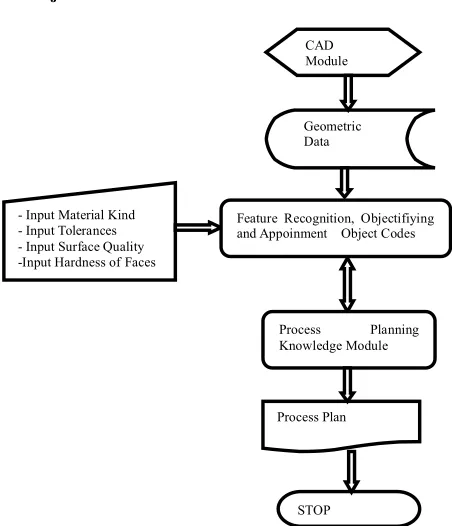
Method has been developed as feature based and ob-ject oriented. As a result, high level information for the feature required for manufacturing has been capsulated in the object. Object code defines the type and location of the object on the workpiece. That type of modeling is a big advantage for CAPP because CAPP easily deter-mines and orders operations according to object codes. Decisions required for operation parameters are deter-mined by object variables. General flow graphic of proc-ess plan for the interpretation of objects is in Figure 6. The workpiece binding-support surfaces and operations are determined according to the features forming the workpiece. The cutting tool is selected according to the material type. The finish processes is determined ac-cording to the surface quality and tool paths is deter-mined according to object variables. The method pre-sented in this article is only explained for channel fea-tures. Developed method also includes features like hole, step, pocket, boss, radius, pah and screw. Additional feature types can be added in the system.
4. Application Sample
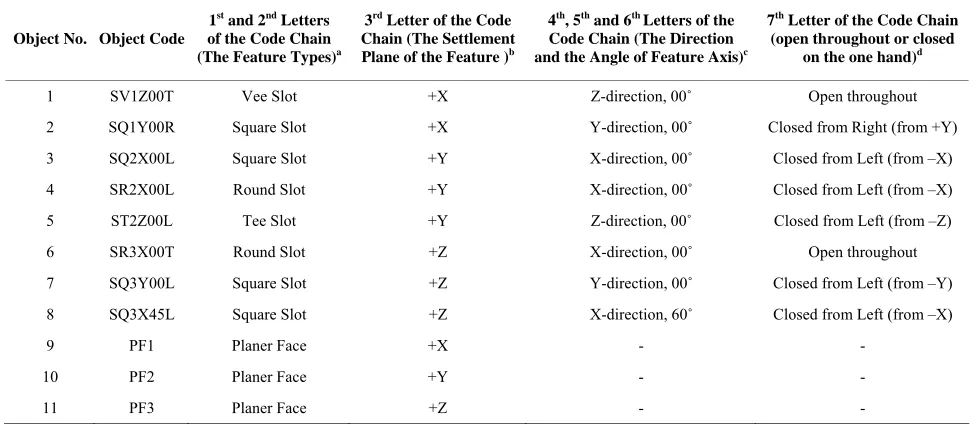
The workpiece in Figure 7 is given as an example with its forming features. An object code was assigned to each feature extracted from STEP AP-203 interface file. Raw workpiece sizes were determined based on geometric values of border features. Table 1 summarizes object code information and code assignment logic of the work-piece given in Figure 7. That information is used by
- Input Material Kind - Input Tolerances - Input Surface Quality -Input Hardness ofFaces
Feature Recognition, Objectifiying and Appoinment Object Codes
Process Planning Knowledge Module
Process Plan
[image:7.595.307.533.238.501.2]STOP
Figure 6. The use of object codes in the process planning.
[image:7.595.314.535.534.718.2]Table 1. Object codes and definitions as objects (from example part in Figure 7).
Object No. Object Code (
Chain (The
a
ter of the Code Chain 1st and 2nd Letters 3rd Letter of the Code 4th, 5th and 6th Letters of the 7th Let
of the Code Chain The Feature Types)a
Settlement Plane of the Feature )b
Code Chain (The Direction nd the Angle of Feature Axis)c
(open throughout or closed on the one hand)d
1 SV1Z00T Vee Slot +X Z-direction, 00˚ Open throughout
2 SQ1Y00R S Close +Y)
Round Slot
Close )
quare Slot +X Y-direction, 00˚ d from Right (from
3 SQ2X00L Square Slot +Y X-direction, 00˚ Closed from Left (from –X)
4 SR2X00L Round Slot +Y X-direction, 00˚ Closed from Left (from –X)
5 ST2Z00L Tee Slot +Y Z-direction, 00˚ Closed from Left (from –Z)
6 SR3X00T +Z X-direction, 00˚ Open throughout
7 SQ3Y00L Square Slot +Z Y-direction, 00˚ d from Left (from –Y
8 SQ3X45L Square Slot +Z X-direction, 60˚ Closed from Left (from –X)
9 PF1 Planer Face +X - -
10 PF2 Planer Face +Y - -
11 PF3 Planer Face +Z - -
a1st and 2nd letters of object code chain: They point out the type of features; b3rd number of code chain: 1, , 3, 4, 5 and 6 point out +X, +Y, – –Y, +Z and –Z 2 X,
settlement plane of the features, respectively; 4 , 5 and 6 letters of code chain: They indicade the axis direction and angle of the slots on the settlement c th th th
plane; d7th letter of object code: Throuhout open (T), closed from Left (L), closed from Right (R).
AP oftware. C P s
developed method in a CAPP system
, a method for CAD/CAM integration is The use of the
has been demonstrated in Figures 8 and 9. User interface of CAPP is given in Figure 8. At that stage, codes have been assigned to each feature determined by CAPP fea-ture recognition module. Material type is defined for the first feature, and the same value will be assigned to other features. The surface roughness value (Ra) will be
as-signed as 6.3 μm by the system automatically if not en-tered by the user. Process plan makes manufacturing de-cisions according to object codes and variables.
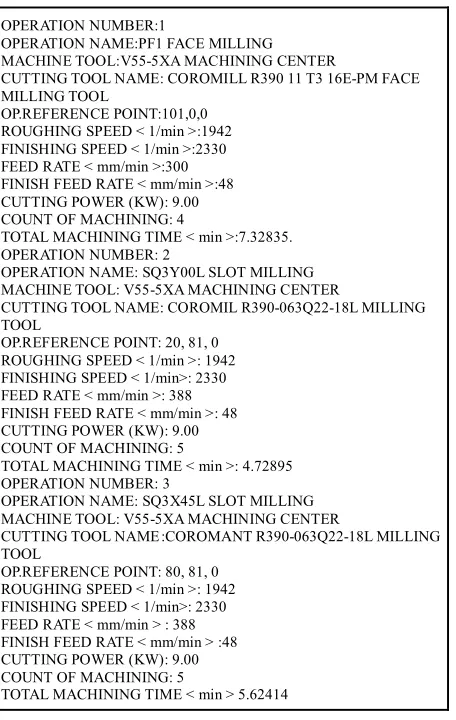
The process plan generated by process planning sys-tem by using objects and object codes is shown in Figure 9. Process plan determines operations needed for each feature. At this stage, planning is made for all features on the workpiece by researching feature codes determined before. Process plan determines raw material sizes, op-eration sequence number, opop-eration name, pass number in each operation, cutting edge, reference point for each operation, processing regime and operation time. Here can be seen that each operation belongs to a feature. Be-cause information needed to determine operational in-formation has been capsulated as an object in every fea-ture, process plan easily determines the manufacturing information required by each operation.
5. Results
In this paper
constructed as the feature based and object oriented. This method can be used for process planning during feature recognition and making manufacturing decisions. STEP
There is SV1Z00T feature. RAW MATERIAL DIMENSIONS:100,80.80
There is SQ1Y00R feature.
There is SQ2X00L feature. INPUT MATERIAL KIND:?3 There is SR2X00L feature. Code Material
There is ST2Z00L feature. 1 Ck35 There is SR3X00T feature. 2 Ck45 There is SQ3Y00L feature. 3 Ck60 There is SQ3X45L feature. 4 16MnCr5
There is PF1 feature. 5 4 CrMo4
There is PF2 feature. There is PF3 feature. There is PF4 feature. There is PF5 feature. There is PF6 feature.
[image:8.595.326.523.357.631.2]SV1Z00T face roughness (Ra = 6.3?):? SQ1Y00R face roughness(Ra = 6.3?):? SQ2X00L face roughness(Ra = 6.3?):? SR2X00L face roughness(Ra = 6.3?):? ST2Z00L face roughness(Ra = 6.3?):? SR3X00T face roughness(Ra = 6.3?):? SQ3Y00L face roughness(Ra = 6.3?):? SQ3X45L face roughness(Ra = 6.3?):? PF1 face roughness(Ra = 6.3?) :? PF2 face roughness(Ra = 6.3?) :? PF3 face roughness(Ra = 6.3?) :? PF4 face roughness(Ra = 6.3?) :? PF5 face roughness(Ra = 6.3?) :? PF6 face roughness(Ra = 6.3?) :?
Figure 8. User interface of feature recognition.
interface file from CAD systems are analyzed, and
fea-tures acted
atures are classified object orientedly according toforming the workpiece are extracted. Extr type fe
OPERATION NUMBER:1
OPERATION NAME:PF1 FACE MILLING MACHINE TOOL:V55-5XA MACHINING CENTER
CUTTING TOOL NAME: COROMILL R390 11 T3 16E-PM FACE MILLING TOOL
OP.REFERENCE POINT:101,0,0 ROUGHING SPEED < 1/min >:1942 FINISHING SPEED < 1/min >:2330 FEED RATE < mm/min >:300 FINISH FEED RATE < mm/min >:48 CUTTING POWER (KW): 9.00 COUNT OF MACHINING: 4
TOTAL MACHINING TIME < min >:7.32835. OPERATION NUMBER: 2
OPERATION NAME: SQ3Y00L SLOT MILLING MACHINE TOOL: V55-5XA MACHINING CENTER
CUTTING TOOL NAME: COROMIL R390-063Q22-18L MILLING TOOL
OP.REFERENCE POINT: 20, 81, 0 ROUGHING SPEED < 1/min >: 1942 FINISHING SPEED < 1/min>: 2330 FEED RATE < mm/min >: 388 FINISH FEED RATE < mm/min >: 48 CUTTING POWER (KW): 9.00 COUNT OF MACHINING: 5
TOTAL MACHINING TIME < min >: 4.72895 OPERATION NUMBER: 3
OPERATION NAME: SQ3X45L SLOT MILLING MACHINE TOOL: V55-5XA MACHINING CENTER
CUTTING TOOL NAME :COROMANT R390-063Q22-18L MILL TOOL
OP.REFERENCE POINT: 80, 81, 0 ROUGHING SPEED < 1/min >: 1942 FINISHING SPEED < 1/min>: 2330 FEED RATE < mm/min > : 388 FINISH FEED RATE < mm/min > :48 CUTTING POWER (KW): 9.00 COUNT OF MACHINING: 5
TOTAL MACHINING TIME < min > 5.62414
[image:9.595.62.290.82.442.2]ING
Figure 9. Output of process plan.
logic, and methods are determined. Process plan system see features forming the workpiece with their
codes while kes a
proc-ss plan by interpreting variables included in each feat
rk cturing engineering. Furthermore, pro-ct codes, which were developed at this
ufactur- ing Process Planning Systems,” Chapman & Hall, New York, 1994, pp.
[2] A. Hoda, E. E an, W. H. Davies,
ning
planning manufacturing, and ma
e ure.
The object coding logic which is developed in this me- thod is original. It is apparent that object codes will be very advantageous for process planning systems. When the process plan picks up the object code of each feature, it can analyze the feature type and location, and also de- termine operations which belong to the feature, operation sequence, reference points, tool paths, process regimes, process time for each operation, etc. by evaluating vari- ables in the object. As a result, it is determined and proved that the objectification and object codes have a great advantage in process planning operations.
6. Conclusion
At the CAD and CAM integration, feature based and object oriented part design will facilitate the wo s of design and manufa
cess planning obje
time, are providing significant advantages. These
meth-ods can be used for the complicated shaped parts.
REFERENCES
[1] H. C. Zhang and L. Alting, “Computerized Man 16-18.
l Maraghy, B. J. Agerm
W. El Maraghy, D. G. Eversheim, I. Halevi, H. B. Ham, H. J. Jasperse, A. Y. C. Kals, G. Nee, V. Sohlenius, H. K. Tipnis, C. A. Tönshoff, R. Van Luttervelt, H. P. Weill and F. J. Weindahl, “Evolution and Future Perspectives of CAPP,” CIRP Annals-Manufacturing Technology, Vol. 42, No. 2, 1993, pp. 739-751.
[3] W. Eversheim, G. Marczinski and R. Cremer, “Structured Modeling of Manufacturing Processes as NC-Data Prepa- ration,” CIRP Annals, Vol. 40, No. 1, 1991, pp. 429-432.
http://dx.doi.org/10.1016/S0007-8506(07)62022-8 [4] M. Duhwan, H. Soonhung, K. Junhwan and O. Youchon,
“A Set of Standard Modeling Commands for the His- tory-Based Parametric Approach,” Computer-Aided De- sign, Vol. 35, No. 13, 2003, pp. 1171-1179.
http://dx.doi.org/10.1016/S0010-4485(03)00022-8 [5] P. B. Berra and M. M. Barash, “Investigation of Auto-
mated Planning and Optimization of Metal Working Pro- cesses,” Report 14, Purdue Laboratory for Applied Indus- trial Control, 1968.
[6] C. H. Link, “CAPP, CAM-I Automated Process Planning System,” Proceedings of the 13th Numerical Control So-
ciety Conference, Cincinnati, March 1976, pp.
[7] D. K. Allen, “Process Planning Primer,” 19th CIRP In-
rt Process
ter Aided Process ternational Seminar on Manufacturing Systems, Penn State University, Pennsylvania, 1987.
[8] T. Lenau and L. Alting, “XPLAN—An Expe
Planning System,” Proceedings of the 2nd International
Expert Systems Conference, London, 1986.
[9] L. Alting and H. C. Zhang, “Compu
Planning: The State-of-the-Art Surrey,” International Jour-
nal of Production Research, 1989, pp. 553-585.
http://dx.doi.org/10.1080/00207548908942569
[10] A. Shah, F. Fotouhi, W. Grosky and J. Al-Muhtadi, “Op- erators of the Temporal Object System and Their Imple- mentation,” Information Sciences, Vol. 158, 2003, pp. 37-
68. http://dx.doi.org/10.1016/j.ins.2003.08.004
[11] D. C. Chatfield, T. P. Harrison and J. C. Hayya, “SCML: An Information Framework to Support Supply Chain Mo- deling,” European Journal of Operational Research, Vol.
196, No. 2, 2009, pp. 651-660.
http://dx.doi.org/10.1016/j.ejor.2008.03.027
[12] N. N. Z. Gindy, X. Huang and T. M. Ratchev, “Fea- ture-Based Component Model for Computer-Aided Proc- ess Planning Systems,” International Journal of Com-
puter Integrated Manufacturing, Vol. 6, No. 1-2, 1993,
pp. 20-26.
i.org/10.1016/S0736-5845(98)00023-4 http://dx.do
69-023X(02)00059-9 [14] S. Coulondre and T. Libourel, “An Integrated Object-
Role Oriented Database Model,” Data & Knowledge En- gineering, Vol. 42, No. 1, pp. 113-141.
http://dx.doi.org/10.1016/S01
e-Par
ms and
ustrial Automation Systems and
d I. K. Hui, “Ob-
or [15] ISO 10303-1, “Industrial Automation Systems and Inte-
t gration-Product Data Representation and Exchange-Part 1,” Overview and Fundamental Principles, 1994.
[16] ISO 10303-11, “Industrial Automation Systems and Inte-gration-Product Data Representation and Exchang 11: Description Methods,” The EXPRESS Language Ref- erence Manual, 1994.
[17] ISO 10303-203, “Industrial Automation Syste Integration-Product Data Representation and Exchange- Part 203,” Application Protocol: Configuration Controlled 3D Designs of Mechanical Parts and Assemblies, 1994. [18] ISO 10303-224, “Ind
Integration-Product Data Representation and Exchange- Part 224,” Application Protocol: Mechanical Product De- finition for Process Plans Using Machining Features, 2001. [19] ISO/DIS 10303-238, “Industrial Automation Systems and
Integration-Product Data Representation and Exchange- Part 238,” Application Protocols: Application Interpreted Model for Computerized Numerical Controllers, 2003. [20] A. Chep, L. Tricarico, P. Bourdet and L. Galantucce, “De-
sign of Object Oriented Database for Definition of Ma- chining Operation Sequences of 3D Workpieces,” Inter- national Journal of the Computer Integrated Manufactur- ing, Vol. 34, No. 2, 1998, pp. 257-279.
[21] J. M. Usher and K. J. Fernandes, “An Object Oriented Application of Tool Selection in Dynamic Process Plan- ning,” International Journal of the Computer Integrated
Manufacturing, Vol. 37, No. 13, 1999, pp. 2879-2894.
[22] W. L. Hang, Y. T. Hon, H. S. C. Alan an
ject Oriented Knowledge Based Computer Aided Process Planning System for Bare Circuit Boards Manufacturing,”
Computers in Industry, Vol. 45, No. 2, 2001, pp. 137-153.
[23] Y. S. Ma and T. Tong, “Associative Feature Modeling f Concurrent Engineering Integration,” Computers in In- dustry, Vol. 51, No. 1, 2003, pp. 51-71.
http://dx.doi.org/10.1016/S0166-3615(03)00025-3 [24] L. Hvam, J. Riis and B. L. Hansen, “CRC Cards for Prod-
uct Modeling,” Computers in Industry, Vol. 50, No. 1,
2003, pp. 57-70.
http://dx.doi.org/10.1016/S0166-3615(02)00143-4
Intel--
[25] S. Amaitik, “Development of a Step Feature Based ligent Process Planning System for Prismatic Parts,” Ph.D. Thesis, Middle East Technical Univesity, Ankara, 2005. [26] K. Samanta and B. Koc, “Feature Based Design and Ma-
terial Blending for Free-Form Heterogeneous Object Mo deling,” Computer-Aided Design, Vol. 37, No. 3, 2005, pp. 287-305. http://dx.doi.org/10.1016/j.cad.2004.03.005 [27] D. L. Luca, P. Veron and M. Florenzano, “Reverse Engi-
neering of Architectural Buildings Based on a Hybrid Modeling Approach,” Computers & Graphics, Vol. 30,
No. 2, 2006, pp. 160-176,
http://dx.doi.org/10.1016/j.cag.2006.01.020 [28] H. A. Van der Meiden and
Topological Constraints for Declarative Fam
W. F. Bronsvoort, “Solving ilies of Ob- jects,” Computer Aided Design, Vol. 39, No. 8, 2007, pp.
652-662. http://dx.doi.org/10.1016/j.cad.2007.05.013 [29] X. Z. Ye, H. Z. Liu, L. Chen, Z. Y. Chen, X. Pan and S.
Y. Zhang, “Reverse Innovative Design—An Integrated Product Design Methodology,” Computer Aided Design,
Vol. 40, No. 7, 2008, pp. 812-827. http://dx.doi.org/10.1016/j.cad.2007.07.006 [30] S. A. Ajila and A. B. Kaba, “Evolu
nisms for Software Product Line Process,” T
tion Support Mecha-
he Journal of
Semantics,” Computer Languages, Systems &
ols and Applica-
Systems and Software, Vol. 81, No. 10, 2008, pp. 1784-
1801.
[31] F. Logozzo, “Class Invariants as Abstract Interpretation of Trace
Structures, Vol. 35, 2009, pp. 100-142.
[32] T. Pulecchi, F. Casella and M. Lovera, “Object-Oriented Modeling For Spacecraft Dynamics: To
tions,” Simulation Modeling Practice and Theory, Vol. 18,
No. 1, 2010, pp. 63-86.
http://dx.doi.org/10.1016/j.simpat.2009.09.010 [33] M. Otter, “Modellica Ove
https://www.modelica.org/education/educationarwiev,” 2009. l-material w.pdf
nguages /lecture-material/english/ModelicaOvervie
[34] A. L. Santos, K. Koskimies and A. Lopes, “Automating the Construction of Domain-Specific Modeling La for Object-Oriented Frameworks,” The Journal of Sys-
tems and Software, Vol. 83, No. 7, 2010, pp. 1078-1093.
http://dx.doi.org/10.1016/j.jss.2010.01.047
[35] ISO 14649-1, “Data Model for Computerized Numerical Controllers: Part 1,” Overview and Fundamental Princi-
Method for Setup Planning from STEP ples, 2003.
[36] V. Rameshbabu and M. S. Shunmugam, “Hybrid Feature Recognition
AP-203,” Robotics and Computer-Integrated Manufac- turing, Vol. 25, No. 2, 2009, pp. 393-408.
http://dx.doi.org/10.1016/j.rcim.2007.09.014 [37] I. Celik, “Knowldege Based Process Plannin