http://dx.doi.org/10.4236/ojce.2016.63039
Standardization of BIM Objects:
Development of a Proposal for Portugal
Filipa Salvado, Maria João Falcão Silva, Paula Couto, Álvaro Vale e Azevedo Buildings Department, LNEC, Lisbon, Portugal
Received 12 September 2015; accepted 6 June 2016; published 9 June 2016
Copyright © 2016 by authors and Scientific Research Publishing Inc.
This work is licensed under the Creative Commons Attribution International License (CC BY). http://creativecommons.org/licenses/by/4.0/
Abstract
The management of information systems contributes to the economic development of the con-struction sector by organizing and structuring technical and economic information. It is proposed how BIM (Building Information Modelling) and a Portuguese information system-ProNIC (abbrev-iation for Protocol for the Standardization of Construction Technical Information) may be inter-connected. The scope of this information transmission in construction sector is a step to solve several problems that have been identified in conception of BIM models.
Keywords
BIM Objects, Standardization, Technical Information, ProNIC
1. Introduction
In Portugal, the use of BIM (Building Information Modelling) methodology in the construction industry is not yet widespread [1]. However, it is unquestionable that BIM models are a reality to consider with extremely im-portant contributions, not only for the design phase, but also for the remaining ones, contributing to the devel-opment of construction sector [2] [3]. Its implementation in the medium and long term will bring success and effectiveness to the sector, considering that it is a methodology for information and communication sharing be-tween all stakeholders and at all phases of a building life cycle [4].
Informa-tion brought higher complexity to design process and a bigger amount of technical informaInforma-tion to the process. The CICS followed this development contributing to a better organization and efficiency [8].
Actually, there are some modern CICS developed internationally, that are a reference for the construction sector. Next is presented some of them, their philosophy and applicability.
Uniclass (Unified Classification for the Construction Industry) is a new classification scheme for the con-struction industry. It is intended for organizing library materials and for structuring product literature and project information. It incorporates both CAWS (Common Arrangement of Work Sections for building works) and EPIC (Electronic Product Information Co-operation), a new system for structuring product data and product li-terature. Uniclass comprises 15 tables, each of which represents a different broad facet of construction informa-tion. Each table can be used as a “stand alone” table for the classification of a particular type of information, but, in addition, terms from different tables can be combined to classify complex subjects [9] [10].
The OmniClass Construction Classification System [11] is a means of organizing and retrieving information specifically designed for the construction industry. OmniClass is useful for many applications in the area of Building Information Modeling (BIM), from organizing reports and object libraries to providing a way to roll up or drill down through data to get the information that meets your needs. OmniClass draws from other extant systems in use to form the basis of its tables wherever possible (MasterFormat for work results, UniFormat for elements, and EPIC (Electronic Product Information Cooperation) for products). OmniClass consists of 15 hie-rarchical tables, each of which represents a different facet of construction information. Each table can be used independently to classify a particular type of information, or entries on it can be combined with entries on other tables to classify more complex subjects.
The Industry Foundation Classes (IFC) [12] data model is intended to describe building and construction in-dustry data. It is a platform neutral, open file format specification that is not controlled by a single vendor or group of vendors. It is an object-based file format with a data model developed by buildingSMART (formerly the International Alliance for Interoperability, IAI) to facilitate interoperability in the architecture, engineering and construction (AEC) industry, and is a commonly used collaboration format in Building information model-ing (BIM) based projects. The IFC model specification is open and available. It is registered by ISO and is an official International Standard ISO 16739:2013 [13].
3. Protocol for the Standardization of Construction Technical Information
in Portugal (ProNIC)
The main objective of ProNIC is to develop a CICS for the Portuguese construction, in accordance with the standards and the “know-how” about this subject.
ProNIC is a research project developed by a team of three Portuguese research, development and innovation institutes (which integrate LNEC—National Laboratory for Civil Engineering). The main purpose is to develop an information management system to support the construction industry that allows the simplification of pro-ceedings related to contracts and make available both technical and economic information in a structured and standardized way [7] [14] inFigure 1.
Figure 1. ProNIC details [8].
In his base, ProNIC is a breakdown structure, commonly referred in English literature as Work Breakdown Structure (WBS). This structure may be more or less detailed in terms of associations or links established and dependent of the detailed degree desired. Contrarily to what occurs in other systems, ProNIC WBS, being the basis of all information produced, has been the object of a structured and comprehensive development in order to achieve a higher degree of detail. The task of defining the structure desegregation has been one of the main works.
The ProNIC work classification criterion presents a division by groups, subgroups and items (the construction work) assigned to a particular code (the same code is always assigned to the same construction work). An item presents the description of the construction work, which will be edited and after integrated on the Work and Quantities Statement. After the definition of an item the user can perform the measurements and the cost esti-mate.
Linked with the item there are files with work and material technical specifications. These files are individual and seek the principle that each type of work has a description of how it is performed (a work specification file), and files with specifications for each different used material.
ProNIC comprehend the entire construction life cycle. From above, it is verifiable that it serves first the de-signer and the work owner needs, mainly during the construction design and procurement. However, its struc-ture contains feastruc-tures that are transversal to all the constructive process, as the work contract process (designer and contractor/sub-contractors), construction (contractor and technical supervision) and use (maintenance provi-sions). It is expected that, in Portugal, ProNIC will be mandatory for use in public works process.
4. Standardized Information in BIM Objects
4.1. FrameworkBIM methodology presents, as main asset, the possibility of an accurate representation of the objects geometry of a construction, together with the integration of information and organized data in several dimensions [15] [16].
The constructive process starts from the owner idea of developing a project. This process gains information in different stages, information that is added to the process. The combination of documents, from drawings, images or written elements need to be defined during the design. The structural and data standardization of the attached documents has several advantages for the management of the different actors, both in terms of achievement, but also in view of a broad range of achievements that are developed by a given actors. In terms of construction sector assessment, it’s possible to collect the data that will “feed” on the performance indicators [4] [6].
In this aspect, ProNIC is well developed, because it incorporates technical content and items in different documents with details about work execution, materials and costs, associated to each construction work. This information is standardized and in accordance with the engineering projects under applicable European Standard. It also includes informatics applications of different interface modules with different users allowing them to work in a collaborative environment.
tech-1. Defining normalized procedures for the parameterization of BIM models and the type of information and level of detail in each step of construction process;
2. Implementing and defining the configuration of fundamental principles in order to obtain an evident, objec-tive and concise information in accordance with applicable law and Portuguese reality;
3. Making correspondence between the parameterization of BIM methodology and the ProNIC classification of construction articles;
4. Associating each parameterized building BIM object with a few ProNIC articles. The engineering projects are the same in ProNIC and BIM methodology and are in accordance with the provisions of “Portaria no. 701-H/2008” (in the case of Portuguese law, transposed from the European Standards) [17];
5. Integrating the technical information available on ProNIC in each parameterized BIM object;
6. Organizing ProNIC articles associated to BIM objects with the aim to prepare the technical documents, measurement details, work quantities and budget estimates. ProNIC makes a direct connection of project in-formation to planning and construction management modules.
4.3. Practical Example
As an illustrative example, a BIM object is presented–a window designed in appropriate software.
Associated with this BIM object, in ProNIC, there are two construction works (1.related to the frame and 2. related to the glass):
1. “Exterior window $1 $2 $3, deformation (wind resistance) class $4, pressure (wind resistance) class $5, wa-ter tightness class $6, $7, $8, $9, $10, $11, $12, air permeability class $13, $14, $15, $16 including hoops, sealants, fixations, accessories, supplies, transportation, charge, discharge and placement, according to the design detailed and technical specifications”.
2. “Glass base material $1 $2 $3 $4 $5, thickness $6 [mm], $7 $8 $9 $10 $11 $12 $13 $14 $15 $16 $17 $18 in-cluding sealants, fixations, accessories, supplies, transportation, charge, discharge and placement, according to the design detailed and technical specifications”.
The options, with the $ symbols represents technical specifications (Figure 2).
This information are in accordance with the parameters required for CE windows marking and are prescribed in European Standard (EN 13830:2003) [18], transposed to the Portuguese law.
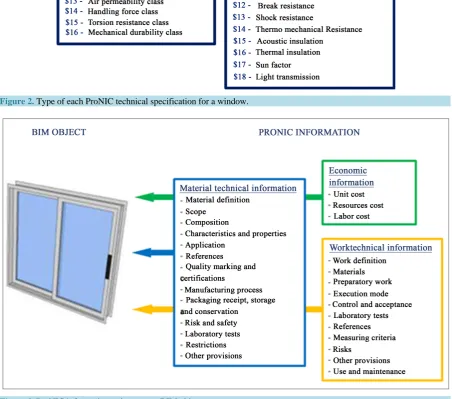
To define a BIM object, each user must fill the technical and economic specifications according with the re-sults of laboratory tests.
The technical and economic information available for these ProNIC items (Figure 3) can be used to match the corresponding BIM object.
5. Final Remarks
The ideal integration scenario, for the information system in the construction industry, is one that all actors are interconnected and work in a collaborative mode, throughout all phases of the building life cycle and all tools communicate in order to produce the desired results.
Figure 2. Type of each ProNIC technical specification for a window.
Figure 3. ProNIC information to integrate a BIM object.
The example presented in this paper, though still at a preliminary stage, aims to integrate the technical and economic information already normalized for several BIM objects.
References
[8] Sousa, H., Moreira, J. and Mêda, P. (2008) ProNIC and the Evolution of the Construction Information Classification Systems. GESCON.
[9] Andamp, E.A. and Häggström, L. (2016) Building Classification for BIM—Reconsidering the Framework. Proceed-ings of the CIB W078-W102: 2011 Joint International Conference, Sophia Antipolis, 26-28 October 2016.
http://2011-cibw078-w102.cstb.fr/papers/Paper-20.pdf
[10] (1994) Classification of Information in the Construction Industry. Tech. Rep. 14177, ISO TC 59 SC/WG2, Oslo, In-ternational Organization for Standardization.
[11] OmniClass—A Strategy for Classifying the Built Environment. Introduction and User’s Guide. Edition: 1.0.
[12] Adalsteinsson, G.O. (2014) Feasibility Study on the Application of BIM Data for Facility Management. Reykjavik University, Reykjavik.
[13] ISO 16739:2013—Industry Foundation Classes (IFC) for Data Sharing in the Construction and Facility Management Industries.
[14] (2011) ProNIC Contribution for Processes Sustainability, Universidade de Aveiro. www.centrohabitat.net/
[15] Van Nederveen, G.A. and Tolman, F.P. (1992) Modelling Multiple Views on Buildings. Automation in Construction, 1, 215-224.http://dx.doi.org/10.1016/0926-5805(92)90014-B
[16] CRC Construction Innovation 2007—Adopting BIM for Facilities Management: Solutions for Managing the Sydney Opera House.
[17] Mandatory Contents of Program and Project Implementation and Standards to Adopt in the Preparation and Staging of Public Works Projects (Published by Portaria n.º 701 H/2008, de 29 de julho). Diário da República, n.º 145/2008, Série I, de 29 de julho de 2008, 5106(37)-5106(80). (In Portuguese)
![Figure 1. ProNIC details [8].](https://thumb-us.123doks.com/thumbv2/123dok_us/7920750.747446/3.595.125.487.84.254/figure-pronic-details.webp)