http://dx.doi.org/10.4236/ica.2013.44045
Observer for Linear Distributed-Parameter Systems with
Application to Isothermal Plug-Flow Reactor
Nadia Barje1, Mohamed Elarbi Achhab1, Vincent Wertz2 1
LINMA, Department of Mathematics, Faculty of Sciences, Université Chouaib Doukkali, El Jadida, Morocco 2
CESAME, Université Cathoulique de Louvain, Louvain-La-Neuve, Belgium Email: [email protected]
Received July 27,2013; revised August 27, 2013; accepted September 5, 2013
Copyright © 2013 N. Barje et al. This is an open access article distributed under the Creative Commons Attribution License, which permits unrestricted use, distribution, and reproduction in any medium, provided the original work is properly cited.
ABSTRACT
This paper presents a conception of an exponential observer for a class of linear distributed-parameter systems (DPSs), in which the dynamics are partially unknown. The given distributed-parameter observer ensures asymptotic state esti- mator with exponentially decay error, based on the theory of -semigroups in a Hilbert space. The theoretical ob- server developed is applied to a chemical tubular reactor, namely the isothermal Plug-Flow reactor basic dynamical model for which measurements are available at the reactor output only. The process is described by Partial differential equations with unknown initial states. For this application, performance issues are illustrated in a simulation study.
0 C
Keywords: Distributed-Parameter Systems; -semigroup; Exponential Observers; Perturbed Systems; Tubular Reactor
0 C
1. Introduction
In many physical systems (e.g., bio-reactor, vibrations problems in mechanics, diffusion problems), the states of the mathematical model depend on spatial variable, which is a position in a one-dimensional or multi-dimen- sional space. This kind of system is called distributed- parameter system(s) (DPSs) (see [1]). A powerful tool in the analysis of DPSs is the theory of -semigroups (see [2,3]).
0 C
For the state feedback control, the exact and full knowledge of sates of the system is important. However, the presence of spatial variables makes the state not available for direct measurements and that imposes limi- tations to the design. In such case, the states can be esti- mated using state estimators (observers). For this purpose, the classical theory of the Luenberger observer [4] has been extended from linear finite-dimensional systems to a large class of DPSs by many authors, (we mention as examples [5-10] and the references within). However, research on efficient and practicable observer design for DPSs has not been so extensive as in the case of finite- dimensional systems, and papers on distributed-parame- ter observers are scattered in the literature.
In This paper, we focus on estimating the states of lin- ear DPSs with partially unknown dynamics. The paper
presents an exponential distributed-parameter observer design which is an asymptotic state estimator with expo- nentially decay error. The proposed conception is effi- cient and suitable in practice applications; for instance, it is appropriate to be applied to estimate the states of a chemical tubular reactor, namely the isothermal Plug- Flow Reactor basic dynamical model, with unknown initial state, in the case where measurements may occur at the reactor output only.
2. Infinite Dimensional Observer Design
Let consider the linear Infinite-Dimensional system given by
, 0 0x Ax t Bu t
y t Cx t x x
(1)
Here, A is the infinitesimal generator of a 0- semigroup on a real Hilbert space
C H with inner prod- uct .,. and the induced norm . , y t
Y is the known output function associated to the unknown initial condition x
0 , is another real Hilbert space andis a bounded linear operator from Y
C H into . The
dot over a variable means the time derivative of the var- iable.
The purpose is to design a dynamic system (observer or state estimator) for the system (1) by using as the input such that the output of this designed dynamic sys- tem is used as an estimate of the current state
y
x t of (1).The initial state of (1) is unknown while the initial state of the observer can be assigned arbi-trarily. Thus, the error between and is still an unknown quantity even if we know . As a basic requirement in observer design, we require that if
then
0 x
ˆ
ˆ 0 x
0
0 x
ˆ 0 x
ˆ 0 x
ˆ 0x x x t x t
for all . So, theobserver for (1) can be expressed in the following form
0
t
0ˆ ˆ ˆ
ˆ 0 ˆ .
x t Ax t Bu t L y t Cx t
x x (2)
where L is the observer gain operator.
Proposition 2.1: Given the linear infinite-dimensional system (1). Suppose that there exists a bounded linear operator L from H into H such that the linear op- erator A LC
T t is the infinitesimal generator of a 0- semigroup
0
t on
C
H, such that there exist con- stants M0 and 0 and a time t satisfying:
exp
,T t M t t t
then the dynamic system (2) with arbitrary cho-sen is an exponential observer for system (1) and
ˆ 0 x
ˆ exp
x t x t k t
for all tt
0 0, where is a positive number depending on
k
ˆx x .
Proof 1 Let consider the estimation error
, for all , the evolution sys- tem,
ˆ
e t x t x t e
0 H
0 ˆ0 0e t A LC e t
e x x
(3)
has a unique mild solution on the interval
0,
, given by: e t
T t e
0 , for all t0 (see [2,3]).Hence,
0 , 0e t T t e t
Thus, the error satisfies:
exp
,e t T t t t t
and that implies that the norm of the difference
ˆ
x t x t will decrease exponentially to zero. This competes the proof.
Let now suppose that linear operator A is the infini- tesimal generator of a 0-semigroup A t0 and
is linear bounded operator on
C
T
t
D H. The following
result will be needed in the sequel.
Theorem 2.2: [3] The operator AD is the infini-
tesimal generator of a C0 -semigroup
TA D
t
t0
s x s0d which is the unique solution of the equation
0
0
A D A A D
T t x T t x T ts DT 0
t A
for all x0H . If in addition, TA
t Mexp
t ,then,
t
0 b exp M bC C A D
T t M D
2
3. Application to the Plug-Flow Reactor
Basic Model
The theory presented in the linear infinite-dimensional sitting in Section 2, is applied to reconstruct the states of a chemical tubular reactor with the following chemical reaction:
1
C (4)
where 1 is the reactant, 2 the product, and is the stoichiometric coefficient of the reaction. The dy- namics of the process in a tubular reactor without axial dispersion are given, for all time and for all
C
0
t
0,z L where is the reactor length, by mass bal- ance equations (see [11]):
L
1 1 0 1 0 1 k x bk x 2 2 w in x x x t t z x x t z (5)with the boundary conditions:
x
1 0, 0, 2 0, 0
x z t z t (6)
and the initial conditions:
0,
01 , 0 1 2 , 0 2
x z t x x z t x (7)
where x z t1
, ,x2 z t, ,xin
z,t and are the con- centrations of 1 and 2 (mol/l), the influent reactant concentration (mol/l) and the fluid superficial velocity (m/s). We assume that the kinetics depend only on the reactant concentrationC C
1
x and we consider a reaction rate model of the form 0 1, where 0 is the kinetic constant
k x k
1s . w
.0
z
denotes a finite unit impulse of window width w, i.e. an approximate Dirac delta distri- bution at , given by
1, 0, sewhere. w w z z z if 0, el 0 2 wThe initial states 0 1,
x x are supposed to be unknown hereafter.
Throughout the sequel, we assume
2 2
0, 0,
x x1, 2
, y y1, 2
x y1, 1 L2 x y2, 2 L2 and the induced norm
2 22 2
1, 2 1L 2 L
x x x x
for all
x x1, 2
T and
in T 1, 2y y H .
A partial-differential equations like (5)-(7), when ex- pended with an output equation, can also be expressed as an abstract state space equation on the Hilbert space H:
, 0 0 x t Ax t Bu ty t Cx t x x
(8)
associated to the unknown initial condition
0 0 T0: 1, 2
x x x . Where, x
.,stands for the time derivative of the state x t
x1 t
,x2 .,t
T, and the control. The control operator is a bounded linear operator from
in
u t x t B
2
IR to H, which is defined by
.0 w
B
The output trajectory is a bounded linear operator, and the linear operator
C
A is defined on its domain,
12
1,2
: is absolutely continuous,
d
and 0 0
d i
x
D A x H x
x x H x z by, 0 1 2 0 d 0 d d d k x z Ax x bk z
The operator A is the infinitesimal generator of a 0-semigroup t on
C
0
TA t H , exponentially stable,i.e., there exist constants M k, 1IR
such that,
exp
1
, 0A
T t M k t t
Satisfying,
11
21 220
A
T t
T t
T t T t
such that for all
x x1, 2
H, (see [11] and the refer- ences within for more detail),
0
1
11 1
exp if
0 i
k t x z t z t
T t x z
z t f ,
2
22 2
if ,
0 if
and
21 1 0 22 0 11 d .
t
T t x
T ts bk T s sRemark 3.1 [11] It can be observed that the C0- semigroup
0
t
T t is such that T t x
0 for allxH , for all tL, whence the stability bound is rather conservative and is only of interest for t small.
More specifically, Remark 3.1 could lead us to deduce intuitively that the growth bound 0 of the -semi- group
0
C
T t
t0, defined as follows:
0 0 log inf t T t t is equal to .
3.1. Observer Design
Hereafter we consider measurements of the state vector
x t are available at the reactor output only. In this case, the output function y
. is defined as follows: we con- sider a (very small) finite interval at the reactor output
1,1
such that:
1 1 ,1 0
: , d ,
y t Cx t
a x a t a t IR
(9)where, 1,1
a 1 if a
1 ,1
and1,1
a 0 elsewhere, with 01 is a small number.
The observer operator C H: IR2 is linear bounded. For all x y, H IR2
,
2 2 2 1 1 ,1 0 1 1 ,1 0 , ,,. , d
IR . d ,
IR IR
Cx y a x a a y
x a a y
aThe adjoint operator C of C is defined for all
z t,
0,1IR by:
C y
z 1 ,1
z y
For all xH,
2
2 1 1
1 1 ,1
0 0
2 1
1 ,1 0
2 2 2 2
[1 ,1]
,. d d
,. d
C Cx z a x a a z
a x a a
x x
Then, C C
,
x z t z t
T t x z
z t
ob-
1 1
0 1 1 1 1 1 1
2 2
0 1 2 2 2 2
ˆ ˆ
ˆ
ˆ ˆ
ˆ ˆ
in
x x
k x x t gC C x C x
t z
x x
bk x gC C x C x
t z
ˆ
1,
(10)
with the boundary conditions:
1 2
ˆ 0, 0,
ˆ 0, 0
x z t
x z t
(11)
and the initial conditions:
0 1
0
2 2
ˆ , 0 ˆ
ˆ , 0 ˆ
x z t x
x z t x
(12)
With defined by (9) and g the is a
positive number.
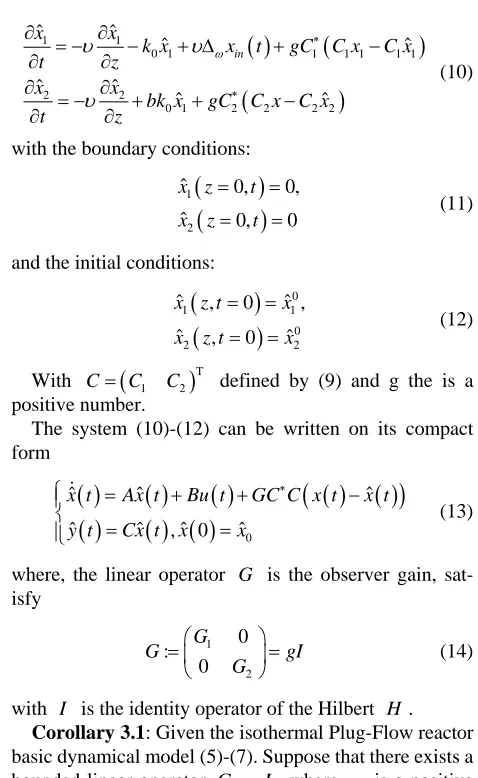
T1 2
C C C
The system (10)-(12) can be written on its compact form
0ˆ ˆ ˆ
ˆ ˆ ,ˆ 0 ˆ
x t Ax t Bu t GC C x t x t
y t Cx t x x
(13)
where, the linear operator is the observer gain, sat- isfy
G
1 2 0 :
0
G G
G
gI (14)
with I is the identity operator of the Hilbert H .
Corollary 3.1: Given the isothermal Plug-Flow reactor basic dynamical model (5)-(7). Suppose that there exists a bounded linear operator GgI , where g is a positive number, such that gk0, the dynamic system (10)-(12) is an exponential observer for the system (5)-(7).
Proof 2 Let consider the linear operator GgI , where g is a positive number. The operator is a bounded linear operator on
GC C H , such that
GC C g.
On the other hand, from Remark 3.1 and the definition of the growth bound, there exists a time tk0 such that
0 0
log
, k
T t
k t t
t
Hence,
exp
0
, k0T t k t t t
Now, by the Theorem 2.2, the linear operator A GC C is the infinitesimal generator of a C0-semi- group
satisfying, for all :0
A GC C t
T t
ttk0
0 0 exp
exp A GC C
T t k GC C
k g t
If k0
g
, it follows by application of the Theorem 2.1,
that the dynamic system (10)-(12) is an exponential ob- server for the system (5)-(7). More precisely the reconstruction error x tˆ
x t
satisfies, for all ttk0,
0
ˆ ˆ 0 0 exp
x t x t x x k g t
3.2. Simulation Result
In order to test the performance of the proposed observer, numerical simulations will be given. The equations have been integrated by using a backward finite difference approximation for the first-order space derivative z. The adopted numerical values for the process parameters are taken from the Table 1 (see [12]).
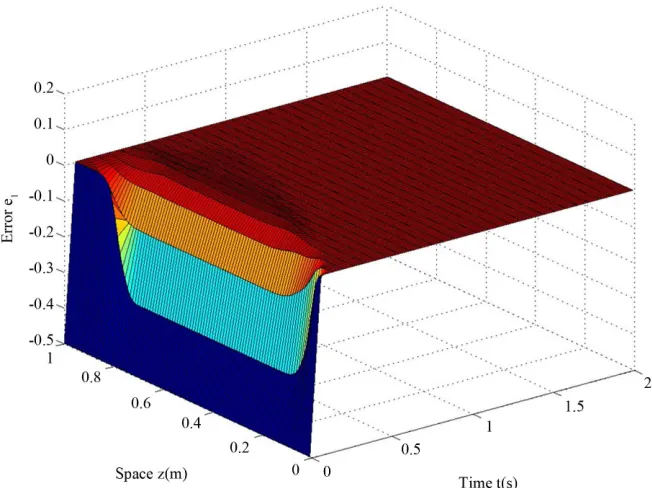
Figures 1 and 2 show respectively the evolution in time and space of the error on the reactant concentration
1 ˆ1 1
e x x and the evolution in time and space of the error on the product concentration , related to the observer (10)-(12).
2 ˆ2 e x x2
The measurements are taken on the length interval
3L 4 ,L
i.e., 3 L 4, and the process model has been arbitrary initialized with the constant profiles
1 0, 1, 2 0, 0,ˆ1 0, 0,
x z x z x z and xˆ2
0,z 1 . In order to response to the assumption of the Corollary 3.1,we set 1 0 2
k g
for the observer design parameter.
4. Conclusions and Prospects
In this paper we present a conception of a state estimator for linear distributed-parameter systems, which ensures that the estimation error converges exponentially to zero. The theory developed is applied to reconstruct the state of the isothermal Plug-Flow reactor basic dynamical model, and performed by a simulation study in which the parameters can be tuned by the user to satisfy specific needs in terms of convergence rate.
[image:4.595.51.290.76.465.2]One of the purposes in designing an observer is to ob- tain an efficient and practicable feedback control that stabilizes the original system around a desired profile. So the investigation of the stability of the overall closed- loop system (which is composed of original system, ob-
Table 1. Process parameters for numerical simulations.
Process parameters Numerical values
0
in
L k
b x
6 1
0.025 m s 1 m 10 s 2 0.02 mol L
t
Figure 1. Error evolution of the reactant concentration.
Figure 2. Error evolution of the product concentration.
server, and feedback controller), is an interesting topic for future research.
(CNRST). The work is also supported by the Belgian Programme on Interuniversity Poles of Attraction (PAI).
5. Acknowledgements
REFERENCES
This paper presents research results of the Moroccan “Programme Thématique d’Appui à la Recherche Scien- tifique” PROTARS III, initiated by the Moroccan “Cen- tre National de la Recherche Scientifique et Technique”
[1] M. Renardy and R. C. Rogers,” An Introduction to Partial Dif ferential Equations,” Springer, New York, 1993. [2] A. Pazy, “Semigroups of Linear Operators and Applica-
[image:5.595.136.460.359.598.2]New York, 1983.
http://dx.doi.org/10.1007/978-1-4612-5561-1
[3] R. F. Curtain and J. Zwart, “An Introduction to Infinite Dimentional Linear Systems Theory,” Springer, New York, 1995.http://dx.doi.org/10.1007/978-1-4612-4224-6
[4] D. Luenberger, “An Introduction to Observers,” IEIEEE Transactions on Automatic Control, Vol. 16, No. 6, 1971, pp. 596-602.
http://dx.doi.org/10.1109/TAC.1971.1099826
[5] T. Kobayashi and S. Hitotsuya, “Observers and Parameter Determination for Distributed Parameter Systems,” In-ternational Journal of Control, Vol. 33, No. 1, 1981, pp. 31-50.http://dx.doi.org/10.1080/00207178108922906
[6] A. VandeWouwer and M. Zeitz, “State Estimation in Distributed Parameter Systems,” In: Encyclopedia of Life Support Systems (EOLSS): Control Systems, Robotics and Automation. EOLSS Publishers, London, 2003.
[7] M. A. Demetriou, “Natural Second-Order Observers for Second-Order Distributed Parameter Systems,” Systems & Control Letters, Vol. 51, No. 3-4, 2004, pp. 225-234.
http://dx.doi.org/10.1016/j.sysconle.2003.08.005
[8] A. Smyshlyaev and M. Krstic, “Backstepping Observers for a Class of Parabolic PDEs,” Systems & Control Let- ters, Vol. 54, No. 7, 2005, pp. 613-625.
http://dx.doi.org/10.1016/j.sysconle.2004.11.001
[9] T. D. Nguyen, “Second-Order Observers for Second- Order Distributed Parameter Systems in R2,” Systems & Control Letters, Vol. 57, No. 10, 2008, pp. 787-795.
http://dx.doi.org/10.1016/j.sysconle.2008.03.011
[10] R. Miranda, I. Chairez and J. Moreno, “Observer Design for a Class of Parabolic PDE via Sliding Modes and Backstepping,” Proceedings of International Workshop on Variable Structure Systems, Mexico City, Jun 2010, pp. 215-220.
[11] J. Winkin, D. Dochain and P. Ligarius, “Dynamical Analysis of Distributed Parameter Tubular Reactors,”
Automatica, Vol. 36, No. 3, 2000, pp. 349-361.
http://dx.doi.org/10.1016/S0005-1098(99)00170-3 [12] I. Y. Smets, D. Dochain and J. F. Van Impe, “Optimal