Automatic Extraction of Chinese Multiword Expressions with a
Statis-tical Tool
Scott S.L. Piao
1Guangfan Sun
2Paul Rayson
1Qi Yuan
21
UCREL
Computing Department
Lancaster University
Lancaster, UK
2
CIPOL
China Centre for Information Industry
De-velopment (CCID)
Beijing, China
Abstract
In this paper, we report on our experi-ment to extract Chinese multiword ex-pressions from corpus resources as part of a larger research effort to improve a machine translation (MT) system. For ex-isting MT systems, the issue of multi-word expression (MWE) identification and accurate interpretation from source to target language remains an unsolved problem. Our initial test on the Chinese-to-English translation functions of Systran and CCID’s Huan-Yu-Tong MT systems reveal that, where MWEs are in-volved, MT tools suffer in terms of both comprehensibility and adequacy of the translated texts. For MT systems to be-come of further practical use, they need to be enhanced with MWE processing capability. As part of our study towards this goal, we test and evaluate a statistical tool, which was developed for English, for identifying and extracting Chinese MWEs. In our evaluation, the tool achieved precisions ranging from 61.16% to 93.96% for different types of MWEs. Such results demonstrate that it is feasi-ble to automatically identify many Chi-nese MWEs using our tool, although it needs further improvement.
1
Introduction
In real-life human communication, meaning is often conveyed by word groups, or meaning groups, rather than by single words. Very often, it is difficult to interpret human speech word by word. Consequently, for an MT system, it is im-portant to identify and interpret accurate meaning of such word groups, or multiword expressions (MWE hereafter), in a source language and
in-terpret them accurately in a target language. However, accurate identification and interpreta-tion of MWEs still remains an unsolved problem in MT research.
In this paper, we present our experiment on identifying Chinese MWEs using a statistical tool for MT purposes. Here, by multiword ex-pressions, we refer to word groups whose con-stituent words have strong collocational relations and which can be translated in the target lan-guage into stable translation equivalents, either single words or MWEs, e.g. noun phrases, prepositional phrases etc. They may include technical terminology in specific domains as well as more general fixed expressions and idioms. Our observations found that existing Chinese-English MT systems cannot satisfactorily trans-late MWEs, although some may employ a ma-chine-readable bilingual dictionary of idioms. Whereas highly compositional MWEs may pose a trivial challenge to human speakers for inter-pretation, they present a tough challenge for fully automatic MT systems to produce even remotely fluent translations. Therefore, in our context, we expand the concept of MWE to include those compositional ones which have relatively stable identifiable patterns of translations in the target language.
highly sophisticated MT tools still struggle to produce adequate English sentences..
Chinese Sentences
English (Systran)
English (HYT)
今天下午会练
球吗? 我希 望不会。
This afternoon can practice a ball game? I hope not to be able.
Can practise a ball game this afternoon? I hope can not.
你不可以那样
做,让我们各 付各的。
You may not such do, let us pay respec-tively each.
You cannot do like that, and let us make it Dutch.
恐怕没办法让 你们坐同桌,
你们介不介意
分开坐呢?
[image:2.595.70.291.108.416.2]Perhaps does not have the means to let you sit shares a table, did you mind sits sepa-rately?
Perhaps no way out(ly) let you sit with table, are you situated be-tween not mind to separate to sit?
来点冰镇的奶 咖啡。
Selects the milk coffee which ices.
Ice breasts coffee take is selected.
好的,我要啤
酒,再来点咖 啡。
Good, I want the beer, again comes to select the coffee.
Alright, I want beer, and take the coffee of order-ing again.
Table 1: Samples of Chinese-to-English transla-tions of Systran and HYT.
Ignoring the eccentric English syntactic struc-tures these tools produced, we focus on the trans-lations of Chinese MWEs (see the italic charac-ters in the Table 1) which have straightforward expression equivalents in English. For example, in this context, 希望不会 can be translated into “hope not”, 各付各 into “go Dutch”, 同桌 into “together” or “at the same table”, 奶咖啡 into “white coffee” or “coffee with milk”, 再来点 into “want some more (in addition to something already ordered)”. While these Chinese MWEs are highly compositional ones, when they are translated word by word, we see verbose and awkward translations (for correct translations, see the appendix).
To solve such problems, we need algorithms and tools for identifying MWEs in the source language (Chinese in this case) and to accurately map them to their adequate translation equiva-lents in the target language (English in our case) that are appropriate for given contexts. In the previous examples, an MT tool should be able to identify the Chinese MWE 各付各 and either provide the literal translation of “pay for each” or
map it to the more idomatic expressions of “go Dutch”.
Obviously, it would involve a wide range of issues and techniques for a satisfactory solution to this problem. In this paper, we focus on the sub-issue of automatically recognising and ex-tracting Chinese MWEs. Specifically, we test and evaluate a statistical tool for automatic MWE extraction in Chinese corpus data. As the results of our experiment demonstrate, the tool is capable of identifying many MWEs with little language-specific knowledge. Coupled with an MT system, such a tool could be useful for ad-dressing the MWE issue.
2
Related Work
The issue of MWE processing has attracted much attention from the Natural Language Proc-essing (NLP) community, including Smadja, 1993; Dagan and Church, 1994; Daille, 1995; 1995; McEnery et al., 1997; Wu, 1997; Michiels and Dufour, 1998; Maynard and Ananiadou, 2000; Merkel and Andersson, 2000; Piao and McEnery, 2001; Sag et al., 2001; Tanaka and Baldwin, 2003; Dias, 2003; Baldwin et al., 2003; Nivre and Nilsson, 2004 Pereira et al,. 2004; Piao et al., 2005. Study in this area covers a wide range of sub-issues, including MWE iden-tification and extraction from monolingual and multilingual corpora, classification of MWEs according to a variety of viewpoints such as types, compositionality and alignment of MWEs across different languages. However studies in this area on Chinese language are limited.
A number of approaches have been suggested, including rule-based and statistical approaches, and have achieved success to various extents. Despite this research, however, MWE processing still presents a tough challenge, and it has been receiving increasing attention, as exemplified by recent MWE-related ACL workshops.
se-mantic tagger which relies on a large manually compiled lexicon.
Other directly related work includes the de-velopment of the HYT MT system at CCID in Beijing, China. It has been under development since 1991 (Sun, 2004) and it is one of the most successful MT systems in China. However, being a mainly rule-based system, its performance de-grades when processing texts from domains pre-viously unknown to its knowledge database. Re-cently a corpus-based approach has been adopted for its improvement, and efforts are being made to improve its capability of processing MWEs.
Our main interest in this study is in the appli-cation of a MWE identifiappli-cation tool to the im-provement of MT system. As far as we know, there has not been a satisfactory solution to the efficient handling of Chinese MWEs in MT sys-tems, and our experiment contributes to a deeper understanding of this problem.
3
Automatic Identification and
extrac-tion of Chinese MWEs
In order to test the feasibility of automatic identification and extraction of Chinese MWEs on a large scale, we used an existing statistical tool built for English and a Chinese corpus built at CCID. A CCID tool is used for tokenizing and POS-tagging the Chinese corpus. The result was thoroughly manually checked by Chinese experts at CCID. In this paper, we aim to evaluate this existing tool from two perspectives a) its formance on MWE extraction, and b) its per-formance on a language other than English. In the following sections, we describe our experi-ment in detail and discuss main issues that arose during the course of our experiment.
3.1 MWE extraction tool
The tool we used for the experiment exploits statistical collocational information between near-context words (Piao et al., 2005). It first collects collocates within a given scanning win-dow, and then searches for MWEs using the col-locational information as a statistical dictionary. As the collocational information can be extracted on the fly from the corpus to be processed for a reasonably large corpus, this process is fully automatic. To search for MWEs in a small cor-pus, such as a few sentences, the tool needs to be trained on other corpus data in advance.
With regards to the statistical measure of col-location, the option of several formulae are available, including mutual information and log
likelihood, etc. Our past experience shows that log-likelihood provides an efficient metric for corpus data of moderate sizes. Therefore it is used in our experiment. It is calculated as fol-lows (Scott, 2001).
For a given pair of words X and Y and a search window W, let a be the number of windows in which X and Y co-occur, let b be the number of windows in which only X occurs, let c be the number of windows in which only Y occurs, and let d be the number of windows in which none of them occurs, then
G2 = 2 (alna + blnb + clnc + dlnd - (a+b)ln(a+b)
- (a+c)ln(a+c) - (b+d)ln(b+d)
- (c+d)ln(c+d)) + (a+b+c+d)ln(a+b+c+d))
In addition to the log-likelihood, the t-score is used to filter out insignificant co-occurrence word pairs (Fung and Church, 1994), which is calculated as follows:
) , ( 1
) ( ) ( ) , (
b a
b a
b a
W W prob M
W prob W prob W
W prob
t= −
In order to filter out weak collocates, a thresh-old is often used, i.e. in the stage of collocation extraction, any pairs of items producing word affinity scores lower than a given threshold are excluded from the MWE searching process. Fur-thermore, in order to avoid the noise caused by functional words and some extremely frequent words, a stop word list is used to filter such words out from the process.
If the corpus data is POS-tagged, some simple POS patterns can be used to filter certain syntac-tic patterns from the candidates. It can either be implemented as an internal part of the process, or as a post-process. In our case, such pattern filters are mostly applied to the output of the MWE searching tool in order to allow the tool to be language-independent as much as possible.
Another language-specific adjustment needed was to use a Chinese POS-pattern filter for se-lecting various patterns of the candidate MWEs (see Table 6). As pointed out previously, it was implemented as a simple pattern-matching pro-gram that is separate from the MWE tool itself, hence minimizing the modification needed for porting the tool from English to Chinese lan-guage.
A major advantage of this tool is its capability of identifying MWEs of various lengths which are generally representative of the given topic or domain. Furthermore, for English it was found effective in extracting domain-specific multi-word terms and expressions which are not in-cluded in manually compiled lexicons and dic-tionaries. Indeed, due to the open-ended nature of such MWEs, any manually compiled lexicons, however large they may be, are unlikely to cover them exhaustively. It is also efficient in finding newly emerging MWEs, particularly technical terms, that reflect the changes in the real world.
3.2 Experiment
In this experiment, our main aim was to exam-ine the feasibility of practical application of the MWE tool as a component of an MT system, therefore we used test data from some domains in which translation services are in strong de-mand. We selected Chinese corpus data of ap-proximately 696,000 tokenised words (including punctuation marks) which cover the topics of food, transportation, tourism, sports (including the Olympics) and business.
In our experiment, we processed the texts from different topics together. These topics are related to each other under the themes of enter-tainment and business. Therefore we assume, by mixing the data together, we could examine the performance of the MWE tool in processing data from a broad range of related domains. We ex-pect that the different features of texts from dif-ferent domains will have a certain impact on the result, but the examination of such impact is be-yond the scope of this paper.
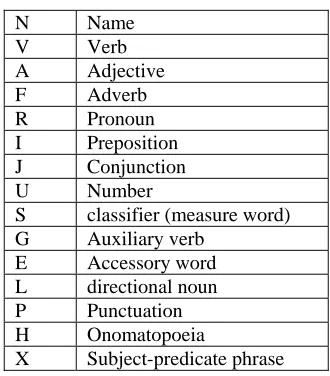
As mentioned earlier, the Chinese word to-keniser and POS tagger used in our experiment has been developed at CCID. It is an efficient tool running with accuracy of 98% for word to-kenisation and 95% for POS annotation. It em-ploys a part-of-speech tagset of 15 categories shown in Table 2. Although it is not a finely grained tagset, it meets the need for creating POS pattern filters for MWE extraction.
N Name V Verb A Adjective F Adverb R Pronoun I Preposition J Conjunction U Number
S classifier (measure word) G Auxiliary verb E Accessory word L directional noun P Punctuation H Onomatopoeia
[image:4.595.331.496.66.254.2]X Subject-predicate phrase
Table 2: CCID Chinese tagset
Since function words are found to cause noise in the process of MWE identification, a Chinese stop list was collected. First, a word frequency list was extracted. Next, the top items were con-sidered and we selected 70 closed class words for the stop word list. When the program searches for MWEs, such words are ignored.
The threshold of word affinity strength is an-other issue to be addressed. In this experiment, we used log-likelihood to measure the strength of collocation between word pairs. Generally the log-likelihood score of 6.6 (p < 0.01 or 99% con-fidence) is recommended as the threshold (Ray-son et al., 2004), but it was found to produce too many false candidates in our case. Based on our initial trials, we used a higher threshold of 30, i.e. any word pairs producing log-likelihood score less than this value are ignored in the MWE searching process. Furthermore, for the sake of the reliability of the statistical score, when extracting collocates, a frequency threshold of five was used to filter out low-frequency words, i.e. word pairs with frequencies less than five were ignored.
An interesting issue for us in this experiment is the impact of the length of collocation search-ing window on the MWE identification. For this purpose, we tested two search window lengths 2 and 3, and compared the results obtained by us-ing them. Our initial hypothesis was that the shorter window length may produce higher pre-cision while the longer window length may sacri-fice precision but boost the MWE coverage.
candidate was counted as false. Furthermore, in order to estimate the recall, experts manually identified MWEs in the whole test corpus, so that the output of the automatic tool could be com-pared against it. In the following section, we present a detailed report on our evaluation of the MWE tool.
3.3 Evaluation
We first evaluated the overall precision of the tool. A total of 7,142 MWE candidates (types) were obtained for window lengths of 2, of which 4,915 were accepted as true MWEs, resulting in a precision of 68.82%. On the other hand, a total of 8,123 MWE candidates (types) were obtained for window lengths of 3, of which 4,968 were accepted as true MWEs, resulting in a precision of 61.16%. This result is in agreement with our hypothesis that shorter search window length tends to produce higher precision.
Next, we estimated the recall based on the manually analysed data. When we compared the accepted MWEs from the automatic result against the manually collected ones, we found that the experts tend to mark longer MWEs, which often contain the items identified by the automatic tool. For example, the manually marked MWE 网球 运动 发展 计划 (develop-ment plan for the tennis sport) contains shorter MWEs 网球 运动 (tennis sport) and发展 计划 (development plan) which were identified by the tool separately. So we decided to take the partial matches into account when we estimate the re-call. We found that a total 14,045 MWEs were manually identified and, when the search win-dow length was set to two and three, 1,988 and 2,044 of them match the automatic output, pro-ducing recalls of 14.15% and 14.55% respectively. It should be noted that many of the manually ac-cepted MWEs from the automatic output were not found in the manual MWE collection. This discrepancy was likely caused by the manual analysis being carried out independently of the automatic tool, resulting in a lower recall than expected. Table 3 lists the precisions and recalls.
Window length = 2 Window length = 3 Precision Recall Precision Recall
68.82% 14.15% 61.16% 14.55%
Table 3: Overall precisions and recalls
Furthermore, we evaluated the performance of the MWE tool from two aspects: frequency and MWE pattern.
Generally speaking, statistical algorithms work better on items of higher frequency as it depends on the collocational information. How-ever, our tool does not select MWEs directly from the collocates. Rather, it uses the colloca-tional information as a statistical dictionary and searches for word sequences whose constituent words have significantly strong collocational bonds between them. As a result, it is capable of identifying many low-frequency MWEs. Table 4 lists the breakdown of the precision for five fre-quency bands (window length = 2).
Freq Candidates True MWEs Precision >= 100 17 9 52.94% 10 ~ 99 846 646 76.36% 3 ~ 9 2,873 2,178 75.81%
2 949 608 64.07%
1 2,457 1,474 59.99%
Total 7,142 4,915 68.82%
Table 4: Breakdown of precision for frequencies (window length = 2).
As shown in the table above, the highest preci-sions were obtained for the frequency range be-tween 3 and 99. However, 2,082 of the accepted MWEs have frequencies of one or two, account-ing for 42.36% of the total accepted MWEs. Such a result demonstrates again that our tool is capable of identifying low-frequency items. An interesting result is for the top frequency band (greater than 100). Against our general assump-tion that higher frequency brings higher preci-sion, we saw the lowest precision in the table for this band. Our manual examination reveals this was caused by the high frequency numbers, such as “one” or “two” in the expressions “一 个” (a/one) and “一种” ( a kind of). This type of ex-pression were classified as uninteresting candi-dates in the manual checking, resulting in higher error rates for the high frequency band.
Freq candidates true MWEs Precision >= 100 17 9 52.94% 10 ~ 99 831 597 71.84% 3 ~ 9 3,093 2,221 71.81%
2 1,157 669 57.82%
1 3,025 1,472 48.66%
[image:6.595.70.289.70.157.2]Total 8,123 4,968 61.16%
Table 5: Breakdown of precision for frequencies (window length = 3).
In fact, not only the top frequency band, much of the errors of the total output were found to be caused by the numbers that frequently occur in the test data, e.g. 一_U 个_S (one), 两_U 个_S (two) etc. When a POS filter was used to filter them out, for the window length 2, we obtained a total 5,660 candidates, of which 4,386 were ac-cepted as true MWEs, producing a precision of 77.49%. Similarly for the window length 3, a total of 6,526 candidates were extracted in this way and 4,685 of them were accepted as true MWEs, yielding a precision of 71.79%.
Another factor affecting the performance of the tool is the type of MWEs. In order to exam-ine the potential impact of MWE types to the performance of the tool, we used filters to select MWEs of the following three patterns:
1) AN: Adjective + noun structure; 2) NN: Noun + noun Structure; 3) FV: Adverb + Verb.
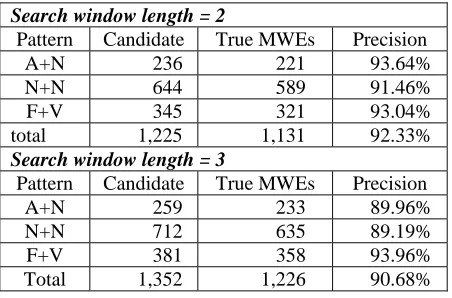
Table 6 lists the precision for each of the MWE types and for search window lengths of 2 and 3.
Search window length = 2
Pattern Candidate True MWEs Precision
A+N 236 221 93.64%
N+N 644 589 91.46%
F+V 345 321 93.04%
total 1,225 1,131 92.33%
Search window length = 3
Pattern Candidate True MWEs Precision
A+N 259 233 89.96%
N+N 712 635 89.19%
F+V 381 358 93.96%
Total 1,352 1,226 90.68%
Table 6: Precisions for three types of MWEs
As shown in the table, the MWE tool achieved high precisions above 91% when we use a search window of two words. Even when the search window expands to three words, the tool still obtained precision around 90%. In particular, the tool is efficient for the verb phrase type. Such a
result demonstrates that, when we constrain the search algorithm to some specific types of MWEs, we can obtain higher precisions. While one may argue that rule-based parser can do the same work, it must be noted that we are not in-terested in all grammatical phrases, but those which reflect the features of the given domain. This is achieved by combining statistical word collocation measures, a searching strategy and simple POS pattern filters.
Another interesting finding in our experiment is that our tool extracted clauses, such as想喝些
什么 (What would you like to drink?) and先喝
点什么? (Would you like a drink first?). The clauses occur only once or twice in the entire test data, but were recognized by the tool because of the strong collocational bond between their con-stituent words. The significance of such per-formance is that such clauses are typical expres-sions which are frequently used in real-life con-versation in the contexts of the canteen, tourism etc. Such a function of our tool may have practi-cal usage in automatipracti-cally collecting longer typi-cal expressions for the given domains.
4
Discussion
As our experiment demonstrates, our tool pro-vides a practical means of identifying and ex-tracting domain specific MWEs with a minimum amount of linguistic knowledge. This becomes important in multilingual tasks in which it can be costly and time consuming to build comprehen-sive rules for several languages. In particular, it is capable of detecting MWEs of various lengths, sometimes whole clauses, which are often typical of the given domains of the corpus data. For ex-ample, in our experiment, the tool successfully identified several daily used long expressions in the domain of food and tourism. MT systems often suffer when translating conversation. An efficient MWE tool can potentially alleviate the problem by extracting typical clauses used in daily life and mapping them to adequate transla-tions in the target language.
[image:6.595.71.297.510.659.2]algo-rithm is needed to identify discontinuous MWEs, which are important for NLP tasks.
Besides the technical problem, a major unre-solved issue we face is what constitutes MWEs. Despite agreement on the core MWE types, such as idioms and highly idiosyncratic expressions, like 成语 (Cheng-Yu) in Chinese, it is difficult to reach agreement on less fixed expressions.
We contend that MWEs may have different definitions for different research purposes. For example, for dictionary compilation, lexicogra-phers tend to constrain MWEs to highly non-compositional expressions (Moon, 1998: 18). This is because monolingual dictionary users can easily understand compositional MWEs and there is no need to include them in a dictionary for native speakers. For lexicon compilation aimed at practical NLP tasks, however, we may apply a looser definition of MWEs. For example, in the Lancaster semantic lexicon (Rayson et al., 2004), compositional word groups such as “youth club” are considered as MWEs alongside non-compositional expressions such as “food for thought” as they depict single semantic units or concepts. Furthermore, for the MT research community whose primary concern is cross-language interpretation, any multiword units that have stable translation equivalent(s) in a target language can be of interest.
As we discussed earlier, a highly idiomatic expression in a language can be translated into a highly compositional expression in another lan-guage, and vice versa. In such situations, it can be more practically useful to identify and map translation equivalents between the source and target languages regardless of their level of com-positionality.
Finally, the long Chinese clauses identified by the tool can potentially be useful for the im-provement of MT systems. In fact, most of them are colloquial expressions in daily conversation, and many such Chinese expressions are difficult to parse syntactically. It may be more feasible to identify such expressions and map them as a whole to English equivalent expressions. The same may apply to technical terms, jargon and slang. In our experiment, our tool demonstrated its capability of detecting such expressions, and will prove useful in this regard.
5
Conclusion
In this paper, we have reported on our experi-ment of automatic extraction of Chinese MWEs using a statistical tool originally developed for
English. Our statistical tool produced encourag-ing results, although further improvement is needed to become practically applicable for MT system in terms of recall. Indeed, for some con-strained types of MWEs, high precisions above 90% have been achieved. This shows, enhanced with some linguistic filters, it can provide a prac-tically useful tool for identifying and extracting MWEs. Furthermore, in our experiment, our tool demonstrated its capability of multilingual proc-essing. With only minor adjustment, it can be ported to other languages. Meanwhile, further study is needed for a fuller understanding of the factors affecting the performance of statistical tools, including the text styles and topic/domains of the texts, etc.
Acknowledgement
This work was supported by the National Natural Science Foundation of China (grant no. 60520130297) and the British Academy (grant no. SG-42140).
References
Biber, D., Conrad, S., Cortes, V., 2003. Lexical bun-dles in speech and writing: an initial taxonomy. In: Wilson, A., Rayson P., McEnery, T. (Eds.), Corpus Linguistics by the Lune: A Festschrift for Geoffrey Leech. Peter Lang, Frankfurt. pp. 71-92.
Baldwin, T., Bannard, C., Tanaka, T. and Widdows, D. 2003 An Empirical Model of Multiword Ex-pression Decomposability, In Proceedings of the ACL-2003 Workshop on Multiword Expressions: Analysis, Acquisition and Treatment, Sapporo, Ja-pan, pp. 89–96.
Dagan, I., Church, K., 1994. Termight: identifying and translating technical terminology. In: Proceed-ings of the 4th Conference on Applied Natural Language Processing, Stuttgart, German. pp. 34-40.
Daille, B., 1995. Combined approach for terminology extraction: lexical statistics and linguistic filtering. Technical paper 5, UCREL, Lancaster University.
Dias, G., 2003. Multiword unit hybrid extraction. In: Proceedings of the Workshop on Multiword Ex-pressions: Analysis, Acquisition and Treatment, at ACL'03, Sapporo, Japan. pp. 41-48.
Dunning, T., 1993. Accurate methods for the statistics of surprise and coincidence. Computational Lin-guistics 19 (1), 61-74.
Maynard, D., Ananiadou, S., 2000. Trucks: a model for automatic multiword term recognition. Journal of Natural Language Processing 8 (1), 101-126.
McEnery, T., Lange, J. M., Oakes, M., Vernonis, J.., 1997. The exploitation of multilingual annotated corpora for term extraction. In: Garside, R., Leech, G., McEnery, A. (Eds.), Corpus Annotation --- Linguistic Information from Computer Text Cor-pora. Longman, London & New York. pp 220-230.
Merkel, M., Andersson, M., 2000. Knowledge-lite extraction of multi-word units with language filters and entropy thresholds. In: Proceedings of 2000 Conference User-Oriented Content-Based Text and Image Handling (RIAO'00), Paris, France. pp. 737-746.
Michiels, A., Dufour, N., 1998. DEFI, a tool for automatic multi-word unit recognition, meaning assignment and translation selection. In: Proceed-ings of the First International Conference on Lan-guage Resources & Evaluation, Granada, Spain. pp. 1179-1186.
Moon, R. 1998. Fixed expressions and idioms in Eng-lish: a corpus-based approach. Clarendon Press: Oxford.
Nivre, J., Nilsson, J., 2004. Multiword units in syntac-tic parsing. In: Proceedings of LREC-04 Workshop on Methodologies & Evaluation of Multiword Units in Real-world Applications, Lisbon, Portugal. pp. 37-46.
Pereira, R., Crocker, P., Dias, G., 2004. A parallel multikey quicksort algorithm for mining multiword units. In: Proceedings of LREC-04 Workshop on Methodologies & Evaluation of Multiword Units in Real-world Applications, Lisbon, Portugal. pp. 17-23.
Piao, S. L., Rayson, P., Archer, D. and McEnery, T. 2005. Comparing and Combining A Semantic Tag-ger and A Statistical Tool for MWE Extraction. Computer Speech & Language Volume 19, Issue 4, pp. 378-397.
Piao, S.L , Rayson, P., Archer, D., Wilson, A. and McEnery, T. 2003. Extracting multiword expres-sions with a semantic tagger. In Proceedings of the Workshop on Multiword Expressions: Analysis, Acquisition and Treatment, at ACL'03, Sapporo, Japan, pp. 49-56.
Piao, S., McEnery, T., 2001. Multi-word unit align-ment in English-Chinese parallel corpora. In: Pro-ceedings of the Corpus Linguistics 2001, Lancas-ter, UK. pp. 466-475.
Rayson, P., Archer, D., Piao, S. L., McEnery, T. 2004. The UCREL semantic analysis system. In proceedings of the workshop on Beyond Named Entity Recognition Semantic labelling for NLP
tasks in association with LREC 2004, Lisbon, Por-tugal, pp. 7-12.
Rayson, P., Berridge, D. and Francis, B. 2004. Ex-tending the Cochran rule for the comparison of word frequencies between corpora. In Proceedings of the 7th International Conference on Statistical analysis of textual data (JADT 2004), Louvain-la-Neuve, Belgium. pp. 926-936.
Sag, I., Baldwin, T., Bond, F., Copestake, A., Dan, F., 2001. Multiword expressions: a pain in the neck for NLP. LinGO Working Paper No. 2001-03, Stanford University, CA.
Scott, M., 2001. Mapping key words to problem and solution. In: Scott, M., Thompson, G. (Eds.), Pat-terns of Text: in Honour of Michael Hoey. Benja-mins, Amsterdam. pp. 109 – 127.
Smadja, F., 1993. Retrieving collocations from text: Xtract. Computational Linguistics 19 (1), 143-177.
Sun, G. 2004. Design of an Interlingua-Based Chi-nese-English Machine Translation System. In Pro-ceedings of the 5th China-Korea Joint Symposium on Oriental Language Processing and Pattern Rec-ognition, Qingdao, China. pp. 129-134.
Tanaka, T., Baldwin, T., 2003. Noun-noun compound machine translation: a feasibility study on shallow processing. In: Proceedings of the ACL-03 Work-shop on Multiword Expressions: Analysis, Acquisi-tion and Treatment, Sapporo, Japan. pp. 17-24.
Wu, D., 1997. Stochastic inversion transduction grammars and bilingual parsing of parallel corpora. Computational Linguistics 23 (3), 377-401.
Appendix: English translations of the
sample Chinese sentences
1. 今天下午会练球吗?我希望不会。 Tran: Do we have (football) training this
af-ternoon? I hope not.
2. 你不可以那样做,让我们各付各的。 Tran: You can’t do that. Let’s go Dutch. 3. 恐怕没办法让你们坐同桌,你们介不介
意分开坐呢?
Tran: I am afraid I can’t arrange for you to sit at the same table. Would you mind if you sit separately?
4. 来点冰镇的奶咖啡。
Tran: I’d like iced white coffee (please). 5. 好的,我要啤酒,再来点咖啡。