
R E S E A R C H
Open Access
The developmental regulator PKL is
required to maintain correct DNA
methylation patterns at RNA-directed DNA
methylation loci
Rong Yang
1, Zhimin Zheng
1, Qing Chen
2, Lan Yang
1, Huan Huang
1, Daisuke Miki
1, Wenwu Wu
1, Liang Zeng
1,
Jun Liu
2, Jin-Xing Zhou
2, Joe Ogas
3, Jian-Kang Zhu
1,4, Xin-Jian He
2and Heng Zhang
1*Abstract
Background:The chromodomain helicase DNA-binding family of ATP-dependent chromatin remodeling factors play essential roles during eukaryote growth and development. They are recruited by specific transcription factors and regulate the expression of developmentally important genes. Here, we describe an unexpected role in non-coding RNA-directed DNA methylation inArabidopsis thaliana.
Results:Through forward genetic screens we identifiedPKL, a gene required for developmental regulation in plants, as a factor promoting transcriptional silencing at the transgenicRD29Apromoter. Mutation ofPKLresults in DNA
methylation changes at more than half of the loci that are targeted by RNA-directed DNA methylation (RdDM). A small number of transposable elements and genes had reduced DNA methylation correlated with derepression in thepkl mutant, though for the majority, decreases in DNA methylation are not sufficient to cause release of silencing. The changes in DNA methylation in thepklmutant are positively correlated with changes in 24-nt siRNA levels. In addition, PKLis required for the accumulation of Pol V-dependent transcripts and for the positioning of Pol V-stabilized
nucleosomes at several tested loci, indicating that RNA polymerase V-related functions are impaired in thepklmutant. Conclusions:PKL is required for transcriptional silencing and has significant effects on RdDM in plants. The
changes in DNA methylation in the pkl mutant are correlated with changes in the non-coding RNAs
produced by Pol IV and Pol V. We propose that at RdDM target regions,PKLmay be required to create a chromatin environment that influences non-coding RNA production, DNA methylation, and transcriptional silencing.
Keywords:Non-coding RNA (ncRNA), ATP-dependent chromatin remodeling, DNA methylation, RNA-directed DNA methylation (RdDM)
Background
DNA methylation is an important epigenetic modifi-cation that is associated with heterochromatin forma-tion and transcripforma-tional gene silencing. Plant DNA methylation occurs in three different sequence con-texts: CG, CHG, and CHH (H = A, C, T). DNA methylation patterns are faithfully replicated from generations to generations [1]. Maintenance of CG
methylation requires the DNA methyltransferase MET1 [2, 3] and the VIM/UHRF1 proteins [4, 5], which function at the DNA replication foci to copy methylation from the parent strand to the daughter strand. Maintenance of CHG methylation requires the DNA methyltransferase CMT3 [6] and the histone methyltransferase KYP/SUVH4, SUVH5, and SUVH6 [7], through a positive feedback loop that involves H3K9me2 [8, 9]. The RNA-directed DNA methylation (RdDM) pathway (recently reviewed in [10, 11]) and another DNA methyltransferase CMT2 [12, 13] are required to maintain CHH methylation.
* Correspondence:[email protected]
1Shanghai Center for Plant Stress Biology, Shanghai Institutes for Biological
Sciences, Chinese Academy of Sciences, Shanghai 210602, China Full list of author information is available at the end of the article
RdDM is also required for de novo methylation in all three sequence contexts [6]. Genetic screens and bio-chemical approaches have identified more than 40 pro-teins involved in RdDM thus far [10]. RdDM requires two classes of non-coding RNAs: the 24-nucleotide (24-nt) small interfering RNAs (siRNA) whose production is initiated by RNA polymerase IV (Pol IV) and the scaf-fold RNAs that is generated by RNA polymerase V (Pol V). Both Pol IV and Pol V evolved from RNA polymer-ase II and the three share six common subunits out of 12 [11, 14, 15]. Loading of siRNAs into the Argonaute (AGO4/6) proteins and base pairing between the siRNAs and scaffold RNAs are believed to provide the target in-formation for de novo methylation by DRM2 [16].
RdDM is involved in many biological processes, in-cluding repression of transposon activity, response to bi-otic and abibi-otic stresses, paramutation, establishment of methylation patterns during reproduction (recently reviewed in [10]). Despite its important functions in de novo methylation, most Arabidopsis RdDMmutants do not have obvious developmental phenotypes. Indeed, only rdm4/dms4 exhibits developmental defects among all the RdDM mutants reported in Arabidopsis [17, 18]. In addition to being a transcriptional regulator of Pol IV and Pol V, RDM4/DMS4 is also involved in Pol II func-tion, thus influencing the expression of developmentally important genes [18].
ATP-dependent chromatin remodeling factors belong to the SF2 superfamily of DNA helicases [19]. As the name suggests, they utilize energy from ATP hydrolysis to modify the conformation of nucleosomes and chromatin. In vivo they usually exist in the form of multi-subunit protein com-plexes [20]. A comprehensive phylogenetic analysis using the ATPase domain sequences identified seven large groups and 24 subfamilies in all eukaryotes [19]. The Arabidopsis genome contains members in 18 out of these 24 subfam-ilies. At least four subfamilies have been suggested to func-tion in DNA methylafunc-tion regulafunc-tion but their molecular mechanisms remain to be clarified. DDM1, the first remod-eling factor that was identified to affect DNA methylation in plants, plays a major role in promoting transposon methylation. Loss ofDDM1leads to elimination of almost all DNA methylation in heterochromatic regions [21]. DDM1 facilitates DNA methylation by assisting DNA methyltransferases to access the most repressed chromatin [12]. The plant-specific DRD1 subfamily is specialized for the RdDM pathway. The six-member subfamily contains four CLSY proteins and two DRD proteins. DRD1 is part of a three-component complex called DDR (DRD1/DMS3/ RDM1) that assists in RNA Pol V transcription [22–24]. The function of its closest homolog DRD2 remains unclear. CLSY1 is required for siRNA accumulation and is believed to have a role in assisting Pol IV transcription [25]. The in-teractions between Pol IV and CLSY and between Pol V
and DRD were detected in both Arabidopsis and maize [23, 26–28]. In addition, a SWI/SNF complex that belongs to the Snf2 subfamily functions downstream of Pol V-generated scaffold RNAs through its interaction with the IDN complex and promotes methylation of RdDM targets [29]. Recently the ETL1/CHR19 remodeler and two pro-teins of the five-member Ris1 subfamily, FRG1/CHR27 and FRG2/CHR28, were also found to be required for DNA methylation and silencing at some RdDM loci [30, 31].
PKL belongs to the Mi-2/CHD3 subfamily of ATP-dependent chromatin remodelers [19, 32]. PKL was originally identified as a factor that is required to re-press embryonic traits during seed germination and to facilitate the transition from embryonic phase to vegetative phase of plants [33]. Later it was identified in multiple suppressor screens and was found to be involved in establishment of carpel polarity, initiation of lateral roots, and promoting hypocotyl cell elong-ation during skotomorphogenesis [34–36]. The pkl
mutant exhibits pleiotropic defects including semi-dwarfism, reduced apical dominance, decreased root meristem activity, and other developmental pheno-types [33, 37]. PKL may also play a role in integrating hormone signaling during plant development [33, 38]. PKL mainly exists as a monomer in plant cells, and it exhibits in vitro nucleosome remodeling activity [32]. In contrast, its animal homolog Mi-2 forms stable complexes with histone deacetylases (HDAC) called NURD, which account for the highest HDAC activity in human cells [39–42]. Although Mi-2/CHD3 pro-teins mainly function as a transcriptional co-repressor, instances of these proteins being recruited by specific transcription factors and functioning as transcription co-activator were also reported in specific cell types [43, 44]. Similarly, PKL functions as a transcriptional repressor in many cases and is required to promote H3K27me3, a repressive histone modification typically associated with tissue-specific genes [45, 46], but it was also found that PKL could promote the tion of specific genes by interacting with transcrip-tional activators [36]. Overall the CHD3-type chromatin remodeling factors are employed as tran-scriptional co-regulators in many important develop-mental processes [47].
Besides developmental genes, PKL was also found to bind directly to certain transposable elements [45], al-though microarray-based transcriptome analyses did not identify significant overlaps with other DNA methylation mutants [46]. Thus, whether and how PKL functions in heterochromatic regions remain largely unknown. In this study, we identified a role of PKL in RNA-directed DNA methylation. In genetic screens searching for mutants defective in transcriptional silencing of the
of which showed defects in DNA methylation and silen-cing of a subset of classical RdDM target loci. Map-based cloning revealed that the rdm18 mutations reside in thePKLgene. Based on whole genome DNA methyla-tion, small RNA, and transcriptome analyses, we propose that PKL may create a chromatin environment that influences non-coding RNA transcription, DNA methylation, and transcriptional silencing through its nucleosome remodeling activity. These results reflect the complexity in transcriptional regulation of non-coding RNAs and show that the developmentally important chromatin remodeler PKL also plays a role in RNA-directed DNA methylation.
Results
RDM18 is required for silencing of the pRD29A-LUC transgene
The RD29Apromoter is abiotic stress responsive and is activated when the plant is under cold or salinity. We previously showed that the transcriptional activity of a
pRD29A-LUC transgene is regulated by DNA methyla-tion [48]. The 5-methylcytosine DNA glycosylase ROS1 is required to prevent DNA methylation at the RD29A
promoter and allows gene activation [49]. By screening for mutants that regain luminescence signals in the ros1-1 mutant background, a number of factors that are in-volved in RNA-directed DNA methylation (RdDM) were identified [50]. From a T-DNA mutagenized pool of
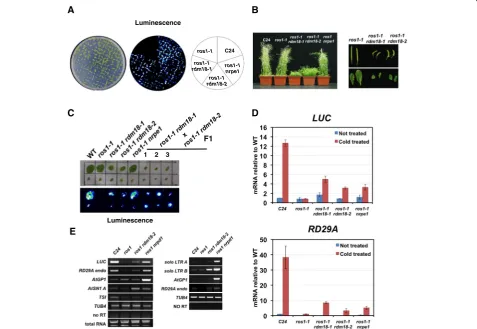
ros1-1, we identified a mutant named rdm18-1 that ex-hibited strong luminescence signals after cold treatment (Fig. 1a). The rdm18-1 mutant also exhibited develop-mental defects including dwarfism, late flowering, small and curled leaves, and severely reduced fertility (Fig. 1b). In a separate ethyl methanesulfonate (EMS) mutagen-ized pool, we identified a second rdm18 mutant allele (rdm18-2) that exhibited increased luminescence signals, as well as similar developmental defects as rdm18-1
(Fig. 1a and b). The intensity of the luciferase signal in
ros1 rdm18 double mutants is comparable to that of
ros1 nrpe1, which serves as a positive control (Fig. 1a). In order to determine whether rdm18-1 and rdm18-2
are allelic, we made crosses between the two mutants. The F1 plants also exhibited increased luminescence sig-nals and various developmental defects as the parents, indicating that the two mutations reside in the same gene (Fig. 1c).
We observed changes at the transcript level for both the transgenic pRD29A-LUC and endogenous RD29Agenes. Quantitative reverse transcription polymerase chain reac-tion (qRT-PCR) identified substantially higher levels of
LUC transcripts in ros1-1 rdm18 mutants compared to
ros1-1(Fig. 1d). The EMS inducedrdm18-2mutant seems to be a weaker allele because its luciferase signals are weaker compared to ros1-1 rdm18-1 (Fig. 1a) and the
adult plants are slightly taller than ros1-1 rdm18-1
(Fig. 1b). We also observed lessLUCtranscripts inros1-1 rdm18-2than inros1-1 rdm18-1(Fig. 1d). Similar to pre-viously identified RdDM mutants, the endogenousRD29A
gene also showed released silencing in the ros1-1 rdm18
double mutants compared toros1-1(Fig. 1d).
In addition to the pRD29A-LUC transgene, the same T-DNA insertion also contains a p35S-NPTII(neomycin phosphotransferase) transgene, which is expressed in wild-type (WT) C24 plants and confers kanamycin re-sistance. When the ROS1gene is mutated, the35S pro-moter gained more DNA methylation and became silenced [49]. We examined whetherRDM18 could also play a role in the silencing of theNPTIIgene. The ros1-1 plants are sensitive to kanamycin, while the rdm18-1 ros1-1mutant is partially resistant (Additional file 1: Fig-ure S1A). Due to the severe developmental defects, the
ros1-1 rdm18 seedlings are generally much smaller on the plate (Additional file 1: Figure S1A). Consistent with the partial gain of kanamycin resistance, we observed el-evated levels of NPTII transcript in the ros1-1 rdm18-1
double mutant compared to ros1-1 (Additional file 1: Figure S1B). This is different from classical RdDM com-ponents such as NRPD1 andNRPE1, which are not re-quired for the silencing of the NPTII gene in the ros1
background [51].
We next examined other genomic loci that are also regu-lated by RdDM. Using RT-PCR, we detected increased levels of transcripts at AtSN1 and soloLTR B in the ros1 rdm18 double mutants compared to ros1 (Fig. 1e). How-ever, no changes were observed forAtGP1orTSI(Fig. 1e).
In summary, we identified two rdm18 alleles that showed defects in silencing of thepRD29A-LUCtransgene and some endogenous RdDM targets. Different from pre-viously identified RdDM mutants,RDM18 is required for multiple developmental processes and also plays a role in promoting silencing of thep35S-NPTIItransgene.
RDM18 is required for DNA methylation at selected RdDM targets
In order to test the involvement of RDM18 in DNA methylation regulation, we measured DNA methylation levels of both transgenic and endogenous RdDM targets using multiple methods. Sodium bisulfite sequencing re-vealed mild decreases in non-CG methylation levels at the transgenicRD29Apromoter inros1-1 rdm18double mu-tants compared to ros1-1(Additional file 1: Figure S2A). However no consistent changes at the endogenous
(MEDEA INTERSTITIAL SUBTELOMERIC REPEATS), no changes in DNA methylation levels were found (Additional file 1: Figure S2C).
We used southern blotting to examine DNA methyla-tion levels at the 5S ribosomal DNA repeats and centro-meric regions. Theros1-1 rdm18mutant showed slightly reduced DNA methylation at the 5S rDNA repeats, albeit not to the same level as inros1-1 nrpd1(Additional file 1: Figure S2D). Mutation of RDM18 had no effect on the methylation levels of 180-bp centromeric repeats, similar to theros1-1 nrpd1control (Additional file 1: Figure S2E).
The expression level of the demethylase gene ROS1is significantly decreased in plants that are defective in DNA methylation [52–54]. A methylation monitoring sequence (MEMS) was found within the promoter region ofROS1, methylation of which correlated with increasedROS1 ex-pression [54, 55]. Thus, the transcript level ofROS1may
serve as an indicator of the DNA methylation activity in the cell. We observed a threefold to fourfold decrease of
ROS1transcripts inros1-1 rdm18mutants, similar to that in ros1-1 nrpe1 (Additional file 1: Figure S2F). Overall these results indicate that RDM18 is required for proper DNA methylation at some RdDM loci.
Map-based cloning of RDM18
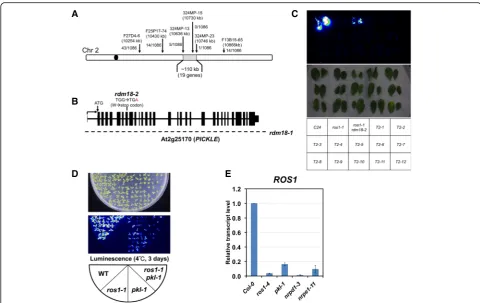
We used map-based cloning to identify the causal muta-tion in both rdm18 alleles. We narrowed the rdm18-1
mutation down to a ~110-kb region on chromosome 2 (Fig. 2a). Screening of genes with decreased expression in that region identified PICKLE (PKL, At2g25170), a chromatin remodeling factor gene involved in multiple developmental processes. Consistent with the observa-tion that rdm18 mutants exhibit severe developmental defects, pleiotropic developmental phenotypes of thepkl A
Luminescence
C24
ros1-1
ros1-1 rdm18-1
ros1-1 rdm18-2
ros1-1 nrpe1
B
C D
Luminescence 1 2 3
F1
E
Fig. 1RDM18promotes transcriptional gene silencing at RdDM loci.aBioluminescence phenotype of two-week-oldros1 rdm18seedlings.
bTheros1 rdm18mutants exhibit multiple developmental defects. Shown in the figure includes dwarfism, short and curled siliques, and small leaves (eight-week-old plants).cBioluminescence phenotype of F1 plants generated from crosses between ros1-1 rdm18-1and ros1-1 rdmros1-18-2. Cauline leaves from six-week-old plants were used for the analyses.dTranscript levels of thepRD29A-LUCtransgene and endogenousRD29Agene examined by quantitative reverse transcription polymerase chain reaction (qRT-PCR). Relative transcript levels were shown with non-treated C24 set to one.Error barsindicate standard deviations calculated from three biological replicates.eTranscript levels of typical RdDM loci measured by RT-PCR. Two independent RT-PCR experiments were performed and the results are shown in two separate panels.LUC:
[image:4.595.60.538.90.419.2]mutant was reported [33, 34]. However, the pkl-1 mu-tant, which was a strong loss-of-function mutant allele from the Col ecotype, was taller and produced more seeds, indicating that different genetic backgrounds of
C24andColmay contribute to the difference.
T-DNA insertion in therdm18-1 mutant caused a de-letion that spans at least the whole PKL gene body, as using 15 primer pairs that tiled the gene body failed to generate any PCR products (Fig. 2b; data not shown). The mutation of rdm18-2 is a G-A point mutation in the eighth exon of the PKL gene, which changes a tryp-tophan residue (W342) to a premature stop codon in the protein sequence (Fig. 2b).
In order to further confirm that therdm18 mutations reside inPKL, we transformed therdm18 mutants with constructs that contain the PKL genomic DNA frag-ment. Due to severe fertility phenotype of rdm18 mu-tants, we failed to generate any complementation lines despite multiple attempts. Thus, we transformed the
PKL-FLAG genomic constructs [45] into ros1-1 +/+
rdm18-2 +/– plants, which were generated by crossing
ros1-1 rdm18-2 to ros1-1. The rdm18-2 allele was used because the point mutation allowed us to distinguish homozygous from heterozygous alleles. After transform-ation, we obtained two T1 plants that were heterozygous for the rdm18-2 mutation. In the following T2 gener-ation, we selected glufosinate-resistant plants for geno-typing. Though genotyping confirmed that the presence ofPKL-FLAG transgene and that the rdm18-2 mutation segregated (data not shown), all the plants exhibited no luciferase signals or developmental defects (Fig. 2c), in-dicating the presence of the PKL-FLAG transgene com-plemented the mutant phenotype.
We also crossedpkl-1(in the Col background) to ros1-1 (in the C24 background) to confirm that pkl-1 ros1-1 could recapitulate the mutant phenotype of ros1-1 rdm18. We examined the phenotype in F3 progenies of the cross. We found that in homozygous pkl-1 or pkl-1
ros1-1 plants containing the pRD29A-LUC transgene emitted luminescence signals whereas ros1-1 plants did
A
B
D E
C
[image:5.595.56.537.86.389.2]not (Fig. 2d), indicating that the pkl-1 mutation could suppress the silencing of pRD29A-LUC in the ros1-1
mutant background.
We also examined the ROS1 transcript level in the
pkl-1 mutant using qRT-PCR. Similar to those innrpe1
andrdm18mutants (Additional file 1: Figure S2F),ROS1
transcripts decreased to less than 20% of WT level in the pkl-1 mutant (Fig. 2e). These results indicate that the mutation of PKLis responsible for the silencing de-fects of pRD29A-LUC and that the mutation affects
ROS1expression.
PKL is required for proper methylation of RdDM target loci To gain a full picture of the effect of PKL on DNA methyla-tion, we performed whole-genome bisulfite sequencing using 14-day-oldpkl-1seedlings (Col ecotype). Mutants of two core components of the RdDM pathway,nrpd1-3and
nrpe1-11, were included as controls. NRPD1 and NRPE1, respectively, encode the largest subunits of RNA
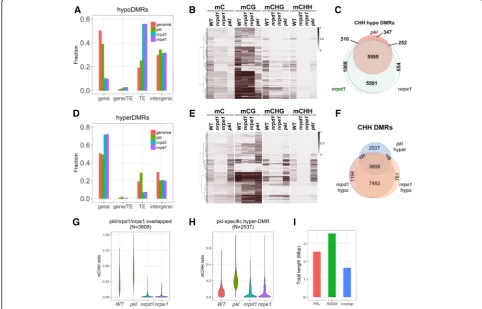
polymerase IV and V. By comparing to the WT control, we identified 2641, 7265, and 6948 hypo differentially methyl-ated regions (hypoDMRs) inpkl,nrpd1, andnrpe1, respect-ively. The average size of pkl hypoDMRs is smaller than those ofnrpd1andnrpe1hypoDMRs (315 versus 436 and 433). Most of the hypoDMRs identified innrpd1 ornrpe1
located to transposable elements (TEs) while hypoDMRs identified in pkl located more evenly to genes, TEs, and intergenic regions (Fig. 3a). Examination of the pkl
hypoDMRs in the genome browser revealed loci where only non-CG methylation were reduced, as well as loci where DNA methylation was lost in all sequence contexts (Additional file 1: Figure S3A). Indeed, heatmap illustra-tion of DNA methylaillustra-tion levels in all the 2641 pkl
hypoDMRs indicated that both CG and non-CG methylation were reduced but rarely eliminated in the
pkl mutant, while mutations in Pol IV or Pol V (nrpd1 or nrpe1) resulted in elimination of CHH methylation and severe reduction of CHG methylation
A B C
E
G
F D
H I
[image:6.595.55.538.326.635.2]at most loci (Fig. 3b and Additional file 1: Figure S3B), indicating that RdDM activity is required to maintain CHH methylation at those regions. We thus analyzed the CHH methylation specifically [56]. We identified 12,394 and 12,010 hypomethylated CHH re-gions in nrpd1 and nrpe1, respectively, and 11,136
(94.4%) were shared between the two mutants
(Fig. 3c). Among the 6670 regions that showed sig-nificant reduction in CHH methylation in the pkl mu-tant, 91.7% (6117/6670) of them were also identified in nrpd1 or nrpe1 (Fig. 3c), indicating the majority of CHH hypoDMRs of pklare RdDM targets. In most of the regions decreases in CHH methylation in pklwere not as dramatic as in nrpd1 or nrpe1, but the 347 pkl
unique regions exhibited significantly lower CHH methylation levels in pkl compared to nrpd1 or nrpe1
(Additional file 1: Figure S3C).
We also identified 4210 hyperDMRs in thepklmutant, a higher number than the 2493 and 2715 hyperDMRs identi-fied innrpd1andnrpe1, respectively. HyperDMRs ofnrpd1
andnrpe1showed preferences for genes instead of TEs or intergenic regions, while hyperDMRs of pkl were more likely distributed to TEs, but not intergenic regions (Fig. 3d). We observed increases of DNA methylation levels in CG, CHG and CHH contexts in pklhyperDMRs (Fig. 3e and Additional file 1: Figure S3B). However non-CG methyla-tion was dependent onNRPD1orNRPE1in most of those regions (Fig. 3e and Additional file 1: Figure S3B), suggest-ing that the majority of hyperDMRs identified in pkl are also RdDM loci. Most of thepklhyperDMRs already con-tained low levels of DNA methylation in WT plants (Fig. 3e). This was confirmed by visual inspection of thepkl
hyperDMRs in the genome browser (Additional file 1: Fig-ure S3D). More than 56% (3608/6394) of the CHH hyperDMRs identified in pkl overlapped with the CHH hypoDMRs ofnrpd1andnrpe1(Fig. 3f). Compared to the WT, in the 3608pkl/nrpd1/nrpe1overlapped regions, CHH methylation decreased to basal levels innrpd1 andnrpe1, whereas the methylation was significantly higher in pkl
(Fig. 3g). In the 2537pkl-specific regions, we also observed a decrease of CHH methylation in nrpd1 and nrpe1
(Fig. 3h). Those regions were not identified as hypoDMRs in nrpd1 or nrpe1 because in WT plants the majority of those regions had significantly lower CHH methylation levels than the overlapped regions (Fig. 3g; see Methods). Thus, the results indicated that the majority of differentially methylated regions of pkl, whether with increased or de-creased DNA methylation, are RdDM target loci.
The total length of CHH DMRs of pkl added up to 2.55 Mbp, whereas the total length of RdDM loci, de-fined by CHH DMRs identified in bothnrpd1andnrpe1, was 3.57 Mbp (Fig. 3i). The overlap between the two was 1.64 Mbp, indicating that at least 46% of the RdDM loci were affected by PKL. Overall the results above
demonstrated thatPKLis an important factor that is re-quired to maintain the correct methylation pattern in roughly half of the genomic regions regulated by RdDM.
PKL affects genome-wide 24-nt siRNA levels
We next tested whether PKL could influence DNA methylation by affecting 24-nt siRNA levels. First, we used northern blotting to examine the 24-nt siRNAs generated from the RD29A promoter. While pRD29A
specific siRNAs were undetectable in the ros1-1 nrpd1
mutant, their levels in ros1-1 rdm18-1 and ros1-1 rdm18-2 were comparable to those in WT and ros1-1
plants (Additional file 1: Figure S4A), indicating that
RDM18/PKL is not required for siRNA accumulation at theRD29Apromoter.
We also examined siRNA levels at other endogenous RdDM loci using small RNA northern blotting. The methylation level at AtSN1 was dependent on RDM18/
PKL (Additional file 1: Figure S2B) and we also found a decrease in siRNA levels at this locus in theros1-1 rdm18-2mutant (Additional file 1: Figure S4B). However, for an-other locus, soloLTR, where DNA methylation level also decreased in pkl, no changes in siRNA levels were ob-served (Additional file 1: Figure S4B). For the other two loci where we did not detect changes in DNA methylation levels in rdm18, AtMu1, and siRNA1003, no significant changes in siRNA levels were detected either (Additional file 1: Figure S4B), though siRNA levels did decrease in theros1-1 nrpe1plants. As a control, neithertasiRNA255
normiRNA171was affected by therdm18ornrpe1 muta-tion (Addimuta-tional file 1: Figure S4B).
We next performed small RNA sequencing to under-stand the genome-wide changes in siRNA levels in the
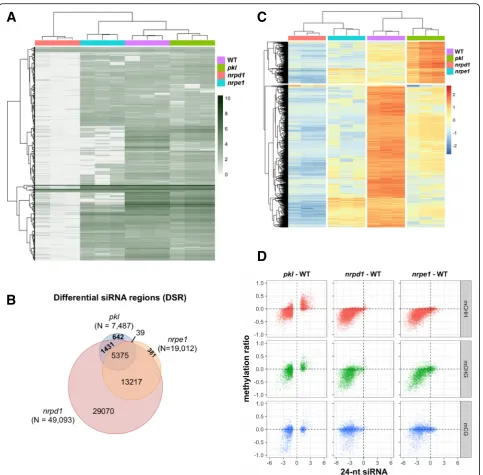
pkl mutant. We identified 57,094 regions where 24-nt siRNAs are expressed in either WT or mutant plants. As illustrated by the heatmap, the whole-genome profile of 24-nt siRNAs of the pkl mutant was more similar to WT than tonrpd1 ornrpe1(Fig. 4a). While mutation of
NRPD1 eliminated siRNAs from most of the loci, PKL rarely reduced siRNAs to basal levels (Fig. 4a). It was re-ported that AGO4 protein level decreases significantly in mutants that are defective in siRNA production, pre-sumably because formation of the siRNA-AGO4 com-plex stabilizes both the siRNA and AGO4 protein [57]. We thus examined AGO4 protein levels in the pkl mu-tant. Consistent with the less affected total siRNA abun-dance in pkl and nrpe1, anti-AGO4 western blot revealed no decreases of AGO4 proteins levels in pkl-1,
nrpe1-11, orpkl-1 nrpe1-11plants, whereas mutation of
NRPD1 lead to significant reduction of AGO4 proteins (Additional file 1: Figure S4C).
Using a false discovery rate (FDR) cutoff of 0.01, 7487 differential siRNA regions (DSRs) were identified in the
overlapped with DSRs identified in nrpd1 (Fig. 4b), in which 24-nt siRNAs at those regions decreased to basal levels (Fig. 4c). In contrary tonrpd1ornrpe1, whose DSRs are mainly hypoDSRs, a large number of hyperDSRs (n = 1691) was identified in pkl (Fig. 4c). Those regions con-tained medium levels of 24-nt siRNAs in WT and basal levels of siRNAs innrpd1, indicating that they are normal RdDM targets. Interestingly more than 70% of the DSRs
(5375/7487) identified inpklwere also affected byNRPE1
(Fig. 4b), mutation of which led to reduction of siRNA levels in those regions (Fig. 4c). Despite the significantly smaller number of DSRs identified in pkl compared to
nrpe1 (7487 versus 19,012), 24-nt siRNAs also decreased inpklat the majority ofnrpe1affected regions (Additional file 1: Figure S4D), indicating thatPKL and NRPE1tend to affect siRNA production at similar genomic loci.
C
A
B
D
Fig. 4Effects of thepklmutant on 24-nt siRNA abundance.aHeatmapshowing the log(RPTM) value of 24-nt siRNAs in the genome.bOverlaps among differential siRNA regions (DSRs) identified inpkl,nrpd1andnrpe1. Both upregulated and downregulated DSRs are included.cHeatmap
[image:8.595.58.542.85.560.2]We further explored the relationship between changes in 24-nt siRNA levels and DNA methylation levels in thepkl
mutant. In mostpklDSR regions, increases and decreases in 24-nt siRNAs positively correlated with increases and de-creases in non-CG methylation levels (Fig. 4d). In the same regions, nrpd1 and nrpe1 showed associated reduction in both siRNA and DNA methylation levels, withnrpd1 hav-ing a stronger effect on siRNA reduction (Fig. 4d). Most of the CG methylation changes centered around zero, no mat-ter decreases or increases in 24-nt siRNA levels were ob-served (Fig. 4d). These results indicated that mutation of
PKL changed the abundance of 24-nt siRNAs at the af-fected RdDM loci, the levels of which correlated with non-CG methylation levels.
PKL is required for Pol V function
Based on the strong overlap between PKL-affected and NRPE1-affected siRNA regions, we tested whether
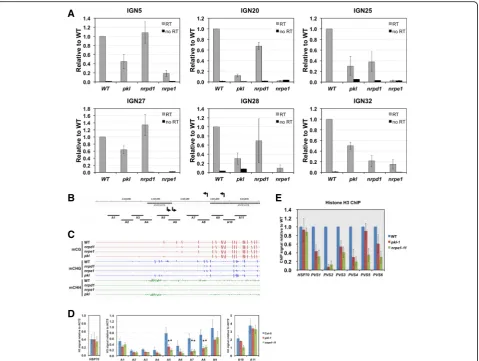
PKL is required for the proper function of Pol V. We first examined the accumulation of Pol V-dependent transcripts. We randomly selected intergenic regions where Pol V-dependent transcripts can be detected using real-time PCR in previous studies [29]. Six re-gions with significantly decreased Pol V-dependent transcripts levels in the pkl mutant were identified (Fig. 5a). While scaffold RNAs generated by Pol V can be readily detected in WT plants, they were dra-matically decreased to background levels in the nrpe1
mutant (Fig. 5a). In general, the reduction of Pol V-dependent transcripts in pkl was not as dramatic as in nrpe1 (Fig. 5a). Correspondingly, we observed a re-duction of non-CG methylation at all six IGN loci in the pkl mutant (Additional file 1: Figure S5). We also observed reduction of Pol V dependent RNAs in the
nrpd1 mutant at IGN25 and IGN32, suggesting that their accumulation could be affected by DNA methy-lation levels (Additional file 1: Figure S5).
In order to further understand the effect of PKL at Pol V transcribed regions, we examined nucleosome dens-ities at the IGN5 locus in the pkl mutant. The IGN5 locus is surrounded by two transposable elements and Pol V transcripts start from near the 3’and 5’end of the two TEs, respectively, and run in opposite directions [58] (Fig. 5b). A recent whole-genome study on Pol V transcripts also indicated that the IGN5 transcripts could start from inside the two TEs [59] (Fig. 5b). CHH methylation was decreased in pkl while abolished in
nrpe1in this region (Fig. 5c). We examined nucleosome density within and around IGN5 using 11 primer pairs (Fig. 5b) and found that Pol V is required to promote nucleosome occupancy across the whole region except at the two ends, A1 and A11. Pol V has stronger effect of nucleosome stabilization in regions from A5 to A8, where Pol V presumably transcribes both strands
(Fig. 5d). Except at A10, the effect of PKL on nucleo-some occupancy in this region largely resembled that of Pol V (Fig. 5d), even though thepklmutant had a milder effect on DNA methylation.
The scaffold RNAs generated by Pol V were shown to recruit SWI/SNF chromatin remodeling complexes that mediated nucleosome positioning at RdDM target re-gions [29]. We examined the effect ofPKLon Pol V sta-bilized nucleosomes since PKL was shown to have nucleosome positioning activities in vitro [32]. We per-formed histone H3 ChIP following micrococcal nuclease digestion of the chromatin. Out of the six randomly chosen Pol V-stabilized nucleosomes, five exhibited sig-nificantly reduced occupancy in pkl, except for PVS5 (Fig. 5e). Similar to what we observed at IGN5, the nu-cleosome density signals in thepklmutant were not sta-tistically different from those in nrpe1at the 5 affected loci (Fig. 5e).
The effect ofpklon gene andTEsilencing
In order to further understand the function of PKL in gene and TE silencing, a messenger RNA (mRNA)-seq experiment was performed in two-week-old pkl-1 seed-lings, as well as in the two RdDM mutantsnrpd1-3and
nrpe1-11. Statistical testing using a FDR cutoff of 0.05 and fold change cutoff of 2 identified 25 transposable el-ements (TEs) and 651 genes that were differentially expressed in the pkl mutant (Additional file 1: Figure S6A). The majority of DEGs (differentially expressed genes) of pkl did not show an expression change in
nrpd1 ornrpe1(Additional file 1: Figure S6A). Eighteen of 274 upregulated genes and six derepressed TEs ofpkl
also showed increased expression in nrpd1 or nrpe1
(Additional file 1: Figure S6B and S6C); similarly, 17 of 377 downregulated genes of pkl also showed decreased expression in nrpd1 or nrpe1 (Additional file 1: Figure S6D). Consistent with a previous report, in the pkl mu-tant 34% (n= 92) of the upregulated genes and 42% (n= 159) of the downregulated genes were also targets of H3K27me3, an epigenetic modification important for the silencing of developmentally regulated genes [46, 60]. The differences in the number of differentially expressed genes (DEGs) betweenpkl andnrpd1/nrpe1are consistent with the role ofPKLin developmental regulation and a role of RdDM in TE methylation.
We found that 50 of the 296 upregulated genes/TEs in
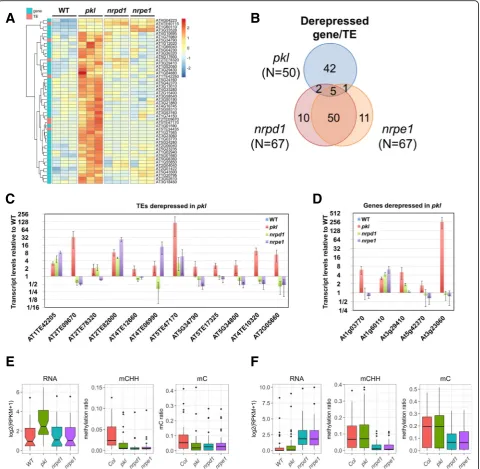
pkl overlapped with 52 hypoDMRs within 1-kb regions upstream and downstream of the gene/TE body. How-ever, expression of most of the 50 genes/TEs did not show a significant increase in nrpd1 or nrpe1 (Fig. 6a). Indeed, the majority of upregulated genes/TEs innrpd1
Most of the derepressed genes and TEs had low ex-pression levels in WT plants. We thus performed qRT-PCR to confirm their upregulated expression in pkl. Among the 17 randomly selected genes/TEs (12 TEs and five genes), 15 were confirmed to exhibit signifi-cantly increased expression in the pkl mutant (Fig. 6c and d). Among the qRT-PCR verified genes/TES, two TEs (AT1TE42205 and AT2TE82000) and one gene (AT1G60110) were also identified as derepressed in
nrpd1 and nrpe1 (Fig. 6c and d), suggesting that de-creased DNA methylation may be responsible for their derepression.
We further analyzed the expression and DNA methylation levels of the 42 and 50 genes/TEs that are specifically affected by PKL and RdDM (Fig. 6b). Transcript levels of the 42 pkl affected genes/TEs in
nrpd1/nrpe1 were very similar to WT plants (Fig. 6e). Consistent with the observation that the majority of
pkl DMRs were RdDM loci, the DNA methylation
level, especially CHH methylation level, decreased in the promoter region of the 42 affected genes/TEs in
nrpd1 and nrpe1 (Fig. 6e), suggesting that decreased DNA methylation are not sufficient to release
silen-cing at those genes/TEs. In contrast, DNA
E B
A
C
D
Fig. 5PKL is required for RNA Pol V-dependent noncoding RNA accumulation and nucleosome occupancy.aNon-coding RNA levels at six IGN loci were examined by real-time PCR. No RT (reverse transcriptase) samples serve as controls for genomic DNA contamination. All the transcript levels are shown on a relative scale with the level in WT (Col-0) plants being set to one.Error barsrepresent standard deviations calculated from three biological replicates.b
Diagramshowing the IGN5 locus on chromosome 4.Arrowsabove and below the coordinates indicate the position and direction where Pol V-dependent transcripts start. Positions of amplicons used for assaying nucleosome density in (d) were indicated byblack lineslabeled as A1 through A11.cAscreen shot
of IGV (Integrative Genomics Viewer) showing DNA methylation levels at the IGN5 locus. Thecolored bars(red,blue,green) represent the methylation levels of specific cytosines on the DNA double strands on a scale from–1 to 1; minus values indicate the methylated cytosine is on the reverse strand.d
[image:10.595.60.540.87.448.2]methylation levels at the 50 RdDM affected loci were significantly higher than the pkl affected genes/TEs and decreased DNA methylation was correlated with increased transcript levels innrpd1and nrpe1(Fig. 6f ). Changes in the transcript level or the DNA methyla-tion level at the 50 RdDM affected loci were not ob-served in pkl (Fig. 6f ).
Among the 25 differentially expressed TEs inpkl, 22 ex-hibited increased transcript levels (Additional file 1: Figure S6A), consistent with a role of PKL in transcriptional si-lencing of some TEs. The number of TEs that were dere-pressed innrpd1andnrpe1 were 44 and 42, respectively, and 36 of them were shared between the two (Additional file 1: Figure S6C). Thepklmutant shared six derepressed
B
D
C
A
F
E
Fig. 6The effects of PKL on the silencing of genes and TEs.aHeatmapshowing the relative transcript levels of the 50 derepressed genes/TEs in
[image:11.595.59.540.88.557.2]TEs withnrpd1 ornrpe1 (Additional file 1: Figure S6C). The 16 TEs derepressed inpklbut not innrpd1ornrpe1
exhibited slightly reduced DNA methylation inpkl (Add-itional file 1: Figure S6E). However, similar or stronger de-creases in DNA methylation levels were also observed in
nrpd1andnrpe1(Additional file 1: Figure S6E). This was in contrast to the 32 TEs that were derepressed innrpd1
and nrpe1 but not pkl (Additional file 1: Figure S6C), where the correlation between decreased DNA methyla-tion and increased transcripts was clear (Addimethyla-tional file 1: Figure S6F). These results suggest that PKL also has a role in transcriptional silencing that is independent of DNA methylation.
The relationship between PKL and repressive histone modifications
We next tested if other repressive epigenetic modifica-tions besides DNA methylation could be involved in transcriptional silencing mediated by PKL. One of the mechanisms by which PKL represses gene expression is by promoting H3K27me3 deposition [45, 46]. The level of H3K9me2 is tightly linked to non-CG DNA methyla-tion [13]. We wonder if repressive histone modificamethyla-tions
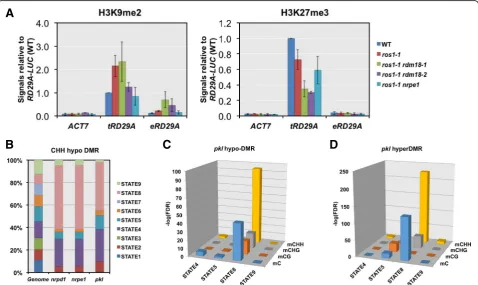
such as H3K27me3 and H3K9me2 were also involved in silencing at the transgenic RD29A promoter. Indeed, substantial levels of H3K27me3 and H3K9me2 were de-tected in WT plants and significant decreases of H3K27me3 were observed at the transgenicRD29A pro-moter in theros1-1 rdm18mutant (Fig. 7a).
A recent study using 16 features classified the Arabi-dopsis chromatin into nine different states, each repre-sented by a specific combination of features [61]. Of those, states 4, 5, 8 and 9 are the ones that are associated with transcriptional repression [61]. We examined the distribution of DMRs identified inpkl,nrpd1 and nrpe1
over the nine states. While the total lengths of the nine artificial types of chromatin are similar in the genome,
nrpd1 and nrpe1CHH hypoDMRs showed a clear pref-erence for state 4 and state 8 (Fig. 7b). Similar distribu-tion over these chromatin states was observed for CHH hypoDMRs of pkl(Fig. 7b). The FDRs for any types of DMRs (mC, mCG, mCHG, or mCHH) of pklto reside in state 8 by chance varied from 3 × 10–95 to 5 × 10–17 (Fig. 7c). This strong preference for state 8 chromatin was also observed for hypoDMRs identified in nrpd1
andnrpe1, with even smaller FDR values (Additional file
A
B C D
[image:12.595.59.538.377.662.2]1: Figure S6A). Interestingly, we observed the same pat-tern for hyperDMRs of pkl(Fig. 7c), consistent with our findings that both hypoDMRs and hyperDMRs of pkl
are mainly RdDM target loci. State 8 chromatin is enriched for heterochromatic features including H3K9me2, H3K27me1, histone H3.1, and varying levels of H3K27me3 [61]. Considering that the reported roles of PKL in both promoting and antagonizing H3K27me3 [46] and that elimination of H3K27me1 does not have an effect on genome DNA methylation levels [62], we speculated that PKL may affect DNA methylation through its effect on H3K27me3. We examined DNA methylation levels in the H3K27me3-defective mutant
clf-29 [63]. CLF encodes a histone methyltransferase specific for histone H3 lysine 27 [64]. Compared to hypo-DMRs identified in pkl, much fewer DMRs were identified in the clf-29 mutant (CHH hypo-DMR = 185; CHG hypo-DMR = 27; CG hypo-DMR = 489). Non-CG DNA methylation levels were also very similar between
clf-29 and WT plants at pkl CHH hypo-DMRs (Additional file 1: Figure S6C). These results indicate that decreased H3K27me3 levels inclf-29do not lead to changes in DNA methylation levels at PKL-affected regions.
Discussion
The effects of PKL at RdDM heterochromatin
In this study, we characterized the effects of PKL in RNA-directed DNA methylation. Mutation of PKL
changed the DNA methylation pattern of about half of RdDM loci and affected the noncoding RNAs gen-erated by RNA Pol V. We also found that PKL had both DNA dependent and methylation-independent roles in gene/TE silencing.
PKL is a CHD3-type chromatin remodeling factor that was shown to regulate many developmental pro-cesses [35–38, 46, 65, 66]. Its effect on DNA methyla-tion was underappreciated because microarray-based transcriptome analyses of pkl failed to identify statisti-cally significant overlap of differentially expressed genes with DNA methylation mutants [46]. Since TEs are underrepresented in the ATH1 microarray and their transcript levels are typically too low to be de-tected by the technology, the effect of PKL on TEs was largely unknown [45]. This study identified genome-wide changes in DNA methylation patterns in the pkl mutant and found that the DNA methyla-tion changes were predominantly at RdDM loci. RdDM mainly targets TEs and loss of RdDM activity does not lead to dramatic changes in the expression level of genes (Fig. 3a) [11]. Thus, our results are consistent with previous findings and revealed a new role of PKL in modulating DNA methylation at RdDM loci.
The involvement of PKL in regulating DNA methyla-tion levels of RdDM loci is supported by several pieces of evidence. First, PKL was identified in the ros1 sup-pressor screen and is required to promote non-CG methylation and transcriptional silencing of the
pRD29A-LUC transgene, which requires RNA-directed DNA methylation for silencing (Fig. 1d and Additional file 1: Figure S2A). Tens of components involved in RdDM have been identified from the same screen [50]. Second, the transcript level of the DNA demethylase gene ROS1 decreased in all therdm18/pkl alleles. Inde-pendent studies found that theROS1transcript level de-creases in mutants defective in DNA methylation or in plants treated with DNA methylation inhibitors [53, 55, 67, 68]. Two recent studies identified a TE-derived cis -regulatory element, DNA methylation of which posi-tively regulates ROS1 expression [54, 55]. Mutation of
PKLreduced the DNA methylation level at the samecis -element. Third, whole-genome bisulfite sequencing ana-lyses indicated that PKL was required for proper methy-lation of about half of the RdDM target loci (Fig. 3 and Additional file 1: Figure S3). It remains to be tested if further mutation of other CHD family chromatin remo-delers could enhance the DNA methylation phenotype ofpkl[32].
Correlated with changes in DNA methylation levels, significant changes in the 24-nt siRNA profile of pkl
were also observed (Fig. 4). The numbers of hyperDSRs identified inpklwere significantly smaller than the num-bers of CHH hyperDMRs. This may be due to the
tech-nical limitation of the small RNA sequencing
experiment. Regions that showed increases in DNA methylation and siRNA levels in pklwere RdDM target loci that contain low levels of DNA methylation and 24-nt siRNAs (Figs. 3e and 4c). While whole-genome bisul-fite sequencing covers the genome relatively evenly, small RNA reads are dominated by loci that are more highly methylated. Thus, deeper sequencing may be needed to reveal the changes in siRNA levels at the other hyperDMRs. It remains to be determined as to how PKL affects siRNA production. The majority of 24-nt DSRs ide24-ntified in pkl, whether increased or de-creased, are also affected by nrpe1 (Fig. 4b), suggesting that PKL may affect secondary siRNA production as NRPE1 does. Other evidence also suggests that the func-tion of Pol V was affected by pkl. Correlated with DNA methylation decreases, the scaffold RNAs generated by Pol V and the occupancy of Pol V stabilized nucleosomes were reduced in thepklmutant (Fig. 5a and c).
RNA-seq analyses identified 50 genes/TEs that were derepressed and correlated with decreases in DNA methylation in pkl. However similar analyses in nrpd1
of them (Fig. 6). Overall these results demonstrated that multiple aspects of RNA-directed DNA methylation were affected in thepklmutant.
Possible functions of PKL at RdDM target loci
ATP-dependent chromatin remodeling factors are con-served helicase-derived machineries that are involved in almost all aspects of chromatin regulation [20]. Arabi-dopsis contains 45 ATP-dependent chromatin remodel-ing factors, out of which DDM1 and PKL are the only two that were confirmed to exhibit nucleosome remod-eling activity in vitro [32, 69]. It is believed that DDM1 promotes CMT2-dependent CHH methylation in the middle of long transposable elements by allowing CMT2 to better access its substrate DNA [12]. The observation that PKL is required for both promoting and repressing DNA methylation at RdDM loci is different from other known RdDM mutants, suggesting that the phenotype is not through affecting the expression of any single com-ponent of the RdDM pathway. Indeed, transcriptome analyses in pkl-1 did not identify reduced expression in any known RdDM component genes (Additional file 2: Table S4). It was shown before that PKL could bind to certain TEs [45]. The animal homologs of PKL, Mi-2α/β, were also recruited to the heterochromatin by MeCP2 (methyl CpG binding protein 2) [70]. We propose that PKL binds to the chromatin of RdDM target loci and af-fects DNA methylation through its nucleosome remod-eling activity.
PKL could affect RNA-directed DNA methylation by regulating nucleosome positioning. Similar to other classic chromatin remodelers, PKL exhibits nucleosome “sliding” activity in vitro [32]. In Arabidopsis, nucleosome-bound DNA exhibits higher methylation levels than nucleosome-free DNA and non-CG methylation are promoted by the histone modification H3K9me1/2 [13, 71]. Thus, simply changing the nucleosome positioning could change DNA methylation patterns. Indeed, the positioning of several Pol V stabilized nucleosomes was altered in the pkl mutant (Fig. 5e). Alternatively, PKL may function in regulating the nucleosome conformation, which in turn has an effect on noncoding RNA production by Pol IV and Pol V or on the activity of DNA methyltransferases. We found that in addition to non-CG methylation, CG methylation was also affected at some DMRs identified in pkl (Fig. 3b and e), suggesting that the activity of other DNA methyltransfer-ases, in addition to DRM2, was affected in those regions.
PKL participates in the Pol V transcription process is an-other possibility by which PKL affects DNA methylation at RdDM loci. Immunoaffinity purification of Pol V identified the chromatin remodeler DRD1, but not PKL [15, 23, 27, 28]. Though the specific activity of DRD1 in promoting Pol V function is unknown, DRD1 is required for the associ-ation of Pol V to the chromatin and its mutant has a similar
DNA methylation profile asnrpe1[24, 56]. Despite its func-tional importance, DRD1 is unlikely the only chromatin re-modeler participating in the transcription process. In animals, different CHD proteins are required at the initiation, elongation, or termination phase of Pol II tran-scription [72, 73], indicating that their heterogeneous bio-chemical activities suit multiple aspects of the transcription cycle. The different effects of PKL and DRD1 on DNA methylation suggest they could function in different phases of Pol V transcription [56]. For example, CHD1 from yeast and Drosophila function during transcription elongation and facilitate reassembly and repositioning of nucleosomes after the polymerase [72, 74]. Although CHD remodelers can contribute to different aspects of transcription, they do not necessarily exhibit a strong association with Pol II. Interestingly, similar to CHD1, PKL primarily exists as a monomer in vivo [32, 75] and thepklmutant exhibits re-duced nucleosome occupancy at Pol V transcribed regions (Fig. 5). In addition, a number of genes/TEs that were dere-pressed inpklwere not due to decreases in DNA methyla-tion (Fig. 6e), suggesting that a DNA-methylation independent role of PKL in promoting transcriptional silen-cing via its nucleosome remodeling activity. In the future, understanding the in vivo biochemical activity of PKL on the chromatin and its correlation with DNA methylation will be important.
Conclusions
We found that the CHD3 protein PKL has an unexpected role in the regulation of DNA methylation levels at the loci targeted by RNA-directed DNA methylation. The changes in CHH methylation in pkl positively correlates with changes in Pol IV-dependent siRNAs and Pol V-dependent scaffold RNAs. These findings significantly advance our un-derstanding of how RNA-directed DNA methylation can be regulated and highlight the diverse functions of CHD proteins in the regulation of chromatin activities.
Methods
Plant materials and growth conditions
Plants in the C24 ecotype (WT, ros1-1, ros1-1 nrpd1,
ros1-1 nrpe1) carry a homozygous T-DNA insertion that contains the pRD29A-LUC and p35S-NPTII transgenes. For genetic screening, a T-DNA mutagenized and an EMS-mutagenized ros1-1 populations were generated and screened for plants that show increased luciferase signals as described previously [50]. Plants were grown in growth chambers or air-conditioned rooms at 22 °C with 16 h-8 h light-dark cycle.
DNA methylation analyses of individual loci
DNA methylation-sensitive restriction endonuclease (NEB) and 5μg of the digested DNA was loaded into a 1% agarose gel and separated at 40 V for 12 h. Then southern blotting was performed following a standard protocol.
For individual bisulfite sequencing, genomic DNA was ex-tracted from two-week-old seedlings using the Plant DNeasy Mini Kit (Qiagen). Then 2 μg of genomic DNA was subjected to sodium bisulfite treatment and purification using the EpiTect Plus Bisulfite Kit (Qiagen). Then locus-specific primers (Additional file 2: Table S5) were used to amplify regions of interested and the PCR product were cloned into the T-easy vector (Promega). At least 18 unique sequences from each genotype/locus was obtained and ana-lyzed at the CyMATE website (http://www.cymate.org).
RT-PCR
RT-PCR and qRT-PCR were performed as described pre-viously [50]. Briefly Trizol reagent (Life Technologies) extracted total RNA was subjected to DNase I treatment (Ambion) and RT using Superscript III First Strand Syn-thesis Kit (Life Technologies). The synthesized comple-mentary DNA (cDNA) was then diluted to 5–10 ng/μL and 5 μL was used for each RT-PCR or qRT-PCR reac-tion. For RT-PCR, the optimal PCR cycle number for each primer pair was empirically determined. The primers used for RT-PCR analyses are listed in the Sup-plementary Material (Additional file 2: Table S5).
Analyses of Pol V-dependent transcripts
Detection of Pol V-dependent transcripts was performed by following a published protocol [29]. Briefly, total RNA was extracted from two-week-old seedlings using Plant RNeasy Mini Kit (Qiagen). The eluted RNA was treated with Turbo DNase I (Ambion) at 37 °C for 30 min. Then 2 μg of RNA without contaminated DNA was used for synthesis the first strand cDNA using SuperScript III First-Strand Synthesis System (Invitrogen) with the ran-dom hexamers. Then 200 ng of cDNA was used per real-time reaction using transcript-specific primers.
Small RNA northern blotting
Northern blotting for small RNA analyses was performed as described previously [76]. Briefly, small RNAs were ex-tracted using the TRIzol reagent and PEG precipitation and then separated on a 15% polyacrylamide gel at 200 V for 3–4 h. The small RNA was stained with ethium brom-ide and electro-transferred to the Hybond-N+ membrane (GE Lifesciences). Small RNA hybridization was carried out in PerfectHyb buffer (Sigma) overnight at 38 °C. Probes were produced by PCR amplification in the pres-ence of [α-32P] dCTP. Primers used for generating the probes are listed in Additional file 2: Table S5.
Whole-genome bisulfite sequencing and data analyses Genomic DNA was extracted from two-week-old pkl-1
seedlings using the Plant DNeasy mini kit (Qiagen) and sent to BGI (Shenzhen, China) for whole-genome bisul-fite sequencing. For clf-29 and the corresponding WT control, two-week-old seedlings were grown under the same conditions and sent to Core Facility for Genomics at Shanghai Center for Plant Stress Biology (PSC) for whole-genome bisulfite sequencing.
For the analyses of BS-seq data, first adapter sequences and low-quality reads (Q < 20) were trimmed and clean reads were mapped to the TAIR10 genome using BSMAP [77]. The method for the identification of total C DMRs (differentially methylated regions) was reported before [78]. For the identification of different types of DMRs (mCG, mCHG, and mCHH) we followed a published method [56]. Briefly, the genome was divided in 100-bp bins and CG, CHG, CHH methylation levels in each bin (covered at least four times) was calculated and compared between WT and mutant plants. Bins that show differ-ences in DNA methylation levels (mCG > 0.4, mCHG > 0.2, mCHH > 0.1) were recorded and filtered based on Fisher’s exact test and multi-testing corrected p values (cutoff = 0.05). DMRs were generated by joining bins that are no more than 200 bp apart.
Transcriptome sequencing and data analyses
Total RNAs were extracted from two-week-old WT,pkl-1,
nrpd1-3, andnrpe1-11seedlings using Trizol reagent (Life Technologies). PolyT purification of messenger RNAs, stranded RNA library preparation and paired end sequen-cing were performed using Illumina reagents following the manufacturer’s instructions at Genomics Core Facility of PSC. For data analyses adapter sequences and low qual-ity bases (q < 30) were trimmed and clean reads were mapped to the TAIR10 reference genome using the sub-read package. Read counts for both genes and TEs were produced using the featureCounts command and statis-tical testing was performed using the edgeR package in R [79].
Small RNA sequencing and data analyses
every 100-bp bin of the genome were generated using bed-tools coverage [80] and were normalized to reads per 10 million (RPTM) according to the total number of mapped reads (excluding structural sRNAs). Only bins with a nor-malized RPTM value of 24-nt sRNAs higher than 5 in any plant were retained for differential analyses using the edgeR package [79].
Chromatin immunoprecipitation
Chromatin immunoprecipitation was performed accord-ing to a published protocol [46]. Typically, two-week-old seedlings grown on ½ MS plates supplemented with 1% sucrose were used as the starting material. After crosslink-ing and nuclei extraction, the chromatin was fragmented using either directly sonication or sonication after MNase digestion. Afterwards soluble fraction of fragmented chro-matin was incubated with H3 (Abcam ab1791), anti-H3K27me3 (Millipore 07-449) or anti-H3K9me2 (Abcam ab1220) antibodies for overnight at 4 °C. After washing and reverse crosslinking, the immunoprecipitated DNA was then purified using PCI extraction and examined using gene specific primers by qPCR.
Western blotting
After total proteins were extracted, the proteins were heated at 95 °C for 5 min before being separated on SDS-PAGE for Commassie Blue staining. A standard western blotting protocol was used with anti-AGO4 antibody (Agrisera, AS09617) at 1:5000 dilutions.
Additional files
Additional file 1: Figure S1.RDM18/PKLpromotes silencing at the p35S-NPTIItransgene but does not affect DNA methylation levels.Figure S2.
RDM18is required for proper methylation at RdDM target loci.Figure S3.
Characterization of differentially methylated regions in thepklmutant.Figure S4.Effects ofpklon 24-nt siRNA levels and AGO4 protein levels.Figure S5.
Analyses on TEs and genes that are differentially expressed in mutants.Figure S6.Chromatin features of the RdDM loci. (PDF 6385 kb)
[image:16.595.302.538.389.739.2]Additional file 2: Table S1.Statistics of RNA-seq data.Table S2.List of differentially expressed genes in thepklmutant identified by RNA-seq.
Table S3.List of differentially expressed TEs in thepklmutant identified by RNA-seq.Table S4.Transcript level of genes involved in DNA methylation regulation.Table S5.List of primers used in this study. (XLSX 218 kb)
Abbreviations
DEG:Differentially expressed genes; DMR: Differentially methylation regions; ncRNA: Non-coding RNA; nt: Nucleotide; PCR: Polymerase chain reaction; Pol IV: RNA polymerase IV; Pol V: RNA polymerase V; RdDM: RNA-directed DNA methylation; siRNA: Small interfering RNA
Funding
Funding for this study was provided by National Natural Science Foundation of China (31371312), Chinese Ministry of Science and Technology of China (2016YFA0503200) and Youth Innovation Promotion Association, Chinese Academy of Sciences (CAS) to HZ, by National Basic Research Program of China (973 Program) (2012CB910900) and the 973 Program (2011CB812600) from Chinese Ministry of Science and Technology to XJH, by NIGMS and by CAS to JKZ, and by National Science Foundation (Grant No. 1413183) to JO.
Availability of data and materials
Sequencing data have been deposited at the Gene Expression Omnibus (GEO) (https://www.ncbi.nlm.nih.gov/geo/) under the accession code GSE98286. Other experiment materials are available upon request.
Authors’contributions
HZ, XJH, JKZ, and JO designed the research; RY, ZZ, QC, DM, JL, JXZ, and HZ performed research; LY, HH, WW, LZ, and HZ performed bioinformatics analyses; HZ wrote the paper. All authors read and approved the final manuscript.
Competing interests
The authors declare that they have no competing interests.
Ethics approval and consent to participate
Not applicable.
Publisher’s Note
Springer Nature remains neutral with regard to jurisdictional claims in published maps and institutional affiliations.
Author details
1Shanghai Center for Plant Stress Biology, Shanghai Institutes for Biological
Sciences, Chinese Academy of Sciences, Shanghai 210602, China.2National Institute of Biological Sciences, Beijing 102206, China.3Department of Biochemistry, Purdue University, West Lafayette, IN 47907, USA.4Department of Horticulture and Landscape Architecture, Purdue University, West Lafayette, IN 47907, USA.
Received: 25 January 2017 Accepted: 3 May 2017
References
1. Law JA, Jacobsen SE. Establishing, maintaining and modifying DNA methylation patterns in plants and animals. Nat Rev Genet. 2010;11:204–20. 2. Lister R, O’Malley RC, Tonti-Filippini J, Gregory BD, Berry CC, Millar AH, et al.
Highly integrated single-base resolution maps of the epigenome in Arabidopsis. Cell. 2008;133:523–36.
3. Cokus SJ, Feng S, Zhang X, Chen Z, Merriman B, Haudenschild CD, et al. Shotgun bisulphite sequencing of the Arabidopsis genome reveals DNA methylation patterning. Nature. 2008;452:215–9.
4. Feng S, Cokus SJ, Zhang X, Chen PY, Bostick M, Goll MG, et al. Conservation and divergence of methylation patterning in plants and animals. Proc Natl Acad Sci U S A. 2010;107:8689–94.
5. Woo HR, Dittmer TA, Richards EJ. Three SRA-domain methylcytosine-binding proteins cooperate to maintain global CpG methylation and epigenetic silencing in Arabidopsis. PLoS Genet. 2008;4:e1000156.
6. Cao X, Aufsatz W, Zilberman D, Mette MF, Huang MS, Matzke M, et al. Role of the DRM and CMT3 methyltransferases in RNA-directed DNA methylation. Curr Biol. 2003;13:2212–7.
7. Ebbs ML, Bender J. Locus-specific control of DNA methylation by the Arabidopsis SUVH5 histone methyltransferase. Plant Cell. 2006;18:1166–76. 8. Du J, Zhong X, Bernatavichute YV, Stroud H, Feng S, Caro E, et al. Dual
binding of chromomethylase domains to H3K9me2-containing nucleosomes directs DNA methylation in plants. Cell. 2012;151:167–80. 9. Du J, Johnson LM, Groth M, Feng S, Hale CJ, Li S, et al. Mechanism of DNA
methylation-directed histone methylation by KRYPTONITE. Mol Cell. 2014;55: 495–504.
10. Matzke MA, Mosher RA. RNA-directed DNA methylation: an epigenetic pathway of increasing complexity. Nat Rev Genet. 2014;15:394–408. 11. Matzke MA, Kanno T, Matzke AJ. RNA-directed DNA methylation: the
evolution of a complex epigenetic pathway in flowering plants. Annu Rev Plant Biol. 2015;66:243–67.
12. Zemach A, Kim MY, Hsieh PH, Coleman-Derr D, Eshed-Williams L, Thao K, et al. The Arabidopsis nucleosome remodeler DDM1 allows DNA methyltransferases to access H1-containing heterochromatin. Cell. 2013;153:193–205.
13. Stroud H, Do T, Du J, Zhong X, Feng S, Johnson L, et al. Non-CG methylation patterns shape the epigenetic landscape in Arabidopsis. Nat Struct Mol Biol. 2014;21:64–72.
and segmental gene duplications, retrotransposition, and lineage-specific subfunctionalization. Cold Spring Harb Symp Quant Biol. 2010;75:285–97. 15. Ream TS, Haag JR, Wierzbicki AT, Nicora CD, Norbeck AD, Zhu JK, et al. Subunit
compositions of the RNA-silencing enzymes Pol IV and Pol V reveal their origins as specialized forms of RNA polymerase II. Mol Cell. 2009;33:192–203. 16. Wierzbicki AT, Ream TS, Haag JR, Pikaard CS. RNA polymerase V
transcription guides ARGONAUTE4 to chromatin. Nat Genet. 2009;41:630–4. 17. He XJ, Hsu YF, Zhu S, Liu HL, Pontes O, Zhu J, et al. A conserved
transcriptional regulator is required for RNA-directed DNA methylation and plant development. Genes Dev. 2009;23:2717–22.
18. Kanno T, Bucher E, Daxinger L, Huettel B, Kreil DP, Breinig F, et al. RNA-directed DNA methylation and plant development require an IWR1-type transcription factor. EMBO Rep. 2010;11:65–71.
19. Flaus A, Martin DM, Barton GJ, Owen-Hughes T. Identification of multiple distinct Snf2 subfamilies with conserved structural motifs. Nucleic Acids Res. 2006;34:2887–905.
20. Narlikar GJ, Sundaramoorthy R, Owen-Hughes T. Mechanisms and functions of ATP-dependent chromatin-remodeling enzymes. Cell. 2013;154:490–503. 21. Vongs A, Kakutani T, Martienssen RA, Richards EJ. Arabidopsis thaliana DNA
methylation mutants. Science. 1993;260:1926–8.
22. Kanno T, Mette MF, Kreil DP, Aufsatz W, Matzke M, Matzke AJ. Involvement of putative SNF2 chromatin remodeling protein DRD1 in RNA-directed DNA methylation. Curr Biol. 2004;14:801–5.
23. Law JA, Ausin I, Johnson LM, Vashisht AA, Zhu JK, Wohlschlegel JA, Jacobsen SE. A protein complex required for polymerase V transcripts and RNA- directed DNA methylation in Arabidopsis. Curr Biol. 2010;20:951–6. 24. Zhong X, Hale CJ, Law JA, Johnson LM, Feng S, Tu A, et al. DDR complex
facilitates global association of RNA polymerase V to promoters and evolutionarily young transposons. Nat Struct Mol Biol. 2012;19:870–5. 25. Smith LM, Baulcombe DC. Dissection of silencing signal movement in
Arabidopsis. Plant Signal Behav. 2007;2:501–2.
26. Law JA, Vashisht AA, Wohlschlegel JA, Jacobsen SE. SHH1, a homeodomain protein required for DNA methylation, as well as RDR2, RDM4, and chromatin remodeling factors, associate with RNA polymerase IV. PLoS Genet. 2011;7:e1002195.
27. Haag JR, Brower-Toland B, Krieger EK, Sidorenko L, Nicora CD, Norbeck AD, et al. Functional diversification of maize RNA polymerase IV and V subtypes via alternative catalytic subunits. Cell Rep. 2014;9:378–90.
28. Huang L, Jones AM, Searle I, Patel K, Vogler H, Hubner NC, et al. An atypical RNA polymerase involved in RNA silencing shares small subunits with RNA polymerase II. Nat Struct Mol Biol. 2009;16:91–3.
29. Zhu Y, Rowley MJ, Bohmdorfer G, Wierzbicki AT. A SWI/SNF chromatin-remodeling complex acts in noncoding RNA-mediated transcriptional silencing. Mol Cell. 2013;49:298–309.
30. Groth M, Stroud H, Feng S, Greenberg MV, Vashisht AA, Wohlschlegel JA, et al. SNF2 chromatin remodeler-family proteins FRG1 and -2 are required for RNA-directed DNA methylation. Proc Natl Acad Sci U S A. 2014;111:17666–71. 31. Han YF, Dou K, Ma ZY, Zhang SW, Huang HW, Li L, et al. SUVR2 is involved
in transcriptional gene silencing by associating with SNF2-related chromatin-remodeling proteins in Arabidopsis. Cell Res. 2014;24:1445–65. 32. Ho KK, Zhang H, Golden BL, Ogas J. PICKLE is a CHD subfamily II ATP-dependent
chromatin remodeling factor. Biochim Biophys Acta. 1829;2013:199–210. 33. Ogas J, Cheng JC, Sung ZR, Somerville C. Cellular differentiation regulated by
gibberellin in the Arabidopsis thaliana pickle mutant. Science. 1997;277:91–4. 34. Eshed Y, Baum SF, Bowman JL. Distinct mechanisms promote polarity
establishment in carpels of Arabidopsis. Cell. 1999;99:199–209. 35. Fukaki H, Taniguchi N, Tasaka M. PICKLE is required for SOLITARY-ROOT/
IAA14-mediated repression of ARF7 and ARF19 activity during Arabidopsis lateral root initiation. Plant J. 2006;48:380–9.
36. Jing Y, Zhang D, Wang X, Tang W, Wang W, Huai J, et al. Arabidopsis chromatin remodeling factor PICKLE interacts with transcription factor HY5 to regulate hypocotyl cell elongation. Plant Cell. 2013;25:242–56. 37. Aichinger E, Villar CB, Di Mambro R, Sabatini S, Kohler C. The CHD3 chromatin
remodeler PICKLE and polycomb group proteins antagonistically regulate meristem activity in the Arabidopsis root. Plant Cell. 2011;23:1047–60. 38. Zhang D, Jing Y, Jiang Z, Lin R. The chromatin-remodeling factor PICKLE
integrates Brassinosteroid and Gibberellin signaling during skotomorphogenic growth in Arabidopsis. Plant Cell. 2014;26:2472–85. 39. Wade PA, Jones PL, Vermaak D, Wolffe AP. A multiple subunit Mi-2 histone
deacetylase from Xenopus laevis cofractionates with an associated Snf2 superfamily ATPase. Curr Biol. 1998;8:843–6.
40. Xue Y, Wong J, Moreno GT, Young MK, Cote J, Wang W. NURD, a novel complex with both ATP-dependent chromatin-remodeling and histone deacetylase activities. Mol Cell. 1998;2:851–61.
41. Tong JK, Hassig CA, Schnitzler GR, Kingston RE, Schreiber SL. Chromatin deacetylation by an ATP-dependent nucleosome remodelling complex. Nature. 1998;395:917–21.
42. Zhang Y, LeRoy G, Seelig HP, Lane WS, Reinberg D. The dermatomyositis-specific autoantigen Mi2 is a component of a complex containing histone deacetylase and nucleosome remodeling activities. Cell. 1998;95:279–89. 43. Lai AY, Wade PA. Cancer biology and NuRD: a multifaceted chromatin
remodelling complex. Nat Rev Cancer. 2011;11:588–96.
44. Saether T, Berge T, Ledsaak M, Matre V, Alm-Kristiansen AH, Dahle O, et al. The chromatin remodeling factor Mi-2alpha acts as a novel co-activator for human c-Myb. J Biol Chem. 2007;282:13994–4005.
45. Zhang H, Bishop B, Ringenberg W, Muir WM, Ogas J. The CHD3 remodeler PICKLE associates with genes enriched for trimethylation of histone H3 lysine 27. Plant Physiol. 2012;159:418–32.
46. Zhang H, Rider Jr SD, Henderson JT, Fountain M, Chuang K, Kandachar V, et al. The CHD3 remodeler PICKLE promotes trimethylation of histone H3 lysine 27. J Biol Chem. 2008;283:22637–48.
47. Becker PB, Horz W. ATP-dependent nucleosome remodeling. Annu Rev Biochem. 2002;71:247–73.
48. Kapoor A, Agius F, Zhu JK. Preventing transcriptional gene silencing by active DNA demethylation. FEBS Lett. 2005;579:5889–98.
49. Gong Z, Morales-Ruiz T, Ariza RR, Roldan-Arjona T, David L, Zhu JK. ROS1, a repressor of transcriptional gene silencing in Arabidopsis, encodes a DNA glycosylase/lyase. Cell. 2002;111:803–14.
50. He XJ, Hsu YF, Pontes O, Zhu J, Lu J, Bressan RA, et al. NRPD4, a protein related to the RPB4 subunit of RNA polymerase II, is a component of RNA polymerases IV and V and is required for RNA-directed DNA methylation. Genes Dev. 2009;23:318–30.
51. Li X, Qian W, Zhao Y, Wang C, Shen J, Zhu JK, et al. Antisilencing role of the RNA-directed DNA methylation pathway and a histone acetyltransferase in Arabidopsis. Proc Natl Acad Sci U S A. 2012;109:11425–30.
52. Huang CF, Miki D, Tang K, Zhou HR, Zheng Z, Chen W, et al. A Pre-mRNA-splicing factor is required for RNA-directed DNA methylation in Arabidopsis. PLoS Genet. 2013;9:e1003779.
53. Mathieu O, Reinders J, Caikovski M, Smathajitt C, Paszkowski J.
Transgenerational stability of the Arabidopsis epigenome is coordinated by CG methylation. Cell. 2007;130:851–62.
54. Williams BP, Pignatta D, Henikoff S, Gehring M. Methylation-sensitive expression of a DNA demethylase gene serves as an epigenetic rheostat. PLoS Genet. 2015;11:e1005142.
55. Lei M, Zhang H, Julian R, Tang K, Xie S, Zhu JK. Regulatory link between DNA methylation and active demethylation in Arabidopsis. Proc Natl Acad Sci U S A. 2015;112:3553–7.
56. Stroud H, Greenberg MV, Feng S, Bernatavichute YV, Jacobsen SE. Comprehensive analysis of silencing mutants reveals complex regulation of the Arabidopsis methylome. Cell. 2013;152:352–64.
57. Li CF, Pontes O, El-Shami M, Henderson IR, Bernatavichute YV, Chan SW, et al. An ARGONAUTE4-containing nuclear processing center colocalized with Cajal bodies in Arabidopsis thaliana. Cell. 2006;126:93–106.
58. Wierzbicki AT, Haag JR, Pikaard CS. Noncoding transcription by RNA polymerase Pol IVb/Pol V mediates transcriptional silencing of overlapping and adjacent genes. Cell. 2008;135:635–48.
59. Bohmdorfer G, Sethuraman S, Rowley MJ, Krzyszton M, Rothi MH, Bouzit L, et al. Long non-coding RNA produced by RNA polymerase V determines boundaries of heterochromatin. Elife. 2016;5:e19092.
60. Zhang X, Clarenz O, Cokus S, Bernatavichute YV, Pellegrini M, Goodrich J, et al. Whole-genome analysis of histone H3 lysine 27 trimethylation in Arabidopsis. PLoS Biol. 2007;5:e129.
61. Sequeira-Mendes J, Araguez I, Peiro R, Mendez-Giraldez R, Zhang X, Jacobsen SE, et al. The functional topography of the arabidopsis genome is organized in a reduced number of linear motifs of chromatin states. Plant Cell. 2014;26:2351–66. 62. Jacob Y, Stroud H, Leblanc C, Feng S, Zhuo L, Caro E, et al. Regulation of
heterochromatic DNA replication by histone H3 lysine 27 methyltransferases. Nature. 2010;466:987–91.
63. Xu L, Shen WH. Polycomb silencing of KNOX genes confines shoot stem cell niches in Arabidopsis. Curr Biol. 2008;18:1966–71.
65. Henderson JT, Li HC, Rider SD, Mordhorst AP, Romero-Severson J, Cheng JC, et al. PICKLE acts throughout the plant to repress expression of embryonic traits and may play a role in gibberellin-dependent responses. Plant Physiol. 2004;134:995–1005.
66. Xu M, Hu T, Smith MR, Poethig RS. Epigenetic regulation of vegetative phase change in Arabidopsis. Plant Cell. 2016;28:28–41.
67. Penterman J, Uzawa R, Fischer RL. Genetic interactions between DNA demethylation and methylation in Arabidopsis. Plant Physiol. 2007;145: 1549–57.
68. Yokthongwattana C, Bucher E, Caikovski M, Vaillant I, Nicolet J, Mittelsten Scheid O, et al. MOM1 and Pol-IV/V interactions regulate the intensity and specificity of transcriptional gene silencing. EMBO J. 2010;29:340–51. 69. Brzeski J, Jerzmanowski A. Deficient in DNA methylation 1 (DDM1) defines a
novel family of chromatin-remodeling factors. J Biol Chem. 2003;278:823–8. 70. Wade PA, Gegonne A, Jones PL, Ballestar E, Aubry F, Wolffe AP. Mi-2
complex couples DNA methylation to chromatin remodelling and histone deacetylation. Nat Genet. 1999;23:62–6.
71. Chodavarapu RK, Feng S, Bernatavichute YV, Chen PY, Stroud H, Yu Y, et al. Relationship between nucleosome positioning and DNA methylation. Nature. 2010;466:388–92.
72. Murawska M, Brehm A. CHD chromatin remodelers and the transcription cycle. Transcription. 2011;2:244–53.
73. Bottardi S, Mavoungou L, Milot E. IKAROS: a multifunctional regulator of the polymerase II transcription cycle. Trends Genet. 2015;31:500–8.
74. Venkatesh S, Workman JL. Histone exchange, chromatin structure and the regulation of transcription. Nat Rev Mol Cell Biol. 2015;16:178–89. 75. Sims JK, Wade PA. SnapShot: Chromatin remodeling: CHD. Cell. 2011;144:
626. e621.
76. Liu J, Bai G, Zhang C, Chen W, Zhou J, Zhang S, et al. An atypical component of RNA-directed DNA methylation machinery has both DNA methylation-dependent and -independent roles in locus-specific transcriptional gene silencing. Cell Res. 2011;21:1691–700.
77. Xi Y, Li W. BSMAP: whole genome bisulfite sequence MAPping program. BMC Bioinformatics. 2009;10:232.
78. Zhang H, Ma ZY, Zeng L, Tanaka K, Zhang CJ, Ma J, et al. DTF1 is a core component of RNA-directed DNA methylation and may assist in the recruitment of Pol IV. Proc Natl Acad Sci U S A. 2013;110:8290–5. 79. Chen Y, Lun AT, Smyth GK. From reads to genes to pathways: differential
expression analysis of RNA-Seq experiments using Rsubread and the edgeR quasi-likelihood pipeline. F1000Res. 2016;5:1438.
80. Quinlan AR, Hall IM. BEDTools: a flexible suite of utilities for comparing genomic features. Bioinformatics. 2010;26:841–2.
• We accept pre-submission inquiries
• Our selector tool helps you to find the most relevant journal
• We provide round the clock customer support
• Convenient online submission
• Thorough peer review
• Inclusion in PubMed and all major indexing services • Maximum visibility for your research
Submit your manuscript at www.biomedcentral.com/submit
![2,4,6 Trinitro 2,4,6,8 tetraazabicyclo[3 3 0]octan 7 one](data:image/gif;base64,R0lGODlhAQABAIAAAP///wAAACH5BAEAAAAALAAAAAABAAEAAAICRAEAOw==)