Technology (IJRASET)
Performance Analysis of Power Aware Clustering
Based Routing Protocol in Mobile Ad Hoc Network
N. Abinaya1, K. Ajikumar2
1
PG Scholar, 2 Assistant Professor (SS),Department of ECE Dr. Mahalingam College of Engineering & Technology
Abstract: a mobile ad hoc network (manet) is a progressively self-configuring, wirelessly connected mobile device without an infrastructure. In manet, the flat routing schemes do not scale well in the performance because of the movement of the nodes and topology changes abruptly resulting in the increase of overhead. Another disadvantage of flat routing is that any increase in size of network will tremendously increase the size of routing table and topology information. It may result in low bandwidth utilization in large network with high load and longer source routes. We can solve this by grouping a number of nodes into easily manageable set known as cluster. We propose a routing protocol with the different parameter of pcbrp performs in a better way than the existing similar protocols like wca.
Keywords: flat routing, low bandwidth, pcbrp.
I. INTRODUCTION
Each device in a mobile ad hoc network is independent to move freely in all direction and will change its links to other nearby devices frequently. MANET nodes are typically distinguished by their memory resources, processing & limited power as well as high degree of mobility. In such mobile networks, the wireless nodes may dynamically enter and leave the network. Due to very limited transmission range of wireless nodes, multiple hops are usually needed for a node to exchange information with any other node in the network. The first challenge we face in building a MANET is equipping each device to continuously maintain the information about other nearby nodes to properly route traffic. The main advantage of a clustering solution is automatic recovery from failure so we go for clustering in MANET. The stability of clustering architecture of MANET depends on the stability of cluster head so we need a better node stability based clustering protocols which provides a stable structure to the cluster so that an uninterrupted communication can be achieved to good extent [1] a rapid reestablishment of route should be done in case of node link failure or cluster head failure. We will see the process of routing used in the proposed routing protocol. Each node possess a neighbour table (NT) along with a cluster adjacency (CAT).NT information is broadcasted in form of HELLO packets to all its neighbours. When a node receives a HELLO packet with time to live. The node will set a new TTL as TTL>1 and fill its node ID into the HELLO message then it is rebroadcasted hence each node maintains. When a source needs a route to a destination which is not in transmission range, it starts routing process by sending out the RREQ through cluster head. The clustering head receiving RREQ will follow the routing algorithm for route discovery.
II. RELATED WORK
In this part, we present a brief explanation about frequently used clustering algorithms in MANET
A. Highest- Degree Heuristic
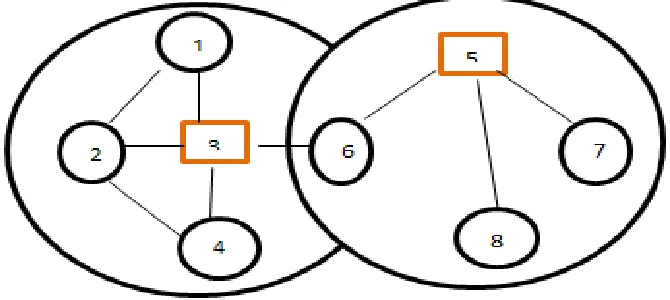
The highest degree in which its degree is calculated based on their distance from the others, also known as connectivity-based clustering [1] [2]. Each node will broadcast its ID to all the nodes which are in its transmission range.an example with eight nodes is shown in the figure 1.node 3 and 5 is chosen as cluster head and node 6 acts as a gateway between this two clusters. The highest degree algorithm have some disadvantages.it is almost only based on ID of the node. Since all nodes are mobile a node being more mobile with highest ID should not be chosen as a cluster head because a cluster head has to perform additional task in the cluster[3][4].as number of nodes goes high then the throughput drops and slowly there is a decrease in system performance.
Drawbacks of high ID clustering:
1) Cluster head changes at low rate.
2) Due to low mobility numbers of re-affiliations are high.
Technology (IJRASET)
Fig. 1 Highest Connectivity Cluster
B. Lowest-ID Heuristic
The lowest ID, also known as identifier based clustering [2][4].This algorithm choose a node with minimum ID as a cluster head after assigning a unique ID to each node. Thus, the IDs of the neighbours of the cluster head are higher than that of cluster head. A node is called as the gateway if it lies within the transmission range of two and above clusters. Routing within the clusters is done using the gateway. Only gateway node is facilitated to listen to the different nodes of the overlapping clusters that they lies. When the clusters are non-overlapping then distributed gateway can also be used for inter-cluster communication. Distributed gateway is a pair of nodes which lies in different clusters but they are within the transmission range of each other. The main advantage of distributed gateway is that even if any clustering algorithm fails it helps to maintain the connectivity so that their throughput is good when compared to the Highest- Degree Heuristic.
Drawbacks of Lowest-ID Heuristic:
Drainage of battery is high for certain nodes.
Does not check the stability of the node which is chosen as the cluster head.
Fig. 2 Lowest Connectivity Cluster
C. Weighted Clustering Algorithm
[image:3.612.201.412.470.608.2]Technology (IJRASET)
power of the nodes.Drawbacks of WCA:
1) It is not possible to create multilevel hierarchical clusters.
2) Weight of the neighbour cluster head are not consider in cluster formation process. 3) Algorithm is totally user dependent
III. POWER AWARE CLUSTERING BASED ROUTING PROTOCOL
One of the vital research areas in MANET is to establishing and maintaining the ad-hoc network through the routing protocols. Objectives of MANET Routing Protocols are to maximize network throughput and network lifetime by minimizing the delay of the entire network. The network throughput is normally measured by packet delivery ratio while the most significant contribution to energy consumption is measured by routing overhead which is the number or size of routing control packets. The one of the most necessary objectives of MANET routing protocol is to magnify energy efficiency, since nodes in MANET depend on limited energy resources.so in this clustering protocol we overcome the disadvantage of WCA and other routing protocols by choosing clustering method along with five important metrics such as band width, remaining energy, degree, mobility and distance.
Cluster Head: A cluster head serves as a local coordinator for its cluster, performing inter-cluster routing, data forwarding and so on. In our self-organized clustering scheme the cluster head only serves the purpose of providing a unique ID for the cluster, limiting the cluster boundaries.
Cluster Gateway: A cluster gateway is a non-cluster-head node with inter-cluster links, so it can access neighbouring clusters and forward information between clusters.
Cluster Member: A cluster member is a node that is neither a cluster head nor a cluster gateway.
A. Cluster Selection Criteria
1) Initial Energy: This is an important parameter to select the cluster head. When any algorithm starts it generally considers the initial energy.
2) Residual Energy: After some of the rounds are completed, the cluster head selection should be based on the energy remaining in the nodes.
3) Energy Consumption Rate: This is another critical parameter that considers the energy in each round.
4) Average Energy of the Network: The average energy is used as the reference energy for each node. It is the ideal energy that each node should own in current round to keep the network alive.
B. Cluster Head Selection Algorithm If broadcasting Time then
Send (ID, Er, RSn, RTn, X, Y) (RSn represents restart number)
While RTn indicates retransmission number (X, Y is the coordinate of the node) Else
Receive (ID, Er, RSn, and RTn, X, Y) End if
Matrix construction based on questionnaire investigation
The consistency test Calculate the composite value f of the following criteria Ti ← (1-(0.9 x f +0.1 x rand (0, 1))) x Ti
If no CH advertisement was received && Ti time out Then
Broadcast (CH) Head Flag ← 1
End if
If total advertisement Time timeout Then
My CH ← select Best (CH)
Technology (IJRASET)
IV. RESULT AND ANALYSIS
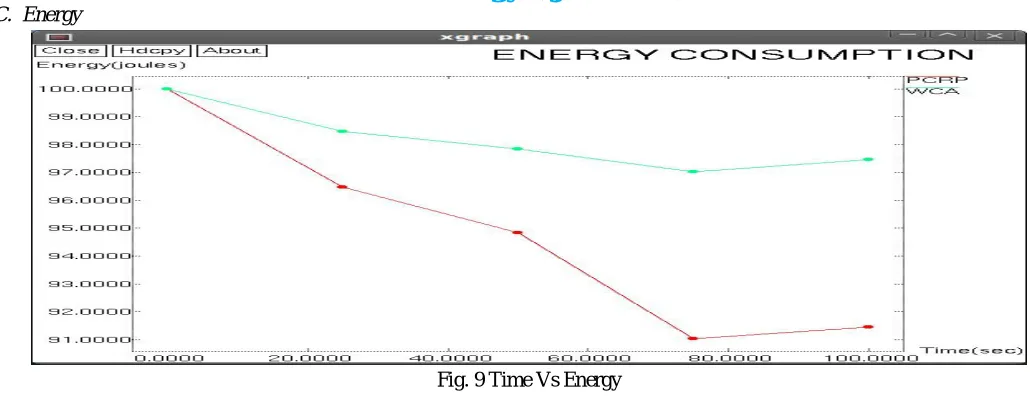
The proposed method addresses the Network lifetime issues considering delay, packet loss and packet delivery ratio and energy. Based on the above parameters let us consider a scenario of a mobile network with 50 nodes and simulate it using the network simulator tool (NS2). The below parameters are configured in the network simulator.
TABLE I
PARAMETERS CONFIGURED
Packet Size 1000 bytes
No. of Node 50
Protocol Used AODV
Dimension 1000*900
Channel Type Wireless channel
IEEE 802.11
Queue Type Drop tail/PriQueue
Antenna Omni Antenna
Protocol TCP
Mobility 0.5 m/s
Traffic Type CBR
Mobility Model Random Way Point
Traffic interval 1.2
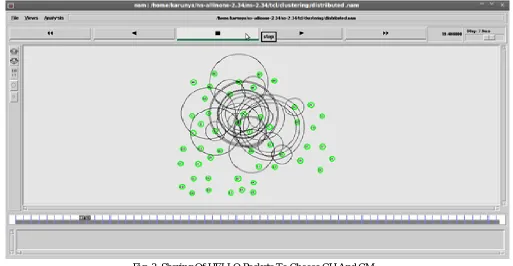
The nodes are formed and mobility is given to it in a random way after setting its position each node will share its HELLO packet to each of its neighbour node to elect the cluster head and cluster member.
[image:5.612.53.566.370.636.2]
Fig. 3 Sharing Of HELLO Packets To Choose CH And CM
Technology (IJRASET)
Fig. 4 Sending Packets from Source To Destination
A. Performance Metrics
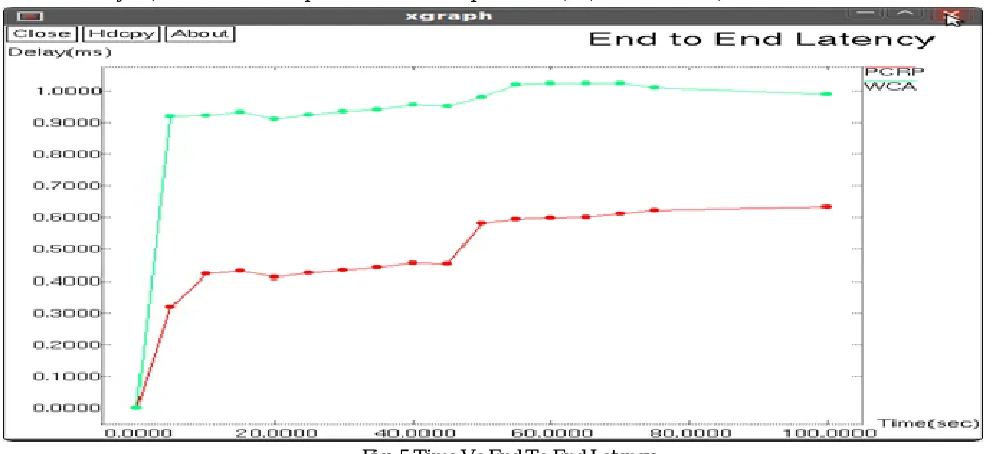
1) End To End Latency: It is defined as the average time taken by the packet to reach the server node from the client node. End to end latency = (Inter arrival of 1st packet time and 2nd packet time) / (simulation time)
Fig. 5 Time Vs End To End Latency
2) Packet Delivery Ratio: It is defined as the average of the ratio of the number of packets received by the receiver over the number of packets sent by the source.
[image:6.612.52.548.422.649.2]Technology (IJRASET)
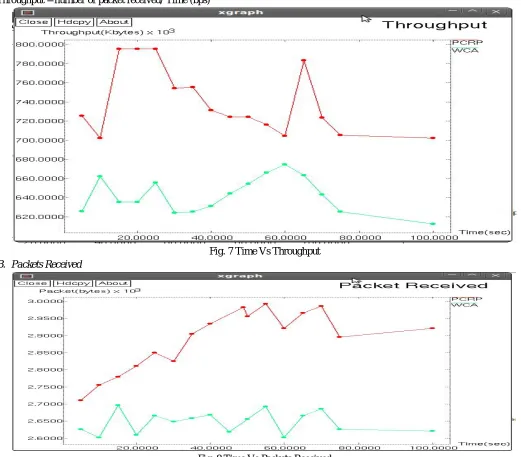
[image:7.612.44.565.255.712.2]Fig. 6 Time Vs Packet Delivery Ratio 3) Throughput: It is the rate of successful message delivery over a communication channel. Throughput = number of packet received/ Time (bps)
Fig. 7 Time Vs Throughput B. Packets Received
Technology (IJRASET)
C. EnergyFig. 9 Time Vs Energy
V. CONCLUSION
In mobile ad-hoc networks have been attracted more attention in recent years, much research has been addressing all the kinds of issues related. Since a large-scale MANETs not guarantee performance with a flat structure, many cluster hierarchy algorithms have been implemented to solve the availability issue. In this article, a new routing algorithm aimed at reducing the overhead, total time required and increasing the stability of formed cluster by PCRP which provides basic concepts about MANET, importance of structure; cluster selection based routing protocols, clustering in MANET including the definition of the cluster and clustering, importance of Cluster Head selection for a large dynamic MANET Clustering. We conducted simulation experiment to measure the performance of our cluster based routing algorithm is demonstrated and it performs significantly better.The future scope is to apply k-means algorithm to form clusters and measure its performance.
REFERENCES
[1] Murad, N.M. (2009), “Low energy clustering adaptation protocol for an adhoc wireless sensor network”, IEEE International Conference on Wireless Telecommunications Symposium,WTS pp.1-7.
[2] Dongkyun Kim, Chai-Keong Toh, Yanghee Choi(2000), “Location-aware long-life route selection in wireless ad hoc networks”, Electronics Letters Vol. 36 No.18.
[3] Cokuslu, D., Erciyes K (2007), “A Hierarchical Connected Dominating Set Based Clustering Algorithm for Mobile Ad hoc Networks”,15th International Symposium on modeling.pp.60-66.
[4] Chai-Keong Toh (1996), “A Novel Distributed Routing Protocol To Support Ad-Hoc Mobile Computing”, proc. IEEE international phoenix Conference on Computers and communications, IEEE IPCCC, phoenix, AZ, USA,pp.480-486.
[5] Egecioglu O, Gonzalez T.F (2001), “minimum-energy broadcasting in simple graphs with limited nodes power”,proc. IASED Int’1.Conf.Parallel And Distributed Computing And Systems (PDCS ’01).pp.334-338.
[6] Tzay-Farn Shih, Chao-Cheng Shih, Chin-Ling Chen (2008), “Location-based multicast routing protocol for Mobile Ad Hoc Networks”,Volume 7.pp.1270-1279.
[7] Roberto Carlos Hincapie (2006), “Survey on Clustering Techniques for Mobile Ad Hoc Networks”, IEEE Journal.pp.1-8
[8] Suganyadevi Devaraju, Padmavathi Ganapathi (2010), “Dynamic Clustering for QoS based Secure Multicast Key Distribution in Mobile Ad Hoc Networks”, International Journal of Computer Science Issues, Vol. 7, Issue 5.pp.31-35.
[9] YC. Hu, Perrig A, Johnson D.B (2005), “Ariadne: A Secure On-Demand Routing Protocol for Ad Hoc Networks”, In proc.8th ACM int’.Conf.Mobile Computing and Networking(Mobicom’02) ,Atlanta. Georgia,pp 12-23.
[10] Dayin Promkotwong, Ohm Sornil (2007), “A Mesh-Based QoS Aware Multicast Routing Protocol”, ACIS International Conference on Software Engineering.pp.1046-1051.
[11] Muthuramalingam S, Sujatha M, Surya R, Rajaram R (2011), “An Enhanced Sectorized Clustering Scheme based on Transmission Range for MANETS”, IEEE International Conference on Recent Trends In Information Technology (ICRTIT). pp.269-274.
[12] Dimitris Vassis, Georgios Kormentzas (2008), “Performance analysis of IEEE 802.11 ad hoc networks in the presence of exposed terminals”, Ad hoc networks,issue 3.pp.474-482.
[13] Vaishali Chourey, Paridhi Kala, “Cluster Head Election Approach based on Weighted Clustering Algorithm for MANET”, International Journal of Computer Applications (0975 – 8887).Volume 117 – No. 19, May 2015.