Technology (IJRASET)
Comparative Parameter of Stone Dust as a
Replacement Material of Sand
Mr.Ashish B.Ghogare1, Dr. P.P. Saklecha2, Prof. M.R.Nikhar3
Department of Civil Engineering, B.D. College of Engg. Sevagram
Abstract: In this we are investigating the comparative parameter for stone dust as a replacement material of sand .The whole study is mainly done only for replacement material of sand by stone dust which is used in mortar. Stone dust is occurred from aggregate quarry, Stone dust is such materials which is easily available in large quantities from crusher units. Diminishing natural sand resources have increased and the efforts to identify substitutes for natural sand as a constituent of Portland cement concrete. The use of crusher stone dust in making mortar by partial replacement of natural river sand not only provides economy in the cost of construction but at the same time solves the problem of disposal of stone dust.
Keywords: Stone dust, Sand, Cement, Mortar, Water
I. INTRODUCTION
In civil engineering Mortar is a product composed of cement and fine aggregate. In civil engineering the mixture of cement and fine aggregate gives the product Mortar. In which water is added to make mixture. Water is added to make mixture , and when we add water to mixture cement activate which act as a binding material. Mortar works as a matrix in concrete. Mortar is different from concrete. Mortar basically made by cement and fine aggregate and concrete is made by mixture of cement, coarse aggregate and fine aggregate with proper proportion. Concrete acts in a similar way of mortar but which contains coarse aggregate which is bound together by the cement. Also mortar is an integral part of masonry wall systems. Now days people needs alternatives , new innovation. Mortar with stone dust gives them new technology. Mortar also provides protection to the outer part of structural concrete from detrimental effect, consisting the outer layer.
When water mixed in cement it react with cement and form harsh, stiff paste that is unworkable and becoming hard very quickly. Some Portland cement assists the workability and plasticity of the mortar. It also provides early strength to the mortar and speeds setting. Sand is the general component of mortar which gives its distinctive color, texture and cohesiveness. In mortar Sand plays important part as cement.
Sand which is used for concrete and mortar it must be free of impurities, such as salts, clay or other foreign materials. The three key characteristics of sand are particle shape, gradation and void ratio. Sand is mainly used as inert material to give volume in mortar for economy. The strength of mortar is largely affected by the fine aggregates The main constituents of mortar is sand are mainly natural resources Stone dust, fly ash, silica fume, wheat husk etc are the waste materials. Exchange of normal sand by stone dust will assist both solid waste minimization and waste recovery.
Stone dust is such materials which is easily available in large quantities from crusher units. Diminishing natural sand resources have increased and the efforts to identify substitutes for natural sand as a constituent of Portland cement concrete. The use of crusher stone dust in making concrete and mortar by partial/full replacement of natural river sand not only provides economy in the cost of construction but at the same time solves the problem of disposal of stone dust.
II. RESEARCH METHODOLOGY
The use of these by products not only helps to utilize these waste materials but also enhances the properties of mortar in fresh and hydrated states . In the first stage of this investigation, the compressive strengths of different grades of cement mortar are observed by replacing natural sand by CRP at different levels of replacement namely 10%,20%,30%,40% . Two mortar are mixes in ratio of 1:4 selected for the study of both CRP and plain cement mortar. Moulds of size 70.7mm x 70.7mm x 70.7mm were used which gives cross sectional area of 5000mm2. The compressive strength of both types of mortars are obtained at age of 3days, 7days and 28days.
A. Collecting the crushed rock powder from locally available quarry.
Technology (IJRASET)
C. For sand replacement the gradation and fineness modulus of stone dust will kept similar to the sand.
D. Preparing plain mortar of different proportions i.e 1:4 & 1:5
E. Preparing mortar using different percentage of sand & crushed rock powder (i.e. 10%, 20%,30% & 40%).
F. Physical properties of stone dust have to performed i.e specific gravity,bulk density , absorption(%), moisture content (%),sieve analysis.
G. These casted mortar specimens are to be cured for 3 days, 7 days, 28 days.
H. After curing the specimens are tested for compressive strength and shrinkage
I. Finally the results are computed and analyzed with varying percentages of CRP comparing it with normal mixture of mortar.
III. OBSERVATIONS
In this comparative parameter we are going to study mortar properties in which stone dust ie crushed rock powder is utilized as a replacement for fine aggregate in mortar. Crushed rock powder is replaced at 10% 20%, 30%, 40% .
The study on mortar includes determination of compressive strength at different mortar mixes i.e. 1:4
The new alternative material i.e. stone dust is to replace the fine aggregate, such that excess river erosion and harm to environment is prevented.
A. Physical properties Of Stone Dust
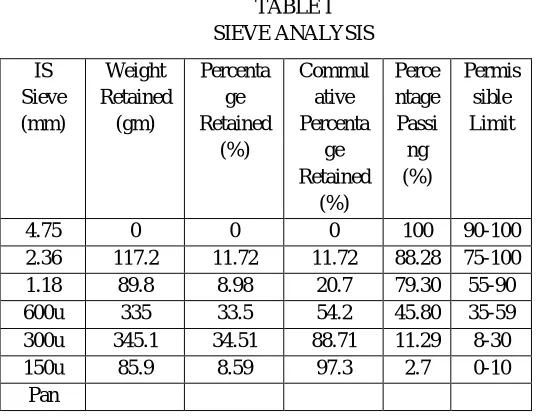
1) Sieve Analysis
[image:3.612.173.441.340.548.2]Weight of Sample: - 1000gm
TABLE I SIEVE ANALYSIS
2) Fineness Modulus
Total Commulative = Percentage Retained / 100
= 272.63/100
= 2.73 %
3) Silt Content
= 15/528
= 2.84%
4) Bulkage of Stonedust
a) Weight of empty graduated jar (w1) = 224 gm
b) Weight of graduated jar + sand (w2) = 2200 gm IS Sieve (mm) Weight Retained (gm) Percenta ge Retained (%) Commul ative Percenta ge Retained (%) Perce ntage Passi ng (%) Permis sible Limit
4.75 0 0 0 100 90-100
2.36 117.2 11.72 11.72 88.28 75-100 1.18 89.8 8.98 20.7 79.30 55-90 600u 335 33.5 54.2 45.80 35-59 300u 345.1 34.51 88.71 11.29 8-30 150u 85.9 8.59 97.3 2.7 0-10
Technology (IJRASET)
c) Weight of sand (w2-w1) = 1976gm
d) Initial height h1= 690ml
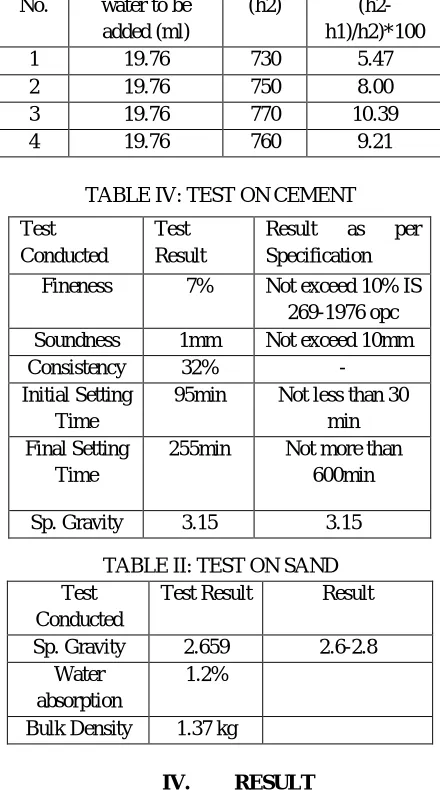
TABLE III: BULKAGE OF STONEDUST Sr
No.
Percentage of water to be added (ml) Height (h2) Bulking = (h2-h1)/h2)*100
1 19.76 730 5.47
2 19.76 750 8.00
3 19.76 770 10.39
[image:4.612.196.416.133.528.2]4 19.76 760 9.21
TABLE IV: TEST ON CEMENT
TABLE II: TEST ON SAND Test
Conducted
Test Result Result
Sp. Gravity 2.659 2.6-2.8 Water
absorption
1.2%
Bulk Density 1.37 kg
IV. RESULT
TABLE V: COMPRESSIVE STRENGTH FOR 1:4 PROPORTION OF 3 DAYS % Stone Dust Sample 1 (N/mm²) Sample 2 (N/mm²) Sample 3 (N/mm²) Avg.Streng th (N/mm²)
0% 3.20 2.80 2.00 2.67
10% 6.00 4.40 4.80 5.06
20% 6.40 4.00 5.20 5.20
30% 5.60 6.80 4.80 5.73
40% 5.20 7.20 5.60 6.00 Test
Conducted
Test Result
Result as per Specification Fineness 7% Not exceed 10% IS
269-1976 opc Soundness 1mm Not exceed 10mm Consistency 32% - Initial Setting
Time
95min Not less than 30 min Final Setting
Time
255min Not more than 600min
Technology (IJRASET)
TABLE VI: COMPRESSIVE STRENGTH FOR 1:4 PROPORTIONS OF 7 DAYS
TABLE VII: COMPRESSIVE STRENGTH FOR 1:4 PROPORTION OF 28 DAYS % Stone Dust Sample 1 (N/mm²) Sample 2 (N/mm²) Sample 3 (N/mm²) Avg.Strength (N/mm²)
0% 8.80 8.00 8.40 8.40
10% 16.00 16.80 15.20 16.00
20% 21.20 25.60 22.00 22.93
30% 25.20 28.00 27.20 26.80
40% 29.60 31.20 28.80 29.87
V. CONCLUSION
Th e above study reveals that in case of cement mortar, the naturally occurred sand can be replaced partially by Stone dust (Crushed Rock Powder). In this study sand is replaced partially by different proportion like 10%, 20%, 30% & 40%. The strength of mortar in 1:4 ratios, mortar containing 40% stone dust gives much higher strength than normal mortar containing only sand as fine aggregate. Though the trend in variation of compressive strength with percentage of stone dust was found to be different with different percentage of stone dust. It is better to use stone dust in mortar with fine aggregate. For rich mortar mixes, stone dust can be replaced up to 40%. It is concluded that the compressive strength, Hence, stone dust can be effectively used to replace natural sand, without reduction in the strength of mortar with stone dust replacement level up to 40%.
REFERENCES
[1] Tasnia Hoque, Muhammad Harunur Rashid, Md. Rokon Hasan, Ebna Forhad Mondol,“Influence of Stone Dust as Partially Replacing Material of Cement and
Sand on some Mechanical Properties of Mortar” International Journal of Advanced Structures and Geotechnical Engineering ISSN 2319-5347, Vol. 02, No. 02,
April 2013[1]
[2] Sudhir S.Kapgate And S.R.Satone, “Effect Of Quarry Dust As PartialReplacement Of Sand In Concrete” Indian Streams Research Journal Volume 3, Issue. 5,
June.2013 ISSN:-2230-7850[2]
[3] A.V.S.Sai. Kumar1, Krishna Rao B, “A Study on Strength of Concrete With PartialReplacement Of Cement With Quarry Dust And Metakaolin” International
Journal Of Innovative Research In Science, Engineering And Technology (An ISO 3297:2007 Certified Organization ) Vol. 3. Issue 3, March 2014.[3]
[4] Priyanka A. Jadhav, Dilip K. Kulkarni, “Effect of replacement of natural sand by manufactured sand on the properties of cement mortar” International Journal
Of Civil And Structural Engineering Volume 3, No 3, 2013 ISSN 0976-4399[4]
[5] Lohani T.K.1, Padhi M.2, Dash K.P.3, Jena S.4, “Optimum utilization of Quarry dust as partial replacement of sand in concrete” Int. Journal of Applied
Sciences and Engineering Research, Vol. 1, No. 2, 2012 © 2012 by the authors – Licensee IJASER- Under Creative Commons License 3.0 ISSN 2277 – 9442
[5]
[6] R. Ilangovana
1
, N. Mahendrana
1
and K. Nagamanib, “ Strength And Durability Properties Of Concrete Containing Quarry Rock Dust As Fine Aggregate”
% Stone
Dust Sample 1 (N/mm²) Sample 2 (N/mm²) Sample 3 (N/mm²) Avg. Stren gth (N/m m²) 0% 4.00 4.40 3.60 4.00
10% 6.80 5.20 6.40 6.13
20% 6.00 6.40 7.60 6.67
30% 7.20 6.80 7.20 7.07
Technology (IJRASET)
ARPN Journal of Engineering and Applied Sciences VOL. 3, NO. 5, OCTOBER 2008 ISSN 1819-6608[6]
[7] V. Bhikshma, R. Kishore & N.H.M. Raju, “Flexural behavior of high strength stone dust concrete” Challenges, Opportunities and Solutions in Structural
Engineering and Construction – Ghafoori (ed.) © 2010 Taylor & Francis Group, London, ISBN 978-0-415-56809-8[7].
[8] H. M. A. Mahzuz1*, A. A. M. Ahmed2 and M. A. Yusuf “Use of stone powder in concrete and mortar as analternative of sand”African Journal of