Technology (IJRASET)
Implementation of DWT-SVD Based Secured
Image Watermarking For Copyright Protection
Using Visual Cryptography
Miss.Priyanka Ramesh Shirsat1, Miss.Mayuri Satish Mundada 2 , Mr. Shubham Sunil Dipte 3, Prof. G.R.Suryawanshi4
1,2,3,4Department of Information Technology, Pravara Rural Engineering College, Loni
Abstract—In this paper, a new rough watermarking technique for copyright protection based on Discrete Wavelet Transform and Singular Value Decomposition is to intend. The high frequency sub band of the wavelet decomposed cover image is modified by changing its singular values. A secret key is generated from the original watermark with the help of visual cryptography to claimed the ownership of the image. The ownership of the image can be demand by superimposing this private key on the extracted watermark from the watermarked image. The robustness of the technique is tested by applying diverse attacks and the visual quality of the extracted watermark after applying these attacks is better. Also, the visual quality of the watermarked image is can not be distinguish from the original image.
Keywords—Image watermarking; Visual Cryptography; Singular Value Decomposition; Discrete Wavelet Transform; Robustness
I. INTRODUCTION
Digital information is comfortable to disunite, duplicate and modify which leads to the desideratum for copyright aegis techniques. Digital watermarking technique is the solutions to eschew not sanctioned facsimileing of multimedia data. Recently many watermarking schemes have been ti intend to address this quandary. The watermarking schemes are broadly divided into two main domains i.e. transform domain and the spatial domain. In spatial domain watermarking the watermark is embedded by directly transmuting the intensity values of the cover image. The most famous technique is the least consequential bit (LSB) method. In transform domain the watermark is securely circumvented by transmuting the frequency coefficients of the transformed image. The mutual methods in the transform domain are Fourier transform (DFT), discrete cosine transform (DCT), discrete wavelet transform (DWT), etc. Recently, singular value decomposition (SVD) was to examine for watermarking. It is one of the most utilizable numerical analysis method having property that the singular values (SVs) of an image do not superseded significantly when a diminutive agitation is integrated to an image..
The two major assumption in visual cryptography are pixel expansion and number of pubis encoded. If the pixel expansion is smaller then it may results in shortest size of the share. If the multiple secret images are encoded then the same pubis images requires less overhead while sharing multiple secrets. Here we apply the concept of SVD to embed a watermark into the cover image and to extract this watermark from the watermarked image. The watermark to be embedded is to encrypt using visual cryptography. The watermark is first split into two shares. However, only the first pubis acts as a watermark while the second pubis acts as the private key. Thus, the other pubis is the key to reconstruct the watermark. The visually crypted watermarks can be transmitted on the internet and the private key share is hold by the copyright possessor of watermarked image as the secret key. In this sense, it is very ease to perform the image authenticate by just stratifying the key share over the decrypted watermark image. Since these two pubis are mutually dependent, the watermark will not be outside if one of these two pubis is modified. The scheme is rough after several attacks are performed on the watermarked image. Section 2 presents the method for splitting a watermark using visual cryptography and embedding and extraction of the pubis and conclusion in Section 3.
II. PROPOSED TECHNIQUE
The proposed technique is classified in two sections, embedding technique and the extraction technique as described below:
A. Technique for Embedding
Technology (IJRASET)
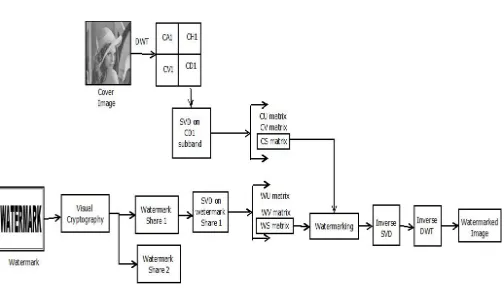
SVD is calculated for HH sub band only. This will reduce the computational overhead as we cannot considered the whole cover image.
The watermark is now encrypted to become larger the security of the scheme. We applied the visual cryptography on the watermark. This will classified the watermark into two pubis, i.e pubis 1 and pubis 2. The original watermark can be obtained if both the pubis of the encrypted watermark are superimposed on each other. Hence we will use pubis1 of the watermark for the embedding purpose while pubis 2 of the watermark is provided as the private key.
Apply SVD on the pubis1 of the watermark
Changed the singular values of the HH sub band of cover image and apply invert SVD. Where, CS is the SV of the cover image and WS are the SV of the watermark. the embedding strength.
Perform the invert DWT by combining the sub bands with the modified one to get the watermarked image.
The embedding Method is shown in following figure 1.
Figure 1. Embedding Method
B. Extraction Method
The extraction technique is exactly the contrary of the embedding method.146
Computer Science & Information Technology
To Perform level-1 DWT on watermarked image.
To Perform SVD on the HH sub band.
To extract the singular values of the watermark.
To Perform invert SVD to get the pubis 1 of the decrypted watermark1 i.e. pubis1 of the watermark.
Pubis 2 which acts as private key is superimposed on the decrypted watermark pubis 1 to get the extracted watermark.
The extraction Method is shown in figure2.
[image:3.612.190.442.267.413.2]
Figure 2. Extraction Method
III. EXPERIMENTAL RESULT
Technology (IJRASET)
[image:4.612.166.448.135.325.2]as shown in fig 3 and watermark is of size 256X256 as shown in figure 4. As shown in figure 4 the watermark is dissevered into two shares after applying visual cryptography This image is represented as visual cryptography watermark 1 and 2 respectively. The decrypted watermark 1 is the portion 1 of the watermark extract from the watermarked images .This is amalgamated with the visual crypt watermark 2 to obtain the extracted watermark.
[image:4.612.160.463.352.428.2]Figure 3. Cover Images (a) Lena (b) Living room (c) Pirate (d) Cameraman (e) Woman (f) Mandrill
[image:4.612.178.436.490.664.2]Figure 4. Embedded and Extracted Watermark
Figure 5 shows the PSNR obtained intermediate cover image and watermarked image for all standard test images. The PSNR betokens that the imperceptibility of the watermarked image is good and the watermarked image is not distinguishable from the cover image.
Technology (IJRASET)
IV. CONCLUSION
In this paper, we are going to implement watermarking method for digital image. The watermarked is integrated to the Singular Value Decomposition to pristine image. The background the image is very pellucid and the error between pristine image and watermarked image can be estimated. In watermarking method for copyright aegis has been proposed. We applied the singular value decomposition with the Discrete Wavelet Transform. Since the technique make a subsidiary the properties of both Discrete Wavelet Transform and Singular Value Decomposition the proposed method is more Skepticality against different attacks. The exordium of this paper is that the security of the algorithm is increase with the avail of visual cryptography on the watermark image. If the second portion of the watermark which acts as the key is not present then it is not possible to extract the exact watermark information. It is very arduous to transmuted or abstract the watermark without kenning the secret key share as the watermark is divided into two shares with arbitrary patterns. The robustness of the method is to provide by giving analysis of the effect of attacks and still we are able to get good visual quality of the embedded watermark.
V. ACKNOWLEDGMENT
Some part of the work discussed in this paper the authors would like to thanks the refer for their through review of the paper and their constructive comments.
REFERENCES
[1] R. Sun, H. Sun, and T. Yao, “A SVD and quantization based semifragile watermarking technique for image authentication,” in Proc .Int .Conf.Signal Process.,
pp.15921595, (2002)
[2] C. C. Chang, P. Y. Tsai, and M. H. Lin, “SVD-based digital image watermarking scheme,”Pattern Recogn.Lett. 26, 15771586, (2005).
[3] J. M. Shieh, D. C. Lou, and M. C. Chang, “A semi-blind digital watermarking scheme based on singular value decomposition,” Comput. Stand. Inter. 28, 428–
440, (2006).
[4] R. Liu and T. Tan, “An SVD-based watermarking scheme for protecting rightful ownership,” IEEE Trans. Multimedia 4, 121–128, (2002).
[5] Moni Naor and Adi Shamir, “Visual Cryptography”, advances in cryptology– Eurocrypt, pp 1-12,(1995).
[6] Chin-Chen Chang, Jun-Chou Chuang, Pei-Yu Lin , “Sharing A Secret Two-Tone Image In Two Gray-Level Images”, Proceedings of the 11th International
Conference on Parallel and Distributed Systems , ICPADS'05, (2005).
[7] Liguo Fang, BinYu, “Research On Pixel Expansion Of (2,n) Visual Threshold Scheme”, 1st International Symposium on Pervasive Computing and
Applications, pp 856-860, (2006)
[8] Xiao-qing Tan, “Two Kinds Of Ideal Contrast Visual Cryptography Schemes”, International Conference on Signal Processing Systems, pp. 450-453,( 2009)
[9] Xiao-qing Tan, “Two Kinds Of Ideal Contrast Visual Cryptography Schemes”, International Conference on Signal Processing Systems, pp. 450-453,( 2009)
[10] C. C. Chang and J. C. Chuang, “An image intellectual property protection scheme for gray-level images using visual secret sharing strategy,” Pattern Recogn.
Lett. 23, 931–941, (2002).150
[11] D. C. Lou, J. M. Shieh, and H. K. Tso, “Copyright protection scheme based on chaos and secret sharing techniques,” Opt. Eng. 44_11_, 117004, (2005).