Technology (IJRASET)
Implementation of an Efficient Way of
Broadcasting Response Message to Help
Demanding Vehicle in VANET
Ajitender Kaur1, Praveen Kumar Pal2, Pushparaj Pal3
M.Tech Scholor ECE, ISTK Kalawad1, Asst.Prof.ECE Dept. ISTK Kalawad2, Asst.Prof.ECE,SRM IET,Naraingarh3
Abstract: VANET is very demanding area of research in these days. In this paper, we identify that when an emergency condition occurred at any location on the road, then emergency support take time to reach emergency location due to traffic. So, we proposed a new technique to manage road traffic in between emergency location and emergency support vehicle. Which provide quack and timely support to emergency location? Simulation result shows that it provides better result in terms of broadcasting overhead, packet delivery ratio and reduces packet drops.
I. INTRODUCTION
Vehicular Ah-hoc Network is a collection of node like cars, bus, and emergency vehicle as mobile nodes to create a Vehicle to Vehicle wireless Ad-hoc Network. In this network, all the vehicles are enabling with router, GPS and communication radio with IEEE 802.11p standard. Thus, vehicles can communicate with nearby vehicles or road side unit via wireless links with highly dynamic network. As cars fall out of the signal range and drop out of the network, other cars can join in, connecting vehicles to one another so that a MANET (Mobile Ad-hoc Network) is created. It is estimated that the first systems that will integrate this technology are police and fire vehicles to communicate with each other for safety purposes.
These days, Vehicular Ad-Hoc Network is getting more popularity for researchers and academic center to improve the road safety and make the journey reliable. This paper presents a new technique to provide quick response when any type of misshapen occurs on the road side like an accident of vehicles.
II. RELATED WORK
VANET can be categorized based on information used in forwarding into topology-based and Position-based routing [1-2]. This paper focuses on position routing protocol. In a proactive routing protocol, each node maintains and updates its routing table information of a given network at all the times. Routing updates are sent periodically regardless of network status. A route to any node within the network is available whether it is required or not, since each node periodically maintains a routing table of network topology. However, this kind of protocols has two disadvantages:
A. Overhead due to periodic update of routing tables.
B. For distance nodes the propagation information updates might carry outdated information about routing because of rapid
changes of VANET network topology.
In order to establish a communication session with new nodes those are not having connection with use reactive protocols. A global search procedure is employed for finding the route between source to destination is called flooding Route Request (RREQ) message to other nodes. Once the RREQ is received by destination or intermediate nodes that have a valid route to the destination, a Route Reply (RREP) is sent back to the source of the RREQ. Then route is created between them. A common example of this category is Ad hoc On-demand Distance Vector (AODV) [4] and Dynamic Source Routing (DSR) [5].
Geographic routing protocol can be defined as a stateless type of routing protocol. Currently, the geographic routing protocol is gaining considerable attention due to civilizing the service of location information. It uses location information of destination to take routing decisions. In this type of protocol, it is assumed that each vehicle is operational with location service devices in order to know its location information. Nowadays, most cars are equipped with GPS devices, which can provide the location information easily.
Technology (IJRASET)
Routing Protocols-based Link Lifetime :Greedy Perimeter Stateless Routing with lifetime (GPSR-L) [13]: proposes the concept of lifetime to GPSR in order to overcome the problem hello message in GPSR (each node maintains the knowledge of its one-hop neighbors nodes by exchange the Hello message) GPSR-L sets a lifetime timer (Lt) for each neighbor node, instead of using only hello time. Therefore, when the hello time expires, the node checks the lifetime of neighbor node, if it is expired the node assumes the neighbor node is out of the range.
Menouar et.al in [8] proposed a Movement Prediction based Routing Protocol (MOPR). MOPR is a mechanism used as Add-on to other routing protocols, in other words it is an enhancement method of existing protocols. Such as, in [8] MOPR based-GPSR or Ad hoc On Demand Vector (AODV) [12]. MOPR based on GPSR selects the most stable route from source to destination based on communication life time by choosing the best links of intermediate vehicles.
Connectivity Aware Routing (CAR) [9]: CAR is proposed mainly to solve frequent disconnections caused by rapid topology changes can be partially solved using carry-forward mechanism, which may incur higher delay, CAR selects the route based on least probability of disconnection. It developed a geographic routing protocol that works as follows, first models the probability of connectivity for each road segment and selects the road with the highest probability of connectivity based on the product of probability of all road segments along the route to forward the packets.
Geo-casting packet transmission Protocol [12] is an IEEE802.11p based vehicular network broadcasting technique could increase the contention level thus increasing information dissemination delay. We assume that each vehicle is equipped with a GPS and knows its position on the road. This is a realistic assumption as most modern vehicles enjoy the facility of the GPS. If a vehicle meets an accident or experiences a fault, it broadcasts this information to the vehicles behind it. an emergency message is only received by a vehicle if that message is not a duplicate. The proposed protocol selects the furthest vehicle for rebroadcast with the help of a new backoff window design which reduces the number of packet transmissions thus lowering the contention levels. This technique author considered only packet forwarding procedure when any misshapen occur on the road side but there is no provision in the technique to response on the receiver. So we consider this problem in our proposed concept. In this problem, when any control center receives an emergency message from the help required vehicle then it directly response to that vehicle but there may be loot of traffic in between help provider and help demanding vehicle. So it may cause delay to reach the help provider vehicle.
III. PROPOSED WORK
Proposed concept is the solution of above discussed problem. In this technique, we proposed a new technique to give response of received emergency message from the help providing vehicle at any road side location that need help. When any control center receives an emergency message from the help required vehicle then it directly response to that vehicle but there may be loot of traffic in between help provider and help demanding vehicle. So it may cause delay to reach the help provider vehicle. Solution of Road Traffic management when an emergency happen on road at any location used following steps:
If there is an emergency at location A and supporting vehicle is available at location B. Then A want to support from B.
A send help request to B and then B receive this request and response this request to A.
B Broadcast an emergency message to all the vehicle available in A location direction.
When any vehicle receives this emergency message then it slow down his speed and give space to emergency support
vehicle. So that it rehearses at A location within time
Technology (IJRASET)
2) Algorithm for Destination node
By using these algorithms, we manage the road traffic and send emergency support to the help demanding vehicle as soon as possible. Due to direction specific broadcasting following by the emergency support vehicle, it reduces delay and broadcasting overhead.
IV. PERFORMANCE ANALYSIS
In order to validate the proposed protocol and show its efficiency we present simulations using MATLAB. MATLAB is a very popular network simulation tool. MATLAB is an interactive software package which was developed to perform numerical calculations on vectors and matrices. The simulation environment settings used as the network area is 35x 35 that include variable number of mobile nodes ranging from 15 to 35. The radio transmission range is assumed to be 5 to 7(in Matlab plot). The scenario of nodes mobility is generated randomly based on random way point model where a mobile node moves to a new position.
Technology (IJRASET)
[image:5.612.123.496.163.591.2]Figure 4.1 shows that the proposed protocol provides better result in terms of broadcast overhead when number of node on the road increases. Base protocol generate more broadcast overhead because it broadcast information packet into reverse direction without any restriction but proposed protocol provide less number of broadcast overhead because it utilized the available location of the help demanding vehicle .
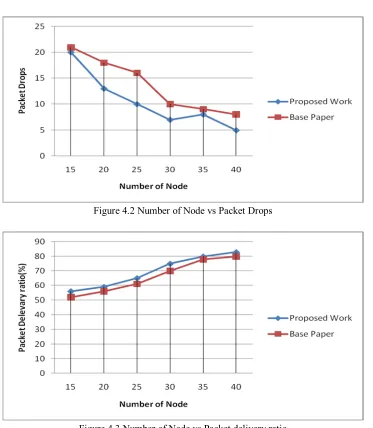
Figure 4.2 shows that proposed protocol provides less number of packets drops when number of node increases accordingly. Base protocol provides increase packet drops when number of node increase in between help demanding vehicle and help providing vehicle.
Figure 4.2 Number of Node vs Packet Drops
Figure 4.3 Number of Node vs Packet delivery ratio
Figure 4.3 shows the packet delivery ratio when number of node increases in between help demanding vehicle and help providing vehicle. Graph shows that proposed protocol provide better result as compare to base paper.
V. CONCLUSION
[image:5.612.123.489.178.365.2]Technology (IJRASET)
REFERENCES
[1] W. Enkelmann, "Fleetnet-applications for inter-vehicle communication," in Intelligent Vehicles Symposium, 2003. Proceedings. IEEE, 2003, pp. 162-167. [2] Fonseca and T. Vazao, "Applicability of position-based routing for VANET in highways and urban environment," Journal of Network and Computer
Applications, vol. 36, pp. 961-973, 2013.
[3] J.-H. Kim and S. Lee, "Reliable routing protocol for Vehicular Ad Hoc Networks," AEU - International Journal of Electronics and Communications, vol. 65, pp. 268-271, 2011.
[4] C. Perkins, E. Belding-Royer, and S. Das, "Ad hoc on demand distance vector (AODV) routing (RFC 3561)," IETF MANET Working Group (August. 2003), 2003.
[5] D. B. Johnson and D. A. Maltz, "Dynamic source routing in ad hoc wireless networks," Mobile computing, pp. 153-181, 1996.
[6] K. Shafiee and V. C. M. Leung, "Connectivity-aware minimum-delay geographic routing with vehicle tracking in VANETs," Ad Hoc Networks, vol. 9, pp. 131-141, 2011.
[7] F. Granelli, G. Boato, and D. Kliazovich, "MORA: A movementbased routing algorithm for vehicle ad hoc networks," in IEEE Workshop on Automotive Networking and Applications (AutoNet 2006), San Francisco, USA, 2006.
[8] H. Menouar, M. Lenardi, and F. Filali, "Movement Prediction-Based Routing (MOPR) Concept for Position-Based Routing in Vehicular Networks," in Vehicular Technology Conference, 2007. VTC-2007.
[9] E. Stevens-Navarro, Y. Lin, and V. W. S. Wong, “An MDP-based vertical handoff decision algorithm for heterogeneous wireless networks,” IEEE Trans. Veh. Technol., vol. 57, pp. 1243-1254, Mar. 2008.
[10] O. Dousse, P. Thiran, and F. Baccelli, “Connectivity in ad-hoc and hybrid networks,” in Proc. IEEE Intern. Conf. Computer Commun. INFOCOM, vol. 2, pp. 1079 - 1088, Jun 2002.
[11] M. Khabazian and M. K. Ali, “A performance modeling of connectivity in vehicular ad hoc networks,” IEEE Trans. Veh. Technol., vol. 57, pp. 2440 - 2450, July 2008