Indexed Bonds
Rost van Tonningen, Nicholas A. and Sargent, John and
Miller, Robin and Grady, Patrick
1979
Online at
https://mpra.ub.uni-muenchen.de/43317/
Indexed Bonds
A Background Paper
Prepared for the
Task Force on Retirement Income Policy
By
Nicholas A. Rost van Tonningen,
John Sargent, Robin Miller, and
Patrick Grady
INDEXED BONDS
Nicholas A. Rost van Tonningen, John Sargent, Robin
Miller and Patrick Grady
*;
A.
Introduction
1. Objective. The purpose of this paper is to discuss the pros and cons of establishing a system of indexed bonds as a means of assisting employers in the event that governments (federal and/or provincial) should require them to adjust pension payments under their pension plans to compensate
for inflation. Cl) The main body of this appendix is divided into three
parts. This introduction describes briefly the mechanics of indexed bonds, the way that inflation may affect the cost of indexed pensions and, hence, the reasons why indexed bonds are being considered as a means of offsetting such inflationary impacts. It also notes the role of pension fund money in the financial system in Canada. The second part appraises the possible impact of indexed bonds on the economy generally, on financial markets, and on government operations. It also briefly reviews experience abroad with indexed bonds. The third part deals with the conclusions arrived at from the foregoing
discussion. In addition, there are two annexes. One of these provides an estimate of the possible demand for, and supply of, indexed bonds. The other comments on the risk that with indexed bonds, public debt servicing costs might become less predictable.
2. The Mechanics of Indexed Bonds. The indexing of securities involves the periodic adjustment over time of interest and/or principal payments on those securities in line with recorded changes in some predetermined standard - the 'index'. The choice of the index and the precise method of linkage to changes in principal or interest is a function of the ingenuity of borrowers and of their perception of the potential demand in the market for specific indexing arrangements.
The following discussion focuses only on two simple types of indexed bonds: 1) the 'principal compensation' bond and, 2) the 'indexed principal' bond. In the case of the former, compensation is paid at the end of each year for the decline in the real value of the bond's nominal value during that year. At maturity, therefore, only the original
*
Mr. Rost van Tonningen was a consultant to the Task Force on Retirement Income Policy. Mr. Sargent, Mr. Grady and Mr. Miller are Departmentof Finance officers.
nominal value of the bond, adjusted for the inflationary experience of the last year, would need to be repaid, since the lender would already have been compensated for the loss in the real value of his original investment during each of the previous years. The indexed principal bond, on the other hand; provides for repayment of
principal in real terms only upon maturity. In that case, full compensation for the loss in real value of the principal amount of the bond is paid when the bond matures.
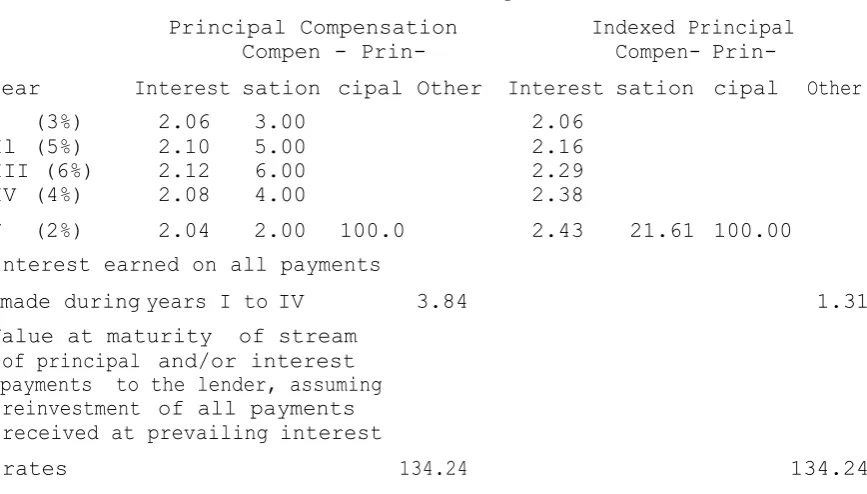
In both cases, a specific 'real' rate of interest would also be paid annually. Mechanically, the real value interest stream can be calculated by applying the specified real rate of interest on the bond (i.e. 2%) to the indexed value of the bond's principal at the end of each interest period. Table 1 illustrates how the alternative systems would work based on two five-year indexed bonds, one of the principal compensation variety and the other of an indexed principal type, each carrying a 2% 'real value' coupon. This illustration further assumes that, during the five-year life of these bonds, the annual inflation
[image:4.623.126.560.372.619.2]experience was as follows: 3%, 5%, 6%, 4%, 2%. This would have
produced the following stream of payments with respect to
interest, inflation compensation, and principal.
Table 1
Debt Servicing Schedules for Principal Compensation
and Indexed Principal Bonds
Principal Compensation
Indexed Principal
Year
Compen - Prin-
Compen-
Prin-Interest
sation
cipal Other
Interest
sation
cipal
Other
I
(3%)
2.06
3.00
2.06
Il
(5%)
2.10
5.00
2.16
III (6%)
2.12
6.00
2.29
IV
(4%)
2.08
4.00
2.38
21.61
100.00
V
(2%)
2.04
2.00
100.0
2.43
Interest earned on all payments
1.31
made during
years I to
IV
3.84
Value at maturity of stream
of principal
and/or interest
payments to the lender, assuming
reinvestment
of all payments
received at prevailing
interest
134.24
rates
134.24
value series for the purpose of calculating interest payments is as follows: $103, $105, $106, $104 and $102, and where 2% of $103, for instance, is $2.06. In the case of the indexed
principal bond, however, where no inflation compensation
payments are made until maturity, a compounding element occurs in the principal base used for calculating interest payments. Interest payments are, therefore, based on the following
series: $103, '$108.15, $114.64, $119.22, $121.61. The $108.15 principal base for year 11, in this case, is derived by
multiplying the $103 principal value at the end of year I by 1.05 (which reflects the second year's rate of inflation).
3. The Impact of Inflation on Pensions. Generally speaking, as shown in the Task Force report, inflation causes fluctuations and uncertainties in the cost of defined benefit pension plans even in the case of those that are not indexed. The extent to which cost fluctuations occur in individual plans varies widely at any given level of inflation and depends on a number of ~actors. These include the economic assumptions used, the method of
valuation of assets and liabilities, the extent to which a plan may already have been underfunded, the provisions for amortization of unfunded
liabilities and the type of plan concerned. Moreover, it appears that the more a defined benefit plan is indexed
for inflation, the greater the range of cost fluctuations it is
likely to experience. By definition, however, there is no impact
on money purchase or other defined contribution plans because
liabilities in such plans are simply a function of contribution
levels and of realized rates of return.
Employers would feel more confident with respect to the cost of their pension plans if the rate of return on their pension fund assets were always to reflect the current inflationary experience. Ideally, therefore, many employers would like access to an investment instrument with a yield which would adjust fully and immediately to changing rates of inflation. Unfortunately, the present financial system offers no such instrument. The market value of long-term bonds fluctuates inversely with interest rates. In periods of rising inflation, therefore, the market value of outstanding long-term bonds may be eroded both in nominal and real terms. Equities produce unstable rates of return and are no longer considered to provide an adequate short- and medium-term hedge against inflation. Residential mortgages offer more scope for yield adjustment since the periodic renewal clause has come into general use, but still may lag well behind changes in inflation
4. Indexed Securities and the Significance of Real Rates of Return. Under existing non-indexed pension plans providing benefits based on career average earnings - the relative importance of which has been declining - there may be a tendency to seek to maximize nominal rates of return because, ill other things being equal, higher than anticipated money income on pension fund assets reduces the need for employer pension contributions. Those pension plans providing
benefits based on so-called final average earnings, which have been gaining in importance are, of course, already effectively indexed until retirement. Nominal returns are, therefore, of lesser concern (and real returns of greater concern) for such plans. With full indexing, however, real, rather than nominal, rates of return would become the overriding concern for all plans because all liabilities (pre- and post-retirement) would be indexed. (Basically, the real rate would 'finance' the accumulation of assets necessary to produce a given level of real downstream pension benefits, while the 'inflationary premium' part of the
nominal rate of return could be deemed to be funding the current dollar value of that level of downstream benefits.)
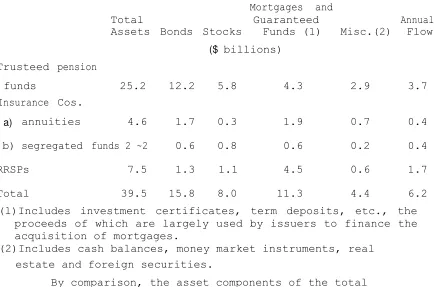
5. The Significance of Employer-Sponsored Pension Funds in Financial Markets. It may be useful to note briefly the significance of the flow of savings associated with employer-sponsored pension plans, and of the already existing stock of such savings, within the overall Canadian financial framework. If employer-sponsored pensions (particularly those in the private sector) were to be indexed, and indexed bonds made available to facilitate the indexing of those pensions, questions would arise as to what the demand for such bonds might be and what portion of Canadian financial markets and financial assets might become indexed for inflation. An examination of the total volume of assets involved,
and of their current deployment as between various types of instruments, constitutes a necessary step towards determining the demand for indexed bonds and their possible effect on financial markets. While for a number of reasons the volume of pension fund assets will likely always be less than the volume of pension liabilities, the asset figure will nevertheless be useful in developing a first approximation of demand.
Table 2
Estimated Assets of Trusteed Pension Plans,
Other Employer-Sponsored Plans, and RRSPs, 1976
Mortgages and
Total
Guaranteed
Annual
Assets
Bonds
Stocks
Funds (1)
Misc.(2)
Flow
($
billions)
Trusteed
pension
funds
25.2
12.2
5.8
4.3
2.9
3.7
Insurance
Cos.
1.7
1.9
a)
annuities
4.6
0.3
0.7
0.4
b)
segregated
funds 2 ~2
0.6
0.8
0.6
0.2
0.4
RRSPs
7.5
1.3
1.1
4.5
0.6
1.7
Total
39.5
15.8
8.0
11.3
4.4
6.2
(l)Includes investment certificates, term deposits, etc., the
proceeds of which are largely used by issuers to finance the
acquisition of mortgages.
(2)Includes cash balances, money market instruments, real
estate and foreign securities.
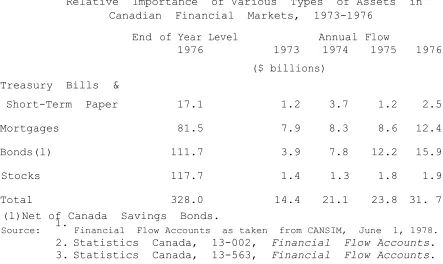
By comparison, the asset components of the total
Canadian financial market are illustrated in Table 3.
.
' [image:8.615.133.576.73.337.2]l I
Table 3
Relative Importance of Various Types of Assets in
Canadian Financial Markets, 1973-1976
End
of Year Level
Annual
Flow
1976
1973
1974
1975
1976
($ billions)
Treasury Bills
&
17.1
1.2
3.7
1.2
2.5
Short-Term Paper
Mortgages
81.5
7.9
8.3
8.6
12.4
Bonds(l)
111.7
3.9
7.8
12.2
15.9
Stocks
117.7
1.4
1.3
1.8
1.9
Total
328.0
14.4
21.1
23.8
31. 7
(l)Net of Canada Savings Bonds.
Source:
1.
Financial Flow Accounts as taken from CANSIM, June 1, 1978.2.
Statistics Canada, 13-002,
Financial Flow Accounts
.
3.
Statistics Canada, 13-563,
Financial Flow Accounts
.
The importance of these private retirement financing arrange-ments relative to the Canadian financial structure taken as a whole can be gauged from comparisons of the 1976 cash flow of these private
retirement income funds, at $6.2 billion, with overall savings flows of $31.7 billion in 1976 (amounting to 20%), and of the 1976 figure for retirement-related assets of $39.5 billion with the total asset figure of $328 billion (representing 12%). It can be further illustrated by the fact that the annual net cash flows of trusteed pension funds alone
during the decade to December 31, 1974, in all but one year were
equivalent to 22-26% of the total net new supply of Canada long-term
financial instruments.
It is difficult to be specific about the offsetting liabilities of retirement income funds. By definition, total liabilities with respect to RRSPs and money purchase plans are identical to their assets.
Insured plans also have few or no unfunded liabilities. As for segregated funds of insurance companies, no data are available. With regard to
trusteed pension fund liabilities, however, a 1975 survey by the Ontario Pension Commission of a substantial sample of plans indicated that 68%
of the plans surveyed, covering 84% of the surveyed plan membership, were under-funded by an average 32%. Most of this under-funding reflected
Normally, smaller employers with less favourable pension plans tend to be more fully funded. These results do not appear out of line with the United States experience, insofar as the latter can be determined from information provided in new issue prospectuses filed with the Securities and Exchange Commission and, from material published elsewhere.
Little is known about the disbursement patterns of pension plans involving the insurance companies and about the liquidation rates of RRSPs. With regard to trusteed pension funds, however, a reported net cash flow of $3.7 billion in 1976 reflected total contributions of $3.4 billion, plus $1.7 billion of investment income, less $1.1 billion in pensions paid out or purchased, and less a further $0.3 billion in
other miscellaneous expenses - including cash withdrawals by beneficiaries.
In summary, private retirement arrangements constitute a signi-ficant portion of net new savings flows and of the total stock of financial assets in Canada. The future growth in private retirement-related
assets could continue to outstrip the overall rate of asset growth as a result of a number of possible factors. These include a reduction in existing unamortized liabilities, an increase in the popularity of RRSPs as the average age of the population rises, and the possible increase in the future in the assets of private retirement funds. Still, there are offsetting factors and it is difficult to be certain.
B.
Analysis
1.
Choice of Scenarios. If the federal government were to urge - or
require - private employers to index their pension plans, it may well be argued that such a policy stance would have to be augmented by some initiative on the part of the government to reduce the volatility and uncertainty of employer pension costs. The introduction of indexed federal bonds might constitute such an initiative. One question that arises, however, is whether a sufficient quantity of indexed bonds could, as a practical matter, be made available to meet the requirements
of pension plans (including those administered by life insurance companies).
To answer this question, it is necessary to consider the framework within which indexed bonds might be introduced. The analysis below assumes that the federal government would take the initiative
in issuing indexed bonds. (2) Three scenarios are considered:
Scenario 1: Government of Canada indexed bonds are available in
unlimited quantities, but only to eligible purchasers in respect of pension and retirement saving programs. (3)
(2)A report prepared for the Economic Council by James Pesando
argues that, for reasons of cost, private companies are
unlikely to take the lead in offering indexed bonds.
,
ri
Scenario 2: The volume of Government of Canada indexed bonds is
limited, but there are no restrictions on who may
purchase them.
Scenario 3: The volume of Government of Canada indexed bonds is
limited and they are available only to eligible
purchasers for pension-related purposes.
A fourth scenario, where Government of Canada indexed bonds would be available in unlimited quantities to all willing buyers, was examined, but discarded as being impractical. If the demand for, and the supply of, indexed federal bonds were open-ended, the federal government at some point would likely have to assume the role of a major financial intermediary, since the level of indexed bonds it would be expected to issue would, at times at least, be in excess of its own financing needs. (This is what happened in Brazil in 1974.)
Under Scenarios 2 and 3, where there is a limit on the quantity of federal indexed bonds issued, the question arises as to how the
federal government would establish and allocate the available supply. One way of determining the total amount of new indexed bonds to be made available would be to limit it to a fraction of the total of net new cash requirements and rollovers of maturing bond issues, without any commitment to hold this ratio fixed over time. The total supply to be made available and its allocation might be determined simultaneously by offering new indexed bonds to prospective purchasers based on the
historical pattern of their acquisition of assets. The latter would have the advantage of facilitating the forecasting by the government of the future demand for indexed bonds, and of helping to prevent sudden fluctuations in demand as economic conditions changed.
An alternative means of determining the distribution of a given volume of new indexed bonds, however arrived at, would be to allocate the total by auction based on bid prices. In any case, it might well be
desirable to build into any allocation system a preference for small- and medium-size pension funds, while retaining the price mechanism as the basic determinant of who would get the bonds.
2. The Supply of and Demand for Indexed Bonds. To develop even a rough sense of what the demand might be for indexed bonds under each of these three scenarios necessarily involves considerable
guesswork. A major uncertainty concerns the real interest return that should be established on an indexed bond. If the real return is significantly higher than many lenders believe they will likely be able to earn from conventional securities, after discounting the nominal rate of interest offered by the anticipated rate of future inflation, the resulting heavy demand for indexed bonds could have a disruptive effect on financial markets. In the reverse situation, however, the demand .for indexed bonds may be minimal, with the result that they will fail to achieve their stated objective. (4)
(4)To the.extent that a viable secondary market develops for indexed
Other questions relate to the number of buyers who would be willing to pay something extra to obtain an indexed bond in a period of more than normal uncertainty about future inflation, and to the number of buyers (e.g. some small
pension funds) who would be willing to do so at all times, regardless of inflationary circumstances. For instance, it is not inconceivable that some buyers who would not normally accept less than an anticipated 2% real return annually on ordinary money bonds might, in fact, accept, less than a 2% real return annually if that return were assured. Unfortunately, it is by no means clear how the certainty of real returns would be valued by various classes of buyers.
Thus, the demand for a given volume of indexed bonds at any point in time would be influenced heavily by the real rate of return that is guaranteed, and by the way that real rate compares to the anticipated real rate on money bonds in light of
inflationary expectations. On the assumption that the real rate and the price would be appropriate to market circumstances, a very crude approximation of demand and supply
can be developed.(5)
In Scenarios 1 and 3, eligible holders of indexed federal bonds are limited to institutions administering pension and
retirement saving programs - namely, trusteed pension funds, insurance companies with respect to their annuity and segregated fund operations, and all financial intermediaries with respect to RRSPs. The total asset base and the annual cash flow of these sectors of the financial markets was approximately $39.5 billion and $6.2 billion respectively in 1976. These numbers set the outer limit for the potential demand for indexed bonds in that year. In practice, however, total demand would have been a good deal
smaller for the following reasons: a) pension fund managers would be unlikely to commit themselves unreservedly to such a new
instrument; b) a continuing desire to achieve the perceived
benefits of investment diversification; c) institutional inertia, as some investment managers would resist any wholesale move into indexed securities for reasons of their own survival (although in most cases they could be overruled by the plans' sponsors); and d) any widespread liquidation of non-indexed assets to purchase
indexed bonds could cause an erosion in the market value of the former which would increase the cost of making such a switch to the point of being prohibitive.
i! 1,1
The analysis in Annex A suggests that potential_ demand under Scenario 1 might be in the $5 billion range annually for a period of several years, with great uncertainty as to whether the demand might subsequently drop, remain constant, or rise. The factors that bear on demand are so numerous, and so contradictory, that it is difficult to make any judgment as to what the outcome would be.
Under Scenario 3, although potential demand would be similar to Scenario 1, the limited supply under some allocation procedures could result in a lower real return as compared to Scenario 1 and, hence, serve to cut down the total effective demand. Under Scenario 2, assuming the same supply of indexed bonds as in Scenario 3, the real
return required to place those bonds could be even lower than in
Scenario 1, since potential demand would be greater at all price levels.
On the supply side, Scenario 1 guarantees that the supply will meet the demand at the real rate of return chosen. Scenarios 2 and 3 are based on a limited supply, and the inference is that there are other government objectives that must be considered, and that these
necessarily constrain the potential supply. Some of these other objectives are discussed below. Here it is sufficient to note that the analysis
in Annex A suggests that perhaps $3 billion annually might be
made available in indexed bonds by federal and provincial
governments in the several years ahead if this approach were
adopted. This would be about two-thirds of the estimated
potential demand. On a longer term basis, however, the potential
supply from governments would likely drop to half the potential
demand, or less, as government cash requirements declined.
As noted previously, there would be nothing to prevent the federal government from limiting the sale of its indexed bonds to
institutions financing indexed pensions. However, the federal government would not be able to impose the same constraints on other issuers. It would be up to the latter to decide for themselves if the sale of their indexed bonds would be limited in this, or any other, way.
What about sources of supply for indexed bonds other than the federal and provincial governments? Municipalities have a revenue base which is less elastic relative to inflation than the federal or provincial
governments. Hence, they would likely feel less able to issue indexed bonds than the provinces. In any event, pension funds are at present a less
significant source of financing for municipalities than for the provinces and, accordingly, municipalities may feel less compelled to offer indexed bonds to protect an established financing source.
It is also doubtful that, in the first instance at least, the corporate sector would be a major source of indexed bonds. For one thing, corporations that issue indexed bonds would face substantial uncertainties. For instance, even if initial debt servicing costs were lower for indexed bonds than for money bonds, the differential might not be considered sufficient to offset the apparently open-ended nature of the borrower's debt servicing liability during the life of the
untried instrument, they might well involve the borrower in additional marketing and advertising costs, which would further reduce the advantage in initial borrowing costs that indexed bonds might have over money
bonds. Finally, assuming that indexed bonds would be geared to some general index, such as the Consumer Price Index (CPI), future debt
servicing costs need not conform with the specific future cost and profit patterns of individual borrowers. Even if the proceeds of an indexed issue were invested in generally 'inflation-proof' assets such as real estate, the fact that the value of these assets might keep pace with inflation over the long haul would not eliminate corporate concern about its ability to meet current debt servicing costs during the
short and medium term.
On the other hand, it should be noted that some corporations are already accepting what is clearly equivalent to the servicing costs of 'indexed debt'. Some large corporations, for example, depend on 'short-term 'commercial paper' as a source of financing. Others use revolving lines of bank credit. Still others in recent years have obtained term financing from banks on a 'prime rate plus' basis. In each of these instances, future debt servicing costs will fluctuate with the interest rate structure and will not be predictable with
precision. To the extent that indexed bonds would replace such financing, corporate exposure to risk from unforeseen future debt service cost
fluctuations would not be much different than it would be under existing circumstances. Still, a long-term indexed bond issue would commit the corporate borrower to more unpredictable debt servicing costs over
longer periods of time.
Furthermore, the degree of acceptance by corporations of indexed bonds as a financing instrument is likely to vary from one corporation to another. To the extent that corporations could readily 'layoff' the risk of future debt service cost fluctuations onto someone else, their attitude towards indexed bonds would likely be less
negative. Monopolies, or near monopolies - whose market power enabled them to pass on to their customers cost increases, including debt servicing costs - might have fewer reservations about indexed bonds than companies in more competitive environments. To the extent that firms in regulated industries could incorporate anticipated increases in future debt servicing costs into their expenditure base for the purpose of justifying rate increases, they might also be relatively less concerned about t6e fluctuating debt service cost aspects of indexed bonds. Finally, financial intermediaries which could match indexed liabilities with indexed assets could, all other things being
equal, be expected to be in a favourable position to issue
indexed bonds. (6)
In summary, because federal and provincial governments would appear unlikely to meet the initial demand for indexed bonds, and corporations would probably not be in the field at first, it appears almost inevitable that the supply of indexed federal and provincial bonds would need to be subject - at least at the outset - to some form
of restraint, with the result that there would be some, perhaps substantial, unsatisfied demand. (7) These conclusions, it bears repeating, are based on very rough estimates only. Furthermore, governments might find
themselves in future unable to issue as many indexed bonds as may be practical simply because of limits on their cash requirements. And while some corporations might have begun by then to issue such bonds, demand may also have risen. Therefore, with the passage of time, the allocation problem may remain difficult. There are, however, too many variables at this stage to speak with any certainty.
3. The General Economic Impact. Indexed bonds may have an effect on
the efficiency and stability of the economic system because they eliminate the transfers of real wealth between borrowers and lenders that occur
with money bonds when the actual inflation rate differs from the anticipated rate. There is no consensus as to the nature or likely importance of
these effects. Some advocate the use of indexed bonds as having potentially beneficial 'effects on the functioning of the economy; others see substantial dangers to the economy from the use of indexed financial instruments.
This section provides a brief discussion of the effects that the existence of indexed bonds might have on saving, investment, economic stability, and investor psychology. Unfortunately, key links in the analysis are subject to considerable uncertainty. One uncertainty concerns the role that indexed assets would come to play in financial markets and, in particular, the extent to which they would be issued by borrowers other than the federal government. The financial market
might adjust readily to a limited issue of indexed federal bonds (and to offsetting reductions in the issue of other types of securities
by the federal government) through some switching in financial flows. If this were to occur, the use of indexed assets in the capital markets might remain modest. This is most likely in Scenario 3 and, under
these circumstances, any general economic effect would be quite limited. Alternatively, if the federal government were to issue substantial
quantities of indexed bonds and not restrict their holding (Scenario 2), or if it were to issue unlimited quantities to pension funds and
life insurance companies in respect of their pension and annuity
liabilities (Scenario 1), there might well be a general shift to
indexed securities which could have a significant economic impact.
a) Effect on Savings. The availability of indexed bonds would offer savers increased certainty as to the real rate of return they would be able to obtain on their savings over specific periods of time. While this might be counted as a benefit in itself, it is by no means clear what effect it would have on the total level of savings. For some people it might make saving more attractive; others might feel they would need to save less, since they would no longer have to protect themselves against the contingency of a major reduction in their real wealth due to unanticipated inflation at some point in the future. It is also unclear whether the availability of indexed bonds would result in savers expecting higher or lower real returns. It would not be unreasonable to expect that, because of the removal of the inflation risk, somewhat lower real rates of return on indexed bonds would be acceptable to many lenders than the real return that they might in practice be able to earn on securities denominated in money terms. However, this could not be taken for granted.
If unanticipated inflation did occur, the existence of indexed assets would mean that wealth would not be redistributed from the personal sector (net asset holders) to net debtors (the corporate sector and governments), which is what occurs when only money bonds are available. Again, however, there is no very strong 'presumption as to the direction of the net effect on savings of such a redistribution of wealth. (8) One might conclude, therefore, that whatever the direction of the effect, indexation is unlikely to cause a major change in net savings in the economy.
(8)Widespread adoption of indexed principal financial instruments, however, would cause a significant change in the appearance of the
composition of savings as depicted in the National Accounts. Basically, the 'inflation component' of nominal interest, which is now recorded
in different parts of the ledger as part of personal
But the effect of indexation on the composition of savings appears to be more predictable and perhaps more significant. The
availability of indexed bonds could be expected to reduce the relative attractiveness of assets such as consumer durables, objets d'art, inventories and real estate which have acquired a growing appeal in recent years as hedges against inflation. As a result, everything else being equal, the availability of indexed bonds would mean that a greater proportion of savings would be available for investment in financial assets; in particular, one would expect a greater willingness to channel savings into long-term debt instruments.
b) Effect on Investment.
Indexed bonds could have some
favourable and
some unfavourable effects on the allocation of investment.
On the
favourable side, the issuance of indexed bonds by corporations, if it
were to come about, would likely reduce two tendencies towards distortion
in the allocation of business investment which otherwise exist when
either the inflationary outlook is uncertain and/or when a high continuing
rate of inflation and high nominal interest rates prevail.
Firstly, in
the absence of
indexed
instruments, expectations about inflation forecasts
might be expected to have a significant influence on a firm's willingness
to invest, particularly
in longer-term projects, when a
substantial
part of the investment must be financed through borrowing.
Everything
else being equal, the higher the rate of inflation a firm expects, the
more likely it is to judge a project to be profitable when financed
through issuing debt at a given nominal interest rate.
There is little
reason to expect different firms' expectations about future rates of
I .
inflation to be correlated with the inherent real returns on their
investment projects.
Thus, in the absence of indexation,
diverse
expectations about future rates of inflation will introduce an extraneous
factor (individual firms' expectations 2about inflation)
into the allocation
of investment.
The use
of indexed bonds as a financing
medium by
corporations would tend to reduce this extraneous factor.
In particular,
the possibility of borrowing via indexed bonds might encourage investment
on the part of those with low inflationary expectations,
i.e. those who
look upon current interest rates as incorporating a high real interest
cost.
rates of inflation are to have the same present values - as is the case if nominal interest rates adjust fully for inflation - the one that declines faster in real terms (the higher inflation case) must start at higher levels in real (and nominal) terms and end at a lower level in real terms. Also, since a longer, maturity implies a greater decline from start to finish in the value of the real payments stream for any given rate of inflation, the longer the maturity, the larger will be the initial shift up (and the larger the shift down at maturity).
Without indexed bonds, the 'tilting effect' of this time profile of real debt services charges(9) means that a shift to higher levels of
inflation will result in more severe initial cash flow problems for long-lived investment projects than for shorter-long-lived projects.
Some relative discouragement of long-lived projects under the existing system might thus be expected. In other words, firms, confronted with the choice of two projects having the same expected real rate of return over their lifetimes, will choose the shorter-lived project in order to avoid the higher risks associated with the longer-lived project during the initial period of reduced relative cash flow. An indexed loan, however, would have a constant debt service stream in real terms.
It can thus be argued that if the corporate sector were to follow the government's example in selling indexed bonds, the use of the indexed bonds by corporate borrowers would tend to avoid two potentially distorting effects on the allocation of corporate investment which
otherwise tend to occur under inflationary conditions. But it is not possible to determine the quantitative significance of these distortions.
On the other hand, the introduction of indexed bonds (by the federal government) could also have some adverse effects on private borrowers and private investment.. If some borrowers were to issue indexed bonds, it might well become more difficult for others to raise funds on an unindexed basis. If that were to be the case, this might have the effect of raising interest rates on unindexed debt and discouraging private investment. However, this need not be the case. If governments only substituted indexed debt for some of the non-indexed debt they·
would otherwise have issued, there need not necessarily be any effect
on the nominal interest rate which those wishing to borrow on an unindexed basis would need to pay. But even in this case, as the great majority
of private borrowers would be reluctant to issue debt on an
indexed basis, many private borrowers would believe themselves
to be at a disadvantage in raising funds in the market relative
to governments. The psychological effect alone might discourage
these private borrowers from undertaking investment.
I ·"1
: \!:\ ;'-11
Mortgage borrowers might be thought to be among those placed at a disadvantage if indexed debt became available from governments. But because of the generally long amortization periods associated with
mortgages, mortgage borrowers are particularly vulnerable to the
tilting of real payment streams under inflationary conditions
already discussed. As a result, the indexation of mortgages could
provide benefits to mortgage borrowers by reducing the initial
real .debt servicing cost burden.
c) Effect on Expectations and Other Economic Effects. Extension of indexing to federal government bonds might be taken as a further indication that the government viewed the problem of inflation as insoluble. The Organization for Economic Cooperation and Development (OECD) put the traditional case against indexed government bonds on expectational grounds most strongly in a 1973 report entitled Indexation of Fixed Interest Securities. It stated that "a concern of governments must be to guard against the risks that recourse to indexation would be interpreted by public opinion as a sign that the authorities were less firm in their determination to bring inflation under control and that a widespread adoption of indexing would fuel inflation expectations". In recent years, however, the high rates of inflation experienced have increased somewhat the importance of the equity objectives achieved
through indexing relative to the concerns that exist about its expectational impact. A group of independent experts chaired by Paul McCracken
presented a report to the OECD in 1977 in which they commented
rather favourably on the indexation of financial assets, even though
they continued to express reservations about the desirability of
wage indexation and escalators in price contracts.
Indexing financial instruments would also have certain broad economic effects which parallel those resulting from the indexation of taxes, social security payments or wages. It would tend to reduce one source of 'automatic stabilization' in the economy to variations in demand-related inflation. For instance, at present, an increase in inflation causes a decline in real wealth and, thus, presumably a decline in real consumer spending. This reduction in real demand will tend to brake the increase in inflation, if it has its origins in excess demand. To the extent that a growing portion of total wealth would be held in the form of indexed bonds, the real value of which would not be affected by inflation, this stabilizing wealth effect on consumer spending would tend to diminish.
On the other hand, by reducing the shifts in the distribution of wealth and income between borrowers and lenders which result from unexpected inflation, and by reducing any changes in the composition of demand which these income shifts entail, the indexing of financial instruments might well reduce one possible source of disturbance in the economy. Under the existing system, a demand management policy that is successful in reducing inflation tends to leave some borrowers stranded with previous high nominal interest rate commitments, which may create financial difficulties for those borrowers. The use of indexed bonds could lessen the financial difficulties corporate borrowers might. encounter during the transition from high to low rates of inflation and thereby facilitate the implementation and acceptance of
anti-inflationary monetary and fiscal policies.
In summary, from the point of view of its effects on economic stability, there is a great deal of uncertainty as to the direction of the effect of indexation. It might impede adjustment if the economy experienced a shock to prices that was not created by excessive demand but by other causes such as a sharp increase in the cost of imported oil. At the same time, however, it might facilitate adjustment to lower rates of inflation achieved through conventional demand management methods. As was the case with savings and
investment, the impact of indexing on economic stability would likely be least significant under Scenario 3.
4. The Implications for Financial Markets. A key to the
implications for the financial markets of the issuance of the Government of Canada indexed bonds relates to the effect they might have in inducing other borrowers to follow suit. The
experience of other countries has shown that the introduction of indexed securities by a leading borrower does have some effect on other borrowers' willingness to market indexed securities.
The impact of the issuance of indexed federal bonds on the financial system can be analyzed in terms of their effect on lenders and borrowers and would depend, to a large extent, on the proportion of overall demand for this type of security. If demand were large, exceeding that required for retirement income funding purposes, many debt issuers might eventually feel obliged to resort to this type of financing.
This would likely lead to a greater variety of indexed investment
instruments being developed so as to enable borrowers to remain
competitive and the needs of lenders to be met.
The relative attractiveness of indexed securities depends not only on the market's forecast with respect to inflation and real
interest rates, but also on the degree of confidence the market has in this outlook. The choice the market faces is whether there is greater risk in its outlook on real interest rates or its outlook on inflation; another uncertainty relates to the volatility of possible changes in
these outlooks. When the market has little confidence in its inflationary outlook, changes in which can be quite volatile, it would prefer an
1' '
always be some demand for indexed bonds. This demand would exist even in the absence of expectations of high and rising inflation rates and would be a function of the degree of uncertainty borrowers attached to their anticipated rate of inflation and to the volatility of that rate vis-à-vis anticipated real interest rates.
On the assumption that there would likely be a substantial demand for indexed bonds, a key determinant of the impact on financial markets of the introduction of indexed bonds is obviously the extent to which they might be issued by borrowers other than the federal government. As noted earlier, however, it is uncertain what the reaction of other
borrowers might be. The issuance of indexed bonds by the federal government could result in pension funds seeking to purchase more indexed federal bonds and fewer bonds of other borrowers. While such switching of financial flows could put pressure on other borrowers to compete through indexation of their own securities, this need not be the case, provided
the government did not increase the overall demands on the market beyond that which would otherwise exist. In the former case, the
increased purchase of indexed federal bonds by pension funds would mean that fewer federal bonds would need to be sold elsewhere. This, in turn, would leave funds available from lenders for those borrowers who had previously depended heavily on financing from pension funds. It
is, thus, conceivable that the financial market adjustment to the issuance of indexed federal bonds could be limited to some switching in financial flows, without any overwhelming pressure for more widespread indexation of bonds by other issuers. On the other hand, the federal example with respect to the indexing of its bonds could induce a general shift towards indexation, in which case there would likely be less switching of capital flows. The indexation of securities would tend to spread, however, if borrowers who previously had depended heavily on pension
funds as a major source of long-term financing found that it was
necessary to issue indexed bonds of their own in order to attract
the funds they required from other sources or, indeed, to compete
for a share of funds from retirement savings.
Under Scenario I (unlimited quantities of indexed federal bonds for eligible purchasers), the indexing of bonds would be most likely to spread to other issuers either because the latter sought to, protect their traditional financing sources or because they found that an indexed bond feature was essential to the development of alternate sources of long-term financing. Under Scenario 2 (limited quantities of indexed federal bonds to all comers), the risk of the spread of
indexation might be somewhat lower in the first instance because there might not be the same pressure on borrowers to protect traditional funding sources. On the other hand - depending on investors' experience with indexed bonds - there might eventually develop greater pressure for more, and more widespread, indexing of all bonds. Under Scenario 3
5.
The Impact on Government Operations.
a) Effect on the Conduct of Monetary Policy. The introduction of indexed bonds would influence the structure of the bond market - that is, the types and amounts of securities available - and the nature of those who issued and purchased securities. The extent to which the market structure changed would have considerable implications for the conduct of monetary policy because of the importance of open market
operations (the buying and selling of federal securities) by the
Bank of Canada as a means of implementing monetary policy. The
success with which open market operations is conducted depends
heavily on the nature of that capital market.
From this perspective stems one argument against the unrestricted Scenario 1. This is the need to retain flexibility in the type of instrument available for trading in the market. The implementation of
an effective monetary policy could be hampered if ownership of federal
securities were unduly concentrated, particularly if it were concentrated in less actively traded accounts. If indexed federal government bonds were freely available to the pension system and if the private sector did not issue indexed securities on a significant scale, a substantial volume of pension funds might switch into federal government debt.
Over time, pension funds could end up holding a large proportion of federal debt outstanding. In that case, the breadth and depth
required in the market to absorb large transactions in federal bonds without causing excessive fluctuations in interest rates might be reduced. In this context, Scenarios 2 and 3, with their implied restraints on the supply of indexed bonds, would be easier from the point of view of the implementation of monetary policy.
The Bank of Canada normally purchases some portion of new government debt issues for purposes of managing the money supply. If pension funds were allowed to acquire any amount of indexed federal debt they wished, they might not only force the federal government into the role of a financial intermediary in years when pension funds' demand for such debt was in excess of the amount needed to finance government operations, but they could also interfere with the central bank's management of the money supply.
! ':! <i
"
, "JI , .Ih~
~ ::ii\111
signals to market participants. (10) Under Scenario 3, however, there would likely be a very thin market for indexed bonds, and very little trading; the potential for using indexed bonds as a monetary policy tool, as outlined here, would then be very small.
In summary, it is difficult to be precise about the impact of the introduction of indexed bonds on the effectiveness of open market operations, and hence on monetary policy, as it has traditionally been implemented. It can be assumed, however, that except under Scenario 2, difficulties might arise for implementing monetary policy because of a likely reduction of the depth and diversity of the market for
government securities. Parallel markets for indexed and non-indexed bonds, however, would not in themselves inhibit the government from implementing effective policy. They might even be helpful.
b) Effect on Public Debt Charges. Two sorts of questions may be
raised about the implications of indexed bonds for the cost of
public debt charges to the government:
a) how might one expect the interest costs of such bonds to
compare, on average, with those of conventional bonds? and
b) what are the risks of significant budgetary problems if the actual costs turn out very differently from expected costs
(because inflation turns out differently from
expectations at 'the time the bonds were issued)?
With regard to the cost of borrowing through indexed bonds, a theoretical case can be made that the expected cost to the government should be lower for indexed than money bonds. This assumes that bond buyers would be willing to accept a lower real rate of interest than the real rate which they expect on a money bond, in return for the elimination of the 'inflation risk'. Of course, if both investors and
governments under-estimated future rates of inflation, as they appear to have done fairly consistently during the last two decades, the cost to
(lO)For instance, in a market confined to the trading of money bonds, an increase in interest rates resulting from open market sales might
be misinterpreted as reflecting an increase in inflationary expectations. Hence, it could fail to curtail the rate of growth in spending. In
contrast, an increase in the real cost of borrowing caused by open market sales of indexed bonds would be less likely to be misinterpreted and more likely to reduce all types of spending, including investment. Furthermore, a sale of indexed bonds would tend to compress the yield differential between money and indexed bonds, would lower one possible indicator of inflationary expectations and could possibly have a
the government of using indexed bonds would be higher than the cost of using money bonds (since the actual cost of the money bond in real terms would turn out to be lower than the real rate interest coupon on the indexed bonds likely would have been). The reverse could also occur; if the government had greater confidence than the public in its ability to reduce the rate of inflation over time, the use of indexed bonds would appear very attractive from an expected cost point of view. Annex B seeks to quantify the magnitude of the possible cost fluctuations and to measure the risks involved.
On balance, however, it could well be wrong to assume that the use of indexed bonds would lead to significant savings to the government on average public debt charges over any extended period of time. For such an assumption to be realized, a high degree of success in forecasting inflation would be required, and the experience of recent years raises questions about such an outcome. Use of indexed bonds would also increase the margin of uncertainty surrounding short-run forecasts of the dollar value of public debt payments, though this margin would still be relatively
small in the case of the 'indexed principal' form of indexed bonds
(where the compensation for the loss of real value is delayed until maturity, i.e. until some point well into the future). (ll) In general, the use of indexed principal bonds could be expected to increase the stability of public debt payments marginally in terms of Gross National Product (GNP), whereas if the principal
compensation form of bond were used, stability in terms of GNP would decrease. Thus, if the government wished to maintain a relatively stable ratio of public debt charges to
GNP,
use of indexed principal bonds would be preferable to principal compensation bonds.c) Implications for Tax Policy. Before considering: the
implications for tax policy, some clear limits must be placed on
this aspect of the issue of indexed bonds.
Firstly, there are direct implications for tax policy only if taxable entities are involved. Since neither registered pension funds nor the government are taxable, any system of bond indexing involving only these institutions is not directly relevant for tax policy. This means that the following discussion is largely limited to Scenario 2, where some of the indexed bonds are held outside pension funds, and to circumstances where taxable corporations issue indexed instruments.
Secondly, even under Scenario 2, there are direct implications for tax policy only if special tax treatment is accorded to the inflation component of interest payments on the indexed bonds. Under Scenario 2, the government issues specific quantities of indexed bonds to the public at large. At present, with unindexed bonds, bond holders are not
indifferent to the existence of inflation. Inflation increases nominal
I'll 11 :'1'
rates of interest, but with progressive taxation, increases taxes proportionately more. The interaction of inflation and taxation has the effect of reducing the real income that bond holders would have earned from their investment in a non-inflationary environment, since tax is also paid on the inflationary portion of interest.
Under a system of indexed bonds, taxation of the inflationary element of the investment return would be highly visible and would likely generate criticism. But the exemption from taxation of the explicitly inflationary component of interest payments on indexed bonds
would also generate demands to exempt the implicitly inflationary component of interest payments on non-indexed bonds. In turn, this would raise wider questions about the way the entire income tax system handles inflation. Until such time as the structure of the tax system can be altered in a fundamental way to handle inflationary situations more
fairly, tax policy considerations may be viewed as a substantial
argument against Scenario/2.
There is one further fact to consider. If indexed federal bonds were sold under Scenario 2 and a special exemption provided for the inflationary component of the interest income, that
exemption would make the bonds of greater value to taxable entities than to non-taxable entities. In that case, pension funds might have trouble acquiring them in competition with other taxable investors. In any case, with taxable entities bidding for them, real returns might decline, making them of less interest to pension funds.
6. Other Countries' Experience with Indexed Bonds. Indexation
of financial assets has been tried at one time or another in a
number of countries, including Finland, Israel, Sweden, Norway,
France, Austria, Ireland, the United Kingdom, Brazil and
Argentina. However, in only a few countries did the volume of
indexed bonds outstanding at any one time ever reach a high
proportion of the total volume of securities outstanding.
In Finland, the indexing of long-term bonds was initiated immediately after World War 11 to avoid criticism from those who were being paid off in bonds for war-induced damage and losses. The index used was linked to wholesale prices. Initially, indexed bonds were
issued only by the government, but over time financial institutions also became major issuers. Gradually indexing also spread to pensions and life insurance policies. During the late 1960s, indexing was abolished for everything but pensions and life insurance policies following an exchange crisis and currency devaluation. The government feared that the rapidly rising import prices would create an inflationary spiral via the various index linkages which would offset the benefits intended by the currency devaluation.
In Israel, the
concept of indexed bonds was introduced
in 1948
(using
an
exchange rate
index) and was applied to government bonds in
1957.
Since 1957, indexation has spread
to many other economic
and
During the 1950s, when high rates of inflation prevailed
in France, indexed instruments were popular and both public and
private sector borrowers used them so extensively that up to
one-half of the total new bond volume was of an indexed nature. The
indexing bases used varied widely and related to prices,
productivity, gold, and stock exchange prices, to mention only a
few. Early in the Fifth Republic (1958), indexation was outlawed.
In Brazil, indexation was introduced in 1964 amidst conditions of runaway inflation. Ten years later, in 1974, government issuance of indexed bonds had to be temporarily suspended as accelerating inflation
induced a wholesale shift towards indexed government bonds which
threatened to dislocate the entire financial system. The index used
in Brazil can be, and has been, altered from time to time so as to
produce 'appropriate' results. Outside the government bond sector,
indexing is of significance only in the area of housing finance.
The experience of other countries with respect to the indexing of bonds may not be directly applicable to Canada. Most other countries which have used indexed securities have a greater measure of government control over interest rates and the allocation of credit than does Canada. Their experience may, therefore, be of limited relevance to the relatively unrestricted, sophisticated and competitive North American financial markets.
Nevertheless, foreign experience suggests that:
-
indexing can be, and has been, tied to many bases;
-
parallel markets for indexed and non-indexed securities can
exist side by side;
-
the possibility of a proliferation of indexation does exist. In Finland and Israel, indexing spread to bonds issued byalmost every type of borrower, to bank deposits and bank loans, to pension and insurance benefits, and to many other types of financial assets as well as to wages and salaries;
-
indexing of financial instruments is not a panacea. An
indexed system can produce undesirable feedbacks,
particularly in countries which have a relatively open
economy, where export prices can get out of line through
the interaction of internal index-linkages; and
-
on balance, the failure of indexed bonds to spread, or to maintain themselves where j:hey were introduced, may well be indicative of their limitations as a policy instrument.C. Summary and Conclusions
1.
Summary.
a) Unanticipated inflation has a strong adverse impact on the financing arrangements underlying defined benefit pension plans, even in their
! I:, I
··1.
1 ',Ill
~nI
':r.
11'
pension fund assets and liabilities. The introduction of indexed
bonds has been suggested in some quarters as a means of helping
to ensure that the current return on pension fund assets would
more adequately reflect the current inflationary experience.
b) The funding of retirement income constitutes a major source
of new private financing in Canada's financial markets. By the
end of 1976, total assets accumulated in this manner amounted to
$39.5 billion, i.e. 12% of the total financial assets in Canada,
while the $6.2 billion annual cash flow amounted to 20% of the
total flow of savings in that same year.
c) A federal initiative to issue indexed federal bonds might
well be required as a
quid pro quo
if private employers were to
be persuaded to index their pension plans, or if, in conjunction
with the provinces, indexed pension plans were to be legislated.
d) Three separate scenarios were identified involving the volume of indexed bonds issued by the federal government and the
restrictions placed on the identity of the holders of such bonds. It appeared that the broad effect of the introduction of indexed bonds would be quite different under each approach, although with a considerable degree of uncertainty as to detailed effects.
e) A great deal of uncertainty surrounds any analysis of the economic impact of the introduction of indexed bonds. The effect on total savings would likely be fairly insignificant. The introduction of indexed bonds could have some impact on the ability of the economy to adapt to changing circumstances (i.e. on its built-in stabilizing capability). It could add to cost-push inflation by making possible a more rapid transmittal
of price increases through the economy. It could also increase demand-pull types of inflation because indexed bonds would eliminate the transfers of wealth from lenders to borrowers which currently tend to reduce the
purchasing power of savers in an inflationary environment. If corporations were to issue indexed bonds, the potential exists for some favourable effects on the allocation of corporate investment. On the other hand,
if corporations did not issue indexed bonds, they might become less competitive in the long-term .bond market, in which case the future growth of the economy could be impaired.
f) The effect of the introduction of indexed bonds on Canadian capital markets is also far from certain. In other countries where indexed bonds have been experimented with, they appear to have failed, by and
large, to achieve a permanent place in the overall capital market structure.
g) The effect on government operations is only marginally clearer than the effect on the economy. The impact on government debt servicing costs would likely be small. While in theory it should be cheaper to borrow through indexed bonds because of the removal of the inflationary
risk premium which is now part of the overall returns required by lenders, in
to be under-estimated. The effect on the market for government securities, and hence on the implementation of monetary policy, under Scenarios 1
and 3, would not be favourable, while Scenario 2 raises problems
of tax policy.
h) The current demand for indexed bonds by retirement income funds alone could be in the range of $5 billion annually during an initial five-year period. The main source of indexed bonds would almost inevitably have to be the federal and provincial governments, which might be able to divert, within their current borrowing programs, as much as $3 billion to indexed bonds, an amount that could be easily absorbed by the market with appropriate pricing. The several years ahead are perhaps an ideal time to introduce indexed bonds because the cash requirements of the federal government appear likely to be abnormally high by historical standards.
i) Finally, it must be noted that although the overall analysis suggests that from a broad economic and financial perspective indexed bonds might have as many advantages as disadvantages, the analysis is very
tentative. There appears to be a good deal of scope for things to go wrong, the risk of which needs to be balanced against the various
alternatives facing the government relating to retirement income policy.
2. Conclusions.
a) Indexed federal bonds by themselves should not be expected to make possible the indexing of the private pension system; the amount of bonds that would likely be required would be too large for the federal government alone or in conjunction with the provinces, to supply. They could, however, perhaps be of some use in any package of measures designed to enhance the feasibility of indexed private pension plans.
b) Of the three possible scenarios identified, Scenario 1, which assumes that unlimited amounts of indexed federal bonds would be issued to all those who wanted them for retirement income funding purposes, would be best suited to the needs of pension funds. However, it might require
the federal government to act as a major financial intermediary;
it might also interfere with the conduct of monetary policy by
narrowing the market for Government of Canada securities. Because
of this, and because of its likely unsettling effect on the
Canadian capital markets, it would have to be rejected.
I~
111
d) Scenario 3, which limits both the supply of indexed federal
bonds and the right to hold indexed federal bonds, would be more
useful to pension funds than Scenario 2. Any meaningful restriction
on the supply, however, might drive up the price of indexed bonds
and reduce their real returns. Such a scenario would thus have some
value - but only limited value - in helping to persuade the private
sector to accept an indexed pension system.
e) If other bond issuers were involved in the issuance of indexed bonds, there would be some advantages. The issuers would share the burden of risk of greater than expected interest payments. Any increase in the supply and the diversity of indexed bonds available might help to better meet the needs of pension funds. On the other hand, a loss of control by the federal government as to who might hold indexed bonds, would likely cause holdings to spread beyond the pension funds, and thus would bring the difficulties associated with taxation front and centre.
Unfortunately, if only for technical reasons, these tax difficulties are not easily solved. There would still be no assurance that the total supply of indexed bonds would be anywhere close to what pension funds might need, unless the federal government were prepared to accept, regardless of its own financing requirements, a role as the supplier of last resort of indexed securities.
ANNEX A
THE SUPPLY OF, AND DEMAND FOR, INDEXED BONDS
A. The Demand for Indexed Bonds
In Scenario 1 eligible holders of indexed federal bonds are limited to institutions administering pension and retirement saving
programs, namely trusteed pension funds, insurance companies with respect to their annuities' and segregated funds' operations, and all financial intermediaries with respect to Registered Retirement Savings Plans (RRSPs). The total asset base and current cash flow involved in these activities in 1976 was $39.5 billion and $6.2 billion respectively.
To quantify what proportion of these outstanding holdings might be converted into indexed bonds, and how much of this annual cash flow might be invested in indexed bonds, the pension fund sector was divided, somewhat arbitrarily into three separate components, each of which might react differently to the availability of indexed bonds. Firstly, there are the small pension funds (with assets of less than $1 million). Secondly, there is a group of public sector funded plans comprising federal and provincial Crown corporations, boards and commissioners, civil services of five provinces, and municipalities and municipal agencies (but excluding teachers' federations, educational institutions and health organizations). This group is already exposed to an indexing risk and generally more restricted in its investment powers than the 'average' funded plan. Finally, there is the residual of all other plans.
Small funds generally have had a poor investment performance. During the last decade during, they tended to be heavily committed to mutual funds and pooled funds typically operated by large institutions. Investment managers do not actively seek these accounts because the potential remuneration is not commensurate with the work involved. Therefore, small funds are left with the choice of continuing to invest
through trust and insurance companies or to administer their own arrangements (via a trustee). With the availability of indexed bonds, one might
expect that most, if not all, existing assets and new cash flows of small funds would be channelled into those instruments.
In recent years there has been a tendency among pension funds to move into quasi-indexed assets, e.g. liquid instruments and mortgages. This appears to reflect in large part the realization that the rates of return on these short- and medium-term assets are more elastic vis-à-vis inflation than the rates on other investment instruments. To the extent that liquid assets were used as quasi-indexed instruments, much of the future demand for indexed bonds among all other pension funds might well, therefore, arise from a reduction in such assets. Since, however,