www.ijraset.com Vol. 2 Issue VI, June 2014 ISSN: 2321-9653
I N T E R N A T I O N A L J O U R N A L F O R R E S E A R C H I N A P P L I E D S C I E N C E
AN D E N G I N E E R I N G T E C H N O L O G Y (I J R A S E T)
Page 36
Transient and Steady State Analysis of Fin Using
FEM for Different Material
M. P. Shah*1 ,K. S. Mehra*2,S.Gautam*3, P.Negi*4
*
Department of Mechanical Engineering,
BipinTripathiKumaon Institute of Technology, Dwarahat-263653, Uttarakhand, India
Abstract— Fins are used to augment the rate of heat transfer. Generally, the material used for the application of fins arealuminium alloys. In this present work Thermal behaviour of cylindrical fin is numerically investigated using Ansys APDL Software for different materials like Copper, AA1100, AA2011,AA3105. Transient and steady state analysis is carried out for the cylindrical fin under the convection and a specified base temperature condition. The length, base thickness, and end thickness of the fin is specified. Thermal conductivity of the fin material is specified. A constant temperature condition is applied at the base of the fin convective boundary conditions applied at the tip of the fin. Comparative study is being done among the fin material here used to find out the best material under the conditions. Base heat transfer rate, time to reach steady state, temperature distribution at different times,steady state temperature distribution is investigated.
Keywords-Ansys APDL, Temperature distribution, Steady state,Transient state, Heat flux
I. INTRODUCTION
Fins are used to enhance convective heat transfer in a wide range of engineering applications, and offer a practical means for achieving a large total heat transfer surface area without the use of an excessive amount of primary surface area. Fins are commonly applied for heat management in electrical appliances such as computer power supplies or substation transformers. Other applications include IC engine cooling, such as fins in a car radiator. It is important to predict the temperature distribution within the fin in order to choose the configuration that offers maximum effectiveness. This exercise serves as a visualization tool for evaluating the effect of shape on fin effectiveness, efficiency, and temperature distribution. In many heat transfer applications, it is desirable to increase the surface area that is available for the heat transfer process; this is particularly true when one desires to dissipate heat to a low conductivity medium such as air. Profile under convective conditions was first proposed by Schmidt(1926) based on a physical reasoning. Later on Duffin (1959) proved Schmidt criteria using calculus of variation. Both Schmidt (1926) and Duffin(1959) estimated the fin surface area neglecting the profile curvature. This has formed a major assumption in further exercises of fin optimization and is known as length of arc idealization (LAI) in literature. LAI was used for optimizing fin shapes under convective,
and negligible surface curvature effect and finally suggested a correlation for the optimality criteria. Based on a diameter dependent convective heat transfer coefficient, Chung (1987) improved the design of optimum cylindrical pin fins originally proposed by Sonn (1981).Different fins configuration are presented and analyzed in ref. Dul’kin (2002). During last decays, Palm III, (2005) computational software’s (CS) are extensively used to solve the heat transfer problem. Recently,
computational software’s (CS) such as MATLAB, Maple, and
Mathematica is growing up very rapidly. In fact, Computational software is playing a major role in under-standing engineering mathematics problems.An analytical solution for straight fin with combined heat and mass transfer is applied by Sharqawyand Zubair(2008). They used the four different profiles for the fin and compared the temperature profile and fin efficiency for them. In the analysis of fin geometries, attention must give to constraints or assumptions that employed to define and limit the problem and often to simplify its solutions.
II. PROBLEM SPECIFICATION
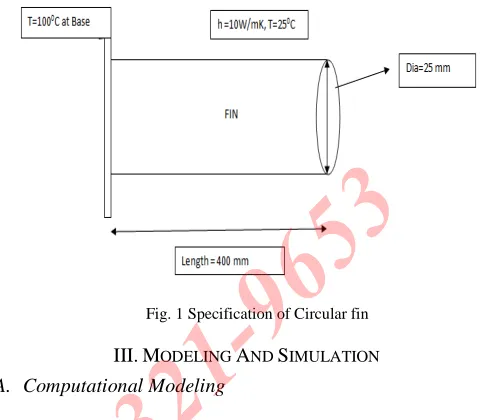
Considering cylindrical fin of length 400mm and diameter 25mm conducts heat away from its base at 1000C and transfers it to a surrounding fluid at 250C through convection. The convection heat transfer coefficient is 10 W/m2K.Objective of the study are the time required to reach steady state.The steady state temperature distribution (using a transient analysis).The temperature distribution after 10000 seconds.Thesteady state heat transfer rate through the base of the fin (using a transient analysis).The steady state temperature distribution and heat transfer rate through the base using a steady state thermal analysis. For the transient analysis, we assumed that the fin has an initial temperature of 250C Analysis is done to find out the above results by taking four different materials Copper,AA1100,AA2011, AA3105 (Aluminium alloys) individually.
[image:3.612.315.564.104.314.2]Comparison of above results is done to get best material for the fin to have better response under the conditions.
Fig. 1 Specification of Circular fin
III. MODELING AND SIMULATION
A. Computational Modeling
The method consists of using FEM technique to solve the problem by taking help of ANSYS APDL Software. Modeling is done by the preprocessor part.After that material is given to the model and then meshing is done by taking Quad 4 Node 55 element and turning onsmart size to 4 as edge length.
Loading
Loads are defined in the preprocessor as base temperature and convective heat transfer surrounding according to the problem.
Solution
Setting the analysis type to transient and then moving to the solution part by solve option.Similarly for the steady state analysis setting the analysis type to Steady state and then solving the part by solve option.
Postprocessing
After getting solution results are analyzed in postprocessing.Contours are plotted for temperature distribution.Graphs are also plotted for time to reach steady state pertaining to different material.
B. Material Properties
www.ijraset.com Vol. 2 Issue VI, June 2014 ISSN: 2321-9653
I N T E R N A T I O N A L J O U R N A L F O R R E S E A R C H I N A P P L I E D S C I E N C E
AN D E N G I N E E R I N G T E C H N O L O G Y (I J R A S E T)
Page 38 Table 3.1 Properties of Copper,AA1100,AA2011 and AA3105
Properties
Density(kg/m3) 8933 2710 2830 2720 Specific Heat(J/kg) 385 904 880 897 Thermal Conductivity
(W/m-K)
398 222 152 172
IV. RESULTS AND DISCUSSION
Modeling and Analysis is performed in ANSYS APDL for the above discussed cylindrical fin problem for different material.Results for different material are shown as following:
[image:4.612.47.300.123.235.2]A. Response Time(sec) Vs Material Conductivity(W/m-K)
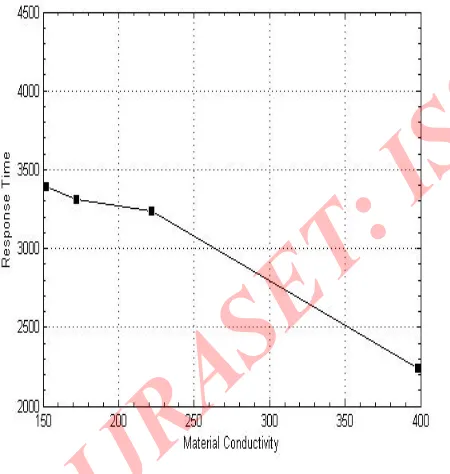
Fig. 2Graph between response time or time to reach steady state with conductivity for different materials.
It is observed from the Fig. 2,as the material conductivity increases,response timei.e. the time required to reach steady state also increases.
B. Contour Plots:Temperature Distribution
[image:4.612.149.556.184.625.2]It is analyzed that Fig. 3 (steady state temperature distribution) and Fig. 4 (Temperature distribution at 10000 seconds) are similar.Therefore,the transient analysis is validated with the steady state analysis. Similar results are found for aluminium alloys.
Fig. 3 Steady state temperature distribution for copper fin
[image:4.612.68.293.347.584.2]C. Contour Plots:Heat Flux
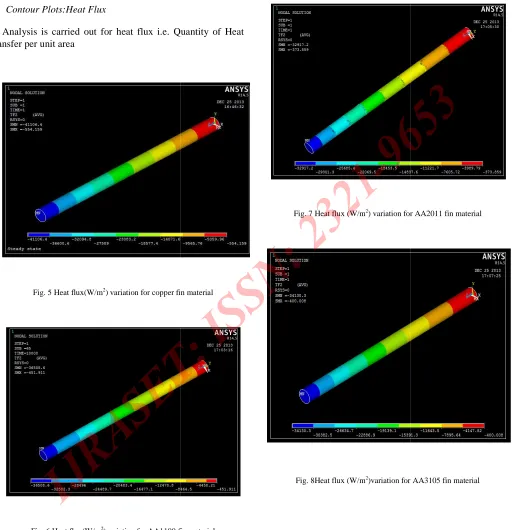
Analysis is carried out for heat flux i.e. Quantity of Heat transfer per unit area
[image:5.612.56.569.103.633.2]Fig. 5 Heat flux(W/m2) variation for copper fin material
Fig. 6 Heat flux(W/m2)variation for AA1100 fin material
flux i.e. Quantity of Heat
fin material
fin material
Fig. 7 Heat flux (W/m2) variation for
Fig. 8Heat flux (W/m2)variation for AA3105
variation for AA2011 fin material
www.ijraset.com Vol. 2 Issue VI, June 2014 ISSN: 2321-9653
I N T E R N A T I O N A L J O U R N A L F O R R E S E A R C H I N A P P L I E D S C I E N C E
AN D E N G I N E E R I N G T E C H N O L O G Y (I J R A S E T)
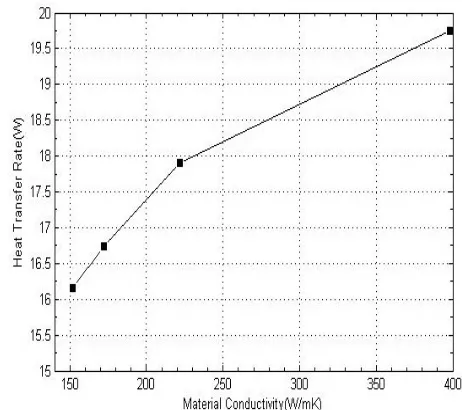
[image:6.612.60.291.107.312.2]Page 40 Fig. 9 Variation of heat transfer ratewith different material conductivity
It is concluded from the Fig. 9 that as the conductivity of material increases, heat transfer rate of material also increases.In the present study copper possessing the high rate of heat transfer because of its higher thermal conductivity,while AA 2011 material fin possessing the lowest rate of heat transfer because the thermal conductivity is low.
V. CONCLUSIONS AND FUTURE SCOPE OF THE WORK
A. Conclusions
A computational study of cylindrical fin of different materials are discussed. Copper,AA1100,AA2011 and AA3105 are used as fin material. Key conclusion of this chapter can be summarized as follows:
Response time for Copper fin is minimum and maximum for AA3105 to reach steady state.
Steady state analysis data is validated or is in good agreement with transient analysis data.
Minimum temperature of fin at steady state is increases with increase in material conductivity.
Heat transfer rate is maximum for copper material because of its higher conductivity and minimum for AA1100.
B. Future Scope Of Work
Comparative analysis of the thermal characteristics of Straight Rectangular and Triangular fin.
REFERENCES
[1] E. Schmidt, Die WarmeubertragungdurchRippen, Z. Ver. Dtsch. Inc. 70 pp. 885–951,1926.
[2] R. Duffin, “A variational problem relating to cooling fins”, J. Math. Mech.,vol. 8, pp. 47–56, 1959.
[3] C.Y. Liu, “A variational problem with applications to cooling fins”, J. Soc. Ind. Appl. Math., vol. 10, pp. 19–27, 1962.
[4] C.J. Maday, “The minimum weight one dimensional straight fin”,
ASME J. Eng. Ind., vol. 96, pp. 161–165, 1974.
[5] A. Sonn, A. Bar-cohen, “Optimum cylindrical pin fin”, ASME J. Heat Transfer,vol. 103, pp. 814–815, 1981.
[6] B.T.F. Chung, R.W. Kan, “The optimum dimensions of convective straight fins with profile curvature effect”, AIChE J.,vol. 83, pp. 77–83, 1987.
[7] A. Ullmann, H. Kalman, “Efficiency and optimized dimensions of annular fins of different cross-section shapes”, Int. J. Heat Mass Transfer, vol. 32, pp. 1105–1110, 1989.
[8] P. Razelos, B.R. Satyaprakash, “Analysis and optimization of convective trapezoidal profile longitudinal fins”, ASME J. Heat Transfer,vol. 115, pp. 461–463, 1993.
[9] I.N. Dul’kin, G.I. Garas’ko, “Analytical solutions of 1D heat conduction problem for a single fin with temperature dependent heat transfer coefficient –II. Recurrent direct solution”, Int. J. Heat Mass Transfer,vol. 45, pp. 1905–1914, 2002.
[10] W. J. Palm III, Introduction to MATLAB 7for engineers, McGraw-Hill, New York, 2005.
[11] M. H. Sharqawy and S. M. Zubair, “Efficiency and optimization of
straight fins with combined heat and mass transfer—an analytical