Towards a model-checker for
Circus
Artur Oliveira Gomes[0000−0002−5248−9587]1 and Andrew Butterfield[0000−0002−2337−2101]2
1
Universidade Federal de Mato Grosso do Sul, Brazil [email protected]
2
School of Computer Science and Statistics Trinity College Dublin, Ireland
Abstract. Among several approaches aiming at the correctness of sys-tems, model-checking is one technique to formally assess system mod-els regarding their desired/undesired behavioural properties. We aim at model-checking theCircusnotation that combines Z, CSP, and Morgan’s refinement calculus, based on the Unifying Theories of Programming. In this paper, we experiment with approaches for capturingCircus pro-cesses in CSP, and for each approach, we evaluate the impact of our decisions on the state-space explored as well as the time spent for such a checking using FDR. We also experimented with the consequences of model-checking CSP models that capture both state invariants and pre-conditions ofCircusmodels.
1
Introduction
The use of formal methods provides a way to rigorously specify, develop, and verify complex systems. Among several approaches aiming at the correctness of systems, model-checking formally assesses given systems regarding their de-sired/undesired behavioural properties, through exhaustive checking of a finite model of that system.
Some related work on techniques for model-checkingCircuswas presented by Freitas [12] where a refinement model checker based on automata theory [19] and the operational semantics of Circus [39] was formalised in Z/Eves [34]. He also prototyped a model checker in Java. Moreover, Nogueira et al. [24] also presented a prototype of a model checker based on the operational semantics of Circuswithin the Microsoft FORMULA [21] framework. However, they could not provide a formal proof of the soundness of their approach, since FORMULA does not have an available formal semantics. Yet another approach for model-checking Circus was defined by Ye and Woodcock [41], who defined a link fromCircus to
CSPkB with model-checking using ProB [31]. Finally Beg [4] prototyped and investigated an automatic translation that supports a subset ofCircusconstructs. SinceCSPM does not have a notion of variables for state as in Z, Circus or even the B-Method, we have to somehow capture them in order to obtain aCSPM model as similar as possible to the originalCircusone. Therefore, one could either use a memory model [30,25] in order to manage the values of the state variables, or else, to adopt the idea ofstate-variable parametrised processes [4].
Following the results presented in ABZ’16 [16], which involved manual trans-lation, we decided to developCircus2CSP3, an automatic translator from Circus intoCSPM, aiming at model-checking with FDR. Our tool was then built based on the strategy presented in Section 5.3 of Deliverable 24.1 [29], from the COM-PASS project [37], that defines a rigorous but manual translation strategy aiming at obtainingCSPM specifications from Circus.
This paper reports design decisions regarding different approaches for model checking and experimental results obtained forCircusspecifications. Such exper-iments were enough to identify an effective general form for any CSPM model derived fromCircus, where FDR could perform refinement checks with reduced time and memory consumption compared to existing approaches from the liter-ature.
2
Circus
Background
ACircusspecification is in some sense an extension of Z [40] in that it takes the paragraphs of Z and adds new paragraph forms that can defineCircuschannels, processes and actions. Channels correspond to CSP events:
channelc:T
Circus actions can be considered as CSP processes extended with the ability to read and write shared variables, usually defined using a Z schema:
LocVars= [vb 1:T1, . . . ,vn:Tn]
3
ACircusprocess is an encapsulation of process-local shared variables andCircus
actions that access those local variables, along with a ‘main’ action.
processProcName =b begin statePState ==LocVars PBody =b haction defn.i
PInit =b haction defn.i
PMain =b PInit
;
PBody•
PMain endCircusprocesses can only communicate with the external environment via chan-nels, while Circus actions can also communicate via the local variables of their containing process. Processes can be modified and combined with each other, us-ing the followus-ing CSP operators: sequential composition (; ), non-deterministic choice (u), external choice (@), alphabetised parallel (J. . .K), interleaving (9), iterated versions of the above (e.g.,ue∈E •. . .), and hiding (\).
Circusactions can be built with the CSP operators detailed above, as well as the following CSP constructs: termination (Skip), deadlock (Stop), abort(Chaos), event prefix (→), guarded action (N), and recursion (
µ
). In addition aCircus ac-tion can be defined by a Z schema, or Dijkstra-style guarded commands, includ-ing variable assignment (:=). Note that actions cannot be defined as standalone entities at the top level of aCircusspecification.Parallel composition of Circus actions differs from that in CSP, in that we need to also specify which variables each side is allowed to modify. Parallel action composition, written asA1Jns1 |cs |ns2KA2 states that action Ai may only modify variables listed in nsi, wherens1 andns2 are disjoint, and both actions must synchronise on events listed incs. The semantics is that each side runs on its own copy of the shared variables, and the final state is obtained by merging the (disjoint) changes when both sides have terminated.
Circusalso allows the use of local declarations in a variety of both process and action contexts. For actions, we can declare local variables, using varx:T
•
Awhich introduces variablevof typeTwhich is only in scope withinA. Variations of these can be used to define parameterised actions, of which the most relevant here is one that supports read-write parameters.
Finally, there is a refinement calculus forCircus, which is a fusion of those for both Z and CSP (failures-divergences)[27].
3
Translating
Circus
to
CSP
Musing
Circus2CSP
We started the development based on theCircus-to-CSPM translation strat-egy developed for the EU COMPASS project and described in deliverable D24.1 [29, Section 5]. It specifies the translation in two parts: a function Ω that maps a Circusspecification to an equivalentCircusspecification using only the CSP sub-set of the Circuslanguage; and a functionΥ that translates CSP-as-Circus into machine-readableCSPM (Figure 1).
Fig. 1.MappingCircusintoCSPM(derived from [29, Fig.7, p77])
Function Ω has two phases: ΩP and ΩA. Function ΩP extracts mutable state from the input state-rich (CircusSR) processPSR and gathers it in a new
Memory action, while replacing direct references to state inPSRwith appropri-ate “get” and “set” messages that communicappropri-ate with that Memory, to obtain a state-poor (CircusSP) process PSP0 . Function ΩA then translates PSP0 into its CSP equivalent PSP00 , by replacing Circus-specific actions by CSP-as-Circus (CircusCSP) equivalents. All of the transformations done by ΩP and ΩA are valid Circus refinement steps, each of which are in fact equivalences, defined in D24.1[29,§5.3 and App. A].
3.1 The Memory Model
The need for a memory model arises from the fact that CSP does not natu-rally capture the notion of mutable state. One solution for that is to produce a state-poor process that communicates with a Memory model [25] that stores the values of state components and local variables from the original state-rich processes. Initially, our memory model was very similar to that in D24.1, with some differences in naming conventions. In our approach, we defined a notation for renaming the variables allowing the user to easily identify which are (global) state components, or local variables. Variables are renamed by adding a prefix
sv or lv indicating respectively a state or local variable.
As part of the translation strategy, the CSPM environment is redefined in terms of the type system. Based on the work of Motaet al. [25], D24.1 defined a union typeUNIVERSE containing any type defined in the specification. When translated intoCSPM, use is made of thesubtype facility of that language to manage the universe construction. Moreover, the names of every state component and local variable are defined as elements of a type NAME.
The approach makes use of a set of bindings, BINDING, which maps all the names,NAME, into the UNIVERSE type. In [29], a function δis defined as a mapping between each variable inNAME and its type, where each type (Ti is a subtype ofUNIVERSE), and is used to defineMemory.
BINDING==NAME→UNIVERSE
δ=={sv v17→T1,sv v27→T2, . . . ,sv vn7→T3, . . . ,lv lk7→Tm}
As a result of applying theΩfunctions, the state of aCircusprocess is replaced by aMemoryaction parameterised by a read/write binding (vresb), which manages the mutable state, offering mget andmset channels carrying name/value pairs (n.v).
Memory=b vresb:BINDING
•
(@n: domb
•
mget.n!b(n)→Memory(b))@(@n : domb
•
mset.n?nv : (nv ∈δ(n))→Memory(b⊕ {n7→nv})) @terminate→SkipNote, that while syntactically aCircusaction,Memoryuses only the CSP subset of Circus Such a Memory process runs in parallel with the main action of the translatedCircusprocess, communicating through the channelsmget andmset. Moreover, the process execution ends when theterminatesignal is triggered. The above three channels compose the MEMI channel set:channelsetMEMI == {|mget,mset,terminate|}
The final specification puts the original process afterΩ-translation in parallel with the memory model, synchronising on theMEMI channels, which are them-selves hidden at the top-level, with the binding as a top-level parameter. Note that the semantics of this at the top-level involves a non-deterministic choice4 of the values in the initial bindingb. This results in the following CSP form:
ub:BINDING
•
(ΩA(P); terminate→Skip)
kMEMI Memory(b)
\
MEMIDeliverable D24.1 contains manual proofs of the correctness of the transla-tion [29, Appendix K]
4
Upgrading the Memory Model
With the initial version of the tool, we took examples from D24.1 (e.g. the ring-buffer example [29, Appendix D.2, p163]) and automatically translated them and then succesfully performed FDR checks. However, when we turned our attention to the somewhat larger HD model, we immediately uncovered some limitations of the basic translation, which were overcome by changing the memory model.
4
4.1 Limitation 1: Z types vs. CSPM types
The use of the UNIVERSE type, theCSPM subtype feature, and a function written in CSPM to map a name to its specific type, worked fine if all the types inUNIVERSE were a sub-type of one supertype. In the D24.1 examples, all types were sub-types of the natural numbers. However, in the HD model we were developing, we had a mixture of natural sub-types, and enumerations. The type system in CSPM does not consider enumeration types to be isomor-phic to subtypes of any sufficiently large number type. We could have gener-ated those isomorphisms, but these would have complicgener-ated the back-annotation problem, whenever a counter-example was found using FDR. Instead, we parti-tioned UNIVERSE and BINDING into the distinct supertypes present in the Circusmodel.
Memory=b vresbT1 :BINDINGT1, . . . ,bTk :BINDINGTk
•
(@n1: domb1
•
mget.n1!b1(n1)→Memory(b1, . . . ,bk))@
@n1: domb1
•
mset.n1?nv : (nv ∈δ(n1))→Memory(b1⊕ {n17→nv}, . . . ,bk)
@. . .@(@nk : dombk
•
mget.nk!bk(nk)→Memory(b1, . . . ,bk))@
@nk: dombk
•
mset.nk?nv : (nv ∈δ(nk))→Memory(b1, . . . ,bk⊕ {nk7→nv})
@terminate→Skip
We then changed the top-level view to have a non-deterministic choice over all the distinct bindings.
ubT1:BINDINGT1, . . . ,bTk :BINDINGTk
•
(ΩA(P); terminate→Skip)
kMEMI Memory(bT1, . . . ,bTk)
\
MEMI4.2 Limitation 2: FDR time/space explosion
We quickly discovered that using this translation, we could only check Circus models with a small number of state variables, usually less than ten, with even the hand-translation of the HD model done for the original case-study being more effective. We proceeded to experiment with transformations to the memory model, justified by theCircusrefinement laws.
Variables have non-deterministic start values. We first changed the top-level non-deterministic choice over the various bindings by replacing it with parameters.
varbT1 :BINDINGT1, . . . ,bTk :BINDINGTk
•
(ΩA(P); terminate→Skip)
kMEMI Memory(bT1, . . . ,bTk)
This is an equivalence, as (varx : T
•
A(x)) = (ux : T•
A(x)). However, FDR treats the latter as being parameterised byx and requires it to be given an initial value. This means that we can only check a very strong proper refinement, rather than the full equivalence. However, we argue that in the safety-critical domain in general, it is always mandatory to initialise all variables. IfInit is an action that initialises each variable precisely once with a constant value, with no intervening participation in events, then, regardless of the assignment ordering or any arbitrary initial value of any variable, the outcome is always the same:s0 =S0, whereS0 is the assignment of those constants to the coprresponding variables. If we insist on proper initialisation, then equivalence is restored. Given that the main usage of model-checking takes place in safety critical domains, we consider this a reasonable trade-off, particularly because it resulted in FDR performance improvements. However, our experiments revealed that a process translated this way, with more than ten state variables, still could not be checked with FDR in a reasonable time.
Distributed Memory Model The final step, was to do more partitioning, moving to a situation were every variable gets its own memory process. The supertype bindings were retained at the top-level, but each variable’s memory process was parameterised by the relevant binding with its domain restricted to just the name of that variable. So, for example, if variableni has a type whose supertype is T, then we first define a binding bT for that supertype, and use it to parameterise a memory action for all variables of that supertype, which is itself the parallel composition of a memory process for each such variable, all synchronising onterminate, but interleaving all themget andmset events:
MemoryT(bT)=b
J{|terminate|}Kn: dombT
•
MemoryTVar(n,{n}CbT)Here N Cµrestricts the domain of mapµto setN. We then define a parame-terised process that represents a single variable:
MemoryTVar(n,b)=b
mget.n.b(n)→MemoryTVar(n,b)
@mset.n?nv :δ(n)→MemoryTVar(n,b⊕n7→nv) @terminate→Skip
The entire memory is constructed by putting the memories for each supertype in parallel, in the same way as for the individual variable processes.
Memory(bT1, . . . ,bTk)=b
MemoryT1(bT1)J{|terminate|}K. . .J{|terminate|}KMemoryTk(bTk)
This last transformation produced a marked improvement in the time and mem-ory consumption of FDR when checking models.
5
Experimental Results
In this section we present the tests we performed using our tool, Circus2CSP, exploring ways of overcoming any limitations from FDR, as well as comparing our approach with others from the literature. Firstly, we explore the interference of invariants and preconditions in CSPM. Then, we compare Circus2CSP with the model from [16]. We also the effects of using some compression techniques available in FDR. Finally, we compare different approaches for modeling the Ring Buffer case study.
One of the requirements when model-checking a system is to produce a model whose range of values is enough for covering any condition imposed by an op-eration. However, when including the state invariant, we are also restricting the range of values permitted to be used within the system. From the example of the chronometer [27], we know that both min andsec was declared as natural numbers. However, while thinking of a chronometer in the real world, we know that neither a second, nor a minute goes beyond 59 units, without flipping the next unit counter. Therefore, it is safe to restrict the range of min and sec to 0. . 60, where 60 is an unexpected value in the system.
We experimented with the impact of explicitly including invariant and pre-condition checks using the example of the Chronometer [27], with a new process
Chrono. When using the translation rules presented in [29], we noticed that it is hard for FDR to check the model: it was translated using the conversion from normalised schemas to specification statements and from there, to the appropri-ate rules that introduce a condition that checks if pre is satisfied. If satisfied, it behaves as a non-deterministic choice of values from the state variables that satisfies both invariant and precondition, followed by updating these values in the memory model. Otherwise, ifpre is not satisfied, it behaves likeChaos.
Our example of the chronometer has only two state variables and the results obtained using FDR are enough to show how the invariant checks throughout the specification increase the time spent during the assertion check in FDR. We deliberately modified the original model with the inclusion of the state invariant restricting bothminandsecto values below 60, in order to experiment with the translated model in FDR.
processChrono=b begin
state AState = [secb ,min :N|min <60∧sec<60] AInit = [AStateb 0|sec0 = 0; min0 = 0]
IncSec = [b ∆AState |sec0= (sec+ 1) mod 60]
IncMin = [b ∆AState|min0 = (min+ 1) mod 60]
Run =b tick →
(
IncSec)
;
(sec
= 0)N(
IncMin)
@(sec
6= 0)NSkip@time→out!(min,sec)→Skip
!
We illustrate our experiment in Table 1 while exploring the inclusion of state invariants and precondition verification in the chronometer model, and used the following derived models5:
D241 Model manually translated using the approach from [29] without invariants and preconditions, using a non-deterministic choice of any set of bindings.
D241Inv Model manually translated using the approach from [29] including the in-variants as a restriction to the bindings set.
D241Pre Model manually translated using the approach from [29] which includes pre-condition checks before the operations, but no invariants in the main action.
D241InvPre Combination ofD241Inv andD241Pre.
CTOC Model translated using our improved translation rules, the result from our toolCircus2CSP, as discussed in Section 4 (no invariant checks).
CTOCPre Extension ofCTOCmodel where pre-condition checks, as done forD241Pre, are entered manually.
From the models above, our tool is able to automatically generate CTOC,
CTOCPre was obtained by manually modifyingCTOC, while the others were generated by hand. We performed checks for deadlock freedom6using the trans-lated models in the six variants above, combined with a different range of values for natural numbers, ranging from . . .3 to 0. . .60. For example, in a specifica-tion where the values for natural numbers are restricted to the range 0. .10, the process state was defined as [min,sec: 0. .10|min <10∧sec<10].
Table 1. Interference of invariants and preconditions in CSPM—Deadlock freedom
checks (in seconds unless indicated otherwise)
CTOC CTOCPre D241 D241Inv D241InvPre D241Pre Values Exec States Exec States Exec States Exec States Exec States Exec States Range Time Visited Time Visited Time Visited Time Visited Time Visited Time Visited 0..3 0.116 68 0.134 21 0.206 1085 0.177 610 0.173 190 0.187 337 0..6 0.242 260 0.373 42 0.416 12734 0.35 9355 0.393 1513 0.428 2059 0..9 0.559 578 1.4 63 1.158 57791 1.138 46810 1.826 5104 1.955 6301 0..12 1.246 1022 4.197 84 2.714 172706 2.57 147157 5.22 12097 5.45 14197 0..15 2.533 1592 9.867 105 5.846 407537 5.452 358186 11.988 23626 12.6 26881 0..60 3m27s 25262 22m29s 1024 2h48 99M 1h40 91M 52m28s 3.7M 1h05 3.8M
We noticed a first difference between models D241 and D241Inv, on one hand, and CTOC and CTOCPre on the other. The number of states visited for checks with the modelsD241 andD241Inv was over 10-fold larger than for
CTOC and CTOCPre, . However, the influence of a precondition check within an operation makes a significant reduction in the state exploration, but with the price of spending more time computing preconditions, as seen in Table. 1, betweenCTOC andCTOCPre. Moreover, we also observed that the checks for
5 The files used in this experiment can be found in the tool repository at https:
//bit.ly/2ONnk2T
6
invariants has a weaker effect on states visited, when comparing the results be-tweenD241InvPreandD241Pre. We also noticed that all variants ofD241 were executed in a much larger time frame than the approaches using the translation from our tool, Circus2CSP. However, the models generated by our tool do not include either invariants or preconditions.
Finally, as a way of experimenting with the real world example of the chronometer, we examined the models with numbers ranging from 0 up to 60, as presented in the last row of Table 1. We see a significant difference among the results from the approaches evaluated, where the model using CTOC was evaluated (3 minutes) by FDR, which is 97% less time than the time spent to check the model usingD241Inv (over 1h40) and 94% less thanD241Pre(1h05). In general, theCSPM models (CTOC) translated using our tool were evaluated by FDR using a much smaller state space and were checked in less time than all the other models we tried. Such a result shows how different models of the same system can be affected by the checks of invariants and preconditions, as well as how optimising the memory model can result in much smaller state exploration when using FDR. Finally, we observed no correlation between time and state visited, in spite of the use (or not) of compression by default in FDR.
5.1 Haemodialysis (HD) Machine Experiments
The manual translation (hereinbyHand) of theCircus[16] HD model resulted in a CSPM specification with twice as many lines as the Circus model. Using the
CTOC translation results inCSPM with approximately 75% fewer lines than the correspondingCircusfile.
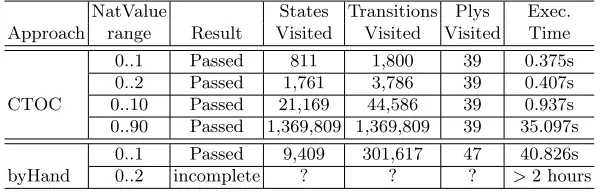
Our referenceCircusmodel was that of the HD machine running in parallel with a model of one of the case study requirements (R-1 [2, Section 4.2, p11]). The requirement model is effectively a monitor that observes the machine model, checking that it is satisfied, and deadlocking if it observes a violation. We then check the proposition that the HD model is correct w.r.tR-1 by showing that the combination is deadlock free. In addition to comparing various translation schemes, we also explored the effect of changing the size of our “natural number” type:NatValue == 0. .N, in order to estimate the number of states visited in FDR.
We explored thebyHand and CTOC translation schemes with four ranges of
NatValue size, with N up to a maximum of 90, as shown in in Table 2. The only case where we could compare the two approaches was our first case, with
N = 2: it resulted in 9,409 states visited using byHand, in contrast with 811 states visited using CTOC, demonstrating a reduction of 91% in terms of states explored. Moreover, the execution time with the model generated usingCTOCwas equally reduced by 91% compared to the the model using byHand. The “Plys” column indicates how deep the breadth-first search algorithm used by FDR went while checking. This is larger for the byHand model, and is independent of the value of N. Interestingly, after waiting more than 2 hours, we were unable to obtain results from the model generated withbyHandwhen we increased theN
executed in in 35 seconds, which is still quicker than byHand withN = 2. We also note that amount of memory used was constant, at 240MB approx.
Table 2.Time for asserting deadlock freedom of the HD Machine in FDR4
NatValue States Transitions Plys Exec. Approach range Result Visited Visited Visited Time
0..1 Passed 811 1,800 39 0.375s
0..2 Passed 1,761 3,786 39 0.407s
0..10 Passed 21,169 44,586 39 0.937s CTOC
0..90 Passed 1,369,809 1,369,809 39 35.097s 0..1 Passed 9,409 301,617 47 40.826s
byHand 0..2 incomplete ? ? ? >2 hours
We could not get results here for theD241 scheme as its translation of the HD model resulted in type errors being reported by FDR.
In addition to experiments that variedN above, we also explored how the
numberof variables, rather than the size of their datatypes, influenced the check-ing time. Uscheck-ing a hypothetical example havcheck-ing 12 state variables, checks uscheck-ing
D241were performed in 35 minutes, compared to 76 ms usingCTOC. We observed segmentation faults using D241with a more than 12 variables. However, checks using CTOCin an example with 42 state variables andNatValue = 0. .30, were performed in 870 ms. What is clear is that with the CTOC translation scheme, namely one memory-process per state-variable, we can now handleCircusmodels of considerable complexity.
5.2 Ring-Buffer Experiments
Another interesting example was to take theCircusspecification of the bounded reactive ring buffer, RB, from D24.1 [29, Appendix D.2, p. 163], based on the model presented in [7]. We compared the CTOC translation of this using Cir-cus2CSP(RBCTOC), with the by-hand translation in D24.1 [29, Appendix D.4, p166] (RBCTOC). We firstly perform the usual tests like deadlock freedom and termination checks fortheRBCTOC and for theRBCTOC specifications, as illus-trated in Table 3.
We can see a clear difference between the states visited between the three approaches, notably those between RBbyH and RBCTOC where the number of states and transitions visited was reduced considerably, as well as the amount of time spent by FDR4 to check the assertions.
We also experimented to check the failures-divergences refinement (P vFD
Table 3.RingBuffer checks: deadlock and livelock freedom, and determinism.
Test Model Result States Visited Transitions Plys Exec.Time RBbyH Passed 8,297,025 16,805,249 44 26.657s
deadlock free
RBCTOC Passed 1,628 3,109 38 0.145s
RBbyH Passed 8,297,025 16,805,249 44 25.476s
livelock free
RBCTOC Passed 1,628 3,109 38 0.151s
RBbyH Passed 9,869,889 19,852,673 69 54.863s
deterministic
RBCTOC Passed 2,012 3,853 63 0.159s
Table 4.Refinement checks between models of the Ring Buffer example
Refinement States Transitions Plys Exec. Check Result Visited Visited Visited time 1 RBbyH vFD RBCTOC Passed 1,628 3,109 38 58.019s
2RBCTOC vFD RBbyH Passed 8,297,025 16,805,249 44 42.543s
Interestingly, if we compare the states and transitions visited, as well as the execution time from Table 3 with Table 4, given a refinement A vFD B, the states and transitions visited are almost the same as when checking B for deadlock freedom.
During our experiments, we also compared ourCircus2CSP model with the Ring Buffer model RBKW, based on [40, Chapter 22], produced using the ap-proach of Kangfeng and Woodcock [41] for translating Circus into CSP||B, for model checking using ProB [22]. Such an approach is similar [29, p. 116] but makes use of Z schemas asCircus actions that are currently not available in our translation scheme. In our experiments, we observed that the model RBKW is refined by bothRBCTOC andRBbyH, but the refinement in the reverse direction does not hold,i.e., RBKW is not a refinement of neitherRBCTOC norRBbyH, as it is a more abstract model since its data aspects of specification are defined in B.
Unfortunately, the structure defined for our translation strategy is not fully supported by ProB, which was used to testRBKW [42]. ProB is another model-checker, which like FDR, also allows the user to animate specifications. It was originally developed for the B language, but it has been extended and now it supports other formal languages such as CSP, Z, Event-B [1], as well as combined languages such asCSP||B. We observed that the use of subtype, in our models, is not fully supported by the ProB tool, causing some commands like ”model-check” to result in errors. However, we were able to animate our translated specification using ProB, and to execute the same assertion check, as in FDR: we obtained similar results to those when running FDR.
[image:12.612.157.457.244.293.2]no way to fully compare both approaches since CSP||B takes into account the system state in ProB, whereas we only have theCSPM side of the model, which captures the behavior of the system, but does not captures the system state. The most obvious explanation for the deadlock inRBKW is that the state (modeled in B) influences control-flow that results in deadlock situations being avoided.
5.3 Compression Experiments
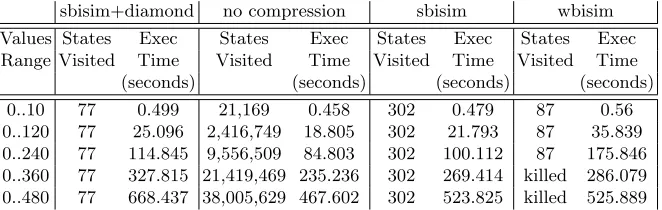
[image:13.612.144.475.374.479.2]An important aspect when using FDR is the availability of compression tech-niques [33] in order to reduce the number of states, reducing the time spent for refinement checking. A compression transforms a labelled-transition system (LTS) into a corresponding one, which is expected to be smaller and more ef-ficient whilst using it for checks in FDR. Currently, FDR applies compressions in parallel compositions by default, which is the main structure we use in our memory model. We explored a few other compression tecniques, such assbisim, which determines the maximal strong bisimulation [5], andwbisim, which com-putes the maximal weak bisimulation. Depending on the compression used, the number of states visited, were indeed reduced, as illustrated in Table 5.
Table 5.ExperimentingCSPM compression techniques with the HD Machine
sbisim+diamond no compression sbisim wbisim
Values States Exec States Exec States Exec States Exec Range Visited Time Visited Time Visited Time Visited Time
(seconds) (seconds) (seconds) (seconds)
0..10 77 0.499 21,169 0.458 302 0.479 87 0.56
0..120 77 25.096 2,416,749 18.805 302 21.793 87 35.839 0..240 77 114.845 9,556,509 84.803 302 100.112 87 175.846 0..360 77 327.815 21,419,469 235.236 302 269.414 killed 286.079 0..480 77 668.437 38,005,629 467.602 302 523.825 killed 525.889
Although the states/transitions/plys visited were considerably reduced using the compression techniques mentioned above, there was little impact on overall execution time, and the number of states visited are independent of the size of
NatValue, while the number of transitions grows slowly. However, the results obtained here are related to the model of the HD machine, and it is difficult to identify which compression technique will be most effective in a general case, and indeed, further experiments are required.
6
Future Work
in specifying a translation strategy for Z schemas used asCircusactions within a process. The best approach would be to use Z Refinement Calculus [6]. For now, our tool deals only with those schemas that in fact can be translated into as-signments. We intend to explore the operators for Z schemas and the refinement laws that can be applied accordingly.
In addition, we also plan to establish a link between Circus2CSP and Is-abelle/UTP [11], so that we can use their mechanised UTP semantics forCircus to verify the correctness of our Haskell implementation. Moreover, our tool also has aCircusrefinement “calculator” embedded in it, which implements the laws listed in Appendix A of the Deliverable 24.1 [29, p.147], which can easily be extended to the other refinement laws proved by Oliveira [27] in the near future.
We can eliminate the use of CSPM subtyping in CTOC (the process-per-variable model), and simplify “get” and “set” prefixes of the forms mget.n.v
andmset.n.v toget n.v andset n.v respectively, where we now have dedicated channels per variable. However, the relationship of this new form toCTOC is no longer a simple equivalence as there are now different events in the two models.
Finally, in terms of improvement of our tool, compared to other approaches [9], it would also be interesting to review the parser of Z andCircusfromCircus2CSP in order to rewrite it to be in conformance with the International Standards Organization (ISO) standards, ISO/IEC 13568:2002 [20], which describes the syntax, type system and semantics of Z formal notation. Moreover, we would like to include thelibcspm library7 intoCircus2CSPin order to be able to parse the relevant code included in our definition of theassertion LATEX environment. Such an attempt would help a Circus2CSP user wishing to review any fault in theCSPM specification translated fromCircus.
Finally, we can envisage work in the future that might extend the benefits gained here to the wider model-checking community. One possibility is extending the translator to target model-checkers other than FDR. This would require us to have either a rigourosly defined embedding, of the subset of CSP that we produce, into the modelling language of the proposed checker, or have a way of linking the semantics of the target modelling language toCircus and/or CSP to verify the correctness of direct output in that language. The second aspect concerns the possibility that our approach can be adapted to work within another model-checking eco-system entirely. ne key advantage in having a state-rich form is the ability to easily describe state changes that only modify small parts of the state (compareP =w :=y−x; Q with P(u,v,w,x,y,z) =Q(u,v,y−x,x,y,z)). We note that the CADP system, which is based on LOTOS (state-poor), has already moved in this direction, with tools now working with LTN (LOTOS New Technology, state-rich), using a LTN to LOTOS translator [13]. Do other modelling notations have state-rich forms that are hard to check, but have good checkers for state-poor forms?
7
7
Conclusions
In this paper we evaluated possible approaches for translatingCircusintoCSPM, for model checking using FDR. Our main concern was how the state of aCircus process could be captured inCSPM in such a way that FDR could handle a large amount of state variables and an even larger range of values. We then produced several models ofCSPM specifications translated fromCircus and also explored the consequences of including both state invariants and preconditions of Circus actions in the CSPM models. Such a research resulted in the development of Circus2CSP, a tool for model checkingCircus, through the automatic translation fromCircustoCSPM, and therefore, being able to use FDR for refinement checks. Circus2CSPdevelopment was developed in 24 months, and has a total of over 26 thousand lines of Haskell code.
We observed that a distributed memory model, rather than a centralised one, as proposed by Mota et al. [24] is beneficial for larger states. Moreover, the time spent as well as the state exploration from FDR’s refinement checks is larger when capturing preconditions and state invariants. Another observation from our experiments is that we were able to reduce the state exploration even more by refining our model to one where the bindings were explicitly defined by Circus2CSP, rather than considering a non-deterministic choice over such bindings, as per the original manual translation. This is justified by assuming that every state variable should be initialised prior to its use in the process. The outcome is that we now have a mechanised translator fromCircustoCSPM that produces tractable models, and allows the use of FDR on larger case studies than has been possible up to now.
We should clarify that our approach to produce parametrised processes is not an attempt to use the bindings data-independently [32, p. 453]. That is solving a different problem, namely finding a finite size of a type that is suitable to demonstrate the correctness for any finite or even infinite size of such type. Moreover, to date, our approach is unable to generate counterexamples or any kind of back annotation to theCircusmodels, and thus is in our plans for future work.
We used the HD machine and the ring buffer case studies as examples in order to test the capabilities of our tool whilst model checking the automati-cally translated models in FDR. Our aim was to contribute to reducing FDR’s workload in order to model check larger systems. We learned that a practical implementation/mechanisation of a theory may reveal difficulties that could not otherwise be discovered without extensive use of a tool prototype, especially when applying it to larger case studies.
Acknowledgments
References
1. Abrial, J.R.: Modeling in Event-B: System and Software Engineering. Cambridge University Press, New York, NY, USA, 1st edn. (2010)
2. Atif, M.: The hemodialysis machine case study. In: Butler, M.J., Schewe, K.D., Mashkoor, A., Bir´o, M. (eds.) Lecture Notes in Computer Science (including sub-series Lecture Notes in Artificial Intelligence and Lecture Notes in Bioinformat-ics). Lecture Notes in Computer Science, vol. 9675, pp. 329–343. Springer (2016), https://doi.org/10.1007/978-3-319-33600-8_29
3. Beg, A., Butterfield, A.: Linking a state-rich process algebra to a state-free algebra to verify software/hardware implementation. Proceedings of the 8th International Conference on Frontiers of Information Technology - FIT ’10 pp. 1–5 (2010),http: //portal.acm.org/citation.cfm?doid=1943628.1943675
4. Beg, A., Butterfield, A.: Development of a prototype translator from Circus to CSPm. In: ICOSST 2015 - 2015 International Conference on Open Source Systems and Technologies, Proceedings. pp. 16–23 (dec 2016)
5. Boulgakov, A., Gibson-Robinson, T., Roscoe, A.W.: Computing maximal weak and other bisimulations. Formal Aspects of Computing 28(3), 381–407 (2016), https://doi.org/10.1007/s00165-016-0366-2
6. Cavalcanti, A., Woodcock, J.C.P.: ZRC - A Refinement Calculus for Z. Formal Aspects of Computing 10(3), 267–289 (mar 1998), http://link.springer.com/ 10.1007/s001650050016https://doi.org/10.1007/s001650050016
7. Cavalcanti, A.L.C., Sampaio, A.C.A., Woodcock, J.C.P.: A Refinement Strategy for Circus. In: Formal Aspects of Computing. vol. 15, pp. 146–181 (nov 2003), https://doi.org/10.1007/s00165-003-0006-5
8. Conserva Filho, M., Oliveira, M.V.M.: Implementing tactics of refinement in CRe-fine. In: Eleftherakis, G., Hinchey, M., Holcombe, M. (eds.) Lecture Notes in Com-puter Science (including subseries Lecture Notes in Artificial Intelligence and Lec-ture Notes in Bioinformatics). LecLec-ture Notes in Computer Science, vol. 7504 LNCS, pp. 342–351. Springer (2012),https://doi.org/10.1007/978-3-642-33826-7_24 9. CZT Partners: Community{Z}tools. (oct 2006),czt.sourceforge.net/ 10. Dijkstra, E.W.: Guarded commands, nondeterminacy and formal derivation of
pro-grams. Communications of the ACM 18(8), 453–457 (1975),http://portal.acm. org/citation.cfm?doid=360933.360975{%}5Cn
11. Fowler, S., Zeyda, F., Woodcock, J.C.P.: Isabelle/UTP: {A}Mechanised Theory Engineering Framework. In: Unifying Theories of Programming - 5th International Symposium,{UTP}2014, Singapore, May 13, 2014, Revised Selected Papers. pp. 21–41 (2014),http://dx.doi.org/10.1007/978-3-319-14806-9_2
12. Freitas, L.: Model checking Circus. Ph.D. thesis, Department of Computer Science, The University of York, UK (2005)
13. Garavel, H., Lang, F., Serwe, W.: From LOTOS to LNT. In: Katoen, J., Langerak, R., Rensink, A. (eds.) ModelEd, TestEd, TrustEd - Essays Dedicated to Ed Brinksma on the Occasion of His 60th Birthday. Lecture Notes in Com-puter Science, vol. 10500, pp. 3–26. Springer (2017),https://doi.org/10.1007/ 978-3-319-68270-9_1
15. Gomes, A.O.: Formal Specification of the ARINC 653 Architecture Using Circus (2012),http://etheses.whiterose.ac.uk/id/eprint/2683
16. Gomes, A.O., Butterfield, A.: Modelling the haemodialysis machine with Circus. Lecture Notes in Computer Science (including subseries Lecture Notes in Artificial Intelligence and Lecture Notes in Bioinformatics) 9675(201857), 409–424 (2016), https://doi.org/10.1007/978-3-319-33600-8_34
17. Gomes, A.O., Oliveira, M.V.M.: Formal Specification of a Cardiac Pacing System. In: Cavalcanti, A., Dams, D. (eds.) FM 2009: Formal Methods, Lecture Notes in Computer Science, vol. 5850, pp. 692–707. Springer (2009),https://doi.org/10. 1007/978-3-642-05089-3_44
18. Hoare, C., He, J.: Unifying Theories of Programming. Prentice-Hall (1998) 19. Hopcroft, J.E., Motwani, R., Ullman, J.D.: Introduction to automata theory,
lan-guages, and computation - international edition (2. ed). Addison-Wesley (2003) 20. ISO/IEC: ISO/IEC 13568:2002 Information Technology Z formal
speci-fication notation Syntax, type system and semantics. Tech. rep. (2002), http://standards.iso.org/ittf/PubliclyAvailableStandards/c021573_ISO_ IEC_13568_2002(E).zip
21. Jackson, E.K., Levendovszky, T.T., Balasubramanian, D.: Reasoning about meta-modeling with formal specifications and automatic proofs. In: Whittle, J., Clark, T., K¨uhne, T. (eds.) Lecture Notes in Computer Science (including subseries Lec-ture Notes in Artificial Intelligence and LecLec-ture Notes in Bioinformatics). LecLec-ture Notes in Computer Science, vol. 6981 LNCS, pp. 653–667. Springer (oct 2011), https://doi.org/10.1007/978-3-642-24485-8_48
22. Leuschel, M., Butler, M.: ProB: A Model Checker for B. FME 2003 Formal Methods 2805, 855–874 (2003),https://doi.org/10.1007/978-3-540-45236-2_46 23. Morgan, C., Carroll: Programming from specifications (2nd. Ed.), Prentice Hall
International series in computer science, vol. 16. Prentice Hall (1994), https:// dl.acm.org/citation.cfm?id=184737
24. Mota, A., Farias, A.C., Didier, A., Woodcock, J.C.P.: Rapid prototyping of a se-mantically well founded Circus model checker. In: Giannakopoulou, D., Sala¨un, G. (eds.) Lecture Notes in Computer Science (including subseries Lecture Notes in Artificial Intelligence and Lecture Notes in Bioinformatics). Lecture Notes in Computer Science, vol. 8702 LNCS, pp. 235–249. Springer (2014), https: //doi.org/10.1007/978-3-319-10431-7_17
25. Nogueira, S., Sampaio, A., Mota, A.: Test generation from state based use case models. Formal Aspects of Computing 26(3), 441–490 (2014)
26. Oliveira, D., Oliveira, M.V.M.: Joker: An Animation Framework for Formal Speci-cations. In: SBMF’11 - Short Papers. pp. 43–48. ICMC/USP (sep 2011)
27. Oliveira, M.V.M.: Formal Derivation of State-Rich Reactive Programs using Circus. Ph.D. thesis, University of York, UK (2005), http://ethos.bl.uk/ OrderDetails.do?uin=uk.bl.ethos.428459
28. Oliveira, M.V.M., Cavalcanti, A., Woodcock, J.C.P.: Unifying theories in ProofPower-Z. In: Formal Aspects of Computing. vol. 25, pp. 133–158 (jan 2013), https://doi.org/10.1007/s00165-007-0044-5
29. Oliveira, M.V.M., Sampaio, A., Antonino, P., Ramos, R., Cavalcanti, A., Woodcock, J.C.P.: Compositional Analysis and Design of CML Models. Tech. Rep. D24.1, COMPASS Deliverable (2013), http://www.compass-research.eu/ Project/Deliverables/D241.pdf
31. Plagge, D., Leuschel, M.: Validating Z Specifications Using the ProB Animator and Model Checker. In: Davies, J., Gibbons, J. (eds.) Integrated Formal Methods, Lecture Notes in Computer Science, vol. 4591, pp. 480–500. Springer (2007),https: //doi.org/10.1007/978-3-540-73210-5_25
32. Roscoe, A.W.: The Theory and Practice of Concurrency. Prentice Hall PTR, Upper Saddle River, NJ, USA (1973)
33. Roscoe, A.W., Gardiner, P., Goldsmith, M., Hulance, J., Jackson, D., Scattergood, J.: Hierarchical compression for model-checking CSP or how to check 1020 dining philosophers for deadlock. In: Brinksma, E., Cleaveland, R., Larsen, K.G., Mar-garia, T., Steffen, B. (eds.) Tools and Algorithms for the Construction and Analysis of Systems. Lecture Notes in Computer Science, vol. 1019, pp. 133–152. Springer (1995),http://dx.doi.org/10.1007/3-540-60630-0_7
34. Saaltink, M., Meisels, I., Saaltink, M.: The Z/EVES Reference Manual (for ver-sion 1.5). Reference manual, ORA Canada pp. 72–85 (1997),http://dl.acm.org/ citation.cfm?id=647282.722913
35. Scattergood, B.: The semantics and implementation of machine-readable CSP pp. 1–179 (1998),http://ethos.bl.uk/OrderDetails.do?uin=uk.bl.ethos.299037 36. Schneider, S.: Concurrent and Real-time systems. Wiley Chichester, UK (2000) 37. Woodcock, J.C.P., Bryans, J., Canham, S., Foster, S.: The COMPASS Modelling
Language : Timed Semantics in UTP pp. 1–32 (2014)
38. Woodcock, J.C.P., Cavalcanti, A.: The Semantics of Circus. In: Zb 2002: Formal Specification and Development in Z and B: 2nd International Conference of B and Z Users Grenoble (2002)
39. Woodcock, J.C.P., Cavalcanti, A.L.C., Freitas, L.: Operational Semantics for model checking Circus. Lecture Notes in Computer Science 3582, 237–252 (2005) 40. Woodcock, J.C.P., Davies, J.: Using Z, Specification, Refinement, and Proof.
Pren-tice Hall International Series in Computer Science, PrenPren-tice-Hall, Inc., Upper Sad-dle River, NJ, USA (1996)
41. Ye, K.: Model Checking of State-Rich Formalisms. Ph.D. thesis, University of York (2016)
![Fig. 1. Mapping Circus into CSPM (derived from [29, Fig.7, p77])](https://thumb-us.123doks.com/thumbv2/123dok_us/8810614.918328/4.612.207.411.212.279/fig-mapping-circus-cspm-derived-fig-p.webp)