371
CAP National Seminar
CHANGING
DIRECTIONS
Towards Sustainable
Transport in Malaysia
7-10 September 2001 RECSAM, Penang
ACCESS FOR ALL
by
Naziaty Mohd
Yaacob and Ati Rosemary Mohd
Ariffin,
Department of Architecture,
University of Malaya
CONSUMERS' ASSOCIATION OF PENANG
228 Jalan Macalister 10400 Pulau Pinang
Malaysia
SAHABA T ALAM MALA YSJA 27 Lorong Maktab
10250 Pulau Pinang Malaysia
372
ACCESS
FOR ALL
Naziaty Mohd Yaacob and Ali Rosemary Mohd Ariffin
Abstract
We do not see many disabled and elderly persons using the streets, pathways and pedestrian crossings in many Malaysian cities. Reports of the disabled being disadvantaged and sidelined where equal opportunities in education, recreation, employment and commerce, had been highlighted before. The issue of inaccessible or barrier-filled access often originates from discrepancies in the planning, design and building of the built environment that do not cater adequately to the needs of the disabled and elderly persons.
The lack of accessibility, erect barriers for the disabled. The frustrations in being immobile, dependent and being patronized while having to cope with day to day living, saps the energy and efficiency away from the disabled user in wanting to have equal opportunities at being successful in life, like everyone else.
For example, with the lack of access to better education, many disabled persons have difficulties to pursue further education, and limited opportunities to progress. Depending on the degree and type of impairment and the emphasis on mobility, the limitations are obvious when an able-bodied person would have no problems traveling long distances to work, or work overtime or part-time in order to supplement the high cost of living. Due to rapid urbanization, and the expansion of cities in Malaysia and everywhere else in the world, the disabled person has to live in the cities to survive and get a better life.
Many disabled persons are from the low-income group. Hence, the expensive mode of public transport and mobility is the norm for a disabled person, rather than a choice. So, there is actually 'no choice'. ILack in mobility due to lack of facilities for the disabled and elderly in
transportation is further burdened with the lack of access in the built environment, in particular the pedestrian environment.
Some of the recent surveys undertaken and visual observation in Kuala Lumpur of pedestrian movements, commuter services and building access has indicated that there are not many di abled or elderly users. Some of the reasons are as follows:
a) There is not much consideration given to the disabled or elderly in the overall
pedestrian planning in the city. ...
b) There is evident lack of facilities for the disabled within the City, to permit easy
m bilit) of the di abled and elderly. . " ...
) There are incon i tent design standards In the c?nstructlon of walkway fa?dltles: signage, lamp-po t ,garbage bins, and other objects that hinder the movement of the disabled and the elder! .
~iJI) \lohli Yaacob and Christine Lee oon Kup, 'The Future of Hcalthcare lorthe Disabled', Seminar
373
t dfOi1t:JOl () 1 ~~r I erl 1))1>, (J( 'LJ ~ I, f)I'.J erir h'J(IJr,:;,11 IJ
l~fJJ Ill"''1 J i1 I I )1 I ....
d) Many buildings and malls in the city lack of adequate access for the disabled and the
elderly. '
e)
Commuting in and out of the city via public transport facilities (LRT, taxis and buses) that are not designed to cater for the disabled and the elderly.f 'u
Ihe objective of this paper is to review the existing situation in Malaysian cities, in particular
Kuala
Lumpur and Penang, focusing on current issues and problems on accessible tran1portation and mobility practices with references to certain good practices that is available in other countries.Recent discussions that we had during a visit by an expert on this issue Dr Kit Mitchell, at Petaling Jaya and Penang, in October 12, 2000, had raised several issues that could be address immediately. And the paper will be addressing these issues that was part of a continuing group discussions among the disabled persons, and the elderly.
What would benefit for the disabled persons, would be of benefit to the rest of the population who may also have mobility problems such as mothers with young children, those 'with temporary and slight disabilities, and people carrying heavy luggage or shopping.
Introduction
At present, the high cost of living for the disabled person in Kuala Lumpur is based on 'no choice'. Hypothetically, a wheelchair user living in Cheras, which is a dense residential suburb that has a light-rail transit line passing through it, would logically use the public transportation, a cheaper mode of transportation, ifhe is working in the center of the city. The daily return rate to travel from Cheras could even be about Ringgit Malaysian 3 (three) or less than one US dollars, if the person can walk or travel without cost to the light-rail transportation stations. For the wheelchair user, the pavements are un accessible and although it could be a short distance, the person would have to hire a taxi to the station. At present circumstances, the person could not access the station's platform as there are no lifts to cater up to 3 or 4 storeys of access. The cost of travel may even be up to 10times more.
Many disabled persons are from the low income group. Hence, the expensive mode of public transport and mobility is the norm for a disabled person, rather than a choice. So, there is actually 'no choice'r' Lack in mobility due to lack of facilities for the disabled and elderly in transportation is further burdened with the lack of access in the built environment, in particular the pedestrian environment.
The content for discussion will be based on 3 main topics: a) Advocacy for access to transport;
2PAG Consult B / Japan International Co-operation gency / Dewan Bandaraya Ku I Lumpur. 'The tudj
on Pedestrian Friendly City in Kuala Lumpur'. Interim Report. June I 99.
1Naziaty Mohd Yaacob and Chri tine 1 ee n Kup, 'The Future of Healthcare for th Di abled'. eminar
b) Access to streets and pathways, shelters and waiting areas and bus stops; c) Access to transit vehicles."
Figure J from Lats cartoons, who depicts accurately' Scenes of Malaysian Life' shows the hectic, chaotic and dangerous life of a pedestrian in Kuala Lumpur or other cities.
Figure 2 [below]
o
KLCC Pedestrian Walk/.."
/ /
o
KLCC LRTT",
<, LRT
'0
Pedestrian Walk /~
o
/Change at Stars Masjid Jamek~ I RT tn Pntra I RT
<,
LR~,,-o
B. Cheras Star LRT...
/13us
o
A.
House
315
Figure 2 illustrates a possible route that a disabled person have to take when using The public transportation system in Kuala Lumpur. There are a lot of disembarking and alighting that the disabled pedestrian have to do. Typical user from Cheras that works in KLCC.
Min of LG & Housing /Min. of Transport I
..
It'
public works ~Developerl Transport Local Councill Transport
provider provider
Min. of LG
& Housing
Local .. Developer Council
Housel Flat
~
o
o
B.Taxil A.Taxilbus
---~taf
o
Pedestrian walk
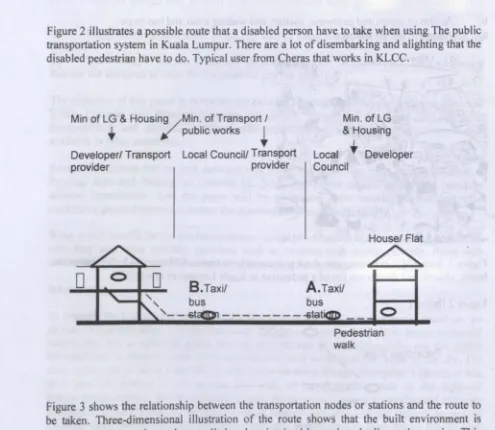
Figure 3 shows the relationship between the transportation nodes or stations and the route to be taken. Three-dimensional illustration of the route shows that the built environment is owned by many parties and controlled and maintained by various bodies and agencies. This route is just a small part of what the overall route in Figure 2.
Advocacy for access to transport
Advocacy is needed to ensure that there is the citizen's participation in shaping the policy and decision making processes on the urban development of a city. Participation alone without actually taking account and proceeding later with some plan of action and implementation of what is being decided will not ensure that the problems will be re olved. Advocacy does not have to be adversarial. Public participation in studies , survey, forums, eminars and discussions will gauge the realistic needs and should be encouraged and upported by the local authority and government.
researchers and academics from institution of higher learning and professionals, such as architects, as a working group to realize impactful objectives.
Public awareness measures and high-lighting the issues via events to initiate action using the media is just one of the ways to advocate. Going back in time, in ) 994, there was a peaceful demonstration by advocates of access and mobility for the disabled, against the transport providers that started the first light-rail transit lines in Kuala Lumpur. Quotations from the providers that' the trains are not safe for the usage of the disabled' outraged the disabled users, and decision making from the providers not to provide lifts caused the outcry to be even louder.
Something good came out of the demonstration, as the second train line stations by PUTRA, designed a service for the disabled user, that not only include lifts from the street level, but also include assistance service and other architectural features. Such as ramps, Braille lift buttons and guide tiles for the visually impaired.
The implementation to include all possible users in the main customer policies, which includes the disabled and elderly persons, should be addressed from the very beginning. Advocacy groups could play a crucial role as a 'watchdog' by reporting to the relevant authorities whether the building or facilities provide for adequate access. A less confrontational way would be to persuade the owners to modify the building.
The Swedish Railway had learned from 80s to change their exclusively commercial priorities to that which is more user oriented. In economic terms, it had made sense to them to do so as, ' " .what is necessary to the handicapped is normally of great value to the other passengers as well. .. ' (Kult Hulgren) 5
Advocacy groups or efforts need to be focused and relate to mainstream advocacy for a better pedestrian environment. Representation i~ working groups that work closely with the government is one of the best ways to get things done.
377
Figure 4 shows a working group that works for advocacy for access and mobility issues in Kuala Lumpur [Photo of Access Initiative Group at DAMAI Centre]
Figure 5 shows the difficulty in negotiating a badly designed and constructed pavements during the survey for 'Study on Pedestrian Friendly Kuala Lumpur' by JICA / DBKL, 1999. Itwould be impossible for the wheelchair user to use the pavements on her own. [Photo taken by author]
Aspects of access to streets and pathways, shelters and waiting areas and bus stop
This section deals with the built environment aspect of access where the e facilities exi ton the streets, the pavements and the open space. Acce s or acce ible means that di abled persons can, without assistance, approach, enter, pas to and from, and make u e of an area and its facilities without undue difficulties. 6 The ba ic factor that the built envir nment
should provide for the disabled user are reachability, u ability, afetv, workability and barrier-free or non-handicapping.
6U -E AP. 'Promotion of. on-HandicappingPhy ical -nvironment forDi at-ledP n. Case tudie: and
Guidelines', United ations. cw York,I995
37
Based on the findings of the attitude survey and the general observations during discussions and interviews 2, the following are the major findings that we find on the external environment of the streets and open spaces, which includes pavements, crossings, bridges and malls (squares), which are generally unsafe, uncomfortable and in accessible. This is based on the following data:
a) 71% felt that the dropped kerbs are impractical and unsafe for the visually impaired and the wheelchair users.
b) 63% felt that the installation of traffic signals at pedestrian crossings are unsafe for the visually-impaired.
c) 81% felt that the pavement is unsuitable and cannot be used easily. d) 84% said that the path does not have sufficient safety requirement.
These figures are the yet to be disclosed figures of the report on 'The Study on Pedestrian-Friendly Kuala Lumpur'; which gives a clear indication on how inaccessible the pedestrian environment in Kuala Lumpur is.
Different sectors control this environment. In Kuala Lumpur, the implementation of the correct design are under different agencies and departments. The local authorities, the ministries of transportation and local government, and the department on traffic from City Hall are responsible. The developers and transport providers are the ones from the private sector involved.
Integration and smooth flow of available facilities is another factor that could result in un-accessibility. Although PUTRA may provide for full access, the other light-rail transport provider did not. So, in the end, the disabled user still could not use the route intended to finish the journey.
1PAG Consult B / Japan International Co-operatio~ Agency / Dewan Bandaraya Kuala Lumpur, 'The Study
On P d trian Friendly City in Kuala Lumpur', Interim Report, June 1999.
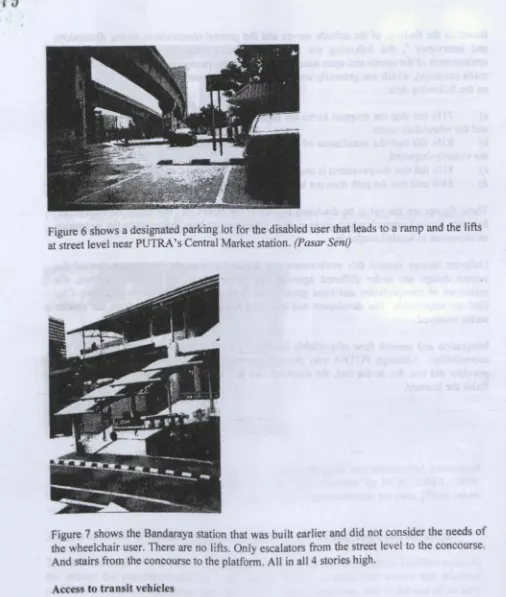
Figure 6 shows a designated parking lot for the disabled user that leads to a ramp and the lifts
at street level near PUTRA's Central Market station.
(Pasar Seni)Figure 7 shows the Bandaraya station that was built earlier and did not con ider the needs of
the wheelchair user. There are no lifts. Only escalators from the street level to the concourse.
And stairs from the concourse to the platform. All in all
4stories high.
Access to transit
vehicles
The feeder buses that ply the routes for PUTRA light-rail tran port are advertised as being
wheelchair friendly, with signages indicated at the back of the bu e . However the feature of
a ramp is impossible to implement as the traffic system doe not allow
fr the
rvice to
occur. There is no training for bus drivers in servicing for the wh elchair u
f.3.80
The processes to enter into the bus safely and comfortably depends on a few step-by-step situations that will take time. The bus driver must stop indefinitely for the wheelchair user toboard, and park safely onto a dedicated area where the user can fasten and secure the wheelchair ro a clamp or device that would not allow for the wheelchair to roll.
The overall traffic system should provide for weJJ-planned dedicated bus lanes which provides for a smooth flow for buses, and priority for buses to ply and not have to share with other traffic.
An awareness programme for all road users to be patient and courteous to the needs of the disabled and the elderly user will provide for a long term investment towards a 'caring society'. If sole bus lanes are not possible to install, a delay in boarding and disembarking, will take the patience of other road users to task.
Taxis should provide for services to the disabled, at least free of charge when calling for them. Often the taxi drivers refuses a wheelchair user due to difficulties in boarding and carrying the wheelchair for them. Again, an awareness programme included in the services required for the driver is needed.
The overall planning and design of the streets is needed to carefully study how people go into the vehicles from the curbs.
~Jj~~~~"M,
·~~I:7J'!II1I Figure 8 shows a low kneeling bus which allows381
Figure 9 shows a London Taxi cab with makeshift ramps. This design does not allow for independent entry.'
Figure 10 shows a Yellow cab with independent entry access.'
JTom Rickert, 'Mobility for All: Acce sible Tran portati n Ar und the World'. ccess E. chang International Guide, an Francisco, 1998
Appendix I
MEMORANDUM ON ACCESSIBLE TRANSPORTATION FROM THE ELDERLY,
MOTHER'S WITH YOVNG CHILDREN, AND DISABLED PERSONS'
ORGANISATIONS AND CONCERNED INDIVIDUALS TO RELEVANT
GOVERNMENT AGENCIES AND TRANSPORT OPERA TORS
Special notes:
• "Accessible" refers to the goal of enabling access by all, including elderly and
disabled person. Accessible also implies that disabled person can, without assistance,
approach, enter, pass to and from, and make use of an area and its area and its facilities without undue difficulties.
• The phrase "disabled person" includes all person whose physical, sensory or
cognitive conditions are not sensitively nor seriously taken into account in the planning, drawing and implementation of social policies or structural designs.
On the occasion of the Seminar on Accessible Transportation to be held at the Petaling Jaya Community Library, on Thursday, 12 October 2000.
WE HEREBY URGE
1.0 THE FEDERAL GOVERNMENT TO:
J.I RECOGNISE that providing an accessible environment and transportation benefits EVER YBODY, especially the growing number of elderly people and also parents with young children. Itis not only disabled persons that benefit.
1.2 INTRODUCE POLICY to provide accessible transportation in phases, particularly in urban areas.
1.3 PROVIDE INCENTIVES for transport operators for providing accessible vehicles'
services.
1.4 PREPARE, PUBLISH and ENACT standards for accessible public transport
vehicle and transport infrastructure (based on universally accepted practice but appropriate for conditions in Malaysia); then REQUIRE new public transport vehicles and infrastructure to comply with these standards.
1.5 ENACT AND ENFORCE legislation requiring that disabled persons not be excluded from acti ities olely because of the design and operation of public transport vehicles and tran p rt in Ira tructure.
1.6 E 0 R GE the immediate application of accessible design for public transport ehicle and transport infra tructure even before the legally enforced. tandards take effect.
~83
1.7 ENFORCE the design standards for an accessible external built environment; this is the missing link between accessible transport and accessible buildings.
1.8 SET TARGET DATES for the achievement of a fully accessible transport system in Malaysia. We suggest the year 2005.
2.0
ALL STATE GOVERNMENTS AND LOCAL AUTHORITIES TO:2.1 WORK IN PARTNERSHIP WITH Federal Government to develop design
standards for accessible public transport vehicles and transport infrastructure that are appropriate to conditions in Malaysia;
2.2 INCLUDE ACCESSIBILITY for disabled person in the formulation of all new or revised structure / local plans.
2.3 SURVEY their area for accessibility and develop a list of priorities for removing barriers to access, in doing so, IDENTIFY priority routes to be made accessible and take action on these.
2.4 ENCOURAGE and provide INCENTIVES for new development to incorporate accessible built environment.
2.5 PROVIDE RATING SYSTEM to built environments which comply with access requirements.
2.6 ENFORCE all existing by-laws and design guidelines for an accessible built environment.
2.7 SET TARGET DATES for the achievement of full accessible status, including target dates for interim goals such as accessibility of priority routes.
3.0 ALL PUBLIC TRANSPORT OPERATORS TO:
3.1 PLAN to gradually achieve accessible services by a target date, even before legislation requires it.
3.2 REVISE operating practices and regulations to remove barriers for disabled person.
3.3 TRAIN AND SENSITISE staff at all levels to be aware of the problems of disabled person and to know how most appropriately to assist them.
3.4 ENSURE that all NEW vehicles or new infrastructure is acce sible to everybody. particularly the elderly and the disabled person.
38
Appendix II
Access Provisions for Public Transport'
(a) Road Transport
(i) Regulations should specify that new vehicles bought by public and private transport companies be accessible for people with disabilities. Studies indicate that buying a bus with lifts adds only 5 per cent to its cost.
(ii) Access regulations should specify modifications required for public buses, which are already in use.
(iii) A minimum of four seats in all buses should be designated for persons with disabilities. Those seats should be near entrance/exit doors.
(iv) Adequate space for one wheelchair should be provided in all buses.
(v) Parallel transport services for persons with disabilities who cannot use mainline systems are recommended.
(vi) Access regulations should be adapted to meet the needs of rural communities.
(b) Rail transport (including local trains, under and over ground trains and inter-city trains)
(i) Access regulations should stipulate that new rail transport facilities must be accessible for persons with disabilities.
(ii) All mainline train stations must be modified to become accessible.
(iii) One car per existing train should be modified to incorporate access features.
(iv) A minimum of two seats per car should be designated for persons with disabilities. Those seats should be near entrance/exit doors.
(v) A minimum of one accessible toilet should be available near the above-mentioned seats.
(c) Sea and river transport (including ferries, as well as domestic and international passenger ship)
conomte and cia I ommi ion for A ia and the Pacific [E CAP], Promotion ofNon-llandicapping Ph}, i al Envir nment for Disabled Person: Guideline • New York 1995
t
85
(i) Access regulations should stipulate that new sea/river transportation must be
barrier-free.
(ii) A minimum of one deck in ferries and domestic and international passenger ships should be modified to incorporate access features.
(iii) Ramps, passageways, gangways, safety equipment and at least two berths or cabins must be modified to incorporate access features.
(d) Air transport (including domestic and international passenger aircrafts)
(i) Access regulations should stipulate that new air transport facilities must be
barrier-free.
(ii) A rrummum of two seats near the entrance/exit doors in all domestic passenger aircraft should be available for persons with disabilities.