Probabilistic
Programming
KI 2014
Angelika Kimmig
A key question in AI:
Dealing with uncertainty
Reasoning with
relational data
Learning
A key question in AI:
Dealing with uncertainty
Reasoning with
relational data
Learning
?
•
logic
•
databases
•
programming
•
...
A key question in AI:
Dealing with uncertainty
Reasoning with
relational data
Learning
?
•
logic
•
databases
•
programming
•
...
•
probability theory
•
graphical models
•
...
A key question in AI:
Dealing with uncertainty
Reasoning with
relational data
Learning
?
•
logic
•
databases
•
programming
•
...
•
probability theory
•
graphical models
•
...
•
parameters
•
structure
A key question in AI:
Dealing with uncertainty
Reasoning with
relational data
Learning
Statistical relational learning, probabilistic logic
?
•
logic
•
databases
•
programming
•
...
•
probability theory
•
graphical models
•
...
•
parameters
•
structure
codes for gene protein pathway cellular component homologgroup phenotype biological process locus is homologous to participates in participates in is located in is related to refers to belongs to is found in is found in participates in refers to Biomine
Networks of Uncertain
Information
Biomine
network
Biomine
network
Biomine Network
presenilin 2
Gene
EntrezGene:81751
Notch receptor processing
BiologicalProcess
Biomine Network
-participates_in
0.220
Biomine Network
-participates_in
0.220
BiologicalProcess
•
different types of nodes & links
•
automatically extracted from text,
databases, ...
•
probabilities quantifying source
reliability, extractor confidence, ...
•
similar in other contexts, e.g., linked
Example:
Example:
Information Extraction
Example:
Information Extraction
Can we find the mechanism
connecting causes to effects?
Molecular interaction
networks
Dynamic networks
border border border border Alliance 2 Alliance 3 Alliance 4 Alliance 6 P 2 1081 895 1090 1090 1093 1084 915 1081 1040 1077 955 1073 804 1054 830 942 1087 621 P 3 744 748 559 P 5 P 6 950 644 985 932 837 871 777 P 7 946 878 864 913 P 9Travian
: A massively multiplayer
real-time strategy game
Can we build a model
of this world ?
Can we use it for playing
better ?
Dynamic networks
Travian
: A massively multiplayer
real-time strategy game
Can we build a model
of this world ?
Can we use it for playing
better ?
border border border border Alliance 2 Alliance 4 P 2 948 951 990 856 795 980 730 P 3 898 803 860 964 1037 1085 689 1005 1007 899 1005 760 P 5 1051 1051 1040 860 774 1061 886 844 945 713 P 10 839 796 838Analyzing
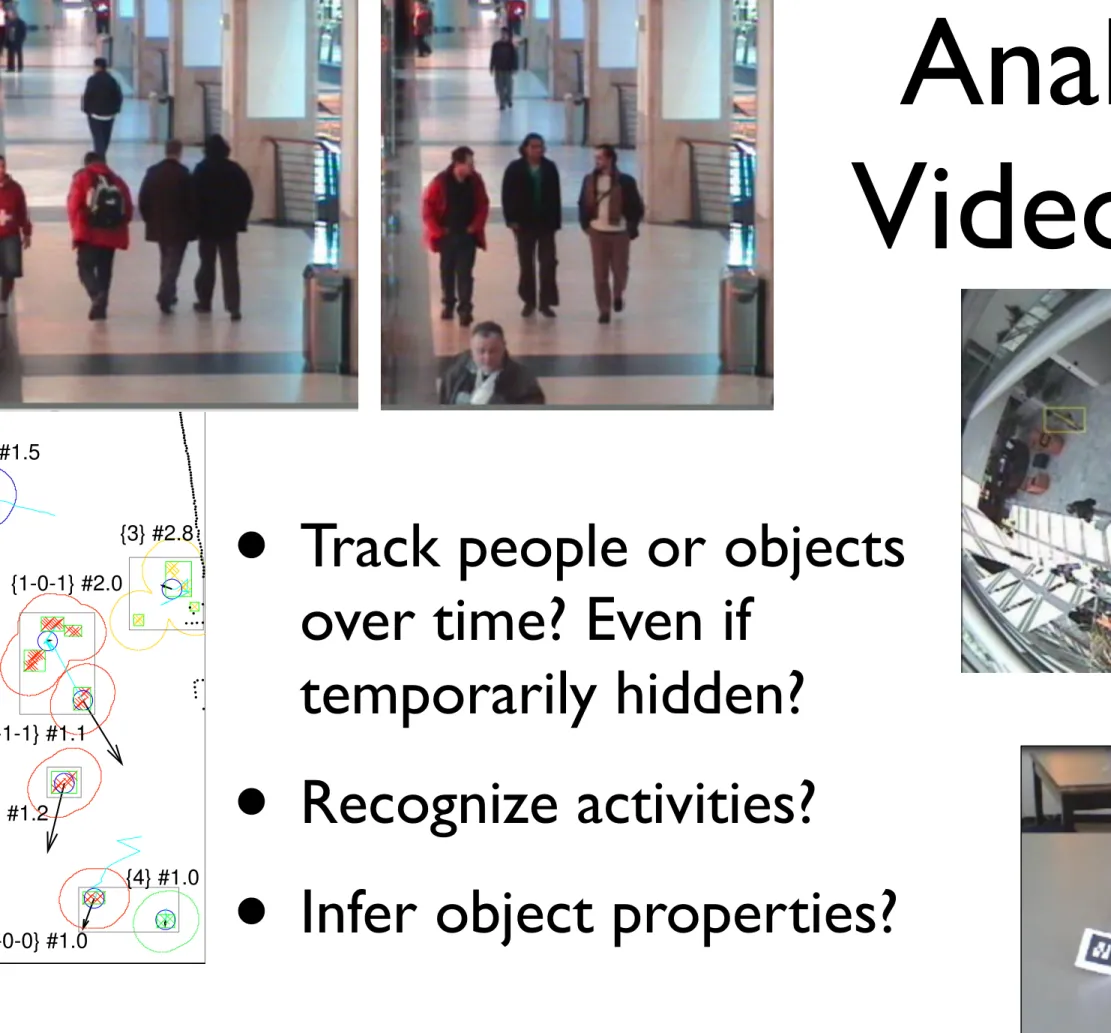
Video Data
•
Track people or objects
over time? Even if
temporarily hidden?
•
Recognize activities?
•
Infer object properties?
Fig. 4. Tracking results from experiment 2. In frame 5, two groups are present. In frame 15, the tracker has correctly split group 1 into 1-0 and 1-1 (see Fig. 3). Between frames 15 and 29, group 1-0 has split up into groups 1-0-0 and 1-0-1, and split up again. New groups, labeled 2 and 3, enter the field of view in frames 21 and 42 respectively.
Six frames of the current best hypothesis from experiment 2 are shown in Fig. 4, the corresponding hypothesis tree is shown in Fig. 3. The sequence exemplifies movement and formation of several groups.
A. Clustering Error
Given the ground truth information on a per-beam basis we can compute the clustering error of the tracker. This is done by counting how often a track’s set of points P contains too many or wrong points (undersegmentation) and how often P is missing points (oversegmentation) compared to the ground truth. Two examples for oversegmentation errors can be seen
0 0.1 0.2 0.3 0.4 0.5 0.6 0.5 1 1.5 2 2.5 3 3.5
Error rates per track and frame
Clustering distance threshold dP (m) w/o tracking Overs. + Unders. Oversegm. Undersegm. 0 0.2 0.4 0.6 0.8 1 0 4 8 12 16 20
Avg. cycle time (sec)
Number of people in ground truth Group tracker
People tracker
Fig. 5. Left: clustering error of the group tracker compared to a memory-less single linkage clustering (without tracking). The smallest error is achieved for a cluster distance of 1.3 m which is very close to the border of personal and social space according to the proxemics theory, marked at 1.2 m by the vertical line. Right: average cycle time for the group tracker versus a tracker for individual people plotted against the ground truth number of people.
relations can be determined in such cases.
For experiment 1, the resulting percentages of incorrectly clustered tracks for the cases undersegmentation, overseg-mentation and the sum of both are shown in Fig. 5 (left), plotted against the clustering distance dP . The figure also
shows the error of a single-linkage clustering of the range data as described in section II. This implements a memory-less group clustering approach against which we compare the clustering performance of our group tracker.
The minimum clustering error of 3.1% is achieved by the tracker at dP = 1.3 m. The minimum error for the
memory-less clustering is 7.0%, more than twice as high. In the more complex experiment 2, the minimum clustering error of the tracker rises to 9.6% while the error of the memory-less clustering reaches 20.2%. The result shows that the group tracking problem is a recursive clustering problem that requires integration of information over time. This occurs when two groups approach each other and pass from opposite directions. The memory-less approach would merge them immediately while the tracking approach, accounting for the velocity information, correctly keeps the groups apart.
In the light of the proxemics theory the result of a minimal clustering error at 1.3 m is noteworthy. The theory predicts that when people interact with friends, they maintain a range of distances between 45 to 120 cm called personal space. When engaged in interaction with strangers, this distance is larger. As our data contains students who tend to know each other well, the result appears consistent with Hall’s findings.
B. Tracking Efficiency
When tracking groups of people rather than individuals, the assignment problems in the data association stage are of course smaller. On the other hand, the introduction of an additional tree level on which different models hypoth-esize over different group formation processes comes with additional computational costs. We therefore compare our system with a person-only tracker which is implemented by
[Skarlatidis et al, TPLP 14;
Common theme
Dealing with
uncertainty
Reasoning with
relational data
Learning
Common theme
Dealing with
uncertainty
Reasoning with
relational data
Learning
Statistical relational learning, probabilistic logic
•
many different formalisms
•
our focus: probabilistic
ProbLog
probabilistic Prolog
Dealing with
uncertainty
Reasoning with
relational data
Learning
Prolog / logic
programming
ProbLog
probabilistic Prolog
Dealing with
uncertainty
Learning
stress(ann). influences(ann,bob). influences(bob,carl). smokes(X) :- stress(X).Prolog / logic
programming
ProbLog
probabilistic Prolog
Dealing with
uncertainty
Learning
stress(ann). influences(ann,bob). influences(bob,carl). smokes(X) :- stress(X).one world
Prolog / logic
programming
atoms as random
variables
ProbLog
probabilistic Prolog
Learning
stress(ann). influences(ann,bob). influences(bob,carl). smokes(X) :- stress(X). 0.8::stress(ann). 0.6::influences(ann,bob). 0.2::influences(bob,carl).one world
Prolog / logic
programming
atoms as random
variables
ProbLog
probabilistic Prolog
Learning
stress(ann). influences(ann,bob). influences(bob,carl). smokes(X) :- stress(X). 0.8::stress(ann). 0.6::influences(ann,bob). 0.2::influences(bob,carl).one world
Prolog / logic
programming
atoms as random
variables
ProbLog
probabilistic Prolog
Learning
stress(ann). influences(ann,bob). influences(bob,carl). smokes(X) :- stress(X). 0.8::stress(ann). 0.6::influences(ann,bob). 0.2::influences(bob,carl).one world
several possible worlds
Distribution Semantics [Sato, ICLP 95]:
probabilistic choices + logic program
parameter learning,
adapted relational
learning techniques
Prolog / logic
programming
atoms as random
variables
ProbLog
probabilistic Prolog
stress(ann). influences(ann,bob). influences(bob,carl). smokes(X) :- stress(X). 0.8::stress(ann). 0.6::influences(ann,bob). 0.2::influences(bob,carl).one world
several possible worlds
Distribution Semantics [Sato, ICLP 95]:
probabilistic choices + logic program
Probabilistic Prologs:
Two Views
•
Distribution semantics:
•
probability distribution over interpretations
•
degree of belief
•
Stochastic Logic Programs (SLPs):
•
probability distribution over query answers
Probabilistic Prologs:
Two Views
•
Distribution semantics:
•
probability distribution over interpretations
•
degree of belief
•
Stochastic Logic Programs (SLPs):
•
probability distribution over query answers
•
random graph
Random graph:
which edges exist?
0.3
0.1
0.5
0.7
0.4
Random walk:
which edge to take
from a given node?
0.1
0.2
Probabilistic Logic
Programming
Distribution Semantics [Sato, ICLP 95]:
probabilistic choices + logic program
→
distribution over possible worlds
e.g., PRISM, ICL, ProbLog, LPADs, CP-logic, ...
multi-valued
switches
probabilistic
facts
causal-probabilistic
laws
Extensions of basic PLP
Distribution Semantics [Sato, ICLP 95]:
probabilistic choices + logic program
→
distribution over possible worlds
continuous RVs
decisions
constraints
time & dynamics
programming
constructs
semiring
labels
Roadmap
•
Modeling
•
Reasoning
•
Language extensions
ProbLog by example:
A bit of gambling
h
•
toss (biased) coin & draw ball from each urn
0.4 :: heads.
ProbLog by example:
A bit of gambling
h
•
toss (biased) coin & draw ball from each urn
•
win if (heads and a red ball) or (two balls of same color)
probabilistic fact
: heads is true with
probability 0.4 (and false with 0.6)
0.4 :: heads.
0.3 :: col(1,red); 0.7 :: col(1,blue) <- true.
ProbLog by example:
A bit of gambling
h
•
toss (biased) coin & draw ball from each urn
•
win if (heads and a red ball) or (two balls of same color)
annotated disjunction
: first ball is red
with probability 0.3 and blue with 0.7
0.4 :: heads.
0.3 :: col(1,red); 0.7 :: col(1,blue) <- true.
0.2 :: col(2,red); 0.3 :: col(2,green);
0.5 :: col(2,blue) <- true.
annotated disjunction
: second ball is red with
probability 0.2, green with 0.3, and blue with 0.5
ProbLog by example:
A bit of gambling
h
•
toss (biased) coin & draw ball from each urn
0.4 :: heads.
0.3 :: col(1,red); 0.7 :: col(1,blue) <- true.
0.2 :: col(2,red); 0.3 :: col(2,green);
0.5 :: col(2,blue) <- true.
win :- heads, col(_,red).
logical rule
encoding
ProbLog by example:
A bit of gambling
h
•
toss (biased) coin & draw ball from each urn
0.4 :: heads.
0.3 :: col(1,red); 0.7 :: col(1,blue) <- true.
0.2 :: col(2,red); 0.3 :: col(2,green);
0.5 :: col(2,blue) <- true.
win :- heads, col(_,red).
logical rule
encoding
ProbLog by example:
A bit of gambling
h
•
toss (biased) coin & draw ball from each urn
0.4 :: heads.
0.3 :: col(1,red); 0.7 :: col(1,blue) <- true.
0.2 :: col(2,red); 0.3 :: col(2,green);
0.5 :: col(2,blue) <- true.
win :- heads, col(_,red).
ProbLog by example:
A bit of gambling
h
•
toss (biased) coin & draw ball from each urn
•
win if (heads and a red ball) or (two balls of same color)
Questions
•
Probability of
win
?
•
Probability of
win
given
col(2,green)
?
•
Most probable world where
win
is true?
0.4 :: heads.
0.3 :: col(1,red); 0.7 :: col(1,blue) <- true.
0.2 :: col(2,red); 0.3 :: col(2,green); 0.5 :: col(2,blue) <- true. win :- heads, col(_,red).
Questions
•
Probability of
win
?
•
Probability of
win
given
col(2,green)
?
•
Most probable world where
win
is true?
0.4 :: heads.
0.3 :: col(1,red); 0.7 :: col(1,blue) <- true.
0.2 :: col(2,red); 0.3 :: col(2,green); 0.5 :: col(2,blue) <- true. win :- heads, col(_,red).
win :- col(1,C), col(2,C).
marginal probability
query
Questions
•
Probability of
win
?
•
Probability of
win
given
col(2,green)
?
•
Most probable world where
win
is true?
0.4 :: heads.
0.3 :: col(1,red); 0.7 :: col(1,blue) <- true.
0.2 :: col(2,red); 0.3 :: col(2,green); 0.5 :: col(2,blue) <- true. win :- heads, col(_,red).
win :- col(1,C), col(2,C).
marginal probability
conditional probability
evidence
Questions
•
Probability of
win
?
•
Probability of
win
given
col(2,green)
?
•
Most probable world where
win
is true?
0.4 :: heads.
0.3 :: col(1,red); 0.7 :: col(1,blue) <- true.
0.2 :: col(2,red); 0.3 :: col(2,green); 0.5 :: col(2,blue) <- true. win :- heads, col(_,red).
win :- col(1,C), col(2,C).
marginal probability
conditional probability
Possible Worlds
0.4 :: heads.
0.3 :: col(1,red); 0.7 :: col(1,blue) <- true.
0.2 :: col(2,red); 0.3 :: col(2,green); 0.5 :: col(2,blue) <- true. win :- heads, col(_,red).
Possible Worlds
0.4 :: heads.
0.3 :: col(1,red); 0.7 :: col(1,blue) <- true.
0.2 :: col(2,red); 0.3 :: col(2,green); 0.5 :: col(2,blue) <- true. win :- heads, col(_,red).
Possible Worlds
H
0.4 :: heads.
0.3 :: col(1,red); 0.7 :: col(1,blue) <- true.
0.2 :: col(2,red); 0.3 :: col(2,green); 0.5 :: col(2,blue) <- true. win :- heads, col(_,red).
win :- col(1,C), col(2,C).
Possible Worlds
H
R0.4 :: heads.
0.3 :: col(1,red); 0.7 :: col(1,blue) <- true.
0.2 :: col(2,red); 0.3 :: col(2,green); 0.5 :: col(2,blue) <- true. win :- heads, col(_,red).
win :- col(1,C), col(2,C).
×
0.3
0.4
Possible Worlds
H
R×
0.3
0.4 :: heads.
0.3 :: col(1,red); 0.7 :: col(1,blue) <- true.
0.2 :: col(2,red); 0.3 :: col(2,green); 0.5 :: col(2,blue) <- true. win :- heads, col(_,red).
win :- col(1,C), col(2,C).
×
0.3
0.4
Possible Worlds
H
W
R×
0.3
0.4 :: heads.0.3 :: col(1,red); 0.7 :: col(1,blue) <- true.
0.2 :: col(2,red); 0.3 :: col(2,green); 0.5 :: col(2,blue) <- true. win :- heads, col(_,red).
win :- col(1,C), col(2,C).
×
0.3
0.4
Possible Worlds
H
W
R×
0.3
0.4 :: heads.0.3 :: col(1,red); 0.7 :: col(1,blue) <- true.
0.2 :: col(2,red); 0.3 :: col(2,green); 0.5 :: col(2,blue) <- true. win :- heads, col(_,red).
win :- col(1,C), col(2,C).
×
0.3
0.4
(1
−
0.4)
Possible Worlds
RH
W
R×
0.3
0.4 :: heads.0.3 :: col(1,red); 0.7 :: col(1,blue) <- true.
0.2 :: col(2,red); 0.3 :: col(2,green); 0.5 :: col(2,blue) <- true. win :- heads, col(_,red).
win :- col(1,C), col(2,C).
×
0.3
0.4
(1
−
0.4)
×
0.3
Possible Worlds
R RH
W
R×
0.3
0.4 :: heads.0.3 :: col(1,red); 0.7 :: col(1,blue) <- true.
0.2 :: col(2,red); 0.3 :: col(2,green); 0.5 :: col(2,blue) <- true. win :- heads, col(_,red).
win :- col(1,C), col(2,C).
×
0.3
0.4
(1
−
0.4)
×
0.3
×
0.2
Possible Worlds
W
R RH
W
R×
0.3
0.4 :: heads.0.3 :: col(1,red); 0.7 :: col(1,blue) <- true.
0.2 :: col(2,red); 0.3 :: col(2,green); 0.5 :: col(2,blue) <- true. win :- heads, col(_,red).
win :- col(1,C), col(2,C).
×
0.3
0.4
(1
−
0.4)
×
0.3
×
0.2
Possible Worlds
W
R RH
W
R×
0.3
0.4 :: heads.0.3 :: col(1,red); 0.7 :: col(1,blue) <- true.
0.2 :: col(2,red); 0.3 :: col(2,green); 0.5 :: col(2,blue) <- true. win :- heads, col(_,red).
win :- col(1,C), col(2,C).
×
0.3
0.4
(1
−
0.4)
×
0.3
×
0.2
(1
−
0.4)
Possible Worlds
W
R RH
W
R R×
0.3
0.4 :: heads.0.3 :: col(1,red); 0.7 :: col(1,blue) <- true.
0.2 :: col(2,red); 0.3 :: col(2,green); 0.5 :: col(2,blue) <- true. win :- heads, col(_,red).
win :- col(1,C), col(2,C).
×
0.3
0.4
(1
−
0.4)
×
0.3
×
0.2
(1
−
0.4)
×
0.3
Possible Worlds
W
R RH
W
R R G×
0.3
0.4 :: heads.0.3 :: col(1,red); 0.7 :: col(1,blue) <- true.
0.2 :: col(2,red); 0.3 :: col(2,green); 0.5 :: col(2,blue) <- true. win :- heads, col(_,red).
win :- col(1,C), col(2,C).
×
0.3
0.4
(1
−
0.4)
×
0.3
×
0.2
(1
−
0.4)
×
0.3
×
0.3
Possible Worlds
W
R RH
W
R R G×
0.3
0.4 :: heads.0.3 :: col(1,red); 0.7 :: col(1,blue) <- true.
0.2 :: col(2,red); 0.3 :: col(2,green); 0.5 :: col(2,blue) <- true. win :- heads, col(_,red).
win :- col(1,C), col(2,C).
×
0.3
0.4
(1
−
0.4)
×
0.3
×
0.2
(1
−
0.4)
×
0.3
×
0.3
Possible Worlds
W
R RH
W
R R G×
0.3
0.4 :: heads.0.3 :: col(1,red); 0.7 :: col(1,blue) <- true.
0.2 :: col(2,red); 0.3 :: col(2,green); 0.5 :: col(2,blue) <- true. win :- heads, col(_,red).
win :- col(1,C), col(2,C).
×
0.3
0.4
(1
−
0.4)
×
0.3
×
0.2
(1
−
0.4)
×
0.3
×
0.3
All Possible Worlds
W
R RH
R BH
W
R GH
W
R R R G R BH
B BH
B GH
W
R B B R G B B B0.024
0.036
0.060
0.036
0.054
0.090
0.056
0.084
0.084
0.126
0.140
0.210
Most likely world
where
win
is true?
W
R RH
R BH
W
R GH
W
R R R G R BH
B BH
B GH
W
R B B R G B B B0.024
0.036
0.060
0.036
0.054
0.090
0.056
0.084
0.084
0.126
0.140
0.210
MPE Inference
Most likely world
where
win
is true?
W
R RH
R BH
W
R GH
W
R R R G R BH
B BH
B GH
W
R B B R G B B B0.024
0.036
0.060
0.036
0.054
0.090
0.056
0.084
0.084
0.126
0.140
0.210
MPE Inference
MPE Inference
Most likely world where
col(2,blue)
is false?
W
R RH
R BH
W
R GH
W
R R R G R BH
B BH
B GH
W
R B B R G B B B0.024
0.036
0.060
0.036
0.054
0.090
0.056
0.084
0.084
0.126
0.140
0.210
MPE Inference
Most likely world where
col(2,blue)
is false?
W
R RH
R BH
W
R GH
W
R R R G R BH
B BH
B GH
W
R B B R G B B B0.024
0.036
0.060
0.036
0.054
0.090
0.056
0.084
0.084
0.126
0.140
0.210
P(win)=
W
R RH
R BH
W
R GH
W
R R R G R BH
B BH
B GH
W
R B B R G B B B0.024
0.036
0.060
0.036
0.054
0.090
0.056
0.084
0.084
0.126
0.140
0.210
?
Probability
Marginal
P(win)=
W
R RH
R BH
W
R GH
W
R R R G R BH
B BH
B GH
W
R B B R G B B B0.024
0.036
0.060
0.036
0.054
0.090
0.056
0.084
0.084
0.126
0.140
0.210
∑
Probability
Marginal
P(win)=
W
R RH
R BH
W
R GH
W
R R R G R BH
B BH
B GH
W
R B B R G B B B0.024
0.036
0.060
0.036
0.054
0.090
0.056
0.084
0.084
0.126
0.140
0.210
∑
=0.562
Probability
Marginal
P(win|col(2,green))=
W
R RH
R BH
W
R GH
W
R R R G R BH
B BH
B GH
W
R B B R G B B B0.024
0.036
0.060
0.036
0.054
0.090
0.056
0.084
0.084
0.126
0.140
0.210
?
Conditional
Probability
=P(win
∧
col(2,green))/P(col(2,green))
P(win|col(2,green))=
W
R RH
R BH
W
R GH
W
R R R G R BH
B BH
B GH
W
R B B R G B B B0.024
0.036
0.060
0.036
0.054
0.090
0.056
0.084
0.084
0.126
0.140
0.210
∑
/
∑
Conditional
Probability
=P(win
∧
col(2,green))/P(col(2,green))
P(win|col(2,green))=
W
R RH
R BH
W
R GH
W
R R R G R BH
B BH
B GH
W
R B B R G B B B0.024
0.036
0.060
0.036
0.054
0.090
0.056
0.084
0.084
0.126
0.140
0.210
∑
/
∑
Conditional
Probability
P(win|col(2,green))=
=0.036/0.3=0.12
W
R RH
R BH
W
R GH
W
R R R G R BH
B BH
B GH
W
R B B R G B B B0.024
0.036
0.060
0.036
0.054
0.090
0.056
0.084
0.084
0.126
0.140
0.210
∑
/
∑
Conditional
Probability
Distribution Semantics
(with probabilistic facts)
[Sato, ICLP 95]P
(
Q
) =
X
F
[
R
|
=
Q
Y
f
2
F
p
(
f
)
Y
f
62
F
1
p
(
f
)
Distribution Semantics
(with probabilistic facts)
[Sato, ICLP 95]P
(
Q
) =
X
F
[
R
|
=
Q
Y
f
2
F
p
(
f
)
Y
f
62
F
1
p
(
f
)
query
Distribution Semantics
(with probabilistic facts)
[Sato, ICLP 95]P
(
Q
) =
X
F
[
R
|
=
Q
Y
f
2
F
p
(
f
)
Y
f
62
F
1
p
(
f
)
query
subset of
probabilistic
facts
Distribution Semantics
(with probabilistic facts)
[Sato, ICLP 95]P
(
Q
) =
X
F
[
R
|
=
Q
Y
f
2
F
p
(
f
)
Y
f
62
F
1
p
(
f
)
query
subset of
probabilistic
facts
Prolog
rules
Distribution Semantics
(with probabilistic facts)
[Sato, ICLP 95]P
(
Q
) =
X
F
[
R
|
=
Q
Y
f
2
F
p
(
f
)
Y
f
62
F
1
p
(
f
)
query
subset of
probabilistic
facts
Prolog
rules
sum over possible worlds
where Q is true
Distribution Semantics
(with probabilistic facts)
[Sato, ICLP 95]P
(
Q
) =
X
F
[
R
|
=
Q
Y
f
2
F
p
(
f
)
Y
f
62
F
1
p
(
f
)
query
subset of
probabilistic
facts
Prolog
rules
sum over possible worlds
where Q is true
probability of
possible world
Alternative view:
CP-Logic
[Vennekens et al, ICLP 04]
throws(john).
0.5::throws(mary).
0.8 :: break <- throws(mary). 0.6 :: break <- throws(john).
probabilistic causal laws
John throws
Window breaks
Window breaks
Window breaks
doesn’t break
doesn’t break
doesn’t break
Mary throws
Mary throws
doesn’t throw
doesn’t throw
1.0
0.6
0.4
0.5
0.5
0.5
0.5
0.8
0.8
0.2
0.2
•
Discrete- and continuous-valued random variables
•
Inference: particle filter
•
Discrete- and continuous-valued random variables
•
Inference: particle filter
Distributional Clauses (DC)
length(Obj) ~ gaussian(6.0,0.45) :- type(Obj,glass).
•
Discrete- and continuous-valued random variables
•
Inference: particle filter
Distributional Clauses (DC)
length(Obj) ~ gaussian(6.0,0.45) :- type(Obj,glass). stackable(OBot,OTop) :-
≃length(OBot) ≥ ≃length(OTop), ≃width(OBot) ≥ ≃width(OTop).
comparing
values of
random variables
•
Discrete- and continuous-valued random variables
•
Inference: particle filter
Distributional Clauses (DC)
length(Obj) ~ gaussian(6.0,0.45) :- type(Obj,glass). stackable(OBot,OTop) :-
≃length(OBot) ≥ ≃length(OTop), ≃width(OBot) ≥ ≃width(OTop).
ontype(Obj,plate) ~ finite([0 : glass, 0.0024 : cup,
0 : pitcher, 0.8676 : plate, 0.0284 : bowl, 0 : serving, 0.1016 : none])
:- obj(Obj), on(Obj,O2), type(O2,plate).
•
Discrete- and continuous-valued random variables
•
Inference: particle filter
Distributional Clauses (DC)
length(Obj) ~ gaussian(6.0,0.45) :- type(Obj,glass). stackable(OBot,OTop) :-
≃length(OBot) ≥ ≃length(OTop), ≃width(OBot) ≥ ≃width(OTop).
ontype(Obj,plate) ~ finite([0 : glass, 0.0024 : cup,
0 : pitcher, 0.8676 : plate, 0.0284 : bowl, 0 : serving, 0.1016 : none])
Answering Questions
program
queries
evidence
marginal
probabilities
conditional
probabilities
MPE state
Given:
Find:
?
Answering Questions
program
queries
evidence
marginal
probabilities
conditional
probabilities
MPE state
Given:
Find:
?
possible worlds
inf
easible
Answering Questions
program
queries
evidence
marginal
probabilities
conditional
probabilities
MPE state
Given:
Find:
?
possible worlds
inf
easible
logical reasoning
probabilistic inference
data structure
Answering Questions
program
queries
evidence
marginal
probabilities
conditional
probabilities
MPE state
Given:
Find:
?
possible worlds
inf
easible
logical reasoning
probabilistic inference
data structure
Dealing with
uncertainty
Reasoning with
Dealing with
uncertainty
relational
Probabilistic Databases
person city ann london bob york bornIn city country london uk york uk paris usa cityInselect x.person, y.country from bornIn x, cityIn y
where x.city=y.city
Dealing with
uncertainty
relational
Probabilistic Databases
one world
person city ann london bob york bornIn city country london uk york uk paris usa cityInselect x.person, y.country from bornIn x, cityIn y
where x.city=y.city
relational
tuples as random
variables
Probabilistic Databases
one world
person city ann london bob york bornIn city country london uk york uk paris usa cityIn person city P ann london 0.87 bob york 0.95eve new york 0.90
tom paris 0.56 bornIn city country P london uk 0.99 york uk 0.75 paris usa 0.40 cityIn
select x.person, y.country from bornIn x, cityIn y
where x.city=y.city
relational
tuples as random
variables
Probabilistic Databases
one world
several possible worlds
person city ann london bob york bornIn city country london uk york uk paris usa cityIn person city P ann london 0.87 bob york 0.95
eve new york 0.90
tom paris 0.56 bornIn city country P london uk 0.99 york uk 0.75 paris usa 0.40 cityIn
select x.person, y.country from bornIn x, cityIn y
where x.city=y.city
relational
tuples as random
variables
Probabilistic Databases
one world
several possible worlds
person city ann london bob york bornIn city country london uk york uk paris usa cityIn person city P ann london 0.87 bob york 0.95
eve new york 0.90
tom paris 0.56 bornIn city country P london uk 0.99 york uk 0.75 paris usa 0.40 cityIn
select x.person, y.country from bornIn x, cityIn y
where x.city=y.city
probabilistic tables + database queries
→
distribution over possible worlds
Example:
Information Extraction
select x.Product, x.Company
from ProducesProduct x, HeadquarteredIn y
where x.Company=y.Company and
y.City=‘san_jose’
select x.Product, x.Company
from ProducesProduct x, HeadquarteredIn y
where x.Company=y.Company and
y.City=‘san_jose’
select x.Product, x.Company
from ProducesProduct x, HeadquarteredIn y
where x.Company=y.Company and
y.City=‘san_jose’
select x.Product, x.Company
from ProducesProduct x, HeadquarteredIn y
where x.Company=y.Company and
y.City=‘san_jose’
select x.Product, x.Company
from ProducesProduct x, HeadquarteredIn y
where x.Company=y.Company and
y.City=‘san_jose’
Querying: probabilistic db
select x.Product, x.Company
from ProducesProduct x, HeadquarteredIn y
where x.Company=y.Company and
y.City=‘san_jose’
Querying: probabilistic db
select x.Product, x.Company
from ProducesProduct x, HeadquarteredIn y
where x.Company=y.Company and
y.City=‘san_jose’
Querying: probabilistic db
select x.Product, x.Company
from ProducesProduct x, HeadquarteredIn y
where x.Company=y.Company and
y.City=‘san_jose’
Querying: probabilistic db
select x.Product, x.Company
from ProducesProduct x, HeadquarteredIn y
where x.Company=y.Company and
answer tuples ranked by
Querying: probabilistic db
select x.Product, x.Company
from ProducesProduct x, HeadquarteredIn y
where x.Company=y.Company and
PDB with tuple-level
uncertainty in ProbLog?
select x.Product, x.Company
from ProducesProduct x, HeadquarteredIn y
where x.Company=y.Company and
PDB with tuple-level
uncertainty in ProbLog?
PDB with tuple-level
uncertainty in ProbLog?
0.96::producesProduct(sony,walkman). 0.96::producesProduct(microsoft,mac_os_x). 0.96::producesProduct(ibm,personal_computer). 0.9::producesProduct(microsoft,mac_os). 0.9::producesProduct(adobe,adobe_indesign).PDB with tuple-level
uncertainty in ProbLog?
select x.Product, x.Company
from ProducesProduct x, HeadquarteredIn y
PDB with tuple-level
uncertainty in ProbLog?
result(Product,Company)
producesProduct(Company,Product),
headquarteredIn(Company,san_jose).
query(result(_,_)).
select x.Product, x.Company
from ProducesProduct x, HeadquarteredIn y
PDB with tuple-level
uncertainty in ProbLog?
result(Product,Company)
producesProduct(Company,Product),
headquarteredIn(Company,san_jose).
query(result(_,_)).
select x.Product, x.Company
from ProducesProduct x, HeadquarteredIn y
PDB with tuple-level
uncertainty in ProbLog?
0.96::producesProduct(sony,walkman). 0.96::producesProduct(microsoft,mac_os_x). 0.96::producesProduct(ibm,personal_computer). 0.9::producesProduct(microsoft,mac_os). 0.9::producesProduct(adobe,adobe_indesign). 0.87::producesProduct(adobe,adobe_dreamweaver). ... 1.00::headquarteredIn(microsoft,redmond). 0.99::headquarteredIn(ibm,san_jose). 0.93::headquarteredIn(emirates_airlines,dubai). 0.93::headquarteredIn(honda,torrance). 0.93::headquarteredIn(horizon,seattle). 0.93::headquarteredIn(egyptair,cairo). 0.93::headquarteredIn(adobe,san_jose). ...PDB with attribute-level
uncertainty in ProbLog?
item color P
mug greenblue 0.650.35 plate pink red purple 0.23 0.14 0.63 color
PDB with attribute-level
uncertainty in ProbLog?
item color P
mug greenblue 0.650.35 plate pink red purple 0.23 0.14 0.63
0.65::color(mug,green); 0.35::color(mug,blue) <- true. 0.23::color(plate,pink); 0.14::color(plate,red);
0.63::color(plate,purple) <- true.
ProbLog by example:
ProbLog by example:
Rain or sun?
day 0
0.5
0.5
0.5::weather(sun,0) ; 0.5::weather(rain,0) <- true.
ProbLog by example:
Rain or sun?
day 00.5
0.5
0.5::weather(sun,0) ; 0.5::weather(rain,0) <- true.
ProbLog by example:
Rain or sun?
day 00.5
0.5
day 10.6
0.4
day 20.6
0.4
day 30.6
0.4
day 40.6
0.4
day 50.6
0.4
day 60.6
0.4
0.5::weather(sun,0) ; 0.5::weather(rain,0) <- true. 0.6::weather(sun,T) ; 0.4::weather(rain,T) <- T>0, Tprev is T-1, weather(sun,Tprev).
ProbLog by example:
Rain or sun?
day 00.5
0.5
day 10.6
0.4
day 20.6
0.4
day 30.6
0.4
day 40.6
0.4
day 50.6
0.4
day 60.6
0.4
0.5::weather(sun,0) ; 0.5::weather(rain,0) <- true. 0.6::weather(sun,T) ; 0.4::weather(rain,T) <- T>0, Tprev is T-1, weather(sun,Tprev).
ProbLog by example:
Rain or sun?
day 00.5
0.5
day 10.6
0.4
day 20.6
0.4
day 30.6
0.4
day 40.6
0.4
day 50.6
0.4
day 60.6
0.4
0.8
0.2
0.8
0.2
0.8
0.2
0.8
0.2
0.8
0.2
0.8
0.2
0.5::weather(sun,0) ; 0.5::weather(rain,0) <- true. 0.6::weather(sun,T) ; 0.4::weather(rain,T) <- T>0, Tprev is T-1, weather(sun,Tprev). 0.2::weather(sun,T) ; 0.8::weather(rain,T) <- T>0, Tprev is T-1, weather(rain,Tprev).
ProbLog by example:
Rain or sun?
day 00.5
0.5
day 10.6
0.4
day 20.6
0.4
day 30.6
0.4
day 40.6
0.4
day 50.6
0.4
day 60.6
0.4
0.8
0.2
0.8
0.2
0.8
0.2
0.8
0.2
0.8
0.2
0.8
0.2
0.5::weather(sun,0) ; 0.5::weather(rain,0) <- true. 0.6::weather(sun,T) ; 0.4::weather(rain,T) <- T>0, Tprev is T-1, weather(sun,Tprev). 0.2::weather(sun,T) ; 0.8::weather(rain,T) <- T>0, Tprev is T-1, weather(rain,Tprev).
ProbLog by example:
Rain or sun?
day 00.5
0.5
day 10.6
0.4
day 20.6
0.4
day 30.6
0.4
day 40.6
0.4
day 50.6
0.4
day 60.6
0.4
0.8
0.2
0.8
0.2
0.8
0.2
0.8
0.2
0.8
0.2
0.8
0.2
ProbLog by example:
Friends & smokers
1
2
3
4
person(1). person(2). person(3). person(4). friend(1,2). friend(2,1). friend(2,4). friend(3,4). friend(4,2).0.3::stress(X):- person(X). 0.2::influences(X,Y):-
person(X), person(Y).
ProbLog by example:
Friends & smokers
1
2
3
4
person(1). person(2). person(3). person(4). friend(1,2). friend(2,1). friend(2,4). friend(3,4). friend(4,2).typed probabilistic facts
0.3::stress(X):- person(X). 0.2::influences(X,Y):-
person(X), person(Y).
ProbLog by example:
Friends & smokers
1
2
3
4
person(1). person(2). person(3). person(4). friend(1,2). friend(2,1). friend(2,4). friend(3,4). friend(4,2).typed probabilistic facts
= a probabilistic fact for each grounding
0.3::stress(1). 0.3::stress(2). 0.3::stress(3). 0.3::stress(4). 0.2::influences(1,1). 0.2::influences(1,2). 0.2::influences(1,3). 0.2::influences(1,4). 0.2::influences(2,1). ... 0.2::influences(4,2).
0.3::stress(X):- person(X). 0.2::influences(X,Y):-
person(X), person(Y). smokes(X) :- stress(X).
smokes(X) :-
friend(X,Y), influences(Y,X), smokes(Y).
ProbLog by example:
Friends & smokers
1
2
3
4
person(1). person(2). person(3). person(4). friend(1,2). friend(2,1). friend(2,4). friend(3,4). friend(4,2).0.3::stress(X):- person(X). 0.2::influences(X,Y):-
person(X), person(Y). smokes(X) :- stress(X).
smokes(X) :-
friend(X,Y), influences(Y,X), smokes(Y). 0.4::asthma(X) <- smokes(X).
ProbLog by example:
Friends & smokers
1
2
3
4
person(1). person(2). person(3). person(4). friend(1,2). friend(2,1). friend(2,4). friend(3,4). friend(4,2).0.3::stress(X):- person(X). 0.2::influences(X,Y):-
person(X), person(Y). smokes(X) :- stress(X).
smokes(X) :-
friend(X,Y), influences(Y,X), smokes(Y). 0.4::asthma(X) <- smokes(X).
ProbLog by example:
Friends & smokers
1
2
3
4
person(1). person(2). person(3). person(4). friend(1,2). friend(2,1). friend(2,4). friend(3,4). friend(4,2).ProbLog by example:
Limited Luggage
weight(skis,6). weight(boots,4). weight(helmet,3). weight(gloves,2).ProbLog by example:
Limited Luggage
weight(skis,6). weight(boots,4). weight(helmet,3). weight(gloves,2).P::pack(Item) :- weight(Item,Weight), P is 1.0/Weight.
flexible probability:
ProbLog by example:
Limited Luggage
weight(skis,6). weight(boots,4). weight(helmet,3). weight(gloves,2).P::pack(Item) :- weight(Item,Weight), P is 1.0/Weight.
flexible probability:
computed from the weight of the item
1/6::pack(skis). 1/4::pack(boots). 1/3::pack(helmet). 1/2::pack(gloves).
ProbLog by example:
Limited Luggage
weight(skis,6). weight(boots,4). weight(helmet,3). weight(gloves,2).P::pack(Item) :- weight(Item,Weight), P is 1.0/Weight.
excess(Limit) :- excess([skis,boots,helmet,gloves],Limit).
ProbLog by example:
Limited Luggage
weight(skis,6). weight(boots,4). weight(helmet,3). weight(gloves,2).P::pack(Item) :- weight(Item,Weight), P is 1.0/Weight.
excess(Limit) :- excess([skis,boots,helmet,gloves],Limit). excess([],Limit) :- Limit<0.
excess([I|R],Limit) :-
pack(I), weight(I,W), L is Limit-W, excess(R,L). excess([I|R],Limit) :-
ProbLog by example:
Limited Luggage
weight(skis,6). weight(boots,4). weight(helmet,3). weight(gloves,2).P::pack(Item) :- weight(Item,Weight), P is 1.0/Weight.
excess(Limit) :- excess([skis,boots,helmet,gloves],Limit). excess([],Limit) :- Limit<0.
excess([I|R],Limit) :-
pack(I), weight(I,W), L is Limit-W, excess(R,L). excess([I|R],Limit) :-
\+pack(I), excess(R,Limit).
pack first item, decrease
ProbLog by example:
Limited Luggage
weight(skis,6). weight(boots,4). weight(helmet,3). weight(gloves,2).P::pack(Item) :- weight(Item,Weight), P is 1.0/Weight.
excess(Limit) :- excess([skis,boots,helmet,gloves],Limit). excess([],Limit) :- Limit<0.
excess([I|R],Limit) :-
pack(I), weight(I,W), L is Limit-W, excess(R,L). excess([I|R],Limit) :-
\+pack(I), excess(R,Limit).
ProbLog by example:
Limited Luggage
weight(skis,6). weight(boots,4). weight(helmet,3). weight(gloves,2).P::pack(Item) :- weight(Item,Weight), P is 1.0/Weight.
excess(Limit) :- excess([skis,boots,helmet,gloves],Limit). excess([],Limit) :- Limit<0.
excess([I|R],Limit) :-
pack(I), weight(I,W), L is Limit-W, excess(R,L). excess([I|R],Limit) :-
ProbLog by example:
Limited Luggage
weight(skis,6). weight(boots,4). weight(helmet,3). weight(gloves,2).P::pack(Item) :- weight(Item,Weight), P is 1.0/Weight.
excess(Limit) :- excess([skis,boots,helmet,gloves],Limit). excess([],Limit) :- Limit<0.
excess([I|R],Limit) :-
pack(I), weight(I,W), L is Limit-W, excess(R,L). excess([I|R],Limit) :-
•
input database: ground facts
•
probabilistic facts
•
typed probabilistic facts
(body deterministic)
•
flexible probabilities
•
annotated disjunctions
•
Prolog clauses
Summary: ProbLog Syntax
person(bob). 0.5::stress(bob).
0.5::stress(X) :- person(X).
0.5::weather(sun,0) ; 0.5::weather(rain,0) <- true. 0.4::asthma(X) <- smokes(X).
smokes(X) :- influences(Y,X), smokes(Y). P::pack(Item) :- weight(Item,W), P is 1.0/W.
0.5::stress(1). 0.1::stress(2). 0.8::stress(3). 0.3::stress(4). smokes(X) :- stress(X). smokes(X) :- friend(Y,X), smokes(Y).
ProbLog example:
Friends & smokers
1
2
3
4
0.9::friend(1,2). 0.8::friend(2,1). 0.3::friend(2,4). 0.7::friend(3,4). 0.1::friend(4,2).0.5::stress(1). 0.1::stress(2). 0.8::stress(3). 0.3::stress(4). smokes(X) :- stress(X). smokes(X) :- friend(Y,X), smokes(Y).
ProbLog example:
Friends & smokers
1
2
3
4
0.9::friend(1,2). 0.8::friend(2,1). 0.3::friend(2,4). 0.7::friend(3,4). 0.1::friend(4,2).1
2
4
example possible world
friend(1,2). friend(3,4). friend(4,2). stress(1). stress(2). stress(3). smokes(1).
0.5::stress(1). 0.1::stress(2). 0.8::stress(3). 0.3::stress(4). smokes(X) :- stress(X). smokes(X) :- friend(Y,X), smokes(Y).
ProbLog example:
Friends & smokers
1
2
3
4
0.9::friend(1,2). 0.8::friend(2,1). 0.3::friend(2,4). 0.7::friend(3,4). 0.1::friend(4,2).1
2
4
example possible world
friend(1,2). friend(3,4). friend(4,2). stress(1). stress(2). stress(3). smokes(1).
•
several instances of
smokes(X)
in same world
•
smokes(2)
:multiple
derivations in same world
0.5::weather(sun,0) ; 0.5::weather(rain,0) <- true. 0.6::weather(sun,T) ; 0.4::weather(rain,T) <- T>0, Tprev is T-1, weather(sun,Tprev). 0.2::weather(sun,T) ; 0.8::weather(rain,T) <- T>0, Tprev is T-1, weather(rain,Tprev).
ProbLog by example:
Rain or sun?
day 00.5
0.5
day 10.6
0.4
day 20.6
0.4
day 30.6
0.4
day 40.6
0.4
day 50.6
0.4
day 60.6
0.4
0.8
0.2
0.8
0.2
0.8
0.2
0.8
0.2
0.8
0.2
0.8
0.2
day 0
0.5
day 10.6
day 20.4
?- weather(rain,2).0.5
0.4
0.2
day 00.5
day 10.4
day 20.8
0.5
0.8
0.8
Possible worlds
P1=0.12
P=P1+P2+P3+P4
P2=0.16
P3=0.04
P4=0.32
Mutually Exclusive Rules:
no two rules apply simultaneously
0.5::weather(sun,0) ; 0.5::weather(rain,0) <- true. 0.6::weather(sun,T) ; 0.4::weather(rain,T)
<- T>0, Tprev is T-1, weather(sun,Tprev). 0.2::weather(sun,T) ; 0.8::weather(rain,T)
Mutually Exclusive Rules:
no two rules apply simultaneously
0.5::weather(sun,0) ; 0.5::weather(rain,0) <- true. 0.6::weather(sun,T) ; 0.4::weather(rain,T)
<- T>0, Tprev is T-1, weather(sun,Tprev). 0.2::weather(sun,T) ; 0.8::weather(rain,T)
<- T>0, Tprev is T-1, weather(rain,Tprev).
Mutually Exclusive Rules:
no two rules apply simultaneously
0.5::weather(sun,0) ; 0.5::weather(rain,0) <- true. 0.6::weather(sun,T) ; 0.4::weather(rain,T)
<- T>0, Tprev is T-1, weather(sun,Tprev). 0.2::weather(sun,T) ; 0.8::weather(rain,T)
<- T>0, Tprev is T-1, weather(rain,Tprev).
first rule for day 0, others for later days
Mutually Exclusive Rules:
no two rules apply simultaneously
0.5::weather(sun,0) ; 0.5::weather(rain,0) <- true. 0.6::weather(sun,T) ; 0.4::weather(rain,T)
<- T>0, Tprev is T-1, weather(sun,Tprev). 0.2::weather(sun,T) ; 0.8::weather(rain,T)
<- T>0, Tprev is T-1, weather(rain,Tprev).
first rule for day 0, others for later days
day 0: either sun or rain
rules for T>0 cover mutually exclusive cases
on previous day
PRISM
[Sato and Kameya, JAIR 01]
•
Another probabilistic Prolog based on the
distribution semantics
•
Mutual exclusiveness assumption
•
allows for efficient inference by dynamic
programming, cf. probabilistic grammars
•
but excludes certain models, e.g., smokers
PRISM
•
“multi-valued random switches” = annotated
disjunctions with body
true
•
switch gives fresh result on each call
•
Prolog rules
Weather in PRISM
values(init,[sun,rain]). values(tr(_),[sun,rain]). :- set_sw(init,[0.5,0.5]). :- set_sw(tr(sun),[0.6,0.4]). :- set_sw(tr(rain),[0.2,0.8]). weather(W,Time) Time >= 0, msw(init,W0), w(0,Time,W0,W). w(T,T,W,W). w(Now,T,WNow,WT) :-Now < T, msw(tr(WNow),WNext), Next is Now+1, w(Next,T,WNext,WT).Weather in PRISM
values(init,[sun,rain]). values(tr(_),[sun,rain]). :- set_sw(init,[0.5,0.5]). :- set_sw(tr(sun),[0.6,0.4]). :- set_sw(tr(rain),[0.2,0.8]). weather(W,Time) Time >= 0, msw(init,W0), w(0,Time,W0,W). w(T,T,W,W). w(Now,T,WNow,WT) :-Now < T, msw(tr(WNow),WNext), Next is Now+1, w(Next,T,WNext,WT).Weather in PRISM
values(init,[sun,rain]). values(tr(_),[sun,rain]). :- set_sw(init,[0.5,0.5]). :- set_sw(tr(sun),[0.6,0.4]). :- set_sw(tr(rain),[0.2,0.8]). weather(W,Time) Time >= 0, msw(init,W0), w(0,Time,W0,W). w(T,T,W,W). w(Now,T,WNow,WT) :-Now < T, msw(tr(WNow),WNext), Next is Now+1, w(Next,T,WNext,WT).random variables and their values
probability distributions
Weather in PRISM
values(init,[sun,rain]). values(tr(_),[sun,rain]). :- set_sw(init,[0.5,0.5]). :- set_sw(tr(sun),[0.6,0.4]). :- set_sw(tr(rain),[0.2,0.8]). weather(W,Time) Time >= 0, msw(init,W0), w(0,Time,W0,W). w(T,T,W,W). w(Now,T,WNow,WT) :-Now < T, msw(tr(WNow),WNext), Next is Now+1, w(Next,T,WNext,WT).random variables and their values
probability distributions
Weather in PRISM
values(init,[sun,rain]). values(tr(_),[sun,rain]). :- set_sw(init,[0.5,0.5]). :- set_sw(tr(sun),[0.6,0.4]). :- set_sw(tr(rain),[0.2,0.8]). weather(W,Time) Time >= 0, msw(init,W0), w(0,Time,W0,W). w(T,T,W,W). w(Now,T,WNow,WT) :-Now < T, msw(tr(WNow),WNext), Next is Now+1, w(Next,T,WNext,WT).random variables and their values
probability distributions
set
W0
to random value of
init
set
WNext
to random
value of
tr(WNow)
, using
Weather in PRISM
values(init,[sun,rain]). values(tr(_),[sun,rain]). :- set_sw(init,[0.5,0.5]). :- set_sw(tr(sun),[0.6,0.4]). :- set_sw(tr(rain),[0.2,0.8]). weather(W,Time) Time >= 0, msw(init,W0), w(0,Time,W0,W). w(T,T,W,W). w(Now,T,WNow,WT) :-Now < T, msw(tr(WNow),WNext), Next is Now+1, w(Next,T,WNext,WT). 0.5::init(sun) ; 0.5::init(rain) <- true. 0.6::tr(T,sun,sun) ; 0.4::tr(T,sun,rain) <- true. 0.2::tr(T,rain,sun) ; 0.8::tr(T,rain,rain) <- true. weather(W,Time) Time >= 0, init(W0), w(0,Time,W0,W). w(T,T,W,W). w(Now,T,WNow,WT) :-Now < T, tr(Now,WNow,WNext), Next is Now+1, w(Next,T,WNext,WT)./ ProbLog
Probabilistic Prologs:
Two Views
•
Distribution semantics:
•
probability distribution over interpretations
•
degree of belief
•
Stochastic Logic Programs (SLPs):
•
probability distribution over query answers
Probabilistic Prologs:
Two Views
•
Distribution semantics:
•
probability distribution over interpretations
•
degree of belief
•
Stochastic Logic Programs (SLPs):
•
probability distribution over query answers
Probabilistic Context Free Grammars
1.0 : S -> NP, VP 1.0 : NP -> Art, Noun 0.6 : Art -> a 0.4 : Art -> the 0.1 : Noun -> turtle 0.1 : Noun -> turtles … 0.5 : VP -> Verb 0.5 : VP -> Verb, NP 0.05 : Verb -> sleep 0.05 : Verb -> sleeps ….The turtle sleeps
Art Noun Verb
NP VP S 1 1 0.5 0.4 0.1 0.05 P(parse tree) = 1x1x.5x.1x.4x.05
PCFGs
P
(
parse tree
) =
⇥
ip
cii
where
p
iis the probability of rule
i
and
c
ithe number of times
it is used in the parse tree
P
(
sentence
) =
p:parsetreeP
(
p
)
Observe that derivations always succeed, that is
S
T, Q
and
T
R, U
always yields
S
R, U, Q
P
(
parse tree
) =
Q
ip
cii
where
p
iis the probability of rule
i
and
c
ithe number of times
it is used in the parse tree
P
(
sentence
) =
P
p:parsetreeP
(
p
)
Observe that derivations always succeed, that is
S
!
T, Q
and
T
!
R, U
always yields
Probabilistic Definite
Clause Grammar
1.0 S -> NP(Num), VP(Num)
1.0 NP(Num) -> Art(Num), Noun(Num) 0.6 Art(sing) -> a 0.2 Art(sing) -> the 0.2 Art(plur) -> the 0.1 Noun(sing) -> turtle 0.1 Noun(plur) -> turtles … 0.5 VP(Num) -> Verb(Num)
0.5 VP(Num) -> Verb(Num), NP(Num) 0.05 Verb(sing) -> sleeps
0.05 Verb(plur) -> sleep ….
The turtle sleeps Art(s) Noun(s) Verb(s)
NP(s) VP(s) S 1 1 0.2 0.1 0.05 P(derivation tree) = 1x1x.5x.1x .2 x.05
In SLP notation