1
I
No.2
.. J.
ARCSTAT
Users of Datapoint's Attached Resource Computer™ system can enhance their system's configuration and performance through ARCST AT, the ARC™ system statistical software package. ARCST A T provides detailed information on a wide variety of operations performed by the ARC system. With the information provided by ARCSTAT, users can:
- optimize ARC system performance
- examine the effect of modifications or upgrades of hardware on system performance
- examine the effect of modifications or upgrades of software on system performance
- assess ARC system performance over a period of time by recording the ARCST A T statistics to disk files ARC systems are composed of three functional components:
1. File processors- manage the ARC system's common disks, performing the data storage and retrieval functions for the other processors in the system. 2. Applications processors- execute programs, enter data,
communicate, and perform other business information processing tasks.
3. Interprocessor bus- provides for communications between the processors.
ARCST AT uses a screen menu to access the five different screen displays of system statistics. The command menu screen display appears as soon as ARC-ST AT is executed. The menu includes a "help" feature, and makes use of operator prompting messages. The command menu also allows the operator to specify which file processor is to be examined and at what time period. ARCST AT may be used with any ARC system ap-plications processor.
continued next page ...
August, 1979
Editor's Note
In the first newsletter we asked you what you'd like to see in upcoming issues of Source Data. Some of you have said that Source Data is hard to read because of the dark grey paper. In response (as you can see!) we have changed the color, and hope it's easier on your eyes.
Datapoint Users Groups
Local Datapoint Users Groups are active and growing in areas across the country. Here is a list of those groups we know about:
Chicago Area Datapoint Users P.O. Box 218
Park Ridge, Illinois 60068
Columbus Datapoint Users Group 1560 Fishinger Road
Columbus, Ohio 43221 Datapoint Users P.O. Box 38648
Denver, Colorado 80238 Datapoint Users Group ATTN: Tony Renner 215 N. Fifty
Fargo, North Dakota 58102 Houston Area Datapoint Users P.O. Box 19233
Houston, Texas 77055
Southern California Datapoint Users Group 7407 Gloria Avenue
Van Nuys, California 91406 Wichita Datapoint Users Group 906 N. Main
The Five Statistical Functions
Screen 1 - Task Timers 'The task timers screen display is a bar graph that shows the percentage of time the file processor spends performing each of the seven major file processor tasks. These tasks are:
1. Automatic volume recognition - continuously scans the on-line disk drives to determine the availability of disk file volumes.
2. Disk input/output manager -services requests for disk file information from ARC system applications processors.
3. Disk operation initiating task - performs physical disk input/output tasks as directed by the disk I/O manager.
4 . Link transfer monitor - handles the transfer of in-formation between the file processor's RIM(s) and the other file processor tasks.
5 . Request interpreter - receives requests from ap-plications processors via the link transfer monitor and directs them to the proper area for servicing.
6 . Enqueue/dequeue - services enqueue and dequeue requests from applications processors.
7 . Console command monitor - recognizes and routes ,operator commands entered into the file processor
console.
By comparing the percentages obtained from the task timers screen display to the typical values furnished in ARCST AT documentation, users may examine the workload of the file processor. If appropriate, task load changes may be made to speed the work being done in the processor.
Screen 2 - All Statistics
The All Statistics function displays the raw statistics counters maintained by the file processor. While not often necessary for operator analysis, these statistics may be used by any other program for detailed statistical analyses of ARC system operations.
Screen 3 - Absolute Reads
The Absolute Reads function tracks the data retrieval load of a file processor. This screen displays the total number of disk read requests handled by the file processor since the processor became active. By examining data, users can often determine if system throughput can be increased by file relocation, ap-plication program restructuring, or the addition of another file processor.
Screen 4 - Comparative Reads
The Comparative Reads function helps determine the workload of a file processor at a specific time (such as peak usage periods). The Comparative Reads function displays the same statistics as does the Absolute Reads function, but the time period to be measured starts at the time of initiation of the function.
Screen 5 - lnterprocessor Bus Monitor
The Interprocessor Bus Monitor provides a graphic display of the level of activity of the interprocessor bus of the ARC system. Through this function, users may pinpoint off-line or malfunctioning processors anywhere within the system. The level of interprocessor bus ac-tivity may also gauge the usage rate of the entire ARC system.
Each ARCST AT statistical operation can be instructed to write a copy of its screen display to a disk file. These disk files can then be used as data by a user-written program to provide even more detailed statistical analyses. In addition, these data files may be recorded in order to compare system performance throughout changes in system size and configuration. They can also be used as a tool to identify peak load periods without visually monitoring the system. The output file is written in standard Disk Operating System (DOS) format, permitting its use by any Datapoint programming language or utility program.
ARCST AT functions only as a monitoring device, and does not permit the inspection of data files or any other ARC system software component.
ARCSTAT - Model No. 20527, 1 cassette, $15.00 User's Guide - Document No. 50383, $2.50
DATASHARE
®
VVersion 2
DAT ASHARE is Datapoint's multiuser, multiap-plication business processing system. It is a combination of hardware and software elements which extends data processing capabilities to functionally dispersed sites. Users can execute the same or different programs, enter data, communicate, and perform many other operations, all working from a common data storage base.
All program execution in DAT ASHARE occurs in the DA T ABUS® language. DAT ASHARE V is a program which interprets the user's DAT ABUS programs. Only one DA T ASHARE release is needed - DSV Version 2 replaces the following Version 1 interpreters:
DS56600 for 6600, 6020 processors DS55500 for 6010, 5500 processors DS51170 for 1170 processors DS51800 for 1800, 3800 processors
Configuring DATASHARE V Version 2
Multiple user DATASHARE
DS
Single user DATABUS
DATASHAREV Common Code
DAT ASH ARE V allows concurrent execution, from a single 6600 processor, of up to 24 programs (16 from a 5500, 4 from an 1170, 1800, or 3800), each dealing with its own terminal. DSVVersion 2 has many new features in the areas of list controls, logic, and string handling, with user program area expanded to 63.5K bytes.
A configuration file specific to each user is established at the time of system initialization -- the processor en-vironment, the interpreter features, and the ports are all configured using the CHAINPLUS program. Numerous features of DS5 can be optionally configured, allowing the DA T ASHARE £ system to be tailored to each user's needs.
Among the options which are available are:
-a variable sized ACALL area
-external and internal communications (MUL TILINKTM) -ISAM disk input/output package
-automatic creation of print spooling files
-POLLINK modules to build a polling DAT ASH ARE -remote slave processing
- Universal Partition Supervisor (UPS)
These enhancements supply increased processing power and allow faster program implementation. The new file handling techniques offer more programming flexibility to the user of common data storage handling facilities.
Configurable Options
Typical DA
TASHARE
Configurations
6600
Multiport
Disk Storage
System Printer
Datastations Modem L---II;J~F----....,
With a disk-based system ...
To remote Host processor (optional)
The 6600 processor extends DA T ASH ARE processing capabilities to as many as 24 Datastations.
Diskette storage
System Printer
9022 Multiport
!I.I'
. ----=:::.With a diskette-based system ...
The 1800 processor enables up to four users to enter, store, process, and communicate data.
RIM
6020 Processor
(optional Terminal Printer)
Up to 24 Datastations
Local disk storage (optional)
3800 Processor
6600 Processor
Up to 16 Datastations
Active Hub
!I_I'
!I_I'
Upt04 DatastationsCommon file storage
DA T ASH ARE under ARC ...
Nearly any number of DA T ASH ARE systems sharing common data storage facilities may participate in an ARC system.
The following features have been added since DATASHARE ¥ Version 1.
List Controls
List controls are provided to allow more flexibility for data input and output. They may be used to control the manner in which data is requested, stored in variables, displayed, and printed. The following list controls can help reduce code and coding time, and allow for easier operator interface.
1. KEYIN list controls
*RV
*DV
*B *W[n] *T[n]
- Retain Variable - retains contents of a variable if ENTER is the only input received
- Display Variable - displays a variable's contents on th.e terminal screen
- Beep - causes an audible "beep" - Wait n seconds
- Time-out if n seconds elapse between entering any two characters
2. DISPLAY list controls
*B - Beep
*W[n] - Wait n seconds
3. PRINT list controls
*[nvar] - Print pOSItIOn is set to the column specified by the numeric variable
Logic Considerations
These new additions can reduce both the amount of source code and the time to write it, as well as give the programmer greater control of procedure execution.
1 . CLOCK has been expanded to allow access to the DAT ASHARE V's version number, time clock, port number, and port characteristics (screen size, port type, maximum user's data area [UDAl available).
2. NORETURN permits program modification of the CALL stack, thereby making the logic flow more flexible. When a subroutine is CALLed, the return address is saved in the CALL stack. The NORETURN instruction removes the last entry from the stack so that control can be transferred to the next instruction rather than returning tQ the address specified on top of the stack.
3. TRAP specifies that program control will be transferred to a certain program location if a specified event occurs. TRAP can now sense the depression of the interrupt key and one selected character key. This offers the user more control of the DA T ASHARE operation itself.
4. Function key support for the GOTO and TRAP in-structions (above) provides the operator with more
String Manipulation
Character strings can contain any type of data (except numeric data which is to be used for arithmetic com-putation). Every character string has two pointers associated with it -- the logical length pointer and the form pointer. The character string manipulation instructions can change the con tentsof character strings or move the character string pointers. These enhancements permit easier coding by simplifying string control, and are among the extra verbs which are optionally configured.
1. The MOVEFPTR instruction allows the user to observe a string variable's form pointer value.
2. The MOVELPTR instruction allows the user to observe a string variable's logical length pointer value.
3. Direct manipulation of the logical length pointer is possible with the SETLPTR instruction.
4. The EDIT instruction can be used to aid in formatting arithmetic and character output.
5. The BUMP instruction allows the user to move the form pointer an indicated number of character positions by using a numeric variable.
ROLLOUT
The ROLLOUT feature allows the execution of all programs to be temporarily suspended while a DOS command such as SORT or INDEX is executed. Modifications have been made to ROLLOUT for im-plementation of DATASHARE under ARC.
1. The rollfile may be specified on the DA T ASHARE command line. Under ARC, each applications processor may now have its own rollfile.
2. The SHUTDOWN instruction allows DAT ASHARE to end execution and immediately return to the operating system without affecting the ROLLOUT file.
File Handling
These features enhance the flexibility of DAT ASH ARE by making it easier for the programmer to manipulate files.
1 . The FPOSIT instruction allows access to the current file position. It can be used to observe the current position, or to save it and restore it later.
2. ISAM OPEN sets the pointer to the beginning of an index file. READKS (READ Key Sequential) need no longer be preceded by a file positioning instruction.
3. DELETEK will delete only the key of an ISAM index file without affecting the data file. This greatly benefits users with multiple key files.
4. INSERT makes it possible to insert a single key into more than one index file. This instruction is used in conjunction with indexed READs and WRITEs. IN-SERT after READ facilitates use of the DELETEK instruction.
Communications
Communications support of terminals is greatly enhanced with these features of DSV Version 2. (MUL TIUNK is implemented as in prior versions.)
Networking: (Slaves)
I. DIAL allows central station dialing. This enables operator unattended distribution to "slave stations" using ASYNC or SYNC communications.
2. DATASHARE can support synchronous com-munications with remote slaves at a maximum rate of 4800 baud.
Polling:
1. Addressing of pollable devices may now be achieved with a user-written assembler routine and the KEYIN, DISPLAY, and POLL verbs.
2: The POLL instruction is used to improve throughput when handling pollable terminals by reducing system overhead.
3. With a multiport adapter, DSV can support multi dropped RS232C compatible terminals. This support can be configured on up to 8 ports.
Print Spooling
Print spooling allows the DAT ABUS program to direct output to a disk file instead of directly to the printer. Spooling can help to eliminate the conflict of multiple ports attempting to print at the same time. Existing systems can be easily changed, and new programs easily implemented.
1. Print spooling is accomplished through the use of SPLOPEN and SPLCLOSE. SPLOPEN directs printer output to a disk file. SPLCLOSE returns the output to the printer.
2. DA T ASH ARE offers support of a single print file per port.
3. SPOOL trap senses an error that occurs while printer output is being spooled to a disk file. The error could mean the disk space is full, or the drive is off-line, or a parity error has occurred.
The Ten Commandments of DATASHARE
(This article is intended primarily jor programmers, and as such, a knowledge oj DA T A SHARE is assumed.)
DA T ASHARE, like any other language, may show increased performance through coding optimization techniques. The intent of this article is not to promote scrutiny of existing code, but to offer helpful hints for future programming and development. The best rule of thumb, in most cases, is a combination of straight forward code and good old common sense. However, some rules are not so obvious. Therefore the following aids in optimizing DA T ASHARE code are offered:
1. SIZE
Ideally, the size of executable instructions (lDBC) should be kept as small as possible. DAT ASHARE's interpretive code is already very well compressed but the replacement of literals with constants will also help the
cause.
Example
-Satisfactory: ADD" 1" TO COUNT Optimal: ONE FORM "1"
ADD ONE TO COUNT
The first example requires the interpreter to fetch nine bytes of object code, the second only five. This dif-ference will be even even more apparent in KEYIN and DISPLAY prompts.
However, if exceeding the bounds of the User Data Area (UDA) is a concern, the above roles are reversed. The
literal "1" embedded in the ADD will help conserve UDA, with the sacrifice being larger IDBC Code.
2. REDUNDANT CODE
In some cases, highly active redundant routines should be placed in a subroutine and CALLed when needed. If
several ports are executing the same program, pages of
IDBC code (equivalent to one disk sector) containing commonly used subroutines will tend to become resident in memory. This action reduces the number of disk accesses for the needed IDBC page. In all cases, retrieval of a page from memory will be faster than from disk.
3. INTERRUPTS
The KEYIN and DISPLAY instructions will cause an interrupt to occur. A single KEYIN statement that requests ten variables is far more efficient than ten KEYIN statements each requesting a single variable. Also, in the case of DISPLAY, it is ideal to display as much as possible in a single instruction. The new controls in DS~ Version 2, such as *DV-Display Variable, and *B-Beep, can also help reduce interrupts
by cutting down the need for multiple KEY INs and DISPLAYs.
Example-PROMPT NAME RESPONSE
INIT DIM INIT
"YOUR NAME PLEASE -" 20
"THANK-YOU"
Satisfactory: DISPLAY *ES,*PlO:5,PROMPT;
Optimal:
KEY IN NAME BEEP
DISPLAY *PI5:7,RESPONSE,NAME KEYIN
*ES,*PI0:5,*DV,PROMPT,NAME,*B:
*PI5:7,*DV,RESPONSE,* DV,NAME
Because of the DSV V2 list controls used in the this example, one instruction achieves the same result as four instructions did in previous versions.
In short, get as much work done as feasible between interrupts.
4. LIST CONTROLS
Use of the built-in KEYIN edit checks, which are *ZF (zero fill), *DE (digit entry), * JL (left justify), * JR (right justify), is recommended, rather than editing the field with actual DAT ABUS code. These internal checks execute faster and require less object .code than DA TABUS instructions do.
Example-Satisfactory: GETDATE KEYIN *P25:12,DATE TYPE DATE
Optimal:
GOTO
GETDA TE IF NOT EQUAL KEYIN *P25:12,*DE,DATE
In this case *DE insured digital entry, thereby eliminating the TYPE and conditional GOTO.
5. LOOPS
A loop should be kept as small as possible while still getting the job done. Also, avoid loops that cross page boundaries. In other words, a highly active loop that could fit in one program page ends up overflowing to a second, because it started near the end of the first page. In this case, DA T ASHARE would fetch two pages
instead of one each time the loop is executed.
Example- LOOP COMPARE FIVE TO COUNT GOTO GETOUT IF EQUAL 01774 ADD ONE TO COUNT 02001 GOTO LOOP
A page boundary (equivalent to the end of a disk sector) occurred between 01274 and 02QOl. A quick way to recognize a page boundary change is that the middle digit (underlined above) of the instruction address will change. A T ABPAGE instruction located before the COMPARE would have caused the loop to start in the beginning of the next sector instead of crossing a page boundary. Because of the T ABPAGE instruction, only one fetch is required instead of two.
Warning: T ABPAGE can result in many unused bytes in a IDBC page. Be frugal and utilize TABPAGE on only the high activity routines and loops. One con-venient characteristic of T ABPAGE is that it can be inserted and deleted without affecting program logic. If performance does not increase, removal of the T ABPAGE instruction and recompiling the program cannot hurt.
6. CONFIGURA TION
When configuring the DAT ASHARE system, include only those routines that will be used by your programs. For example, if none of the programs use the ACALL answer "N" to the ACALL question, eliminate that routine. Also, bear in mind that configuring port 1 on the console imposes extra processor overhead.
It is a good idea to be economical with the User Data Area. DATASHARE can use some of the non-allocated UDA pages for buffering of IDBC pages. Therefore, allocate only the required amount of data area needed for each port. This tailoring of each port to only the necessary amount of UDA may improve performance.
There is no need to configure a specific baud rate unless a port. is accepting data from a non-keyboard device. DAT ASHARE has to work harder to adhere to a special baud rate than to work at optimal speed.
7. ISAM Files
A few key points for improving ISAM performance are:
*
Setting up dummy records with expected keys saves adding to the IISI tree.*
Try to keep the length of ISAM keys to a minimum.*
Write protect a read only ISAM file~under ARC. This signals DAT ASH ARE that there is no need toreread from disk an IISI page that is already resident in memory.
*
When possible, it is more efficient to add ISAM records in descending sequence in a "high-add" en-vironment.8. UTILITIES
Utilities such as REFORMAT and INDEX should be run as often as possible. Using CHAIN, these func
-tions can be run during off-hours to prepare for the next day's production.
In a generic search environment, a SORT of the ITXT
file before INDEXing will permit sequential access after the first find.
9. PI and FILEPI
A PI instruction gives a program exclusive access to all logical drives (volumes) connected to a DAT ASHARE system. Under ARC, a PI instruction would cause a program to have exclusive access to all of its ARC MOUNTed drives, thus temporarily locking out other processors which might be accessing different files on the same drive. Instead of all drives, FILEPI locks out only specified files. It is therefore highly recommended that all ARC programs use FILEPI instead of PI. In the non-ARC environment, FILEPI works the same as a PI instruction. In short, it is safe to use FILEPI whether stand-alone or on ARC.
10. THROUGHPUT CONSIDERA TIONS
Following is a potpourri of general considerations.
*
Exception checking is best performed outside a main loop.*
A BRANCH instead of a series of COMPAREs can normally save time.*
LOAD and STORE are extremely convenient in-structions, but they do cause extra overhead.*
A TYPE rather than RESET is best used for null entry testing. The form pointer is left unchanged and the EOS flag will be set if the field is null.*
Remember that TRAP uses the CALL mechanism. If you exit a TRAP by a GOTO instead of by a RETURN, use the new NORETURN verb in DSV V 2 to avoid stack overflow.*
If your system has more than one physical drive, it is often a good idea to separate text files (lTXT) and their corresponding index (lISI) files. You can move the ITXT file anywhere but you must reINDEX if the IISI has be repositioned.*
Doing CLOSE on multi user files risks unwanted deallocation.*
A :VOLlD directed OPEN is more flexible than drive directing and much faster than no direction at all.It should be pointed out that the above suggestions are greatly dependent on your existing operation. It is possible that some of these techniques will show little, if any, increase in throughput. Many times a single bot-tleneck elsewhere in a system will cause even good code
to perform poorly. Remember, also, that there is a point of diminishing returns -- to save a few seconds of processing time per day is hardly worth a week's work.
The number one priority should always be the satisfaction of end-user's needs by building an ap
Disk Maintenance Under ARC
Time should be made available on a regular basis to
perform normal disk maintenance on the volumes at a file processor running under ARC. The multiuser nature of the Attached Resource Computer system necessitates that some
special provisions be made for accompl~shing these
maintenance tasks.
Maintenance utilities such as DOSGEN, BACKUP, and DSKCHECK in the fix mode will not run under ARC (see below) -- a volume at a file processor is available to more than one user, and therefore the volume could be in use while a maintenance utility is being run. DSKCHECK may be run under ARC in a check-out only mode.
The best way to perform the necessary disk housekeeping under ARC is in one of two ways:
1. Set aside a period for maintenance and take down the
appropriate file processor to run the utilities.
2. Remove the disks from the file procesesor one at a time
and perform the maintenance work on a stand-alone system (an applications processor or a spare file processor not running under ARC at the time).
COBOL SUBSCRIPTING
CONSIDERATIONS
Datapoint's ANSI COBOL, like most other vendors'
COBOL, is sensitive to the number of levels of subscripts
being used for table or array processing. Datapoint COBOL execution is generally faster when the fewest
. number of subscript levels is used for any type of matrix manipulation.
The following chart indicates the percentage of increased throughput that may be experienced as a result of reducing the number of subscript levels in a COBOL program.
1 Level 2 Levels 3 Levels of Subscripts of Subscripts of Subscripts
39% Faster 20% Faster Imposes highest than 3 levels than 3 levels amount of
- - - - - - - execution
23% Faster overhead than 2 levels
These findings are based on a program which read from the same memory table area via single, double, and triple subscript access techniques. The program was executing on a 6600 Applications Processor under ARC.
The moral of the story is -- use single subscripts for maximum execution speed when performing matrix processing in COBOL.
If backups of a disk must be made while ARC is active, the files on the disk can be copied to magnetic tape using DCT APE, or transferred to a disk reserved for the backup using COPY. These methods could lead to copying a file which is in the process of being updated.
The BACKUP command provides for making copies of DOS disks. If BACKUP were to run under ARC, files
being updated could be copied, and for a time two volumes
with identical VOUDs (volume IDs) and files would exist. DOSGEN prepares a disk for use by writing on it the basic system tables required by DOS for support of its file
structures. DSKCHECK repairs a logically damaged DOS volume (it replaces REPAIR in DOS 2.5). If OOSGEN or
OSKCHECK in the fix mode were executed under ARC, the result could be volumes with incomplete or incorrect system
tables.
1800 DATABUS MULTILINK
MUL TIUNK is an enhancement tb Datapoint's OATABUS language. MUL TIUNK allows
com-munications between a user's DAT ABUS programs and a variety of other computer systems via telecommunication
facilities. The communications may be of an interactive or batch nature .
1800 DA TABUS MUL TIUNK is a single terminal DA TABUS interpreter which offers both internal and external MUL TIUNK capabilities. It operates on either
a Datapoint 1800 or 3800 processor. The 1800 may use its local diskettes or may be operated under Datapoint's Attached Resource Computer system. The 3800 must be operated under ARC.
The 1800 DATABUS MULTIUNK interpreter requires
the 1800 processor to execute OOS.G, or, under ARC, to execute OOS.O. Since it operates under DOS, DBMLl8 can take advantage of ~OS's file handling capabilities. It may also be used to access files randomly, sequentially,
or index-sequentially, thus providing a powerful data entry and processing facility. In addition to file han-dling, DOS provides full control over either a local or servo printer. This configuration allows a flexible mix of batch and interactive processing, all under the control of a
high-level language program.
There are two methods of utilizing OBMLl8 as a DA TABUS interpreter:
- as a batch processing program -as an interactive data entry program
•
DBMU8 can be used for batch processing from a DOS CHAIN file. This application should require no in-teractive data key-in and can thus run unattended for
long periods of time.
For ~xample:
I I. SUM RECORDS BY CONTRACT DBMU8 PR008
I I. SORT FOR JOB REPORT
SORT PRFILE1,PRFILE2;19-26
II. EXTRACT DETAIL RECORDS
DBMLl8 PR009
The DAT ABUS programs is this example require no key In.
As a data entry program, DBMLl8 requires interactive key in and display.
DBMU8 allows the use of the keyboard function keys Fl through F5, and screen highlighting. An optional "phantom" port may be configured for concurrent print spooling, data communications, or both. If the main DAT ABUS program is busy with the printer, the "phantom" port will wait until the main program releases the printer (or vice versa if the "phantom" port is busy with the printer).
DBMLl8 -Model No. 40309, 1 Double Density Diskette,
$25.00
Model No. 20480, 1 Cassette (for use on the file processor for the 3800 running under ARC), $15.00 User's Guide - Document No. 50342, $4.50
RPG and COBOL on the 1800
Datapoint's diskette-based 1800 offers both COBOL and RPG compiler support (in addition to OAT ABUS,
OAT ASHARE, and BASIC). RPG programs can be
compiled using RPGPLUS on a two-drive system, while
COBOL programs use four drives. The addition of
RPGPLUS and COBOL support on the 1800 make the
system very versatile.
Special
Compilation Considerations
COBOL
With the larger capacity of the dual density diskettes on the 1800, it is possible to set up the COBOL files on two diskettes:
- one contains all files for the compiler pass
- the other is used during the linkage pass
This will permit the flexibility necessary for large or
highly complex COBOL programs.
continued ...
To provide adequate workspace for normally complex
programs (up to 1500 lines) to be compiled, the best
set-up on a four-drive system is:
Drive 0 -scratch diskette
Drive I - source program on an otherwise clear diskette
Drive 2 -COBOL compiler files
Drive 3 -COBOL compiler files
RPGPLUS
RPGPLUS files should also be organized into compiler and linkage diskettes. The RPGPLUS compiler code is
more compact than COBOL. This allows room for
workspace on the RPGPLUS diskettes. The setup on a two-drive system is:
Drive 0 -source program on an otherwise clear diskette Drive 1 - compiler and linkage diskettes swapped as
needed .
The setup for a system with four drives would be the same as for COBOL:
Drive 0 -scratch diskette
Drive 1 -source program on an otherwise clear diskette Drive 2 - RPGPLUS compiler files
Drive 3 - RPGPLUS compiler files
3275 Communications on the
Datapoint 1500
A new feature has been added to the Datapoint 1500 Dispersed Processor to further increase its versatility and power -- IBM 3275 communications emulation. EM3275 enables a 1500 processor to emulate the IBM 3275 Model 2 Information Display System in a wide variety of in-teractive inquiry applications. With the 1500's remote processing ability, the remote 3275 locations gain the advantages of dispersed data processing, including on-site data entry.
How It Works
EM3275 may be executed on any 1500 processor, and
requires only the addition of an RS232 compatible
synchronous modem, 3275 keycaps, and a keyboard
ROM kit. No modifications of either the hardware or software on the host mainframe are required.
3275 configuration
~-~A"""'IlA
1500 Dispersed
Processor
Diskettes (not used during
emulation)
~~
----~Z-
____ _
Modem To remote host
EM3275 can provide the tranSItIOn to dispersed data processing --existing IBM 3275 software applications and mainframe hardware are supported, and remote processing power is added. With EM3275, benefits of the mainframe are retained:
- powerful batch data processing - extensive data storage capacity - sophisticated access methods - large network support
In addition, the advantages of dispersed processing are added:
- remote processing and storage - mainframe independence
- user developed and controlled applications -economical system growth
- shorter development cycles
EM3275 supports the 1500's keyboard, display screen, and optional printer (from 80 cps to 340 LPM), but does not use the system's diskettes during emulation. The connection of the 1500 and emulator to the mainframe can be made over dial-up or leased telephone lines at speeds of up to 4800 baud.
EM3275 emulates the following IBM 3275 keyboard display features:
- repeat action keys - program function keys - program access keys - cursor control keys - field position keys - selector pen simulation - operator status information - inverse video
-audible alarm
The following features are not emulated:
- key lock
- operator 10 card reader - SDLC operation
- ASCII transmission (line) code
Software
Along with EM3275, the 1500 includes the following
I
software components at no charge:-DOS (Diskette Operating System) and utilities
-DAT AFORM ® - local forms generation and data entry -DAT ABUS - programming language
-DAT APOLL CE - communications package -TTY, 2780, and 3780 emulation
A Typical EM3275 Application
While only one of many possible applications, the following example serves to show some of the capabilities of EM3275.
One store in an auto parts chain is out of stock on several items. To determine item availability in the warehouse, an inquiry of the mainframe inventory file will be made. To begin 3275 emulation, the operator types a single-line command that initializes the system and specifies the configuration details (transmission line type, printer, etc.). For this example, the following details will be included in the command line specifications.
-Leased line transmission -Multipurpose keyboard used -Emulator is connected to a printer -BEEP and CLICK options are enabled
A prompting message from the mainframe applications program is displayed on the 1500's screen to aid in the inquiry process. The operator types in the out-of-stock item numbers to make the inquiry of the mainframe inventory file. The request is then transmitted over the telephone line to the mainframe. The reply to the inquiry is transmitted back to the 1500 in the same way.
When not engaging in 3275 communications, the 1500 can be used in a wide variety of applications on a stand -alone basis.
Model Codes and Pricing
EM3275 is available as Model Code 9811. There is a $500 one-time charge, which covers software and documentation. The monthly maintenance fee is $10. One copy of the software is provided, which may be copied by the user (pursuant to the licensed agreement) to fill his or her needs.
Special 3275 keycaps and the new keyboard ROM for 3275 communications are Model Code 9033. The price is $50, with installation being $125. There is no charge for the keycaps and the keyboard ROM when specified on the initial 1500 order.
n
J
Software System Releases
Name/
Release Date
Description
DATASHARE Systems
S4620 2.2 6600 DAT ASHARE system (5MB)
Release consists of one 2.5 MB cartridge disk
10 Apr. '79 containing the following Datapoint
released programs:
S46302.3 Release 5 June '79
S46402.3 Release 4 June '79
DOS.E 2.4
DOS.E 2.4.1 DOS.E 2.4.2 DS56600 1.2
DBCMPLUS 1.1
DSTEXT 3.1
DSGEN 1.2
LIBSYS 1.3
S4620/RFM
Cartridge Disk Operating System Maintenance Release Maintenance Release 6600 DA T ASH ARE V Interpreter
DOS DATABUS Compiler
DAT ASH ARE Text File Handling System DATASHARE Program Generation System
System Library Maintenance Utility System Release Form Print File
6600 DAT ASHARE system (20MB)
consists of one 10MB cartridge disk containing the following Datapoint released programs:
DOS.D 2.5
DS566001.1
DBCMPLUS 1.1
DSTEXT 3.1
DSGEN 1.1
LIBSYS 1.3
S4630/RFM
Mass Storage Disk Operating System 6600 DA T ASHARE V Interpreter
DOS DATABUS Compiler
DAT ASHARE Text File Handling System
DAT ASHARE Program Generation System System Library Maintenance Utility System Release Form Print File
6600 DA T ASHARE system (50MB)
consists of a 25MB mass storage disk
containing the same programs as above except:
S4640/RFM System Release Form
Print File
Purpose
Adds new features cancels S46202.1
Corrects problems cancels S46302.2
Corrects
problems
cancels
S46402.2
Release Items
Model
Media Cost
24020
24021
24022
1 2.5 MB
Disk $110.00
110MB Disk $155.00
1 25 MB Disk
Name/
Release Date
S46501.1
Release
22 May '79
S45202.2
Release
10 Apr. '79
S45302.3
Release
5 June '79
S45402.3
Release
4 June '79
Description
The 6600 DATASHARE system (120MB) consists of one 60MB mass storage disk containing the following released programs.
DOS.D 2.5 Mass Storage Disk Operating System DS56600 1.2 6600 DA T ASHARE V
Interpreter DBCMPLUS DOS DA TABUS 1.1
DSTEXT 3.1
DSGEN 1.2
LlBSYS 1.3
LINK 2.2
S4650/RFM
Compiler
DAT ASH ARE Text File
Handling System DA T ASHARE Program Generation System System Library Maintenance Utility Relocatable Link Editor System Release Form
Print File
5500 DAT ASH ARE system (5MB) consists of one LGO cassette containing the Universal DOS BOOT, UBOOT, and one 2.5MB cartridge disk con-taining the same programs as S4620 2.2,
above, except:
DS55500 1.2 5500 DA T ASH ARE V Interpreter
S4520/RFM System Release Form Print File
5500 DAT ASH ARE system (20MB) consists of one LGO cassette containing the Universal DOS BOOT, UBOOT, and one 10MB cartridge disk containing the same programs as above except:
DS55500
S4530/RFM
5500 DA T ASHARE V Interpreter
System Release Form Print File
5500 DAT ASHARE system (50MB) consists of one LGO cassette containing the Universal DOS BOOT, UBOOT, and one 25MB Mass Storage Disk containing the same programs as above except:
S4540/RFM System Release Form Print File
Purpose
New Software Package
Adds new features cancels S45202.1
Corrects problems cancels S45302.2
Corrects problems cancels S45402.2
*Media Charges -- 1 DMF Cassette - $15.00
Release Items
Model
Media Cost
24037
24011
20373
24018
20373
24016
20373
160MB Disk $450.00
12.5MB disk $110.00 1 Cassette*
110MB Disk $155.00 1 Cassette*
125MB Disk $280.00 1 Cassette*
•
Name/
Release Date
Description
Batch Processing Systems S4633 1.4
Release 22 Sept. '78
S4643 1.4
Release 22 Sept. '78
S4533 1.4 Release 22 Sept. '78
S4543 1.4 Release 22 Sept. '78
6600 Batch Processing System (20MB) consists of one 10MB cartridge disk
containing the following Datapojnt
released programs:
DOS.D 2.4 Mass Storage Disk
DOS.D 2.4.1 DOS.D 2.4.2 DOS.D 2.4.3 DBII 3.3
DBCMP 2.1
S4633/RFM
Operating System Maintenance Release Maintenance Release Maintenance Release DATABUS II In-terpreter
DOS DATABUS Compiler
System Release Form Print File
6600 Batch Processing System (50MB) consists of one 25MB Mass Storage Disk containing the same programs as above except:
S4643/RFM System release form print file
5500 Batch Processing System (20MB) consists of one LGO cassette containing the Universal DOS BOOT, UBOOT, and one 10MB top-loading cartridge disk containing the same programs as above except:
S4533/RFM System Release Form Print File
5500 Batch Processing System (50MB) consists of one LGO cassette containing the Universal DOS BOOT, UBOOT, and one 25MB mass storage Disk
containing the same programs as above except:
S4543/RFM System Release Form
Print File
ARC File Processor Systems
S4634 1.3 ARC File Processor System (20MB) Relea e consists of one 10MB disk pack con-22 Sept. '78 taining the following Datapoint released
programs:
DOS.D 2.4
DOS.D 2.4.1
DOS.D 2.4.2
DOS.D 2.4.3 ARC 1.1
S4634/RFM
Mass Storage Disk Operating System
Maintenance Release
Maintenance Release
Maintenance Release
ARC System (Model
Code 9801)
System Release Form
Print File
Purpose
Corrects problems cancels S4633 1.3
Corrects problems cancels S4643 1.3
Corrects problems cancels S4533 1.3
Corrects problems cancels S4543 1.3
Corrects
problems cancels S4634 1.2
*Media Charges -- 1 DMF Cassette - $15.00
Release Items
Model
Media Cost
24027
24028
24024
20373
24025
20373
20462
110MB Disk
$155.00
125MB Disk $280.00
110MB Disk
$155.00 1 Cassette*
125MB Disk
$280.00
1 Cassette*
110MB Disk
Name/
Release Date
S4644 1.3
Release 22 Sept. '78
S4654 1.1
Release 22 May '79
Description
ARC File Processor System (50MB) consists of one 25MB disk pack con-taining the same programs as above except:
S4644/RFM System Release Form
Print File
The ARC File Processor System consists of one 60MB disk pack containing the following Datapoint released programs:
DOS.D 2.5
ARC 1.3
S4654/RFM
LINK 2.2
LIBSYS 1.3
5500 Mass Storage Disk Operating System Attached Resource Computer System(Mo-del 9801)
1.1 System Release Form Print File
Relocatable Link Editor General Purpose Library Facility
Miscellaneous Systems
S 1800A 1.1 The S 1800A software system consists of
Release one diskette containing the following
4 May '79 programs:
S1800B 1.1
Release 4 May '79
DBCMPLUS 1800/3800 DATABUS Compiler
DBMLl8 1800/3800 DATABUS
DCCONV18
DCDFMTl8
DOS.G
FASTSORT LIBSYS
LINK
S1800A/RFM
MUL TILINK In-terpreter
1800 single/ double- den-sity File Copy Utility 1800 IBM Diskette Conversion Program
1800 Diskette Operating System
Fast Sort program System Library Maintenance Utility Linking Editor for Relocatable Modules Release Form Print File
The SI800B software system consists of one diskette containing the following programs:
DS51800
DSGEN
DSTEXT
S1800/RFM
1800/3800 DATASHARE
V Interpreter
DA T ASHARE Program Generation System DA T ASHARE Text Processing System Release Form Print File
Purpose
Corrects problems cancels S4644 1.2
New Software Package
New Software Package
New Software Package
*Media Charges -- 1 Dual Diskette - $25.00
Release Items
Model
Media Cost
20463
24038
40395
40396
125MB Disk
$280.00
160MB Disk $450.00
1 DDD*
Name/
Release Date
S1800C 1.1 Release 4 May '79S1800D 1.1 Release 4 May '79
S1500 1.5 Release 16 Apr. '79
Purpose
Release Items
Model
Media Cost
Description
The S1800C software system consists of New 40397 1 DDD*
one diskette containing the following Software
programs: Package
DPSDMP18 1800/3800 DATAPOLL
Synchronous Disk Master Program
DPSMTM18 1800/3800 DATAPOLL
Synchronous Magnetic Tape Master Program
DPSDSP18 DA T APOLL
Syn-chronous Disk Spooling Program
S1800C/RFM Release Form Print File
The S1800D software system consists of New 40398 1 DDD*
one diskette containing the following Software
programs: Package
DPDMP18 1800/3800 DATAPOLL
Disk Master Program
DPMTM18 1800/3800 DATAPOLL
Magnetic Tape Master Program
DPDSP18 1800/3800 DATAPOLL
Disk Spooling Program
S1800D/RFM Release Form Print File
The 1500 software system consists of Corrects 40296 4 Diskette
four diskettes containing the following problems $45.00
Datapoint released programs: cancels
S1500 1.4 DOS.H 2.4.2 1500 Disk Operating
System
L1BSYSI5 1.2 System Library Maintenance Utility CHARIN 15 1.1 International Character
Set Generator
JOB152.1 Concurrent Job Loader PRINTl52.1 Concurrent Print
De-Spooler
S1500/RFM S1500 Release Form
DBCMP15 1.2 DAT ABUS Compiler DF15SYS 2.1 Data Entry System DCDFMT15 1.2Diskette Converter DPS15M 3.4 DAT APOLL
Syn-chronous Disk Master Program
DPS15S 3.4 DAT APOLL Syn-chronous Disk Spooling Program
UNITRM15 1.4 Universal Terminal Emulator
DEM015 1.1 DATABUS/DATAFORM
Demonstration continued ...
Name/
Release Date
continued ...DBCMPI51.2 Release
26 Mar. '79
DFI5SYS 2.1 Release
27 Mar. '79
UNITRMI5 1.4 Release
II Apr. '79
DCCONVI8 1.2 Release
5 Apr. '79
RCOPY 2.2 Release 30 Mar. '79
CC2780152.1 Release 5 Apr. '79
Description
Purpose
CCDP15 1.1 Concurrent DATAPOLL Programs
DB152.1 DA TABUS Interpreter
CC3780152.1 Concurrent 3780 Emulator CC2780152.1 Concurrent 2780
Emulator
Software Program Releases
DBCMPI5 compiles programs written in DA TABUS for running under the 1500 DA TABUS interpreter. It executes on either a 32K or 60K 1500 processor.
DATAFORM for the 1500 processor is a set of programs designed to provide a personalized data entry system. The system provides for generation of screen forms to be used for data entry. These forms are created by DFI5GEN and may contain normal and highlighted prompting information and fields to be filled in by the operator.
UNITRMI5 is a terminal emulator for use on the Datapoint 1500. It handles communications in a teletype discipline and will replace a conversational remote job entry or remote access instant response terminal which operates in the same discipline.
This utility program is designed to copy files between double density and single density diskettes. Single files, selected groups of files, or the entire diskette contents may be copied from one diskette to the other.
RCOPY is a cassette tape duplication program which copies loader, source or object compressed, and multiple file tapes.
CC278015 is a program which will emulate the on-line characteristics of an
IBM 2780 Data Communications
Terminal as a concurrent job on the 1500. It executes on either 32K or 60K systems.
Corrects problems cancels DBCMPI51.1
Adds new features cancels DFI5SYS 1.2
Adds new features cancels
UNITRMI5 1.3
Corrects problems cancels
DCCONVI81.1
Corrects problems cancels RCOPY 2.1
New Software Package
Release Items
Model
Media Cost
50302
40273
50305
40275
50320
40294
50343
40310
50318
20028
50426
40394
User's Guide $15.00
I Diskette
User's Guide $7.00
I Diskette
User's Guide $4.00
I Diskette
User's Guide $.75
I DOD
User's Guide $1.00 I Cassette
User's Guide $1.50
I Diskette
Name/
Release Date
CC3780152.1
Release
2 Apr. '79
DOS.D 2.5
Release
2 Apr. '79
ARC 1.3
Release
9 May '79
DB152.1
Release
16 Mar. '79
DSGEN 1.2
Release
17 Apr. 79
SNAP/3 2.1
Release 160c(. 78
Description
CC378015 is a program which will emulate the on-line characteristics of an
IBM 3780 Data Communications
Terminal, in a point to point en-vironment, as a concurrent job on the
1500. It executes on 32K or 60K
systems.
DOS.D is the Disk Operating System for the 5500 and 6600 processors, and the 9370/9374 disk drives or the Storage
Module System (9390). Features and
corrections from the version 2.4 DOS and its maintenance releases are included in the 2.5 release.
The Attached Resource Computer
System (ARC) makes it possible to
construct a flexible and powerful
dispersed processing system using
Datapoint's wide variety of processors.
Any number of processors may be
connected to provide the processing power and common data storage of a large computer with the flexibility and growth ability of functionally dispersed smaller computers.
DB15 is a stand-alone interpreter for the
DATABUS language on the 1500. It
may be run interactively using the 1500 keyboard and console display, or in the
batch mode via a DOS CHAIN file. It
is capable of printer 110 and either
ISAM, sequential, or random access diskette 110.
DSGEN is a OAT ABUS program for
generating data entry programs using
DATASHARE terminals. Using this
program, a data entry form is composed
on the screen, and field edit definitions, range checks and table look-ups are specified. The output from DSGEN is a
data entry, source program In
DATABUS, ready for compilation and use.
The SNAP3 Macro Assember can
assem ble programs for any Datapoint
processor, and runs on any processor
with at least the 5500 instruction set.
SNAP3 contains all the features of
SNAPI and SNAP2, but runs much
faster, especially when assem bling
programs with many macros. SNAP3
can produce either an absolute object program file or a relocatable object file.
Purpose
Corrects problems cancels CC378015 1.2
Adds new features cancels DOS.D 2.4
Corrects problems and adds new features
Adds new features cancels DB15 1.2
Corrects problems cancels DSGEN 1.1
Corrects problems cancels SNAP/3 1.2
Release Items
Model
Media Cost
50327 40293 50432 20581 50299 9801 9807 20464 50309 40278 50246 20346 20347 40391 50296 20426 20427 40328
User's Guide $3.00 1 Diskette
User's Guide $15.00 5 Cassette $60.00
User's Guide $3.50
File processor: 1 Cassette Applications Processor: 1 Cassette 1 Diskette
User's Guide $3.00 1 Diskette
User's Guide $3.00 I Cassette I Diskette
1 DOD
User's Guide $4.50 I Cassette I Diskette I ODD
Name/
Release Date
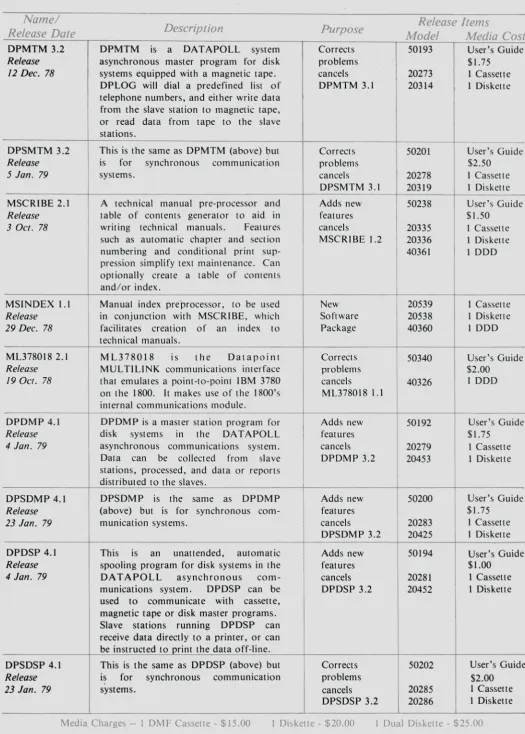
DPMTM 3.2 Release 12 Dec. 78
DPSMTM 3.2 Release 5 Jan. 79
MSCRIBE 2.1 Release
3 Oct. 78
MSINDEX 1.1 Release
29 Dec. 78
ML378018 2.1 Release
19 Oct. 78
DPDMP 4.1
Release
4 Jan. 79
DPSDMP 4.1 Release
23 Jan. 79
DPDSP 4.1
Release 4 Jan. 79
DPSDSP 4.1 Release
23
Jan. 79Description
DPMTM is a DAT APOLL system
asynchronous master program for disk
systems equipped with a magnetic tape. DPLOG will dial a predefined list of telephone numbers, and either write data
from the slave station to magnetic tape,
or read data from tape to the slave
stations.
This is the same as DPMTM (above) but
is for synchronous communication
systems.
A technical manual pre-processor and
table of contents generator to aid in
writing technical manuals. Features
such as automatic chapter and section
numbering and conditional print s
up-pression simplify text maintenance. Can
optionally create a table of contents
and/or index.
Manual index preprocessor, to be used
in conjunction with MSCRIBE, which
facilitates creation of an index to
technical manuals.
ML378018 is the Datapoint
MUL TILiNK communications interface
that emulates a point-to-point IBM 3780
on the 1800. It makes use of the 1800's
internal communications module.
DPDMP is a master station program for
disk systems in the OAT APOLL
asynchronous communications system.
Data can be collected from slave
stations, processed, and data or reports
distributed to the slaves.
DPSDMP is the same as DPDMP
(above) but IS for synchronous
com-munication systems.
This is an unattended, automatic
spooling program for disk systems in the
DATAPOLL asynchronous
com-munications system. DPDSP can be
used to communicate with cassette,
magnetic tape or disk master programs. Slave stations running DPDSP can receive data directly to a printer, or can
be instructed to print the data off-line.
This is the same as DPDSP (above) but
is for synchronous communication
systems.
Purpose
Corrects
problems
cancels DPMTM 3.1
Corrects
problems
cancels
DPSMTM 3.1
Adds new
features
cancels
MSCRIBE 1.2
New Software Package Corrects problems cancels
ML378018 1.1
Adds new features cancels DPDMP 3.2
Adds new
features
cancels DPSDMP 3.2
Adds new
features cancels DPDSP 3.2
Corrects problems cancels DPSDSP 3.2
Release Items
Model
Media Cost
50193 20273 20314 50201 20278 20319 50238 20335 20336 40361 20539 20538 40360 50340 40326 50192 20279 20453 50200 20283 20425 50194 20281 20452 50202 20285 20286
User's Guide
$1.75
I Cassette
1 Diskette
User's Guide
$2.50
1 Cassette
1 Diskette
User's Guide
$1.50
I Cassette
1 Diskette
1 DOD
I Cassette
1 Diskette
1 DOD
User's Guide
$2.00 I DOD
User's Guide
$1.75
1 Cassette
I Diskette
User's Guide
$1.75
I Cassette
1 Diskette
User's Guide
$1.00 1 Cassette 1 Diskette
User's Guide
$2.00
1 Cassette
1 Diskette
[image:18.614.44.569.31.764.2]Beware -
the
Silent Enemy!
,
~
'
<;":
c-.
: ' .11'··:1
~·
..
·
r
··:·
·:
·
:
···:
•··:
···
, . ,,;,.
.
" ..
. .: : . ..: : ... -. ':