UGC Approved Sr. No.49366, NOV-DEC 2017, VOL- 4/37
Copyright © 2017, Scholarly Research Journal for Interdisciplinary Studies
APPLICATION OF MAXIMS OF TEACHING IN TEACHER EDUCATION PROGRAMME WITH SPECIAL REFERENCE TO INDIAN TEACHER EDUCATION SCENARIO
Rajeev Kaushal
Assistant Professor (Dept. of Education), Gagan College of Management & Technology, Aligarh
The sole purpose of psychological principles of teaching is to make the process of teaching-learning interesting and maximize learning. These principles are better known as maxims of teaching and have always stood the test of time. Though these maxims are universally accepted in macrocosm of education, these are an integral part of teacher education programme wherein the teacher educators are mandatorily required to acquaint and equip the prospective teachers with the essentials and techniques of pragmatic use of teaching maxims in real life classroom situations. It is, however, a matter of pity that these maxims are either partially or totally neglected in the current scenario of Indian teacher education programme. The teacher educators don't themselves employ these maxims in their teaching, let alone their knowledge, comprehension and application on the part of prospective teachers. The present paper throws light on the psychological principles of teaching better known as maxims of teaching and their practical application in the field of teacher education programme besides giving valuable suggestions pertaining to developing favorable attitude of teachers, teacher educators and prospective teachers towards these maxims.
Keywords: Maxims, Prospective teachers, Teacher education, Teacher educators,
Introduction
“Teaching is defined as an interactive process primarily involving classroom talk which takes place between teacher and pupil and occurs during certain definable activity.”
-Edmund Amidon “Teaching process is designed and performed to produce change in student behavior.”
-Clarke “Teaching is an intimate contact between a more mature personality and a less mature one which is designed to further the education of the latter.”
-Morrison “Teaching is concerned with the activities which are concerned with the guidance or direction of learning of others.”
-Ryan
Copyright © 2017, Scholarly Research Journal for Interdisciplinary Studies
Teaching is considered a part of learning. The culmination of all teaching processes really
worth the name is learning. Teaching is an external enterprise while learning is a mental
activity. The primary motive of use of maxims of teaching is the enhancement of quality of
learning. Teaching maxims play an important role in making learning stable and permanent.
According to Bernard,“In teaching-learning process, teachers and students encourage learning.” In fact, teaching is a task and learning is an achievement. Learning objectives can be realized by properly organizing teaching skillfully, effectively and carefully.
Maxims of teaching
The role of the teacher is considered main in the classroom. He is responsible for creating
such an ambience as gives rise to maximum learning activities and various experiences may
be achieved. But, practically, it is not as convenient as it looks. However talented, scholarly
and able a teacher may be, he would be considered unsuccessful if he or she is unable to
transfer learning to students. Teaching is an art which encompasses the following:
Mastery over subject
Scientific knowledge of teaching style for transfer of knowledge to pupils
In order to achieve this objective, teacher’s subject knowledge is not the only factor which is
required. In addition to this, the teacher should know some maxims with the help of which
the teacher may present the subject matter before the students effectively as well as
efficiently. The meaning of maxims of teaching is very simple. Those general ideas and methods of doing the work which prove helpful in the task of teaching are termed as maxims of teaching. These maxims have been formulated by the psychologists, educationists,
pedagogues and preceptors on the basis of their experiences. These maxims are reliable and
are universally applicable. Different maxims of teaching are applied in different teaching
situations on the basis of well-planned strategy and logic. Maxims of teaching act as the
springboard which catalyzes the momentum of teaching-learning process and thus helps the
teacher in achieving the pre-determined objectives of education besides providing
contentment to both the learners as well as the teacher.
A glimpse of prominent maxims of teaching
1. From Known to Unknown - This maxim states that the new knowledge to be given to pupils must be logically linked with their previous knowledge. This maxim facilitates
learning process and economizes the efforts of the teacher and the taught. It won’t be an
exaggeration to say that this maxim is an indispensable part of teaching-learning process.
Copyright © 2017, Scholarly Research Journal for Interdisciplinary Studies
that we interpret new things we perceive on the basis of similar things perceived earlier by us.
This roughly corresponds to Analogy and is also the heart and soul of Analytical method of teaching. This maxim is the part and parcel of set induction skill (lesson introduction skill). This maxim can be made use of in following:
It can also be employed in instillation of moral values in prospective teachers. Let’s take a look at a very famous thought in the figure below:
Some applications of 'From Known to Unknown' in Teacher Education
• Lesson Introduction skill • Teaching of Pedagogy • Assessment of Personality • Pedagogical analysis of lessons • Pedagogical analysis of text books • Flander's Interaction analysis
• Teaching the basics of Normal Probability Curve
The beauty of a waterfall lies in its ability to keep flowing.
(KNOWN)
The true beauty of knowledge lies in its ability to be tranferred from
one being to another and so on. (Transfer of knowledge)
Copyright © 2017, Scholarly Research Journal for Interdisciplinary Studies
In The Bhagvad Gita, Lord Krishna enlightens Arjuna by employing this very maxim. This maxim is frequently used by pupil-teachers during their pre-service training in their
lessons to be delivered by them in their teaching subjects. The skill of Lesson Introduction is
based on this very maxim.
2. From Simple to Complex - This maxim states that difficulty should follow ease in teaching. Alternatively, the teacher should start with simple thing and proceed to difficult one
in a logical, systematic and step wise manner. The skillful application of this maxim proves
to be advantageous in teaching of all subjects. Q1. Name some eminent Greek philosophers. A1. Socrates, Plato, Aristotle, etc.
(The teacher educator writes the following quotes on board (or projects the following quotes) and asks the requisite questions that follow these quotes.)
"Knowledge is the food of the soul."
(Quote by Plato) "All men by nature desire knowledge."
(Quote by Aristotle)
"Prefer knowledge to wealth, for the one is transitory, the other perpetual."
(Quote by Socrates) Q2. What has been described as the food of the soul by Plato?
A2. Knowledge.
Q3. According to Aristotle, what do all men desire by nature? A3. Knowledge.
Q4. What is being described as perpetual by Socrates? A4. Knowledge.
Now the teacher educator can ask the following problematic question(s):
Q5. What do we call a person who has an incessant desire for gaining knowledge?
OR
What do you understand by the word 'Philosophy'?
Statement of aim - So, dear pupil-teachers, today we shall study about Philosophy and its basics.
Copyright © 2017, Scholarly Research Journal for Interdisciplinary Studies
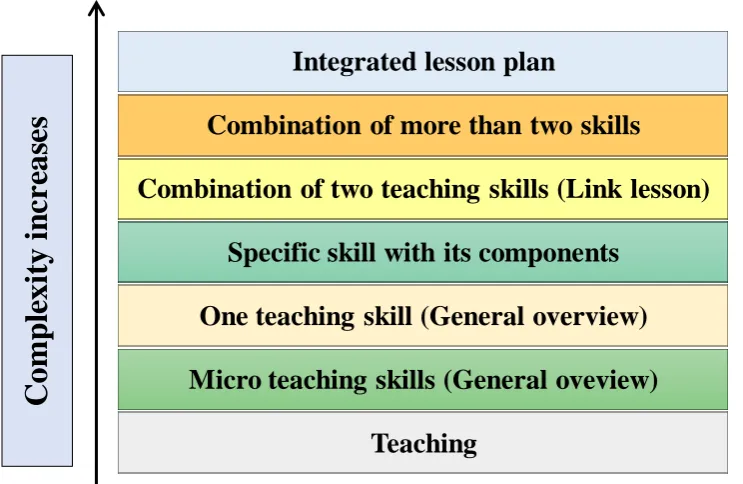
FIGURE 1: APPLICATION OF ‘FROM SIMPLE TO COMPLEX’ IN TEACHING LESSON PLANThe maxim 'From Simple to Complex' in association with another maxim 'From Psychological to Logical' can work wonders for research scholars too as it is not necessary that each and every student who undertakes research work is well acquainted with the essentials of research methodology.
Workshops (based on this maxim) should be organized for research scholars so that they get well
acquainted with the basics of research. It has been observed that student find 'Formulation of Research
design' and 'Statistical interpretation of data' a Herculean task, especially those who are from Arts
background or those who are not comfortable with mathematics or data analysis. It is here when this
[image:5.595.116.488.92.334.2]maxim can prove to be boon for such students as well as others too.
FIGURE 2: APPLICATION OF ‘FROM SIMPLE TO COMPLEX’ (BLOOM’S TAXONOMY)
Integrated lesson plan
Combination of more than two skills
Combination of two teaching skills (Link lesson)
Specific skill with its components
One teaching skill (General overview)
Micro teaching skills (General oveview)
Teaching
Writing learning objectives for Lesson plan
Writing learning objectives (level wise)
Action verbs associated with each specific level
Specific level of Specific Domain (step-by-step)
Specific Domain (in detail)
Bloom's Taxonomy of Educational objectives
Aims & Objectives
C
o
mpl
ex
it
y
i
n
cr
ea
se
s
C
o
mpl
ex
it
y
i
n
cr
ea
se
[image:5.595.43.517.447.747.2]Copyright © 2017, Scholarly Research Journal for Interdisciplinary Studies
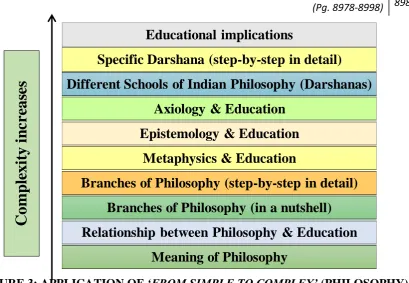
FIGURE 3: APPLICATION OF ‘FROM SIMPLE TO COMPLEX’ (PHILOSOPHY)
If teachers start with complicated problem, it is possible that 70-80% of students may not be
able to understand and answer it. Therefore they will lose their heart, confidence and interest
in study. Teacher has to be careful in deciding about simpler part too. What is simple in
teacher’s view is not necessarily simple for students. It can be vice-versa too. Thus, keeping
in view students ability, attitude, potentiality and interest, simple tasks should be fixed. This
maxim should also be coupled with another maxims viz. 'From Whole to Part','From Analysis to Synthesis' and other maxims as per the felt need.
Educational implications
Specific Darshana (step-by-step in detail)
Different Schools of Indian Philosophy (Darshanas)
Axiology & Education
Epistemology & Education
Metaphysics & Education
Branches of Philosophy (step-by-step in detail)
Branches of Philosophy (in a nutshell)
Relationship between Philosophy & Education
Meaning of Philosophy
From 'Whole to Part', 'From Simple to Complex', 'From Analysis to Synthesis':
Test (Introduction)
Different types of tests (General overview)
Specific test and its subtypes (in detail) with merits and demerits
Measurement (Introduction) Measurement in Education Scales of Measurement (General overview) Specific scale in detail Applications of different scales
Evaluation (Introduction) Evaluation in Education
Types of Evaluation (General overview) Specific type of Evaluation (in detail)
Interrelationship between Test, Measurement and Evaluation (From Analysis to Synthesis)
C
o
mpl
ex
it
y
i
n
cr
ea
se
Copyright © 2017, Scholarly Research Journal for Interdisciplinary Studies
3. From Concrete to Abstract
1. Is the maxim (in question) feasible for the topic to be taught?
2. Where could the maxim be logically employed?
3. How can the maxim be employed?
The above questions hold good for all the other maxims of teaching also. In fact, the degree
of effectiveness and success of teaching maxim(s) depends on teacher's knack of applying the
maxim(s). At times, it is the 'Rule of thumb' that determines the strategy of employing maxims in teaching.Application of this maxim helps the learners understand the materials
more easily. Some power of imagination also develops in them.
Copyright © 2017, Scholarly Research Journal for Interdisciplinary Studies
The teacher-educator ought to make the prospective-teachers realize the significance of this
very maxim in teaching-learning process as in need and significance of using different types of
teaching aids, need and significance of live / virtual demonstration, need and significance of
visual illustration (LCD projection, multimedia, charts, pictures, specimens, models, science
kit, mathematics kit, etc.), need and significance of laboratory visit and work, need and
significance of direct experience.
An able and skilled teacher educator can employ this maxim of teaching in the following:
• Live demonstration of different teaching skills before pupil-teachers • Such concepts as MS-Office basics (using projection method) • Making use of appealing and apt teaching aids as and when required
• Demonstration of apparatus and instruments used in Psychology laboratory, Science laboratory, Mathematics laboratory, ICT laboratory, Art and craft laboratory, etc.
• Various activities based on Psychomotor domain • Illustration of complex topics
• Teaching of such teaching skills as Demonstration / Illustration / Blackboard writing / Stimulus variation, etc.
• Preparation of Objective type tests (different types of objective question)
• Preparation of Test Blue print (preferably projection method viz. Power Point presentation)
• Observation of teaching skill being demonstrated by the teacher educator
• Observation of skill of using teaching aid (being demonstrated)
CONCRETE
• Consequent change in behaviour of pupil-teacher
• Engram (memory)
• Consequent change in attitude
Copyright © 2017, Scholarly Research Journal for Interdisciplinary Studies
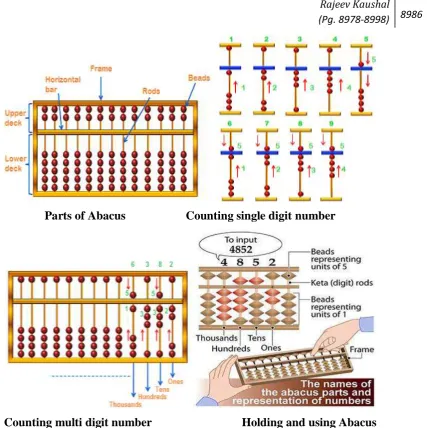
Parts of Abacus Counting single digit number
[image:9.595.107.535.52.481.2]Counting multi digit number Holding and using Abacus
FIGURE 4: COUNTING BY USING ABACUS (FROM CONCRETE TO ABSTRACT)
The teacher educators and in-service teachers should themselves realize as well as make the
prospective teachers realize too that methodologies have become revolutionized by increasing
and imaginative use of various appealing audio-visual aids most of which are electronic and
have now caught the attention of the students and the teachers.
4. From Analysis to Synthesis - This maxim states that the difficult or complex topic or subject matter be logically and systematically broken into different components. (This maxim
is also known as 'from Part to Whole'.) Analysis means breaking something into individual
elements. Synthesis is just reverse of Analysis. It means joining the individual elements into
one whole. In other words, in analysis, the subject is broken into its components or elements
while in synthesis, the scattered elements of the subject are collected and the clarification of
these elements is logically presented. In fact, these two are an integral part of Cognitive
Copyright © 2017, Scholarly Research Journal for Interdisciplinary Studies
use of this maxim in their own teaching as well as motivate and aid pupil teachers make use
of it in their practice teaching too. The teacher educators ought to scaffold neophytes in this
pursuit. The complex topics or subjects need to be taught in a logical and systematic manner
with the help of this maxim. (Formulation of objectives, hypothesis or hypotheses on the basis of the rough and systematic analysis of research problem in question.)This maxim is quintessential of science and mathematics. It can, however, be made use of in other subjects
too viz. economics, commerce, geography, political science, etc. In the field of teacher
education this very maxim can be employed in such areas as:
Some applications of 'From Analysis to Synthesis' in the field of Teacher Education
• Writing specific objectives in behavioral terms • Preparation of macro lesson plan
• Preparation of plan based on micro teaching skills
• Statistical interpretation of data (Psychological tests, Dissertation work) • Educational measurement & evaluation
• Research methodology • Doctoral research work
• Preparation of objective type test
• Pedagogical analysis of text book, pedagogical analysis of lesson(s) • Writing Bibliography (APA, MLA styles)
Analysis of merits of various Western philosophies
(Idealism, Naturalism, Realism, Pragmatism) --->ANALYSIS
ECLECTICISM( Drawing useful ideas from different Western philosophies)
Copyright © 2017, Scholarly Research Journal for Interdisciplinary Studies • Selection of Topic
• Selection of Content
• Selection of Educational objectives
• Selection of teaching aid(s)
• Selection of Teaching method(s)
• Selection of types of questions for evaluation of students
ANALYSIS
•
LESSON PLAN
• Framing of Introductory questions
• Formulation of teaching points
• Framing of Developmentary questions, Comprehension questions,
• Framing of Recapitulatory questions
SYNTHESIS
Statistical interpretation of data
(Dissertation work, Psychological tests)
(ANALYSIS)
Result & Findings (Thesis)
(SYNTHESIS)
Selection of ACTION VERBS (Domains of learning)
(ANALYSIS)
Writing learning objectives in BEHAVIOURAL TERMS
(SYNTHESIS)
Selection of content Selection of type(s) of questions
Selection of teaching points Selection of teaching aid(s)
(ANALYSIS)
Construction of Achievement test Preparation of Test Blue print
Copyright © 2017, Scholarly Research Journal for Interdisciplinary Studies
5. From Psychological to Logical - As regards the realm of Educational Psychology, the cynosure is the child or the learner. The entire teaching-learning process is planned and
[image:12.595.77.343.265.517.2]organized on the basis of interests, abilities, capacities, etc. of the learner.
FIGURE 5: QUOTE BY AUTHOR OF PRESENT RESEARCH PAPER
Similarly, the teacher educator should systematically and logically deal with such topics as
measures of central tendency, measures of dispersion or variability before dealing with
Normal Probability Curve (at post-graduation level).
Selection of content Selection of type(s) of questions Selection of evaluation objectives
Weightage of test items
(ANALYSIS)
Construction of Achievement test Preparation of Test Blue print
Scoring key
(SYNTHESIS)
Copyright © 2017, Scholarly Research Journal for Interdisciplinary Studies
6. From Actual to Representative - Teaching is more effective when the teacher displays actual teaching aids instead of artificial ones before the pupils in the classroom. Researches
have shown that the natural teaching material has more influence in the teaching process
instead of artificial one. So, as far as possible, the teacher should make use of this maxim in
teaching-learning process. It is not that this maxim should be blindly resorted to. The teacher
should use logic to apply this maxim. The teacher educators can employ this maxim in
teaching such topics as:
It won't be an exaggeration to say that in the current scenario of teacher education in India,
various Psychological tests are not actually performed by pupil-teachers. They never ever get
the opportunity to get a first-hand (direct) experience of various apparatuses, instruments and
concrete entities that are an indispensable part of Psychology laboratory. The pupil-teachers
are either made to copy written matter verbatim without any knowledge and comprehension In the same way, the teacher educator can deal with the topic 'Research' by logically and systematically presenting such topics as:
• What is Research? • Essentials of research
• Types of research (general overview of different bases of classification) -Fundamental, Applied, Action
• Qualitative and Quantitative
• Historical, Descriptive, Experimental, Ex-post facto • Types of research (one by one in detail)
• Difference between research methodology and research method • What is a research design?
• Types of research design
• The topic 'Sampling' can also be taught in a similar fashion
What is Multimedia?
(By Projecting Any Educational film or animated moral stories or anecdotes of any legend on the screen.)
What is Smart Classroom?(Demonstrating the use of Smart board) Showing the various essentials of a smart classroom.
What is Virtual classroom?
Copyright © 2017, Scholarly Research Journal for Interdisciplinary Studies
of the test under question or they are given haphazard knowledge of these tests. The teacher
educators ought to make the pupil-teachers visit Psychology laboratory on a periodical basis
and get first-hand experience of various instruments and concrete stuff prior to completing
their requisite practical work. For example:
Likewise, the pupil-teachers must be shown different verbal and non-verbal tests (in original).
The teacher educators ought to make use of similar strategy in case of other such labs as
science laboratory, mathematics laboratory, social science laboratory, language laboratory,
music lab, art & craft lab, etc.
The teacher educators must also properly train the pupil-teachers in the use of this very
maxim as regards their teaching subjects.
7. From Empirical to Rational - It means that the empirical knowledge of a student should be made rational so that it becomes true and definite. (It may be recalled here that empirical
knowledge is the one which a learner receives by observation.) If we study and analyze the
definitions of learning, we will come to know that the changes in human behavior through
experiences are termed as learning. The experiences contribute especially in the learning
process. The pupil learns through observation and experience and consequently acquires
substantial knowledge. The teacher can employ this maxim especially in teaching of
mathematics and sciences. In simple words, the ability to know something, to learn and verify
it is acquired first and the ability to interpret it on the basis of logic or reasoning develops
afterwards.
The pupil-teachers must be given proper training in the effective use of this maxim by teacher
educators. This maxim can be made use of by teacher educators in demonstration of micro
teaching skills whereby pupil-teachers observe and note the different teaching skills being
demonstrated by the teacher educators whereby the pupil-teachers get to know and
comprehend the essentials of various teaching skills and make use of this empirical
knowledge in evaluation of peer-teaching (analysis and interpretation of peer-teachers on the
basis of logic i.e. rational knowledge) - Mirror Drawing apparatus
- Maze Leaning Electrical apparatus - Memory Drum Hand Operated Apparatus - Finger Dexterity Board Apparatus with pins
Copyright © 2017, Scholarly Research Journal for Interdisciplinary Studies
Disquisition
Methods vary from subject to subject, from topic to topic and from teacher to teacher. An
adequate knowledge and practice of vital principles of teaching methods and learning theories
can help the teachers to improve their performance in classrooms.
Some noteworthy suggestions for teachers and teacher educators
1. The teacher educators must make use of a balanced blend of different maxims of teaching
in their own teaching. They ought to serve as role models who inspire their students
(prospective teachers) to deliberately follow in their footsteps and imitate their behavior. P.C. Wren aptly remarks, "As is the teacher, so are pupils."
Copyright © 2017, Scholarly Research Journal for Interdisciplinary Studies
2. In keeping with the essence of the adage, 'two heads are better than one', the teacher
educators should resort to mutual reciprocation in discussing about how to best employ these
maxims of teaching in their own teaching subjects.
3. Orientation programmes and workshops should be organized from time to time on how to
effectively and efficiently employ maxims of teaching in teacher education programme and
practice teaching for both teacher educators and prospective teachers.
4. The teacher educators need to scaffold their students regarding the use of teaching maxims
in different ways. Thorndike's laws of learning should be kept in consideration.
5. The teacher educators ought to develop a favorable attitude towards the need, significance
and use of teaching maxims. Unless the teacher educators realize the value of maxims of
teaching, they won't be able to instill the spirit of the same in prospective teachers. They must
motivate prospective teachers in using the different maxims of teaching in their teaching
subjects.
6. Sample or model lesson plans should be developed by respective teacher educators on the
use of various maxims of teaching pertaining to different topics such as:
(Step by step Demonstration of basics PowerPoint presentation, Making prospective teachers
visit ICT lab and have direct experience of working with MS- PowerPoint, Giving Simple
assignments to be prepared by using PowerPoint presentation software viz. Inserting text box
on a slide and edit font color, size and type as desired, Inserting Animation and Transition,
Inserting images on a slide, Making use of Smart art, etc. Once these basics are mastered,
Complexity of assignment should be gradually increased viz. Using a single slide, animate
introductory questions on any topic of your choice in your teaching subjects, now complexity
should further be increased as in 'assignment on preparation of lesson plan using
MS-PowerPoint (The teacher educator must properly demonstrate all these before the students
step by step by making use of Projection method prior to giving the aforementioned
assignments and the like).
• From known to unknown(Lesson Introduction skill) • From inductive to deductive(Explanation skill)
• From concrete to abstract(Illustration skill, Teaching aids, Stimulus variation skill) • From analysis to synthesis(Flander’s Interaction analysis, Writing learning objectives in
behavioral terms, preparation of test blue print, components of micro teaching skills, components of lesson plan)
Copyright © 2017, Scholarly Research Journal for Interdisciplinary Studies
7. It is a misconception that maxims of teaching fall under the purview of teacher education
programme only. In fact, maxims of teaching are psychological principles of teaching that
have a universal appeal, be it any field. Regrettably, if these maxims are ever employed, these
remain confined to the field of teacher education only. These are hardly made use of by
teachers in disciplines other than education. It won't be an exaggeration to say that a majority
of teachers today have no cognizance of principles and maxims of teaching. Those who do,
hardly take cognizance of these on a pragmatic basis. It must be borne in mind that mere
acquisition of degrees or awards does not necessarily guarantee the acquisition of art and
skills of teaching. For doing away with this misconception and negligence, isolation between
education department and other departments needs to be removed. National level workshops
on effective and efficient use of teaching maxims should be organized from time to time in
Education department, resulting in broadening the pedagogical horizon of teachers from
different disciplines. Besides this, such workshops in other departments too should be in
cooperation with teacher education department.
8. As far as possible, the teacher educators should throw light on the maxim of teaching being
employed by him or her in the classroom so that the prospective teachers get an idea of the
underlying rationale. For example,
9. The teacher educators should teach a good number of topics to the prospective teachers in
their respective teaching subjects by making use of maxims of teaching and the former must
ask the latter to prepare lesson plans on different topics employing the different maxims of
teaching in a logical manner. The teacher educators ought to hold discussion sessions with
their students regarding this move and must be a friend, philosopher and guide to them.
"I hear, I forget.
I see, I remember.
I do, I know."
Some applications of various teaching maxims
• Demonstration method (From Concrete to Abstract) • Laboratory method (From Concrete to Abstract) • Lesson Introduction skill (From Known to Unknown) • Illustration skill (From Concrete to Abstract)
Copyright © 2017, Scholarly Research Journal for Interdisciplinary Studies
- Confucius
10. It must be borne in mind that the practical application of maxims of teaching is a science
as well as an art. The use of teaching maxim(s) depends on the nature of subjects being
taught. It is not that each and every maxim can be applied in all subjects at all times. The
preceptor needs to work on the analysis, selection and strategy prior to employing maxims of
teaching in his or her teaching. This ought to be done during Pre-active phase of teaching.
Some of the teaching maxims may not be made use of at all.These maxims of teaching are
not mutually exclusive. These usually remain amalgamated in some way or the other
(mutually inclusive).
For example:In writing Book review on the basis of pedagogical analysis of a text book, following maxims are become mutually inclusive.
From Known to Unknown
From Analysis to Synthesis
From Empirical to Rational
11. The teacher educators should make use of the maxim 'From Analysis to Synthesis' in devising teaching strategies during Pre-active phase of teaching.
12. The teacher educators should make use of essentials of Behavioral technology to bring
about desirable changes in the behavior of pupil-teachers. (Behavioral technology states that teachers are not always inborn, they can be trained through training and effective teachers can be produced.) It is definitely more useful in teacher-education programme. This technology does take into consideration the individual differences of pupil-teachers.
13. The teacher educators should also make use essentials of teaching technology. The prime aim of this technology is to make classroom teaching purposeful and effective. Not only
pupil-teachers but also in-service teachers can be benefitted from this very technology. With
the help of this technology, the teaching process can be organized from memory level to
reflective level. A good rapport between teacher and taught is essential.
14. In tune with Thorndike's laws of learning, pupil-teachers should be motivated to apply
various maxims of teaching during their practice teaching session (Law of readiness). They
must be given a good number of opportunities for ample practice under proper guidance and
supervision (Law of exercise). Constructive feedback and reinforcement should be given by
teacher educators as and when required. Care must be taken that the pupil-teachers (in-service
teachers too) achieve satisfaction and pleasant experience both during theoretical and practice
Copyright © 2017, Scholarly Research Journal for Interdisciplinary Studies
the day (Law of effect). In addition to these laws, Bloom's taxonomy of Educational
objectives should also be kept in consideration, especially cognitive as well as affective
domain.
15. During initial stages, processing and not product should be emphasized; accuracy and not
speed should be emphasized.
Conclusion
Teaching is inspiring the learner to learn, the learner being a child or a pupil-teacher or an
in-service teacher or an adult. It is a dignified profession that demands proficiency and it is
mandatory for every teacher to acquire this ability. Teaching is a form of social service which
aims at bringing a reform in the behavior of the student who in turns reforms the society.
Teachers are the makers of destiny of a nation. They are considered as role models for their
students. It is but natural for a learner to imitate its teacher. Pupil-teachers are none other than
learners. They are mature minds who resort to observational and imitational learning. The
attitude and demeanor of teachers or teacher educators undoubtedly leave an indelible
impression on the minds of prospective teachers. It is, therefore, the moral duty of teachers
and teacher educators to make every sincere endeavor to bring about positive and fruitful
desirable changes in the behavior of their students (pupil-teachers). Mere dictation of notes or
allocation of bland and drab assignments to be completed by the pupil-teachers amount to
nothing valuable but an exercise in futility. These do not fall under the purview of real and
effective teaching and learning. What is the use of such learning which is not effectively and
efficiently transferred to those whom it is really meant for? Sustainability of learning is an
index of its effectiveness. It is the ability to recollect, recall and apply the skills at appropriate
time and place. P.C. Wren aptly remarks, "As is the teacher so are pupils." Unless the in-service teachers, prospective teachers, teacher-educators, educational administrators are
themselves equipped with teaching skills, art of use of maxims of teaching, they won't be able
Copyright © 2017, Scholarly Research Journal for Interdisciplinary Studies
remarks “Without good teachers, even the best of system is bound to fail. With good teachers, even the defects of system can be largely overcome.” So the teacher is of paramount importance in any system of education. They play a pivotal role in the development of
education system as a whole. Enlightened, emancipated and empowered teachers lead
communities and nations in their march towards better and higher quality of life. They are
responsible for acculturating the role of education. It is no denying the fact that teaching is a
science as well as an art. The various maxims of teaching tantamount to what is known as
science of teaching whereas the strategies, techniques, skills and tactics employed by the
teacher to make use of these maxims in an effective as well as efficient manner pertain to
what is known as art of teaching. The tenets, working rules or general truths through which
teaching becomes interesting, easy and effective are called the maxims of teaching. They
have universal significance. Every person who is expected to enter into the teaching
profession has to familiarize himself with the maxims of teaching. Their knowledge helps
[image:20.595.155.436.373.613.2]him to proceed systematically.
FIGURE 6: QUOTE BY AUTHOR OF PRESENT RESEARCH PAPER
But it is to be reiterated here that simply mugging up these maxims is a child's play while
practical application of these is a Herculean task. What maxim(s) a teacher practically
uses/use is science but how skillfully is or are these maxims used is really an art. The various
maxims of teaching are universal and therefore must not remain confined to school education
Copyright © 2017, Scholarly Research Journal for Interdisciplinary Studies
to the field of education. A real teacher is the one who keeps the spirit of true philosophy
alive forever and in tune with the same keeps philosophizing on the ways of improving his or
her pedagogy. The teacher (be it a teacher educator or an in-service teacher or pupil-teacher)
ought to be an ever-learning one in concomitance with the following dictum that captures the
real essence of philosophy:
‘Never stop learning because learning never stops’
Education Commission (1964-66) had rightly said, “A sound programme of professional education of teachers is essential for the qualitative improvement of education. Investment in teacher education can yield very rich dividends because the financial resources required are small when measured against the resulting improvements in the education of millions. ” The author of the present paper earnestly hopes that this paper appeals to the teacher
educators and motivates them to employ the teaching maxims in their own teaching as well as
encourage, aid and constructively supervise the prospective teachers as well to make use of
these maxims (as is being done by the author). We must be the epitome of change we want to
see in others.
References
Agrawal, J.C. & Kulshreshtha, S.P. (2015).Educational Technology & Computer instructions. Agra: Agrawal Publications.
Chaube, S.P. (2010). History and problems of Indian education.10th edition.Agra :Agrawal Publications.
Chauhan, C. P. S. (2010). Modern Indian Education: Policies, Progress and Problems. New Delhi :Kanishka Publishers.
Jamwal, B.S. (2012). Teacher Education: Issues and their Remedies. International Journal of Educational Planning & Administration.ISSN 2249-3093 Volume 2, Number 2 (2012).
Kumari, S. (2005).Increasing role of technology in education. Delhi: Isha Books.
Lal, R. B. & Sinha, G.N. (2014).Development of Indian Education and its problems.Meerut :R.Lall Book Depot.
Maisnam, P., Lenka, S. K. & Gandhi, A.K. (2016).Understanding disciplines & subjects. Meerut: R. Lall Book Depot.