MAY-JUNE 2014, VOL. II, ISSUE-XII www.srjis.com Page 1607 A DIGITAL EDUCATION REVOLUTION
Ramarcha Prasad Pandey, Ph. D.
Principal J.P. College of Education, Rewa (MP)
Introduction:
To have the best job and life opportunities in the future, Indian students must receive a world
class education today. A world class education system requires significant government and
private investment, quality subjects to study, well-trained and dedicated teachers, and the best
classroom facilities such as computers, laboratories and workshops. In coming years, a
critical component of a world class education system in India will be having computers on
every desk and having access to reliable, high speed broadband. This digital infrastructure
will provide closer links between schools, teachers, students and parents, and help realise the
true potential of e-education and internet-based learning. It will change the way teachers
teach, and the way students learn. E-education applications are currently being developed at a
frenetic pace. While the most innovative educational tools have probably not yet been
thought of, few doubt the potential of computers and broadband to revolutionise the
classroom. While e-education is in its infancy, the potential of computers and broadband is
clear: Standard professional applications such as word processing and spreadsheets have
significant classroom applications such as essay and letter writing, interpreting statistics and
learning practical financial skills. Technical subjects such as woodwork and industrial design
have been transformed through the use of computer aided design software. Quality online
content can enhance student learning, such as through virtual tours of museums for art and
science classes and e-books for those not available at the school library or local library.
Online communication across great distances, such as interaction with overseas students for
foreign language classes, and web chats with subject experts such as business people,
academics and scientists. This document outlines the educational applications of computers
MAY-JUNE 2014, VOL. II, ISSUE-XII www.srjis.com Page 1608 Digital Education:
Those Indian schools are able to provide students with the tools they will need to live and
work in a world shaped by technological change. Computers and broadband are critical
enabling technologies that are driving substantial productivity gains around the world.
Computers and broadband will not only increase efficiency, help reduce costs and create new
markets for Indian business. They also have the potential to transform the way our schools
operate in the future for the better.
Computers: The toolbox of the 21st century
Whichever industry, trade, skill or profession they work in, India‟s children will need to be
equipped for computer applications such as word processing, spreadsheets, and making
presentations. These are the basic skills of the 21st century.
“An effective use of ICT in schools can have an immediate positive impact on the schools‟
learning environments, for example by: creating more dynamic interaction between students
and teachers, increasing collaboration and team work in problem-solving activities,
stimulating creativity in both students and teachers, and helping students to control and
monitor their own learning…Further, a successful use of ICT in schools can help students to
develop skills, both specific to ICT and more generally, that will be useful for them in their
future academic and professional lives.” „Are students ready for a technology-rich world?‟,
OECD 2006 Computers will enhance the learning experience of every high school student in
the country, giving them the tools they need to engage more effectively in the classroom and
with the world. There are a broad range of applications for computers in our schools, from
basic applications such as spreadsheets to help teach practical financial skills, to
supplementing a trades education with skills in computer aided technical design.
MAY-JUNE 2014, VOL. II, ISSUE-XII www.srjis.com Page 1609 Students with better access to technology can receive a stronger education and achieve better
academic performance. The OECD has found that in Australia, along with 14 other OECD
countries (out of 29 surveyed) there is a strong relationship between students who have used
computers for several years and performance in mathematics. This shows that the use of
computers at school should not be seen as recreational relief from studying, but instead as
being crucial to helping students to learn. Australia‟s overall use of computers in schools
ranks well amongst other developed economies. Nevertheless, there is room for improvement
both in the accessibility and sophistication of computer use in the classroom –
34 per cent of students are in schools where principals report that instruction is hindered by a
shortage of computers.
The computer skills that our children will gain from their school education will be invaluable
to help them secure their future jobs. ICT skills are not just necessary for jobs in
programming and systems maintenance – they are critical to well-paid jobs across all
industries, in agriculture, mining, manufacturing and services. Examples of applications of
computers in some industries that our children will work include:
In agriculture, through the use of „virtual farming‟ for operations such as remotely
monitoring the health and security of livestock; remote measuring of temperature,
MAY-JUNE 2014, VOL. II, ISSUE-XII www.srjis.com Page 1610
In mining, ICT applications are used for stockpile management, logistics, ore body
evaluation, blast and mine design, mineral sampling and quality analysis, and seismic
monitoring and geologic sensing.
In manufacturing, applications used to boost productivity include incorporation of
(computerised) numerical controllers into machines, robotics, and local area
communication and control networks in factories.
In service businesses, computers are used by architects transmitting fully rendered 3D
models of buildings, by engineers transmitting geo-spatial models, and by doctors
examining data intensive patient test results.
It is critical that India increases the accessibility of computers in schools and improves how
they are used to maximise their benefit in the classroom.
Broadband: plugging into the digital revolution
Access to world class broadband will revolutionise classroom education and enable students
to engage more effectively with the resources from around the world.
The full potential of broadband in schools can only be realised through reliable, high speed
and affordable broadband services. The potential of high speed broadband connections is
already clear, with the development of:
Video conferencing for distance education, which will provide better opportunities for
students in regional and rural areas, and give all students a greater range of subject
choice.
Quality online content that enhances student learning, such as virtual tours of
museums for art and science classes, e-books for those not available at the school or
local library, and access to the latest news and current affairs.
Online communication across great distances, such as interaction with overseas
students for foreign language classes, and web chats with subject experts such as
business people, academics and scientists.
High speed broadband will also mean that Australian students have access to world class
infrastructure that is the „tool of the trade‟ for jobs of the future in computing, information
studies, engineering, and across the sciences. If Indian students cannot access broadband of
the same speed or quality as students in other countries, they may struggle to compete in the
labour market against better trained students from overseas for the most highly paid,
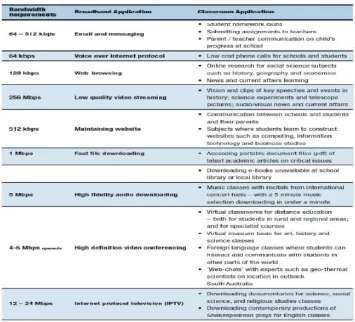
MAY-JUNE 2014, VOL. II, ISSUE-XII www.srjis.com Page 1611 Figure 2: Classroom Applications of Broadband
Note: Broadband speeds required for performance of applications are indicative only
Broadband will also foster the development of students‟ online research skills. The internet is
not a perfect information source, and it is important that students learn internet skills, and the
limitations of the internet at school under the guidance of teachers. While the internet is
undoubtedly one of the most powerful information innovations in history, it is important that
it is used in conjunction with traditional information sources such textbooks and reference
materials in the school library. Broadband also enables greater parental involvement in a
child‟s education. There will be more feedback on their child‟s progress, and greater
awareness of curriculum content, teaching methods and what homework is being set for their
children. School students to use the internet as an everyday research tool in the classroom
more easily. High bandwidth enhances the effectiveness of existing distance learning
programs by enabling video conferencing on the desktop.”
Emerging media-rich applications are bandwidth hungry. To give Australian students the
opportunity to access the very best learning materials, our schools must be equipped with
MAY-JUNE 2014, VOL. II, ISSUE-XII www.srjis.com Page 1612 The Digital Education Revolution (DER) aims to contribute sustainable and meaningful
change to teaching and learning in Indian schools that will prepare students for further
education, training and to live and work in a digital world.
In this context, the Indian Government is investing to support the effective integration of
information and communication technology (ICT) in Indian schools in line with the
Government‟s broader education initiatives, including the Indian Curriculum.
The National Broadband Network (NBN) will deliver high speed broadband connections to
individual schools, homes and workplaces. The NBN will mean that Indian school students
will have access to similar bandwidth capabilities at home and at school, anywhere and at any
time.
Industry Status
The last few years have seen digital content bringing about phenomenal changes in the field
of education and entertainment. There is a huge transformation in the way educators today
are using digital content in the classroom. Today , digital content on mobile phones and other
multimedia content can be linked with social networks . Besides, satellite-based education is
revolutionising classrooms worldwide by facilitating live delivery of lectures.
Further, digital content is being beamed through DTH services; this is providing learners
access to quality entertainment right in their homes. In terms of media, the trend has shifted
from 2D to 3D, whether it is in the real-life video or in the animation industry. Recently,
stereoscopic 3D has made an entry into movies and in education and is likely to feature in
televisions and mobiles too.
Growth Areas
Growth areas in digital content are branching out in animation and filmmaking . Animations
can be 3D or 2D animations. In addition, the area needs subject matter experts, instructional
designers (ID), graphic visualisers and software professionals.
Skill-Set Required
Freshers entering this area must have good writing, editing, and ID skills. They must be
creative and have knowledge of 2-D /3-D animation, video editing, sketching, programming
and project management.
Remuneration
Fresher‟s are paid anything from 10,000 - 20,000 per-month depending on their
qualifications. Growth in this field is similar to the IT industry, with 15-20 % growth in
MAY-JUNE 2014, VOL. II, ISSUE-XII www.srjis.com Page 1613 industry, and experienced creative managers and media experts get a six-figure monthly
salary.
Conclusion:
To have the best job and life opportunities in the future, Australian students must receive a
world class education today. A world class education system requires significant government
and private investment, quality subjects to study, well-trained and dedicated teachers, and the
best classroom facilities such as computers, laboratories and workshops. In coming years, a
critical component of a world class education system in Australia will be use of a computer
and access to reliable, high speed broadband. This will provide closer links between schools,
teachers, students and parents, and help realise the true potential of e-education. It will
change the way teachers teach, and the way students learn. Information and communications
technology is no longer just another subject taught by schools, it is a means of learning across
all subjects – from English, mathematics and science, to the humanities, technical and applied
studies, music and visual arts. It is also a driver of productivity and growth across all sectors
of the economy, from farming and mining to manufacturing and services. Australian students
need greater access to, and more sophisticated use of, information and communications
technology. They need a digital education that prepares them for the jobs of tomorrow. They
need the best hardware, high speed broadband connections and the best trained teachers to
integrate new technology into classroom lessons. Understanding the importance of a digital
education to the future of Australia, a Rudd Labor Government will invest $1 billion over
four years to provide capital grants to Government, Catholic, and Independent Secondary
Schools and schooling systems to assist them to provide world class information and
communications technology (ICT) for every secondary student in years 9 to 12. Schools will
be able to apply for grants of up to $1 million to revolutionise their classrooms with new or
upgraded ICT equipment. This could include personal laptops, thin clients with virtual
desktops1, and internet network infrastructure to plug our schools into the information
superhighway. This initiative is aimed at ensuring that one million Australian secondary
school students get an education with the latest technology, to prepare them for the jobs of
the future. A Rudd Labor Government will also revolutionise classroom education by
providing Indian schools with fibre to the premises (FTTP) broadband connections, which
will deliver internet speeds up to 100 megabits per second (mbps) – around 100 times faster
than most current speeds in schools. Fast, reliable broadband will give Australian students
access to new e-education applications such as virtual classrooms, electronic books
MAY-JUNE 2014, VOL. II, ISSUE-XII www.srjis.com Page 1614 digital content could be exciting as it allows professionals to combine knowledge with
pedagogy and technology. It also gives ample scope to multimedia experts to unleash their
creativity by creating engaging visuals to bring abstract concepts to life. The digital content
revolution has accelerated the demand for academicians, editors, instructional designers,
graphic animators, illustrators and technology experts. Some of the industries where these
skills are used include education, television and film industry, advertising and media,
publishing, web and IT industry.
References for Further Studies
Thin clients are computer terminals that have their data and applications stored on a hard drive in a remote server.
OECD (2006), Press Release, Are students ready for a technology rich world?
‘When everything connects – Information Technology has nothing to lose but its cables’, in The Economist, 28 April 2007, page 11.
Department of Communications, Information Technology and the Arts (2004), Australia’s strategic
framework for the information economy 2004–2006, available at:
http://www.dcita.gov.au/__data/assets/pdf_file/20457/New_SFIE_July_2004_final.pdf Queensland Department of Education (2004), Homework Literature Review, available at:
http://education.qld.gov.au/review/pdfs/homework-text-for-web.pdf or Hard Wiring What the Next Decade in Education Policy Means for Educational Technology, available at: http://www.exploratorium.edu/research/digitalkids/HardWiring_Rotherham.pdf, p. 3
The Le@rning Federation is a joint initiative of the State, Territory and Federal Governments of Australia and New Zealand, and operationally is a joint venture between the Curriculum Corporation and education.au limited. The Federation utilizes ICT to produce online curriculum content to encourage student learning and to provide support for teachers in Australian and New Zealand schools. http://www.thelearningfederation.edu.au/node1.
National Office for the Information economy (2002), Broadband in Education: Availability, Initiatives and Issues, August 2002, page 4.