Middle-Secondary Education and Instructional Technology Dissertations
Department of Middle-Secondary Education and Instructional Technology (no new uploads as of Jan. 2015)
Fall 10-22-2010
Life Portraits: A Comparative Case Study of Four
Veteran Spanish Teachers
Myrnelle L. Gregory-Bryan
Follow this and additional works at:https://scholarworks.gsu.edu/msit_diss
Part of theEducation Commons
This Dissertation is brought to you for free and open access by the Department of Middle-Secondary Education and Instructional Technology (no new uploads as of Jan. 2015) at ScholarWorks @ Georgia State University. It has been accepted for inclusion in Middle-Secondary Education and Instructional Technology Dissertations by an authorized administrator of ScholarWorks @ Georgia State University. For more information, please [email protected].
Recommended Citation
Gregory-Bryan, Myrnelle L., "Life Portraits: A Comparative Case Study of Four Veteran Spanish Teachers." Dissertation, Georgia State University, 2010.
ACCEPTANCE
This dissertation, LIFE PORTRAITS: A COMPARATIVE CASE STUDY OF FOUR VETERAN SPANISH TEACHERS, by MYRNELLE GREGORY-BRYAN, was prepared under the direction of the candidate‘s Dissertation Advisory Committee. It is accepted by the committee members in partial fulfillment of the requirements for the degree Doctor of Philosophy in the College of Education, Georgia State University. The Dissertation Advisory Committee and the student‘s Department Chair, as representatives of the faculty, certify that this dissertation has met all standards of excellence and scholarship as determined by the faculty. The Dean of the College of Education concurs.
_____________________________ _____________________________ Gertrude Tinker Sachs, Ph.D. Joel Meyers, Ph.D.
Committee Chair Committee Member
_____________________________ _____________________________ Diane Belcher, Ph.D. Joyce Many, Ph.D.
Committee Member Committee Member
_____________________________ Date
_____________________________ Dana L. Fox, Ph.D.
Chair, Department of Middle-Secondary Education and Instructional Technology
_____________________________ R.W. Kamphaus, Ph.D.
AUTHOR‘S STATEMENT
By presenting this dissertation as a partial fulfillment of the requirements for the
advanced degree from Georgia State University, I agree that the library of Georgia State University shall make it available for inspection and circulation in accordance with its regulations governing materials of this type. I agree that permission to quote, to copy from, or to publish this dissertation may be granted by the professor under whose direction it was written, by the College of Education‘s director of graduate studies and research, or by me. Such quoting, copying, or publishing must be solely for scholarly purposes and will not involve potential financial gain. It is understood that any copying from or publication of this dissertation which involves potential financial gain will not be allowed without my written permission.
NOTICE TO BORROWERS
All dissertations deposited in the Georgia State University library must be used in
accordance with the stipulations prescribed by the author in the preceding statement. The author of this dissertation is:
Myrnelle Gregory-Bryan 578, Fortune Ridge Road Stone Mountain, GA, 30087
The director of this dissertation is:
Dr. Gertrude Tinker Sachs
Department of Middle-Secondary Education and Instructional Technology College of Education
VITA
Myrnelle Gregory-Bryan
ADDRESS: 578, Fortune Ridge Road, Stone Mountain, Georgia, 30087.
EDUCATION:
Ph.D. 2010 Georgia State University Teaching and Learning
M.Ed. 1995 University of the West Indies
Educational Psychology/Educational Administration
B.A. 1982 University of the West Indies Spanish/English Language and Literature
PROFESSIONAL EXPERIENCE:
1996-Present Spanish Teacher
DeKalb County School System, Decatur, Ga
1995-1996 Lecturer- English/ Reading in the Content Area
University of Technology, Jamaica. Kingston, Jamaica
1989-1995 Spanish teacher
St Andrew High School, Kingston, Jamaica
Lecturer – Psychology
St Andrew Community College
Lecturer – Psychology
College of Arts, Science and Technology
1982-1989 English Teacher
PROFESSIONAL SOCIETIES AND ORGANIZATIONS:
2006-Present Georgia Association of Teacher Educators 2007-Present Foreign Language Association of Georgia 2007-Present Teachers of English to Speakers of Other Languages
PRESENTATIONS:
Gregory-Bryan, M. & Perez, C. (2010, March). Facilitating the development of conversational skills. Presented at FLAG (Foreign language Association of Georgia) Savannah, Ga.
Gregory-Bryan, M. ( 2007, March). Art as literacy in the Foreign Language Classroom. Session presented at the Third International Online Conference on Second and Foreign and Foreign language Teaching Research.
http://www.readingmatrix.com/onlineconference/index.html.
ABSTRACT
LIFE PORTRAITS:
A COMPARATIVE CASE STUDY OF FOUR VETERAN SPANISH TEACHERS by
Myrnelle Gregory- Bryan
In foreign language education the classification native or nonnative speaker of a
language often evokes thoughts related to degrees of competence in language teaching
(Braine, 2004; Davies, 2004). This comparative case study focused on Spanish teachers
in a United States context. It contributes toward the literature base in research related to
native and nonnative speakers of languages other than English within the local context.
Using the threefold theoretical framework of role identity theory (Stryker, 1968; Stryker
& Burke, 2000), teacher efficacy (Tschennen Moran & Woolfolk Hoy, 2001) and social
constructivism (Schwandt, 2007), the study aimed at developing understandings about the
lived experience of foreign language teachers given the native/ nonnative speaker
construct. It investigated how their personal perception of their role impacted the
execution of professional duties. It also explored their conceptualization of the language
teacher, given their extensive observation of teachers of various languages.
The questions guiding the research were: (a) How does each participant
conceptualize her role identity as Spanish teacher in a predominantly English speaking
setting?, (b) How viable is the native/nonnative speaker construct when teacher efficacy
is considered?, and (c) how has the experience of supervising teachers of differing
influenced the participants‘ understanding of the language teacher construct in the USA?
Data collection was done through interviews, focus group discussions and classroom
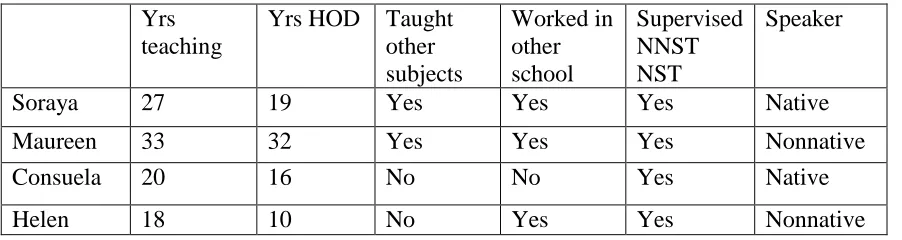
observations. The participants were four veteran Spanish teachers who had been in the
department chair position for more than ten years. Two grew up speaking the language
while the others learned the language in an academic setting.
Findings revealed that there was great similarity in the way teachers
conceptualized their role as Spanish teacher and that they gave no credence to the native/
nonnative speaker construct as an indicator of language proficiency and competence in
LIFE PORTRAITS: A COMPARATIVE CASE STUDY OF FOUR VETERAN
SPANISH TEACHERS by
Myrnelle Gregory-Bryan
A Dissertation
Presented in Partial Fulfillment of Requirements for the Degree of
Doctor of Philosophy in
Teaching and Learning in
the Department of Middle-Secondary Education and Instructional Technology in
the College of Education Georgia State University
Copyright by Myrnelle Gregory-Bryan
ii
ACKNOWLEDGMENTS
I am exceedingly grateful to my creator Jehovah God who gave me all that I needed to successfully complete this dissertation. I felt his holy spirit most when my human spirit was at its lowest.
My heartfelt gratitude goes to my participants Soraya, Maureen, Consuela, and Helen who, although they had very demanding responsibilities at work, graciously made themselves available for all activities associated with my data collection. I appreciate their commitment to the success of the dissertation study. I am also grateful for the guidance and help from my committee members: Dr. Gertrude Tinker Sachs, Dr. Joel Meyers, Dr. Diane Belcher, and Dr. Joyce Many. I extend my gratitude to my advisor, Dr. Tinker Sachs, whose high standards encouraged me to aim for excellence
My friends and colleagues were a source of motivation and support throughout this process. I therefore express thanks to Dr. Jayoung Choi, Dr. Lori Fredrick, and Dr. Monique Robinzine.
Without the support of my family and relatives I would not have completed this journey. I therefore thank my husband B. Orlando; my sons Bilton, Dayne and
iii
TABLE OF CON TENTS
PAGE
LIST OF TABLES ... vii
LIST OF FIGURES ... viii
ABBREVIATIONS ... ix
CHAPTER 1 ... 1
INTRODUCTION ... 1
Statement of the Problem ... 3
Rationale and Purpose of the Study ... 3
Guiding Questions ... 6
Theoretical Framework ... 7
Role Identity... 7
Teacher Efficacy ... 9
Narrative Construction of Reality ... 11
Social Constructivism ... 12
2 ... 14
REVIEW OF LITERATURE ... 14
The Native Speaker Construct ... 14
The Non-native Speaker ... 20
The Spanish Language Experience in the USA ... 23
The Heritage Speaker ... 24
The Heritage Speaker in Teaching ... 26
Heritage Language Speakers as Students ... 28
Foreign Language Pedagogy and the Native Nonnative Paradigm ... 30
Communicative Competence ... 33
Technology in Teaching ... 34
Research on the Nonnative Speaker ... 40
Use of L1 in Learning Situations ... 42
Self-Perception of Nonnative Speaker Teachers ... 45
A Critical Look at the ―Dichotomy‖ ... 48
Teacher Efficacy ... 52
3 ... 59
METHODOLOGY ... 59
Research Design... 60
Context and Participants ... 62
Data Sources and Collection ... 64
Questionnaire ... 64
Interviews and Observations ... 65
In-depth Interviews ... 65
iv
Focus Groups ... 70
Member checking... 71
Researcher Journal ... 72
Peer Debriefing ... 72
Researcher‘s Role ... 73
Data Management and Analysis ... 73
Trustworthiness and Rigor ... 78
Transferability ... 78
Limitations ... 79
4 ... 80
FINDINGS ... 80
Soraya ... 81
Early Years... 82
Main Challenges ... 84
Feeling Alone, and Alienated ... 87
Solutions and Successes ... 88
In the Language Teacher Role ... 89
Perception of Success ... 93
Soraya as Department Chair ... 94
Providing Support for Supervisees ... 94
Encouraging Differentiation ... 96
Selecting Teachers ... 97
Summary ... 99
Maureen 99 Early Years... 101
Maureen the teacher ... 103
Effective Teaching ... 105
Adapting for Changes ... 107
Maureen as Department Chair ... 109
Standard Setting ... 110
Sharing and Modeling ... 111
Mentoring New Teachers ... 113
Selecting Teachers ... 115
Classroom Management... 117
Summary ... 118
v
Managing the Problem ... 122
From no help to help ... 124
Experiencing success ... 125
Consuela the Teacher ... 126
Differentiation ... 127
Using Technology ... 129
Consuela the Department Chair ... 130
Change ... 131
Selecting Teachers ... 133
Summary ... 133
Helen ... 134
Early Years... 135
Support ... 138
Success ... 138
Helen the Teacher ... 140
Differentiation ... 141
Teaching Advanced Placement Spanish ... 143
Change ... 143
Helen as Department Chair ... 148
Summary ... 152
Similarities and Dissimilarities ... 153
Formative Years ... 154
Teaching ... 156
Head of Department Role ... 157
Research Question Considered ... 161
Soraya ... 162
Maureen ... 163
Consuela ... 163
Helen ... 163
Summary ... 166
Native and Nonnative Speaker Teachers ... 166
Primary Focus of the Selection Process ... 167
Language Use... 170
Perception of Strength... 173
Role of Experience ... 176
The Impact of Culture ... 180
Assisting Teacher Growth... 184
The Language Teacher ... 186
vi
5 ... 190
DISCUSSION ... 190
Discussion of Findings ... 192
Developing Competence ... 193
The Language Teacher ... 196
Facilitator Role... 198
Cultural Considerations ... 201
Teacher Efficacy ... 202
Teacher Efficacy in Supervisees ... 204
Research Questions Answered ... 205
Implications of the Study ... 206
Language teacher Efficacy ... 208
References ... 213
vii
LIST OF TABLES
viii
LIST OF FIGURES
ix
ABBREVIATIONS
FG1 First focus group
FG2 Second focus group
FG1C Consuela‘s comment in first focus group
FG1H Helen‘s comment in first focus group
FG1M Maureen‘s comment in first focus group
FG1S Soraya‘s comment in first focus group
FG2C Consuela‘s comment in second focus group
FG1H Helen‘s comment in second focus group
FG1M Maureen‘s comment in second focus group
FG1S Soraya‘s comment in second focus group
INT1P1 1st Interview with participant 1 - Soraya
INT2P1 2nd Interview with participant 1- Soraya
INT3P1 3rd Interview with participant 1- Soraya
INT1P2 1st Interview with participant 2 - Maureen
INT2P2 2nd Interview with participant 2 - Maureen
INT3P2 3rd Interview with participant 2 - Maureen
INT1P3 1st Interview with participant 3 - Consuela
INT2P3 2nd Interview with participant 3 - Consuela
INT3P3 3rd Interview with participant 3- Consuela
INT1P4 1st Interview with participant 4- Helen
INT2P4 2nd Interview with participant 4 - Helen
x NNS Nonnative speaker
NS Native speaker
CHAPTER ONE
INTRODUCTION
You are the kind of person we want in our classroom – a native speaker
(County Coordinator – World language Department)
These words, spoken to me upon my receiving a teaching position in one school system
introduced a novel phenomenon to me. Prior to hearing them, I had been oblivious to the overt
categorization of language teachers as native and nonnative speakers, and the attendant
implication for individuals falling into each category. In my studies at the university level I had
had professors who could neatly fit into each category, but my peers and I had never discussed
that distinction. It seemed as irrelevant as the gait of the professors. Such distinction never had
any bearing on how the teachers were rated when we were selecting classes. The way the
professor structured the course, presented the information, and related to her students were the
points we considered. It never occurred to us that we would have had an advantage with one over
the other because we instinctively assumed that their being on the faculty was evidence that they
possessed a sufficiently strong knowledge base in their discipline, and that they were all
adequately qualified to teach the subject area they offered, be it the language or the literature of
the target language.
The statement remained pounding in my subconscious and forced me to reflect on the
seven years I had taught Spanish at the high school level prior to migrating to the United States.
Teachers did their utmost to adequately prepare students for examinations, the major ones being
set by external examining bodies based in other countries. Spanish was taught mainly as a
foreign language, and the examination was geared towards testing the students‘ proficiency in
including listening and reading comprehension, translation, and composition. The teachers‘
competence in facilitating the development of the required skills was crucial, but was not seen as
being related to their having learnt the language by virtue of having been born into that language
group, or through the course of formal education. The coordinator‘s statement presented at the
opening was therefore unexpected, so unanticipated that I could not think of an appropriate
response. I said nothing, but as I have pondered his words throughout the years, they have alerted
me to the possibility that, at the very least, in my new environment there were persons in
positions of responsibility in the school system, who perceived competence in language teaching
as being a function of the teachers‘ history of contact with the language.
As I muse over the coordinator‘s words today, I am still unsure of how I should have
responded. The words might have been an expression of confidence in my ability to make a
meaningful contribution to students‘ language learning. They may have been an indication that
he felt secure about my language proficiency based on my performance in the interview and my
scores on the state examination for teachers, which he held in his hand. On the other hand, they
might have been indicative of a comparatively lower level of confidence in the ability of the
individual who teaches a language other than her primary language of communication – a subtle
implication that there was doubt about her ability to perform equally creditably in the role of
language teacher.
The coordinator visited my school on my very first day on the job. He observed my class
and congratulated me on a job well done, highlighting my use of the target language as the
medium of instruction and the use of visual aids as outstanding aspects that aided comprehension
of the language. He gave a glowing report to my principal and described my class in detail at a
taught their primary language of communication as facilitators was planned. I was invited to be
one of them. It was at this point that I informed him that Spanish was not my primary language
of communication. My exposure to Spanish had always been in an academic setting, beginning
in high school and continuing through to the university level.
Statement of the Problem
Different scholars (Canagaragh, 1999; Cook 2005; Pasternak &Bailey, 2004; Phillipson,
1996) have carried forward the debate about the merit of the native versus the nonnative speaker
in the classroom. Their arguments have included thoughts about the use of technological
resources in exposing students to authentic language; the role of adequate training in facilitating
effective teaching by both native and nonnative speakers; and the marginalization of the
nonnative speaker, particularly in English language teaching. Given these examples of the trend
seen in the literature, I became aware that there are a variety of issues associated with the
language teaching arena that are consequential to the native or nonnative speaker status of the
teacher. These included questions related to linguistic competence and target culture familiarity;
suitable modeling of target language use; and the subject of expertise in teaching.
Rationale and Purpose of the Study
At the high school level in the United States 70% of students studying a foreign language
study Spanish (Draper & Hicks, 2000). Eighty percent of foreign language teachers at the high
school level are teachers of Spanish and, numbering 45.5 million, Spanish-speaking persons now
form the largest minority group in the United States (ACTFL Student Survey, 2008). Students in
this group manifest a variety of levels of proficiency in Spanish, thereby requiring of teachers a
level of competence linguistically and pedagogically that allows them to meet the specific
approximately 12% of the Latino group having a bachelor‘s degree or higher (Bureau of Census,
2006) access to a Spanish teacher whose primary language of communication is Spanish might
be relatively easy. The existence of programs that offer three-year contracts to teachers from
other countries for faculty positions in the USA form another pool from which Spanish teachers
who teach their primary language might be taken. Soriana (2004) reports that those offering to
teach their primary language experience less difficulty in obtaining faculty positions as there is
less meticulous checking of credentials than in the case of those offering to teach a language
other than their primary language. In view of the foregoing, a study investigating the status of
and implications for Spanish teachers who fall into each of these two categories is highly
relevant in this society. This study therefore explored the lived experience of Spanish teachers
who teach their primary language and those for whom a language other than Spanish is primary.
The purpose was to provide an understanding of the issues that impacted their professional lives.
Inarguably, teachers who teach their primary language and those who teach languages
other than their primary language learnt the language in different social contexts. Consequently,
each brings a unique life history of language learning to the educational setting. This is a
noteworthy factor that can affect the language teaching/learning context. Risager (2006) argues
that linguistic and cultural resources that language teachers bring to the classroom context are an
important part of their identity. It is evident that these would also have an effect on their role
identity. Role identity refers to the internalized, personal perceptions of what a given position
requires of a person (Fuller, Hester, Barnett, Beu, Frey & Relyea, 2009). These internalized,
symbolic aspects have accompanying meanings and behavioral expectations that one associates
linguistic and cultural concepts are intertwined and it is possible that one‘s personal history of
learning the language can impact the way these concepts are presented to the learner.
My piqued awareness of the presence of the native /nonnative speaker distinction caused
me to become sensitized to the phenomenon. I wondered at ―nativeness‖ and ―nonnativeness‖,
pondering their impact on teacher attitude, viewpoint on teaching, as well as the development of
their classroom persona. Thinking of the native speaker as one who has been speaking the
language from earliest childhood (Cook 2005), and the nonnative speaker as one who learnt an
academically accepted form of the language (Moussu, 2000), I became interested in exploring
the phenomenon from the viewpoint of selected individuals. Consequently, this study was
undertaken with the purpose of investigating the lived experience of four veteran teachers of
Spanish – two of whom teach their native language while the other two are nonnative speakers.
This selection was not intended to perpetuate a distinction, or the idea of a dichotomy. Rather,
the selection is reflective of the two principal ways individuals learn a language. This means that
the participants‘ exposure to the language they teach would have mirrored that of the vast
majority of language teachers. Having participants from both language learning backgrounds
allowed the researcher to have a more in-depth view of the subject being studied, and likely one
that is more reflective of the spectrum of perspectives that are likely to exist.
The study required that the veteran teachers revisit their experience from the neophyte
stage to the time of the study in order that the gamut of feelings, range of emotions, variety of
concerns, and differing personal victories that might have arisen as they had engaged in their
daily activities in the professional world could be brought to the fore. It also required that they
precisely recall native and nonnative speaker teachers whom they had supervised, reflecting
Studies have been done on differing aspects related to native and nonnative speakers such
as self-perception (Rajagopalan, 2005); learners‘ perception of the strengths of the nonnative
speaker versus the native speaker (Lasagabaster & Sierra, 2005); and teaching behaviors (Arva &
Medgyes, 2000). These have, however, mainly addressed English language teaching, a large
number being done on the nonnative speaker of English who teaches the language in sites
outside the USA. I identified two studies dealing with native and nonnative speakers of
languages other than English, specifically in sites in the United States, which was done on
university teacher assistants (En-Chow, 2003; Terashima, 1996). This study contributes to the
knowledge base in this specific area of deficiency. A further purpose of this study is to have
professionals in the field of language teaching critically consider the relevance of the
native/nonnative speaker construct in predicting level of competence in language teaching.
Guiding Questions
The following questions guided this study:
1. How does each participant conceptualize her role identity as Spanish teacher in a
predominantly English speaking setting?
2. How viable is the native nonnative speaker construct when teacher efficacy is
considered?
3. How has the experience of supervising teachers of differing linguistic backgrounds
(native and nonnative speakers) in the language they teach informed the participants‘
Theoretical Framework
Different philosophies and theories have contributed to the theoretical underpinnings of
this study. Primary among these are role-identity theory (Burke & Tully, 1997; Hogg & Abrams,
1988; McCall, 2003; Stryker, 1968; 1980; Stryker & Burke, 2000), teacher efficacy
(Tschannen-Moran, Woolfolk, & Hoy, 1998; 2001), and social constructivism (Crotty, 1998; Neuman, 2000).
Identity is defined as ―the totality of one‘s self-construal, in which how one construes
oneself in the present expresses the continuity between how one construes oneself as one was in
the past and how one construes oneself as one aspires to be in the future‖ (Weinreich,2003, p.
26). It might be conceptualized as a form of social representation that mediates the relationship
between the individual and the social world, giving rise to a sense of self that has been
constructed though active participation in social groups (Chryssochoou, 2003). This social
interaction, which presupposes intercommunication in a variety of group settings, impacts one‘s
self-definition (identity), causing it to be linked to roles individuals occupy in these groups. The
self is therefore seen as being multifaceted, emerging from people‘s role in social settings
(Stryker, 1968; 1980; Stryker &Burke, 2000). A role is a set of expectations prescribing
behavior that is deemed appropriate by others (Simon, 1992).
Role Identity
Role identity can be conceptualized as ―a set of meanings that are taken to characterize a
self-in-role‖ (Burke & Reitzes, 1981, p.85); the individual‘s perception of what the role requires
of him/her (Fuller, et al, 2009). The term encompasses self-conceptions in terms of one‘s
position in the social structure (Stryker & Serpe, 1982; Thoits, 1983). These self-conceptions are
based on enduring, reciprocal relationships that carry obligations to others and serve as the basis
in relation to social groupings, interacts with others, acquires relevant knowledge, and
subsequently develops an internalized version of a particular identity as it relates to a given role
(Stets & Harrod, 2004). Hence the meanings and expectations that the individual internalizes and
attaches to herself becomes part of her role identity.
A role identity has normative expectations in that it has a set of meanings and practices
associated with it. One‘s role identity influences one‘s behavior as role-related components of
self are enacted (Burke & Reitzes, 1981; Thoits, 1991). Turner (1978) promotes the concept of
role-person merger, in which the role identity becomes integrated with a person, leading to the
formation of behavioral, psychological and social commitments to the particular role, which
influences the individual to display role-appropriate attitudes and behaviors. The role identity
therefore becomes a frame of reference through which the individual appraises actions, and
interprets and responds to life events (Vignola, Regalia, Manzi, Golledge, & Scabini, 2006) As
the individual develops competence in performing the role, and receives confirmation of
creditable performance in the role, she internalizes the self-description associated with the role
(Piliavin & Callero, 1991). This has implications for self-evaluations and self-esteem issues in
relation to one‘s role identity. If one perceives oneself as satisfactorily enacting one‘s role, one‘s
self-esteem is positively impacted. Conversely, negative feelings about one‘s self-worth result
from perceptions of poor role performance (Hogg, Terry & White, 1995).
Among the plethora of structural positions individuals occupy in society are occupational
roles. These are enacted within normative guidelines and expectations of various stakeholders.
Professional identity, for example, implies interaction between person and context, requiring that
individuals adopt and adapt related characteristics. Teachers, in constructing their professional
understanding themselves in the teacher role (Beijaard, Meijer, & Verloop, 2004). The use of
role identity theory can allow the researcher to develop an understanding of the meanings and
expectations one associates with the role, and the ways in which these are verified through social
interaction as she carries out the role. Role identity theory is therefore apt in partially forming a
unit of analysis for investigating features related to individuals in their professional milieu as the
researcher examines implicit and explicit references that speak to their interpretation of the
language teacher role.
Teacher Efficacy
Complementing role identity is the concept of teacher efficacy, a construct that has been
conceptualized as ―the teacher‘s belief in her capability to organize and implement courses of
action required to successfully accomplish a specific teaching task in a particular context
(Tschannen-Moran, Woolfolk, Hoy, & Hoy, 1998, p.240). Influenced initially by Rotter‘s social
learning theory (Rotter, 1966) and Bandura‘s Social cognitive theory (Bandura, 1977; 1997),
particularly his construct of self-efficacy, teacher efficacy contains the thought of the
individual‘s sense of agency in bringing about positive outcomes in the learning situation. The
level of teacher efficacy would therefore be a function of the teacher‘s perception of the degree
of influence she has in bringing about student learning. The teacher who feels that factors beyond
her influence are not as strong in affecting student learning as those within her control displays
high teacher efficacy.
In the model devised by Tschannen-Moran, Woolfolk, Hoy, and Hoy (1998), teacher
efficacy is perceived as a convergence of one‘s self-perception about one‘s personal teaching
competence and one‘s analysis about the teaching task. In determining the former, the teacher
assumed requirements of the teaching task. Analysis of the teaching task involves assessing the
resources and constraints that are features of the particular teaching context. This includes
considering various factors such as student ability and motivation; the availability and quality of
instructional material; and managerial issues; and appropriate teaching strategies. The underlying
element driving the consideration of these factors is the anticipated outcome of the teaching
episode. Thus, the teacher ponders what would constitute success in that particular teaching
episode, and what means or actions would facilitate attaining it.
Mastery experiences exert a major influence on the development of efficacy beliefs in
general (Bandura, 1997), hence on teacher efficacy in particular (Tschannen-Moran, Woolfolk,
Hoy, & Hoy, 1998; 2001). If a person perceives her performance as having been successful, her
efficacy beliefs are strengthened. They are particularly strengthened when success is achieved on
difficult tasks, with little assistance. Tschannen-Moran, Woolfolk, Hoy, and Hoy (1998) argue
that there is a cyclical nature to the effect of mastery experience. They explain that proficient
performance gives rise to new mastery experience which provides new information that is
processed to produce new efficacy beliefs. This, in turn leads to greater effort and persistence,
which ultimately leads to better performance. Improved performance ultimately leads to greater
efficacy. Efficacy beliefs are lowered when one perceives that one‘s performance has been
unsuccessful.
Teacher efficacy has been found to be related to important educational variables. Among
these are teacher classroom behaviors; openness to new ideas, attitudes to teaching, and teacher
satisfaction (Browers & Tomic, 2001; Caprara, Barbaranelli, Borgogni, & Stecca, 2003;
Coladarci, 1992; Good & Brophy, 2003; Henson, 2002; Onafowora, 2004; Ross, 1998; Ross &
Goddard, 2000; Goddard, 2001; Goddard, Hoy & Woolfolk Hoy, 2004; Ross, 1992). Using the
correlates of teacher efficacy therefore proves useful in forming a framework for analyzing
levels of teacher efficacy.
Narrative Construction of Reality
Bruner (1991) proposes a theory labeled the narrative construction of reality, in which the
mind is seen as structuring its sense of reality using mediation through cultural products such as
language and other symbolic systems. Narrative is one such cultural product and has been
effectively used in research in education. Bruner (1996) argues that we frame our most cherished
beliefs, our immediate experience, even our lives in the form of narrative. In this vein, people are
conceptualized as making sense of the world by telling stories about it. Stories are therefore
regarded as instruments of mind connected to meaning making, and telling them as the natural
way of organizing experience and knowledge. Bakhurst (2001) complements Bruner‘s theory in
stating that ―our identities as self-conscious subjects of experience depend on our identities as
―narrative selves‖ (p.186).
Connelly and Clandinin (1990) suggest that human beings lead storied lives individually
and socially, and are storytelling organism. Thus, studying narratives in research constitutes a
study of how humans experience the world because they relive their stories as they reflect upon
their lives and tell their stories to others. As individuals relate their story in interviews which are
later transcribed, along with field notes that reveal intricate details, the researcher obtains texts
(Clandinin & Connelly, 2000) that can be analyzed with the view to acquiring an
Social Constructivism
Social constructivism is a paradigm based in the assumption that individuals seek
understanding of the world in which they live and work, thereby developing subjective
meanings of their experiences as they engage with the world they seek to interpret (Lincoln &
Guba, 2000; Neuman, 2000; Schwandt, 2000) . Reality is seen as being socially constructed
(Berger & Luckman, 1967). Using the social constructivist lens, the researcher relies primarily
on the views of the participants, expressed in response to open-ended questioning, observations
and group discussions. In accord with the central tenet of social constructivism that subjective
meanings are negotiated socially and historically and are formed through interaction with others,
careful listening and keen observation were crucial in this research.
Expression is a meaning- making event that exhibits the particular conditions of its
telling; characteristics of its teller; and the cultural, historical, and ideological horizons
that support or constrain the speaker in his or her search for understanding (Freeman,
2007, p. 925)
The above captures the fundamental reason for using social constructivism as the
overarching theoretical framework for this research. It allows the researcher to mull over the
participants‘ conscious reflection on experiences; their role identity - conceived within the view
of self as a multifaceted social construct; and their narrative construction of reality.
Each of the above theories presented served a distinct purpose in this study. Firstly,
narrative construction of reality and social constructivism provided a framework for situating the
lived experience as reported by the participants. Secondly, teacher efficacy, given its correlates,
provided the lens through which the self-perceptions, reported and observed activities of the
participants‘ individual journey to their present understandings of self in their professional
setting as I examined explicit and implicit references to role behaviors. These, together, allowed
CHAPTER TWO
REVIEW OF LITERATURE
This chapter begins with a discussion of the native speaker (NS) and nonnative speaker
(NNS) construct as presented in the literature. It synthesizes the information from research and
other scholarly work to formulate a definition of each term. An examination of the heritage
speaker who often manifests features associated with the two above is then attempted,
highlighting the implications of their unique situation in teaching positions, and as students in the
U.S. classroom. Complementing this, a discussion of the status of Spanish as a language in the
USA ensues. The review continues by presenting scholarly views of the native and nonnative
speaker in foreign language pedagogy; highlighting research on the self-perception of nonnative
speaker teachers. It then takes a critical look at the perceived dichotomy in the foreign language
teaching arena. The penultimate part of the review examines research related to teacher efficacy.
It ends with a brief look at language teacher supervision.
The Native Speaker Construct
The native speaker and all the linguistic social and economical consideration that
accompanies it are troublesome and open to controversy. (Braine, 1999, p. XIV)
The above succinctly captures the atmosphere of dissention that prevails among linguists,
social theorists, and educators regarding the native speaker construct, particularly as it pertains to
competence, expectation, and abilities in foreign language pedagogy. In the recent history of
foreign language education, pedagogical experts and scholars in the field of Applied Linguistics
have analyzed, debated, redefined, and even rejected and replaced the term. Medgyes (1996)
gives the scenario of an English-speaking boy who has been living in the United States since
mother tongue and a Mexican father who speaks to him in Spanish. Medgyes poses the pertinent
question, ―Which is his native language English, Spanish, or Norwegian?‖ (p. 22). The scenario
well illustrates the complexity of formulating a clearly defined category for ―native speaker.‖ It
effectively supports his point that the construct is controversial from both a sociolinguistic and a
purely linguistic perspective. It further underscores the inherent difficulty in devising an
operational definition for the term.
Scholarly sources imply that an individual is a native speaker of the language learned first
(Cook, 1999), usually in childhood (Cook, 2005). Based on multiple sources Cook (1999)
compiles a list of non-developmental characteristics ascribed to the NS that complements the
core meaning above. These include (a) a subconscious knowledge of rules, (b) an intuitive grasp
of meanings, (c) the ability to communicate within social settings, (d) a range of language skills,
(e) creativity in language use, (f) identification with a language community, (g) the ability to
produce fluent discourse,(h) knowledge of differences between their own speech and that of the
standard form of the language, and (i) the ability to interpret and translate into the L1 of which
he or she is a native speaker. Cook expresses agreement that some of the above characteristics (1
and 2 for example) are rightly applied to a native speaker while others (8 and 9 for example) are
merely incidental features. For instance, one‘s ability to interpret and translate into an L1 is a
function of one‘s having acquired an L2.
Pragmatic and strategic competence in their language has been seen as features of the
native speaker (Lee, 2005). In addition, native speakers possess ―internalized strategic
competence‖ that allows them to use verbal and nonverbal skills to repair breakdowns commonly
experienced in conversation. These verbal and non-verbal skills allow the NS to perform
communicative competence namely the ability to carry out fluent, spontaneous discourse, utilize
circumlocutions and hesitations, predict what an interlocutor will say, and make clarifications
through repetition of the message in other forms. Kramsch (2003) asserts that originally native
speakership was viewed as a privilege of birth and NSs were deemed to have grammatical
intuition not possessed by NNS.
Both Cook (2005) and Lee (2005) above make salient points regarding features of the
native speaker. Intuitive grasp of meaning is a component of pragmatic competence. Pragmatic
competence encompasses the ability to make inferences that are guided by relevance to the
situation as individuals interact in the language. It implies the use of language in a sociocultural
context and therefore relates to the choice speakers make and the constraints they encounter as
they use the language (Peterwagner, 2005). It is therefore reasonable to assume that individuals
who have been immersed in a given language for a number of years, particularly beginning in
early life, would possess a relatively high level of pragmatic competence. Along with this,
strategic competence, which is knowledge of how to use one‘s language to communicate
meaning, is presumed.
Another perspective juxtaposes the term ―native speaker‖ with ―mother tongue‖, stating
that these terms imply: (a) that language is inherited through genetic endowment or birth into a
given language group, (b) inheriting a language means being able to speak it well, (c) being a
native speaker involves comprehensive grasp of the language, and (d) people are native speakers
of one mother tongue (Rampton, 1996, p.18). Rampton observes that the above implications are
strongly contested by others on a number of bases. Among these is the fact that languages are
acquired in social settings and, because people participate in various groups to which
group does not guarantee mastery of its language. Language users do not possess total functional
command. Rather, they possess varying degrees of proficiency in different areas of language use
(Traine, 2003). In spite of the logic of the foregoing, the normal expectation is that the NS has a
superior level of competence in the language when compared to the NNS.
Many writers (e.g., see the works of Braine, 2004; Canagarajah, 1999; Kramsch, 2003)
have alluded to and criticized the Chomskyan concept of the native speaker as an ideal speaker
listener in a speech community that is completely homogeneous, and who knows the language
perfectly. Braine (2004) denounces the concept with the claim that such a speaker is ―an
abstraction with no resemblance to a living human being‖ (p. 15). Canagarajah (1999) dismisses
the concept as an idealized construction. Kramsch (2003) interprets Chomsky‘s ―ideal speaker
listener‖ as ―a monolingual individual whose intuition matches the expectations of one
homogeneous standard community‖ (p. 260) and classifies the native speaker as ―an imaginary
construct, a canonically literate monolingual middle class member of a largely fictional national
community‖ (p. 255). Adding another dimension to the native speaker construct, Kramsch
(2003) suggests that native speakers are made rather than born, and argues for an awareness of
the role of education and social class in conditioning the language of the native speaker.
Kramsch opines that the real status as native speaker is legitimated through one‘s acceptance by
the dominant group responsible for formulating the native and non-native speaker (NNS)
distinction. This view concurs with that of Widdowson (2003) who states
The mastery of a particular grammatical system, especially perhaps those features
that are redundant, makes you a member of the community which has developed
that system for its own social purposes beyond the transaction of ordinary
Garza (2003) is in agreement with Kramsch (2003) that factors of social class and
education condition the language of the native speaker. In commenting on the American Council
on the Teaching of Foreign Languages (ACTFL) Proficiency Guidelines, Garza opines that the
upper scales describe a ―fully educated‖ native speaker. Garza sees level 5, the highest point,
which indicates superior language skills as excluding a large percentage of speakers of their
mother tongue due to the lexical choices they make and the grammaticality of their speech. He
draws attention to his own parents, Mexican-Americans born in Texas, who spoke both English
and Spanish at home, but who would not be classified at level 5 in either due to ―the limitations
in their education and the particular idiolects of both languages.‖ (p.274). This point reflects one
made by Traine (2003) who argues that not all native speech practices fall into the acceptable
native standard speaker category. The idea that individuals can be native speakers of more than
one language finds support in Davies (2003) who argues that a child may be a NS of more than
one language as long as the acquisition process begins in the pre-puberty stage. This may be
different from being a monolingual speaker of either language (Cook, 1999).
In considering the various aspects of the above discussion, the native speaker of a
language may be seen as one who has been immersed in it from an early age and who has
acquired a standard form of the language with which he effectively demonstrates communicative
competence. This competence is seen in his ability to use the grammars of the language
appropriately, to display sound pragmatic behavior in it, and to model strategic competence in it.
This thought concurs with Davies (2003) who credits the native speaker with linguistic
competence in her native language. In explaining this concept, he points out that the native
speaker can operate as a grammatical being; can generate new sentences and understand
and to know when this is being done.‖ While there is a high degree of veracity in the argument
above, it is not foolproof. Many linguists have observed that finding a true native speaker poses
great difficulty seeing that very few people speak the language into which they were ―born‖ at
home, at school, at work, and hear only one variety of the language (Moussu, 2000). This
observation is apropos. It brings to the fore the question of the place of different registers in the
language context. Different registers occur naturally in the linguistic experience of speakers
depending on the context of the discourse.
It is realistic to view education and social class as having a significant impact on one‘s
facility in using the standard language of a community. Additionally, prolonged contact with the
community that speaks the target language gives rise to familiarity with different registers of the
language. Thus, those who have been part of a speech community in a prolonged way from their
early years are often more flexible with the language and manifest considerable pragmatic
competence. This is an advantage that one can reasonably attribute to those who are classified as
native speakers of a language. They often manifest flexibility in participating in communicative
exchanges with speakers of different language varieties, and those using varying registers of a
given language. A register is a varied form of a language that is used for a particular purpose or
in a specific social setting. A variety is a different form of a language.
The foregoing discussion has considered sources from various scholars and has shown
that there is difficulty, and even controversy associated with formulating a working definition of
the term native speaker for the purposes of language teaching. However, in accord with what has
been stated above, this study will conceptualize the native speaker as an individual who has been
communication in which she demonstrates a high level of language proficiency, along with
appropriate pragmatic, linguistic, and strategic competence.
The Non-native Speaker
In language teaching a non-native speaker (NNS) is one who consciously learnt an
academically accepted form of a language (Moussu, 2000). This is an accepted descriptive
definition, although it leaves room for debate. Liu (1999) presents the perspective of some
subjects of a study that he did with reference to the classification ―nonnative speaker‖ in TESOL.
One subject had been speaking English for twenty years, since age ten when she migrated to the
U.S. and strongly felt that her years of Speaking English overshadowed her years of Danish from
birth to ten. She suggested that native speakers and nonnative speakers should be seen as being
on a continuum with a person who learnt the language as his primary language (L1) at one end,
and one who learnt it as an adult at the other. This would allow an individual who learnt it as a
child to be placed at a level that reflects her/his competence. She sees herself as being closer to
the native speaker on such a continuum and so perceives of herself as a native speaker, thereby
rejecting the order in which the language was learnt as a criterion for classification. A language
continuum might be useful in reflecting the level of proficiency of a speaker in relation to others.
It might also provide incentive for a speaker to improve his language skills in order that he might
move along the continuum. However, it must be noted that the continuum still places the native
speaker at the end. This supports the view of the native speaker as the epitome of language
competence. An adjustment to the suggestion above might be to have the end of the continuum
being a highly competent language user. This allows an individual to be at that point by virtue of
Another subject who had spoken Italian until age six also classified herself as a native
English speaking professional because she was more competent in English since it became her
native language when she started school in the United States. This may lend credence to the
claim that the L1 can be replaced by another later acquired language through frequent and fluent
use (Lee, 2005), rendering the L1 useless because of an inability to use it creatively and
generatively. Herein lies one of the controversies associated with the native /non-native speaker
construct.
Davies (2004) rightly believes that with sufficient contact and practice, a second
language learner may develop intuitions about the target language that he has learnt. Though
challenging, a NNS can also gain the pragmatic control characteristic of native speakers. He
therefore shows that non-native speakers can develop ―native speaker‖ competence. This
position validates the self -perception of the subjects mentioned above. Medgyes (1996) offers a
modified concept of the interlanguage continuum that seems to have practical value. He shows
zero competence at one end, native competence at the other, and a spot close to the native
competence that some nonnative speakers have been able to reach. Medgyes perceptively
observes that there are a few non-native speakers who come close to native speaker competence
but soon are halted by a glass wall. He recognizes, however, that there is a small number of
nonnative speakers who are able to climb over the wall. This recognition is quite profound as it
has the face of reality both in terms of the percentage of NNs who reach the glass wall, and those
who climb over it. It is likely that a nonnative speaker who is indistinguishable from a native
speaker is a rare find, whereas finding those who are highly competent in the language is not
The position above is also upheld in the stance scholars in the field of applied linguistics
take toward the term ―nonnative.‖ It has been viewed as having a negative connotation because
of the prefix ‗non‘ implying ―lack‖ or ―deficiency.‖ Rampton (1999) suggests the term ―expert‖
or ―accomplished speakers‖ in describing the proficiency level. The rationale for this suggestion
is that expertise is: (a) learnt, not fixed, (b) relative, (c) partial, and (d) achieved through
processes of certification. This suggestion is worth considering because it offers the potential for
a category in which speakers could be placed without any reference to a primary or second
language. It also allows for professionals from a variety of language backgrounds to be able to
reach the highest level, whereas the term ―native speaker‖ is exclusionary. An advantage of using
a neutral term is that it helps to decrease prejudgment of the ability and competence of the
individual, as is often associated with the terms native and nonnative.
This literature review acknowledges the arguments made against the use of the terms
native and nonnative and views them as valid. The writer would have preferred using the terms
primary language of communication and additional language of communication, which are also
used in this study as synonyms for the terms. However, the terms native and nonnative speaker
are used in this work because replacements have not yet been officially formulated and accepted
in the field of Applied Linguistics.
The entire foregoing discussion is germane in this review because the points raised
therein can cause one to question the relevance of the categories native and nonnative speaker
when selecting teachers for faculty positions. A pertinent question in view of the discussion thus
far is: Is the classification native or nonnative speaker teacher connected to pedagogic
The Spanish Language Experience in the USA
It has been observed that whenever more than one language or language variety exist
together their status in relation to each other is often asymmetric, leading to one being viewed as
superior, desirable and necessary, and the other as extraneous (Shannon, 1999). This observation
offers a possible explanation for the different impact being in close contact has had on Spanish
and English. Historically, Spanish has been accorded a low status in the United States though, at
the birth of the nation, it was a language of power in the world. Shannon opines that the status of
the language in the U.S. is a consequence of its being associated with Mexico, rather than with
Spain. She sees the covert subversion of Spanish and its attendant culture in the early years as
being analogous to the experience of the native Indians who were forced to abandon their
language and culture to embrace that of the dominant power.
Many educational institutions still stressed the acquisition of English for Spanish Speaking
students even decades after the dissolution of separate schools in the Southwest
(Macgregor-Mendoza, 2000) ―No Spanish‖ rules demanded that students desist from speaking Spanish while
on the school campus. She refers to the US commission of Civil Rights (1972) as documentation
of physical and verbal disciplinary measures meted out to Mexican- American Students.
Macgregor-Mendoza gives a synthesis of the experience of over 100 informants in a field
research in which adult informants were asked to reflect on their experience as Spanish speakers
while in school. They were required to recount events they experienced or witnessed that
exemplified the language policy of the school, and to relate the effect these had had on them
then, as well as their impact on them in their adult years. The findings indicate that a great
majority of those interviewed did experience some form of punishment for using the Spanish
comprised those who were from small rural communities where Spanish was the primary
language for the vast majority of residents, and those who were in schools where
Spanish-speaking students abounded in large numbers, thereby making a ―no Spanish‖ policy difficult to
enforce. With the suppression of German and other languages after World War I, using English
was a way to attain higher status. There was therefore a willingness to use English at the
expense of losing Spanish (Shannon, 1999). This, along with recrimination informants associated
with speaking Spanish, contributed to the lack of intergenerational transmission of formal
Spanish language. Eventually, this led to later generations not knowing them, and therefore being
unable to express meaning, especially in standard Spanish. These later generations, bearing the
nomenclature heritage speakers, became a noticeable feature of the linguistic landscape.
The Heritage Speaker
Because of the demographics of the USA, there is a strong presence of heritage language
speakers (HLL), mainly of Spanish background. (Colombi & Roca, 2003). The terms native
speaker, ethnic speaker, and home- background speakers have also been used to refer to them.
These terms are applied to people living in the USA who have been brought up speaking a
language other than English in the home (Katz, 2003), or have had in-depth exposure to another
language in their home community. Heritage language speakers generally display a range of
proficiency in the language (Blythe, 2003). Rodriquez-Pino (1997) perceives their proficiency as
existing on a continuum. At one end are English dominant U.S. born Hispanics of a third and
fourth generation. These speakers exhibit strong cultural and linguistic knowledge, but have
weak speaking skills in Spanish (Colombi & Roca, 2003). Further along the continuum are first
end of the continuum are immigrant students who are Spanish dominant but who differ in the
amount of formal education they have had in the language (Carreira, 2003).
An illuminating study done in Los Angeles (Long, 2005) where forty-five percent of the
population is Hispanic focused on the text of advertisements. The researcher used a large corpus
of texts that could be found on signs, posters and billboards. The texts were analyzed and
contrasted with other studies about Spanish in that section of the United States. They found that
the texts showed deviations from standard Spanish that were typical of the Spanish spoken in the
target community. In syntax, these texts tended to follow the English pattern, resulting in, for
example, non-standard use of prepositions. One example is the use of ―en‖ where English would
use‖ in,‖ but ―de‖ is appropriately used in Spanish. Verbs were used in unconjugated forms, and
the English sentence structure was used. There were numerous borrowed words (English words)
that were used extensively. The orthography also showed the evidence of the English sound
system influencing the spelling of some words.
The findings of this research give insight into the way societal influence can facilitate
movement away from a standard form of a language. The features highlighted are typical
changes that result because of languages being in close contact with each other and are
particularly indicative of the influence the Spanish language experienced in the U.S. due to its
close contact with English. A few words have crossed over from Spanish into English but
English has not suffered structural changes as a result. In the case of Spanish, however, the
experience can lead to heritage speakers having difficulty with the use of standard forms or
eventually not knowing them, and therefore being unable to express meaning, especially in
Valdes (1998) suitably describes the speech of the ethnic speaker (heritage speaker) as
being generally reflective of a contact variety of the language, revealing a strong English
influence that deviates from the norm used in formal Spanish. While these varieties may be
adequate for interacting with family and community members, they may prove unacceptable to
educated speakers of standard varieties (Riegeaupt & Carrasco, 2000). In a study investigating
the attitudes of a middle class family toward the Spanish of a bilingual teacher from Yuma,
Arizona Riegeaupt and Carrasco noted that the family perceived the Chicano Spanish spoken by
the teacher as being indicative of a lack of education and of her being of low social status.
Scholars have contemplated the place of heritage students in Spanish teaching and learning.
The Heritage Speaker in Teaching
In discussing the expectations of foreign language departments Valdes (1998) points out
that faculty members are required to carry out intellectual work in the target language, serve as
models for their students and be able to teach the language itself as a subject. She posits that a
commonsense view is that instructors should be able to use the registers of the language
considered appropriate for teaching, to explain, simplify, offer examples, make links to other
kinds of knowledge, and to correct both content and form of the written work produced by
students. She aptly questions whether it is necessary that foreign language instructors be
indistinguishable from native speakers in order to adequately carry out these duties. The issue of
linguistic competence versus pedagogical competence is implied here and one could question
whether heritage speakers with adequate training would not be prime candidates for these
positions.
Kramsch (1999) comments that the ideal near- native speaker sought after by American
a Ph.D. This view is held because the linguistic, sociolinguistic and pragmatic skills required
indicate a person who has used the language extensively, and is conversant with the cultural
attitudes of the specific language group while being, at the same time, fully integrated into the
American society. She, however, points out that the heritage speaker is rejected by these
departments because of intolerance for regional dialects, accents and non- standard varieties due
to the academic bias toward written rather than spoken norms. She argues that the issue of what
is bad or inferior language is tied to the views of the group in power. The aforementioned
intolerance Valdes (1998) sees as being connected to the tendency of nonnative speakers in
foreign language departments who, because of having an idealized, unrealistic perspective based
on textbook standards, are frequently prone to judge some native speakers as using the wrong
type of language. She also advances that speakers raised in countries where the language is
spoken make a similar judgment, particularly when their class background differs from that of
the heritage speakers. This observation implies that the heritage speaker who seeks a faculty
position faces the likelihood of his language being stigmatized by both native and nonnative
speakers of the target language.
The above raises a pertinent consideration related to the difference in the language that
might be taught by NNS teachers versus that taught by NS teachers if textbooks are not
complemented with technological resources commensurate with the twenty first century. Focus
on structures and vocabulary that they have learned from textbooks but which may not always be
practicable in communicative settings can be one result. This is likely connected to the nonnative
speaker being less conversant with different registers of the language. However, it is important
that NSs recognize the social variation of dialects, and acknowledge language varieties that exist