Psychology Theses Department of Psychology
Spring 4-7-2010
Environmental Worldview and Faith in Science as Moderators of
Environmental Worldview and Faith in Science as Moderators of
the Relationship between Beliefs about and Attitudes toward
the Relationship between Beliefs about and Attitudes toward
Nuclear Energy
Nuclear Energy
Adam D. Carton
Georgia State University
Follow this and additional works at: https://scholarworks.gsu.edu/psych_theses
Part of the Psychology Commons
Recommended Citation Recommended Citation
Carton, Adam D., "Environmental Worldview and Faith in Science as Moderators of the Relationship between Beliefs about and Attitudes toward Nuclear Energy." Thesis, Georgia State University, 2010. https://scholarworks.gsu.edu/psych_theses/73
ENVIRONMENTAL WORLDVIEW AND FAITH IN SCIENCE AS MODERATORS OF THE
RELATIONSHIP BETWEEN BELIEFS ABOUT AND ATTITUDES TOWARD NUCLEAR
ENERGY
by
ADAM D. CARTON
Under the Direction of Marci Culley
ABSTRACT
Global climate change (GCC) may be the most pressing social and environmental issue
of our time. The use of fossil fuels tops the list of human behaviors that contribute to GCC.
Several ‘alternative’ energy sources are now being considered in an effort to mitigate GCC,
including—controversially—nuclear energy. Examined here were environmental worldview and
faith in science as moderators of the relationship between beliefs about and attitudes toward
nuclear energy (ATNE). Participants were 272 college students who completed an on-line
survey. Predictor variables were beliefs about whether nuclear energy contributes to GCC
moderated the negative relationship between GCC-beliefs and ATNE. Results implied that the
effectiveness of arguments salient to the current nuclear energy debate concerning GCC have a
medium effect on ATNE except when people are more ecocentric in their environmental
worldviews.
INDEX WORDS: Climate change, Global warming, Attitudes, Beliefs, Nuclear energy, Faith in
ENVIRONMENTAL WORLDVIEW AND FAITH IN SCIENCE AS MODERATORS OF THE
RELATIONSHIP BETWEEN BELIEFS ABOUT AND ATTITUDES TOWARD NUCLEAR
ENERGY
by
ADAM D. CARTON
A Thesis Submitted in Partial Fulfillment of the Requirements for the Degree of
Master of Arts
In the College of Arts and Sciences
Georgia State University
Copyright by
Adam D. Carton
ENVIRONMENTAL WORLDVIEW AND FAITH IN SCIENCE AS MODERATORS OF THE
RELATIONSHIP BETWEEN BELIEFS ABOUT AND ATTITUDES TOWARD NUCLEAR
ENERGY
by
ADAM D. CARTON
Committee Chair: Marci Culley
Committee: Julia Perilla
Gabriel Kuperminc
Electronic Version Approved:
Office of Graduate Studies
College of Arts and Sciences
Georgia State University
Table of Contents
List of Tables and Figures vi
1 Introduction 1
1.1 The Nuclear Renaissance/Relapse: Climate Change and Energy Independence 2
1.2 Attitude Formation and Attitudes Toward Nuclear Energy 4
History of public attitudes toward nuclear energy 4
Site-specific attitudes toward nuclear energy 6
Measuring nuclear attitudes 6
Nuclear energy and global climate change 7
Nuclear energy and energy independence 8
1.3 Worldviews and Attitudes Toward Nuclear Energy 9
Environmental worldview 10
Faith in science 12
1.4 Gender and Attitudes toward Nuclear Energy 13
1.5 Purpose 13
1.6 Orienting Concepts 13
1.7 Rationale 15
1.8 Hypotheses 15
2 Method 16
2.1 Participants 16
2.2 Procedure 17
2.3 Measures 18
Attitudes toward nuclear energy. 18
Beliefs about nuclear energy’s contribution to energy independence (EI-Beliefs). 19
Environmental worldview. 19
Faith in science. 19
Gender: Covariate 20
3 Results 20
3.1 Preliminary Analyses 20
3.2 Analyses 21
3.3 Descriptives 22
3.4 Gender and Beliefs About Nuclear Energy 22
3.5 Environmental Worldview Moderation Analysis 23
3.6 Faith in Science Moderation Analysis 24
4 Discussion 25
4.1 On Previous Literature: Similarities and Differences 25
4.2 Implications 28
4.3 Limitations and Future Research 29
5 References 32
6 Appendix 42
6.1 Nuclear Attitudes (Ansolabehere et al., 2003; Ansolabehere, 2007) 42
6.2 Perceived Effect of Nuclear on GCC 42
6.3 Perceived Effect of Nuclear Energy on Energy Independence 42
6.4 Environmental Worldview (Dunlap & Van Liere, 1978; Dunlap et al., 2000) 42
6.5 Faith in Science 43
Science and Technology Scale (Baxter, 1988) 43
List of Tables and Figures
Table 1. Correlation Matrix for Predictors of Nuclear Attitudes 21
Figure 1.Hypothesized Environmental Worldview Moderation Model 16
Figure 2. Hypothesized Faith in Science Moderation Model 16
1 Introduction
Global climate change (GCC) is perhaps one of the most pressing social and
environmental issues of our time. GCC is the result of accumulating greenhouse gas emissions in
the atmosphere, mostly due to human activities (International Panel on Climate Change; IPCC,
2007). Although there are both anthropogenic (e.g., fossil fuel use) and celestial (e.g., solar
radiation) causes of GCC, the vast majority of scientists agree that it is largely caused by humans
(IPCC, 2007; Oreskes, 2004). The IPCC (2007) predicted that 150 million people will be
displaced due to GCC by the year 2050. This displacement will undoubtedly give rise to major
social issues in the coming years, and—as was observed in New Orleans after Hurricane
Katrina—it will most strongly affect members of marginalized cultures who paradoxically are
the least responsible for current carbon emissions (St. Louis & Hess, 2008).
Given the social and environmental issues related to GCC, psychologists have begun to
pay more attention to this timely issue. The American Psychological Association recently
developed a task force to address GCC issues. Among community psychologists, there has been
increased focus on GCC. For example, there is a forthcoming special issue of the American
Journal of Community Psychology on community psychology and GCC (see Reimer & Reich, in
press), and an interest group (Environment and Justice) was recently formed following the
Society for Community Research and Action’s 2009 biennial meeting.
The role(s) that psychologists might play in this issue are important given that human
behavior plays a central role in GCC (Price, 2008). As Oskamp (2000) posited, psychologists are
in a unique position given that human behavior is both causing and can help to ameliorate the
negative effects of GCC. Of the behaviors known to contribute to GCC, fossil fuel-intensive
fuel-intensive energy sources are now being considered. Relevant to the current study, this includes
nuclear energy, which has been increasingly marketed by proponents as a “green” solution to
GCC.
For the first time since the 1979 accident at Three Mile Island, policy initiatives that call
for the construction of new nuclear power plants and billions of dollars in taxpayer-based federal
nuclear energy subsidies have emerged (Federal News Service, 2010 February 16; U.S. Dept. of
Energy, 2009 May 7). In part, this historical shift in energy policy results from the fact that
nuclear power plants emit substantially less CO2 during normal operations than do fossil fuel-fired plants (e.g., coal-fuel-fired plants). About 30 nuclear reactors—most of them slated for the
southeastern U.S.—are being proposed. This resurgence of nuclear energy has been coined a
“nuclear renaissance” by proponents and a “nuclear relapse” by opponents (see Culley &
Angelique, 2010).
1.1 The Nuclear Renaissance/Relapse: Climate Change and Energy Independence
U.S. legislators have begun to heed scientists’ warnings about GCC, as evidenced by the
recent passage of the energy bill outlined by the U.S. House of Representatives (H. R. 2454,
2009). The U.S. Senate is currently working to develop its version of the energy bill (S. 1733,
2009) currently titled: “A Bill to Create Clean Energy Jobs, Promote Energy Independence,
Reduce Global Warming Pollution, and Transition to a Clean Energy Economy.” Several
republican senators, including John McCain (R-Arizona), have stated that they will not favor an
energy bill unless it provides substantial funding for nuclear energy. McCain recently stated that
“we [the U.S.] need to build 100 nuclear power plants in the next 20 years...otherwise we’re not
On February 16th 2010, U.S. President Barack Obama held a press conference to
announce that the first $8 billion of federally-subsidized loan guarantees (of an estimated $54
billion in total) would be awarded to utility Southern Nuclear for two new nuclear reactors on an
existing site in Waynesboro, Georgia. He said: “Nuclear energy remains our largest source of
fuel that produces no carbon emissions.” He further stated: “make no mistake—whether its
nuclear energy or it’s solar or wind energy—if we fail to invest in the technologies of tomorrow
then we’re [the U.S.] going to be importing those technologies [from other countries] instead of
exporting them” (Federal News Service, 2010 February 16). These sentiments echo those of
former US President George W. Bush (Bennhold, 2004) and have been praised by Republican
congressional leaders like McCain.
Relevant to the current study, two “talking points” for nuclear energy have consistently
been put forth by proponents: that it contributes little or nothing to GCC and that it will enhance
U.S. energy independence. Both points have been called into question (see Culley & Angelique,
2010; Culley & Angelique, in press; Smith, 2006). For example, the Institute for Environmental
and Energy Research maintained that more than one reactor per week would have to be built
between 2010 and 2050 to reduce CO2 emissions to 2000 levels (Makhijani, 2007; Smith, 2006).
This would be impossible, given the timeframe required to plan, license, and build nuclear
reactors. Moreover, the importance of uranium fuel stocks and reactor parts are also inevitable
(Makhijani, 2007; Smith, 2006; Wald & Bradsher, 2010, February 19), which weakens the
energy independence argument. Given the current discourse surrounding GCC and nuclear
energy policy, the question remains: Are GCC- and energy independence (EI)-beliefs related to
attitudes toward nuclear energy (ATNE)? With the current study, I investigated ATNE and their
worldview. To provide some context for this study, I first review the literature on attitude
formation generally and ATNE more specifically. I then turn to the measurement of ATNE and
the lack of research specific to perceptions of nuclear energy as it relates to GCC and energy
independence. Highlighted next is connection between ATNE and worldview, with an emphasis
on environmental worldview and faith in science. I then provide an overview of the research
purpose, orienting concepts, rationale, and hypotheses.
1.2 Attitude Formation and Attitudes Toward Nuclear Energy
Attitudes are thought to encompass affect, behavior, and cognition (Katz & Stotland,
1959) and are seen as relatively flexible over time and context. Several definitions of attitudes
have surfaced over the years. Consistent with Krosnick, Judd and Wittenbrink (2005), the
definition used for the current study is positive or negative evaluations of an object (nuclear
energy). There are several theories of how attitudes are formed. Festinger (1957) conceptualized
the cognitive dissonance phenomenon wherein people rationalize their behaviors toward an
object by changing their attitude towards that object. Adding another layer to the understanding
of attitude formation, Bem (1967) asserted that attitudes are formed after people appraise their
behaviors. In other words, behaviors come first and attitudes follow. Relevant to the current
study, those who utilize the expectancy-value model of attitude formation (discussed in greater
detail below), view attitudes toward an object as a function of the expected outcomes or beliefs
(and resultant values) associated with that object (Fishbein, 1963; Fishbein & Hunter, 1964).
History of public attitudes toward nuclear energy. The social sciences literature on
nuclear energy reached its zenith in the 1970s and 1980s with the 1979 Three Mile Island (a
partial core meltdown) and 1986 Chernobyl (a reactor core explosion) accidents. The majority of
accident at Three Mile Island, a highly publicized event that sunk already declining ATNE (van
der Pligt, 1985). ATNE in the years between the two accidents nearly returned to pre-Three Mile
Island levels but did not fully recover (Rankin, Melber, Overcast, & Nealey, 1981; van der Pligt
& Midden, 1990). Eiser, Hannover, Mann, Morin and van der Pligt (1990) showed that following
the Chernobyl accident, ATNE in general were contingent on attitudes toward related nuclear
issues (e.g., nuclear waste disposal, nuclear weapons). Other researchers saw a clear drop in
support for nuclear energy after Chernobyl (e.g., Drottz-Sjöberg & Sjöberg, 1990). Verplanken
(1989) showed that ATNE in Eastern Europe were negative even before the accident at
Chernobyl, and they continued to drop even further a month after the accident only to return to
pre-Chernobyl levels a year and a half later. After a considerable amount of research on nuclear
energy following the Three Mile Island and Chernobyl accidents, research on this topic remained
somewhat dormant until recently.
As Culley and Angelique (in press) discussed, the American public is by no means
pro-nuclear. Indeed, according to a 2006 Pew poll of a nationwide sample of 1,502 adults (margin of
error + or - 3%), Americans appear to be largely split on the issue (44% favor, 49% oppose).
According to a Civil Society Institute poll (2006) of a nationwide sample of 1,016 adults (margin
of error + or - 3%) that yielded similar findings, this split does not hold when people are asked
whether they would live near a nuclear plant (81% say no) or when asked to weigh nuclear
energy against other energy alternatives. Respondents preferred to explore conservation efforts
(88%) or renewable energy sources such as solar (85%) and wind (81%) over expanding nuclear
energy, and 75% reported that they would be concerned if nuclear energy was focused on at the
Site-specific attitudes toward nuclear energy. In the U.S., a group of researchers at the
University of Tennessee at Knoxville (Hughey, Lounsbury, Sundstrom & Mattingly II, 1983;
Hughey, Sundstrom & Lounsbury, 1985; Lounsbury, Sundstrom & Shields, 1979; Sundstrom,
Lounsbury, DeVault & Peelle, 1981; Sundstrom, Lounsbury, Shuller, Fowler & Mattingly II,
1977) laid the foundation for research on site-specific ATNE. This group of researchers studied
public attitudes toward proposed nuclear reactors at what was to be the largest nuclear plant in
the world in Hartsville, Tennessee. Their original purpose was to assess the local public’s
attitudes toward these reactors before, during and after construction. However, the site was never
finished and they were only able to study public attitudes before and during construction, which
notably halted after the accident at Three Mile Island.
These early ATNE researchers were primarily interested in beliefs about and attitudes
toward the proposed reactors (e.g., whether they would bring increased tourism, commercial
development, jobs, and how these beliefs affected residents’ attitudes toward these reactors).
They found that the public was generally favorable toward the reactors before construction but
became much less favorable over time, particularly after the Three Mile Island accident (those
who reported they would either Probably or Definitely permit construction of the local reactors
decreased from 69% in 1975 to 45% in 1980). Relevant to the current study, they also found that
expectations or beliefs about the anticipated outcomes resulting from construction were related to
area residents’ ATNE, thus supporting the expectancy-value model of attitude formation.
Perceived hazards, expected community disruption, and perceived economic benefit were the
strongest predictors of ATNE.
Measuring nuclear attitudes. For nearly every paper on ATNE, it seems that there is a
supported nuclear energy with a single item (e.g., Drottz-Sjöberg & Sjöberg, 1990; Eiser et al.,
1990; Spears, Eiser, & Van der Plight, 1989). For example, Eiser and colleagues (1990) provided
an item (measured on a nine-point scale) on which participants indicated their ATNE ranging
from Extremely Pro-Nuclear and Extremely Anti-Nuclear. Hughey and colleagues (1983)
combined items that measured willingness to live near a nuclear plant and whether participants
would permit construction of new plants to assess site-specific attitudes toward a proposed
nuclear plant to measure ATNE. Several other researchers assessed whether participants would
permit construction of nuclear plants (e.g., Ansolabehere, 2007; Ansolabehere et al., 2003;
Lounsbury et al., 1979; Siegrist, Keller, & Cousin, 2006). The one-item measure used by
Ansolabehere (2007) and colleagues (2003) was deemed appropriate for the current study
because (a) the use of one-item measures in nuclear-related literature is common-place, (b) it was
easy to administer, and (c) it maintained sufficient content and face validity. That is, this single
item appeared to fully capture the construct of interest. In sum, ATNE have been measured in
several different ways and there does not appear to be consensus on its measurement. Further,
previous ATNE researchers have largely focused on site-specific attitudes or assessment of
attitudes post-Three Mile Island and Chernobyl disasters. In the current study, I explored
global—as opposed to site-specific—ATNE and beliefs salient to recent public discourse related
to GCC and nuclear energy. There has been a dearth of psychological literature specific to these
beliefs about nuclear energy.
Nuclear energy and global climate change. Little is understood about ATNE as they
relate to GCC. It appears that no research exists within the published psychological literature that
links these two issues, and only a handful of studies have been published on the topic within
Figueiredo & Herzog, 2005; Poortinga, Pidgeon & Lorenzoni, 2005). Curry and colleagues
(2005)—from Massachusetts Institute of Technology’s Lab for Energy and the Environment—
appear to be the only researchers that have assessed GCC-beliefs but they did not look at how
such beliefs related to ATNE specifically. They found that about half of European participants
believed that the use of nuclear fuel either increased CO2 or had no impact on CO2 (24% believed nuclear energy Increases Carbon Dioxide, 28% believed it had No Impact, 12%
believed it Decreased Carbon Dioxide, and 36% were Not Sure). On a similar note, according to
Ansolabehere (2007)—who works from Massachusetts Institute of Technology’s Center for
Advanced Nuclear Energy Systems—concern about GCC did not appear to influence US public
ATNE, though this research did not specifically address the perceived effect of nuclear energy
generation on GCC. Instead, Ansolabehere assessed the extent to which participants perceived
nuclear energy as generally harmful to the environment, not how its use may affect GCC in
particular. Poortinga and colleagues (2005) did not explicitly address the perceived relationship
between nuclear energy and GCC either, though they presupposed that the use of nuclear energy
would cut greenhouse gases with their use of two items: “It is better to accept nuclear power than
to live with the consequences of climate change” and “I am willing to accept the building of new
nuclear power stations if it would help to tackle climate change”. Therefore, although these
researchers explored ATNE and GCC, they did not assess whether participants perceived a link
between the two. One aim of the current study was to begin to fill this gap in the literature.
Nuclear energy and energy independence. The psychological literature on the concept
of energy independence (relying on sources of energy that are found within the U.S. and not
other countries) is non-existent. However, it appears that perceived energy independence has
example, Former President George W. Bush supported nuclear energy because he viewed it as a
‘domestic source of energy’ (Bennhold, 2004) and Obama has lauded it for the same reason (see
Federal News Service, 2010 February 16). This assertion has been called into question before
(see Culley & Angelique, 2010; Culley & Angelique, in press; Smith, 2006). Interestingly, it
appears that perceived energy independence is a salient argument for the support of nuclear
energy in France which has, in part, provided a rationale for its use as the source of 76% of the
electricity in France (see Palfreman, n.d.)—there is, however, a strong anti-nuclear movement in
France. So, although the psychological literature is bereft of references to energy independence,
it appears that energy independence may have some influence on perceptions of nuclear energy.
The current study explores this notion further.
1.3 Worldviews and Attitudes Toward Nuclear Energy
The effect of worldview on risk perception with respect to nuclear energy has been
explored in the psychological literature (see Peters, Burraston, & Mertz, 2004; Peters & Slovic,
1996; Slovic, 1999). ATNE and risk perception are distinct; ATNE are influenced by risk
perception (Sjöberg, personal communication, 2010 March 26). However, with the current study,
I am investigating worldviews as they relate to ATNE—and not risk perception. I am focusing
on ATNE because attitudes are more specific than risk perception. That is, I am interested in the
extent to which individuals positively or negatively evaluate nuclear energy as an outcome rather
than how they assess the risks associated with nuclear energy. There is no literature linking
worldview with ATNE but there are several investigations that have shown a link between
worldview and risk perception. Given the link between ATNE and risk perception and the
exploratory nature of the current study, worldviews are seen as appropriate for the current
Worldviews have been conceptualized as “generalized attitudes toward the world and its
social organizations” (Peters & Slovic, 1996, p. 1430). These global attitudes are thought to be a
cognitive filter through which information about the world passes (Jenkins-Smith, 1993) and
individuals are thought to play an active role in assessing all information through this worldview
filter. Peters and Slovic measured aspects of worldview that did not capture orientations to
human-environment relations or faith in science which are included in the scope of the current
investigation. Given the essence of nuclear energy (using nuclear fission to boil and return water
from a nearby water source) and its toxic history (see Alexievich, 2006), I argue that nuclear
energy is inextricably linked to the environment and to science. It follows, then, that a person’s
environmental worldview and/or faith in science will likely alter the relationship between their
beliefs about nuclear energy and ATNE—which is the thesis of the current investigation. To
provide the reader with some context, I next review the psychological literature on two distinct
worldviews: environmental worldview and faith in science.
Environmental worldview. For years, psychologists have studied how people view
themselves in relation to the natural environment (see Pirages & Ehrlich, 1974). The most
widely-used measure for environmental worldview is the New Ecological Paradigm (NEP;
Dunlap & Van Liere, 1978; Dunlap, Van Liere, Mertig & Emmet Jones, 2000), which assesses
two dimensions that have traditionally surfaced in individuals’ orientations toward
human-environment relations. The first dimension has been termed the Human Exceptionalist Paradigm
or the Dominant Social Paradigm (Dunlap & Van Liere, 1978; Dunlap et al., 2000) which
captures the anthropocentric, Judeo-Christian idea (see Nooney, Woodrum, Hoban, & Clifford,
2003; Lundmark, 2007) that humans are the lone organisms on the Earth that have intrinsic
Earth exists for humans to use for their own purposes. The second dimension reflects the NEP or
eco-centrism (Dunlap & Van Liere, 1978; Dunlap et al., 2000), which captures the idea that
humans are merely part of an interdependent web of organisms on the Earth. Simply put,
anthropocentrism reflects the belief that the Earth belongs to humans, while eco-centrism reflects
the belief that humans belong to the Earth.
An examination of the larger literature outside of psychology yielded only one paper that
examined the relationship between environmental worldview and risk perception as it relates to
nuclear energy (Whitfield, Rosa, Dan & Dietz, 2009), but none linking it with ATNE
specifically. These researchers did not find a significant relationship between environmental
worldview and risk perception. I argue that this relationship may be more complicated than
reflected by main effects. The relationship between environmental worldview and ATNE is of
interest given the salience of new pro-nuclear energy rhetoric in current discourse surrounding
GCC (e.g., “green” solution to GCC and “carbon-free nuclear”) that may be speak to those
previously less supportive of nuclear energy, For example, before making his case for “green”
nuclear energy, President Obama noted, “I know it's been long assumed that those who
champion the environment are opposed to nuclear power” (Federal News Service, 2010
February 16). Given that nuclear energy is being touted as a ‘green’ alternative to fossil fuels and
that eco-centrists believe that the fragile interdependence of life on Earth is being threatened by
GCC, this argument may be more salient for eco-centrics who may have previously been
anti-nuclear. In sum, Whitfield and colleagues (2009) did not find a significant link between
environmental worldview and risk perception, but I hypothesize that it affects the relationship
Faith in science. A person’s faith in science reflects the extent to which they believe that
scientists can solve the problems of humankind. A person who does not have faith in science is
more likely to believe that—given human error—science is risky. Researchers have utilized
participants’ faith in science as a predictor of nuclear risk perception in only a few studies (see
Hine, Summers, Prystupa & McKenzie-Risher, 1997; Sjöberg, 2001; Sjöberg, 2008; Sjöberg &
Drottz- Sjöberg, 2008; Summers & Hine, 1997). One investigation has shown that faith in
science predicted ATNE (Baxter, 1988). Sjöberg and Drottz-Sjöberg, who are psychologists,
have focused on “trust in science”—which is not distinct from faith in science (Sjöberg, personal
communication, 2010 March 26)—and have found it to be predictive of risk perception with
respect to site-specific nuclear waste storage. In their 2008 paper, they ran the expectancy-value
model to predict ATNE in one aspect of the study and the importance of trust in science in
another. Notably, the current study utilized aspects of both. Baxter—a sociologist—wrote a
dissertation on ATNE in general, which is germane to the current study. Hine—a psychologist—
and colleagues (along with Summers and Hine) were interested in local attitudes toward a
proposed underground nuclear repository and the associated waste transportation to that site.
Baxter (1988) found that women had a lower faith in science as well as lower favorability toward
nuclear energy. Hine and colleagues (1997) found that faith in science mediated the relationship
between aboriginal status and support for a nuclear repository. Summers and Hine (1997) found
that those who had lower faith in science were less favorable to the idea of their community
serving as a hub for the transportation of nuclear waste and were marginally less favorable
toward a nuclear repository. Given that there are only a handful of published papers that have
explored the effect of faith in science on nuclear risk perception—and that only one of these was
1.4 Gender and Attitudes toward Nuclear Energy
Both ATNE and nuclear risk perception have been shown to be gendered, though findings
have been mixed. For example, a meta-analysis revealed that, compared to women, men were
less concerned about its environmental risks in general and less concerned about the potential
risks of nuclear energy (e.g., proliferation of nuclear materials for weapons) (Davidson &
Freudenburg, 1996). Three Mile Island anti-nuclear activists have referred to this gendered
phenomenon as “nuclear macho” (Culley & Angelique, 2003). Other researchers, however,
recently found that men and women did not differ in ATNE (e.g., Freudenburg & Davidson,
2007) nor nuclear risk perception (Sjöberg & Drottz- Sjöberg, 2008). Therefore, whereas the
effect of gender on ATNE or risk perception does not appear to be straight-forward but the
majority of the literature has shown that, compared to women, men are more likely to hold more
favorable ATNE and perceive less risk associated with nuclear energy.
1.5 Purpose
The current study explored two worldviews (environmental worldview and faith in
science) as moderators of the relationship between beliefs about nuclear energy and ATNE. That
is, I assessed whether there were multiplicative effects between worldview and beliefs about
nuclear energy (GCC- and EI-beliefs) on ATNE. The central research question is: Do
worldviews (environmental worldview and faith in science) moderate the relationship between
beliefs about nuclear energy relevant to the current debate (GCC-beliefs or EI-beliefs) and
ATNE?
1.6 Orienting Concepts
The current study—which was exploratory in nature—was guided by two orienting
defined as “expectations” in their assessment of site-specific ATNE (e.g., Hughey et al., 1983;
Hughey et al., 1985; Lounsbury et al., 1979; Sundstrom et al., 1981; Sundstrom et al, 1977).
Although I did not test the full expectancy-value model (Fishbein, 1963), this model guided the
inclusion of the two belief variables (GCC-beliefs and EI-beliefs). Given the historical shift in
energy policy and the current discourse surrounding GCC and nuclear energy, I expanded upon
previous conceptions of expectancies (or beliefs) measured by researchers over thirty years ago
to assess beliefs about nuclear energy with respect to GCC and energy independence. Because
the pro-nuclear rhetoric has shifted since the 70’s to incorporate “carbon free” and “energy
independent” arguments, the current belief variables (GCC-beliefs and EI-beliefs) reflected this
change in rhetoric. I expected that one would likely be perceived as positive (contribution of
nuclear energy to energy independence) and that the other would likely be perceived as negative
(contribution of nuclear energy to GCC).
Second, because worldview has been foundational to an individual’s global assessment of
risk (Dake, 1992)—and, more specifically, to risk perception as it relates to nuclear energy
(Peters & Slovic, 1996)—worldview was useful as an orienting concept for the current study.
This is because GCC-beliefs are akin to risk perception and ATNE are dependent upon risk
(Sjöberg, personal communication, 2010 March 26). These three constructs have not been
assessed in the same investigation within the psychological literature. The conceptualization of
worldview as a filter of perception (cv., Jenkins-Smith, 1993) guided my treatment of the two
worldview variables as moderator variables. In other words, the messages embedded in the
current nuclear energy rhetoric (that it is ‘green’ and ‘independent’) are filtered through
worldview whereby the messages (and resultant beliefs) will be more or less salient depending
affect ATNE and it follows that each of them could magnify the relationship between beliefs
about nuclear energy and ATNE. Each of these constructs revealed unique aspects of
participants’ worldviews, which added substance to the existing ATNE literature.
1.7 Rationale
There are environmental injustice implications associated with the location and licensing
process of existing and proposed nuclear reactors (see Alldred & Shrader-Frechette, 2009, Culley
& Angelique, in press-b). Also, given that the assertions of nuclear proponents related to nuclear
energy being “carbon-free” (e.g., Smith, 2006) and “energy independent” (e.g., Wald &
Bradsher, 2010 February 9) have been called into question, more research should be devoted to
exploring how these marketing frames affect ATNE. That is, these “soundbytes” or pro-nuclear
frames do not reflect the complexity—and controversial nature—of the short- and long-term
ramifications surrounding nuclear energy but they may shape ATNE. Also, GCC-beliefs and
EI-beliefs have not been fully examined within the literature. Previous research has also not
assessed the ways that worldviews affect the relationship between beliefs about nuclear energy
and ATNE. With the current study, I have attempted to untangle the complexities surrounding
these beliefs and how they—jointly with worldview—affect ATNE.
1.8 Hypotheses
In this study, I conducted two moderation analyses. I explored six hypotheses (see Figures
1-2 for hypothesized moderation models):
1. Holding gender constant, GCC-beliefs will be negatively associated with ATNE.
2. Holding gender constant, EI-beliefs will be positively associated with ATNE.
3. Participants’ environmental worldview will moderate the relationship between
Figure 1.Hypothesized Environmental Worldview Moderation Model
Figure 2. Hypothesized Faith in Science Moderation Model.
4. Participants’ environmental worldview will moderate the relationship between EI-beliefs
and ATNE.
5. Participants’ faith in science will moderate the relationship between GCC-beliefs and
ATNE.
6. Participants’ faith in science will moderate the relationship between EI-beliefs and
ATNE.
2 Method
2.1 Participants
The sampling frame for this study was the roster of Georgia State University (GSU)
requirement, students participated in psychological research studies. Course instructors offered
alternatives to participation so that students were not coerced into volunteering. Participants
received class credit in exchange for their participation. Data collection met the ethical
guidelines set forth by the American Psychological Association and the study was approved by
the GSU Institutional Review Board.
Two hundred seventy-nine college students enrolled in entry-level psychology courses at
GSU agreed to participate in this study. Of these 279 participants, seven did not complete the
survey and were omitted from further analysis; therefore, 272 participants finished the survey.
Participants ranged in age from 18 to 48 (M = 20.69, SD = 4.38) and were racially diverse (39%
White, 30% Black, 10% Asian, 7% Latino, 7% Multiracial, and 5% Other). Just less than half of
the sample (45%) identified as politically Middle Of The Road, 31% identified as Somewhat or
Very Liberal, 20% as Somewhat or Very Conservative, and 4% as Other. About half (55%) of the
sample identified as Christian, 15% as Spiritual But Not Religious, 13% as Atheist or Agnostic,
13% as Other, and 5% as Muslim. The majority of the sample (74%) identified as Women, which
is higher than the university population (approximately 60% women) (GSU, 2009) but is
comparable to students who are enrolled in psychology courses (77% women and 58% are
members of “minority” groups). None of the respondents indicated that they identified as
Transgender. Overall, participants were representative of the sampling frame: they tended to be
young adult women who were racially, politically, and religiously diverse (although mostly
Christian).
2.2 Procedure
Students were recruited via “Sona Systems”, an online research management system used
completed a survey entitled Energy Attitudes and Perceptions Survey via “PsychData”, an online
survey tool. The current study represented only a part of this larger survey that, in total, took
approximately 40 minutes to complete. This larger study included items that were not relevant to
the proposed study, such as open-ended questions about barriers and facilitators to
environmentally-conscious behavior.
2.3 Measures
See Appendix for a full list of questionnaire items used for the current study. Items were
used to assess five variables (in addition to demographics): (a) ATNE, (b) GCC-beliefs, (c)
EI-beliefs, (d) environmental worldview, (e) and faith in science. These are described in more detail
below.
Attitudes toward nuclear energy. Attitudes toward nuclear energy were assessed using a
one-item measure (Ansolabehere et al., 2003; Ansolabehere, 2007) that assessed the extent to
which participants felt the U.S. should increase or decrease its use of nuclear energy. Participants
answered the following: “With respect to nuclear energy, please indicate whether you feel the
U.S. should increase or reduce its use, or not use at all”. Responses were measured on a
five-point scale ranging from Not Use to Increase A Lot.
Beliefs about nuclear energy’s contribution to climate change (GCC-beliefs). To
indicate the extent to which they believed that nuclear energy contributed to GCC, participants
answered the following: “How much do you think nuclear energy contributes to global
warming?” A higher score was indicative of the belief that the use of nuclear energy resulted in
more GCC. Participants answered this question on a five-point scale ranging from one to five,
Beliefs about nuclear energy’s contribution to energy independence (EI-Beliefs). To
indicate the extent to which they believed that nuclear energy contributed to energy
independence, participants answered the following: “To what extent do you think nuclear energy
gives the US energy independence from other countries?” A higher score was indicative of the
belief that the use of nuclear energy resulted in more energy independence. Participants
answered this question on a five-point scale ranging from one to five, Does Not Contribute to
Contributes A Lot.
Environmental worldview. Participants’ environmental worldview was assessed using
the New Ecological Paradigm scale (NEP; Dunlap & Van Liere, 1978; Dunlap et al., 2000),
which measures centric and anthropocentric beliefs. Higher scores were indicative of an
eco-centric environmental worldview whereas lower scores were indicative of an anthropoeco-centric
worldview. This 15-item scale has seven items that are reverse-scored (which indicate
anthropocentrism). These 15 items were on a five-point Likert-type scale, ranging from Strongly
Disagree to Strongly Agree and seven were reverse-coded. This scale was of acceptable
reliability for the current study (α = .77). Environmental worldview was used as the moderator
variable in the first model (see Figure 1).
Faith in science. To assess participants’ faith in science, I adapted Baxter’s (1988)
Science and Technology Scale and Dunlap and VanLiere’s (1985) Dominant Social Paradigm
Scale. A factor analysis revealed that, of these eight combined questionnaire items, four loaded
together well (eigenvalue > .7) and these items were of acceptable reliability (α = .75). Each of
these items were on a five-point Likert-type scale, ranging from Strongly Disagree to Strongly
Agree. I argue that these four items fit well together because they were all related to the
science affects freedom and quality of life. Items indicative of a lack of faith in science were
reverse-scored and these four items were then averaged. Faith in science was used as the
moderator variable in the second model (see Figure 2).
Gender: Covariate. Participants indicated the gender with which they most identified by
selecting one of the following: Female, Male, or Transgender. Gender was used as a covariate in
both moderation analyses within the proposed study. Of the demographic variables we thought
may influence this model (including age and political identification), gender was the only
demographic variable that was significantly correlated with ATNE.
3 Results
3.1 Preliminary Analyses
Missing data were excluded from analyses. To gain a sense of how predictor and outcome
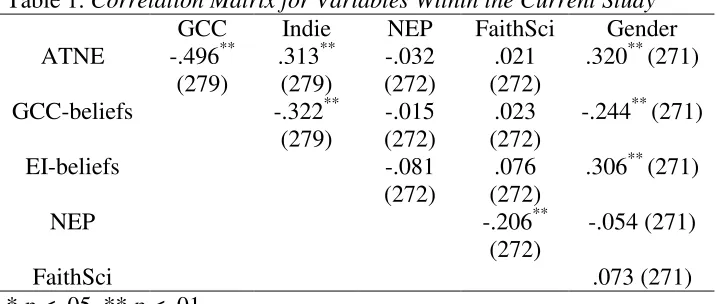
variables related before analyses, I entered them into a correlation matrix (See Table 1). Given
that gender was related to both predictors (GCC- and EI-beliefs) and outcome variables, it was
appropriately used as a covariate. Data met all assumptions. That is, it was determined that (a)
residuals were normally distributed based on an examination of a histogram for standardized
residuals against the normal curve, (b) residuals appeared to be linear based on a scatter plot of
each predictor and the corresponding residuals which were equally distributed around the Loess
line and Ordinary Least Square lines, (c) data were heteroscedastic based on scatter plots of the
residuals and each predictor, (d) data were not multicollinear given that the variance inflation
factor did not surpass 1.5 (a 4 is generally considered problematic) for any variable within either
Table 1. Correlation Matrix for Variables Within the Current Study
GCC Indie NEP FaithSci Gender
ATNE -.496** (279) .313** (279) -.032 (272) .021 (272)
.320** (271)
GCC-beliefs -.322**
(279)
-.015 (272)
.023 (272)
-.244** (271)
EI-beliefs -.081
(272)
.076 (272)
.306** (271)
NEP -.206**
(272)
-.054 (271)
FaithSci .073 (271)
* p < .05. ** p < .01.
Note. Pearson’s r coefficients are reported as well as N in parentheses. ATNE = Attitudes toward nuclear energy. GCCbeliefs = Beliefs about climate change and nuclear energy. EIbeliefs = Beliefs about energy independence and nuclear energy. NEP = Environmental worldview. FaithSci = Faith in Science. BJW = Belief in a just world. Gender: Women = 1, Men = 2 (no respondents identified as Transgender).
3.2 Analyses
To test the six hypotheses, two separate moderation analyses were conducted using a
series of hierarchical multiple regressions, each with four different blocks of variables.
Hypotheses were tested using a 95% confidence interval. Gender was entered as a covariate in
the first block of each of the three moderation models. The second block entered was comprised
of the two belief variables (i.e., GCC-beliefs and EI-beliefs). The third block entered represented
the moderator variable which was environmental worldview for the first moderation analysis and
faith in science for the second analysis. The fourth and final blocks entered into each of the two
analyses were specific to each interaction term. For example, the fourth block within the
environmental worldview moderation analysis contained interaction terms for environmental
worldview by contribution toward climate change (GCC-beliefs) and by contribution to energy
independence (EI-beliefs). Interactions were assessed using the corrected version of the Johnson
Specifically, I used the “MODPROBE” command for use with the Stastistical Package for the
Social Sciences software (Hayes & Matthes, 2009). These analyses gave me the ability to show
that the effect of the focal predictor on the outcome predictor is statistically significant at any
point along the moderator continuum between certain thresholds. This technique has been
favored over the most typical moderation analysis (cites). Researchers typically assess the effect
of the predictor on the outcome at three points on the moderator: at the mean and at ± one SD;
the somewhat arbitrary selection of these three points along the moderator continuum may miss
important effects at other points.
3.3 Descriptives
The distribution of ATNE was positively skewed. Most participants (63%) were not
supportive of nuclear energy or maintained Reduce Somewhat or lower attitudes. The majority of
participants (59%) strongly believed that nuclear energy contributed to GCC (that it Moderately
Contributes or Contributes A Lot). About 55% of participants believed that nuclear energy
contributed to energy independence (making the U.S. Slightly More or Much More Independent).
Only about 2% of the current sample were strictly anthropocentric, or maintained a Somewhat
Disagree (2.5 or less out of five, one being Strongly anthropocentric) or lower attitude toward
eco-centrism. Conversely, about 65% were strictly eco-centric, or maintained a Somewhat Agree
or higher (3.5 or more out of five, five being Strongly eco-centric) attitude toward eco-centrism.
Faith in science appeared to be leptokurtic and positively skewed, whereby only 19% of
participants maintained a Somewhat Agree or higher (3.5 or more out of 5) attitude.
3.4 Gender and Beliefs About Nuclear Energy
By itself, gender accounted for about 10% of the variance in ATNE. Men were more
significantly explained more variance than the model containing gender alone. As EI-beliefs
grew stronger, ATNE became more positive, b = .21, t(265) = 2.29, p = .02. Holding other
predictors constant (Gender and GCC-beliefs), EI-beliefs explained about 10% of the variance in
ATNE.
3.5 Environmental Worldview Moderation Analysis
The interaction between GCC-beliefs and environmental worldview explained
significantly more variance in the model above and beyond the combined effect of gender,
EI-beliefs, and GCC-EI-beliefs, R2-change = .01, F(5, 265) = 4.02, p = .046. There was a small
interaction between GCC-beliefs and environmental worldview, b = .23, t(265) = 2.01, p < .05.
Because the omnibus F test revealed a significant interaction, I further analyzed this moderation
with the MODPROBE command. Results indicated that when environmental worldview was
4.26 or lower (scores ranged from 2.07 to 4.87 out of 5 on the NEP scale), the negative effect of
GCC-beliefs on ATNE was significant at any given point. That is, this negative relationship was
statistically significant only when environmental worldviews were more anthropocentric or
moderately eco-centric (when scores range between 2.07 and 4.26). There was not a relationship
between the predictor and the outcome when participants’ environmental worldviews were
strongly eco-centric (or between 4.26 and 4.87). For simplicity, Figure 3 illustrates the effect of
Figure 3. Simple Slopes for GCC-beliefs with Environmental Worldview on ATNE
Note. ATNE = Predicted attitudes toward nuclear energy. GCC-beliefs = Belief that nuclear energy contributes to climate change. NEP = environmental worldview. Anthropocentric = -1 SD on environmental worldview. Ecocentric = +1 SD on environmental worldview.
3.6 Faith in Science Moderation Analysis
The interaction between EI-beliefs and faith in science did not significantly explain more
variance in the model above and beyond the combined effect of gender, EI-beliefs, and GCC-
beliefs, R2-change = .005, F(5, 265) = 1.74, p = .19. Because this omnibus F-test was not
significant, I did not further probe this interaction. The main effect of faith in science also did not
4 Discussion
The current study explored ATNE in the context of recent public discourse around GCC
and nuclear energy. Three of six hypotheses were supported. EI-beliefs had a small effect on
ATNE. Data supported the hypothesis that environmental worldview would moderate the
relationship between GCC-beliefs and ATNE. Only when participants’ environmental
worldviews were highly eco-centric did the medium negative effect of GCC-beliefs on ATNE
become non-significant. This was a small moderation effect. I interpret this as meaning that for
eco-centric-leaning individuals, there may be other reasons why they have low ATNE when they
believe that nuclear energy is “green” in terms of greenhouse gas emissions. In comparison to
coal and oil, nuclear energy does produce less greenhouse gas overall and for
anthropocentric-leaning and moderate centric individuals this predicts positive ATNE. However, for
eco-centric-leaning individuals the belief that this nuclear energy is “green” does not necessarily
mean that they will have positive ATNE.
It is also important to note the hypotheses that were not supported. I maintain that
environmental worldview moderated the relationship between GCC-beliefs and ATNE but did
not moderate the relationship between EI-beliefs and ATNE because there is a more obvious link
between environmental worldview and GCC (they both pertain to the earth and its environment).
Conversely, whereas environmental worldview pertains to the environment, energy
independence instead pertains to the localization of energy production and jobs (which may not
be perceived as environmental in nature).
4.1 On Previous Literature: Similarities and Differences
Data were generally congruent with the orienting concepts on which the current study
the expectancy-value model—a model that I did not methodologically examine but one that
guided my conceptualization of the relationship between the predictors and outcome variable.
That is, I did not assess the extent to which participants rated their beliefs about nuclear energy
as being positive or negative in nature (cf., Fishbein, 1963). I instead assumed that GCC-beliefs
were generally negative beliefs and that EI-beliefs were generally positive beliefs in terms of
their respective relationships with ATNE. Despite this difference in approach, current findings
were congruent with those reported by previous ATNE researchers (cf., Hughey et al., 1983;
Hughey et al., 1985; Lounsbury et al., 1979; Sundstrom et al., 1981; Sundstrom et al, 1977) and
risk perception researchers (cf., Sjöberg & Drottz- Sjöberg, 2008). That is, expectations—in the
current study, GCC-beliefs and EI-beliefs—were predictors of ATNE; however, the negative
effect of GCC-beliefs on ATNE is only statistically significant when participants are more
anthropocentric. Also, given my conceptual understanding of the way worldviews work as a
filter on the relationship between beliefs about nuclear energy and ATNE, the moderation effect
of environmental worldview on the relationship between environmental worldview and
GCC-beliefs were expected. However, no previous researchers have assessed whether these variables
were related in this way.
The current investigation shares the outcome variable used by Ansolabehere (2007) and
Ansolabehere and colleagues (2003). In congruence with the current study, Ansolabehere and
colleagues (2003) found that, on average, participants maintained Reduce Somewhat attitudes
toward nuclear energy. In contrast to Ansolabehere’s (2007) findings, our participants held
substantially less favorable attitudes toward nuclear energy sources. This might be explained by
a number of differences in our samples. For example, as compared to Ansolabehere’s (2007)
compromised of young, diverse adult women who differed from the US population.
Ansolabehere and company’s (2003) sample was also substantially different than the current
college sample. Ansolabehere (2007) found that participants in the South (the setting for the
current study) were more likely than participants from other geographical areas in the US to be
supportive of all energy sources. This was not the case for the current sample, which clearly
showed much less support for nuclear energy. Ansolabehere’s (2003) earlier study showed that
participants were less supportive of nuclear energy—much like the current study—whereas
Ansolabehere’s (2007) later study showed that participants were relatively more supportive (but
still not in full support). These differences illustrate that college students from diverse
backgrounds currently do not support nuclear energy just as a representative sample of the U.S.
public did not (Ansolabehere et al., 2003).
Previous research did not fully address the relationship between worldview and ATNE.
Instead, the bulk of this research has delved into its effect on risk perception with respect to
nuclear energy. For the current study, neither worldview moderator variables (environmental
worldview nor faith in science) affected ATNE or GCC-beliefs (which is similar to previous
findings related to risk perception). These findings are incongruent with the only existing
investigation with respect to the relationship between faith in science and ATNE. Assuming that
GCC-beliefs are indicative of nuclear risk perception, the null results with respect to
environmental worldview is congruent with previous research (cv., Whitfield et al., 2009).
However, these findings are incongruent with other studies focused on risk perception, broadly.
For example, Peters and Slovic (1996) found worldview to be an important predictor of risk
perception, and—more specifically—other papers have highlighted the importance of faith in
Sjöberg, 2008) and ATNE (see Baxter, 1988). None of these previous papers have assessed
worldview as a moderator of ATNE so it is difficult to compare the current study with previous
literature in terms of interactions.
Finally, current data show that ATNE still appear to be gendered whereby those who
identified as men held more favorable attitudes than those who identified as women. This finding
is congruent with earlier ATNE research (see Culley & Angelique, 2003; Davidson &
Freudenburg, 1996; Vleeming, 1985) but incongruent with contemporary ATNE research (cv.
Ansolabehere et al., 2003; Freudenburg & Davidson, 2007; Sjöberg & Drottz- Sjöberg, 2008).
Future researchers may investigate this from a feminist perspective to better understand why
ATNE are gendered and whether it has to do with the nuclear macho phenomenon described by
Culley and Angelique (2003).
4.2 Implications
The current study is the first study to examine the effects of GCC-beliefs and EI-beliefs
(both salient in the current nuclear energy debate) on ATNE. Most other research has largely
been conducted post-disaster (after Chernobyl and Three Mile Island) or during site-specific
planning and construction of nuclear facilities. Findings suggested that beliefs relevant to current
nuclear energy discourse influences ATNE in ways that are dependent on worldview. For those
with a more eco-centric environmental worldview, the arguments made by nuclear proponents
concerning nuclear energy and GCC appear to be less effective in garnering positive ATNE from
college students. In addition, regardless of worldview, as college students’ GCC-beliefs become
stronger, they are more likely to maintain unfavorable ATNE. This illustrates an important point
for nuclear opponents and proponents alike: GCC-beliefs are a salient predictor of ATNE.
Conversely, I argue that it may be beneficial for nuclear opponents to call into question nuclear
proponents’ assertions that nuclear energy is a ‘carbon-free’ or ‘green’ solution to GCC—
assertions which have been called into question (see Smith, 2006; Wald & Bradsher, 2010,
February 19), and which have implications for ATNE among college students.
4.3 Limitations and Future Research
The current study was limited in several ways that could be addressed with future
research. First, representative community samples that reflect those living near proposed nuclear
reactors should be preferred over college samples because community members will likely bear
the majority of proximal risks (e.g., radiation release, sabotage, etc.) or benefits (e.g., increased
local tax base). Further, given that the outcome was measured with one-item, reliability could not
be determined. However, balancing this is the fact that only a handful of researchers have
assessed attitudes toward nuclear issues by using scales with more than one item (e.g., Eiser, van
der Plight & Spears, 1989; Lee & Balchin, 1995; Peters & Slovic, 1996 Sjöberg, 2003). In other
words, it is fairly commonplace within the literature to measure ATNE with a single item. That
this measure was related to the constructs in a way that was congruent with my understanding of
the relationship between beliefs about nuclear energy and ATNE provided some evidence of the
predictive validity of the current model. I believe this one-item measure also maintained
sufficient content validity. That is, the ATNE survey item pertains to favorability toward nuclear
energy via U.S. energy law preference and this is the essence of the current paradigm of
favorability or non-favorability toward nuclear energy. Future researchers might instead consider
Lee and Balchin’s (1995) 30-item ATNE scale, a more complete and nuanced measure of ATNE.
Future researchers might also utilize qualitative methods to develop a richer
what do those who live near Plant Vogtle in Georgia (the site to receive the first of the federal
subsidies for new reactors) think about Obama’s proposed taxpayer-supported loan guarantees
for the proposed reactors? Interestingly, previous researchers have noted that public meetings
regarding the proposed reactors have been dominated by powerful supporters of nuclear energy
from outside the area (see Culley & Angelique, in press). As these authors noted, in these
meetings, it appeared that the voices of African-American residents (who comprise more than
62% of the area population) were largely absent, which raises troubling questions about
environmental injustice and citizen participation. What are the beliefs and attitudes about nuclear
energy in general and Obama’s speech specifically maintained by people of color living in the
shadows of the reactors versus the nuclear proponents who dominated the town hall meeting?
The answer to such questions could shed some light on how the nuclear renaissance is
experienced differentially across groups. Qualitative data could also shed light on why men are
more supportive of nuclear energy than women, which was shown to be the case in much of the
classic ATNE research (see Davidson & Freudenburg, 1996). Some researchers have
previously—and non-cogently—offered biological arguments to explain why ATNE are
gendered (e.g., Drottz-Sjöberg, & Sjöberg, 1990) whereas other researchers, operating from a
feminist perspective have asserted that women may be more anti-nuclear than men because of
their heightened concern about the effects of radiation on children (Nelkin, 1981). Researchers
might re-assess this from a feminist lens to illuminate the socio-political underpinnings of this
phenomenon. More specifically, researchers might ask why men are supportive of nuclear
instead of focusing on why women are not.
Finally, future research might focus on renewable energy sources as they have been
into the preferences of the public in terms of renewable energy sources vs. non-renewable energy
sources. Previous researchers (Ansolabehere, 2007; Ansolabehere et al., 2003; Culley, Carton,
Ogley-Oliver, Street & Weaver, 2010) have shown that people in the U.S. and U.S. college
students overwhelmingly support renewable energy sources over non-renewable energy sources.
Given that ATNE research has been around since the 1970s it is time that researchers got more
precise in their measurement of this construct. Also, it is essential that ATNE researchers
continue to delve into pro- and anti-nuclear rhetoric to explore additional beliefs about nuclear
5 References
A Bill to Create Clean Energy Jobs, Promote Energy Independence, Reduce Global Warming
Pollution, and Transition to a Clean Energy Economy, S. 1733, 111th Cong. (2009). Alexievich, S. (2006). Voices from Chernobyl. New York: Picador.
Alldred, M. & Shrader-Frechette, K. (2009). Environmental injustice in siting nuclear plants.
Environmental Justice, 2(2), 85-96.
American Clean Energy and Security Act of 2009, H.R. 2454, 111th Cong. (2009).
Angelique, H. L., & Culley, M. R. (2007). History and theories of community psychology in the
US: Returning to political, critical and ecological roots. In: S. Reich , M. Riemer, I.
Prilleltensky, & M. Montero (Eds.), International community psychology: History and
theories.
Ansolabehere, S. (2007). Public attitudes toward America’s energy options: Insights for nuclear
energy (Tech. Rep. No. 8). Cambridge, MA: Massachusetts Institute of Technology,
Center for Advanced Nuclear Energy Systems.
Ansolabehere, S., Deutch, J., Driscoll, M., Gray, P. E., Holdren, J. P., Joskow, P. L., et al.
(2003). The future of nuclear power: An interdisciplinary MIT study. Cambridge, MA:
Massachusetts Institute of Technology.
Baxter, R. (1988). Gender differences in attitudes toward nuclear power: A multivariate
explanation. Unpublished doctoral dissertation, Washington State University, Pullman.
Bem, D. J. (1967). Self-Perception: An Alternative Interpretation of Cognitive Dissonance
Phenomena. Psychological Review, 74, 183-200.
Bennhold, K. “Nuclear comeback fuels terror worry.” International Herald Tribune, October 18,
Civil Society Institute. (May, 2006). American views of alternative energy choices: Wind, solar
and nuclear energy. Accessed August 2, 2008 from
http://www.civilsocietyinstitute.org/reports/R_CSI%20Alternative%20Energy%20524.pd
f
Culley, M. R. & Angelique, H. (2010). Nuclear Power: Renaissance or Relapse?
Global Climate Change and Long-Term Three Mile Island Activists’ Narratives.
American Journal of Community Psychology, published online March 16, 2010:
http://www.springerlink.com/content/v3253075636x2625/
Culley, M. R. & Angelique, H. (in press). Participation, power, and the role of community
psychology in environmental disputes: A tale of two nuclear cities. American Journal of
Community Psychology Special Issue: Community Psychology and Global Climate
Change. M. Reimer & S. Reich (Guest Eds).
Culley, M. R., Carton, A. D., Ogley-Oliver, E., Street, J. C., Weaver, S. R. (2010). Sun, wind,
rock and metal: Attitudes toward energy sources in the context of climate change and the
current energy debate. Manuscript submitted for publication.
Curry, T. E., Relner, D. M., de Figueiredo, M. A. & Herzog, H. J. (2005). A survey of public
attitudes towards energy and environment in Great Britain (Tech. Rep. No. LFEE
2005-001 WP). Cambridge, MA: Massachusetts Institute of Technology, Laboratory for
Energy and the Environment.
Dake, K. (1992). Myths of nature: Culture and the social construction of risk. Journal of Social
Issues, 48(4), 21-37.
Davidson, D. J. & Freudenburg, W. R. (1996) Gender and environmental risk concerns: A
Drottz-Sjöberg, B. & Sjöberg, L. (1990). Risk perception and worries after the Chernobyl
accident. Journal of Environmental Psychology, 10, Special issue: Psychological fallout
from the Chernobyl nuclear accident, 135-149.
Dunlap, R. & Van Liere, K. D. (1984). Commitment to the dominant social paradigm and
concern for environmental quality, Social Science Quarterly, 65, 1013-28.
Dunlap, R. E., & Van Liere, K. D. (1978). The “new environmental paradigm”: A proposed
measuring instrument and preliminary results. Journal of Environmental Education, 9,
10-19.
Dunlap, R. Van Liere, K. D., Mertig, A., & Emmet Jones, R. (2000). Measuring endorsement of
the new ecological paradigm: A revised NEP scale. Journal of Social Issues, 56, 425-442.
Eiser, J. R., Hannover, B., Mann, L., Morin, M., & van der Pligt, J. (1990). Nuclear attitudes
after Chernobyl: A cross-national study. Journal of Environmental Psychology, 10,
Special issue: Psychological fallout from the Chernobyl nuclear accident, 101-110.
Eiser, R. J., van der Plight, J., & Spears, R. (1989). Local residents’ attributions for nuclear
decisions. Basic and Applied Social Psychology, 10, 141-148.
Federal News Service (2010 February 16). Remarks by President Barack Obama, subject:
Energy jobs. Retrieved on February 26, 2010, from
http://www6.lexisnexis.com/publisher/EndUser?Action=UserDisplayFullDocument&org
Id=574&topicId=25188&docId=l:1129142256&start=10
Festinger, L. (1957). A theory of cognitive dissonance. Stanford, CA: Stanford University Press.
Fishbein, M. (1963). An investigation of the relationship between beliefs about an object and the
Fishbein, M. and Hunter, R. (1964). Summation versus balance in attitude organization and
change. Journal of Abnormal and Social Psychology, 69, 505-510.
Freudenburg, W. R. & Davidson, D. J. (2007). Nuclear families and nuclear risks: The effects of
gender, geography, and progeny on attitudes toward a nuclear waste facility. Rural
Sociology, 72(2), 215-243.
Georgia State University. (2009). Georgia State University Fact Sheet. Retrieved on April 19,
2009, from http://www.gsu.edu/factsheet.html
Hayes, A. F., & Matthes, J. (2009). Computational procedures for probing interactions in OLS
and logistic regression: SPSS and SAS implementations. Behavior Research Methods,
41, 924-936.
Hine, D. W., Summers, C., Prystupa, M., & McKenzie-Risher, A. (1997). Public opposition to a
proposed nuclear waste repository in Canada: An investigation of cultural and economic
effects. Risk Analysis, 17, 293-302.
Hughey, J. B., Lounsbury, J. W., & Sundstrom, E., Mattingly, T. J. II. (1983). Changing
expectations: A longitudinal study of community attitudes toward a nuclear power plant.
American Journal of Community Psychology, 11, 655-672.
Hughey, J. B., Sundstrom, E., Lounsbury, J. W. (1985). Attitudes toward nuclear power: A
longitudinal analysis of expectancy-value models. Basic and Applied Social Psychology,