https://doi.org/10.5194/hess-21-3655-2017 © Author(s) 2017. This work is distributed under the Creative Commons Attribution 3.0 License.
HESS Opinions: A conceptual framework for assessing
socio-hydrological resilience under change
Feng Mao1, Julian Clark1, Timothy Karpouzoglou2, Art Dewulf2, Wouter Buytaert3,4, and David Hannah1 1School of Geography, Earth and Environmental Sciences, University of Birmingham, Birmingham, UK
2Public Administration and Policy Group, Wageningen University & Research, Wageningen, the Netherlands 3Department of Civil and Environmental Engineering, Imperial College London, London, UK
4Grantham Institute – Climate Change and the Environment, Imperial College London, London, UK
Correspondence to:Feng Mao ([email protected])
Received: 24 September 2016 – Discussion started: 19 October 2016 Revised: 21 May 2017 – Accepted: 30 May 2017 – Published: 20 July 2017
Abstract.Despite growing interest in resilience, there is still significant scope for increasing its conceptual clarity and practical relevance in socio-hydrological contexts: specifi-cally, questions of how socio-hydrological systems respond to and cope with perturbations and how these connect to resilience remain unanswered. In this opinion paper, we propose a novel conceptual framework for understanding and assessing resilience in coupled socio-hydrological con-texts, and encourage debate on the inter-connections between socio-hydrology and resilience. Taking a systems perspec-tive, we argue that resilience is a set of systematic proper-ties with three dimensions:absorptive, adaptive, and trans-formative, and contend that socio-hydrological systems can be viewed as various forms of human–water couplings, re-flecting different aspects of these interactions. We propose a framework consisting of two parts. The first part addresses the identity of socio-hydrological resilience, answering ques-tions such as “resilience of what in relation to what”. We identify three existing framings of resilience for different types of human–water systems and subsystems, which have been used in different fields: (1) thewater subsystem, high-lighting hydrological resilience to anthropogenic hazards; (2) thehuman subsystem, foregroundingsocial resilienceto hydrological hazards; and (3) thecoupled human–water sys-tem, exhibitingsocio-hydrological resilience. We argue that these three system types and resiliences afford new insights into the clarification and evaluation of different water man-agement challenges. The first two types address hydrological and social states, while the third type emphasises the feed-backs and interactions between human and water
compo-nents within complex systems subject to internal or external disturbances. In the second part, we focus on resilience man-agement and develop the notion of the “resilience canvas”, a novel heuristic device to identify possible pathways and to facilitate the design of bespoke strategies for enhancing resilience in the socio-hydrological context. The resilience canvas is constructed by combining absorptive and adaptive capacities as two axes. At the corners of the resulting two-dimensional space are four quadrants which we conceptu-alise as representing resilient, vulnerable, susceptible, and resistant system states. To address projected change-induced uncertainties, we recommend that efforts now be focused on shifting socio-hydrological systems from resistant towards resilient status. In sum, the novel framework proposed here clarifies the ambiguity inherent in socio-hydrological re-silience, and provides a viable basis for further theoretical and practical development.
1 Introduction
An-thropocene. While presenting hydrological complexity from different viewpoints, both approaches highlight the interrela-tionship of human and water systems as one prone to instabil-ity. Shifting hazard regimes and altering external conditions caused by human-induced change means dealing with un-certainties, and the prospect of system degradation to unde-sired states and/or collapse. This opens up questions of how socio-hydrological systems respond to perturbations and fu-ture management uncertainties, making it an opportune time to explore the concept of resilience in socio-hydrological contexts.
Since its introduction in the 1970s, the idea of resilience has evolved from a descriptive notion to a normative con-cept with broad and often ambiguous meanings (Brand and Jax, 2007; Olsson et al., 2015; Weichselgartner and Kelman, 2015). Some authors have observed that this lack of con-ceptual clarity hinders the application of resilience thinking (Strunz, 2012), raising questions of how to apply the con-cept to socio-hydrological systems. In the coupled human– water context, resilience is now used in many different ways, such as hydrological resilience, aquatic ecological resilience, community and urban resilience to hydrological disasters, and resilience of water cycles (Rockström et al., 2014). Yet these applications do not always capture the essence of socio-hydrological dynamics or lend support to inter-disciplinary resilience research. We argue that this is because of our lim-ited understanding of human–water couplings and hence the type of resilience that adheres to systems, as much as it is a product of lack of clarity in analysing systematic change. As a result, system identities need defining before examination is undertaken of their intrinsic resilience types (Cumming et al., 2005).
Our aim here is to propose a conceptual framework for assessing resilience in socio-hydrological contexts, and by which we provide opinions for understanding and manag-ing socio-hydrological resilience. Instead of offermanag-ing a sin-gle prescriptive solution, this framework supports pluralist perspectives and encourages debate on socio-hydrology and its interrelations with resilience. The paper’s structure is as follows. In Sect. 2, we examine the relationship between resilience, system type and capacities, and characterise re-silience as a set ofabsorptive, adaptive, andtransformative properties of the system. In Sect. 3, we classify three types of human–water couplings and their associated resilience forms. Within this classification, we propose studying socio-hydrological resilience, and explain how this differs from the existing notions of hydrological and social resilience. We also show how different resilience capacities arise in each human–water coupling type. We proceed to argue that socio-hydrological systems and subsystems and their attendant re-silience dynamics can be characterised using the conceptual toolkit of ecosystem services, as this approach effectively classifies dominant processes of human–water interactions already. In Sect. 4, we show how to implement the new con-cept of socio-hydrological resilience. To do so, we develop
the notion of a “resilience canvas” to specify pathways to-ward particular socio-hydrological resilience states. We anal-yse the role of different resilience capacities in water man-agement under change, and identify fields of further enquiry. Our overall conclusion is that to enhance system capacity to face future uncertainties requires a concerted shift away from resistance to resilient water management.
2 Resilience, systems, and capacities
The concept of resilience has many definitions, and is rou-tinely used in multiple fields in widely contrasting contexts (Brand and Jax, 2007). Our aim here is not to focus on this variety, but instead to characterise how resilience is inter-preted in order to clarify its relationship to other concepts, especially systemic capacities and properties (Anderies et al., 2004; Klein et al., 2003; Plummer and Armitage, 2007). Re-silience is usually defined as the capacity of a system to ab-sorb disturbance without substantially challenging its func-tion or structure (Walker et al., 2004). In a more generalised definition, resilience is “the capacity to persist in the face of change, to continue to develop with ever changing environ-ments” (Folke, 2016, p. 2). Thus, this concept is understood as a set of systemic absorptive, adaptive, and transforma-tive capacities, which offers scope for its conceptualisation in three dimensions – persistence for now, and response for future contingencies in incremental or in radical ways (Béné et al., 2014; Miller et al., 2011). A clear understanding of the overallsystemis thus an essential precursor to any evaluation of its resilience, since it determines what the identity or sub-ject of resilience is (Carpenter et al., 2001; Evans and Reid, 2013). A system refers to a set of interacting components forming a complex whole, which is delineated by its bound-aries, surrounded by its environment, and characterised by its structure and functions (Backlund, 2000; Limburg et al., 2002). However, many socio-hydrological systems have am-biguous boundaries, making it difficult to examine resilience. So, for example, referring to “the system” may mean compo-nents or parts of the whole human–water interaction, such as the water subsystem with anthropogenic drivers, or to the human subsystem with hydrological drivers, or to the socio-hydrologicalsystem, which emphasises the feedbacks and interactions between human and water processes in a bal-anced and integrated perspective.
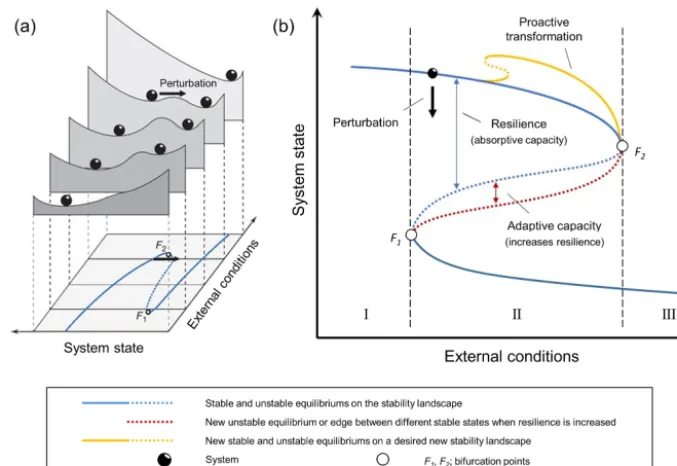
vari-Figure 1.Bifurcation diagrams for socio-hydrological resilience:(a)stability landscape changes along with external conditions, adapted from Scheffer et al. (2001);(b)Bifurcation diagram illustratingabsorptive, adaptive, andtransformativecapacities. The two dashed lines acrossF1 andF2 divide the bifurcation process into three phases. Phase I and III have only one stable equilibrium, while Phase II has two stable equilibriums. Perturbations in Phase II may drive the system from one stable state to another. Absorptive capacity refers to the original meaning of resilience; adaptive capacity refers to the capability to increase resilience in response to external change (red line); transformative capacity refers to the capacity to respond more radically, such as through proactively navigating the system to a desired new stability landscape (yellow line). Panel(a)is adapted with permission from Macmillan Publishers Ltd: Nature Vol. 413 Issue 6856, Scheffer et al., copyright 2001.
ables (Walker et al., 2012). Hazards are threats to a sys-tem, usually comprising occasional, recurrent, and continu-ous perturbations (Gómez-Baggethun et al., 2012; Kuo et al., 2012; Turner et al., 2003) such as diffuse pollution, land-use change, drought, and flooding. External conditions or con-trolling variables include changing climate altering the in-fluence of legal and socio-cultural contexts and the role of science and technology on thestability landscapewhich is used here as a metaphor to describe the resilient process of systems (see Dent et al., 2002; Scheffer et al., 2001). Sys-tems can shift from one position to another, which can result in large, abrupt, long-lasting changes to their structure and function (Biggs et al., 2009). Resilience management seeks both to reduce hazards to prevent the system shifting to an undesirable position (e.g. degradation of ecosystems and liv-ing standards) and to move the system toward a desired po-sition. The stability landscape itself can also alter because of change in slow variables. This resilience process is usu-ally represented as a bifurcation diagram, showing the system state as a ball moving between equilibrium positions (Schef-fer et al., 2001; see Fig. 1).
Thinking through how absorptive, adaptive, and trans-formative capacities feature in these diagrams opens up new possibilities for understanding systematic and resilience properties (Walker et al., 2004, 2009). Based on Fig. 1a,
[image:3.612.128.467.66.299.2]eco-logical, economic, or social structures are untenable (Folke et al., 2010; Walker et al., 2004). Transformations aim to navigate the systematic transitions from an undesired stabil-ity landscape to a new, desired state (Folke et al., 2010, see Fig. 1b; Walker et al., 2009). Proactive transformation may be attempted if change in external conditions is so great that incremental improvement through adaptive capacity is inad-equate to meet managerial goals (Béné et al., 2014; Ernstson et al., 2010).
3 A typology of human–water couplings and resilience framings
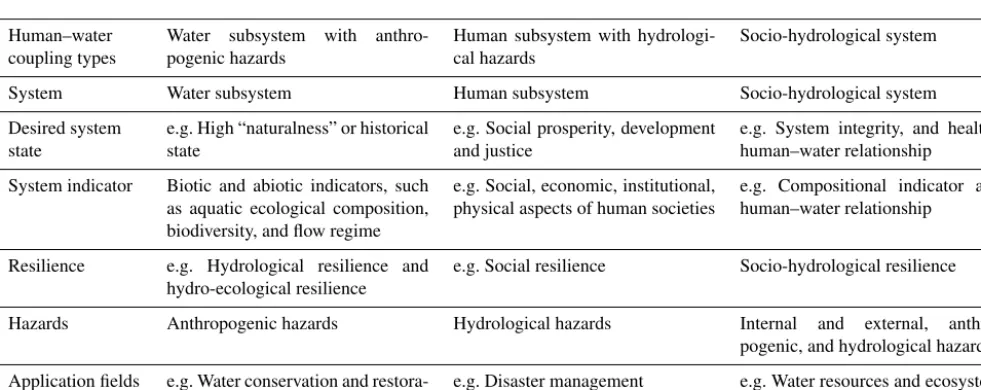
The importance of using resilience in the coupled human– water context is increasingly evident in both academic and public policy fields, ranging from aquatic ecosystem con-servation (Khamis et al., 2013; Sala et al., 2000) to hy-drological risk management (Adger et al., 2005; Halle-gatte et al., 2013) and sustainable water use and develop-ment (Pahl-Wostl et al., 2013; Vorosmarty et al., 2000). For the reasons explained already, it is critical to clarify the character of resilience in socio-hydrological contexts which in turn is determined by the human–water coupling type. Hence, we identify three types of human–water cou-plings with their own resilience framings: (1) thewater sub-system, with hydrological resilience to anthropogenic haz-ards; (2) thehuman subsystem, with social resilience to hy-drological hazards; and (3) the socio-hydrological system, with socio-hydrological resilience (Fig. 2). We therefore ar-gue that socio-hydrological resilience should refer to re-silience of socio-hydrological systems as a whole, which is one specific type of resilience in socio-hydrological con-texts. These three types represent different perspectives from which to approach and understand socio-hydrological sys-tems and human–water interactions, whilst emphasising that humans and water are fundamentally interrelated. The for-mer two types focus on intrinsic hazard–subsystem relations, while the latter covers these subsystem relations and the broader and more iterative interplay between them. Here, it is worth noting that socio-hydrology and hydro-sociology have close connections (Sivakumar, 2012), but different emphases (Wesselink et al., 2016). Here we adopt Sivapalan’s inter-pretation of socio-hydrology which has as its focus the co-evolution and feedbacks of coupled human–water systems (Sivapalan et al., 2012). Thus these three types of coupling encapsulate how different fields (e.g. conservation, disaster management, and water resources management) deal with human–water couplings, rather than normative expectations of what people should (or should not) do. In the following subsections, features such as resilience subjects, desired sys-tem states, indicators, and application fields are examined for each type of resilience framing (Table 1).
3.1 Water subsystem with anthropogenic hazards Resilience was advanced initially as a phenomenon of fresh-water ecosystems to explain the dramatic change in aquatic ecosystems precipitated by anthropogenic disturbance (Ta-ble 1), such as algal blooms caused by nutrient enrichment and fish population collapses triggered by overharvesting (Holling, 1973). Based on these cases, this type of coupling describes a particular aspect of human–water interactions, which focuses on water subsystems and external anthro-pogenic factors shaping water subsystems. However, from this perspective the human subsystem and its attendant hy-drological hazards are not the main emphasis.
Resilience has since been used in many water subsys-tems, such as lakes, rivers, and oceans (Dudgeon et al., 2006; e.g. Gibbs, 2009; Hoegh-Guldberg et al., 2008; Willis et al., 2010), where hydrological conditions can be measured by surrogate indicators (e.g. Holling, 1973) or through examin-ing other biotic or abiotic components. This couplexamin-ing model is primarily used in aquatic ecosystem conservation and man-agement, where the goal is to maintain subsystem equilib-rium or restore it to a desired historical state. Climate change or increased human hazards may degrade aquatic ecosystems or propel them to irreversible undesired end states (O’Reilly et al., 2003; Sala et al., 2000), prompting a need to con-sider options for resilient water management (Mace, 2014). For example, climate change and ocean acidification together with local anthropogenic stress decrease sea water quality, alter community structure and diversity, change species dis-tribution, and might even push ecosystems such as coral reef to functional collapse (Carpenter et al., 2008; Doney et al., 2012; Hoegh-Guldberg and Bruno, 2010). In such cases, aquatic organisms (e.g. macroinvertebrates and macro-phytes) can be used for biological monitoring to assess ad-verse human impacts on species and ecosystems (e.g. Miller et al., 2007; Ozkan et al., 2010). Ecological indicators have been developed for river basin management in many regions of the world (Bunn et al., 2010; Josefsson and Baaner, 2011). Attention has also been paid to the resilience of hydrologi-cal aspects of water systems under climate change, extreme weather and alteration in land cover (Harder et al., 2015; Pe-terson et al., 2012). Better understanding of multiple steady hydrological states and the process interaction of switching between states can inform adaptive water management (Bot-ter et al., 2013).
Figure 2.Schematic diagram of three human–water coupling types, each foregrounding different aspects of the socio-hydrological sys-tem.(a)Water subsystem with anthropogenic hazards, where the human subsystem, water impacts on human subsystem, or other forms of human impacts on the water subsystem are not the main focus.(b)Human subsystem with hydrological hazards, where, similarly to the water subsystem, human impacts on water subsystem or other forms of water impact on the water subsystem are not emphasised.(c) Socio-hydrological system with water and human subsystems and anthropogenic and Socio-hydrological hazards as two of many forms of human–water interactions.
Table 1.A comparison of three types of human–water couplings and resilience framings.
Human–water coupling types
Water subsystem with anthro-pogenic hazards
Human subsystem with hydrologi-cal hazards
Socio-hydrological system
System Water subsystem Human subsystem Socio-hydrological system
Desired system state
e.g. High “naturalness” or historical state
e.g. Social prosperity, development and justice
e.g. System integrity, and healthy human–water relationship
System indicator Biotic and abiotic indicators, such as aquatic ecological composition, biodiversity, and flow regime
e.g. Social, economic, institutional, physical aspects of human societies
e.g. Compositional indicator and human–water relationship
Resilience e.g. Hydrological resilience and hydro-ecological resilience
e.g. Social resilience Socio-hydrological resilience
Hazards Anthropogenic hazards Hydrological hazards Internal and external,
anthro-pogenic, and hydrological hazards
Application fields e.g. Water conservation and restora-tion
e.g. Disaster management e.g. Water resources and ecosystem services management
adaptive capacity does not exclude anthropogenic contribu-tions, and can be achieved by restoring the biodiversity and integrity of aquatic ecosystems. Transformative capacity is seldom used in this water-subsystem-centred type, because the idea of creating an entirely new system is inconsistent with the philosophy of conservation, which focuses on main-taining the natural world.
3.2 Human subsystem with hydrological hazards
[image:5.612.53.544.393.588.2]re-silience from this perspective is on how hydrological haz-ards affect human subsystems and how human societies re-spond to these hazards, rather than how water subsystems are changed by human activities. This human–hydrological cou-pling is commonly applied in disaster management (Kelman et al., 2015; Sudmeier-Rieux, 2014), where resilience is de-rived from capacity-building within human systems to better cope with more frequent hydrological shocks (for example, those induced by climate change; Adger et al., 2005; Aerts et al., 2014).
Human subsystems have many facets and their state is described through numerous indicators and disciplinary ap-proaches. Similarly, resilience understandings vary widely. Meerow et al. (2016) describe human subsystems as com-plex arrangements of processes and phenomena at many dif-ferent scales and levels. Reviewing 675 articles on resilience, Ostadtaghizadeh et al. (2015) identify five main domains of human subsystems, comprised of social, economic, institu-tional, physical, and natural categories. For example, hydro-logical hazards may cause injuries, death, and property and infrastructure loss (Liao, 2012), which can be quantified to estimate the approximate cost of disasters (Keating et al., 2015). Apart from this physical aspect, socio-economic con-dition can also be used to capture the degree of resilience of human systems to hydrological impacts, with economic growth, incomes and livelihoods often used as proxies (Ku-mar, 2015; Plummer and Armitage, 2007).
Resilience of human systems is usually evaluated from so-cial science perspectives (Lorenz, 2013; Olsson et al., 2015), through concepts such as social capital and network struc-tures, institutions, and power relations. Knowledge and dis-courses have received increased attention (Keck and Sak-dapolrak, 2013; Wyborn, 2015). Cutter et al. (2008, 2010) highlight “community competence” as capacities to under-stand risks, promote individual physical and emotional health (Norris et al., 2008), and maintain cultural norms such as livelihood practices and social institutions (Crane, 2010). In-deed, recent studies highlight that an alternative approach to engage with challenges posed by resilience is to use a more theoretically pluralist perspective that enhances engagement and utilisation of insights from different angles, alongside in-sights gained from resilience scholarship (Karpouzoglou et al., 2016a).
Consequently, resilience from the perspective of manag-ing human subsystems tends to emphasise particular soci-etal expectations in relation to how to deal more holistically with hydrological hazards. If social aspects of human sub-systems are also considered, more anticipatory targets can be discerned. However, critics of resilience have argued that there is still significant scope for developing a more nuanced understanding of resilience and how it relates to society. Cote and Nightingale (2012) argue that there is still far less at-tention paid to normative and epistemological questions. For example, the policy use of resilience is often normative in the sense that it implies that resilience is always something
“good” to be strived for. However, the tendency to see re-silience as being an objectively defined desirable can cre-ate challenges for social scientists working with the concept (Olsson et al., 2015). An important point is that questions that relate to the power and politics of both how and who gets to define resilience need to be brought into the foreground of resilience research, otherwise resilience runs the risk of becoming a power-blind concept (Davoudi et al., 2012). A similar point is made by MacKinnon and Derickson (2012) in arguing that resilience as a concept is too conservative in outlook, because it embraces contemporary societal expec-tations rather than challenging them; they go further by ad-vocating a shift from resilience to resourcefulness as a con-cept that better matches the aims of emancipatory social sci-ences. West et al. (2014) have argued that some of the criti-cisms around resilience can be overcome through identifying better ways for researchers from social and natural science backgrounds to open new dialogues, so establishing common ground while identifying areas of disagreement.
In this type of framing, absorptive capacity is the abil-ity to defend from hydrological hazards, while social adap-tive capacity is a means to improve this ability and reduce the vulnerability of human subsystems including individu-als, communities, groups, and institutions in coping with wa-ter related shocks and changes (Bennett et al., 2014). Gupta et al. (2010) reviewed the existing literature and summarise six dimensions of adaptive capacity: variety and diversity of problem framing and solving, learning capacity, room for autonomous change, leadership, resources, and fair gover-nance. A similar conclusion is made by Bennett et al. (2014) in their four categories of adaptive capacity, which include flexibility and diversity, the capacity to organise, learning and knowledge, and access to assets. Besides incremental im-provements, human subsystems can even radically reorgan-ise communities and proactively transform into entirely new settings under global change. An extreme example is climate-change-induced migration; here, the subject of resilience under contingent hydrological impacts (populations at-risk) may abandon settlements, migrate to new locations, and re-structure human subsystems (Methmann and Oels, 2015).
3.3 Socio-hydrological system and its resilience
This third type of coupling foregrounds the states, conditions, and interactions of coupled human and water subsystems to build a more balanced understanding of their process inter-relationships, and highlights resilience of socio-hydrological systems to both internal and external hazards.
As discussed in the previous section, desired states of the water subsystem are usually high “naturalness” or historical conditions measured by biotic and abiotic indicators, while desired states of the human subsystem are more normative societal expectations set by relevant social groups. However, it is a challenge to define the current state as well as the desired state of this coupling type of human–water system, which helps to clarify the identity of socio-hydrological re-silience and to answer “rere-silience of what”. A conventional approach to evaluate coupled systems is to use composi-tional indicators (Meerow et al., 2016). Components from subsystems are assessed separately and then summed up to obtain a proxy value for the overall coupled system state. For example, a disaster resilience index usually regards the overall system as a comprised of constitutive ecosystem and human subsystem domains (i.e. social, economic, institu-tional, and physical; Ostadtaghizadeh et al., 2015). However, if used in the socio-hydrological context, this compositional approach cannot gauge the complex interactions and feed-backs of human–water coupling (Montanari et al., 2013). In-stead, measures are needed that model the dynamic interde-pendencies of continually interacting components (Gao et al., 2016). This demands a direct assessment of the coupled sys-tem using indicators or measures that depict multi-directional interactions. Examples include human benefits from hydro-logical systems, water-resource use, water-supported socioe-conomic development, governance over water, and societal and behavioural response to hydrological hazards (Carey et al., 2014; Elshafei et al., 2014). We argue that the notion of hydrological ecosystem services, which attempt to bridge the two subsystems, is a promising framework to describe the socio-hydrological state and to be incorporated into the re-silience thinking (Biggs et al., 2012, 2015; Engel and Schae-fer, 2013). In effect, the level of ecosystem services provision is the product of conflicting factors from both sides, such as human demand and ecosystem supply, human disturbances and ecosystem regulation and regeneration, and human man-agement and water resources.
The possibility that hydrological ecosystem services offer a good proxy of human–water intersections is also reflected by its normative goals. Thus, high ecosystem service provi-sion implicitly requires integration of at least three compo-nents. First is healthy biophysical systems. Robust ecosys-tem structure, processes, and functioning are necessary pre-conditions for the sustainable provision of ecosystem ser-vices (de Groot et al., 2002). Second is the intrinsic value of biophysical systems to human society, even if the value does not have a direct use (Pearson, 2016). Third is the range of established routeways in human societies to channel ben-efits from nature. This implies that using ecosystem services
to measure the state of socio-hydrological systems not only reflects the naturalness of the hydrological system, but also human preferences for the resulting coupled system (Du-four and Piégay, 2009). So a continuing supply of ecosys-tem services does not necessarily mean ecosysecosys-tems are pris-tine or close to a “natural” condition, but instead reflects the dependence of the human subsystem to select for par-ticular services (National Research Council, 2013; Zedler, 2000). Ecosystem management thus improves the resilience of ecosystems by deliberate human interventions to achieve a desired level of ecosystem services of a preferred sort.
According to the Millennium Ecosystem Assess-ment (2005), each water ecosystem provides multiple benefits to human society, including (1) providing services such as water, aquatic products, and hydropower; (2) reg-ulating services including water purification and flood and climate regulation; and (3) cultural services or nonmaterial benefits obtained from aesthetic or spiritual enrichment, recreation, scientific research, and educational activities. Vigerstol and Aukema (2011) identify four processes that produce water-related ecosystem services – water retention, water yield, natural water filtration, and water quality purification. Terrado et al. (2014) specify four hydrolog-ical ecosystem services vulnerable to climate extremes – drinking water, hydropower production, nutrient retention, and erosion control. Fisheries and products from aquatic ecosystems are essential for human societies but also subject to change, and need to be sustainable and resilient (Barange et al., 2014). Ecosystem services as a framework therefore link the human and water system, while being a viable basis for decision and policymaking (Brauman et al., 2007; Daily et al., 2009). Thus, managing socio-hydrological resilience can be understood as regulating and enhancing the resilience of ecosystem services that support livelihoods and human needs for protection from natural hazards, making it a viable proxy for socio-hydrological systems.
4 Pathways to resilience in the socio-hydrological context
Building on the preceding section, here we conceptualise re-silience in the socio-hydrological context as a normative goal that can be achieved through human intervention.
4.1 Resilience capacities and the resilience canvas Building resilience requires not only improvement of the ab-sorptive capacity to resist existing hazards, but also enhance-ment of system resilience to cope with future uncertainties. This is where the properties ofadaptiveandtransformative capacity advanced here enrich the socio-hydrological per-spective. By conceptualising resilience this way, represented by increased adaptive and transformative capacities, the need for incremental adjustment or radical improvement of sys-tematic states becomes clearer.
An analogy can be drawn with conservation ecology. Gill-son et al. (2013) use two axes of concerns (landscape vul-nerability and conservation capacity) to design conservation strategy. Based on this approach, here we introduce the re-silience canvas by combining two of the constitutive capac-ities as thex andy axes (Fig. 3). This section demonstrates how the resilience canvas can be constructed and applied, by emphasising the first two dimensions of resilience – absorp-tive capacity for current hazards and adapabsorp-tive capacity for future contingencies. The transformative capacity is not fo-cused on in the discussion because it requires some further exploration compared to the first two capacities – there is still an ongoing debate on what exact systematic attributes are needed to support a radical transformation to an entirely new stage (Robinson and Carson, 2015; Wilson et al., 2013). Here we keep the analysis of resilience capacities in a visu-ally simple way as a two-dimensional space instead of a “re-silience cube”, and select the first two capacities for demon-stration purposes.
Four resulting system states are found at the corners of the canvas: most resilient (top-right: high absorptive and high adaptive), vulnerable (bottom-left: low absorptive and low adaptive), susceptible (top-left: low absorptive and high adaptive), and resistant (bottom-right: high absorptive and low adaptive). These four quadrants are not static, and systems can move between them via structured manage-ment interventions over time, which we term “pathways”. A resilient–vulnerable gradient from top-right to bottom-left is shown on the canvas (Fig. 3).
4.2 Building pathways to resilience in socio-hydrological contexts
[image:8.612.340.509.68.235.2]The pathways on the resilience canvas represent a series of three hypothesised human intervention scenarios introduced to effect system change (see Haasnoot et al., 2013; See also Fig. 3). These are hypothesised in the sense that in adopting
Figure 3.“Resilience canvas” with absorptive and adaptive capac-ities as two axes, showing resilient–vulnerable gradient, resilience conditions, and pathways to resilience. The four dashed rectangles illustrate resilient, resistant, susceptible, and vulnerable system con-ditions. The grey arrows represent pathways, or a series of concerted interventions designed to drive systems from one condition to an-other.
a broad definition of resilience, these pathways could be very different depending on the social actors and hydro-social context of operation. However, for the purposes of illustrat-ing how the pathways approach could be useful in the case of the resilience canvas, pathways help steer socio-hydrological systems towards the “most resilient” status (i.e. top-right of the canvas). This is regarded for the purposes of this study as the most valued water management goal.
Susceptible socio-hydrological systems can be strength-ened by increasing absorptive capacity and by making hy-drological ecosystem services supply more robust and sus-tainable under current hazard regimes. For example, wa-ter pollution may decrease potable wawa-ter availability, while introducing vegetated buffer zones can protect water qual-ity (Hickey and Doran, 2004; Khamis et al., 2013); aquatic ecosystem degradation may shrink fish populations and food yield from aquatic products, and diversifying abiotic charac-teristics such as habitat supports the resilience of faunal pop-ulations (Bisson et al., 2009; Khamis et al., 2013). Hydrolog-ical disasters also deplete human benefits derived from water systems, and setting up early-warning systems can substan-tially increase the capabilities to deal with disasters (Adger et al., 2005).
an abiotic context, adaptive capacity can also be determined by features such as high river connectivity (Khamis et al., 2013), stable hydrological cycles (Thomas, 2016), and het-erogeneous landscape (Czucz et al., 2011). A second ap-proach is to raise social and institutional capabilities, such as accessibility to information and resources (Milman and Short, 2008), responsiveness to environmental change (Mal-hotra et al., 2007), enhanced institutional structure and gover-nance processes (Folke et al., 2005; da Silveira and Richards, 2013), boosted stakeholder participation (Few et al., 2007), and encouragement of learning and knowledge dissemina-tion and exchange (Pahl-Wostl, 2009).
Although pathways can be constructed for the four sys-tem states, factors that improve different capacities via differ-ent capacity sources (i.e. ecological–hydrological, social, or human–water interaction) cannot always be distinguished or promoted independently. For example, maintaining diversity and redundancy of system components such as species, land-scape types, knowledge systems, actors, cultural groups, and institutions benefits systematic resilience in various ways; so managing connectivity not only facilitates system recovery, but also improves the responsive capability to future uncer-tainties (Biggs et al., 2012, 2015). These activities are appli-cable for both social and natural sciences and cut across the three socio-hydrological resilience capacities.
[image:9.612.339.510.66.235.2]Scheffer et al. (2015, p. 1317) suggest keeping systems within the “safe operating space” by managing down local stressors (fast variables) to a low value and responding to fu-ture climate projections (slow variables). The resilience can-vas portrays this management strategy from the perspective of preparedness instead of driving variables. The impact of local stressors as well as climate change can be better mit-igated with increasing absorptive and adaptive capacity, re-spectively. It implies that socio-hydrological systems should not only be kept within predetermined operating limits but also be the focus of bespoke resilient strategies. Khamis et al. (2013) compare the network sensitivity and conservation capacity of two catchments – the Taillon–Gabiétous catch-ment in the French Pyrénées and the Rhône catchcatch-ment in the Swiss Alps – by assessing nine variables. It was found that the Rhône catchment has relatively higher absorptive capacity because of its lower network sensitivity, lower po-tential for alien-species invasion, and higher cryosphere-flow buffering, while the Taillon–Gabiétous catchment has higher adaptive capacity due to its larger proportion of conservation area and higher naturalness of river flow. Overall, the two catchments have a similar evaluation of resilience for their similar distance to the most resilient stage on the resilience canvas (Fig. 4). However, customised strategies should be de-veloped for each catchment to achieve the resilient goal.
Figure 4.Regional comparisons of hydrological resilience. Two test catchments are compared, including the Taillon–Gabiétous catch-ment in the French Pyrénées and the Rhône catchcatch-ment in the Swiss Alps.
4.3 Resilience trajectory of global socio-hydrological systems
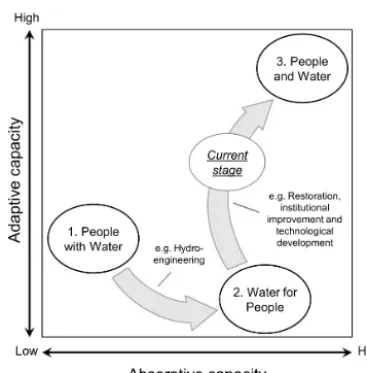
The resilience canvas can be used on scales from the river basin to the global. By analysing our preparedness to cope with local stressors and change, the resilience canvas illus-trates a development trajectory for global socio-hydrological systems (Fig. 5). This section suggests that pathways are not always in straight lines, while the constitutive capacities of resilience do not usually grow equally while the overall re-silience is increasing. It also shows the potential to shift from resistant to resilient water management strategies, and on this basis, identifies attendant future research and implementation gaps.
Figure 5. Global development of socio-hydrological resilience on the “resilience canvas”. Three main developmental stages are (1) People with Water, (2) Water for People, and (3) People and Water. The current global socio-hydrological system has been mov-ing from the second to the third stage.
during the development – it can take years to become aware of the side-effects of infrastructure construction and to test and perform the remedial measures until they have an ef-fect. Kandasamy et al. (2014) described this changing atti-tude in respect of the environment as a “pendulum swing” – the balance point in water allocations is turning around between humans and ecosystems. Along with the develop-ment of socio-hydrological systems, their resilience changes and evolves simultaneously. Therefore, based on these clas-sifications, three main stages of socio-hydrologicalresilience on the global scale are summarised and presented on the re-silience canvas (Fig. 5).
1. People with Water. Before intensive modification of environments, human societies mainly relied on natu-ral hydrological cycles for subsistence (e.g. hunting– gathering) and to support extensive low-productivity agriculture reliant on limited control of the water sub-system (Gleick, 2009). The ecosub-system services were of-ten vulnerable to internal or external hazards, such as water-related diseases and adverse hydrological events, because of insufficient physical and institutional pre-paredness. However, the unoptimised ecosystem ser-vices did not cause too many problems, because of the small and dispersed population and low demand on hy-drological ecosystem services (Gleick, 2009). There-fore, at this stage, absorptive capacity was low and adaptability was mainly provided by the naturalness of ecosystems.
2. Water for People. As the population has grown and socio-economic development risen, ecosystem services obtained by human societies from water systems have
no longer proved sufficient. New technologies and ap-proaches were invented to intentionally manipulate wa-ter cycles to meet new societal demands (Gleick, 2009). Along with the development of hydraulic engineer-ing, humans have dramatically increased the range of ecosystem services obtained from water subsystems, such as hydropower, water availability, flood regulation, and more intensive forms of food production. This de-velopment of socio-hydrological systems explicitly em-phasised the benefits people received from water, and marks a transition to a “Water for People” framing (Mace, 2014).
The resilience of socio-hydrological systems was also altered according to prevailing socio-economic and cul-tural conditions. So, river canalisation increased the ab-sorptive capacity against flooding, but at the cost of rapid water transfer downstream. Major water trans-portation projects were built to transfer water as well as ecosystem services from wet to dry areas, in order to increase socioeconomic resilience (Langridge et al., 2006). Hydraulic engineering was conducted to increase the system’s absorptive capacity to cope with existing and known hazards (e.g. flooding, drought, and pollu-tion). For example, damming was once regarded as one of the best solutions to avoid flooding and drought (End-field, 2012; Ward, 2003). However, this improvement was at the expense of natural ecosystems and conse-quently decreased ecological adaptive capacity. 3. People and Water. Despite increasing capacities to
multi-dimensional relationship between human societies and water systems (Mace, 2014).
We are now facing a new challenge of future water contin-gencies and uncertain water-related hazards, which was tran-sited from the historical challenge of meeting the growing needs of hydrological ecosystem services. It implies that a shift of water strategies is urgently required. We argue that most current water management practices are now seeking to transition from resistant to resilient strategies (Gillson et al., 2013; Khamis et al., 2013; Fig. 5). From the perspec-tive of a resilient socio-hydrological system, we believe that this strategy is not only needed for water management, but potentially offers a feasible alternative for achieving sustain-able hydrological ecosystem service provision. Awareness of change suggests an increase in adaptive capacity, and implies that the pathway to socio-hydrological resilience will involve “soft” approaches that are complementary to engineering-based methods (Park et al., 2013). This implies that inter-ventions in all the source of resilience, including water and human subsystems and human–water interactions need to be considered. Some promising example approaches are pro-vided as follows. Ecosystem restorations such as decanali-sation, improving river connectivity, and floodplain recovery also suggest enhanced ecological or hydrological adaptabil-ity (Brauman et al., 2007), although in the process absorp-tive capacity may be compromised (Chen et al., 2016). This reemphasis on the ecosystem integrity in response to degrad-ing environmental quality is also aligned with the “pendulum swing” phenomenon discussed by Kandasamy et al. (2014). Polycentric water governance and public participation in more centralised forms of decision-making may play impor-tant roles in building socio-hydrological resilience (Buytaert et al., 2014, 2016). Polycentric systems have multiple gover-nance units on multiple scales, which provide the flexibility to deal with the target problems on appropriate scale, and offers institutional back-ups to respond to uncertainties (An-dersson and Ostrom, 2008; Garmestani and Benson, 2013). In addition, technological innovations as well as advances in data collection and prediction models also contribute to improving socio-hydrological resilience, in both absorptive and adaptive ways (Karpouzoglou et al., 2016b). For exam-ple, the Environment Agency for England and Wales offers early-warning systems that provide forecasting and person-alised household information, a practice which builds upon developing technologies and skills to map and measure risk (Environment Agency, 2009).
5 Concluding remarks
Evaluating resilience in a socio-hydrological context is chal-lenging because of different framings of water-related re-silience, including hydrological resilience to anthropogenic disturbances, social resilience to hydrological disasters, and socio-hydrological resilience. Although these reflect
differ-ent aspects of human–water interactions, they are not easy to distinguish. To better conceptualise the linkage between re-silience and socio-hydrology, we have emphasised the need to define the system type prior to discussing their intrin-sic resilience and have argued that resilience be regarded as a set of systematic properties including absorptive, adap-tive and transformaadap-tive capacities. Based on this understand-ing, we have proposed a conceptual framework of human– water couplings and resilience framings, including a heuris-tic approach to identifying possible pathways to resilience in socio-hydrological contexts.
Focusing on three coupling and framing types, we high-lighted the potential of socio-hydrological resilience. If hu-man societies are considered as endogenous components of water cycles, this newly proposed resilience concept is use-ful to answer how socio-hydrological systems respond to and cope with perturbations. On this basis, we have shown the utility and complementarity of resilience with ecosystem ser-vices, and argued that the framework of ecosystem services can be a promising tool to describe the resilient dynamics of socio-hydrological systems, since it reflects an essential as-pect of the human–water interface.
Different types of resilience may match particular prob-lems with knowledge and research traditions in certain aca-demic fields. For example, hydrological resilience to human hazards may be usefully analysed with biophysical sciences for aquatic ecosystem conservation, while social resilience to hydrological hazards will require significant inputs from so-cial sciences. It is important to consider the different nature of human and biophysical systems where different resilience approaches are used. For example, the ecologically oriented concept of resilience has received critiques when applied in human systems, because it oversimplifies the understanding of equilibria and feedbacks, ignores the importance of social conflict and power, and addresses the notion of system func-tion which is not the key focus in social science (Olsson et al., 2015). This does not mean that resilience should be dis-carded as a concept. However, we should heed calls for plu-ralism, stimulate dialogue, and develop a clearer identity of resilience as applied in the socio-hydrological context (Cote and Nightingale, 2012; Cumming et al., 2005; Olsson et al., 2015).
sub-stantial geographic variation globally in the distribution of these socio-hydrological stages.
Therefore, this new conceptual framework with the re-silience canvas motivates some future work on rere-silience. For example, we need to review, compare, and classify existing resilience indicators, propose new quantification and assess-ment methods for different resilience framings, or even de-velop mathematical tools to quantitatively describe the re-silient processes of the capacities (Gao et al., 2016). We also need to conceptualise resilience dynamics and pathways over time with empirical studies and shift resilience studies from focusing on single cases at particular points in time, to macro-scale comparisons between the past, present, and fu-ture. In addition, our argument provokes a rethinking of us-ing resilience in other human-nature contexts, such as social– ecological systems (Ostrom, 2009) and coupled human and natural systems (Liu et al., 2007). We suggest there is con-siderable potential to scrutinise the concept of resilience and better refine its identity and capacities in these systems. Sim-ilarly, different framings such as ecological resilience, so-cial resilience to ecological hazards and soso-cial-ecological re-silience can also be recognised; and within each framing, resilience as systematic properties can be viewed at the ca-pacity level by using the resilience canvas. Hence, we argue that this conceptual framework can be used to guide and con-struct discourses of resilience in the human-nature context, so bringing greater conceptual rigour and clarity to bear on one of the most pressing contemporary public policy chal-lenges of our time.
Data availability. No data sets were used in this article.
Author contributions. FM initialised the ideas of the paper with DH and JC. FM prepared the manuscript with contributions from all co-authors. Figures were prepared by FM.
Competing interests. The authors declare that they have no conflict of interest.
Acknowledgements. This paper was developed within the “Mountain-EVO: Towards a virtual observatory for ecosystem services and poverty alleviation” project, which is supported by the ESPA Project Framework grant (project code: NE/K010239-1). We thank all the project collaborators from Nepal, Peru, Kyrgyzstan, and Ethiopia, for fruitful discussions that facilitated the conception of ideas discussed herewith. We thank Kieran Khamis for his advice in selecting examples for the resilience canvas.There are no additional data associated with this conceptual paper.
Edited by: Hilary McMillan
Reviewed by: Anna Wesselink and one anonymous referee
References
Adger, W. N., Hughes, T. P., Folke, C., Carpenter, S. R., and Rock-ström, J.: Social-ecological resilience to coastal disasters, Sci-ence, 309, 1036–1039, 2005.
Aerts, J. C. J. H., Botzen, W. J. W., Emanuel, K., Lin, N., and De Moel, H.: Evaluating Flood Resilience Strategies for Coastal Megacities, Science, 344, 1–3, 2014.
Anderies, J. M., Janssen, M. A., and Ostrom, E.: A Framework to Analyze the Robustness of Social-Ecological Systems from an Institutional Perspective, Ecol. Soc., 9, 1–18, 2004.
Andersson, K. P. and Ostrom, E.: Analyzing decentralized resource regimes from a polycentric perspective, Policy Sci., 41, 71–93, 2008.
Arnall, A.: Resilience as transformative capacity: Exploring the quadripartite cycle of structuration in a Mozambican resettlement programme, Geoforum, 66, 26–36, 2015.
Backlund, A.: The definition of system, Kybernetes, 29, 444–451, 2000.
Barange, M., Merino, G., Blanchard, J. L., Scholtens, J., Harle, J., Allison, E. H., Allen, J. I., Holt, J., and Jennings, S.: Impacts of climate change on marine ecosystem production in societies de-pendent on fisheries, Nature Climate Change, 4, 211–216, 2014. Barrett, C. B. and Constas, M. A.: Toward a theory of resilience for international development applications, P. Natl. Acad. Sci. USA, 111, 14625–14630, 2014.
Béné, C., Newsham, A., Davies, M., Ulrichs, M., and Godfrey-Wood, R.: Review article: Resilience, poverty and development, J. Int. Dev., 26, 598–623, 2014.
Bennett, N. J., Dearden, P., Murray, G., and Kadfak, A.: The capac-ity to adapt?: Communities in a changing climate, environment, and economy on the northern Andaman coast of Thailand, Ecol. Soc., 19, 5, 2014.
Biggs, R., Carpenter, S. R., and Brock, W. A.: Turning back from the brink: detecting an impending regime shift in time to avert it, P. Natl. Acad. Sci. USA, 106, 826–831, 2009.
Biggs, R., Schlüter, M., Biggs, D., Bohensky, E. L., BurnSilver, S., Cundill, G., Dakos, V., Daw, T. M., Evans, L. S., Kotschy, K., Leitch, A. M., Meek, C., Quinlan, A., Raudsepp-Hearne, C., Ro-bards, M. D., Schoon, M. L., Schultz, L., and West, P. C.: Toward Principles for Enhancing the Resilience of Ecosystem Services, Annu. Rev. Environ. Resour., 37, 421–448, 2012.
Biggs, R., Schlüter, M., and Schoon, M. L. (Eds.): Principles for Building Resilience: Sustaining Ecosystem Services in Social-Ecological Systems, Cambridge University Press, Cambridge, 2015.
Bisson, P. A., Dunham, J. B., and Reeves, G. H.: Freshwater ecosys-tems and resilience of Pacific salmon: habitat management based on natural variability, Ecol. Soc., 14, 45, 2009.
Botter, G., Basso, S., Rodriguez-Iturbe, I., and Rinaldo, A.: Re-silience of river flow regimes, P. Natl. Acad. Sci. USA, 110, 12925–12930, 2013.
Brand, F. S. and Jax, K.: Focusing the Meaning(s) of Resilience?: Resilience as a Descriptive Concept and a Boundary Object, Ecol. Soc., 12, 23, 2007.
Bunn, S. E., Abal, E. G., Smith, M. J., Choy, S. C., Fellows, C. S., Harch, B. D., Kennard, M. J., and Sheldon, F.: Integration of science and monitoring of river ecosystem health to guide in-vestments in catchment protection and rehabilitation, Freshwater Biol., 55, 223–240, 2010.
Buytaert, W., Zulkafli, Z., Grainger, S., Acosta, L., Alemie, T. C., Bastiaensen, J., De Bièvre, B., Bhusal, J., Clark, J., Dewulf, A., Foggin, M., Hannah, D. M., Hergarten, C., Isaeva, A., Kar-pouzoglou, T., Pandeya, B., Paudel, D., Sharma, K., Steenhuis, T., Tilahun, S., Van Hecken, G., and Zhumanova, M.: Citizen sci-ence in hydrology and water resources: opportunities for knowl-edge generation, ecosystem service management, and sustainable development, Front. Earth Sci., 2, 1–21, 2014.
Buytaert, W., Dewulf, A., De Bièvre, B., Clark, J., and Hannah, D. M.: Citizen Science for Water Resources Management: Toward Polycentric Monitoring and Gov-ernance?, J. Water Resour. Plan. Manag., 142, 1816002, https://doi.org/10.1061/(ASCE)WR.1943-5452.0000641, 2016. Carey, M., Baraer, M., Mark, B. G., French, A., Bury, J., Young, K.
R., and McKenzie, J. M.: Toward hydro-social modeling: Merg-ing human variables and the social sciences with climate-glacier runoff models (Santa River, Peru), J. Hydrol., 518, 60–70, 2014. Carpenter, K. E., Abrar, M., Aeby, G., Aronson, R. B., Banks, S., Bruckner, A., Chiriboga, A., Cortes, J., Delbeek, J. C., DeVantier, L., Edgar, G. J., Edwards, A. J., Fenner, D., Guzman, H. M., Hoeksema, B. W., Hodgson, G., Johan, O., Licuanan, W. Y., Liv-ingstone, S. R., Lovell, E. R., Moore, J. A., Obura, D. O., Ochav-illo, D., Polidoro, B. A., Precht, W. F., Quibilan, M. C., Reboton, C., Richards, Z. T., Rogers, A. D., Sanciangco, J., Sheppard, A., Sheppard, C., Smith, J., Stuart, S., Turak, E., Veron, J. E. N., Wallace, C., Weil, E., and Wood, E.: One-Third of Reef-Building Corals Face Elevated Extinction Risk from Climate Change and Local Impacts, Science, 321, 560–563, 2008.
Carpenter, S., Walker, B., Anderies, J. M., and Abel, N.: From metaphor to measurement: Resilience of what to what?, Ecosys-tems, 4, 765–781, 2001.
Chen, X., Wang, D., Tian, F., and Sivapalan, M.: From channel-ization to restoration: Sociohydrologic modeling with changing community preferences in the Kissimmee River Basin, Florida, Water Resour. Res., 51, 1–18, 2016.
Collins, M., An, S.-I., Cai, W., Ganachaud, A., Guilyardi, E., Jin, F.-F., Jochum, M., Lengaigne, M., Power, S., Timmermann, A., Vecchi, G., and Wittenberg, A.: The impact of global warming on the tropical Pacific Ocean and El Nino, Nat. Geosci., 3, 391–397, 2010.
Cote, M. and Nightingale, A. J.: Resilience thinking meets so-cial theory: Situating soso-cial change in socio-ecological systems (SES) research, Prog. Hum. Geogr., 36, 475–489, 2012. Crane, T. A.: Of models and meanings: Cultural resilience in
social-ecological systems, Ecol. Soc., 15, 19, 2010.
Cumming, G. S., Barnes, G., Perz, S., Schmink, M., Sieving, K. E., Southworth, J., Binford, M., Holt, R. D., Stickler, C., and Van Holt, T.: An exploratory framework for the empirical measure-ment of resilience, Ecosystems, 8, 975–987, 2005.
Cutter, S. L., Barnes, L., Berry, M., Burton, C., Evans, E., Tate, E., and Webb, J.: A place-based model for understanding commu-nity resilience to natural disasters, Global Environ. Chang., 18, 598–606, 2008.
Cutter, S. L., Burton, C. G., and Emrich, C. T.: Disaster Resilience Indicators for Benchmarking Baseline Conditions, J. Homel. Se-cur. Emerg. Manag., 7, 1–22, 2010.
Czucz, B., Csecserits, A., Botta-Dukat, Z., Kroel-Dulay, G., Szabo, R., Horvath, F., and Molnar, Z.: An indicator framework for the climatic adaptive capacity of natural ecosystems, J. Veg. Sci., 22, 711–725, 2011.
Daily, G. C., Polasky, S., Goldstein, J., Kareiva, P. M., Mooney, H. A., Pejchar, L., Ricketts, T. H., Salzman, J., and Shallen-berger, R.: Ecosystem services in decision making: time to de-liver, Front. Ecol. Environ., 7, 21–28, 2009.
da Silveira, A. R. and Richards, K. S.: The Link Between Poly-centrism and Adaptive Capacity in River Basin Governance Sys-tems: Insights from the River Rhine and the Zhujiang (Pearl River) Basin, Ann. Assoc. Am. Geogr., 103, 319–329, 2013. Davoudi, S., Shaw, K., Haider, L. J., Quinlan, A. E., Peterson, G.
D., Wilkinson, C., Fünfgeld, H., McEvoy, D., and Porter, L.: silience: A Bridging Concept or a Dead End? “Reframing” Re-silience: Challenges for Planning Theory and Practice Interacting Traps: Resilience Assessment of a Pasture Management System in Northern Afghanistan Urban Resilience: What Does it Mean in Planni, Plan. Theory Pract., 13, 299–333, 2012.
Dawson, T. P., Jackson, S. T., House, J. I., Prentice, I. C., and Mace, G. M.: Beyond predictions: biodiversity conservation in a changing climate, Science, 332, 53–58, https://doi.org/10.1126/science.1200303, 2011.
de Groot, R. S., Wilson, M. A., and Boumans, R. M. J.: A typol-ogy for the classification, description and valuation of ecosystem functions, goods and services, Ecol. Econ., 41, 393–408, 2002. Dent, C. L., Cumming, G. S., and Carpenter, S. R.: Multiple states
in river and lake ecosystems, Philos. T. R. Soc. Lon. B, 357, 635– 645, 2002.
Doney, S. C., Ruckelshaus, M., Duffy, J. E., Barry, J. P., Chan, F., English, C. A., Galindo, H. M., Grebmeier, J. M., Hollowed, A. B., Knowlton, N., Polovina, J., Rabalais, N. N., Sydeman, W. J., and Talley, L. D.: Climate change impacts on marine ecosystems, Ann. Rev. Mar. Sci., 4, 11–37, 2012.
Dudgeon, D., Arthington, A. H., Gessner, M. O., Kawabata, Z. I., Knowler, D. J., Leveque, C., Naiman, R. J., Prieur-Richard, A. H., Soto, D., Stiassny, M. L. J., and Sulli-van, C. A.: Freshwater biodiversity: importance, threats, sta-tus and conservation challenges, Biol. Rev., 81, 163–182, https://doi.org/10.1017/S1464793105006950, 2006.
Dufour, S. and Piégay, H.: From the myth of a lost paradise to tar-geted river restoration: forget natural references and focus on hu-man benefits, River Res. Appl., 25, 568–581, 2009.
Elshafei, Y., Sivapalan, M., Tonts, M., and Hipsey, M. R.: A pro-totype framework for models of socio-hydrology: identification of key feedback loops and parameterisation approach, Hydrol. Earth Syst. Sci., 18, 2141–2166, https://doi.org/10.5194/hess-18-2141-2014, 2014.
Endfield, G. H.: The resilience and adaptive capacity of social-environmental systems in colonial Mexico, P. Natl. Acad. Sci. USA, 109, 3676–3681, 2012.
Engel, S. and Schaefer, M.: Ecosystem services-a useful concept for addressing water challenges?, Curr. Opin. Environ. Sustain., 5, 696–707, 2013.
Environment Agency: A National Assessment of Flood Risk, Flooding Engl., 36, 2009.
Ernstson, H., Van Der Leeuw, S. E., Redman, C. L., Meffert, D. J., Davis, G., Alfsen, C., and Elmqvist, T.: Urban transitions: On urban resilience and human-dominated ecosystems, Ambio, 39, 531–545, 2010.
Evans, B. and Reid, J.: Dangerously exposed: the life and death of the resilient subject, Resilience, 1, 83–98, 2013.
Fernald, A., Guldan, S., Boykin, K., Cibils, A., Gonzales, M., Hurd, B., Lopez, S., Ochoa, C., Ortiz, M., Rivera, J., Rodriguez, S., and Steele, C.: Linked hydrologic and social systems that support resilience of traditional irrigation communities, Hydrol. Earth Syst. Sci., 19, 293–307, https://doi.org/10.5194/hess-19-293-2015, 2015.
Few, R., Brown, K., and Tompkins, E. L.: Public participation and climate change adaptation: avoiding the illusion of inclusion, Clim. Policy, 7, 46–59, 2007.
Folke, C.: Resilience (Republished), Ecol. Soc., 21, 44, https://doi.org/10.5751/ES-09088-210444, 2016.
Folke, C., Hahn, T., Olsson, P., and Norberg, J.: Adaptive Gover-nance of Social-Ecological Systems, Annu. Rev. Environ. Re-sour., 30, 441–473, 2005.
Folke, C., Carpenter, S. R., Walker, B., Scheffer, M., Chapin, T., and Rockström, J.: Resilience thinking: Integrating resilience, adapt-ability and transformadapt-ability, Ecol. Soc., 15, 62–68, 2010. Gallopín, G. C.: Linkages between vulnerability, resilience, and
adaptive capacity, Global Environ. Chang., 16, 293–303, 2006. Gao, J., Barzel, B., and Barabási, A.-L.: Universal resilience
pat-terns in complex networks, Nature, 530, 307–312, 2016. Garmestani, A. S. and Benson, M. H.: A framework for
resilience-based governance of social-ecological systems, Ecol. Soc., 18, 9, https://doi.org/10.5751/ES-05180-180109, 2013.
Gibbs, M. T.: Resilience: What is it and what does it mean for ma-rine policymakers?, Mar. Policy, 33, 322–331, 2009.
Gillson, L., Dawson, T. P., Jack, S., and McGeoch, M. A.: Accom-modating climate change contingencies in conservation strategy, Trends Ecol. Evol., 28, 135–142, 2013.
Gleick, P. H.: Facing Down the Hydro-Crisis, World Policy J., 26, 17–23, 2009.
Gleick, P. H. and MacDonald, G. M.: Roadmap for sustainable wa-ter resources in southweswa-tern North America, P. Natl. Acad. Sci. USA, 107, 21300–21305, 2010.
Gómez-Baggethun, E., Reyes-García, V., Olsson, P., and Montes, C.: Traditional ecological knowledge and community resilience to environmental extremes: A case study in Doñana, SW Spain, Global Environ. Chang., 22, 640–650, 2012.
Gupta, J., Termeer, C., Klostermann, J., Meijerink, S., van den Brink, M., Jong, P., Nooteboom, S., and Bergsma, E.: The Adap-tive Capacity Wheel: A method to assess the inherent character-istics of institutions to enable the adaptive capacity of society, Environ. Sci. Policy, 13, 459–471, 2010.
Haasnoot, M., Kwakkel, J. H., Walker, W. E., and ter Maat, J.: Dy-namic adaptive policy pathways: A method for crafting robust decisions for a deeply uncertain world, Global Environ. Chang., 23, 485–498, 2013.
Hallegatte, S., Green, C., Nicholls, R. J., and Corfee-Morlot, J.: Fu-ture flood losses in major coastal cities, NaFu-ture Climate Change, 3, 802–806, 2013.
Harder, P., Pomeroy, J. W., and Westbrook, C. J.: Hydrological resilience of a Canadian Rockies headwaters basin subject to changing climate, extreme weather, and forest management, Hy-drol. Process., 29, 3905–3924, 2015.
Hickey, M. B. C. and Doran, B.: A review of the efficiency of buffer strips for the maintenance and enhancement of riparian ecosys-tems, Water Qual. Res. J. Canada, 39, 311–317, 2004.
Hoegh-Guldberg, O. and Bruno, J. F.: The Impact of Climate Change on the World’s Marine Ecosystems, Science, 328, 1523– 1528, 2010.
Hoegh-Guldberg, O., Mumby, P. J., Hooten, A. J., Steneck, R. S., Greenfield, P., Gomez, E., Harvell, C. D., Sale, P. F., Edwards, A. J., Caldeira, K., Knowlton, N., Eakin, C. M., Iglesias-Prieto, R., Muthiga, N., Bradbury, R. H., Dubi, A., and Hatziolos, M. E.: Coral Reefs under Rapic Climate Change and Ocean Acidifica-tion, Science, 318, 1737–1742, 2008.
Hoffmann, A. and Sgrò, C.: Climate change and evolutionary adap-tation, Nature, 470, 479–485, 2011.
Holling, C. S.: Resilience and stability of ecological systems, Annu. Rev. Ecol. Syst., 4, 1–23, 1973.
Josefsson, H. and Baaner, L.: The Water Framework Directive – A Directive for the Twenty-First Century?, J. Environ. Law, 23, 463–486, 2011.
Kandasamy, J., Sounthararajah, D., Sivabalan, P., Chanan, A., Vi-gneswaran, S., and Sivapalan, M.: Socio-hydrologic drivers of the pendulum swing between agricultural development and en-vironmental health: a case study from Murrumbidgee River basin, Australia, Hydrol. Earth Syst. Sci., 18, 1027–1041, https://doi.org/10.5194/hess-18-1027-2014, 2014.
Karpouzoglou, T., Dewulf, A., and Clark, J.: Advancing adaptive governance of social-ecological systems through theoretical mul-tiplicity, Environ. Sci. Policy, 57, 1–9, 2016a.
Karpouzoglou, T., Zulkafli, Z., Grainger, S., Dewulf, A., Buytaert, W., and Hannah, D. M.: Environmental Virtual Observatories (EVOs): prospects for knowledge co-creation and resilience in the Information Age, Curr. Opin. Environ. Sustain., 18, 40–48, 2016b.
Keating, K., May, P., Pettit, A., and Pickering, R.: Cost estimation for household flood resitance and resilience measures – summary of evidence, Report – SC080039/R11, 28, 2015.
Keck, M. and Sakdapolrak, P.: What is social resilience? Lessons learned and ways forward, Erdkunde, 67, 5–19, 2013.
Kelman, I., Gaillard, J. C., and Mercer, J.: Climate Change’s Role in Disaster Risk Reduction’s Future: Beyond Vulnerability and Resilience, Int. J. Disaster Risk Sci., 6, 21–27, 2015.
Khamis, K., Hannah, D. M., Hill Calvis, M., Brown, L. E., Castella, E., and Milner, A. M.: Alpine aquatic ecosystem conservation policy in a changing climate, Environ. Sci. Policy, 43, 39–55, 2013.
Klein, R. J. T., Nicholls, R. J., and Thomalla, F.: Resilience to nat-ural hazards: How useful is this concept?, Environ. Hazards, 5, 35–45, 2003.
Krimbas, C. B.: On fitness, Biol. Philos., 19, 185–203, 2004. Kumar, P.: Hydrocomplexity: Addressing water security and
emer-gent environmental risks, Water Resour. Res., 51, 5827–5838, 2015.
of Hard Coral Communities in Taiwan, PLoS One, 7, e44364, https://doi.org/10.1371/journal.pone.0044364, 2012.
Langridge, R., Christian-Smith, J., and Lohse, K. A.: Access and resilience: Analyzing the construction of social resilience to the threat of water scarcity, Ecol. Soc., 11, 18, 2006.
Liao, K. H.: A theory on urban resilience to floods – A ba-sis for alternative planning practices, Ecol. Soc., 17, 48, https://doi.org/10.5751/ES-05231-170448, 2012.
Limburg, K. E., O’Neill, R. V., Costanza, R., and Farber, S.: Com-plex systems and valuation, Ecol. Econ., 41, 409–420, 2002. Lindner, M., Maroschek, M., Netherer, S., Kremer, A., Barbati, A.,
Garcia-Gonzalo, J., Seidl, R., Delzon, S., Corona, P., Kolström, M., Lexer, M. J., and Marchetti, M.: Climate change impacts, adaptive capacity, and vulnerability of European forest ecosys-tems, Forest Ecol. Manage., 259, 698–709, 2010.
Linton, J. and Budds, J.: The hydrosocial cycle: Defining and mo-bilizing a relational-dialectical approach to water, Geoforum, 57, 170–180, 2014.
Liu, J., Dietz, T., Carpenter, S. R., Alberti, M., Folke, C., Moran, E., Pell, A. N., Deadman, P., Kratz, T., Lubchenco, J., Ostrom, E., Ouyang, Z., Provencher, W., Redman, C. L., Schneider, S. H., and Taylor, W. W.: Complexity of coupled human and natural systems, Science, 317, 1513–1516, 2007.
Lorenz, D. F.: The diversity of resilience: Contributions from a so-cial science perspective, Nat. Hazards, 67, 7–24, 2013.
Mace, G. M.: Whose conservation? Changes in the perception and goals of nature conservation require a solid scientific basis, Sci-ence, 245, 1558–1560, 2014.
MacKinnon, D. and Derickson, K. D.: From resilience to resource-fulness: A critique of resilience policy and activism, Prog. Hum. Geogr., 37, 253–270, 2012.
Malhotra, S., Kim, T., Zager, J., Bennett, J., Ebright, M., D’Angelica, M., and Fong, Y.: Use of an oncolytic virus secreting GM-CSF as combined oncolytic and immunotherapy for treat-ment of colorectal and hepatic adenocarcinomas, Surgery, 141, 520–529, 2007.
Mao, F. and Richards, K.: Irreversible river water quality and the concept of the reference condition, Area, 44, 423–431, 2012. McGlade, J., McIntosh, B. S., and Jeffrey, P.: Landscape
Sensi-tivity, Resilience and Sustainable Watershed Management, in: Coping with Water Deficiency: From Research to Policymaking With Examples from Southern Europe, the Mediterranean and Developing Countries, edited by: Koundouri, P., 23 pp., Springer Netherlands, 2008.
Meerow, S., Newell, J. P., and Stults, M.: Defining urban resilience?: A review, Landsc. Urban Plan., 147, 38–49, 2016.
Methmann, C. and Oels, A.: From “fearing” to “empowering” cli-mate refugees: Governing clicli-mate-induced migration in the name of resilience, Secur. Dialogue, 46, 51–68, 2015.
Millennium Ecosystem Assessment: Ecosystems and human well-being: Synthesis, Island Press, Washington, DC, 2005.
Miller, F., Osbahr, H., Boyd, E., Thomalla, F., Bharwani, S., Ziervo-gel, G., Walker, B., Birkmann, J., van der Leeuw, S., Rockström, J., Hinkel, J., Downing, T., Folke, C., and Nelson, D.: Resilience and vulnerability: Complementary or conflicting concepts, Ecol. Soc., 15, 11, 2011.
Miller, S. W., Wooster, D., and Li, J.: Resistance and resilience of macroinvertebrates to irrigation water withdrawals, Freshwater Biol., 52, 2494–2510, 2007.
Milman, A. and Short, A.: Incorporating resilience into sustainabil-ity indicators: An example for the urban water sector, Global En-viron. Chang., 18, 758–767, 2008.
Montanari, A., Young, G., Savenije, H. H. G., Hughes, D., Wa-gener, T., Ren, L. L., Koutsoyiannis, D., Cudennec, C., Toth, E., Grimaldi, S., Blöschl, G., Sivapalan, M., Beven, K., Gupta, H., Hipsey, M., Schaefli, B., Arheimer, B., Boegh, E., Schymanski, S. J., Di Baldassarre, G., Yu, B., Hubert, P., Huang, Y., Schu-mann, A., Post, D. A., Srinivasan, V., Harman, C., Thompson, S., Rogger, M., Viglione, A., McMillan, H., Characklis, G., Pang, Z., and Belyaev, V.: “Panta Rhei – Everything Flows”: Change in hy-drology and society – The IAHS Scientific Decade 2013–2022, Hydrol. Sci. J., 58, 1256–1275, 2013.
National Research Council: Resilience and Ecosystem Services, in: An Ecosystem Services Approach to Assessing the Impacts of the Deepwater Horizon Oil Spill in the Gulf of Mexico, 246 pp., https://doi.org/10.17226/18387, National Academies Press, 2013.
Norris, F. H., Stevens, S. P., Pfefferbaum, B., Wyche, K. F., and Pfefferbaum, R. L.: Community resilience as a metaphor, theory, set of capacities, and strategy for disaster readiness, Am. J. Com-munity Psychol., 41, 127–150, 2008.
Olsson, L., Jerneck, A., Thoren, H., Persson, J., and O’Byrne, D.: Why resilience is unappealing to social science: Theoretical and empirical investigations of the scientific use of resilience, Sci. Adv., 1, e1400217, https://doi.org/10.1126/sciadv.1400217, 2015.
O’Reilly, C. M., Alin, S. R., Plisnier, P.-D. D., Cohen, A. S., and McKee, B. A.: Climate change decreases aquatic ecosystem pro-ductivity of Lake Tanganyika, Africa, Nature, 424, 766–768, 2003.
Ostadtaghizadeh, A., Ardalan, A., Paton, D., Jabbari, H., and Khankeh, H. R.: Community Disaster Resilience: a Sys-tematic Review on Assessment Models and Tools, PLoS Curr. Disasters, 1–14, https://doi.org/10.1371/currents.dis. f224ef8efbdfcf1d508dd0de4d8210ed, 2015.
Ostrom, E.: A general framework for analyzing sustainability of social-ecological systems, Science, 325, 419–422, 2009. Ozkan, K., Jeppesen, E., Johansson, L. S., and Beklioglu, M.: The
response of periphyton and submerged macrophytes to nitrogen and phosphorus loading in shallow warm lakes: A mesocosm ex-periment, Freshwater Biol., 55, 463–475, 2010.
Pahl-Wostl, C.: A conceptual framework for analysing adaptive ca-pacity and multi-level learning processes in resource governance regimes, Global Environ. Chang., 19, 354–365, 2009.
Pahl-Wostl, C., Vorosmarty, C., Bhaduri, A., Bogardi, J., Rock-strom, J., and Alcamo, J.: Towards a sustainable water future: Shaping the next decade of global water research, Curr. Opin. Environ. Sustain., 5, 708–714, 2013.
Park, J., Seager, T. P., Rao, P. S. C., Convertino, M., and Linkov, I.: Integrating risk and resilience approaches to catastrophe man-agement in engineering systems, Risk Anal., 33, 356–367, 2013. Pearson, R. G.: Reasons to Conserve Nature, Trends Ecol. Evol.,
31, 366–371, 2016.
Peterson, T. J., Western, A. W., and Argent, R. M.: Analytical meth-ods for ecosystem resilience: A hydrological investigation, Water Resour. Res., 48, 1–16, 2012.