ScholarWorks @ Georgia State University
ScholarWorks @ Georgia State University
Educational Policy Studies Dissertations Department of Educational Policy Studies
Spring 1-6-2012
Through the Eyes of Gay and Male Bisexual College Students: A
Through the Eyes of Gay and Male Bisexual College Students: A
Critical Visual Qualitative Study of their Experiences
Critical Visual Qualitative Study of their Experiences
Matthew K. Robison Georgia State University
Follow this and additional works at: https://scholarworks.gsu.edu/eps_diss
Part of the Education Commons, and the Education Policy Commons
Recommended Citation Recommended Citation
Robison, Matthew K., "Through the Eyes of Gay and Male Bisexual College Students: A Critical Visual Qualitative Study of their Experiences." Dissertation, Georgia State University, 2012.
https://scholarworks.gsu.edu/eps_diss/89
ACCEPTANCE
This dissertation, THROUGH THE EYES OF GAY AND MALE BISEXUAL COLLEGE STUDENTS: A CRITICAL VISUAL QUALITATIVE STUDY OF THEIR EXPERIENCES BEING OUT AND STAYING SAFE ON CAMPUS, by MATTHEW KYLE ROBISON, was prepared under the direction of the candidate’s Dissertation Advisory Committee. It is accepted by the committee members in partial fulfillment of the requirements for the degree of Doctor of Philosophy in the College of Education, Georgia State University.
The Dissertation Advisory Committee and the student’s Department Chair, as representatives of the faculty, certify that this dissertation has met all standards of excellence and scholarship as determined by the faculty. The Dean of the College of the Education concurs.
______________________________ ______________________________ Jennifer Esposito, Ph.D. Donna Breault, Ph.D.
Committee Chair Committee Member
______________________________ ______________________________ Patricia Carter, Ph.D. Philo A. Hutcheson, Ph.D.
Committee Member Committee Member
_______________________________ Date
______________________________ Sheryl A. Gowen, Ph.D.
Chair, Department of Educational Policy Studies
______________________________ R.W. Kamphaus, Ph.D.
AUTHOR’S STATEMENT
By presenting this dissertation as a partial fulfillment of the requirements for the advanced degree from Georgia State University, I agree that the library of the Georgia State University shall make it available for inspection and circulation in accordance with its regulations governing materials of this type. I agree that permission to quote, to copy from, or to publish this dissertation may be granted by the professor under whose direction it was written, by the College of Education’s director of graduate studies and research, or by me. Such quoting, copying, or publishing must be solely for scholarly purposes and will not involve potential financial gain. It is understood that any copying from or publication of this dissertation which involves potential financial gain will not be allowed without written permission.
NOTICE TO BORROWERS
All dissertations deposited in the Georgia State University library must be used in accordance with the stipulations prescribed by the author in the preceding statement. The author if this dissertation is:
Matthew Kyle Robison 1377Midlawn Drive
Decatur, GA 30032
The director of this dissertation is:
Dr. Jennifer Esposito
Department of Educational Policy Studies College of Education
VITA
Matthew K. Robison
ADDRESS: 1377 Midlawn Drive Decatur, Georgia 30032
EDUCATION:
Ph.D. 2011 Georgia State University Educational Policy Studies M.A. 2001 New York University
Higher Education Administration B.S. 1999 Mississippi State University
Secondary Education, Biology and Physical Science A.S. 1997 Itawamba Community College
General Education, Biology/Chemistry/Physics
PROFESSIONAL EXPERIENCE:
2010-Present Assistant Dean of Students
2005-2010 Director of New Student Programs and Parent Relations Georgia State University, Atlanta, GA
2001-2005 Director of Student Activities and New Student Orientation
Massachusetts College of Pharmacy and Health Sciences, Boston, MA
2000-2001 Student Activities Advisor
Saint John’s University, New York, NY 1999-2000 Residence Hall Advisor
Saint John’s University, New York, NY
PRESENTATIONS AND PUBLICATIONS:
Robison, M. K. (2009). Neophyte qualitative researcher finding his voice through qualitative journeys. The Weekly Qualitative Report,
2(49), 285-287.
Robison, M.K. (2004 – 2009 editions). Careers and involvement: A winning combination. Off to College. Montgomery, AL: Off To College Publications.
Robison, M.K., & Hilton, K. (2009, December). LGBTQ students and safe spaces on campus: A qualitative research study. Report presented at Qualitative Class Symposium, Atlanta, GA. Robison, M.K., & Prabakar, B. A. (2009, May). Communication and
student leadership. Presented at the Georgia State University Student Leadership Academy, Dawsonville, GA.
Robison, M.K. (2007, March). Providing good customer service to parents.
Presented at the annual meeting of the Georgia College Personnel Association, Columbus, GA.
Robison, M.K. (2004, November). Be a better programming board chair.
Presented at the annual meeting of the National Association of Campus Activities Northeast Region, Worcester, MA.
Robison, M.K. (2004, January). Creating a rock’in resume. Presented at the All the Above Conference, Worcester, MA.
Robison, M.K. (2003, November). Understating privilege. Presented at the annual meeting of the National Association of Campus Activities Northeast Region, Hartford, CT.
Robison, M.K. (2002, November). Importance of being an involved college student. Presented at the annual meeting of the National Association of Campus Activities Northeast Region, Marlboro, MA.
PROFESSIONAL SOCIETIES AND ORGANIZATIONS:
ABSTRACT
THROUGH THE EYES OF GAY AND MALE BISEXUAL COLLEGE STUDENTS: A CRITICAL VISUAL QUALITATIVE STUDY OF THEIR EXPERIENCES
BEING OUT AND STAYING SAFE ON CAMPUS by
Matthew Kyle Robison
Lesbian, gay, bisexual, and/or transgender (LGBT) college students have a history
of suffering from discriminatory, marginalizing, and prejudicial attitudes and practices on
American college and university campuses. These homophobic and heterosexist
environments often lead to an unwelcoming, hostile, and sometimes dangerous campus
climate for LGBT college students, prohibiting them to lead out and open lives on
campus. Implementing a critical qualitative methodology, this study examined the lived
experiences of 9 out gay and bisexual male college students at an urban research
university located in the southeastern United States. The study focused on the following
three research questions:
1) What is the college experience like for an individual who identifies as an
out gay or male bisexual student?
2) What does safety mean to an individual who identifies as an out gay or
male bisexual student?
3) How does an individual navigate staying safe as an out gay or male
bisexual student?
The study specifically focused on the participants’ lived experiences of being out
gay and male bisexual college students and their perceptions of safety and what safety
the use of visual methods to compliment the traditional qualitative research approach.
The results of the study centered around four major themes:
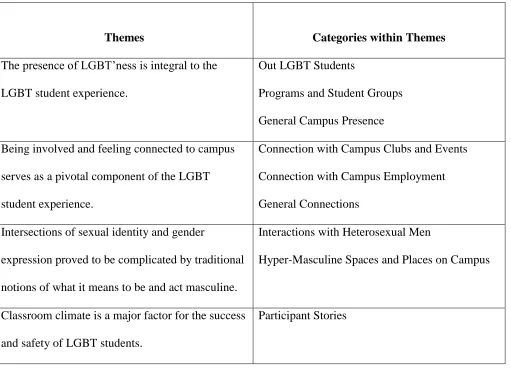
1) The presence of LGTB’ness is integral to the LGBT student experience.
2) Being involved and feeling connected to campus serves as a pivotal component of
the LGBT student experience.
3) Navigating masculinity is complicated given traditional gender roles.
4) Classroom climate is a major factor for the success and safety of LGBT students.
Reviewing the results of this study college faculty, staff, and administrators can
begin to understand the unique experiences of LGBT college students; and through this
meaning making process, higher education officials can learn what is needed to improve
the college experience for this historically marginalized minority. LGBT students enroll
in college expecting their voices to be heard, their needs to be met, and their campus
climates to be safe and welcoming. This study directly informed what colleges and
universities can do to better meet the needs of LGBT college students and ensure they
THROUGH THE EYES OF GAY AND MALE BISEXUAL COLLEGE STUDENTS: A CRITICAL VISUAL QUALITATIVE STUDY OF THEIR EXPERIENCES
BEING OUT AND STAYING SAFE ON CAMPUS by
Matthew Kyle Robison
A Dissertation
Presented in Partial Fulfillment of Requirements for the Degree of
Doctor of Philosophy in
Educational Policy Studies in
the Department of Policy Studies in
The College of Education Georgia State University
Copyright by Matthew Kyle Robison
ACKNOWLEDGMENTS
I would have not completed this journey if it were not for the love, support, guidance, and
participation of many individuals.
I first want to thank the nine young men who participated in this study. They were a
group of confident, fearless, intelligent, honest, open, reflective, concerned, grounded, caring
young gay and bisexual men who I know are going to do great things wherever their life
journeys takes them.
I want to thank the many faculty members who have served as both an influence and an
inspiration to me during the past 5 years. I want to thank Dr. Janice Fourniller for opening my
eyes to the world of visual methods and planting the seed for this research study. I want to
thank the members of my dissertation committee: Dr. Carter, Dr. Breault, and Philo. I want to
especially thank Dr. Esposito for serving as my chair. She was more than just the leader of my
doctoral journey. She was the person who introduced me to the world of naturalistic inquiry; and
because of her mentorship, I am forever changed to the way in which I observe and experience
the world around me.
I also would like to acknowledge Chris Corsello, an individual crazy enough to hire a
young, inexperienced gay boy from Mississippi and give me my first full-time job in higher
education. Also, I want to acknowledge Dr. Rebecca Stout who gave a young, up-and-coming
higher education professional a chance to grow into the administrator I am today. In addition, I
must thank Cindy King who has spent countless hours reading my work and serving as a trusted
editor throughout the dissertation process. She was a life saver, thank you!
I want to acknowledge my mother and father who have inspired and influenced me more
than they will ever know. Though we often see the world through a different lens, I am forever
grateful for all they have done for me over the last 34 years. It is because of them I am the person
I am today. In addition, I want to thank my grandmother and grandfather for their love and
kindness. I want to thank Thad for all the love, support, and encouragement he has given me
throughout this process.
Finally, I want to acknowledge the tens of thousands of LGBT college students currently
navigating their way through the college experience. It is not always easy, and it is not always
safe; but you can make it through. I dedicate this work to you in a hope that what was
discovered throughout this process will make your college years a safer and more enjoyable
experience.
TABLE OF CONTENTS
Page
List of Tables ……… vi
List of Figures ……… vii
Chapter 1 INTRODUCTION ... 1
Purpose ... 8
Research Questions ... 9
Theoretical Framework ... 10
Looking Ahead... 12
2 REVIEW OF THE LITERATURE ... 14
Brief History ... 14
Awareness and Visibility………. 17
Campus Climate ... 22
Identity Development... 29
Conclusion ... 32
3 METHODOLOGY AND METHODS ... 34
Critical Qualitative Methodology ... 35
Visual Methods ... 37
Context and Participants ... 39
Data Collection ... 42
Data Analysis ... 47
Researcher’s Role and Biases ... 49
Trustworthiness ... 50
Conclusion ... 51
4 REPORT OF FINDINGS AND ANALYSIS ... 53
Presence of LGBT’ness ... 56
Involvement and Connection to Campus ... 71
Intersection of Sexual Identity and Gender Expression ... 84
Classroom Climate ... 100
Conclusion ... 111
5 SUMMARY OF RESULTS ... 113
Research Questions……….. 114
Microaggressions and LGBT Students………. ... 124
Policy Recommendations………. 127
Limitations of Study ... 130
Future Research ... 131
Conclusion ... 135
References ... 137
Appendixes ... 146
LIST OF TABLES
Table Page
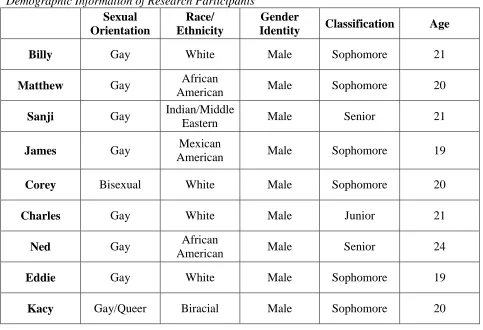
1 Demographic Information of Research Participants ... 41 2 Themes developed from the Research Study ... 55
LIST OF FIGURES
Figure Page
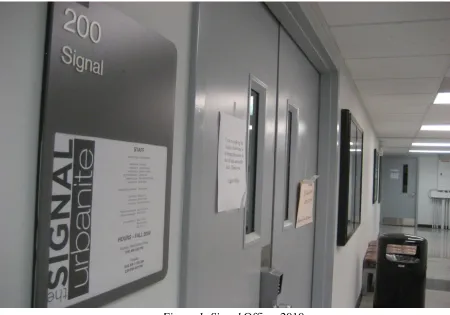
1 Signal Office, 2010 ... 58
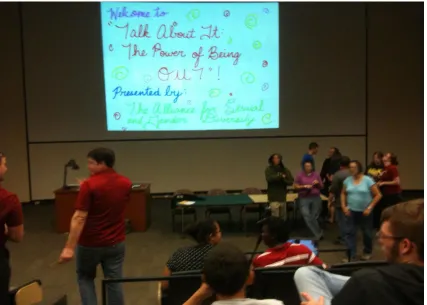
2 Coming Out Panel, 2011 ... 61
3 Eddie and Friend at drag show, 2011... 62
4 Kacy and Friends at drag show, 2011 ... 63
5 Cinefest Campus Movie Theatre, 2010 ... 65
6 Safe Zone Sticker on RA Door, 2011 ... 66
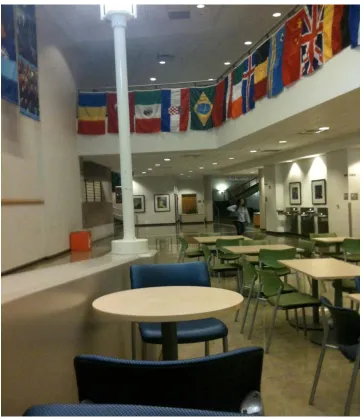
7 Flags in Student Center, 2011 ... 70
8 Alliance Meeting Room, 2011 ... 73
9 Eddie and Friend at Alliance Meeting, 2011 ... 74
10 Orientation Office, 2011 ... 76
11 Progressive Student Alliance, 2010 ... 77
12 Eddie at Work, 2011 ... 79
13 Endocrinology Lab, 2010... 80
14 Kacy’s Friend, 2011 ... 82
15 Unity Plaza, 2011 ... 83
16 Kacy’s Straight Friend Carl, 2011 ... 87
17 Good Straight Guy Friends, 2010……… 91
18 Recreation Center, 2011... 93
19 Recreation Center Basketball Courts, 2010 ... 95
20 Recreation Center Locker Room, 2010 ... 96
21 Greek Housing, 2011 ... 99
22 Plaza on Campus, 2010………... . 100
23 General Classroom Building, 2011 ... 102
24 Classroom and Sanji’s Friend, 2010 ... 106
25 College of Business, 2011... 109
1 CHAPTER 1
INTRODUCTION
“Injustice anywhere is a threat to justice everywhere.”
Dr. Martin Luther King, Jr.
The above quotation comes from a letter penned by the late Dr. Martin Luther King, Jr. in
April 1963 as he sat in a Birmingham, Alabama jail during the American Civil Rights
Movement. His letter served as a warning to a deeply segregated and racially divided country
that, until we, as a nation, wipe out oppression and discrimination, all members of society are at
risk. Dr. King stated in his letter that “whatever affects one, affects all indirectly” (1963, para.
4). Though his words at the time spoke specifically to race relations in this country, I believe
that the spirit of his message can be extended much further to encompass all injustices in
American society. Whether rooted in racism, sexism, classism, heterosexism, or homophobia,
any type of marginalization of a person or groups of people based on circumstances beyond their
control is an unacceptable “injustice” and should have no place in American society.
These different forms of discrimination and prejudice have long plagued American
society and continue to infect all facets of contemporary culture. There are countless writings on
racism (Feagin & Sikes, 1994; West, 2001; Lipsitz, 2006), sexism (Dworkin, 1979; hooks, 1981;
Babcock & Laschever, 2003), and classism (Zinn, 1980; Gans, 1996; hooks, 2000) that serve to
oppress and suppress various minority groups. Homophobia and heterosexism are two additional
forms of prejudice and discrimination that are deeply embedded in modern American society,
(LGBT) communities. Similar to other forms of discrimination, there has been much research
conducted on and books and articles written about the causes and effects of both heterosexism
and homophobia in American society (Pharr, 1988; Comstock, 1991; D’Augelli, 1990;
D’Augelli, 1991; Obear, 1991; Blumenfeld, 1992; Cramer, 2002; Sanlo, Rankin, & Schoenberg,
2002; Herek, 2004).
The term “homophobia” was fashioned by the psychologist George Weinberg in the early
1970s and was used to describe an irrational fear of and hate for homosexual individuals (Herek,
2004). For the purpose of this study, I conceptualize homophobia and heterosexism according to
the definitions that Cramer (2002) offers. Cramer defines homophobia as the “fear, disgust,
hatred, and/or avoidance of lesbians and gay men…behavioral manifestations of homophobic
feelings and beliefs include antigay discrimination and antigay hate crimes” (p. 2). Cramer
defines “heterosexism” as:
The expectation that all persons should be or are heterosexual. The belief that
heterosexual relations are normal and the norm. These expectations and beliefs occur on
individual, institutional, and cultural levels. The behavioral manifestations of
heterosexist beliefs include denying marriage licenses for same sex-couples and
restricting health and retirement benefits to those in heterosexual marriages (p. 2).
Before one can truly understand the effects of heterosexism and homophobia on the
LGBT community, both these terms need to be situated in the overarching context of oppression.
Pellegrinni (1992) defines oppression as:
A process; it is constituted within and through a complicated and dynamic network of
physically, mentally, and emotionally; and, importantly the power to set the very terms
of power (pp. 53-54).
Oppressive systems seek to maintain the status quo giving the ability for one group or groups of
people to maintain almost unquestionable power over other groups in society (Komives &
Woodard, 1996). Once a better understanding of what oppression is and how it operates in
society is gained, the true effects of homophobia and heterosexism can be easily understood. As
stated by Pellegrinni, oppression reinforces complex power relations and individuals who are not
included in the setting of the power agenda often suffer brutal consequences. This is often the
case for members of the LGBT community who are victims of homophobia and heterosexism.
To put the discrimination that LGBT individuals suffer in American society in
perspective, one only has to look to numerous studies that report the prevalence of homophobic
attitudes harbored by many individuals in society and the reports of discrimination and prejudice
that LGBT individuals suffer as a result of these attitudes. The National Gay and Lesbian Task
Force (NGLTF), an organization that fights for full LGBT equality in all facets of American
society, has conducted and gathered much research over the years, which documents the
struggles of the LGBT community. These struggles become painfully apparent when it is
reported that LGBT youth are almost 4 times more likely than their heterosexual peers to attempt
suicide and those LGBT youth rejected by their families are 8.4 times more likely to attempt
suicide (Johnson, n.d.). Adding concern to these alarming statistics are practices of heterosexism
and homophobia that are “preserved through the routine operation of major social institutions
such as employment…marriage…law…and religion” (Sanlo, Rankin, & Schoenberg, 2002, p. 8).
These social institutions betray the trust of LGBT individuals and do nothing to protect the rights
With this context in place, the problem becomes clear: The incorporation of heterosexist
ideas and homophobic practices in all facets of daily life trickle down through society. Societal
judgments and practices eventually find their way onto college campuses. As a result of a
system of ingrained homophobic, heterosexist systems of oppression, college students who
identity as LGBT often experience harassment, discrimination, and prejudice on campus
(D’Augelli, 1989a, 1989b, 1990, 1991, 1992; Sanlo, Rankin, & Schoenberg, 2002; Rankin, 2001,
2003; Renn, 2010). However, I think it is important to note that before students ever reach the
college gates, they bring with them years of often painful memories from their K-12 educational
experiences. A 2007 National School Climate Survey conducted by the Gay, Lesbian, and
Straight Educational Network (GLSEN) (2008) documented the tumultuous experiences of 6,209
LGBT middle and high school students from across the country. Among the results, nine out of
ten respondents reported harassment at school each day. The Human Rights Watch (2001) also
found LGBT youth are nearly 3 times as likely to be assaulted or involved in at least one
physical fight at school because of their sexual orientation. Such statistics reinforce the need for
scholarly work to take place on the conditions faced by LGBT students in the K-12 and
post-secondary educational environments. Below is a brief review of additional key research findings
from the GLSEN survey:
86.2% of LGBT students reported being verbally harassed, 44.1% reported
being physically harassed and 22.1% reported being physically assaulted at school
in the past year because of their sexual orientation.
73.6% heard derogatory remarks such as “faggot” or “dyke” frequently or often at
More than half (60.8%) of students reported that they felt unsafe in school
because of their sexual orientation, and more than a third (38.4%) felt unsafe
because of their gender expression.
31.7% of LGBT students missed a class and 32.7% missed a day of school in the
past month because of feeling unsafe, compared to only 5.5% and 4.5%,
respectively, of a national sample of secondary school students.
The reported grade point average of students who were more frequently harassed
because of their sexual orientation or gender expression was almost half a grade
lower than for students who were less often harassed, 2.8 versus 2.4.
(GLSEN National School Climate Survey, 2008)
The same students who have suffered both physical and mental abuse in middle and high
school often come to college to escape from the painful experiences of their pre-college
educational journeys (Sanlo, Rankin, & Schoenberg, 2002). However, often college does not
serve as a respite for LGBT students, but a continued exposure to prejudicial and discriminatory
actions and attitudes. These tumultuous college experiences were well documented in the State
of Higher Education for Lesbian, Gay, Bisexual, and Transgender People Report (2010) released
by Campus Pride, a national, non-profit organization which works to create safe(r) spaces on
college campuses for LGBT students.
In spring 2009, 5,149 LGBT students, staff, and faculty were surveyed with respondents
representing all 50 states and all Carnegie institutional types were surveyed. The survey
produced some alarming results, finding:
LGBQ respondents experienced significantly greater harassment and
harassment was based on sexual identity.
Respondents who identified as transmasculine, transfeminine, and gender non-
conforming (GNC) experienced higher rates of harassment than men and
women and were more likely to indicate gender identity as the basis.
Multiple minoritized identities (e.g. racial identity and sexual identity; racial
identity and gender identity) encountered multiple forms of oppression.
LGBQ respondents had more negative perceptions of campus climate than their
heterosexual counterparts.
The intersection of multiple cultural and social identities increased the risk for
negative perceptions of campus climate.
(State of Higher Education for Lesbian, Gay, Bisexual and Transgender People,
2010)
Today’s institutions of higher education are more diverse than they have ever been.
From different race/ethnicities to genders and sexual orientations, college students today
represent a diverse sampling of American society (Sanlo, Rankin, & Schoenberg, 2002).
However, this ever-expanding diversity of college students challenges institutions of higher
learning to meet the needs and demands of all students and create a welcoming environment for
everyone. Many institutions take for granted that all students feel welcome and safe on campus
(Cramer, 2002). However, it is often a different story for the LGBT student population as was
highlighted in the aforementioned State of Higher Education report.
Those students who identify as LGBT are often met with not only an unwelcoming, but
also a hostile campus environment (Evans & D’Augelli, 1996; Evans & Rankin, 1998; Rankin,
homophobia and heterosexism (Sears & Williams, 1997; Cramer, 2002). Starting in the early
1990s, D’Augelli & Rose (1990) documented deeply held beliefs of homophobia among
heterosexual freshmen college students. A 1992 study by D’Augelli described the nature of the
harassment and discrimination experienced by self-identified lesbian and gay undergraduate
students. In this study, D’Augelli found that many LGBT students had been not only verbally
harassed but also often threatened with physical violence. The harassment and discrimination
did not lend itself only to student-on-student occurrences, as shown in another D’Augelli (1991)
study, which found that students often experienced derogatory comments, harassment, unfair
treatment and overall discrimination from faculty, staff, and university administrators. Though
some of this research dates back twenty years, once reviewed, an ugly history of discrimination,
prejudice and oppression quickly emerges and the magnitude of harm to LGBT individuals
becomes blatantly apparent.
More recently, a University of Georgia (UGA) research group assessed the campus
climate for LGBT students. The results of this study were published in a report entitled In the
Shadow of the Arch: Safety and Acceptance of Lesbian, Gay, Bisexual, Transgender and Queer
Students at the University of Georgia (2002). The overall study findings indicated that the
University’s educational mission was not being fulfilled when it pertained to LGBT respondents.
One surveyed student reported that “the university treats anti-gay behavior as an inevitable fact
of life and places the blame for such behavior back on the gay person himself rather than
educating those doing the harassing” (p.1).
Other studies replicated and reinforced the results found at the University of Georgia.
For example, a study by Rankin (2003) found that 74% percent of students rated their campus as
identities to avoid harassment and discrimination. The literature indicated a true need for
research on how these hostile atmospheres can be transformed into places of safety and
acceptance for LGBT students. Evans (2002) indicated that “vehicles for indicating support
are…crucial in creating learning communities that are inclusive of LGBT students” (p. 522).
In my research, I examined, through studying the experiences of LGBT college students,
what colleges and universities can do to better ensure the successful and safe inclusion of LGBT
students into all aspects of university life. I examined how colleges and universities can create
“safe zones” (Evans, 2002, p. 522) which create campus environments that are safe for students
to live their lives without fear of harassment, discrimination, and/or prejudice.
Purpose
Realizing the environment that surrounds many LGBT college students each day, I
believe it is extremely important to research the experiences of these college students. In this
study, I strived to understand how today’s LGBT college students navigated the often times
heterosexist and homophobic campus climate. I also explored how students maintained a sense
of safety and security. I examined what is needed to be an “out” LGBT college student living
daily in an environment where a student may be subjected to any form of homophobia and/or
heterosexism, ranging from inappropriate remarks to threats of violence. In my research, an out
college student was defined as a student who acknowledged and/or revealed their lesbian, gay,
bisexual, and/or transgender identity and integrated this LGBT identity into their personal and
social life (de Monteflores & Schultz, 1978).
As more college students openly identify as members of the LGBT community on
campus, college and universities must be aware of the experiences of this increasingly visible
safety and security of this historically oppressed and marginalized group (Wall & Evans, 2000).
Sears (1987) notes that educators have a social responsibility to provide an environment that
supports learning for all students—including LGBT individuals—free from physical and
psychological abuse. Sears continues:
Educators have a social responsibility to promote human dignity and to further social
justice for gays and lesbians. In simplest terms this means providing a learning
environment that is free from physical or psychological abuse, that portrays honestly the
richness and diversity of humanity, that fosters an understanding of human sexuality,
that integrates homosexual themes and issues into the curriculum, and that counsels
young people who have or may have a different sexual orientation (p. 81).
LGBT students are often an invisible minority on campus. Not being able to physically
recognize those students who identity as LGBT, colleges and universities have continually
neglected this minority student population (Evans & Wall, 1991; Wall & Evans, 2000; Sanlo,
Rankin, & Schoenberg, 2002). This often times unresponsive or inattentive attitude by colleges
and universities to the needs of lesbian, gay, bisexual, and transgender college students has
compounded the hostile experiences which LGBT students deal with regularly (D’Augelli,
1989a, 1989b, 1990, 1991; Governor’s Commission on Gay and Lesbian Youth, 1993; Sanlo,
Rankin, & Schoenberg, 2002).
To thoroughly examine the experiences of out LGBT college students, the following
three research questions were used to guide this study:
1) What is the college experience like for an individual who identifies as an
2) What does safety mean to an individual who identifies as an out gay or
male bisexual student?
3) How does an individual navigate staying safe as an out gay or male
bisexual student?
Theoretical Framework
When conducting research on historically marginalized individuals or groups in society,
one needs to have a theoretical home base, which grounds the research in a larger sphere of
meaning and understanding. To ground this research study, I utilized critical theory to assist in
the examination of the various ways in which students who identity as lesbian, gay, bisexual,
and/or transgender (LGBT) have been historically oppressed, suppressed, and silenced by hidden
power structures throughout society. Developed out of the Frankfurt School from scholars
connected with the Institute of Social Research at the University of Frankfurt in Germany,
critical theory was born from a desire to challenge the status quo and disrupt entrenched power
structures (Held, 1980). Cooper, Fusarelli, and Randal (2004) write that critical theory
“examines policy and society through the lens of oppressed groups, with a normative orientation
toward freeing disenfranchised groups from conditions of domination and subjugation” (p. 9).
Part of this disruption process can be seen as critical theory uncovers the privileges held by an
advantaged class in society…privileges that this class is often unwilling to release (Kincheloe &
McLaren, 2002). Many of these privileges can be linked to issues of race, class, gender, and/or
sexuality (Kincheloe and Steinberg, 1997).
Though not of the Frankfurt School, Paulo Freire is another influential critical theorist
who in his work Pedagogy of the Oppressed (1970) spoke directly to those oppressive systems
believed that, through education, the masses can overcome obstacles, challenge entrenched
power structures, and regain their humanity. Freire’s work, starting with Pedagogy of the
Oppressed and continuing with his teachings and research, serves as a guiding force for
contemporary critical theorists.
Clark (n.d.) writes that, “research that aspires to be critical seeks, as its purpose of
inquiry, to confront injustices in society” (para. 3). The purpose of my inquiry was to uncover
how injustices which have been endured by members of the LGBT community have both
directly and indirectly affected the college experiences of LGBT students. In addition, my
inquiry explored what colleges and universities can do to make safe the classrooms, dorm rooms,
libraries, recreation centers and other places on campus, in order to create a comprehensive,
campus-wide safe space for LGBT students. As a critical researcher, I believe that the
knowledge produced in this research study can be used as a first step toward addressing these
injustices.
In this study, I focused on the topic of sexuality and the privileging of heterosexuality in
contemporary American society and how this privilege related to less than pleasant experiences
for students who identify as LGBT. I acknowledged that college students hold multiple
identities and that sexual orientation constitutes just one positionality along with race, ethnicity,
class, gender, age, (dis)ability, etc. In my research, I was conscious of the intersectionality (see
Crenshaw, 1989;1991) of these various identities and how they affected one another. I explored
this intersectionality with the research participants and briefly discuss this topic in Chapter 4.
In exploring how LGBT college students navigated their college experience, the
principles of critical theory assisted me as I built relationships with my study participants and
historically occurred with and to sexual minorities, the use of critical theory assisted me in
thoroughly examining the master narrative of heteronormative culture as I attempted to discover
the unique needs of LGBT college students that often times go unmet. In addition, a critical
mind set enriched my insight of my participants’ general experiences of college life and of
safety. Ultimately, the research produced in this study can be used to assist colleges and
universities in the eradication of heterosexist and homophobic power structures on their
campuses.
Looking Ahead
In Chapter 2, I review the research relevant to my research topic. The research will be
broken down into three major sections: 1) Awareness and Visibility, 2) Campus Climate, 3)
Identity Development.
Chapter 3 describes how I constructed my research study in an attempt to explore LGBT
college students’ experiences using a critical qualitative methodology. To complement this
critical approach, I incorporated components of visual methods. Chapter 3 forms a blueprint for
my study, outlining who I selected for my study, how they were selected, how the data was
collected, coded and analyzed. The combination of a critical qualitative methodology with the
incorporation of visual methods gives my study an added depth which contributes fresh, new
ideas to the scholarly research on LGBT college students.
Chapter 4 outlines the results of the study. After an extensive date analysis, four major
themes emerged from the research:
1) The presence of LGTB’ness is integral to the LGBT student experience.
2) Being involved and feeling connected to campus serves as a pivotal component of
3) Navigating masculinity is complicated given traditional gender roles.
4) Classroom climate is a major factor for the success and safety of LGBT students.
In addition to the inclusion of various excerpts from participant interviews and researcher
memos, Chapter 4 includes numerous images taken by the participants which were relevant to
the meaning making process.
In Chapter 5 I explore what was learned from this scholarly undertaking. I answer the
original study research questions in the context of the four themes which emerged from the
study. In addition, I offer recommendations to colleges and universities on what they can do to
improve the overall college experience for LGBT college students. I end by exploring limitations
14 CHAPTER 2
REVIEW OF LITERATURE
Introduction
New scholarship should be built upon the work of previous scholars to provide
contemporary anchors in the tried and trusted harbor of academic rigor. It is for this reason, that
in this chapter, I review the current literature that relates to the experiences of LGBT college
students. In my review, I grouped the literature into three major sections: 1) Awareness and
Visibility, 2) Campus Climate, 3) Identity Development.
Brief History
Scholarly writing and research on LGBT college students has its origins in the late 1970s
and early to mid 1980s (Cass, 1979; Herek, 1986). Before this time, there was little, if any,
scholarly interest paid to the LGBT community of students on college campuses across the
country. This realization was not surprising because few LGBT students so declared themselves
on any college campus across the country before the 1970s (Renn, 2010). In addition, initial
research focused primarily only on gay and lesbian students (Wall & Evans, 2000; Renn, 2010).
The concept of bisexuality was introduced as research expanded to create the acronym LGB.
Then in the late 1990s, the concept of transgender emerged as sexual identity and gender identity
were separated, thus adding the T to the now common acronym, LGBT (Wall & Evans, 2000).
Before the 1970s, the primary text for dealing with LGBT students as identified by
Tierney and Dilley (1998) was Willard Waller’s 1932 book The Sociology of Teaching. Tierney
and Dilley identified Waller’s work as a foundational (but methodologically flawed) text which
to the early 1970s. Waller’s book portrayed homosexuality as a deviant, contagious, and
dangerous disease (Renn, 2010). Between the time Waller’s book was published and the start of
the 1970s, “colleges and universities, following a similar philosophy designed to eradicate
deviance from campus, routinely expelled male and female students caught in—or suspected of
engaging in—compromising same sex activities” (p. 133).
As the 1970s began, homosexuality was becoming more visible in mainstream society,
due in part to the 1969 Stonewall Riots in New York City. The famous and infamous Stonewall
Riots occurred when a group of gay and lesbian individuals stood up to the New York City
Police after suffering years of harassment and discrimination due to their sexual orientation
(Stewart, 1997). Many cite the Stonewall Riots as the beginning of the modern gay rights
movement (Duberman, 1993). In addition to Stonewall, in 1973, the American Psychiatric
Association voted to remove homosexuality as a disease in its Diagnostic and Statistical Manual
of Mental Disorders (1973). Both incidents indicated a slight shift in the nation’s ability to
recognize the subject of homosexuality and those who belonged to this oppressed community.
Homosexuality was no longer classified as an official disease. LGBT individuals were standing
up for their rights, letting the country know that they were tired of years of harassment and
discrimination and were not going to be invisible and voiceless any longer (Duberman, 1993).
All of this activity in society at large sparked an interest in gay and lesbian individuals who were
studying and living on college campuses. Renn (2010) stated that “as gay and lesbians students
became more visible on campus…professionals took notice” (p. 133).
At the conclusion of the 1970s, researcher Vivian Cass produced the first model of
homosexual identity development, which is now considered a seminal research study for LGBT
and assisted those studying the gay and lesbian population to gain a much deeper understanding
of how those in society who do not identify as heterosexual work through their identity
development and navigate the experience of being gay to self and to society. Over the years, the
Cass model has received much criticism (see Stevens, 2004) for its somewhat linear approach to
development, but it still stands as a groundbreaking piece of research on gay and lesbian
individuals. Building on the research that was started in the 1970s, the 1980s saw a continuation
of research (Astin, 1982; Herek, 1986; Sears, 1987; Kuh & Whitt, 1988; Pharr, 1988; D’Augelli,
1989ab; Troiden, 1989) on gay and lesbian topics and a continued interest in students who
identify as gay and lesbian on college campuses. Renn (2010) stated,
Four factors converged to stimulate scholarship on gay and lesbian issues in higher
education: Decreased pathologizing of minority sexualities, increased visibility of gays
and lesbians on and off campus, emerging emphasis on understanding various domains
(e.g., gender, race, sexuality) of students’ identities, and increased attention to campus
climate and experiences of nonmajority students (p. 134).
It is important to note here, as awareness and visibility grew during the 1990s, the LGBT
community became increasingly empowered and began to take back a historically negative word
associated with the gay community. The word “queer” held many negative connotations for the
older gay and lesbian communities, a term which has been reclaimed by a new generation of gay
and lesbian individuals (Schneck, 2008). The contemporary LGBT community views this
historically derogatory term as a means to unite and empower a very diverse group of individuals
around a common theme of difference, specifically different from the marginalizing,
The review of the literature starts with the 1980s, the decade that almost all research
relevant and related to the study of LGBT college student was born. However, much of the
scholarship of the 1980s and early 1990s focused on white individuals in the Western tradition
(D’Augelli & Patterson, 1995). Chan (1995) noted, “theoretical models of sexual identity
development have come from a Western tradition and have not accounted for cultural differences
in approaches to sexuality” (p. 87). This warning is important to foreground in an in-depth
review of the literature. Yet, I believe my work has contributed positively to the numerous
previous studies and has added an additional dimension to the experiences and histories of LGBT
college students.
Awareness and Visibility
Starting in the 1980s and continuing in the 1990s, much has been written about the
unique collegiate experiences of LGBT students, bringing awareness of and visibility to this
historically neglected group of students.
One of the first mainstream books which brought visibility and awareness to the
experiences of lesbian, gay, and bisexual college students was Evans and Wall (1991) Beyond
Tolerance: Gays, Lesbians, and Bisexuals on Campus. This work has become a “must read” for
anyone interested in researching and/or working with LGBT college students. One of the first
books specifically on and about the experiences of lesbian, gay, and bisexual college students on
American college campuses, the book was written to: 1) bring exposure to the plight of LGB
college students, 2) bring awareness to faculty and administrators that LGB students existed on
campus, and 3) instruct these faculty and administrators on how to work best with this
historically unseen and marginalized group of students. To strengthen their case for attention to
“almost no research had been conducted examining the experiences of gay, lesbian, and bisexual
students within the college environment…only 13 articles on topics related to homosexuality”
could be found in the literature at the time (p. xvi). The book served as a wake-up call to
colleges and universities about a specific community of students whose concerns and needs were
not being met.
An additional important work in terms of LGB, and now T, college student visibility was
Toward Acceptance: Sexual Orientation Issues on Campus. Walls and Evans (2000) follow-up to
their earlier book offered a broader, more encompassing conversation on how professionals who
work on college campuses (both faculty and administrators) can effectively make positive
change for and create safe environments for LGBT students. Between the publication of Toward
Acceptance and the follow-up of Beyond Tolerance, one of the most tragic and memorable
LGBT related episodes of the 1990s took place as Matthew Shepard (a gay University of
Wyoming student) was beaten and murdered, with discrimination against his sexual orientation
being the critical factor in his brutal slaying. This event, along with others in this turbulent
decade, ignited interest and insight into not only the experiences of LGBT college students but
also the lives of all LGBT people across the nation. In the last chapter of Toward Acceptance,
the authors offer these closing words:
This book suggests that progress has been made during the last decade…but LGBT
advocates should not be lulled by current successes into believing that LGBT people are
now accepted and that their issues are a standard part of the diversity agenda of colleges
and universities. Much more work must be done if LGBT people are to be fully included
Sanlo, Rankin, and Schoenberg (2002) in their book Our Place on Campus: Lesbian,
Gay, Bisexual, Transgender Services and Programs in Higher Education constructed an
argument that emphasized the importance of recognizing that LGBT students are on campus and
colleges and universities must listen and meet their critical needs as a marginalized student
population. In addition, this book outlined practical information useful in arguing for the
inclusion of specific services on campus that directly support LGBT students specifically
through the creation of an LGBT center or office. A consistent message throughout the book
was, “LGBT students are arriving on campuses every year with the expectation that their voices
will be heard, their concerns acknowledged, their needs met and their educational environments
welcoming” (p. xv).
In that same year, Elizabeth P. Cramer’s (2002) Addressing Homophobia and
Heterosexism on College Campuses continued the argument that college campuses must address
the experiences of LGBT college students and provide safe spaces where all students on campus
can receive an education without the fear of being victims of discrimination and prejudice
because of their sexual and/or gender orientation. Cramer stated that “for college students who
are LGBT, homophobia and heterosexism can potentially create a hostile and unsafe
environment” (p. 3). Addressing these potentially unsafe environments, Cramer’s book spoke to
all facets of an LGBT student college’s experience. From lesbian students’ experiences of
residence hall life to eliminating homophobic, heterosexist practices in the university classroom,
the book was comprehensive in its ability to paint a vivid portrait of what college life was like
for many LGBT students across the county. Cramer wanted to “challenge some beliefs about
how to go about the business of addressing homophobia and heterosexism on college campuses”
Since the late 1980s, several empirical studies focusing on LGBT college students have
been conducted and leading the early charge of LGBT research on college students was
D’Augelli. In numerous research studies dating back to 1989, D’Augelli has been a constant
champion for lesbian, gay, bisexual, and transgender college students, bringing visibility to the
issues that most affect them and their experiences on college campuses. D’Augelli (1989a)
looked at homophobia in student leaders who served as resident assistants (RAs) in university
housing. He surveyed 103 resident assistants and found many of them harbored negative feelings
toward members of the gay and lesbian community, with those RAs identifying as heterosexual
males harboring statistically significant negative feelings toward members of the LGBT
community.
D’Augelli (1989b) continued his research with a survey of 125 lesbians and gay men in a
university community to determine the incidences of discrimination, harassment, and violence.
His results were troubling, finding “that three quarters of lesbians and gay men responding had
been verbally harassed, one quarter had been threatened with violence, and many feared for their
safety” (D’Augelli, 1992, p. 384). The topic of safety was a paramount theme in the study as
over half the sample feared for their personal safety.
D’Augelli and Rose (1990) chronicled extreme homophobic attitudes among
heterosexual freshmen students, with 50% of students reporting that gay men were disgusting
and 30% of students reported that they would rather go to college with all heterosexuals. In a
1992 study, D’Augelli built on his earlier work documenting the tumultuous experiences of gay
and lesbian students as they dealt with harassment and fear on a specific college campus. In
discussing his results, D’Augelli (1992) found a “high frequency of victimization on campus
In the final paragraph of the research report D’Augelli concluded that “if university and college
officials work to enhance campus climates for openly lesbian women and gay men, they will
inevitably help the many more students who are quietly and fearfully struggling to integrate their
affectional identity into their lives” (p. 393).
Research continued throughout the 1990s as documented by DeSurra and Church (1994)
with a paper they presented at the annual meeting of the Speech Communication Association
based on their qualitative research. The authors’ study attempted to “discover perceptions of
gay/lesbian college students regarding their sense of marginalization or alienation in the
classroom” (p. 3). The study focused on two research questions:
4) What, according to gay/lesbian students, are the characteristics of classroom
environment that create feelings of marginalization?
5) What, according to gay/lesbian students, are specific strategies employed to cope with
these feelings? (p. 15)
The study found that gay and lesbian college students suffered much marginalization in the
classroom and that sensitivity to homosexual issues should be incorporated into all forms of
college curriculum. In addition, the authors supported the use of varied research methods stating
that “we believe that exploring gay/lesbian issues with more qualitative methods can access
important details that cannot possibly come through quantitative measures. Expanding the tool
box of research methods would indeed empower the voices we so faintly hear” (p. 35).
In a more recent exploratory study utilizing quantitative methods, Longerbeam et al.
(2007) examined whether lesbian, gay, bisexual students (transgender students were not included
in this research) differed from their heterosexual peers in their overall college experiences and
administered a secondary analysis of the 2004 National Study of Living-Learning Programs, a
survey given to college students from across the country. Though Longerbeam’s results did not
speak specifically to safety issues of LGBT students, it did “reveal a rich and multifaceted
portrait of the LGBT college experience” (p. 221). It was one of the first studies that examined
the varying experiences of students who identified as lesbian, gay, and bisexual in relation to
their heterosexual peers. The study examined how LGB students varied in both their curricular
success and co-curricular involvement. In a call for future quantitative research on LGBT
college students, Longerbeam encouraged researchers to include questions on surveys relevant to
LGBT students to “capture the LGB student experience, even when their research is not
explicitly about LGB issues” (p. 226).
In her recent comprehensive literature review, Renn (2010) outlined a few additional
empirical studies conducted throughout the 1990s, highlighting the work of Lopez and Chism
(1993), Rhoads (1997), Love (1999), and more recently Love, Bock, Jannarone, and Richardson
(2005). Each study speaks to the commitment of numerous scholars to bring visibility and
awareness to a group more often than not forgotten and ignored until the conclusion of the
twentieth century. Renn stated that “these narratives and studies provided a basis from which
educators could begin to make decisions about policies and programs to support LGBT students”
(p. 134).
Campus Climate
Like the previous section, the following studies bring visibility to the concerns of LGBT
college students. However, the research explored in this section also directly address the often
In one of the earliest studies related to campus climate, Herek (1986) conducted a study
at Yale University which yielded many of the same results as the University of Georgia (UGA)
research. Herek surveyed 215 Yale University students and alumni with a sample consisting of
lesbian, gay, and bisexual individuals (transgender students and alumni were not studied). His
findings were congruent with other research projects: individuals who identified as lesbian, gay
or bisexual experienced high levels of discrimination and prejudice because of their sexual
orientation. Herek specifically examined safety issues of this group and found “many members
of the Yale community living in a world of secretiveness and fear” (p. 8). Herek continued to
study homophobia and heterosexism throughout the 1980s and 1990s and released a theoretical
research paper in 2004 calling on scholars to continue to study and “understand hostility and
oppression based on sexual orientation and, ultimately, eradicate it” (p. 20).
Similar to Herek’s Yale study a little over15 years later, a major study on campus climate
was conducted at UGA in 2002 where a research group was created to assess the campus climate
for LGBT students. The group was charged with conducting a survey and completing a report
which explored safety and acceptance issues of LGBT students at the University. The results of
this study were published in a report entitled In the Shadow of the Arch: Safety and Acceptance
of Lesbian, Gay, Bisexual, Transgender and Queer Students at the University of Georgia (2002).
The research group collected data from 82 UGA students who identified as lesbian, gay,
bisexual, or transgender. The overall findings of the group indicated that the University’s
educational mission was not being fulfilled when it pertained to LGBT respondents. Ninety
Percent of the respondents reported hearing anti-gay remarks or jokes, and 75% of respondents
knew someone who had been verbally harassed because of sexual orientation. Nearly half the
reported that they did not feel safe on campus. One of the students surveyed in the study
reported that “the university treats anti-gay behavior as an inevitable fact of life and places the
blame for such behavior back on the gay person himself rather than educating those doing the
harassing” (p.1). These results were extremely frightening considering that this research report
found many of the same results as D’Augelli (1989a; 1989b) found more than ten years earlier.
Confirming the Yale findings and foreshadowing the UGA study in the early 1990s the
Governor’s Office of the State of Massachusetts released Making Colleges and Universities Safe
for Gay and Lesbian Students: Report and Recommendations of the Governor's Commission on
Gay and Lesbian Youth (1993). Information was collected during the 1992 - 1993 school year by
the Higher Education Committee of the Massachusetts Governor's Commission on Gay and
Lesbian Youth through testimonies and focus groups with a cross-section of students, faculty,
and administrators from a number of colleges and universities in Massachusetts. This report
found that even in colleges and universities that already had clearly stated antidiscrimination
statutes that included sexual orientation, LGBT individuals still often felt excluded. The report
also stated that additional education and advocacy were needed to ensure that sexual minorities
were not subjected to insensitivity, harassment, and violence. Numerous recommendations for
more equity for gay, lesbian, and trans-sexual students were made as result of this report.
In a more recent study, which focused on the experiences of American LGBT youth in
K-12 and higher education, the Human Rights Watch in its report Hatred in the Hallways (2001)
revealed the abuse, both mental and physical, that LGBT youth undergo everyday in American
schooling by both their peers and many times their teachers and administrators. The report
outlined in detail how this group of LGBT students were unprotected by laws and policies at all
should be implemented at all levels of government to ensure that this group of vulnerable LGBT
youth was protected from further abuse and discrimination. At the school district level, the report
recommended that all districts across the nation have sexual orientation and gender identity
included in their nondiscrimination policies. For state governments, the report argued that all
state universities with teacher certificate programs include mandatory training on working with
diverse students including LGBT students. Finally at the federal level, the report contended that
the Department of Education should monitor all local and state organizations for compliance
with the principles of nondiscrimination and intervene when the policies are failing or
ineffective. This report was yet another indicator of the unacceptable conditions both K-12 and
higher education LGBT youth must navigate through as they progress through their educational
journeys.
The National Education Policy Center at the University of Colorado at Boulder in
collaboration with the Williams Institute at the UCLA School of Law released the Safe at
School: Addressing the School Environment and LGBT Safety Through Policy and Legislation
report (2010). This study of K-12 LGBT students reached similar conclusions to the Hatred in
the Hallway study released almost 10 years earlier. Biegel and Kuehl, the authors of this report,
stated:
Lesbian, gay, bisexual, and transgender (LGBT) students face a unique set of safety
concerns each day. Over 85% report being harassed because of their sexual or gender
identity, and over 20% report being physically attacked. Far too often teachers and
administrators do nothing in response. In part because of this, the suicide rate for LGBT
some parts of the country LGBT runaways may comprise up to 40% of the entire teen
homeless population.(p.1)
The report vividly outlined the often times turbulent experiences for those students with
non-heterosexual sexual orientation and/or those students who expressed their gender identities in
non-traditional ways (i.e., males who express their gender identity in traditional female
characteristics). In addition to describing the students’ experiences, the report also offered
concrete policy recommendations to local, state, and national policy makers with model statutory
code language that could be used to immediately implement the recommendations; the report
concluded with empirical evidence of the multiple structural and institutional failures that have
led to a failure of the public school system to keep LGBT students safe. In the study, Biegel and
Kuehl noted some advances have taken place in an effort to provide a more fulfilling experience
for LGBT individuals; however, they go on to say that “the problems facing LGBT youth in
America’ s public schools are still substantial. Gay and gender-non-conforming students
continue to be confronted with challenges that can become overwhelming. Court records and
academic research reveal…a dramatic failure on the part of many education institutions to
adequately address LGBT related issues and concerns” (p. 1).
A recent quantitative research study by Brown, Clarke, Gortmaker, and Robinson-Keilig
(2004) assessed the campus climate for LGBT college students using a multiple perspectives
approach. The study compared the responses to a survey from 80 LGBT students, 253
heterosexual students, 126 faculty members, 41 student affairs staff members, and 105 residence
hall assistants. After statistically analyzing the data, the research team was not surprised to find
that “LGBT students’ perceptions of the campus climate and their experiences differed from
the campus climate more negatively. In their closing remarks, the researchers called for
“multiple perspective approaches…in assessing campus needs and designing and evaluating the
effectiveness of programs aiming to promote positive changes in the campus climate for LGBT
students” (p. 22). Their findings and call to action reinforced the need for continued scholarly
work with the LGBT student population on college campuses.
In their quantitative study, Engstrom and Sedlacek (1997) confirmed that LGBT students’
perceptions of hostile campus environments are more than perceptions; they are fact, a reality
which was verified by the results of the study. In this work, the researchers randomly surveyed
228 self-identified, heterosexual students at a large university located in the southeast. After data
analysis, it was found that the students surveyed “reported more negative attitudes toward both
gay male and lesbian peers than toward students whose sexual orientation was not disclosed in
social, academic, and family situations” (p. 565). Therefore, if an LGBT student chose to live an
out and open life on campus, they would face certain prejudicial attitudes and actions from their
fellow classmates. In stating implications of their study, Engstrom and Sedlacek called for “an
institutional commitment to create welcoming, supportive climates for all students, regardless of
their sexual orientation” (p. 573).
What can campuses do to combat the frightening facts found in the research? Researcher
Nancy Evans attempted to discover ways in which colleges and universities could improve
campus climate for LGBT students. Evans (2002) conducted an extensive critical ethnographic
study on a campus safe zone program. Evans defined a safe zone program as a way campuses
“enable faculty, staff, and students to visibly demonstrate their acceptance of LGBT people via a
sticker, button, or sign…these programs attempt to address the development of heterosexual
that “the project has had a positive impact on the visibility of LGBT people and issues on
campus and has increased support for LGBT people” (p. 522). Specifically, her study found that
a campus safe zone program increased visibility of LGBT student issues, improved the
environment for both LGBT and heterosexual students, increased conversations between/with
different identity groups, and increased the comfort level of the participants in the program with
LGBT people and issues.
Continuing her work, Evans and Herriott (2004) conducted an ethnographic study which
examined the participation of 4 undergraduate students in a freshman honors seminar as they
served as student investigators studying the campus climate for LGBT students. The authors
were interested in the students’ interpretations of campus climate as they observed the
environment for LGBT students. The study was less about the campus climate for LGBT
students, and more about the 4 students’ interpretations of this climate and how their
participation in this study affected their perceptions, self-awareness, and behavior pertaining to
LGBT issues. One of the important recommendations out of this study was that colleges and
universities should “create opportunities for increased interaction of meaningful nature between
heterosexual students and LGBT students” (p. 331).
When compared to K-12 research on LGBT students and campus climate issues, higher
education is truly left with an inadequate supply of useful data documenting college students
experiences (Renn, 2010). However, Campus Pride, the country’s only national nonprofit
organization dedicated to the creation of safer campus environments for LGBT students, released
State of Higher Education for Lesbian, Gay, Bisexual, and Transgender People (2010), a
ground-breaking research report which for the first time presented a comprehensive review of the
compared across higher education institutions” (Renn, 2010, p. 134). The report surveyed over
5,000 LGBT students, staff, and faculty from institutions across the country in multiple areas in
an effort to understand the campus climate for LGBT individuals on campus. In a detailed
report, the research findings indicated “that the overwhelming majority of LGBTQQ students, of
every race, color, and ethnicity, report harassment, isolation, and fear on campus…colleges and
universities are failing to provide LGBTQQ people with an environment that research suggests is
necessary for learning and scholarship” (p. 6). This report included two additional groups in the
common LGBT acronym. The first Q referred to students who identified as queer and the
second Q referred to students who identified as questioning their sexual orientation (e.g., an
individual who is unsure or exploring his or her sexual orientation).
The literature on campus climate indicated a continuing need for more to be done to
provide a safe(r) and welcoming climate for LGBT college students. At the conclusion of almost
all relevant literature regarding LGBT college students, scholars called for new and different
research methods to be used to investigate further the experiences of LGBT college students.
Hence, this qualitative research study directly contributed to the current literature, outlining what
a college or university can do to improve the, well-documented, negative campus climate for
LGBT students.
Identity Development
Research on LGBT student identities and experiences has expanded over the past 10
years. As the identity of being a sexual minority on campus became more and more salient, the
recognition that this non-heterosexual identity needed special attention became more and more
apparent. Renn (2010) stated that “no longer can it be said that there is a gap in the literature on