ScholarWorks @ Georgia State University
ScholarWorks @ Georgia State University
Philosophy Theses Department of Philosophy
Summer 7-11-2012
Hans Kelsen and the Bindingness of Supra-National Legal Norms
Hans Kelsen and the Bindingness of Supra-National Legal Norms
Richard D. Latta Georgia State University
Follow this and additional works at: https://scholarworks.gsu.edu/philosophy_theses
Recommended Citation Recommended Citation
Latta, Richard D., "Hans Kelsen and the Bindingness of Supra-National Legal Norms." Thesis, Georgia State University, 2012.
https://scholarworks.gsu.edu/philosophy_theses/116
by
RICHARD LATTA
Under the Direction of Professor Andrew Altman
ABSTRACT
The pure theory of law is a positivist legal theory put forward by Hans Kelsen. Recently there
have been two attempts to understand democracy as a source for the normativity that the pure theory
assigns to law. Lars Vinx seeks to understand the pure theory as a theory of political legitimacy, in which
the normativity that the pure theory assigns to the laws of a state depends on the state’s adoption of
certain legitimacy enhancing features, including being democratic. Uta Bindreiter argues that, in the
case of European Community law, an additional criterion of democracy must be added to the criteria
that the pure theory normally requires of legal systems before the pure theory can presuppose the
normativity of European Community law. This thesis will argue that neither of these two accounts
suc-ceeds in demonstrating that the normativity of the pure theory can be understood to depend on
democ-racy.
by
RICHARD LATTA
A Thesis Submitted in Partial Fulfillment of the Requirements for the Degree of
Master of Philosophy
in the College of Arts and Sciences
Georgia State University
Copyright by Richard Latta
by
RICHARD LATTA
Committee Chair: Andrew Altman
Committee: William A. Edmundson
George Rainbolt
Electronic Version Approved:
Office of Graduate Studies
College of Arts and Sciences
Georgia State University
ACKNOWLEDGEMENTS
I would like to thank Professor Altman for his patience and guidance in the completion of this
thesis. I would also like to thank Professor and Chain Rainbolt and Professor Edmundson for their
sup-port and feedback. Finally, I would like to thank my family for their supsup-port, especially my sister
TABLE OF CONTENTS
ACKNOWLEDGEMENTS ... iv
LIST OF TABLES ... vii
1 INTRODUCTION ...1
2 KELSEN'S POSITIVISM ...2
2.1 The Stufenbau ...2
2.2 The Necessary Unity of the law ...7
2.3 The Choice Hypothesis ...8
2.4 The Basic Norm of International Law and Its Place When Conceived of as Primary ... 12
2.5 States and the Law, the Identity Thesis ... 13
3 VINX ... 14
4 BINDREITER ... 21
4.1 Integration and Independence ... 22
4.2 EC Law as Distinguished from Ordinary Treaty Organizations ... 23
4.3 Supra-National EC law as Distinct from States; Problematized EC “Constitution” ... 27
4.3.1 EC Law, Dualism and Monism ... 29
4.4 Bindreiter's Solution ... 31
4.4.1 Democratic Legitimacy ... 33
4.4.2 Democratic Legitimacy Cannot Resolve Overlapping Jurisdictions ... 34
4.4.4 A Problem for Bindreiter's Criteria ... 36
4.4.6 A Kelsenian Basic Norm for the EC ... 38
5 CONCLUSION ... 40
LIST OF TABLES
Table 1 Graph A ... 5
Table 2 Graph B ... 9
1 INTRODUCTION
The pure theory of law is a legal theory developed by Hans Kelsen in order to carve out space in
which the law can be cognized in an objective and exact manner. The pure theory attempts to cognize
law as free from a dependence on values advocated by political ideologies (such as conceptions of
jus-tice), while not denying to law its normativity. The pure theory of law is distinguished from other
scien-tific studies of law, especially the sociology of law, because the pure theory of law takes seriously the
normativity of law. Rather than seeing the practice of law as a series of empirical correlations between
written statutes and specific actions by individuals or a descriptive account of people entering capitol
buildings and lifting their hands or pressing buttons at certain intervals (voting on laws, etc.), the pure
theory sees laws as providing an 'ought,' or a reason for an individual to act in a certain way. The pure
theory of law is distinguished from systems of morality and political ideology, because the normativity of
the law is a special normativity. The normativity of law is not derived, by the pure theory, from a moral
norm. Instead, a law receives its normativity from being created in a certain way. Each law is normative
because of its relation to another legal norm that governs its creation. Kelsen refers to this process as
validation. A law is validated by, receives its normativity by virtue of, being posited in accordance with a
higher level norm of that legal system. This creates a Stufenbau, a hierarchy of valid norms. Each norm
of the legal system is validated by being posited in accordance with a higher level norm of that system.
This regress ends with the presupposition of a basic norm, or Grundnorm, which acts as a source of the
bindingness of the posited norms of the legal system. For Kelsen, the law is also distinguished from
oth-er normative ordoth-ers, such as morality or those found in a religion, by virtue of being cooth-ercive.
Recently, two theorists, Lars Vinx and Uta Bindreiter, have sought to understand Kelsen's pure
normativity of law.1 Specifically, these theorists have sought to read the pure theory as requiring
demo-cratic principles or institutions. This thesis will critically examine such a reading. Section II of this thesis
will lay out an exegesis of the pure theory of law focusing on its account of international law and the
relationship between international law and the laws of the various municipal (state) legal systems.
Sec-tion III will consider Vinx's argument that the pure theory should be understood as a theory of
demo-cratic political legitimacy. Section IV will consider Bindreiter's effort to ground the legal system of the
European Community in a “conditional” basic norm having democratic content. Section V will conclude
and explain the correct understanding of the relationship between the pure theory and democracy or
politics.
2 KELSEN'S POSITIVISM
The pure theory of law is a positivist legal theory, insisting on a separation between law and
mo-rality. As Kelsen states: “The Pure Theory of Law is the theory of legal positivism.”2 For Kelsen, a norm
counts as a legal norm, a law of a legal system, not because of a certain relationship to morality, but
be-cause it has been posited in a certain way. Kelsen uses the term “validity” to describe the normativity
that the pure theory ascribes to laws.
2.1 The Stufenbau
For Kelsen, the law is a unitary system of valid norms that are binding on the individuals to
whom the norms are addressed. Each norm in the legal system derives its normativity from another,
higher norm. The higher authorizing norm, in turn, gets its validity from a still higher level norm that
itself is valid because of another, higher, norm than it. This hierarchically structured system of norms is
1 The Two texts that this paper will focus on are: Vinx, Lars Han's Kelsen's Pure Theory of Law: Legality and Legitimacy, Oxford: Oxford University Press, 2007; and Bindreiter, UtaWhy Grundnorm? A Treatise on the Implications of Kelsen's Doctrine, by UtaThe Hague: Kluwer Law International, 2002.
a Stufenbau. For example, a federal statute in the United States is normative in so far as it is passed in
accordance with the requirements laid out by the Constitution of the United States of America. This
sys-tem, eventually, needs to stop in order to avoid an infinite regress of norms, each of which is the reason
for the validity of a lower norm in the system, and each of which derives its own validity from a higher
norm in the chain. For the pure theory, this regress ends with the presupposition of the basic norm.
The basic norm is not a positive norm of the legal system, i.e. does not derive its validity from being
cre-ated under an authority and limitation derived from a still higher norm. Instead, the basic norm is
pre-supposed by legal science as the source of the validity of the norms of the legal system. The relationship
between the basic norm and the positive laws that it validates is one of logical rather than temporal
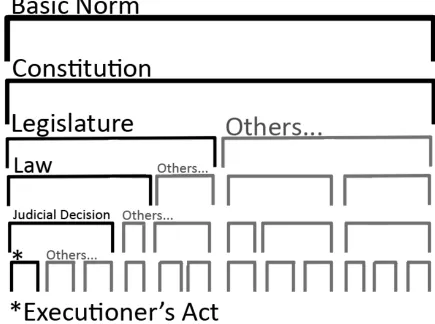
pri-ority. Kelsen uses the following example to illustrate this structure of validity (see Graph A).3
If we begin with one individual depriving another of his life by hanging, we might then ask what
makes this action legal? A legal act is an act by means of which a legal norm is issued, such as the
pas-sage of a new statute or the decision of a judge, provided that this issuance is in accordance with the
higher level norms of the legal system. A legal act is the act of positing law.4 According to Kelsen, this
act of taking another's life can only be legal if it is prescribed by an individual legal norm, a norm that is
issued by judicial decision. The question then arises, why ought this judicial order to be applied? The
answer is that the judicial order was created in applying criminal law, which contains a general norm
according to which the death penalty ought to be applied under the circumstances present in the trial.
The criminal law itself is valid because it was created by a legislature that is authorized by a constitution
to create general legal norms. Therefore, the validity of the act prescribed by the judicial decision is
traced back to the validity of the constitution. But what of the validity of the constitution? It is possible
that the constitution was created in accordance with an earlier constitution. Kelsen states: “If we ask for
3Kelsen, Hans. Pure Theory of Law.Trans. Max Knight. Los Angeles: University of California Press, Berkeley, 1967. § 34(c) p. 199 – 201. [hereinafter PTL]
the reason of the validity of the constitution... we may, perhaps, discover an older constitution.”5 This
change might have been accomplished through an amendment, made in conformity to the rules of the
earlier constitution. Here, the current constitution can be said to derive its validity from being posited in
conformity with the earlier constitution. In this way, we trace our way back to the historically first
con-stitution. This is the constitution that is the source of the validity of the laws of the legal system, but for
which there is no positive source for its validity.
The question then arises, what is it that authorized the historically first constitution, such that
the validity of the historically first constitution might be a reason for the validity of the norms of the
le-gal system? What makes the historically first constitution of a state lele-gal system valid? If we are looking
from the perspective only of the legal system of a specific state, then the validity of the constitution of
that state is grounded in a presupposed basic norm, which entails that the historically first constitution
of a state legal system is valid. As Kelsen states: “What is to be valid as norm is whatever the framers of
the first constitution have expressed as their will – this is the basic presupposition of all cognition of the
legal system resting on this constitution.”6 This is the basic norm of a given state. When we take the
perspective of the law from the point of view of a specific state, i.e. a specific municipal legal system, the
constitution of that municipal legal system becomes the highest valid positive norm.
5 PTL 200
The inverted brackets are used to illustrate that the higher level norms prescribe boundaries for the content of the norms they validate. A norm that exceeds the prescribed boundaries is said, by the pure theory, to be “invalidatable” by a “designated authority”, such as a court.7 However, within these boundaries there are multiple legal norms that can be legislated.
[image:14.612.86.521.182.506.2]7 LT 72
Kelsen also offers a basic norm for international law, which will be discussed in more detail later
in this thesis. Briefly, the hierarchy of the international legal system terminates with international
cus-tomary law as the highest level of positive international legal norms. In the same way that the
histori-cally first constitution in the earlier example existed at a level for which there was no positive law
vali-dating it, here, customary international law plays the same role for the international legal system. It
validates all the other laws of the international legal system, such as international treaties, but there is
no positive norm of international law that it is validated by. Therefore, the legal scientist applying the
pure theory of law can presuppose a basic norm of international law, prescribing that customary law be
followed. This basic norm of international law validates customary international law, and customary
international law is the source for all the other lower laws of the system of international law.
In the pure theory of law all law, including both international law and the laws of the various
municipal legal systems, constitute one unified system. This means that there can only be one basic
norm. All other legal norms will be posited. This means that, with the exception of the one basic norm
of the unified system of all laws, what might be thought of as the basic norms of the various municipal
legal systems will show up as higher order positive laws of the unified system. For example, if we look
to the constitutions of the United States and Canada and ask, “What validates each of these
constitu-tions?”, the answer will not be two basic norms, one for each system. At most, there can only ever be
one basic norm. It can be that both of these constitutions are validated by higher positive norms of
in-ternational law, such as by a customary law of the inin-ternational legal system. I say “can,” because,
ac-cording to Kelsen, the pure theory can be coherently described, without having any effect on any of the
positive laws of the unified system, from either of two perspectives. The pure theory can be coherently
described with the basic norm of international law at its apex, as the one basic norm that provides for
the basic norm of any one, but only one, municipal legal system at its apex. This phenomenon of the
pure theory will be discussed in more detail below in the section entitled “the choice hypothesis.”
2.2 The Necessary Unity of the law
In proposing the unity of all law, the pure theory is at odds with what Kelsen refers to as the
“traditional” view. According to the traditional view, international law and the laws of a municipal legal
system are distinct, having two distinct sources of validity, one for the municipal legal system, and one
for the system of international law. This “dualistic” (or “pluralistic” as there are multiple municipal legal
systems) view of the law is untenable under the pure theory, according to Kelsen.8 The pure theory is
designed to be a science of the law. Kelsen states: “Here it suffices to note that legal scholarship
be-comes a science to the extent that it fulfills the postulate of the unity of its knowledge, that it succeeds
in conceiving of the law as a unitary whole.”9
Kelsen calls the unity of all law an “epistemological postulate.”10 As Kelsen states: “legal
cogni-tion sets the very same task for itself that natural law [as in the domain of cognicogni-tion of the natural
sci-ences] sets for itself: to represent its object as a unity”11 To the extent that both international law and
state law are seen as law (as binding, coercive norms whose validity is derived from the method of their
creation) it is an epistemological requirement that these norms be treated by the legal theorist as parts
of the same unity, the unity of all law.12 Given the unity of all law into one hierarchical system, each law
derives its validity from being posited in accordance with a higher order norm of the system.
8 LT 111
9 Kelsen, Hans. Problem der Souveraenitaet. 152 10 LT § 50(a) p. 111
11 LT § 50(a) p. 111 - 112
2.3 The Choice Hypothesis
For Kelsen, the normatively of all law is grounded in a single basic norm. However, it is still
pos-sible to conceive of such a system in one of two ways. We can conceive of all law as a unified system
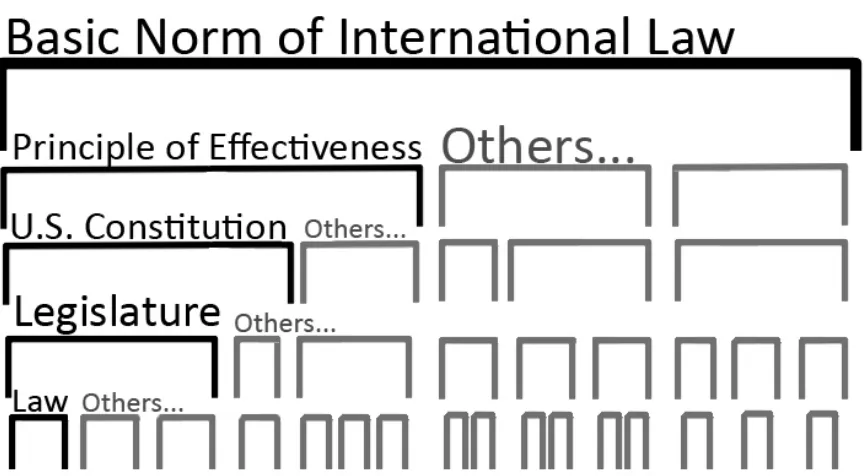
having the constitution of one specific municipal legal system as the highest positive law (see Graph B),
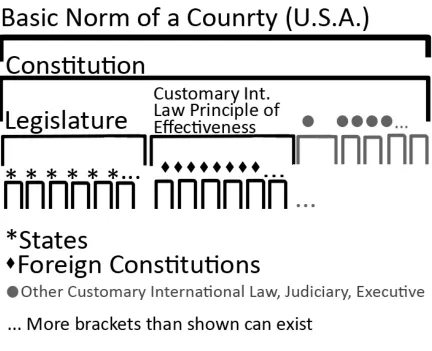
or, alternatively, as having customary international law as the highest positive law (see Graph C). The
basic norm of all law will then be decided based on which hierarchical arrangement is chosen by the
The question of how to determine which basic norm will survive as the basic norm of the unified
legal system is, for Kelsen, not answerable from within the pure theory of law. It is possible to
coherent-ly describe the unified system of law with either the basic norm of international law or with the basic
norm of a state legal system. If we take the basic norm of a state legal system, then the national legal
system delegates, grounds the validity of, international law by recognizing international law as binding.
The legal systems of all other states derive their validity from their recognition by this state legal system
through its recognition of international law.13 Similarly, if we take the international legal system to be
supra-ordinate to the legal systems of the states, then the laws of each legal system will be valid insofar
as they can be traced back, through posited customary international law, to the basic norm of the
inter-national legal system.
Because both of these views of the unitary legal system are coherent and mutually exclusive any
choice between the two views of unified law must be, broadly speaking, political in nature.14 Either way,
to the extent that international law is seen as binding together with the state legal system, the pure
theory holds that they are each parts of one monistic hierarchy of law. Insofar as both the system of
international law and the legal order of a state are considered to be simultaneously valid, the pure
theo-ry holds that they are to be comprehended as parts of one system of laws.15 If we conceive of all law as
belonging to one unified system, a single hierarchy of legal norms (Stufenbau), then the basic norm of
the system becomes the basis of validity for all legal norms, including the norms of lower–order systems.
In this way, all of law gets its validity through derivation from one basic norm.16
13 LT § 50(d) 114 - 116
14 PTL § 43 (c) & (d) p. 332 - 344 15 Ibid § 43 (c) p. 332
2.4 The Basic Norm of International Law and Its Place When Conceived of as Primary
International law, for Kelsen, exhibits the same characteristics as national law. Specifically, it is a
coercive system of norms. In the international legal system, the coercive act, or specific consequence of
an unlawful act, is reprisal or war.17 However, international law is a primitive legal system. The
primi-tive nature of international law is disclosed by its decentralization and its lack of division of labor
through specialized organs (organs of legislation and adjudication, for instance). Being primitive does
not preclude it from being conceived of as part of unified law. The question then arises, what is the
basic norm of international law? In order to answer this question, Kelsen suggests that we should start
with the most concrete examples of international law and follow their validity back through the chain of
international law to find the most general example of positive international law. It will be to this level of
international law that the basic norm of international law will provide validity.18
The most concrete level of norms in the international legal system are found in the decisions of
international courts. If we ask, from where do these norms derive their validity, we find our way to the
international treaty that acts as the foundation for the court. The source of the validity of the treaty is
derived from customary international law, according to which the treaty is binding on its signatories.
Customary international law is the final level of positive international law. There is no constitution of
international law. Therefore, the basic norm of international law picks out international customary law
and asserts that international customary law is binding on those to whom it is directed. As Kelsen
de-scribes the basic norm of international law: “The states ought to behave as they have customarily
be-haved.”19
The ground of each municipal state legal system, then, is found in customary international law,
in Kelsen's view. What was earlier described as the basic norm of a specific municipal legal system, that
17 Ibid.
the historically first constitution is valid (also expressible as authorizing those who created the
historical-ly first constitution to legislate a binding constitution), becomes the norm of international customary
law that Kelsen refers to as the “principle of effectiveness.”20 The principle of effectiveness recognizes
coercive hierarchies of norms (states) that are by-and-large effective as binding. This requirement of
effectiveness is the source of the validity of the norms found in the state legal system. The effectiveness
does not have to be perfect conformity on the part of every individual within the state. If a state had
perfect conformity, then there would be no need for a hierarchy of coercive norms. The positive
cus-tomary law also acts to limit the jurisdiction of the state legal system. The jurisdiction of the state legal
system is defined by the time, place and persons over which it is effective.
The ground of each municipal state legal system, then, is found in customary international law,
which requires by-and-large effectiveness for the historically first constitution of a state legal system to
be valid, and so forth down to the most concrete norms generated by the judicial decisions of a given
state. As Kelsen states: “The basic norm of international law, then, and thus of state legal systems, too,
whose powers are delegated to them by international law, must be a norm that establishes custom –
the reciprocal behavior of the states – as a law-creating material fact.”21 This priority is a logical, not
necessarily temporal, priority. The rules of families and small communities likely predate the
constitu-tions of many modern states. Still, we would say that the validity of the norms of those states is derived
from the subsequently created constitution. “One must not confuse historical sequence with the logical
relation between norms.”22
2.5 States and the Law, the Identity Thesis
According to the pure theory of law, states and their legal systems are identical. This is known
as the identity thesis. In every state legal system, there are a series of legal norms and legal organs. An
20 LT 120
organ is an individual, or group of individuals, who performs a function that can be attributed to the
community.23 Here, the organs that are being considered are legislating organs. The legal organs are
authorized by norms of the legal system to create new, lower, more concrete legal norms. This process
of legislation creates new valid norms of the legal system, and is itself authorized, validated, by higher
legal norms of the system that were themselves created by organs of the legal system. A chain is
creat-ed with organs legislating new norms for the system, bascreat-ed on authorization grantcreat-ed by higher norms
that were themselves created by authorized organs. This chain, according to the pure theory of law,
ends with the presupposed norm of the legal system.24 Every legislative act is authorized by a norm of
the legal system, including the historically first constitution. It is the presupposed basic norm that
au-thorizes the legislating of the historically first constitution. The bindingness of all state acts is derived
from a norm of the legal system. In this way, the pure theory rejects the view that separates the state
into a political and a legal function. Under the pure theory, there is only one hierarchy, with the political
act of legislating being always subordinate to and authorized by legal norms.25
3 VINX
For Vinx, the pure theory is best understood as a theory of political legitimacy.26Vinx seeks to
understand the pure theory of law as providing a reason for the addressees of a legal system to act in
accordance with the norms of that legal system, even in the face of practical considerations speaking
against the act prescribed by those norms. As Vinx states: “The pure theory of law, once it is read in the
23 PTL § 30 (c) p. 199 - 201
24 Ibid § 41 (a) p.
25 For a competing conception see Carl Schmitt's concept of the exception. For Schmitt, it is possible for a state to act, legally, outside of the state's legal system, which Schmitt refers to as the “exception.” The “exception” suggests that it is possible for the state and the legal system to come apart. See Schmitt, Carl. Political Theology: Four Chapters on the Concept of Sovereignty. George D. Schwab, trans. Chicago: University of Chicago Press University of Chicago, 2004.
light of Kelsen's political theory, can be understood as a theory of political legitimacy.”27 One can, for
Vinx, point to the “legality” of a political decision to justify, to some degree, the claim of the “state or
legal system” to the obedience of its citizens.28 The normativity that Vinx sees the pure theory of law as
attributing to the laws of “a legal system can be interpreted as a form of de jure legitimacy which [Vinx
calls] 'legal legitimacy.'”29 De jure legitimacy exists when a reasonable person ought to view the political
decisions of a system as providing “some degree of exclusionary force” in their decision making (Vinx
draws his use of “exclusionary” from Raz, however he seeks to understand exclusionary force as a
mat-ter of weight).30 This is to say, when an addressee of a norm considers the norm, they ought, provided
they are reasonable, to see the norm as having some weight when taken together with other reasons
proscribing the act that the norm prescribes. As Vinx states: “Belief in legal legitimacy, according to
Kel-sen, is the only reasonable form of acceptance of claims to political legitimacy because it is the only
form of belief in political legitimacy that does not depend on ideology.”31Kelsen never uses the term
“le-gitimacy” to describe the normativity that the pure theory assigns to law.32 Although the quote above
might be read to suggest that “legal legitimacy” is, for Vinx, a distinct form of legitimacy from “political”
legitimacy, I think it is better to understand “legal legitimacy,” for Vinx, as a specific form, or species, of
political legitimacy. Legal legitimacy being distinguished, for Vinx, from other forms by its lack of
reli-ance on “ideology.”33
This legitimacy, for Vinx, is categorically distinct from concerns over the substantive justice of
the norms that make up a legal system. To say that a political decision, a norm, within a legal system is
legitimate does not necessarily entail approval of its substantive merits. As Vinx states: “The core
27 Vinx 61 28 Ibid 29 Ibid
30 Vinx 60; “This picture of the relation between legitimate law and individual decisions rejects Raz's view that valid reasons with exclusionary force must invariably prevail over the reasons they replace.” Vinx 74 – 75 footnote 104.
tion guiding my use of [legitimacy] is the idea that a political decision can be legitimate, in virtue of its
pedigree, without being or being accepted as substantively just.”34
Vinx is not arguing that the pure theory is merely compatible with his account of political
macy. Instead, Vinx is arguing that the pure theory itself accounts for the source of the political
legiti-macy that he is seeking to describe. Vinx states that according to the pure theory, “legality is not just a
necessary condition of political legitimacy. It is also the only valid source of de jure legitimacy.”35 It is
“valid” as a source of legitimacy because it “does not depend on ideology.”36
Each state, according to Vinx, no matter how far from its ideal, possesses some degree of legal
legitimacy, even if not enough in certain legal systems to give a reasonable person reason to exclude
other reasons for acting contrary to the prescription of the legal norm.37 Every legal order possesses, at
least, some minimum of legitimacy “due to the fact that all its acts are filtered through a legal
hierar-chy.”38 Being filtered through a legal hierarchy invests the norms of any legal system with a minimum of
exclusionary force, for Vinx, because “someone who is not willing to give any exclusionary force
what-soever, in his practical deliberations, to the fact that a political decision he is expected to defer to has
been filtered through legal order is acting in a morally blameworthy fashion since he expresses a
princi-pled unwillingness to subject his normative conflicts with others to legal arbitration.”39 The degree of
normativity, or exclusionary force, that we ought to “give to the state's decisions is dependent on the
degree to which the system approximates a utopia of legality,” for Vinx.40
34 Vinx 59
For Vinx, the normativity that the pure theory assigns to laws ought to be understood as having
more or less weight for those whose actions the law seeks to instruct.41This is in addition to the base line
of legitimacy that all legal systems have in virtue of their hierarchical structure. Vinx's approach ties the
normativity that the pure theory assigns to laws to a legal system's proximal relationship to an ideal
le-gal system. He argues: “whether the lele-gality of a political decision is a strong enough reason of
legitima-cy to justify the state's unconditional demand for conformity with that decision will depend on how well
the state in question approximates the constitutional ideal of a utopia of legality.”42 That justificatory
force is a “matter of degree.”43 As a state more closely approximates this ideal legal system, the greater
the normativity of its laws. And conversely, the further the state is from the ideal, the less legitimate its
laws, that is, the less likely that the law's existence is sufficient reason to outweigh practical
considera-tions that tend against conformity with a law. Vinx states: “[The ideal of the utopia of legality] is an
at-tempt to outline the conditions under which acceptance of the general claim to obedience made by a
legally organized state can take the form of genuine law abidingness. In a utopia of legality... exercises
of political power that exhibit full legality will typically possess a legitimacy strong enough to motivate
reasonable deference, regardless of how those who are legally authorized to take political decisions
choose to exercise their powers.”44
A state that closely approximates the ideal of legality will have laws with sufficient exclusionary
force to defeat practical considerations tending away from compliance with the act prescribed by the
law. In a state that has fully developed the legitimacy enhancing features so that it perfectly
approxi-mates the ideal of legality, the legitimacy of the norms of the system will be sufficiently strong so that
the addressees of the norms of the state legal system will always be able to “live with” the norms, or
take them to be preemptive, “because the legal legitimacy of these decisions will be strong enough to
41 Vinx 60, especially footnote 83; 74 - 75, especially footnote 105 42 Vinx 61
motivate reasonable deference to these decisions.”45 “In a utopia of legality legal legitimacy can always
step in for other reasons for conformity with the state's demands, for example belief in the substantive
rightness of the decisions, trust in the moral integrity and practical expertise of the rulers, or a shared
conception of good governance, should these latter motivations prove unavailable. And insofar as legal
legitimacy can step in for such reasons, it will make possible the peaceful coexistence between morally
divided groups in a pluralist society.”46
For Vinx, an actual legal system's close proximal relationship to an ideal legal system confers on
the actual system sufficient legitimacy to “justify a general duty to obey the law.”47 He identifies three
legitimacy enhancing features whose possession allows a state to more closely approximate the ideal,
and therefore, be more “legitimate.”48
The three legitimacy enhancing features that Vinx identifies are (1) the impartial administration
of law, (2) the democratic creation of general legal norms, and (3) a formal constitution to protect the
interests of the individual and of minority groups. All municipal legal systems, according to Vinx, share
the same “utopia of legality,” the distance from which measures the normative force of that municipal
legal system's laws. The system of international law, however, does not share the same “utopia” as that
shared by the municipal legal systems. For the system of international law, there is a different ideal
le-gal system, which is called the civitas maxima, the distance from which measures the normative strength
of the norms of international law. Because of this, there is a separate set of legitimacy enhancing
fea-tures that are available to strengthen the normative power of international laws.49 In order to achieve
45 Vinx 74
this civitas maxima, “legally unauthorized use of force” must be prohibited by international law, and
possible conflicts among states must be subject to “compulsory adjudication.”50
3.1 A Problem for Vinx
Vinx states: “whether the legality of a political decision is a strong enough reason of legitimacy
to justify the state's unconditional demand for conformity with that decision will depend on how well
the state in question approximates the constitutional ideal of a utopia of legality.”51The level of
legiti-macy of international law, for Vinx, also depends on the relative closeness of international law to its
ide-al of civitas maxima. In both cases, the norms of each system possess their respective levels of
legitima-cy in virtue of a presupposed basic norm.
The unified system of law has only one basic norm. This basic norm, for Vinx, legitimizes the
laws of the legal system and atop the unified system. If we take as our starting point the conception of
the unified system with international law as the positive legal system at the top, then the basic norm for
the unified system will be the basic norm of international law. For Vinx, this basic norm “makes a
gen-eral attribution” of legitimacy to all of the norms of international law based on the relative closeness of
international law to its ideal.52 Each of the positive norms of international law will possess the
legitima-cy conferred on it by the basic norm. The municipal legal systems derive their legitimalegitima-cy from
custom-ary international law, which is positive law of the system of international law. So, with this conception
of the unified system, all legal norms will share the level of legitimacy which stems from the relative
closeness of international law to its ideal. However, given the choice hypothesis, it is possible to
con-ceive of any one of the municipal legal systems as inhabiting the position that international law inhabits
above. Further, it is not the case that every municipal legal system shares the same level of legitimacy.
Some municipal legal systems are democratic, some are not. Some municipal legal systems have formal
50 Vinx 199
constitutions that protect the rights of minorities and individuals, some do not. Differences in the
ex-tent to which different municipal legal systems have adopted Vinx's three legitimizing features mean
differences in the levels of legitimacy these municipal legal systems will possess, for Vinx. Therefore,
given the choice hypothesis and the unity of the law, the level of legitimacy for any law of the unified
system is left indefinite. Depending on how one conceives of the unity of the law, the level of legitimacy
for all of the laws of the unified system will change, and, as Kelsen recognized, there is nothing in the
pure theory to prefer one conception to another.
Vinx also cannot hold, from within the pure theory, that the level of legitimacy of each legal
sys-tem is derived from that legal syssys-tem's proximity to its ideal. The principle of effectiveness of customary
international law is, according to Kelsen, a positive norm of international law. It is also the source of the
legitimacy of the municipal legal systems under the unified system, or all of the municipal legal systems
with the exception of one in the case of that one being the source for the validity of all law in the unified
system under the choice hypothesis. If we determine the level of legitimacy of one of the municipal
le-gal systems and try to assign that level to the customary international law that is the source, under the
pure theory, of the legitimacy of that municipal legal system, then we will have a norm of a legal system
(here, a norm of customary international law) that does not derive its level of legitimacy from the
rela-tive closeness of its legal system to that legal system's ideal. However, Vinx's point was that each legal
system derives its level of legitimacy from its system's proximal relation to its own ideal.
If, on the other hand, because each legal system derives its level of legitimacy from its proximal
relation to its ideal, we hold that customary international law has that level of legitimacy that is
com-mon to all international law, then we collapse back into the first situation, whereby each legal system
within the unified system shares the same level of legitimacy as the system at the top of the unified
sys-tem. This is because those municipal legal systems for whom customary international law is the source
the choice hypothesis. If we conceive of the unified legal system as having the basic norm of a municipal
legal system as its source of legitimacy, then the source for the legitimacy of international law, according
to the pure theory, will be a positive law of the municipal legal system at the top of the unified system.
3.2 The Basic Norm Left Without a Purpose
For the pure theory, it is the presupposition of the basic norm that is the source for the
norma-tivity of all law. If the legitimacy, or special normanorma-tivity, of the law comes from the relative closeness of
a legal system to its ideal, then it is no longer the presupposition of the basic norm that is supplying
normativity to law. Fundamentally, we are left with no reason to continue presupposing the basic norm.
Vinx's reading of the pure theory thus proves to be untennable.
4 BINDREITER
For Bindreiter, we are today faced with a “plurality of complex legal systems.”53 As “state
sov-ereignty,” has been “transcended” new legal systems have developed.54 There are new legal systems
that include supra-national elements that seemingly cannot be accounted for by legal positivism,
ac-cording to Bindreiter. One such example is the legal system of the European Community (hereinafter
EC). Although it has grown from treaties between the member states, it has come to possess
character-istics that go beyond many treaty organizations, charactercharacter-istics that are state-like. An example is the EC
law's claim of primacy with respect to the laws of the member states. Still, the EC legal system fails to
possess many of the characteristics that other states possess, such as a clearly defined constitution,
clearly defined limits on the scope of power that is exercised by the EC to the exclusion of the legal
sys-tems of the member states, etc. Because of the nature of the EC, Bindreiter is concerned with how legal
53 Bindreiter 215
positivism can account for the “peculiar attributes of EC law.”55 As Bindreiter states: “For a legal
positiv-ist, there is nothing in support of the EC claim to primacy,” for instance.56
Bindreiter tries to find a way to allow legal positivism, specifically Kelsen's pure theory, to
ac-count for EC law and its relationship to its member states. In finding a way to allow legal positivism to
account for the EC legal system, Bindreiter sees a need for legitimation, through democratic legitimacy.
Specifically, Bindreiter argues that the EC can sustain a special kind of “conditional” basic norm within
the pure theory. This “conditional” basic norm exceeds Kelsen's understanding of the basic norm by
adding a criterion of democracy to Kelsen's own criteria for presupposing a basic norm.
4.1 Integration and Independence
Bindreiter is concerned with the EC law's claim to be “integrated” into the national legal systems
of the member states, while also being a legal system “independent” of those same municipal legal
or-ders.57 The relationship between the legal system of the EC and the legal systems of the municipal legal
systems, for Bindreiter, is not describable either as merely the relationship between the member states
and their ratified treaties, nor can the EC legal system be described as a state. Although the EC is not a
federal state, it is a “distinctly federative organization.”58 The EC lacks a constitution, though it is in the
midst of “a process of constitutionalization.”59 The question becomes, can EC law be grounded in the
presupposition of a basic norm, and thereby be accurately accounted for by legal positivism, specifically
Kelsen's pure theory?60 For Bindreiter, the answer is yes, with the use of a “conditional” basic norm for
the EC (which will be discussed in more detail below).61
55 Bindreiter 130
4.2 EC Law as Distinguished from Ordinary Treaty Organizations
Three “constitutional principles” have been elaborated by the European Court of Justice, ECJ,
beginning in the 1960s. These principles are the principles of the “autonomy,” “precedence” and “direct
applicability” of EC law within the legal systems of the member states. Through the adoption of these
principles in the decisions of the ECJ, EC law has, according to Bindreiter, grown beyond its treaty
organ-ization roots and become something more.62
The autonomy principle declares the legal order of the EC and the legal order of any one of the
member states to be “two separate and distinct legal orders.”63 This principle first appeared in the
“Bosch” case. This case originated in a Dutch court of law. A lower Dutch court requested a preliminary
ruling on a question of EC law from the ECJ. Before the ECJ rendered its preliminary ruling, the Dutch
court's decision to request the preliminary ruling was appealed to the Dutch Supreme Court. The
ques-tion that the ECJ faced was whether it must wait for the ruling of the Dutch Supreme Court on the
ap-peal before handing down its preliminary ruling. The ECJ held that it did not have to wait for the ruling
of the Dutch Supreme Court on the procedural correctness, according to Dutch law, of the requested
preliminary ruling of the ECJ in the first place. The ECJ stated: “that the municipal law of any Member
State, whose courts request a preliminary ruling from this court, and Community Law constitute two
separate and distinct legal orders.”64 In a later case, the “Van Gend en Loos” case, the ECJ grounded the
autonomous nature of EC law in the transfer of “sovereignty” from the Member states to the EC.65 The
ECJ looked to the “preamble” and “introductory provisions” and “concluded that [the Rome Treaty, one
of the founding treaties of the EC] was not a question of an ordinary international treaty.”66 In its
62 Bindreiter 157 - 158
63 Bindreiter 159
64 Case 13/61, De GeusUitenborgerd v. Bosch en Van Rijn, [1962] ECR 45 (in E/S p. 118 f.); http://eur-lex.europa.eu/LexUriServ/LexUriServ.do?uri=CELEX:61961CJ0013:EN:PDF p. 49 – 50.
sion, the court stated that the Rome Treaty had created institutions “endowed with sovereign rights, the
exercise of which effects Member States and also their citizens.”67
This transfer of sovereignty to the EC had not only created an independent legal system of EC
law, it also limited the rights of the member states when it came to legislation and interpretation.68 The
precedence principle states that if there is a conflict between a rule of the EC and a rule found in the
legal system of a member state, the EC rule takes precedence. It does not matter on what level of the
norm hierarchy the rule of the municipal legal system is found or when it was created, if it conflicts with
any EC law, it is immediately made inapplicable.
In “Costa,” the ECJ held that provisions of EC law found in Article 5 of the Rome Treaty took
precedence over a later enacted Italian statute. The court stated that the Rome Treaty was an
inde-pendent “source of law” that “on entry into force of the Treaty, became an integral part of the legal
sys-tems of the Member States and which their courts are bound to apply.” The court held that because the
member states had transferred some of their sovereignty to the EC, EC law took precedence in those
areas.69 In a later case, the “InternationaleHandelsgesellschaft” case70, the ECJ showed just how far this
precedence extended. InternationaleHandelsgesellschaft had been required by a regulation of the EC
legal system to leave a deposit in order to obtain a license to sell wheat. If International
Handelsgesell-schaft failed to meet its quota, it would forfeit the deposit. When it failed to meet its quota,
Internatio-naleHandelsgesellschaft sued claiming that the required deposit violated its fundamental right to
pro-portionality under the German constitution. The ECJ held that fundamental rights are already
sufficient-ly protected under EC Law, and that one cannot use national law to review the validity or
67 Ibid
68 Ibid
69 Bindreiter 161 – 162.
ty of EC law. Here, the ECJ held that an EC regulation took precedence over the fundamental rights of
the German constitution.71
The third “constitutional principle” handed down by the ECJ is the principle of Direct
Applicabil-ity. In “EEC Commission v. Italy,” The ECJ held that EC regulations are “directly applicable in all Member
States and come into force by virtue of their publication in the official journal of the Community.”
Fur-ther, the ECJ held that EC regulations must be applied in their original EC form by Member States, and
that “all methods of implementation [implementation being the codification of those regulations into
the codes of a Member States] are contrary to the Treaty.”72 The effect of not allowing the member
nations to codify EC regulations into their own legal systems makes clear that the regulations of the EC
do not derive their validity from being posited in a certain way within the legal systems of the member
states. Instead, those regulations derive their validity from membership in the legal system of the EC. It
also has the effect of not situating those regulations within the procedures of the member states.
In “Simmenthall II,” Italy had enacted a fee for the inspection of meat imported from other
Eu-ropean countries. This additional fee was contrary to the Rome Treaty and two EC regulations.
Sim-menthall, an importer of meat into Italy, filed suit for repayment. In Italy, the court of first impression,
lower court, was forbidden from considering the constitutionality of legislation, so it could not strike
down the Italian law. The ECJ considered two questions: whether the lower court had to apply the
Ital-ian law until it could be overturned by the ItalItal-ian Constitutional Court, and whether the ItalItal-ian law must
prevail because enacted later in time to the EC regulations. The ECJ held that every national court must
apply EC laws and regulations as soon as they enter into force for as long as they remain in force. The
ECJ also held that as soon as the EC law or regulation entered into force, any conflicting national law
71 Bindreiter 163
comes inapplicable, so there is no need to wait for the Italian Constitutional Court to enter judgment on
the Italian statute.73
The “Van Gend en Loos” case concerned Article 12 of the Rome Treaty, which prohibits new
im-port and exim-port duties levied mutually by the member states of the EC. The Netherlands changed the
classification of a type of formaldehyde, causing an increase in its import duty. An importer of this
for-maldehyde sued. The question before the ECJ was whether Article 12 was directly applicable and
whether an individual could directly invoke the Article in a national court. The ECJ held both that the
Article is directly applicable, because it is “clear and unconditional” and does not call for implementing
measures, and that individuals can invoke this EC rule in a national court, because the preamble to the
Rome treaty talks of both nations and “peoples.”74 Following this case, in the “Van Duyn” case, the ECJ
held that even Council Directives of the EC can be invoked by individuals. In that case, the ECJ held that
Council Directive 64/221 on the movement and residence of foreign nationals, protecting the right of
citizens of member states to move between states, was directly applicable when a Dutch woman was
refused entry into the UK to work as a secretary for the Church of Scientology.75
The EC legal system is now independent of the legal systems of the member states. Its
inde-pendence is illustrated in what the ECJ has termed a transfer of “sovereignty” from the member states
to the EC. As well as being independent, the laws of the EC also take precedence over the laws of the
member states and must be applied by the courts of the member states, whether or not the court being
asked to apply the EC law was created with the jurisdiction, or competence, to resolve conflicts between
EC law and the laws of its own state. Finally, use of the laws of the EC is not restricted to the member
states who are the actual signatories to the treaties, but can also be directly appealed to by the citizens
73 Bindreiter 165 - 166
of those states to resolve conflicts. For these reasons, according to Bindreiter, the European Community
is not a mere treaty organization.
4.3 Supra-National EC law as Distinct from States; Problematized EC “Constitution”
For Bindreiter, although the EC is more than a mere treaty organization, it is not a federal state.
Claims of the EC to posses a “constitution” are “highly controversial,” if not just false, according to
Bin-dreiter.76 Thus, she prefers to refer to the EC as being in a process of “constitutionalizing.”77
In support of this position, Bindreiter points to the concept of a constitution being “traditionally
tied to the concept of a state.”78 The European Community is “not even near to being a state,” because
of a “remarkable lack of solidarity” among the citizens of the European Community concerning the
Un-ion. Also, there was no “political act of will” on the part of the citizens of the European Community that
could give rise to a “genuine” constitution of the European Community.79 Although the EC is a “legal
personality and in command of treaty-making power” at the international level, the EC is not, according
to Bindreiter, a “sovereign body.” Rather, the member states are “sovereign” and capable of deciding to
leave the Union “in principle.”80
Additionally, Bindreiter offers four reasons for “calling into doubt” the use of “constitution”
when referring to the EC. First, the treaties underlying the EC contain a number of rules that are not
commonly found in constitutions. The ECJ has “abstained” from distinguishing between the rules found
in the treaties and those not so found, leaving the rules which might be called “constitutional” in nature
on the same level as other rules that are not typically found in constitutions, such as rules on agriculture
76 Bindreiter 174
77 Bindreiter 157 78 ibid
79 ibid
or environmental protection.81 Second, Bindreiter points to the “vague nature” of the treaties of the EC
(there have been, to date, more than 20 treaties between the member nations – including the treaties
of Rome and the Maastricht treaty). This includes a concern that the objectives of the treaties are too
vaguely expressed. Recently, this concern has also been expressed by Germany. In the “Maastricht
Judgment,” the Federal Constitutional Court of Germany, Bundesverfassungsgericht, over concerns
about the lack of clear limitations on the growth of EC jurisdiction, held that it must be clear “at the
out-set, to which extent the national legislator agreed to a transferral of sovereign powers.” In the
“Maas-tricht Judgment,” the German Constitutional Court referenced Article 38(1) of the German constitution,
which grants to Germany's citizens the right to be represented in the German legislature through direct
elections. This provision would be left empty, “entleert,” if there is no limit to the growth of the
jurisdic-tion of EC law, law which is directly applicable in German courts and takes precedence over any
conflict-ing German law.82 Third, any “EU Constitution” cannot be said to be an “expression” of the political will
of the citizens of the European Union. At best, any claim to a constitution must be taken from discrete
sentences of treaties and from decisions of the ECJ. Fourth, there is a lack of unequivocal delimitation in
the powers conferred on the institutions of the European Union.83 Even if not able to constitute a
fed-eral state, Bindreiter argues that: “the European Union emerges in fact as a distinctly federative
organi-zation thanks to the (binding) preliminary rulings of the ECJ.”84
In addition to the EU not being “grounded in a written constitution,”85 there are other reasons
why the EC and the member states fail to constitute a federation, for Bindreiter. As Bindreiter points
out, although the European Union has the power to enter into treaties with foreign nations, treaties
binding on the entire EU, the EU lacks a “sovereignty” that one expects with the federal level of a
81 Bindreiter 176
82 “Urteil des ZweitenSenatvom 12.Oktober 1993 (2BvR 2134/92 and 2159/92); on the constitutionality of the Law on the Treaty on European Union; English translation in [1994] 1 CMLR 57.
ation. Specifically, the member states are themselves considered “sovereign” and capable, in principle,
of leaving the Union “should they want to do so. If they were part of a federation this would be
impos-sible.”86 Additionally, compared with federal constitutional courts, the powers of the ECJ are limited.
Generally, the decisions of constitutional courts, or supreme courts, of federations are binding on both
the federal and state level. However, the ECJ lacks the power to “annul” or “even interpret” national
rules that “diverge from Community provisions.”87 Instead, laws at the level of the member states that
conflict with EC laws are said to be inapplicable, but remain otherwise good law. However, in practice
this means that EC law decides whenever there is a conflict between an EC law and the law of a member
state.
4.3.1 EC Law, Dualism and Monism
The claim of EC law to take precedence over national law is not, according to Bindreiter,
expli-cable under either a monistic or dualistic perspective. For the dualist, the laws of a nation and any other
legal systems are distinct. Therefore, no law that is part of an external legal system can be valid,
appli-cable, etc., unless it has been recognized by the legal system of that nation. For the dualist, EC law
can-not be binding unless it has been expressly incorporated through legal enactment. Otherwise, the
norms of distinct legal systems are simply two ships passing in the night. Each is valid and applicable
within its own system's jurisdiction, competence, but no further.88 Therefore, EC law cannot be seen as
applicable within a member state in the absence of express legislation on the part of a particular nation.
This is at odds with the direct applicability of EC law. In the “EEC Commission v. Italy” case above, the
ECJ not only held that member states did not need to implement EC law within their own legal systems,
it held that member states are not to take such steps of implementation, and that all EC law becomes
86 Bindreiter 154
directly applicable within each member state as soon as it is published in the “official journal of the
Community.”89
Additionally, there is no room in a dualist view as described above for a law from outside a state
to take precedence over a norm of the constitution of a state, because any law of that state that picked
out the external legal norm as applicable within the state would have been enacted pursuant to that
constitution. Under the rule of lex superior derogatlegiinferiori the norm found in the constitution
would take precedence over the external legal norm. However, in “International Handelsgesellschaft”
above, the ECJ held that EC law took precedence over even questions of whether an EC regulation
vio-lates the basic right of proportionality under the German constitution.90
Bindreiter lays out two alternatives for the monistic perspective. The first perspective,
Alterna-tive 1, perceives law from the perspecAlterna-tive of the primacy of national law. With this perspecAlterna-tive, EC law
gets its primacy over state law from the constitution of the state. Bindreiter uses the example of the
“Ramel” case.91 In the “Ramel” case, a French wine merchant imported some wine from Italy. It was
determined by the French government that the wine failed to have the required proportions of alcohol
and sugar. Ramel fought the decision by claiming that the French law conflicted with EC regulations.
The French court held that the EC regulations overruled the French law, but held so based on the French
constitution. Therefore, according to the French court, which was taking the monistic view of the law
with their own constitution as primary, the precedence of EC law is grounded not in a principle of
prec-edence found in EC law, but in a clause of the French constitution. Bindreiter expresses this as EC law
being applied on false grounds from the perspective of the EC. From the perspective of the EC, the
precedence of EC law does not stem from the constitution of a member state, but from the transference
of sovereignty from the member states to the EC.
89 Bindreiter 163
90 Ibid.
The second alternative of legal monism holds that the norms of international law are superior to
the norms of national law. The validity of all law is delegated from the basic norm of international law.
Under this understanding, international law stays international law, binding against the nation but not
within it, until it is transformed into municipal law through an enactment of the state.92 However, EC
law is directly applicable within member states, and can be appealed to by both member states and
citi-zens of those states, without being first codified into the legal systems of those states. Because,
accord-ing to Bindrieter, neither of the traditional theories, monism and dualism, are able to account for the
direct applicability of EC law within the member nations of the EC, Bindreiter looks to a new source to
account for the applicability of the EC laws. The European Community lacks many of the features that
we normally find in a state. At the same time, the European Community can no longer be reduced
simp-ly to its founding treaties.
4.4 Bindreiter's Solution
Bindreiter looks to the pure theory of law and proposes to ground the EC's claim to autonomy
and precedence with a conditional basic norm for the EC. Bindreiter states: “for supra-national law to
be considered as an autonomous, valid and binding legal system it requires, juridico-theoretically, that
an EU-equivalent to Kelsen's basic norm be presupposed or assumed.”93 However, Bindreiter argues
that the EC is not capable of sustaining a basic norm in the way that other states do under the pure
the-ory. There is no “clearly outlined top (or constitutional core),”94 and therefore no historically first
consti-tution to be validated by a basic norm of EC law. Though the EC lacks a consticonsti-tution, it is in the midst of
“a process of constitutionalization” through the preliminary rulings of the ECJ.95 These decisions have
92 PTL 337
had the effect of turning the EC into a “distinctly federative organization.”96 Because of the
“constitu-tionalizing” principles outlined above, EC law is not reducible to a treaty organization of international
law, according to Bindreiter. Bindreiter aims to resolve this difficulty of accounting for EC law using legal
positivism by proposing a “conditional” basic norm for the EC. This “conditional” basic norm is
im-portantly distinct from other basic norms under the pure theory, and will allow the EC to fit into the
pure theory in a way similar to that of a municipal legal system.
For Bindreiter, the claim to autonomy and precedence requires “a wholly new type of ultimate
criterion of validity.”97 This criterion of validity will go beyond the criteria that Kelsen laid out for
pre-supposing a basic norm. For Bindreiter, prepre-supposing a basic norm for the EC will require a criterion of
legitimacy in addition to considerations of the coercive nature of a set of norms, their hierarchical
struc-ture and their by-and-large effectiveness. This added criterion goes beyond “the boundaries of pure
positivism.”98 Instead, Bindreiter argues that by including the “non-juridical” criterion of democracy, her
positivism is “inclusive.” As Bindreiter states: “The positivism suggested here is 'inclusive' in the sense
that it comprises the element of democracy.”99
One reason for the necessity of the criterion of democracy, for Bindreiter, is competing claims to
jurisdiction between the EC and its member states. As Bindreiter states: “The fields of application of
[member state and Community] norms can overlap in so far as several 'legal systems' claim to bind the
same persons in the same issues. In short: the need for legitimation is obvious.”100 For Bindreiter, this
96 Bindreiter 156
97 Ibid
98 Bindreiter 218
99 Ibid. It is not clear that the requirement of democracy as a ground for the normativity of EC law is an example of inclusive, or “soft,” legal positivism. For Bindreiter, it is not that the EC does in fact include a democratic requirement in its positive law, or even that it may, but that a criterion of democracy is necessary for the normativity of EC law (necessary for the presupposition of a basic norm for the EC). Inclusive legal positivism takes the position that there is no necessary moral content to a rule of law, but that moral content may be included in a given legal system by choice. Waluchow, W. J. “The Many Faces of Legal Positivism.” University of Toronto Law Journal 48, 1998: 395.
legitimacy will allow the theoretical tensions that exist for legal positivism between EC law and its
mem-ber states to be relaxed, and allow this “distinctly federative system” to fit within the pure theory of law.
4.4.1 Democratic Legitimacy
Legitimacy is defined by Bindreiter as “acceptance... on the part of the norm addressees, of the
norms, the institutions and the decisions taken by the legal organs.”101 Legal rules can be legitimated in
two different ways. The rules of a legal hierarchy can be legitimated from “within the framework of a
given norm system.”102 This is a legitimation that is internal to the legal system, wherein the legal rules'
“validity” is “established within the framework of a given norm system,” according to Bindreiter.103
Legal rules can also be legitimate by being “justified” from outside the framework of a given
norm system.104 Justification, in this sense, comes from a point of view “different from the internal,
le-gal point of view mentioned above.”105 One such justification, for Bindreiter, is the “principle of
democ-racy.”106
Bindreiter argues that democratic legitimacy ought to have more “weight than other kinds of
le-gitimacy.”107 In support of her claim, Bindreiter points out that democratic legitimacy is relatively
un-controversial. Bindreiter asks rhetorically: “is there... at all an acceptable alternative to the principle of
democracy?”108
101 Bindreiter 5
102 Ibid 103 Ibid. 104 Ibid. 105 Ibid. 106 Ibid.
4.4.2 Democratic Legitimacy Cannot Resolve Overlapping Jurisdictions
Bindreiter argues that the need for legitimation is “obvious” because of overlapping jurisdiction
between EC and member state law.109 However, she fails to see that democratic legitimacy cannot
answer this concern. If the EC meets the condition of being democratic, so do the member states. To
the extent that the EC and its member states are similarly situated with regard to democracy, they each
possess democratic legitimacy. Therefore, appeals to the democratic legitimacy of each will not
distin-guish between the competing claims to jurisdiction over the same persons, time, and subject matter.
4.4.3 A Conditional Basic Norm for the EC
Bindreiter proposes grounding EC law in a “conditional” basic norm.110 “Conditional basic
norms” are adopted by Bindreiter from AleksanderPeczenik.111 For Peczenik, the conditional basic norm
is a way to allow the laws of a system to continue to be recognized as valid after the basic norm for the
system has been “problematized.”112 According to the pure theory, the basic norm for a municipal legal
system states that “whatever the framers of the first constitution have expressed as their will” is
“val-id.”113 This can also be expressed as whatever the framers of the first constitution express as their will
ought to be obeyed. When questions are raised as to whether the constitution ought to be obeyed,
then, according to Bindreiter, the basic norm of the municipal legal system is problematized, called into
doubt. Bindreiter gives the example of a constitution being called into doubt when a series of laws are
enacted that are sufficiently “unjust” as to raise questions about whether they ought to be observed.
“Further questions” may be raised about “whether the constitution [that validated these laws], as such,
ought to be observed.”114 This conflicts with Kelsen's basic norm as stated above. For Peczenik, when a
basic norm is problematized, it is shown to be a weak ground for validity. In situations where the
109 Bindreiter 215 110 Bindreiter 215 - 217 111 Bindreiter 216 112 Bindreiter 216 113 LT 57