Art and Design Theses Ernest G. Welch School of Art and Design
Spring 5-1-2012
Putting Lipstick on a Sculpture
Putting Lipstick on a Sculpture
Kelly A. O'Brien Georgia State University
Follow this and additional works at: https://scholarworks.gsu.edu/art_design_theses
Recommended Citation Recommended Citation
O'Brien, Kelly A., "Putting Lipstick on a Sculpture." Thesis, Georgia State University, 2012. https://scholarworks.gsu.edu/art_design_theses/107
This Thesis is brought to you for free and open access by the Ernest G. Welch School of Art and Design at ScholarWorks @ Georgia State University. It has been accepted for inclusion in Art and Design Theses by an authorized administrator of ScholarWorks @ Georgia State University. For more information, please contact
PUTTING LIPSTICK ON A SCULPTURE
by
KELLY OʼBRIEN
Under the Direction of Christina West
ABSTRACT
Putting Lipstick on a Sculpture is a mixed body of sculptural and two-dimensional work
investigating our societyʼs superficial expectations of beauty. The glitzy covers of glitter
and spandex are used over more traditional structural materials to confuse the viewerʼs
expectations, much like labels categorizing usual fine art. The sculptures are on display
for the audienceʼs aesthetic judgments, while paintings blur lines of what is classified as
traditional and acceptable for emphasis.
INDEX WORDS: Glitz, Sculpture, Painting, Art, Judgmental, Plywood, Spandex, Glitter, Beauty, Grotesque, Superficial, Cheap, Display, Culture, Jurassic, Appearance,
PUTTING LIPSTICK ON A SCULPTURE
by
KELLY OʼBRIEN
A Thesis Submitted in Partial Fulfillment of the Requirements for the Degree of
Level and Degree Title
in the College of Arts and Sciences
Georgia State University
Copyright by Kelly OʼBrien
PUTTING LIPSTICK ON A SCULPTURE
by
KELLY OʼBRIEN
Committee Chair: Christina West
Committee: Craig Drennen
Ruth Stanford
Michael Wsol
Electronic Version Approved:
Office of Graduate Studies
College of Arts and Sciences
Georgia State University
DEDICATION
This is made entirely possible due to my father and mother, who overly
ACKNOWLEDGEMENTS
Sean, thanks for keeping it real growing up. Someone had to keep me in
check.
Brian, thanks for putting up with me, you have a choice unlike my poor
family. I am a better sculptor because of the construction skills you have taught
me.
Christina, thank you for all the outside hours of help and editing, whether
school assigned or personal. I wouldnʼt be as far as I am today without your
guidance.
Ruth, Mike and Craig, thanks for the encouragement. The support Iʼve
had from my thesis committee has kept me motivated and enthusiastic, and I
have sculptures made as a result of specific comments from each one of you.
I would also like to acknowledge Josh Smith and Jenene Nagy. The year
that we worked together at Georgia State was my most transformative and
important, largely thanks to the two of you. Josh, thank you for the casual studio
critiques that often pushed me out of comfort zones into new and exciting work,
and Jenene for being brutally honest, causing me to bring glitter back into my
sculptures.
Last, but certainly furthest from least, thank you Mom and Dad. You have
undoubtedly supported me in my dream-come-true of pursuing a life of an artist,
always believing I have what it takes to succeed, causing me to believe it as well.
TABLE OF CONTENTS
ACKNOWLEDGEMENTS………...v
LIST OF FIGURES……….vii
THESIS STATEMENT………..1
ARTISTIC DEVELOPMENT………2
INFLUENCES………8
THESIS WORK………...15
SUMMATION……….……….22
LIST OF FIGURES
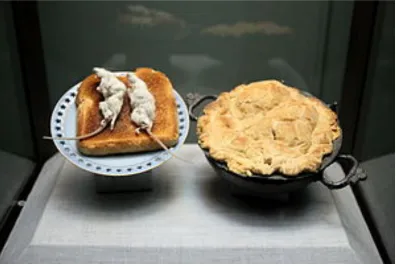
FIGURE 1 Museum of Jurassic Technology: Mice on Toast…….………..25
FIGURE 2 Kelly OʼBrien: Self Portrait as Jackalope……….26
FIGURE 3 Louise Bourgeois: The Fabric Works….………..27
FIGURE 4 Kelly OʼBrien: Mounted Fancy Calf..………28
FIGURE 5 Mitzi Pederson: yellow and orange………..29
FIGURE 6 Angela de la Cruz: Larger Than Life………30
FIGURE 7 The Learning Chanel: Toddlers & Tiaras………31
FIGURE 8 Kelly OʼBrien: Awkward Glitz……….32
FIGURE 9 Kelly OʼBrien: Purple Portrait………...…..33
FIGURE 10 Kelly OʼBrien: Sculpture to Painting Blob Prop…..………..34
FIGURE 11 Kelly OʼBrien: Tube Top Glitz………..………35
FIGURE 12 Kelly OʼBrien: Group Glitz………...36
FIGURE 13 Kelly OʼBrien: Purple Blob Prop………...………...37
FIGURE 14 Kelly OʼBrien: Purple Glitz………...38
FIGURE 15 Kelly OʼBrien: Leaking Blob Prop………...39
The Learner must be led always from familiar objects toward the unfamiliar, guided along, as it were, a chain of flowers into the mysteries of life.
–Charles Wilson Peale,
Quoted in the introductory text of The Museum of Jurassic Technology
1. THESIS STATEMENT
Defining beauty is complex. I have an untamed curiosity about the
uncertain qualities that are assigned to things classified under “beautiful”. This
definition comes with expectations that can easily be generalized, but to whose
standards? The inherently variable nature of what is beautiful stretches past
women and into the gallery; familiar roles are cast upon mediums and how they
function to make up a whole work of art.
If defining beauty is complex so is defining sculpture. This
material-dictated investigation hinges on the careful consideration of the fragile lines that
separate beautiful from grotesque, sculpture from painting. Gaudy aesthetic cues
are borrowed from the extreme spectacle of pageantry, and traditions in art
history are simultaneously played up to examine the classifications of sculpture
versus painting. My curiosity lies in opposites that share similar qualities. Lines
are blurred upon attempt at definition, in which the viewer begins to question
his/her expectations. Cheap becomes classy, bland becomes bright, bulge
become gaunt, and all is turned inside out again. The glitzy covers of glitter and
spandex are used over more traditional structural materials to confuse the
sculptures are on display for the audienceʼs aesthetic judgments, while paintings
blur lines of what is classified as traditional and acceptable for emphasis.
2. ARTISTICDEVELOPMENT
2a. BACKGROUND/STATE OF THE ART
Convincing people of things, anything really, has always been an
interest of mine. To convince someone of a falsehood is more entertaining than
revealing actual facts, even if they are unusual. This may clarify a personal
affinity I have for a particular creature, the jackalope. This cryptozoological
phenomenon lends itself wonderfully to the ability to convince people of
something fake since it is already so widely known, but so narrowly known about.
Testing peopleʼs expectations that they have grown to feel comfort in, leads me
to push the boundaries of what is presumably anticipated in medium
specifications.
Luckily, while making these realizations about my fascination with mythical
creatures and trickery, I made a trip out to Culver City, California and was taken
to a small museum. Having never heard of the Museum of Jurassic Technology
before, I had no idea of what to expect besides the fact that it sounded
science-based and was definitely not the art gallery visit that I had requested of my host.
Walking through the sequentially controlled hallways, I was amazed at how
incredible some of these science “facts” were, among other much more mundane
them were drawn out and rather dull. As I sat through a long video about bats in
its entirety, I realized at the end when they mentioned the animalʼs ability to fly
through walls due to its piercing scream, that this was a hoax. I understand that I
am not the most scientifically inclined individual, but I thought that I might have
heard about this fantastic “fact” before. With my newfound suspicion, I retraced
my steps back through the hallways and discovered that what I had been
glossing over had taken full advantage of museum viewerʼs tendencies to do just
that. The majority of the artifacts and information had been fully fabricated,
mixed in with hints of truth here and there, to keep the uninvolved viewer strung
along in a false educational experience. The farther the visitors walked through
the exhibits, the more ridiculous the “facts” became.
Upon my awareness of this trick, I was overwhelmed with profound
respect for the cleverness that went into such an endeavor as elaborate as
building a whole museum dedicated to deceptive facade, to only later realize it
had been funded through a MacArthur Genius Grant. Publically advertised as an
educational institution (dedicated to the advancement of knowledge), it claims to
house “bizarre relics” from the lower Jurassic period (Figure 1).
After my introduction to this museum and its sarcastic presentation of art, I
began thinking of the role of historic museums versus art galleries. It is a
generalization, but a popular one, that if an object is housed in a museum then it
should be regarded as fact, and if it is in a gallery then it should be questioned
consideration that there exist specified museums solely dedicated to art
collections, as well as galleries. In On the Museumʼs Ruins, Douglas Crimp
presents a “…critique of the museum [that] provides a useful analysis of what
might be called a discourse on the objects of knowledge.” Crimp states,
“It wrests its objects from their original historical contexts not as an act of political commemoration but in order to create the illusion of universal knowledge. By displaying the products of particular histories in a reified historical continuum, the museum fetishizes them, which, as [Walter] Benjamin says, ʻmay well increase the burden of the treasures that are piled up on humanityʼs back. But it does not give mankind the strength to shake them off, so as to get its hands on them.” 1
I was interested in the presentation that the Museum of Jurassic
Technology had exploited to trick its viewers, and attempted this technique in my
own early artwork (Figure 2). Self Portrait as Jackalope was realized as a relic
instead of a sculpture object. By using prosthetic special effects makeup and
mold making skills, I wanted to give the viewer a glimpse of what would happen if
we evolved into jackalopes, and then died. A gory stretch, but it was a start, and
certainly a breakthrough in my conceptual development.
2b. EARLY MATERIAL DEVELOPMENT
Beginning my studio practice in traditional oil painting, I have been trained
early on in the most direct, common applications of the media I was working
within. Having been trained for sculpture in a metal shop, it was only a matter of
time before curiosity set in to explore foreign materials and techniques, and much
later on in my career have this expansion in my painting practice. This trip to The
1 Crimp, Douglas. “This is Not a Museum of Art.” In On the Museumʼs Ruins.
Museum of Jurassic Technology marked the transition in material change.
Thankfully, in my simplistic thought of rebelling with a material different from
metal, I began creating soft sculptures. How clever of me, the opposite of hard
metal is soft fabric. As elementary of a concept as this breakthrough turned out
to be, it is one that has molded my career in one that is more inquisitive. Metal
had such strong, solid roots as the favored historical medium for sculpture. Soft
sculpture, on the other hand, had much more potential for me to explore my
malleable ideas. I have always moved through ideas quickly, as if always asking
questions faster than I can try to present myself answers to them, and sewing
was a speedier way to get ideas out into my physical world for further
examination. I looked to artists who had seamlessly made this transition in art
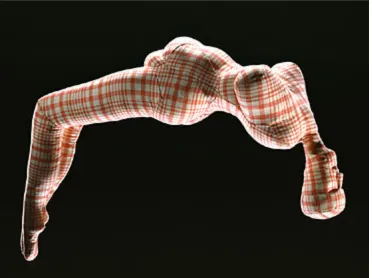
history, and found relevance in the soft sculptures of Louise Bourgeois (Figure 3).
Bourgeois ability to use these drastically different materials to explore similar
conceptual investigations was a tried and trusted guide towards my on material
concerns. Along with the material likeness, Bourgeoisʼ formal ambiguity to
confuse the viewer spoke to me,
“…its elements are unsettling: flesh-coloured forms hanging within a wire mesh resemble body parts – perhaps breasts or uteri or male genitalia – without being clear precisely which. Such suggestive ambiguity is typical of Bourgeoisʼs sculptures, enabling one thing to slip into and signify another, disturbing the viewersʼ conceptions.” 2
2Celant, Germano. Hauser & Wirth Gallery, introduction to “Louise Bourgeois:
The Fabric Works,” Hauser & Worth London, October 15- December 18, 2010,
When the switch from hard to soft sculpture occurred, the shift in my
thinking about content of my work drastically turned as well. While working in
metal, with traditional casting methods, that of which involves slow, process
driven labor, I found that the concepts my work had been revolving around had
been much more serious than what my stuffed work became. As I loosened up
my technical construction of the work, I found myself having more fun with the
ideas my work stemmed from. I thought about what I was attracted to in other
peopleʼs work, and wondered why I hadnʼt been using those qualities in my own.
This realization brought me back to the jackalope. Recalling the excitement from
the challenges that arose from trying to convince people in the existence of
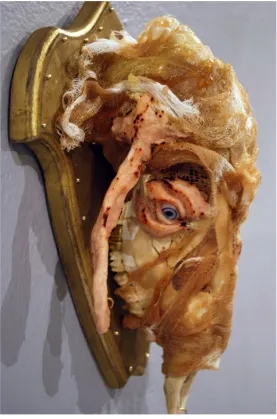
mythological creatures, made me anxious to mimic this trickery in my sculpture
(Figure 4).
Throughout this sculptural development and even dating before its
beginnings, I have been painting oil portraits. I am extremely attracted to painting
flesh, and in turn have chosen to paint people posing in a manner of a traditional
portrait. I had been working on separate bodies of work, always a series of oil
portraits along with a different body of sculptural work. I had always been eager
to combine them, but because of this strong desire, I felt that whatever developed
from the merge would appear to be entirely too forced. Recently, I became
discouraged and on the verge of dropping this hope of ever successfully marrying
the two media together. After several critical discussions, I was advised to ask
told that I needed to unlock why I always ended up going back to depicting
people, since after all, they are not particularly interesting, only when they
contribute to the concept.
2c. RECENT MATERIAL DEVELOPMENT
Since gradually moving on from the soft sculpture creatures that propelled
me from my undergraduate career into my MFA program, I have not yet
abandoned the desire to incorporate my favorite qualities of painting into my
sculptures. The discovery of certain working artists who successfully display my
concerns I have about medium expectations has heavily changed the direction of
my work through appropriately simplified material choices. I have recently found
that the properties of painting that I am after are heavily process driven. I like
mixing unnatural, uncanny colors to create perfect flesh tones, and then applying
the buttery substance to a surface with a meditative technique. These are the
qualities that I love and continuously draw me back towards painting, and these
very qualities are the opposite reasons as to why I love and also need sculpture.
Sculpture is a physically involved process that requires problem solving
and sweat. I need these moments of excitement and frustration, just as badly as
I need my Zen-like breaks found in my painting studio. Since I need both of
these processes to be complete, and it only follows suit that my artwork in turn
3. INFLUENCES
3a. ARTIST INFLUENCES
My influences are drawn from sculpture, painting, and art
philosophy/theory. I have found extraordinary value in the artistsʼ work
separately, but my personal work has thrived from the combination of main ideas
borrowed and melded into my own interests. In addition, influences from a
mid-western taste of appearance-based beauty show through in my material
representations of glitz and glam with glitter and spandex.
Sculptor Mitzi Pederson uses subtle glimpses of glitter and shiny
cellophane to treat the viewer in otherwise overlooked places to provide a treat
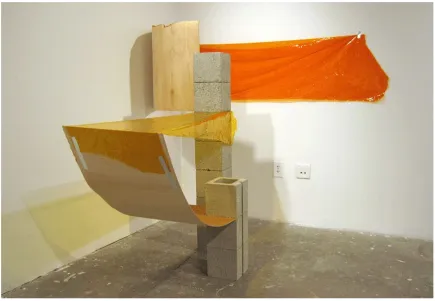
for the viewer. In the work yellow and orange (Figure 5), Pederson combines
extreme materials in extraordinary ways; marrying cinderblocks with cellophane
is unsuspected and rewarding. Her sensitivity to materials, and creation of
straightforward visual experiences as rewards, are often achieved by enhancing
“flaws”. For example, it is intriguing how a connection made with tape, has been
exaggerated rather than hidden with shiny aluminum foil tape. Similar to my
interest in rewards obtained from viewing a piece, Pederson highlights what she
considers mistakes, and brings attention to that which typically goes unnoticed.
She calls this “practicing aspects of consideration.”3 Pedersonʼs careful
consideration of material qualities and powerful minimal compositions leave the
3Hoffmann, Jens. “Mitzi Pederson.” In Vitamin 3-D: New Perspectives in
viewer in awe. Pederson also uses a sophisticated application of bold bright
colors, and even moments of glitter. Pedersonʼs success is in her straightforward
presentation, combined with a penetrating clear concept. The exaggeration of
flaws, pushed to the extreme creates something extraordinary out of the
otherwise mundane material connection.
Non-traditional painter Angela de la Cruz dramatically blurs the line
between painting and sculpture (Figure 6), by virtually destroying her boldly
colored canvases and frames and allowing the remaining materials to be
displayed as pure form. De la Cruz is an influence in her skill of delivering a
concise concept in the most direct fashion possible. These forms act as evidence
for the break that has happened from one fine arts classification into the other,
leaving painting and entering sculpture. De la Cruzʼs work transcends from
painting into the realm of sculpture by introducing flat, glossy color fields, and
transforming canvases into three-dimensions as battered victims crumpled into
forms. The absence of an image helps bring the forms into sculpture. The
mangled canvas is transformed into an elegant form because of her careful
consideration for formal elements of composition in a sculptural sense, and this
realization has shown me that a sculpture should do more than sit atop a
pedestal. A pedestal, or base, should have equal amount of consideration to the
work it is supporting, in more than just a physical relationship.
The physical relationship established between a sculptural form and the
piece as a whole and the viewerʼs distance from it. Sculptor Robert Morris
highlights the conceptual relevance of the physical space between the viewer
and the artwork in an ARTFORUM article entitled, “Aligned With Nazca.” What
Morris is indirectly observing is the importance of the environment in which an
artwork resides. The context of the work has gained hierarchy in contemporary
sculpture, and visual perspectives affect the meanings embodied in the work.
Morris describes space more in terms of a material sense, rather than the
physical area the object is in. The space should be considered as conceptual
language with equal weight to, or even more than other material choices. He
brings up the common contextual scenario of “the confining rectilinear room,…
where the details of the work are never out of focus.” This is a challenge (or
benefit) that I struggle with frequently, to learn the appropriate balance of this
Cartesian battle Morris refers to, the object versus the idea of the self in the
shared space. Morris states, “Our encounter with objects in space forces us to
reflect on our selves”4 in a way that makes me assume he is having a bit of an
existentialist crisis. He likens this dilemma to art in the form of a metaphorical
labyrinth, continuous wandering in the search for the self. Our role, or function,
as the perceivers provides a setting for an object to relate to other objects, or us.
A sculpture requires a “unique cooperation with its site” to not only be
acknowledged, but heavily considered as a conceptual tool for optimal
perception.
4
3b. PHILOSOPHICAL INFLUENCES
The main concerns that I am currently trying to unravel through this series
can be traced back to similar questions in historical philosophy. In Platoʼs
Republic, X, the Divided Line theory is introduced, and examines not only levels
of reality that can be easily translated into fine art analogies, but also an overall
idea of “the good”, which has comparatively strong linear characteristics when
compared to beauty.
To put it simply, Platoʼs Divided Line theory is a breakdown of what is the
most “real” and what is the least “real”, described in his Theory of Forms. He
refers to true knowledge, which is the knowledge of the forms in the Greek term
eidos, which we can understand as a fundamental reality. This begins with the
intelligible realm (known through reason) and trickles into the visible world
(known through the senses), which can roughly be translated into forms, to
visible objects, to (in our example) art. More specifically, the list from most
reason down to least reason is as follows: eidos (forms), then abstract
laws/principles in math, then objects/particular instances, and then lastly
shadows/ reflections. Imitative, or representational art moves away from the
intelligible realm into the visible, making it move in the wrong direction of reason,
or truth. Reason is what philosophy is after, so in turn we are after the form,
idea, or essence. Representational art, think of an oil portrait for example, is
rejected as true knowledge since it is merely an imitation of visible objects,
like imitative art does. Abstract art is inventing something new, new forms, new
true knowledge.
While inventing new forms has come natural for me in my sculptural
practice, painting has presented itself as a challenge. To create an abstract form
in a two-dimensional realm may seem as if it is breaking into the true form level
that is important, but I still must wonder if it is still a representation by its confines
of a single plane in space. If something cannot break into a third-dimension on
itʼs own, can it be considered true? I want to make my sculptures seamless
vehicles that serve as a platform for the paint to dive into another dimension,
while still retaining the qualities I consider to be beautiful in oil portraiture.
As I stated previously, trying to define beauty is problematic, but Plato
touches on this concept as well. Although beauty is typically considered to be
physical attractiveness, it is too subjective to come to a stable agreement. This
issue is comparable to the philosophical dilemma of standardizing “the good” in
terms of true knowledge of forms. To sustain morality amongst a society, the
principles of wrong versus right, or “the good” must be established for
parameters. But how can a word that means something different to any given
person be made into a rule? The same is true with the concept of beauty. While
one person may think that a large nose is attractive, another may be turned off by
the same attribute. Receding hairlines during the Elizabethan era were
considered attractive and desirable, whereas if that were a characteristic of a
Since there is no possible way to set a standard of beauty to abide by, then there
is no truth to beauty, only preferences. Although we know that beauty is abstract,
our culture has guidelines to classify beautiful people. Women are subjected to
these guidelines more readily/strictly than men.
Resistance to this theory stems up through our current state. Not only
does our culture carry assumed expectations towards beauty, but also it allows
organized outlets, or as participants call it, “sport”, for judging beauty. If this
pageantry is examined through the Platonic ideals established in support of
impossible standardization, these contests of objectification could only be
classified as a strange perversion allowed by our society.
3c. CULTURAL INFLUENCES
Beauty is often immediately associated with appearances in our culture.
The superficial beauty that many Americans hold to such high importance is
exaggerated in pageants (Figure 7). The competition between girls in “high glitz”
pageants showcases the most extreme aspects of this aesthetic obsession. Girls
are judged and awarded according to how close they have come to the
established standards of beauty. They strut down a runway, for their looks to be
scrutinized, and the most beautiful glitzy girl will be crowned the winner. These
standards are based on “high glitz,” which refers to sparkling glitter costumes and
make-up.
Tiaras follows families on their quest for sparkly crowns, big titles, and lots of cash.”5
These pageants teach girls to be competitive with one another solely based on
appearance.
As the pageantry examples are an exaggerated example of aesthetic
judgments, it only makes a tiny fraction of our culture. Although most of the
Western world is not involved in this spectacle that attempts to standardize
beauty, many conform to the underlying expectations of what classifies a woman
as sexy. This stereotypical attitude is not only found in our cultureʼs view of
women, but aesthetics in general. Thinking of these generalized expectations of
beauty towards women directly relates to general ideas of what can be
considered acceptable in fine art.
As a sculptor conversing with an average person who is not involved in the
exclusive world of art, it is not unlikely to be asked if I make bronze statues.
Sculpture is monumental, seamless, and expensive. Honing in more specifically
to a student in art school, one begins to understand sculptureʼs further reach,
pulling sound, light, video, and performance for example, under its umbrella.
This same problem occurs in the field of painting as well. The canvas or panel is
bound by the stretcher and frame, and occupies a dedicated two-dimensional
space on the wall. Perhaps it takes a certain level of mastery in these studies to
understand that it is not until these standards can be exploited, to blur
5
expectations and change how people classify high art. This mastery acts as
validation for the viewerʼs assurance that we know what we have done that
creates importance and begs consideration, instead of simply being dismissed as
a lucky accident. These general expectations that our culture has adopted
towards not only beauty, but also categories and materials of conceptual art have
pushed me into what I have been examining and experimenting with in my thesis
work.
The presumptions that accompany classifying characteristics in the
concentrations of sculpture and painting, for example, I will use as my focal point
to abstract into formal emphasis of my hybrid work. These ideas of what
constitutes a sculpture versus a painting have been physically exaggerated and
highlighted in this new work. Instead of trying to build a sculpture that imitates an
awkward creature walking (Figure 8), or a painting that is a copy of disguised
person all “dolled up” (Figure 9), I am showcasing the qualities in which make up
these categories of art in general. Why depict something ugly that already exists,
when the idea could be portrayed in a much clearer light if it were the beginning
source of information in itself?
4. THESIS WORK
4a. MATERIAL CONTENT
The materials that I have included in this body of work have been heavily
movements beyond the stretcher by Angela de la Cruz. With the realization of
how important the connection between these artistsʼ main concerns were for my
own work, I saw in change in my understanding of categories and material
classifications in art. De la Cruzʼs redefinition of what a painting is, Pedersonʼs
attention to clever connections through details, and Morrisʼ careful consideration
to the viewerʼs role in the work had mentally merged together in me to form a
fresh direction. A new outlook on how I had previously been separating my work
made me realized it had all been arbitrary. The subjects no longer needed to be
independent from one another; I would instead embrace their characterizing
qualities to make a more unique hybrid type of work.
While blurring categorical definitions, inspiration for material decisions
must take their cue from something intriguing as well. A grown woman adjusts
her tube top, excess weight stretching through tight spandex, while nagging her
toddler in full make-up. The mysteries that our culture presents to me through
hypocritical situations provoke questions about stereotypical oppositions in fine
art genres. I am prodding the classifications of dimensions and history in attempt
at clarity where probably none lies. Everyone has their own taste when it comes
down to what leggings to wear under their short shorts, so why should there be a
standard for art categories? I can only aim to baffle viewerʼs expectations, as
they have towards mine.
Investigations into art history classifications and interesting fashion
body of work, Putting Lipstick on a Sculpture. Sculptures are not only testing out
what it feels like to be a painting, but my worksʼ clothing is getting as skimpy as
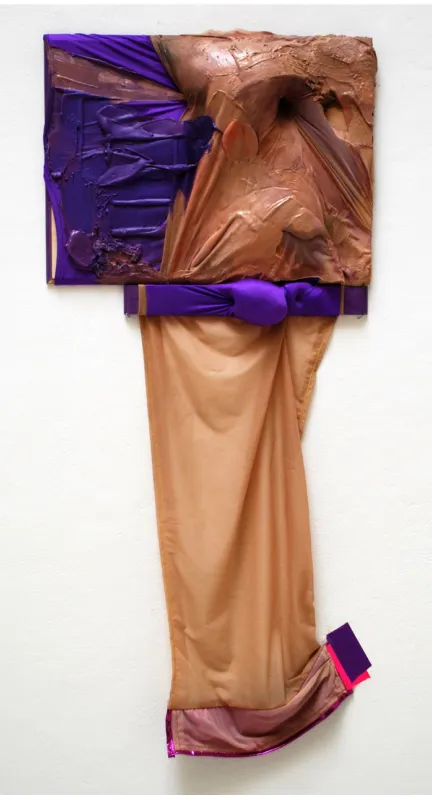
my distinctions between fine art categories themselves. Sculpture to Painting
Blob Prop (Figure 10) creeps up the wall, with fabric color choices determined by
womenʼs nylons and spandex outfits advertised to girls my own age, while the oil
paint is a palette of gaudy cosmetics. Works that stem in the reverse, originating
as a painting but borrowing formal elements from sculpture also make fashion
faux pas, such as Tube Top Glitz (Figure 11). Strong reference to the history of
painting is represented here, with fabric taught around a wooden stretcher, yet
sculptural stuffing and layers are tucked back with cheap florescent duct tape,
directly next to our trusted oil paint. Playing with alternative materials such as
spandex, glitter and tape in the same breath as traditional ones like oils, wooden
structures and fiberglass guide compositional decisions in accordance to
assigned hierarchies for each specific piece.
4b. FORMAL DECISIONS
Material and compositional choices are led by my curiosity in the
differences between beauty and grotesque. Cheap and classy are strongly
considered here as well. Opposing characteristics that often share similar
qualities are confusing enough to make an entire body of work out of. I find
instances where I am struggling to balance these opposite with each other, while
Referencing Platoʼs Theory of Forms helps support artistic inclination
towards honesty in material for me. A stable theory that is trusted as this one
can provide comfort for a viewer when seeing materials such as raw tape
propping up components of my work. I believe there is a place for disguising
materials and tricking the viewer on a formal level, and I appreciate the skill it
takes to successfully accomplish this; however, my work calls for honesty in
media as necessity since it plays into a commentary on a portion of our society
that is so quick to put themselves out into the public eye, no matter how
degrading it is as a representation of America.
The physical state of this work revolves around the ability to disassemble
and move them with ease. With this demonstration of “a profound mistrust of
permanence”, I liken my state of mind with the current exhibit at the New
Museum, NY, The Ungovernables. This collection of artists were all born within
the same time period as I, and critics have deemed this group of my peers with
this classification, a strong reflection of what is happening in the moment. I
reinforce this tendency with techniques such as directly taping to the wall and
fabric itself, a less-than-permanent solution to holding parts in their places for any
extended amounts of time. In Eungie Jooʼs description of a work entitled
Positions, a choreographed protest by the group Public Movement, I found
oppositional ideas and stand with others on the side of their choice.”6 The
incorporation of the term “seemingly oppositional” is intriguing to my interests in
opposites that share similar qualities, while the idea of having to choose sides
with no middle option is anxiously permanent.
4c. STAGE PRESENCE VS. STAGE PROPS
The sculptural earlier, original components of Putting Lipstick on a
Sculpture are categorized by what type of entity the object is mimicking. This can
roughly be broken down into three groups, the “beings” (Figure 12), the “blob
props” (Figure 13), and the models that embody these two ideas into one, which
will make up the a full-scale scene, also known as the gallery set-up.
In the compositional arrangement of the gallery, decisions regarding
placement of the pieces are assisted by stereotypical assignments of whether or
not a work takes a role as a leading presence (as I refer to as “glitz”) or a
supporting prop (usually called a “blob prop”). This arbitrary system will act
purely as a visual aid, helping the formal elements of design guide the flow of the
work with one another, without disrupting the conceptual hierarchy between then
work. For instance, just because a sculpture is on the floor and perhaps in a
non-predominant part of the gallery, bears no weight as to how important it is in
the conceptual realm. That piece down there (Figure 14) is actually incredibly
significant in the development of my paintings. This piece marks the turning point
where I have learned that the wooden structure under the taught fabric acts as a
6
total disregard for the use of a stretcher for the painted flat surfaces, blurring the
distinctions between the categorical classifications of painting and sculpture.
4d. CONCEPTUAL CONTENT
The strange, judgmental tone of a pageant is something that I want to
borrow as a context for the display of my sculpture. I want my work to mimic
contestants walking down the runway, with their glitter shimmering under the
spotlight. For this technique, the innovative approach de la Cruz uses has been
influential to my sculptural decision-making processes. The mangled canvas is
transformed into an elegant form because of her careful consideration to formal
elements of composition in a sculptural sense, and this realization has shown me
that a sculpture should do more than sit atop a pedestal. The fluid incorporation
of the “pedestal” has become a very important element for consideration for
decisions made about my own sculptures; the sculptures are elevated by means
of their form.
Morrisʼs interpretation of the spatial relationship resonates through to my
work when I consider the importance of details versus the whole. Forcing the
object into the corner as opposed to in the center of an open area of a rectilinear
white gallery space will change a pieceʼs context immensely. My work is to be
considered in human scale. Presenting “life-size” forms within the space that the
viewer occupies, asks a person to think of the work as a being, rather than just
concerning beauty. Gaudy details become prominent, but the option to mentally
rest in the bulbous forms as a whole is also included as a retreat.
My sculptures strike a pose for the viewer in a manner similar to the
pauses a pageant contestant would take to let the judges get an adequate look
for their following superficial review. The difference is that my sculptures remain
in this position, for deeper contemplation and understanding on the part of the
audience, whereas the girls on display are not. This configuration is a simplified
presentation of a runway in a pageantry show.
The floor sculptures that resemble props and begin to reference painting
(Figure 15), and the “paintings” (Figure 16) on the walls themselves, start to
delve deeper into our cultureʼs overall beliefs of what is attractively acceptable.
For these pieces, which I classify separately from the works that I call sculpture, I
think it is more important for conceptual impact to go beyond the small, isolated
instances of awkwardness and “beauty” in the world of pageants, and broaden
the scope of conversation to reach for an more universal dichotomy of beauty
and disgust. Pageantry fashion highlights the slippery edge between beauty and
gaudiness I find fascinating, but does not resonate strongly enough into the
overall issues that I am exploring about our cultureʼs perception of aesthetic in
general. Through this research, I have been left with this curiosity about what is
expected from something (or someone) to be labeled “beautiful”, and this has
been leading me to think past of judgments on women, onto what beauty might
5. SUMMATION
Fascination in trickery has lead me down a long, investigatory path
towards how people read my work, and the practice of it has led me to gain the
ability to play with what someone can call a sculpture or a painting. Along the
way I have run into endless questions throughout art history and traditional
applications of media, to confuse me about what is considered to be a general
beauty. Fundamental philosophical history understanding supports my skeptical
stance on a standard of beauty, but this unanswerable question allows for
bountiful room to workout my theories through visual art.
In a recent lecture the philosopher Denis Dutton laid out his idea that
beauty is natureʼs way of providing pleasure from a distance in a talk entitled A
Darwin theory of beauty. It exudes pleasure by arousing and sustaining interest
for survival and reproduction. As this translates easily into modern day through
humanʼs physical beauty, Dutton also carries this theory into the arts by stating;
“We find beauty in something that is done well… not in the eye of the beholder”. 7
Here I have come across a theory that people fundamentally appreciate
something that gives them pleasure through vision, and yet I am still confused by
certain traits that this culture deems appropriate or “sexy”. If that overweight
woman, crammed into her tube top, feeding her toddler pixie sticks so she will
7Dutton, Denis. “A Darwinian theory of beauty.” Filmed February 2010. TED
video, 15:34. Posted November 2010.
smile big while parading around in full makeup is socially appropriate, to the point
where it has become an organized “sport” with regulations and standards, then
how am I supposed to set guidelines within my sculptural/painting practice? The
point, I suppose, is that I do not wish for those rules and standards. I find
excitement in the experimentation and leniency where I can dance around within
my pieces.
Solid artwork is about questioning, and my questions stem from
categorizations of so-called “norms”. I am thrilled to be baffled by what Middle
America finds appropriate for their children, while at the same time frightened by
what is valued as most important in these peopleʼs lives. I draw similarities from
these problems into dialogue about what has come to be expected in sculptural
categories, borrowing cheap materials from these peopleʼs norms to frustrate art
historyʼs standards. Although this investigation is allowing for me to delve into
my art making whole-heartedly, I realize I am merely skimming the surface of this
dilemma in the scope of the contemporary art world amongst my peers. I
understand, as Rosalind Krauss stated over thirty years ago, that “Nothing, it
would seem, could possibly give to such a motley of effort the right to lay claim to
whatever one might mean by the category of sculpture. Unless, that is, the
category can be made to become almost infinitely malleable”.8
8Krauss, Rosalind. “Sculpture in the Expanded Field.” October, volume 8,
I do not attempt to forge a breakthrough in the field of sculpture; rather, I
aim to simply question obvious definitions and what has been allowed to become
acceptable in our culture with a sense of humor to support it. My artwork will
thrive in its role amongst my peers to point out ridiculous examples of “standards”
and exploit them. Like the current exhibition at the New Museum, NY, my work
“…suggests dark humor about this inheritance and the nonsentimental, noncynical approaches to history and survival it requires. Lingering in the present, artists in the exhibition embrace temporality and impermanence to explore new contingencies for an unknown future. ʻThe
Ungovernables,ʼ then, is about rejecting incorporation and monetization, recognizing heat, transforming potential, and offering possibilities while maintaining self-awareness, humility, and humor.” 9
9Joo, Eungie. “The Ungovernables.” The Ungovernables: 2012 New Museum
Figure 1
Museum of Jurassic Technology: display
Figure 2
Kelly OʼBrien
Self Portrait as Jackalope 2008
Cast iron, polymer clay, special effects make-up, glass eyes, antlers and fishing line
Figure 3
Louise Bourgeois Arched Figure 2004
Figure 4
Kelly OʼBrien
Mounted Fancy Calf 2008
Wood, deer skull, liquid gold, glass eyes, rhinestones, cheesecloth, resin and polymer clay
Figure 5
Mitzi Pederson yellow and orange 2006
Figure 6
Angela de la Cruz Larger Than Life 2004
Figure 7
The Learning Chanel Toddlers & Tiaras 2009
Figure 8
Kelly OʼBrien Awkward Glitz 2011
Figure 9
Kelly OʼBrien Purple Portrait 2012
Figure 10
Kelly OʼBrien
Sculpture to Painting Blob Prop 2012
Figure 11
Kelly OʼBrien Tube Top Glitz 2012
Figure 12
Kelly OʼBrien Group Glitz 2011
Figure 13
Kelly OʼBrien
Purple Blob Prop (front and back views) 2012
Figure 14
Kelly OʼBrien Purple Glitz 2011
Figure 15
Kelly OʼBrien
Leaking Blob Prop (back view) 2012
Figure 16
Kelly OʼBrien Sucked-in Paint 2012
REFERENCE LIST
“About Toddlers & Tiaras.” Publicity for Toddlers & Tiaras, Discovery Communications, LLC.,
http://tlc.howstuffworks.com/tv/toddlers-tiaras/about-toddlers-and-tiaras.htm .
Cahn, Steven M. Classics of Western Philosophy. Indianapolis, IN: Hackett Publishing Company, Inc., 1977.
Crimp, Douglas. “This is Not a Museum of Art.” In On the Museumʼs Ruins. Cambridge, MA: The MIT Press, 1993.
Dutton, Denis. “A Darwinian theory of beauty.” Filmed February 2010. TED video, 15:34. Posted November 2010.
http://www.ted.com/talks/lang/en/denis_dutton_a_darwinian_theory_of_be
auty.html .
Celant, Germano. Hauser & Wirth Gallery, introduction to “Louise Bourgeois: The Fabric Works,” Hauser & Worth London, October 15- December 18, 2010,
http://www.hauserwirth.com/exhibitions/743/louise-bourgeois-the-fabric-works/view/ .
Hoffmann, Jens. “Mitzi Pederson.” In Vitamin 3-D: New Perspectives in Sculpture and Installation, edited by Trevor Schoonmaker and Anne Ellegood, 220-223. New York, NY: Phaidon Press Inc., 2009.
Joo, Eungie. “The Ungovernables.” The Ungovernables: 2012 New Museum Triennial, February 15-April 22, 2012, New York, NY: Skira Rizzoli Publications, Inc., 2012.
Krauss, Rosalind. “Sculpture in the Expanded Field.” October, volume 8, (Spring 1979): 30-44.
Morris, Robert. “Aligned with Nazca.” ARTFORUM 14, no. 2, (October 1975): 26-39.
Weschler, Lawrence. Mr. Wilsonʼs Cabinet of Wonder: Pronged Ants, Horned Humans, Mice on Toast, and Other Marvels of Jurassic Technology. New York, NY: Random House, Inc., 1995.