© 2018, IRJET | Impact Factor value: 6.171 | ISO 9001:2008 Certified Journal | Page 3399
An Experimental Study on Behavior of Bacteria in concrete
R.Dhinesh
1, K .Thamizh thendral
2, Dr. G. Dhanalakshmi
31ME (Structural Engineering) Dept. of Civil Engineering, Oxford Engineering College,
Tiruchirappalli, Tamilnadu, India
2Assistant Professor, Dept. of Civil Engineering, Oxford Engineering College Tiruchirappalli, Tamilnadu, India 3Professor and Head, Dept. of Civil Engineering, Oxford Engineering College Tiruchirappalli, Tamilnadu, India
---***---Abstract -
Concrete is the most commonly used buildingmaterial, but the cracks in concrete create problem. Cracks in concrete occur due to various mechanisms such as -shrinkage, freeze-thaw reactions and mechanical compressive and tensile forces .Cracking of the concrete surface was due to the enhance the deterioration of embedded steel bars as ingression rate of corrosive chemicals such as water and chloride ions in to the concrete structure increased. Therefore a novel technique has been developed by using a selective microbial plugging process. The development of a very special concrete with a bacteria is called Bacterial Concrete where bacteria is induced in the mortars and concrete to heal up the faults. In this study, Bacillus Sphaericus bacteria of concentration 1x10⁶ cells/ml is used. The properties of control concrete and bacterial concrete are studied by conducting various tests such as compressive strength, split tensile strength, flexural test with varying grades of concrete M20, M25, M30.
Key Words: Bacterial Concrete, Bacillus Sphaericus bacter
1. INTRODUCTION
Concrete is the most widely used construction material. Despite its versatility in construction, it is known to have several limitations. It is weak in tension, has limited ductility and little resistance to cracking. Cracks and fissures are a common problem in building structures, pavements, historic monuments and other structural members which are subjected to stress in different service conditions. Methods currently used for crack remediation often use synthetic polymers that need to be applied repeatedly, which requires continuous monitoring and recurring expenses. Because of these disadvantages of conventional surface treatments, attention has been drawn to alternative techniques for the improvement of the durability of concrete and also environmentally friendly. the continuous research carried out around in the world, various changes were made from time to time to solve the deficiencies of cement concrete.
1.1 Bacterial Concrete
Bacterial concrete is a new generation concrete which selective cementation by microbiology . In recent days application of mineral producing bacteria to the concrete having considerable improvement in the Strength. Repairing also done by applying the bacteria to the existing structures. Some specific alkali-resistance bacteria related to genus bacillus were added as a self healing agent.
1.2 Classification of bacteria
1.2.1 Classification on the Basis of Shapes:
Based on the shape of a bacteria they are classified into Rod-shaped bacteria (Bacilli), Sphere-Rod-shaped bacteria (Cocci) and Spiral-shaped bacteria (Spirilla).
1.2.2 Classification on the Basis of Gram Strain:
Results obtained from the Gram Staining Method, bacteria are classified into Gram-positive and Gram-negative.
1.2.3 Classification on the Basis of Oxygen Requirement:
Based on the requirement of Oxygen for the survival of bacteria they are classified are Aerobic (Use molecular oxygen as terminal electron acceptor) and Anaerobic (Do not use molecular oxygen as terminal electron acceptor).
1.3 Types of bacteria used in the concrete:
i) Bacillus pasteurii
ii) Bacillus sphaericus (used in the present study) iii) Escherichia coli
iv) Bacillus subtilis
1.4 Survival of bacteria in concrete:
Through the various researches it is found that the bacteria capable of surviving in an alkaline environment. When we mixed the water and cement The pH value goes up to 10. Bacteria survive in a alkaline environments like alkali lakes , some deserts. endolithic bacteria were collected along with bacteria found in sediments in the lakes. Bacteria are grownup in flask. Different types of bacteria were incorporated with in the small lock of concrete. Each concrete block left for two months to set hard. Finally it is found that only one group of bacteria are survived in the concrete. That bacteria have thick cell, that enable them to intact up to 200 years while waiting for a suitable environment. They will be activated when the concrete gets crack, food is available and water goes inside the structure. This will reduce the pH of high alkaline concrete.
2. MATERIALS USED:
2.1 Bacillus sphaericus:
© 2018, IRJET | Impact Factor value: 6.171 | ISO 9001:2008 Certified Journal | Page 3400 bacteria are also known as Spore forming bacteria Which
means that can dormant for many years and it will be able to withstand extreme temperature and physical environment. These mineral producing bacteria helps the concrete while crack by healing the micro cracks in the concrete.
2.2 Cement
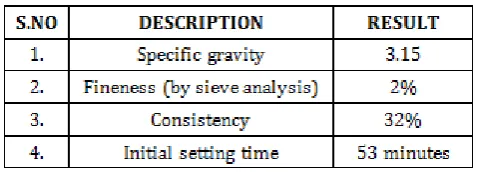
[image:2.595.42.281.285.371.2]Normal Portland pozzolana cement was used for the casting of specimen. PPC was manufactured y mixing of pozzolanic materials with OPC clinkers up to 20%. These pozzolanic materials fill the gap between the grains of OPC. Portland Pozzolana cement mixed with water gives a less heat of hydration and it gives high resistance to attack of aggressive waters than Ordinary Portland Cement.
Table -1: Test results of cement
2.3 Coarse aggregate
S Hard granite stones of less than 20mm size is used for the casting of specimen. The stones are well graded and good in size and various test were conducted to know its properties
Table -2: Test results of coarse aggregate
S.NO Description Values
1 Specific gravity 2.75
2 Bulk density 1648.73 Kg/m3
3 Water absorption 1%
4 Fineness modulus 4.67
2.4 Fine aggregate
River sand of size less than 4.75 mm size were used as fine aggregate. The Specific Gravity, Fineness modulus, Water absorption and Bulk density of the fine aggregate were tested.
Table -3: Test results of fine aggregate
S.NO Description Values
1 Specific gravity 2.69
2 Bulk density 1632.19 Kg/m3
3 Water absorption 1%
4 Fineness modulus 2.72
2.5 Water
Potable water available in laboratory with pH value of of not less than 6 and conforming to the requirement of IS 456-2000 was used for mixing concrete and curing the specimen as well.
3. MIX DESIGN AND CASTING OF SPECIMEN
Mix design is done to achieve the target mean strength and using of materials with required proportion as per the Indian standard codel provisions. The compressive strength of the concrete was determined by cubes of size 150mmx150mmx150mm. Split tensile strength of the concrete was determined by the cylinder of size 150mm diameter and 300mm height.
3.1 Mixing of concrete
The mixing should be homogeneous, uniform in colour and consistency. As the mixing cannot be thorough, it is desirable to add 10% more materials. The mixing was done with tilting drum. Initially, water is poured into the mixer and then cement, fine aggregate, coarse aggregate is dumped into the drum. Allow the drum to rotate for few rotations and then bacteria are added to the concrete.
3.2 Casting of specimen
Cube moulds of size 150mm x 150mm x 150mm and cylinder moulds of size 150mm ø and height 300mm were used for casting the concrete. The fresh mix of concrete waspoured into the mould and the top surface was finished smooth with trowel.
SPECIMEN DETAILS:
Table 4: Control concrete
S.No Specimen Name of Grade of concrete
M20 M25 M30
1 Cubes 6 6 6
2 Cylinder 6 6 6
3 Prism 6 6 6
Table 5: Bacterial concrete
S.No concreteGrade of Grade of concrete
M20 M25 M30
1 Cubes 6 6 6
2 Cylinder 6 6 6
© 2018, IRJET | Impact Factor value: 6.171 | ISO 9001:2008 Certified Journal | Page 3401
4. RESLLTS AND DISCUSSION
4.1Compressive Strength
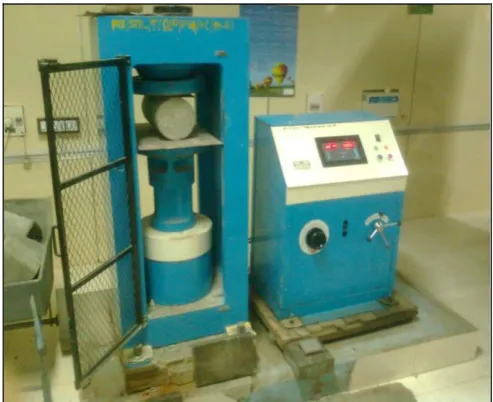
Compressive test are made at various ages of the test specimens. Least three specimens, preferably from different batches shall be made for testing at each selected age. The cubes are placed in the compression testing machine in such manner that the load is applied to the opposite sides of the cube as cast. The load is applied at the rate of 140 kg/cm2/min (approximately) until the failure of the specimen.
Compressive strength, FC= P/A
Where, Fc = Compressive Strength (N/mm2)
P = Ultimate Load (N) and
A = Loaded Area (150mm x 150mm)
[image:3.595.42.282.292.494.2]Fig 1: Compressive Testing machine
Table-6: Comparision of 28th day compressive strength of Control concrete and Bacterial concrete:
Grade of concrete
Average 28th day compressive strength
in N/mm2
Percentage increase in compressive strength (%) Control
concrete concrete Bacteria
M20 grade 26.39 28.40 7.62
M25 grade 31.17 32.73 5.02
M30 grade 37.03 39.59 6.92
Chart 1: Comparison of 28th day split tensile strength of specimen
4.5.2 SPLIT TENSILE STRENGTH TEST
The tensile strength of concrete is determined by splitting the cylinder across the vertical diameter. Split tensile strength is an indirect method of finding out the tensile strength of concrete. As per ASTM, the test was carried out by placing a cylindrical specimen horizontally between the loading surfaces of a compression testing machine. The load was applied until the specimen fails.
Fig 2: Split tensile Test
The split tensile strength is calculated using the formula F=2P/ΠdL
Where P=applied load
D=diameter of the specimen
L=length of the specimen
26
.3
9 31.1
7 37.0
3
28
.4 32.7
3 39.5
9
0 5 10 15 20 25 30 35 40 45
M20 grade
M25 grade
M30 grade
C
o
m
p
re
s
s
iv
e
s
tr
e
n
g
th
i
n
N
/m
m
2
Grade of concrete
28
thday Compressive strength
Control Concrete
[image:3.595.314.561.432.633.2]© 2018, IRJET | Impact Factor value: 6.171 | ISO 9001:2008 Certified Journal | Page 3402 Based on the formulae the split tensile strength of bacterial
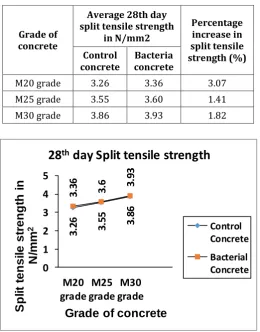
[image:4.595.308.573.110.424.2]concrete and control concrete is determined and the results are compares in the chart. The bellow tabulation shows that the split tensile strength of M20 and M25 and M30 grades are determined.
Table-7: Comparison of 28th day split tensile strength of Control concrete and Bacterial concrete:
Chart 2: Comparison of 28th day split tensile strength of specimen
4.5.3 FLEXURAL STRENGTH TEST
[image:4.595.28.289.177.510.2]The standard size of the specimens 10 x 10 x 50 cm is used. The mould should be made of metal or cast iron, with sufficient plate thickness to prevent spreading or warping. The testing machine may be of sufficient capacity for the testing and rate of loading as specified. The load is applied through the roller placed at middle(central point load). The flexural strength of specimen is expressed as modulus of rupture, fb.
Table-8: Comparison of 28th day flexural strength of Control concrete and Bacterial concrete:
Grade of concrete
Average 28th day flexural strength in
N/mm2 Percentage increase in flexural strength (%) Control
concrete concrete Bacteria
M20 grade 2.18 2.28 4.58
M25 grade 3.36 3.43 2.09
M30 grade 4.02 4.09 1.91
Chart 3: Comparison of 28th day flexural strength of specimen
The examinations of the control concrete and bacterial concrete cubes are done to determine the mechanical properties. The results reveal that the bacteria incorporated concrete specimens shows better compressive strength after 7th and 28th days of curing than control concrete. The percentage increase in compressive test at 7 days of curing are 6.22%, 4.23% and 4.85% for M20, M25 and M30 grade of concrete respectively. Similarly, at 28 days of curing, the percentage increase in strength was found to be 7.62%,
5.02%, 6.92% for M20, M25 and M30 grade of concrete respectively. The split tensile strength of cylindrical specimens were tested at the end of 7 days and the percentage increase in strength was found to be 9.04%, 13.62%, 10.73% for M20, M25 and M30 grade of concrete respectively. Similarly, for 28 days of curing, the percentage increase in strength was found to be 3.07%, 1.41%, 1.82% for M20, M25 and M30 grade of concrete respectively.
The flexural strength of prismatic beam specimens were tested at the end of 7 days and the percentage increase in strength was found to be 12.12%, 15.29%, 6.89% for M20, M25 and M30 grade of concrete respectively. Similarly, for 28 days of curing, the percentage increase in strength was found to be 4.58%, 2.09%, 1.91% for M20, M25 and M30 grade of concrete respectively.
Grade of concrete
Average 28th day split tensile strength
in N/mm2 Percentage increase in split tensile strength (%) Control
concrete concrete Bacteria
M20 grade 3.26 3.36 3.07
M25 grade 3.55 3.60 1.41
M30 grade 3.86 3.93 1.82
2 .1 8 3 .3 6 4 .0 2 2 .2 8 3 .4 3 4 .0 9 0 0.5 1 1.5 2 2.5 3 3.5 4 4.5
M20 gradeM25 gradeM30 grade
F le x u ra l s tr e n g th i n N /m m 2
Grade of concrete
28thday Flexural strength
Control Concrete Bacterial Concrete 3.2 6 3.5 5 3.8 6 3.3 6 3.6 3.9 3 0 1 2 3 4 5 M20 grade M25 grade M30 grade
S
p
li
t
te
n
s
il
e
s
tr
e
n
g
th
i
n
N
/m
m
2Grade of concrete
28
thday Split tensile strength
Control Concrete
© 2018, IRJET | Impact Factor value: 6.171 | ISO 9001:2008 Certified Journal | Page 3403 From above results, due to the incorporation of
bacteria, the compressive strength of concrete increases remarkably. Whereas, the split tensile strength and flexural strength were increases for 7 days of curing. But after 28 days, very small amount of strength is increased. The bacteria incorporated R.C.C. slab specimen withstands more load before starts yielding than that of control concrete slab specimen.
REFERENCES
[1] Meldrum F.C. [2003] “Calcium carbonate in biominerilisation” Biomimetic chemistry, 48, 187-224.
[2] Dick J., De Windt W., De Graef B., Saveyn H., Vander Meeren P., De Belie N., Verstraete W. [2006]. “Bio-deposition of a calcium carbonate layer on [3] degraded limestone by Bacillus species”.
[4] Ghosh P., Mandal S., Chattopadhyay B.D., Pal S [2005]. “Use of microorganism to improve the strength of cement mortar” Cement and Concrete Research 35.
[5] Ramachandran S.K., Ramakrishanan V., Bang S.S. [2001]. “Remediation of concrete using microorganisms ACI Material Journal, 98, 3-9.
[6] Ramakrishnan V., Ramesh K.P., Bang S.S., [2010]. “Improvement of concrete durability by bacterial mineral precipitation” Proceedings of ICR, 11, Torino, Italy.
[7] Schlegel H.G. [1993]. General microbiology, 7th edition, Cambridge University Press.