© 2017, IRJET | Impact Factor value: 5.181 | ISO 9001:2008 Certified Journal
| Page 2653
Performance Analysis of D-Mac Protocol for Free Space Optical Sensor
Networks
Shaifali
1, Anand Kumar Jha
2, Kapil Mangla
31
Mtech Student, Dept. of ECE, Satya College of Engineering & Technology, MDU Rohtak, India
2Assistant Professor, Dept. of ECE, Satya College of Engineering & Technology, MDU Rohtak, India
3
HOD, Dept. of ECE, Satya College of Engineering & Technology, MDU Rohtak, India
---***---Abstract -
In this paper Directional Media AccessProtocol for free space optical wireless sensor network is analysed and its results in terms of energy consumption of sensor network and number of synchronization frames required is simulated and plotted. In this modelling we analyse data traffic that is number of nodes trying to send data. And if number of transmission are more than one through a single channel then it is condition of collision, to avoid collision a random access protocol is used. Due to collision energy consumption of overall network increases drastically. To resolve this problem a new technique is proposed in this paper. At time of random protocol assigning time slot to individual nodes, we introduces a concept of urgent node having high priority of data transmission. This node will be served at the time of sleep mode hence it will reduce the congestion and finally energy consumption will automatically degraded.
Key Words: DMAC Protocol, RA Protocol, Optical Communication, Synchronization Frames.
1. INTRODUCTION
FSO has the potential to produce very quick information rates and really secure communication links as compared to RF, however the perfect surroundings for these links is purpose to purpose, wherever line of sight (LOS) exists [1] [2]. At first, this LOS demand could appear to limit the relevance of FSO technology in networks wherever multiple nodes should be interconnected, however it's been shown that FSO directional networks is helpful certainly network applications [3]. samples of these applications embody structural health observation at intervals a set infrastructure [4], period performance feedback from sensors placed within airplanes, and fast upload/download links at intervals numerous terminals in settings like indoor offices or homes [5] [6], plane cabins [7], and even on the surface beneath shallow waters [8]. So as for FSO networks to become viable alternatives to RF based mostly networks, economical communication parts and network protocols tailored for directional FSO should be designed. This project specifically focuses on the look of low power and short-range wireless device networks wherever multiple device devices got to transfer and transfer data from a central process station. With raised information rates and abstraction diversity techniques,
these low power optical networks is climbable from b/s to many Mb/s, giving the transfer of huge amounts of information during a} very physically secure manner. In general, there square measure things wherever AN optical wireless network is advantageous over a RF wireless network, however the challenge remains in creating these networks sensible, efficient, and value effective when put next to ancient frequency technologies, in order that another wireless technology implementation will become realistic.
© 2017, IRJET | Impact Factor value: 5.181 | ISO 9001:2008 Certified Journal
| Page 2654
network arises from the actual fact that optical direct detection receiver is less sensitive than RF receivers [10]. Since direct detection is that the solely sensible modulation technique for low power applications [1], optical communication needs a lot of complicated transmitter associated a rise in transmission power to supply a similar quantity of signal coverage as an RF transmitter.
2. LITERATURE REVIEW
In the last ten years (2000-2010) the buyer market has seen fast advancements within the practicality of transportable electronic communication devices that has semiconductor diode to endless growth within the user demand for wireless content. With additional wireless content within the air currently than ever before, wireless networks changing into engorged and therefore the interference generated by signals from wireless devices is becoming more of a priority once planning new wireless devices. Thus, it's necessary to research different technologies to standard frequency (RF) wireless devices, which might probably handle the increasing network demand and generate less interference. At this time in time, the most different technology in wireless communications is free area optics (FSO). FSO has the potential to supply very quick knowledge rates and extremely secure communication links as compared to RF, however the perfect surroundings for these links is purpose to purpose, wherever line of sight (LOS) exists [1] [2]. At first, this LOS demand could appear to limit the relevancy of FSO technology in networks wherever multiple nodes should be interconnected, however it's been shown that FSO directional networks is helpful sure network applications [3]. samples of these applications embrace structural health watching inside a set infrastructure [4], time period performance feedback from sensors placed within airplanes, and fast upload/download links inside varied terminals in settings like indoor offices or homes [5] [6], heavier-than-air craft cabins [7], and even on the surface beneath shallow waters [8]. So as for FSO networks to become viable alternatives to RF based mostly networks, economical communication parts and network protocols tailored for directional FSO should be designed. This treatise specifically focuses on the look of low power and short-range wireless sensing element networks wherever multiple sensing element devices have to be compelled to transfer and transfer info from a central process station. With enhanced knowledge rates and spatial diversity techniques, these low power optical networks is scalable from b/s to many Mb/s, allowing the transfer of enormous amounts of knowledge in a very physically secure manner.
3. SYSTEM MODELLING
Communication between multiple sensor nodes and a central node was achieved via a master–slave network. In this type of architecture, the central node coordinates network traffic and aggregates data from all the sensor nodes that are within its FOV. If multiple central nodes were present, directional links could be formed between them, forming a backbone for the network. If a sensor node needed to communicate with a central node that was not within its FOV, the sensor node could relay its signal to another central node that was within its FOV, through the backbone link, to the proper central node. These backbone links could also extend the link range of the network. The central nodes are n transmitters pointing in different directions while the sensor nodes have a single transmitter. Because the central node has multiple transmitters, it can maintain a larger transmission FOV than the sensor nodes, allowing multiple sensor nodes to be positioned anywhere within the FOV.
In point-to-multipoint networks, multiple nodes may need to transmit at any given time, which can lead to packet collisions at a destination node. To maintain organized communication, RA protocols are required. We developed our OW directional MAC protocol by modifying and combining three popular omni-directional RF MAC protocols: dynamic time division multiple access (D-TDMA) [11], carrier-sense multiple access with collision avoidance [12], and slotted ALOHA [13,14]. The combination of these protocols formed the basis for the directional MAC protocol used in this short-range, low-power directional OW sensor network.
The concept of the directional MAC protocol is as follows. On powering up, a sensor node transmits a signal periodically. This signal informs any central node within its FOV that the sensor node is ready to connect to the network. When the central node detects the signal, it transmits a unique directional MAC address back to the sensor node. Once the sensor node receives the signal and updates its internal memory, it stops transmitting the periodic signal and waits for its time slot to begin data transmission. From this point on, every packet that the sensor node transmits contains its directional MAC address, and this allows the central node to detect which node is transmitting data.
© 2017, IRJET | Impact Factor value: 5.181 | ISO 9001:2008 Certified Journal
| Page 2655
node that it has no more data to transmit. At this point, the node can enter sleep mode to conserve energy.
Whenever a sensor node tries to access the channel to either retrieve a time slot from the central node or to transmit data to the central node, the node transmits its directional MAC address. If the channel to the central node is free, the central node will detect the directional MAC address and transmit an acknowledgement and time slot back. If the central node detects an incoming transmission but cannot detect a directional MAC address, the incoming transmission is considered a packet collision. Channel contention occurs when multiple sensor nodes or an adjacent central node try to communicate with the central node at the same time, causing packet collisions at the destination node. Upon detecting packet collisions, the directional MAC protocol runs the RA protocol.
Two different communication effects can lead to packet collisions at the central node: channel contention and unsuccessful data transmissions caused by random degradations in the optical channel.
RA Protocol: The central node broadcasts a stop transmission request signal to the whole FOV telling all device nodes that network traffic are going to be briefly halted for the aim of reconstruction the directional time division multiple access theme. Upon detection the STR signal, all device nodes that had time slots enter sleep mode. The sensor nodes that were contending for channel access stop transmitting but remain awake.
After transmitting the stop transmission request signal, the central node waits for a specific time interval to pass. During this interval, the central node does not expect to receive any signal because all sensor nodes are supposed to stop transmitting. If the central node does detect a signal, then it rebroadcasts the stop transmission request signal to the entire FOV and waits for the time interval to pass. This process continues until the time interval passes without the central node detecting any signal.
Next, the central node broadcasts a RA synchronization (RAS) signal to the entire FOV. Within the RAS signal, the central node transmits a probability value, p, to all the sensor nodes.
The nodes use this value of p to generate a possible reply back to the central node. After the central node transmits a RAS signal, it waits for a specified time interval time for a reply back from the sensor nodes.
If only one sensor node replies, then the central node successfully detects its directional MAC address and transmits back a time slot acknowledge. This particular sensor node now has a time slot and can enter sleep mode. If multiple sensor nodes reply, the central node detects a collision, and if no nodes reply, the central node detects a timeout.
Probability of Transmission:In the protocol described in the previous section, a synchronization frame consists of two communication messages: the central node’s RAS signal and the ensuing replies or non replies from the
sensor nodes replying to the RAS. The probability of transmission, p, transmitted within the RAS signal affects the total number of synchronization frames required to assign all timeslots. The total number of synchronization frames determines the network’s RA times and shorter RA times mean faster node acquisition times. Therefore, an optimal value of p must be transmitted during each synchronization frame to minimize RA times. This optimal value, popt, can be shown to equal k =1∕n, where n denotes the number of sensor nodes contending for channel access. For a given number of n nodes contending for channel access, a successful outcome occurs when only one node replies within the synchronization frame. The probability of a successful packet transmission for a network cluster with n nodes contending for channel access, denoted by , is given by
(1)
If we assume that the optimal value of p is used during each RAS frame, then the expected total number of synchronization frames required to resolve n-node channel contention can be calculated from .
Average time of Synchronization frame,
Av
∑ (2)
With this assumption, each contending node adds approximately 2.7 times synchronization frames to the random access.
Algorithm:
Step1: Initialize parameters.
Step2: Central head node send a stop transmission request signal to all motes.
Step3: All motes go to sleep mode and central head node waits for receiving a signal.
Step4: If central node does not get any signal then again and again transmits stop transmission request.
Step5: If central node detects a signal then sends RA synchronization signal to all nodes.
Step6: If one sensor replies then central node checks its address and transmit back a time slot acknowledgement. Step7: If multiple motes replies detected by central node then its condition of collision.
Step8: If no node replies then its time out condition. Step9: To avoid collision same procedure that is RA protocol called again.
4. RESULTS & DISCUSSION
© 2017, IRJET | Impact Factor value: 5.181 | ISO 9001:2008 Certified Journal
| Page 2656
Table - 1: Simulation ParametersS.
No. Parameter Value
1 LED wavelength 1.6um
2 Transmission Power 2uJ
3 Distance between Rx &
Tx 1m
4 Total No. of Nodes 10
5 Voltage 5v
6 Data Rate 100Kbps
7 Current 9mA
8 No. of Photodiode 1
9 Sleep Mode Energy
Consumption 1pJ
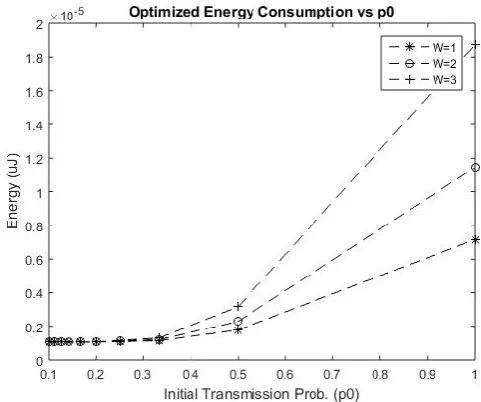
[image:4.595.30.294.119.294.2] [image:4.595.46.280.402.596.2]Now energy consumption is calculated and displayed on fig. 2 for three different window size. Ten nodes of ID 123 478 732 233 134 945 543 459 682 & 823 are taken into consideration and energy consume to listen signal is 8.5nJ. Probability of transmission is taken 0.1 to 1 at 0.1 interval. Hence energy consumption is calculated for ten different values. Number of node contending is taken 8 nodes.
Fig – 2: Energy Consumption for different window size
To improve the performance of the network at processing time of RA protocol the urgent node having maximum priority will be handled due to which number of node contending congestion will be less hence power consumption will drastically degraded and simulated result is shown in fig. 3.
Fig – 3: Energy Consumption for different window size of Proposed System
[image:4.595.322.559.465.659.2]Different network loads were chosen to represent different types of network burst rates (NWBR). The NWBR value corresponds to the number of nodes that wake up and access the channel simultaneously. For instance, NWBR5 corresponds to a network load where 5 nodes wake up and try to access the channel simultaneously. Number of synchronization frames required to assign time period to individual motes is calculated and plotted in fig. 4.
Fig – 4: No. of SFs required by random access protocol for specific NWBR
© 2017, IRJET | Impact Factor value: 5.181 | ISO 9001:2008 Certified Journal
| Page 2657
Fig – 5: Comparison of optimal & simulatedSynchronization Frames
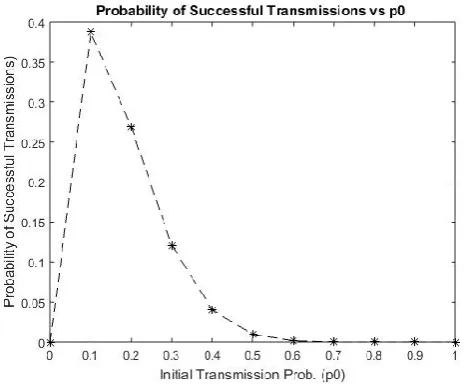
Now relation between initial probability of transmission and actual probability of successful transmission is calculated and plotted on fig. 6
Fig – 6: Probability of Successful Transmission
5. CONCLUSIONS
This paper concludes the performance of random access protocol due to which network congestion shorted our shortly and different time slots are assigned to different nodes. Implementation of direction media access protocol is successful. A new concept of urgent node serves at duration of random access protocol assigning performed good and an improvement of 62% less power consumption is achieved. Basic model DMAC average energy consumption is 2.48uJ, while proposed model’s energy consumption is 0.94uJ.
REFERENCES
1. Wireless infrared communications. Khan, J. M. and Barry, J. R. 1997. Proc. IEEE. Vol. 85, pp. 265-298.
2. Barry, J. R. Wireless Infrared Communications. Boston: Kluwer, 1994.
3. Short-range optical wireless communications. O'Brien, D.C., et al. 2005. Wireless World Research Forum.
4. Free space optical sensor network for fixed infrastructure sensing. Agrawal, N., Milner, S. D. and Davis, C. C. 2009. Proc. SPIE, Free-Space Laser Communications IX. Vol. 7464.
5. Gigabit class high-speed indoor optical wireless; system design, challenges and results. O'Brien, D. C., et al. 2010. Proc. SPIE, Free-Space Laser Communications X. Vol. 7814. 6. Wireless Optical Network for a Home Network. Bouchet, O., et al. 2010. Proc. SPIE, Free-Space Laser Communications X. Vol. 7814, pp. 781406:1-9.
7. High data-rate optical wireless communications in passenger aircraft: Measurements and simulations. O'Brien, D. C., et al. 2008. 6th Internation Symposium on Communication Systems, Networks and Digital Signal Processing, 2008. CNSDSP 2008. pp. 68-71.
8. Free space optical sensor networking for underwater sensing applications. Agrawal, N., Milner, S. D. and Davis, C. C. 2009. 2009 5th International Conference on Intelligent Sensors, Sensor Networks and Information Processing (ISSNIP). pp. 475-480.
9. A 2.4-Ghz CMOS Short-Range Wireless-Sensor-Network Interface for Automotive Applications. Carmo, J. P. and Couto, C. 5, 2010, IEEE Transactions on Industrial Electronics, Vol. 57, pp. 1764-1771.
10. Channel modeling for FSO communications and sensor networking inside structures. Davis, C. C., Eslami, M. and Agrawal, N. 2009. Proc. SPIE, Free-Space Laser Communications IX. Vol. 7464.
11. Angle diversity for non directed wireless infrared communications. Carruthers, J. B. and Khan, J. M. 2000, IEEE Transactions on Communications, Vol. 48, pp. 960-069.
12. Free-space Optics based Sensor Network Design using Angle-diversity Photodiode Arrays. A. K. Ghosh, S. Kunta, P. Verma, R. C. Huck. 2010. Proc. SPIE, Free-Space Laser Communications X. Vol. 7814.
[image:5.595.45.279.399.591.2]