© 2018, IRJET | Impact Factor value: 6.171 | ISO 9001:2008 Certified Journal | Page 507
PERFORMANCE EVALUATION OF EXTRINSIC FACTORS AFFECTING
GRANULATION IN SEWAGE
Baraniya.C
1, Jodhi.C
21PG Student, Department of Civil Engineering, Annamalai University.
2Assistant Professor, Department of Civil Engineering, Annamalai University.
---***---Abstract -
The up-flow anaerobic sludge blanket reactor(UASBR) has been used to effectively treat the variety of wastewaters. Decades of investigations and explorations in the field of anaerobic wastewater treatment have resulted in the noteworthy indications about the significance function of the sludge granules in biodegradation anaerobic process. It is understood that the performance of reactor depends on the formation of granules. An outline on the theory of up-flow anaerobic sludge blanket UASB reactor process as well as the main parts of the reactor is briefly explained in this paper. The aim of this paper is to investigate and assess the mechanisms of granules initiation and development of granules inside the UASB reactor. The factors reviewed are pH and alkalinity, temperature, nutrients, organic loading rate, cations and heavy metals.
Key Words: Biogas, hydraulic retention time, nutrients, organic loading rate, reactor UASB.
1. INTRODUCTION
At present, Upflow Anaerobic Sludge Blanket Reactor (UASBR) is accepted as a most popular technique for the treatment of wastewater. The UASB process become the most attractive technique because of its low biomass production, high cost efficient, low area demand and high production methane gas. Nowadays, more than 1000 UASB units were being operated all over the world. The application of UASB reactors for the treatment of high strength industrial wastewater such as sugar industry wastes, distillery wastes and brewery wastes had been successful [1,2]. Due to the several advantages of UASBR can be considered as the most popular method of secondary treatment compared to other systems as conventional anaerobic digesters, considering that UASB reactor has the gas collection system as supplementary part on which it will reduce the effect of releasing gas emissions into atmosphere as it occurs in conventional ponds [2]. Anaerobic microbial granulation is considered to be a important parameter for the successful operation of a UASB reactor [3]. Sludge present in the reactor is collection of microorganisms that naturally form granules of diameter about 0.5-5 mm that shows high settling velocity and thus oppose wash out from the reactor even at higher loadings [4]. Hence, there is no support media is required for bacterial attachment to improve the retention time for sludge. Formation of high-quality granular sludge is the foremost characteristics of UASBR to achieve higher
COD removal efficiency [5]. The granulation process is generally believed to be susceptible to the abrupt change in the environmental and operational conditions. Factors governing granulation have been widely studied on a variety of wastewaters. Some of these factors are operating conditions [6,7], pH and alkalinity [8], temperature [9], strength and composition of wastewater [10], reactor hydrodynamics [9,11], presence of metal ions and trace metals [12-14], presence of polymers [15,16], microbial ecology [17] and production of exocellular polymeric substances by anaerobic bacteria [18,19]. This paper presents an analysis of various factors such as pH and alkalinity, temperature, nutrients, OLR, and cations and heavy metals affecting granulation and granule size development in UASB reactor are discussed [3]. However, the mechanisms of granulation formation are still not satisfactorily clear [20].
1.1 UASB Technology
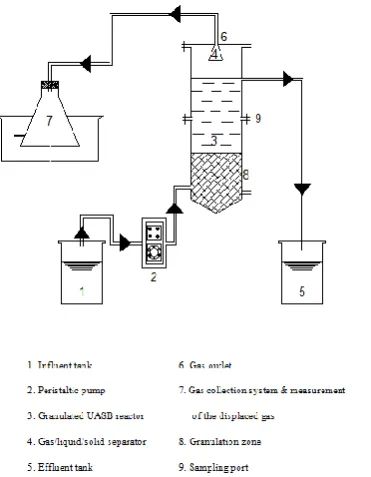
© 2018, IRJET | Impact Factor value: 6.171 | ISO 9001:2008 Certified Journal | Page 508 Fig -1: Schematic Diagram for a Upflow Anaerobic Sludge
Blanket Reactor
Gas-liquid-solid (GLS) separator is fitted at the top of the reactor to separate the solution contents i.e. the liquid as treated effluent, while the solids particle is trapped and returned back downward, and the gas is collected from the top of reactor in the form of biogas (methane and carbon-di-oxide) (20). The collected gas can be used for further purpose.
1.2 Granulation
[image:2.595.63.249.80.319.2]The efficiency and stability of the UASB reactor depends sturdily on the initial start-up, which in turn is mostly affected by various physical, chemical and biological parameters [22], such as type of wastewaters, operational circumstances and the characteristics, accessibility and increase of active microbial populations in the seed sludge or inoculums. An acclimatization period is mandatory before the full design organic loading rates can be applied to inoculate the seed sludge. This period is usually 2-8 months [1] is quite time-consuming and has been the foremost drawback of the industrial applications of UASB reactors. The anaerobic sludge which provides anchorage to microflora is the principle element of a UASB reactor. The treatment of the UASB reactor can be achieved by the continuous interaction of wastewater with the microflora attached with the sludge particles [23]. Fig. 2 shows the anaerobic sludge granules from the UASB reactor.
Fig -2: Anaerobic granules from the UASB reactor
1.3 Granules Composition
Every granule has an assortment of structural compositions, which is diverse according to the discrepancy in the characteristics of wastewater as well as discrepancy in the operational condition. The compositions of Granules are inorganic compounds, microorganism cells, and extracellular polymer in assorted rates [20].
1.4 Inorganic Materials
The variation in granules composition is due to substrate description, supply of seed sludge, operational conditions of the reactor, occurrence chemical interactions, and extrinsic factors. Commonly, inorganic components contain minerals and ash [24]. Where, the granules contains inorganic components can range from 10 to 90% thus it depends on the contents of wastewater, and operational conditions [25]. In the same reactor, the inorganic content in the similar granules can change from place to place and this deviation may usually occur. In fact, under mesophilic condition, the granules in simple wastewater like acetate, propionate, or butyrate generate high amount of ash, while in complex wastewater, it generates low amount of ash [26]. Practically, there is a direct relationship between the ash and density, indicates that there is an increase in density is generally recognized by increase in ash [27]. It was found that, the ash contains calcium, potassium and iron. Besides that, the granules in black color contains FeS in the proportion of 30% of the ash content [28]. So far, it is observed that, the ash has no positive effects on the strength of granules structure [29].
1.5 Microorganism Cells
© 2018, IRJET | Impact Factor value: 6.171 | ISO 9001:2008 Certified Journal | Page 509 granulation is Methanosaeta. Whereby, this functions as
center of nucleation for the further aggregation [30]. Acetate is the firstly formed bacterial clusters. Afterwards, the primary bacteria will generate Methanosarcina species or Methanosaeta species [31].
1.6 Extra Cellular Polymer (ECP)
The generation of ECP is generally considered as natural property of microbial communities in suitable environment and constantly suggests within bacteria, yeast, algae and fungi [31]. Whereby ECP is usually formed from the result of microbial cells secretion and corruption and also organic materials fragments [33]. Gehr and Henry, 1983 reported that there are two types of ECP are obviously known: they are capsular and slime. Whereby, capsular is constantly bound with the microbial cell, as the slime does not bound with the microbial cell. Additionally, the role of capsular on the aggregation phenomenon has recognized as maximum [34].
1.7 Granules Size
The effective granules size can ranges from 0.5-5mm, therefore the effects on settling velocity (Vp) due to the size of the granules must be taken into consideration [4]. There is a strong evidence that indicates, the adding of crushed granular methanogenic sludge into digested sewage in an UASB reactor feed with acetate and propionate may increase diameter of methanogenic sludge granules into 1–4 mm [35]. The time interval for increasing the granule size of syntroph- seeded granules was 31 μm/day, for Methanothix-seeded granules it was 21 μm/day, for Methanosarcina-seeded granules it was 18 μm/day and for acidogenic flocs-seeded granules it was found that 7 μm/day only [14].
1.8 Factors affecting granulation
Temperature
The methanogens are somewhat more affected by temperature than acidogens [36]. Conversely, many kinds of microorganisms are more acclimatized in mesophilic temperature range. It is reported by (Henze, 1983; Zinder, 1990) that in mesophilic reactors, the most favourable range for microorganisms growth is between (30-40) °C. However, rising the temperature of reactor may result in opulence of some species of microorganisms and breakdown, of the other in versus. In fact, mesophilic granules have more warmth against temperature shocks than thermophilic granules, whereby any shock in temperature may breakdown the mesophilic granules [37]. On the other hand, it is reported that seed sludge are more vigorous and takes short period of time for the start-up operation in mesophilic condition than in thermophilic [38]. Although much gab in temperature effect of granulation process and development are alive and also
strong scientific justifications for the respect of granules structure in each mesophilic and thermophilic are still indistinct.
pH and alkalinity
In general, neutral pH as well as eminent partial pressure of hydrogen is radically essential for high quality granules formation [39]. The pH value inside the granule particles have been usually found to be low-grade than the contiguous solutions [40]. According to the nature of microorganisms, methanogens have high pH fluctuation than the acidogenic microorganisms, which has typical pH value ranges from 6.3-7.8. Almost, execution of pH value less than 6.3 will result in customary acidic formation and its prohibits the formation of methanogens as well as methane gas production [41]. In contrast, alkalinity helps in neutralizing the fluctuations in the volatile fatty acids which is frequently arising from the organic loading rate variation [42]. Typically alkalinity value ranges from 250 to 950 mg/l [8].
Nutrient
The fundamental nutrients for the successful development of granules are Nitrogen, Phosphorus and Sulphur. Basically, the excess amount of nutrients in the influent can augment the process throughout the first phases and not affect the process. Although, nutrients deficient in the substrate can badly affects the formation of granules, whereby it has been reported that the growth of granules will declined when the Nitrogen concentration is less than 300 mg/l [8]. Additionally, over-elevated concentration of nutrients will inhibits the process [43]. However, the advantages of nutrients in the wastewater will prevents the flotation of granules as well as reduce the effect of shocks [44]. Ammonia is totally synthesized from nitrogen and hydrogen correlation to introduce electrons donor, it can be concluded that ammonia plays an important role on the correction of pH in medium [45]. Also it is important to reveal that methanogens are commonly utilizing the ammonia as a food source, which hastening the activity of granules in the methanogenic phase [20].
Organic loading rate
© 2018, IRJET | Impact Factor value: 6.171 | ISO 9001:2008 Certified Journal | Page 510 organic loading rate of 1.5 kg COD/m3.d has indicated the
victorious granulation process with no breakdown in granules structure and also in size [13]. Although, organic loading rates of (2-4.5) kg COD/m3.d have been suggested for the high-quality growth of granules [49]. It can be considered that during the start-up process and the formation of granules, the execution OLR values should be cautiously studied to attain good growth [20].
Cations and heavy metals
Numerous concepts which variously explains the formation of Granules. However, it is believed that, the granules are formed by the bacterial adsorption and adhesion. The Granules formation can be accelerated, have been accurately observed in case of subsistence cations or adding up through correlation between assorted charge cells such relating their surfaces with extra cellular polymer (ECP) structure to fabricate bigger as well as stronger granules [17]. On the other hand, the amino and carboxyl fractions in the proteins are the most important required fractions for metals on the bacterial surface [50]. The toxicities of some metals are entirely sovereign on various factors such as category and structure of metal ion, pH, HRT, VFA concentration, and the strength of required fractions on the bacterial surfaces [51]. The literature has broadly exposed the task of some definite multivalent cations on the formation of granules such as Aluminium, Calcium and Iron. Calcium is one of the essential nutrient that enhance the formation of primary granules. Particularly, calcium enhances the adhesion process between the cells and the ECP, where it used as connecting material [52]. Thus, the existence of calcium is indispensable for the successful growth of granules. A variety of opinions have been proposed for the optimum concentration of calcium in solution. For the formation of granules in the first phases, the optimum concentration for calcium was proposed as ranges from (80-150) mg/l [53]. Nonetheless, other opinion for the optimum concentration of calcium should be ranges from (150- 300) mg/l [54]. Further opinions by researchers have been roughly conducted to provide diverse cases in the optimization of calcium. Even though, if the concentration of calcium excess the limits may inhibits the growth of granules. In relation to the iron, COD and iron alteration to biomass is actually existed [55]. The excess of iron concentration upto 300 mg/l which is more significant to obtain large size granules within shorter interval [56]. In addition, the Aluminum has radical role on the speeding up the formation of granules [54]. On the other hand, the surplus minerals existing in UASB reactor have completely inhibits the process and also cause formation of ashes instead of activated granules [20].
1.9 Bacterial activity towards biogas
UASB reactor employs treating wastewater includes organic materials under anaerobic conditions which produces methane gas in the form of biogas. This process
generally requires some kinds of bacterial activity. The bacterial alteration can be achieved through the following phases: hydrolysis, acidogenesis, acetogenesis and methanogenesis and also depends on the solutions pH and temperature [57]. No gas can be produced under low pH while considering that at low pH the methanogens are inactive. However, temperature in the reactor plays an optimistic important role on the quantity of gas produced, whereby under psychrophilic condition the temperature range can be implemented less than 20°C, the amount of biogas will be produced but partial. More biogas can be produced under thermophilic condition (42-55) °C. Nonetheless, in mesophilic condition (28-41) °C biogas generation will be more. It is understood that methanogens microorganisms are absolutely responsible of organics biodegradation which is results in the production of biogas [20].
2. CONCLUSION
Granulation development is the key factor for the successful operation of UASB reactor. These days, granules can be used to treat a variety of industrial effluents which provides more safety as well as protection to our environment. High removal efficiency can be achieved in UASB reactor by preparing big granules with active microorganisms which can easily digest complex wastewater. According to extra cellular polymer (ECP), it is found that ECP is an essential factor used to aggregates the microorganisms. Whereas, inorganic materials are not involved in the activities towards granules formation. Also, it is important to mention that biogas production is generally interrelated with the granular activities. It is recommended that adjustment of temperature and pH is more significant to achieve successful as well as comprehensive work in this field.
REFERENCES
[1] H.H.P. Fang, H.K. Chui, Y.Y. Li, T. Chen, “Microstructural analysis of UASB granules treating brewery wastewater,” Water Sci Technol, Vol. 31, 1995, 129-135.
[2] G. Lettinga, L.W. Hulshoff Pol, “UASB-process design for various types of wastewaters,” Water Science and Technology, Vol. 24, No. 8, 1991, 87-107.
[3] Vidya Singh, Balram Singh, “Influence of extrinsic factors on granule size in UASB reactor”, IJARSE, Vol. No.4, Special Issue (01), March 2015
[4] P. Bhunia, M.M. Ghangrekar, “Required minimum granule size in UASB reactor and characteristics variation with size,” Bioresource Technology, Vol. 98, No. 5, 2007, 994-999.
© 2018, IRJET | Impact Factor value: 6.171 | ISO 9001:2008 Certified Journal | Page 511 different operating conditions,” Water Science and
Technology, Vol. 34 (5-6), 1996, 421-428.
[6] S.V. Kalyuzhnyi, V.I. Sklyar, M.A. Davlyatshina, S.N. Parshina, M.V. Simankova, N.A. Kostrikina, A.N. Nozhevnikova, “Organic removal and microbiological features of UASB reactor under various organic loading rate,” Bioresour Technol, Vol. 55, 1996, 47-54.
[7] J. Shayegan, F. Ghavipanjeh, P. Mirjafari, “The effect of influent COD and upward flow velocity on the behaviour of sulphate reducing bacteria,” Process Biochem, Vol. 40, 2005, 2305-2310.
[8] R.P. Singh, S. Kumar, C.S.P. Ojha, “Nutrient requirement for UASB process: a review,” Biochem Eng J, Vol. 3, 1999, 35-54.
[9] K.S. Singh, T. Viraraghavan, “Impact of temperature on performance, microbiological and hydrodynamic aspects of UASB reactors treating municipal wastewater,” Water Sci Technol, Vol. 48, 2003, 211-217.
[10] H.H.P. Fang, H.K. Chui, Y.Y. Li, T. Chen, “Degradation of phenol in wastewater in an upflow anaerobic sludge blanket reactor,” Water Res, Vol. 30, 1996, 1353-1360.
[11] N. Kosaric, R. Blaszezyk, L. Orphan, “Factors influencing formation and maintenance of granules in upflow anaerobic sludge blanket reactors (UASBR),” Water SciTechnol, Vol. 22, 1990, 275-282.
[12] Y. Kalogo, A. M’Bassiguie´ Se´ka, W. Verstraete, “Enhancing the start-up of a UASB reactor treating domestic wastewater by adding a water extract of Moringa oleifera seeds,” Applied Microbiology and Biotechnology, Vol. 55, No. 5, 2001, 644-651.
[13] M.K. Tiwari, S. Guha, C.S. Harendranath and S. Tripathi, “Enhanced granulation by natural ionic polymer additives in UASB reactor treating low-strength wastewater”, Water Res, 2005, 39, 3801–3810.
[14] R. El-Mamouni, R. Leduc and S.R. Guiot, “Influence of the starting microbial nucleus type on the anaerobic granulation dynamics”, Applied Microbiology and Biotechnology, 47 (1997), 189–194.
[15] J.W. Morgan, C.F. Forster, L.M. Evison, “A comparative study of the nature of biopolymers extracted from anaerobic and activated sludge,” Water Res, Vol. 24, 1990, 743-750.
[16] X.S. Jai, H.H.P. Fang, H. Furumai, “Surface charge and extracellular polymer of sludge in the anaerobic degradation process,” Water Sci Technol, Vol. 34, 1996, 309-316.
[17] P.L.W. Hulshoff, S.I.D. Lopes, G. Lettinga and P.N.L. Lens, “Anaerobic sludge granulation”, Water Research, 2004, 38, 1376–1389.
[18] L. Yu, X. Hai-Lou, Y. Shu-Fang and T. Joo-Hwa, “Mechanisms and models for anaerobic granulation in upflow anaerobic sludge blanket reactor”, Water Research, 2003, 37, 661–673.
[19] C.F. Shen, N. Kosaric, R. Blaszezyk, “The effect of selected heavy metals (Ni, Co and Fe) on anaerobic granules and their extracellular polymeric substances (EPS),” Water Res, Vol. 27, 1993, 25-33.
[20] S.A. Habeeb, A.B. Aziz Bin Abdul Latiff, Zawawi Bin Daud, Zulkifli Bin Ahmad. (2011), “A review on granules initiation and development inside UASB Reactor and the main factors affecting granules formation process”. International Journal of Energy and Environment.” Volume 2, Issue 2, pp.311-320.
[21] Arif Siddiquie, Rajiv Banerjee, “Performance Evaluation & Upgradation of UASB Technology used for the Treatment of Sewage Generated from Lucknow City”, IJSRD - International Journal for Scientific Research & Development| Vol. 4, Issue 03, 2016 | ISSN (online): 2321-0613.
[22] H.H.P. Fang, H.K. Chui, Y.Y. Li, T. Chen, “Performance and granule characteristics of UASB process treating wastewater with hydrolyzed proteins”, Water Sci Technol 30, 1994, 55–63.
[23] Tasneem Abbasi, S.A. Abbasi, “Formation and impact of granules in fostering clean energy production and wastewater treatment in upflow anaerobic sludge blanket (UASB) reactors”, Renewable and Sustainable Energy Reviews 16 (2012) 1696– 1708.
[24] K. Ahring, N. Christansen, I. Mathrani, H.V. Hendrikxen, A.J.L. Macario and D. Conway, “Introduction of a de novo bioremediation ability,aryl reductive dechlorination, into anaerobic granular sludge by inoculation of sludge with Desulfomonile tiedjei”, Appl. Environ. Microbio, 1992, 58, 3677-3682.
[25] K.R.K. Alibhai and C.F. Forster, “Physicochemical and biological characteristics of sludges produced in anaerobic upflow sludge blanket reactors”, Enzyme Microb. Technol, 1988, 8, 601- 605.
[26] W.R. Ross, “The phenomenon of sludge pelletisation inthe anaerobic treatment of a maize processing waste”, Water SA, 1984, 4, 197-204.
© 2018, IRJET | Impact Factor value: 6.171 | ISO 9001:2008 Certified Journal | Page 512
[28] J. Dolfing, A. Griffioen, A.R.W. Van Neerven and L.P.T.M. Zevenhuizen, “Chemical and bacteriological composition of granular methanogenic sludge”, Can J. Microbiol, 1985, 31, 744- 750.
[29] J.G. Zeikus, “Microbial populations in digesters in Anaerobic Digestion”, ed. Stafford, A.D, 1979, 75–103.
[30] F.A. McLeod, S.R. Guiot and J.W. Costerton, “Layered structure of bacterial aggregates produced in an upflow anaerobic sludge bed and filter reactor”, Appl Environ Microbiol, 1990, 56(6), 1598–607.
[31] L. Yu, X. Hai-Lou, Y Shu-Fang and T. Joo-Hwa, “Mechanisms and models for anaerobic granulation in upflow anaerobic sludge blanket reactor”, Water Research, 2003, 37, 661–673.
[32] H.C. Flemming and J. Wingender, “Relevance of microbial extracellular polymeric substances (EPS)-part I: structural and ecological aspects”, Water Science and Technology, 2001, 43(6), 1-8.
[33] J.W. Costerton, R.T. Irving and K.J. Cheng, “The bacterial glycocalyx in nature and diseas”, Annu. Rev. Microbiol, 1981, 35, 299-324.
[34] R. Gehr and J.G. Henry, “Removal of extracellular material techniques and pitfalls”, Water Research, 1983, 17(12), 1743-1748.
[35] L.W. Hulshoff Pol, W.J. de Zeeuw, C.T.M. Velzebber and G. Lettinga, “Granulation in UASB reactors”, Water Science and Technology, 1983, 8(9), 291–304.
[36] H.H. Chou, J.S. Huang and W.F. Hong, “Temperature dependency of granule characteristics and kinetic behavior in UASB reactors”, J Chem Technol Biotechno, 2004, 79, 797–808.
[37] J.B.J. Van Lier, Rintala, J.L. Sanz Martin and G. Lettinga, “Effect of short-term temperature increase on the performance of a mesophilic UASB reactor”, Water Sci Technol, 1990, 22, 183– 190.
[38] K. Syutsubo, H. Harada, A. Ohashi and H. Suzuki, “An effective start-up of thermophilic UASB reactor by seeding mesophilically- grown granular sludge”, Water Sci Technol, 1997, 24, 35–59.
[39] J.S. Gonzalez, A. Rivera, R. Borja and E. Sanchez, “Influence of organic volumetric loading rate, nutrient balance and alkalinity: COD ratio on the anaerobic sludge granulation of an UASB reactor treating sugar cane molasses”, Int Biodeterior Biodegrad, 1998, 41, 127–131.
[40] P. Lens, D. De Beer, C. Cronenberg, S. Ottengraf and W. Verstraete, “The use of microsensors to determine population distributions in UASB aggregates”, Water Sci Technol, 1995, 31, 273–280.
[41] A.C. Van Haandel and G. Lettinga, “Anaerobic sewage treatment: a practical guide for regions with a hot climate”, Wiley, Chichester , England, 1994.
[42] M. Isik and D.T. Sponza, “Effects of alkalinity and co-substrate on the performance of an upflow anaerobic sludge blanket (UASB) reactor through decolorization of Congo red azo dye”, Bioresour Technol, 2005, 96, 633–643.
[43] K.F. Jarrell and M.L. Kalmokoff, “Nutritional requirements of the methanogenic archaebacteria”, Can J Microbiol, 1988, 34, 557–576.
[44] P.A. Alphenaar, R. Sleyster and P. De Reuver, “Phosphorus requirement in high-rate anaerobic wastewater treatment”, Water Res, 1993, 27, 749– 756.
[45] P.C. Kadam and D.R. Boone, “Influence of pH on ammonia accumulation and toxicity in halophilic,
methylotrophic methanogens”, Appl Environ
Microbiol, 1996, 62, 4486–4492.
[46] K.T. Manoj, G. Saumyen, S. Harendranath and T. Shweta, “Influence of extrinsic factors on granulation in UASB reactor”, Appl Microbiol Biotechno, 2006, 71, 145–154.
[47] M. Dohanyos, B. Kosova, J. Zabranska and P. Grau, “Production and utilization of volatile fatty acids in various types of anaerobic reactors”, Water Sci Technol, 1985, 17, 191–205.
[48] Y.H. Ahn, Y.J. Song, Y.J. Lee and S. Park, “Physicochemical characterization of UASB sludge with different size distributions”, Environ Technol, 2002, 23, 889–897.
[49] M.M. Ghangrekar, S.R. Asolekar and S.G. Joshi, “Characteristics of sludge developed under different loading conditions during UASB reactor start-up and granulation”, Water Res, 2005, 39, 1123–1133.
[50] Artola, M.D. Balaguer and M. Rigola, “Heavy metal binding to anaerobic sludge”, Water Res, 1997, 31, 997–1003.
[51] M.S. Gould and E.J. Genetelli, “Effects on complexation on heavy metal binding by anaerobically digested sludges”, Water Res, 1984, 18, 123–126.
[52] J.W. Morgan, L.M. Evison and C.F. Forster, “Internal architecture of anaerobic sludge granules”, J Chem Technol Biotechnol, 1991, 50, 211–26.
© 2018, IRJET | Impact Factor value: 6.171 | ISO 9001:2008 Certified Journal | Page 513
[54] H.Q. Yu, J.H. Tay and H.H.P. Fang, “The roles of calcium in sludge granulation during UASB reactor start-up”, Water Res, 2001, 35, 1052–1060.
[55] J.A. Oleszkiewicz and V.K. Sharma, “Stimulation and inhibition of anaerobic processes by heavy metals— a review”, Biol Wastes, 1990, 31, 45–67.
[56] H.Q. Yu, H.H. Fang and J.H. Tay, “Effect of Fe2+ on Sludge Granulation in Upflow Anaerobic Sludge Blanket Reactor”, Water Sci. Techno 2000, 199-215.
[57] D.R. Kashyap, K.S. Dadhich and S.K. Sharma, “Biomethanation under psychrophilic conditions: a review”, Bioresource Technology, 2003, 87, 147–153.
[58] M. Henze and P. Harremoes, “Anaerobic treatment of wastewater in fixed film reactors—a literature review”, Water Sci Technol, 1983, 15, 1–101.
[59] S.H Zinder, “Conversion of acetic acid to methane by thermophiles”, FEMS Microbiol Rev, 1990, 75, 125– 138.
BIOGRAPHIES
Baraniya.C PG Student,
Department of Civil Engineering, Annamalai University.
Dr. Jodhi.C
Assistant Professor,