Automobile Prototype Sensors
Miss D’ Silva Cecilia Jane Mr. Fernandes Linford William
UG Student UG Student Department of Electronics and Telecommunication
Engineering
Department of Electronics and Telecommunication Engineering
Don Bosco College Of Engineering Fatorda, India Don Bosco College Of Engineering Fatorda, India
Miss Costa Clarissa Joella Miss Rebelo Delicia Perlin
UG Student UG Student Department of Electronics and Telecommunication
Engineering
Department of Electronics and Telecommunication Engineering
Don Bosco College Of Engineering Fatorda, India Don Bosco College Of Engineering Fatorda, India
Prof. D. S. Vidhya Miss
Assistant Professor (Guide)
Department of Electronics and Telecommunication Engineering Don Bosco College Of Engineering Fatorda, India
Abstract
In many applications like vehicle control, medical applications, robotic movement control, etc.; distance measurement of an object in the is used. This can be done using a variety of sensors- Ultrasonic, IR, radar, laser, etc. Measurement using ultrasonic sensors is the cheapest and reliability among several others. In this paper we discuss the uses of these sensors in distance measurement in vehicular applications and compare them for a small automobile prototype using Raspberry Pi.
Keywords: Sensors; Ultrasonic Sensors; Distance Measurement; Obstacle Detection
________________________________________________________________________________________________________
I.
INTRODUCTION
With the increasing demand for autonomous projects, the use of sensors is increasing. Sensors are sophisticated devices that convert the physical parameter (for example: temperature, pressure, humidity, speed, etc.) into a signal which can be measured electrically. They are very important to robotics. It is able to give robots remote access and make decisions as for a desired environment. It can also perceive its own environment and through programming can get the output it desires. Out of these, the motion detectors are based on the Infra-Red, Ultrasonic, and Microwave / radar technology. [1]
In industrial applications, ultrasonic sensors are characterized by their reliability and outstanding versatility. Ultrasonic sensors can be used to solve even the most complex tasks involving object detection or level measurement with millimetre precision, because their measuring method works reliably under almost all conditions. Infrared sensors too, find applications in many everyday products. Their low power requirements, their simple circuitry and their portable features make them desirable.[2]
II.
CRITERIA TO CHOOSE A SENSOR
With the large number of sensors available in the market, it is necessary to choose the right sensor. There are certain features which have to be considered when we choose a sensor: Accuracy, Environmental condition, Range, Calibration, Resolution, Cost and Repeatability.[3]
In our project we make a small prototype of an automobile for Adaptive Cruise Control where the car prototype, whose heart will be a microcomputer-“Raspberry Pi”, when set, will lock the object/car in front of it. For this we need to select a suitable sensor. Therefore, we carried out a study of the following sensors.
Features of Ultrasonic Sensors:
No other measuring method can be successfully put to use on such a wide scale and in so many different applications. 1) The device is extremely robust, making it suitable for even the toughest conditions.
2) The sensor surface cleans itself through vibration, making the sensor insensitive to dirt.
Features of IR Sensors:
1) Low power consumption is a crucial feature of an IR sensor.
2) It can provide you with function guarantee for a particular period of time. 3) Can be used to measure brightness. Thus it is useful for tasks like line tracking. 4) IR sensor features long detection range.
III.
WORKING PRINCIPLE OF AN ULTRASONIC SENSOR
The ultrasonic sensor transmits sound waves and receives sound reflected from an object. When ultrasonic waves are incident on an object, diffused reflection of the energy takes place over a wide solid angle which might be as high as 180 degrees. Thus some fraction of the incident energy is reflected back to the transducer in the form of echoes. If the object is very close to the sensor, the sound waves returns quickly, but if the object is far away from the sensor, the sound waves takes longer to return. But if objects are too far away from the sensor, the signal takes so long to come back (or is very weak when it comes back) that the receiver cannot detect it.[4]
Fig. 1:
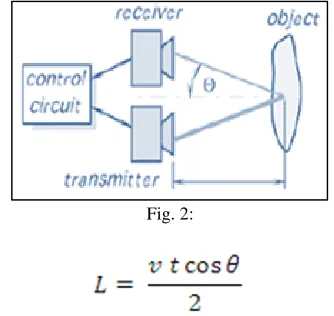
The sensor uses the time it takes for the sound to come back from the object in front to determine the distance of an object.
Fig. 2:
The distance to the object (L) can then be calculated through the speed of ultrasonic waves (v) in the medium by the relation, where, ‘t’ is the time taken by the wave to reach back to the sensor and ‘Ɵ’ is the angle between the horizontal and the path taken as shown in the figure. If the object is in motion, instruments based on Doppler shift are used. The ultrasonic sensor can measure distances in centimetres and inches. It can measure from 0 to 2.5 meters, with a precision of 3 cm.
HCSR04 Range Sensor:
HC-SR04 is a commonly used module for non-contact distance measurement for distances from 2cm to 400cm. It has 4 pins:
VCC – 5V, input power; TRIG – Trigger Input; ECHO – Echo Output; GND – Ground
A trigger signal is provided to TRIG input, a HIGH signal of at least 10μS duration. This enables the module to transmit eight 40KHz ultrasonic burst. If there is an obstacle in-front of the module, it will reflect those ultrasonic waves. If the signal comes back, the ECHO output of the module will be HIGH for duration of time taken for sending and receiving ultrasonic signals. The pulse width ranges from 150μS to 25mS depending upon the distance of the obstacle from the sensor and it will be about 38ms if there is no obstacle.[5]
PING))) Ultrasonic Distance Sensor:
The Parallax PING))) ultrasonic distance sensor provides precise, non-contact distance measurements from about 2 cm (0.8 inches) to 3 meters (3.3 yards). It is very easy to connect to microcontrollers requiring only one I/O pin. The 3pins include: GND - Ground (Vss); 5V - 5 VDC (Vdd); SIG - Signal (I/O pin)
Fig. 4:
The PING))) sensor detects objects by emitting a short ultrasonic burst and then "listening" for the echo. Under control of a host microcontroller (trigger pulse), the sensor emits a short 40 kHz (ultrasonic) burst. This burst travels through the air, hits an object and then bounces back to the sensor. The PING))) sensor provides an output pulse to the host that will terminate when the echo is detected; hence the width of this pulse corresponds to the distance to the target.[6]
HRUSB-MaxSonar-EZ2 MB1423
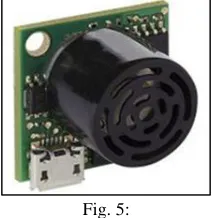
It is a cost-effective solution for applications where precision range-finding, space saving, and low-cost are needed. It detects objects from 1-mm to 5-meters, senses range to objects from 30-cm to 5-meters, with large objects closer than 30-cm typically reported as 30-cm.
Fig. 5:
The sensor utilizes a USB Micro-B connector for sensor interfacing. The range information is sent continuously to the users operating system (OS) and is available to be read at any time. To configure the HRUSB-MaxSonar-EZ on computer systems running Windows, a simple terminal program available at www.maxbotix.com/terminal.htm has to be downloaded and unzipped. When the HRUSB-MaxSonar-EZ ultrasonic rangefinder is connected to a computer running Windows XP or newer, Windows will automatically install and configure the device drivers. For users that operate with a different terminal program, set the configuration to the settings provided.[7]
IV.
WORKING PRINCIPLE OF AN IR SENSOR
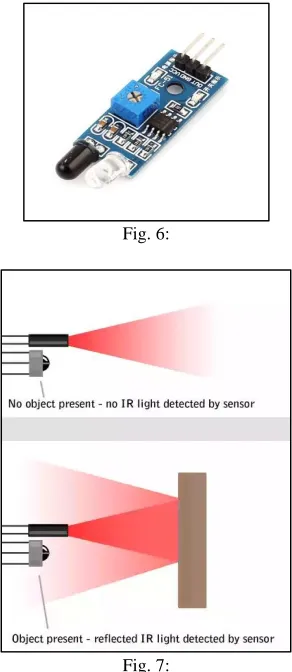
Fig. 6:
Fig. 7:
V.
SENSING TECHNIQUE TO BE USED
Obstacle Detection and Distance Measurement:
In this study we take the Ultrasonic sensor HCSR-04 controlled by a Raspberry Pi. The figures 1&2 show the photographs of the sensors. We keep a flat object in front of the sensor and measure the distance when the code is run. The actual distance is also measured with the help of a scale and both the distances are compared and a graph is plotted.
Fig. 8:
Suppose some obstacle is detected in front of the prototype, the ultrasonic sensor will detect a receiving signal and finds the approximate distance of the object from the prototype. The braking force to be applied depends upon the distance. It depends on the cases discussed below:
Case 1: The Obstacle Is Stationary On The Path
moving, the speed is kept on decreasing in such a way that the host is brought to a stop at a fixed pre-set value before the obstacle.
Case 2: The obstacle is travelling towards the user
This case is similar to the first case. But here, the brakes will be pressed harder. Table - 1
Sr. No. Actual Distance (cm) Measured Distance (cm) Percentage error %
1 5 4.94 0.012
2 8 7.86 0.0175
3 10 9.98 0.002
4 13 13.19 0.015
5 15 14.82 0.012
6 18 18.2 0.011
7 20 20.03 0.0015
8 23 23.17 0.007
9 25 24.97 0.0012
10 28 27.87 0.0048
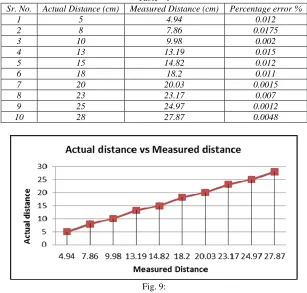
Fig. 9:
The experimental results for the distance measurement are shown in Table I. Fig. 9 shows the graph between actual distance and measured distance. We observe that there is considerable error in the measured distance as compared to the actual distance. The %error column also shows similar results. Since the error is very small, we can easily correct it while programing the code.
VI.
CONCLUSION
The above sensors were studied and the HCSR-04 ultrasonic sensor was selected, as the results are satisfying for use in the automobile prototype system being developed. It will also be used for distance measurement of an object or obstacle. Also IR sensors will be used as fail safe in the prototype.
ACKNOWLEDGMENT
We would like to thank all those who have directly or indirectly encouraged us to take up this project.
REFERENCES
[1] https://en.m.wikipedia.org/wiki/sensor
[2] http://www.ab.com/en/epub/catalogs/12772/6543185/12041221/12041229/Ultrasonic-Advantages-and-Disadvantages.html
[3] https://sensortech.wordpress.com/2010/02/24/hello-world/
[4] http://www.engineersgarage.com/insight/how-ultrasonic-sensors-work
[5] www.micropik.com/PDF/HCSR04.pdf
[6] www.parallax.com/product/28015
[7] www.maxbotix.com/?url=http%3A%2F%2Fwww.maxbotix.com%2FUltrasonic_Sensors%2FMB1423.htm#2808