© 2018, IRJET | Impact Factor value: 6.171 | ISO 9001:2008 Certified Journal | Page 887
Optimization and comparison of a Mono Parabolic Leaf Spring by Using
Design of Experiment & Simulated Annealing Algorithm
Mr. Pradip Sen
1, Mr. Piyush Rai
2, Mr. Nirvikar Gautam
31 M. Tech Scholar, Department of Mechanical Engineering, VEC Lakhanpur, C.G. - India 2,3Assistant Professor, Department of Mechanical Engineering, VEC Lakhanpur, C.G. - India
---***---ABSTRACT- Since last few decades many researchers
worked on the analysis of suspension system. In our research work we consider the mono parabolic leaf spring of mini truck which having gross vehicle weight of 1550 Kg. The thickness of parabolic leaf spring is varying from middle to the both eye end of the spring. Thickness is more at the middle and it continues reduced with the length of spring. The analysis and modeling of parabolic leaf spring (PLS) is done in CATIA V5 by using the part design and analysis workbench. The FEA is performed by creating the discrete model of PLS and applying the same boundary condition as actual working under the static loading condition. The result obtained by the FEA shows that the critical area where the stress concentration is higher is near to the shackle and it may be the lead to the failure.
The DOE and SAA is performed to understand the behavior of the stress and deflection by varying the parameter as camber, leaf spring, thickness and width of the PLS. These studies lead us to find out most optimum configuration of parameter under the given boundary condition.
Keywords – CAE (Computer Aided Engineering), CATIA
(Computer Aided Three Dimensional Interactive Application), CAD (Computer Aided Design), DOE (Design of Experiment), FEA (Finite Element Analysis), SAA (Simulated Annealing Algorithm), PLS (Parabolic Leaf Spring).
1. INTRODUCTION
Design and development of a parabolic leaf spring is a long and time taking process which requires number of experiment to validate the design variables. We have used CAE to shorten this development thereby reducing the tests. A systematic procedure is obtained where CAE and tests are used together. CAE simulations are widely used in the auto industries. In fact, their use has enabled the automakers to reduce product development cost and time while improving the safety, comfort and durability of the vehicles they produce. In this research work parabolic leaf spring of a mini-loader truck has taken into consideration. The objective of this work is to carry out computer aided design and analysis of a conventional leaf spring. The material of the leaf spring is 55Si2Mn90. The Solid modeling and FEA of the leaf spring is done in CATIA V5.
The basic problem which is encountered in parabolic leaf spring is the change in the dimensions of camber and leaf span due to frequent loading and
continuous running of the mini loader truck. The basic observation carried out in this thesis is regarding the decrease in the leaf span and increase in the camber after a period of time. This acts as a limitation to spring action. Hence it becomes very essential to restore the spring action to the initial level. This is because the spring is always loaded and the load on it may be due to the cargo or due to its own weight. It is observed that due to the change in dimensions of camber and leaf span there is a decrease in the amount of comfort level both to the rider and the cargo loaded on it. After continuous running of the automobile the portion of PLS near the shackle tends to weaken in a sense that the thickness is reduced which ultimately results in high stress concentration. This is a cumulative effect and after certain period of time the PLS fails. The objective initially is to study the behavior of a PLS under static loading conditions by varying the camber, leaf span, width and thickness.
2. MATERIAL
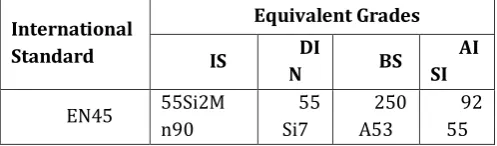
[image:1.595.310.559.570.643.2]The basic requirements of a leaf spring steel is that the selected grade of steel must have sufficient harden ability for the size involved to ensure a full martenstic structure throughout the entire leaf section. In general terms higher alloy required to ensure adequate harden ability when the thick leaf sections are used. The material used for the experimental work is 55Si2Mn90. The other designation of this material is shown in Table-1 and its chemical compositions are shown below in Table -3.
Table 1 – Nomenclature corresponding to current PLS
International Standard
Equivalent Grades
IS DI
N BS
AI SI
EN45 55Si2M n90
55 Si7
250 A53
92 55
© 2018, IRJET | Impact Factor value: 6.171 | ISO 9001:2008 Certified Journal | Page 888
3. DESIGN PARAMETER
[image:2.595.43.276.154.391.2]Dimensional parameters of the parabolic steel leaf spring used are shown in Table - 2.
Table 2 – Material Properties of existing PLS
PARAMETER VALUE
Material selected - steel 55Si2Mn90 Young’s Modulus (E) 200GPa Poission’s Ratio 0.3 Tensile Strength Ultimate 1962 MPa
Tensile Strength Yield 1500 MPa Leaf Span 1025 mm Camber 90.81 mm Thickness 6.35 mm
Width 60 mm
Density 7850 kg/m3
[image:2.595.46.278.156.376.2]Thermal Expansion 11x10-6 / oC
Table 3 – Composition of various elements in 55Si2Mn90
CAD MODELING
CAD model is one of the most important things in FEA because it affects directly the result of output value FEA analysis. So modeling of any geometry in CAD software should required proper attention. In this project work modeling of PLS has done by using the part design workbench and 2D sketch of PLS is initially created and then we convert this 2D sketch into a 3D model by applying the multi section solid tool in design workbench. The parameter of PLS of this 3D model has been cross checked with the existing model of spring by using drawing and drafting of PLS.
Figure – 1 CAD Model of PLS
4. RESULT FROM FEA, DESIGN OF EXPERIMENT &
SIMULATED ANNEALING ALGORITHM
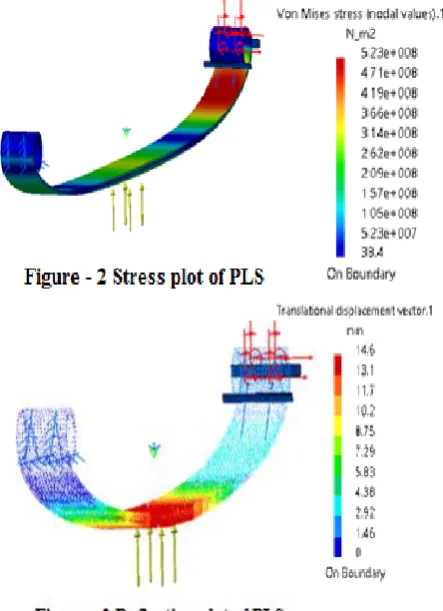
Result From Existing Model: The CAD model of leaf spring is analyzed in CATIA V5R20. For the analysis of stress and displacement one eye end is kept fixed and the other is maintained at sliding contact. The load is applied at the center of the parabolic leaf spring of amount 3800 N in vertically upward direction. And mechanical properties for 55Si2Mn90 are defined in CATIA V5R20 as mentioned above. In this parabolic tetrahedron element with element size 10 mm and absolute sag of 2 mm is considered.
Stress distribution on the parabolic leaf spring is shown in fig. 2 and corresponding displacement is shown in fig. 3. The values of stress and deflection obtained by FEA are shown in Table 4 below
G rade
C %
S i%
M n%
C r%
M o%
P %
S %
5 5Si2 Mn9 0
0 .55
1 .74
0 .87
0 .1
0. 02
0 .05
[image:2.595.310.532.380.686.2] [image:2.595.30.271.428.545.2]© 2018, IRJET | Impact Factor value: 6.171 | ISO 9001:2008 Certified Journal | Page 889
Table 4 - Output parameters by FEA
S.N. PARAMETER VALUE
1 Max Von Mises Stress 523423360 N/m2
2 Max Deflection 14.6 mm 3 Mass 4.863 kg
[image:3.595.303.564.367.530.2]Design of Experiment: It may also be defined as a statistical technique which studies the effects of multiple variables simultaneously. It determines the factor combination for optimum result. DOE offers a fast & efficient means for defining the values of these parameters that would produce the fewer number of defects. There are many algorithms available in CATIA. Here design of experiment is used to find out the optimum setting of parameter for given loading condition. Design of experiments has been implemented by varying camber from 80 mm to 100 mm in steps of 4 and by varying eye distance from 1020 mm to 1030 mm in steps of 4 and width vary from 45 mm to 75 mm in step of 5 and thickness of PLS is vary from 4 mm to 10mm in step of 5.
Table 5 – Most Feasible Parameter Obtained by DOE
S No Parameter Value
1 Camber 93.3 mm 2 Thickness 7.0 mm 3 Width 60 mm 4 Leaf Span 1020 mm
5 Stress 450100000 N/m2
6 Deflection 12.3 mm 7 Mass 5.1 Kg
Variation of Von Mises Stress with respect to Camber, thickness, width and Eye distance is plotted in fig. 4 on the basis of data obtained from DOE
Figure – 4 Result plot from DOE
Simulated Annealing Algorithm:
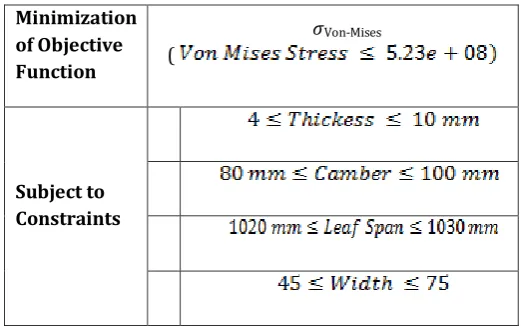
In any optimization whether linear or non-linear there has to be an objective function which is supposed to be either maximized or minimized. In our case we will select Max Von Mises Stress as our objective function. We have to make sure that stress is reduced. As we know that the dimensions of the existing PLS is directly influence the amount of stresses, hence in order to perform the optimization and compute various values of stress, the input parameters such as camber thickness, width and leaf span will be varied. In order to perform the optimization we need to open the optimization workbench in CATIA V5 and the initialize the parameters or factors affecting the outcome.
[image:3.595.51.272.382.515.2]The Non-Linear optimization problem has been formulated in the Table 6 below. It must be noted that here the objective function has not been expressed mathematically because the algorithm is integrated with Finite Element Method to compute values of stress. The algorithm keeps changing the parameters such as camber and deflection between to reach the minimum value of stress.
Table 6 – Non Linear Minimization Problem
Minimization of Objective Function
𝜎Von-Mises
(
Subject to Constraints
1
2
3
4
As per the results obtained it was observed that in the 53th
iteration the stress value computed has minimum and has clearly shown in Figure 5.
© 2018, IRJET | Impact Factor value: 6.171 | ISO 9001:2008 Certified Journal | Page 890 In the 53th iteration von mises stress of magnitude
451667136 N/m2 was minimum and the parameters
[image:4.595.46.276.452.713.2]corresponding to this stress are shown in Table 7.
Table 7 - Most feasible parameter obtained by SAA
S. No Parameter Value
1 Camber 89.7 mm 2 Thickness 6.6 mm
3 Width 56.8 mm
4 Leaf Span 1024.9 mm 5 Stress 451667136 N/m2
5. CONCLUSION
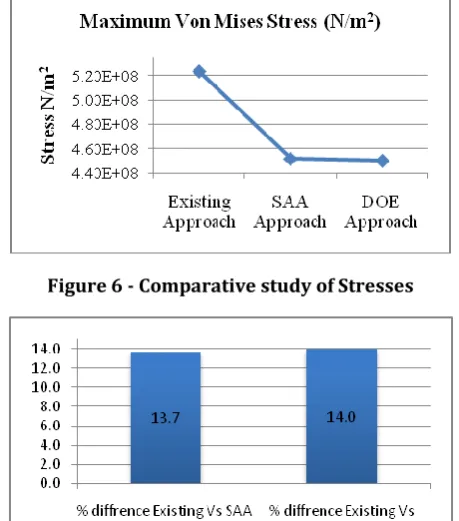
On the basis of the results derived from FEA, & SAA, it is concluded that the most optimum setting of dimensions was obtained in DOE approach. It was found that there was a considerable reduction in the magnitude of stress. The magnitude of new optimized stress was 450100000 N/m2,
which led to a 14 % reduction when compared to the magnitude of stress in the existing PLS. On other hand the result obtained from the optimization technique by applying the simulated annealing algorithm is 13.7 % less the existing result and the optimized parameter is differ from the DOE approaches. So it is clear that the stress difference between the DOE and SAA approach is very less thus we may lead to any one of these two algorithms.
Figure 6 - Comparative study of Stresses
Figure 7 -percentage reduction in stresses by different approach
So the final most optimum parameters obtained after the optimization are Camber – 93.3mm, Thickness – 7.0 mm, Width - 60mm, Leaf Span – 1020 mm.
6. REFERENCES
[1] Manas Patnaik et al, “ Minimization Of Stress In A Parabolic Leaf Spring By Local Algorithm For Constant & Priorities”, International Journal of Engineering Research and Applications, Vol. 2, Issue4, July-August 2012, pp.1897-1899.
[2] Narendra Yadav & SAK Jilani, “Optimization of Multi Leaf Spring by using Design of Experiments & Simulated Annealing Algorithm”, International Journal Of Modern Engineering Research, ISSN: 2249–6645 , Vol. 4, Iss. 12 Dec. 2014 40.
[3] Manas Patnaik et al, “Minimization of Stress of a Parabolic Leaf Spring by Simulated Annealing Algorithm”, International Journal of Engineering Research and Applications, Vol. 2, Issue 4, July-August 2012, pp.457-460.
[4] Manas Patnaik et al, “Study of a Parabolic Leaf Spring by Finite Element Method & Design of Experiments”, International Journal of Modern Engineering Research, Vol.2, Issue 4, July-Aug 2012 pp-1920-1922.
[5] Charde R. B. and Dr. D.V. Bhope, “Investigation of Stresses In Master Leaf of Leaf Spring By FEM and its Experimental Verification”, International Journal of Engineering Science and Technology, Vol. 4, pp. 633-640, Issue 2, February 2012.
[6] Gulur Siddaramanna Shiva Shankar, Sambagam Vijayarangan, “Mono Composite Leaf Spring for Light Weight Vehicle Design, End Joint Analysis and Testing”, J. of Materials Science, Vol. 12, pp. 220-225, Issue 3, 2006. [7] Sachin G. Wagle, Satish S. Oesai, S. B. Wadkar, “Optimized Design & Analysis of Parabolic Leaf Spring Considering Braking, Cornering & Bump loads”, National Conference of computational methods in Mechanical Engineering, pp. 47– 52 , September 2005.
[8] Ahmet Kanbolat , Murathan Soner, Mustafa Karaagaç, Tolga Erdogus, “Parabolic Leaf Spring Optimization and Fatigue Strength Evaluation on The Base of Road Load Data, Endurance Rig Tests and Non Linear Finite Element Analysis”, SAE International, 2011
[9] Kumar Krishan and Aggarwal M.L. “A Finite Element Approach for Analysis of a Multi Leaf Spring using CAE Tools”, Research Journal of Recent Sciences, Vol. 1, pp. 92-96, December 2012.
© 2018, IRJET | Impact Factor value: 6.171 | ISO 9001:2008 Certified Journal | Page 891 [11] Dakshraj Kothari, Rajendra Prasad Sahu and Rajesh
Satankar, “Comparison of Performance of Two Leaf Spring Steels Used For Light Passenger Vehicle”,
BIOGRAPHIES
Mr. Pradip Sen
M. Tech Scholar, Department of Mechanical Engineering, VEC Lakhanpur, C.G. – India
Mr. Piyush Rai
Assistant Professor, Department of Mechanical Engineering, VEC Lakhanpur, C.G. – India
Mr. Nirvikar Gautam