University College London
Catalytic Processes in
Porous Transition Metal
Silicates
By
Carolyn Marie Barker
A thesis submitted for the degree o f Doctor o f Philosophy
Department o f Chemistry
ProQuest Number: U644058
All rights reserved
INFORMATION TO ALL USERS
The quality of this reproduction is dependent upon the quality of the copy submitted.
In the unlikely event that the author did not send a complete manuscript and there are missing pages, these will be noted. Also, if material had to be removed,
a note will indicate the deletion.
uest.
ProQuest U644058
Published by ProQuest LLC(2016). Copyright of the Dissertation is held by the Author.
All rights reserved.
This work is protected against unauthorized copying under Title 17, United States Code. Microform Edition © ProQuest LLC.
ProQuest LLC
789 East Eisenhower Parkway P.O. Box 1346
Abstract
Quantum mechanical cluster calculations on the mechanism o f alkene
epoxidations within peroxide saturated titanium molecular sieve catalysts are
reported. This thesis addresses three major themes; the first is the nature o f the
titanium active sites, in dehydrated and hydrated titanium molecular sieves.
Secondly the nature and formation mechanism o f the oxygen-donating species for
oxidation catalysis is presented. Finally, elucidation o f the complete mechanistic
catalytic cycle for the titanium molecular sieve mediated oxidation o f alkenes to
epoxides, in the presence o f peroxide, is reported. A focal point o f this work is
the relationship between reaction energetics and the structure and electronic
properties o f varied ligands and alkenes.
Highlights include the elucidation o f a new, stable oxygen-donating
species, (=Si0)3Ti-r|’[0(H )0H ](0H 2), isolated for the first time by this work,
which has a low activation barrier o f formation (< 20 k Jm o f’) and shows
favourable reaction energetics for the epoxidation o f alkenes.
Furthermore, the first experimental evidence for the existence o f two
particular oxygen-donating structures in the catalyst, (=SiO)3Ti-ri^(OOR).H2 0 and
(=Si0 )3Ti-T|’(0 0 R)(0 H2).H2 0, which were predicted to exist by quantum
mechanical calculations by this work, is reported. One o f the oxidation agents is
shown to provide an energetically favourable route to epoxide formation and the
other is proposed as the oxygen-donor for diol formation, one o f the major by
Contents
Acknowledgements
Conventions
Chapter 1 Molecular Sieves and Catalysis
1.1 Molecular Sieves .
1.2 Industrial Applications
1.3 Structure .
1.4 Incorporation o f metals .
1.4.1 Framework substitution
1.4.2 Extra-framework metal exchange
1.5 Catalysis .
1.5.1 Acid-Base Catalysis
1.5.2 Redox Catalysis
1.6 Shape Selectivity .
1.7 Experimental Techniques
1.7.1 EXAFS .
1.7.2 Neutron Diffraction
1.7.3 Other Experimental Techniques
1.8 Summary . . . . .
1.9 References. . . . .
10
10
11
12
16
16
17
18
19
19
20
22
22
23
23
24
25
Chapter 2 Molecular Modelling
2.1 Introduction
28
2.2 Classical Mechanics
2.2.1 Bond Stretching.
2.2.2 Angle Bending .
2.2.3 Torsion Angle .
2.2.4 Van der Waals Interactions
2.2.5 Electrostatics
2.2.6 Other terms
2.2.7 Parameterisation.
2.3 Quantum Mechanics
2.3.1 Bom-Oppenheimer approximation
2.3.2 Slater Determinants
2.3.3 Self Consistent Fields (SCF)
2.3.4 Basis sets
2.3.5 Hartree-Fock Theory (HF)
2.3.5.1 Open Shell Systems
2.3.6 Electron Correlation
2.3.6.1 Configuration Interaction
2.3.6.2 Moller-Plesset Pertubation Theory
2.3.7 Density Functional Theory (DFT)
2.4 Advantages and Disadvantages o f DFT and HF
2.5 Transition States . . . .
2.5.1 Methods for finding transition states
2.6 Discussion. . . . .
2.7 References. . . . .
29 31 32 32 32 34 34 34 36 37 39 39 41 42 44 45 45 45 46 49 50 52 53 57
Titanium Molecular Sieves
60Chapter 3 Titanium Molecular Sieves
Literature Review
3.1 Introduction . . . .
3.2 T S - 1 ...
3.3 Industrial Applications
61
61
62
3.4 Epoxidation o f alkenes
3.5 The Ti molecular sieve family
3.5.1. Ti-MCM41
3.6 Structure .
3.5.1 Hydration
3.7 Summary .
3.8 Oxidation activ ity .
3.8.1 Solvent effects
3.8.2 Alkene effects
3.8.3 Acids, bases and additives
3.8.4 R group effects .
3.9 The oxygen donating species in epoxidation reactions
3.10 Summary. . . . . .
3.11 Epoxidation mechanisms
3.12 Summary. . . . . .
3.13 References . . . . .
64 66 66 68 70 73 73 76 78 80 80 82 86 86 90 91
Chapter 4 Hydration and Oxidation of
Titanium Molecular Sieves
4.1 Introduction
4.2 Methodological Details .
4.3 Structure o f the titanium centres
4.3.1 Stability o f Ti sites
4.3.2 Hydration o f Ti sites
4.3.2.1 Geometrical Considerations
4.3.2.2 Electronic Considerations
4.3.4 Conclusion
4.4 Interaction with peroxide .
4.4.1 R gr oups . . . .
4.4.2 Ti-peroxo complexes.
4.4.2.1 The T|^ transition state .
4.4.2.2 The reactant
4.4.2.3 Reaction energetics
4.4.3 Ti-ri'(OOR) Formation .
4.4.3.1 R group effects
4.4.4 Proton Transfer Processes
4.4.5 Ti-T| ' [0(H )0H ] formation
4.4.6 Conclusions
4.4.7 Other Ti-peroxo species.
4.4.8 Conclusions
4.4.9 TBHP/Ti-MCM41 EXAFS
4.4.9.1 DFT models with TBHP
4.4.9.2 Extending the model .
4.5 Summary . . . . .
4.6 References. . . . .
123 125 127 129 131 133 135 139 140 144 145 146 147
Chapter 5 Epoxidation of alkenes by
Titanium molecular sieves
5.1 Introduction . . . .
5.2 Methodological details
5.3 W hich oxygen atom is donated to the alkene?
5.4 R groups . . . . .
5.5 Orbital analysis . . . .
5.5.1 HOMO-LUMO gap
5.5.2 Summary
5.6 Interaction o f alkenes with Ti-peroxo structures
5.6.1 Epoxidation via the ri* Ti-peroxo complex
5.6.1.1 Energetics o f r)’ mediated epoxidation
5.6.1.2 The transition state
5.6.2 Epoxidation via the Ti-peroxo complex
5.7 Interaction o f alkenes with a T i-r|'[0 (H )0 H ] complex .
5.8 Summary . . . .
5.9 References. . . . .
Chapter 6 Summary and Conclusions
6.1 Overview . . . .
6.2 Conclusions
6.2.1 The Ti active site
6.2.2 The Ti-peroxo species .
6.2.3 The Epoxidation o f alkenes
6.2.4 R group effects .
6.3 Concluding Remarks
185
185
186
186
187
188
189
190
Acknowledgements
Firstly, I would like to thank my supervisors, Prof. Richard Catlow and Dr. Nik
Kaltsoyannis for their guidance, dedication and invaluable suggestions to this
work. Many thanks to Richard Catlow and Molecular Simulations Inc., San
Diego for the opportunity to further my research in America for two summers; a
fantastic and unforgettable experience.
I am particular grateful to the Engineering and Physical Sciences Research
Council (EPSRC) for funding me throughout my PhD. Much appreciation goes to
MSI for allowing me access to |3 versions o f their quantum mechanical code
D m o l^l
Thank you to all those members o f the Davy Faraday Research Laboratory
who have given me invaluable help and assistance and who have contributed to
this work. In particular Dr. Martin Attfleld, Dr. Spencer Braithwaite, Dr. Stefan
Bromley, Dr. Furio Cora, Mr. Martin Foster, Dr. Sam French, Dr. David Gleeson,
Dr. Mark Green, Dr. Gopinathan Sankar, Dr. Phil Sinclair, Dr. Ben Slater, Dr.
Alex Simperler, Dr. Alexei Sokol, Dr. John Turner and Mr. Lee Whitmore. I
would also like to acknowledge Dr. George Fitzgerald and Dr. Jan Andzelm at
MSI, San Diego for their assistance and helpful suggestions during my stay.
I would like to acknowledge the members o f the Computational Chemistry
group at Pfizer Global Research and Development, especially Dr. Mike Snarey
and Dr. Alex Alex, who have been so supportive o f me whilst writing this thesis.
Finally, a huge thank you to Ben for his unparalleled support,
Conventions
All pictorial representations o f molecules in this thesis follow the convention
shown below, unless otherwise stated.
Titanium
Q l Oxygen
( 2 ^ Silicon
Carbon
Chapter 1
Molecular Sieves and Catalysis
1.1 M o lec u la r S iev es
Molecular sieves, o f which zeolites are the most well-known example, are
ordered, porous, inorganic solids with void channels running through their
frameworks in one, two or three dimensions.
»
...'T ' v A : ' ' .
; L . - ; » ' " - V - - .
' A ' ' ' " - v x y ÿ ' ...
'W . ^
A
■
^Figure 1.1 Microporous inorganic frameworks, chabasite (left) and silicalite
(right).
Discrete organic molecules, which are sufficiently small to fit into the framework
access to the crystal interior and are therefore absorbed on the exterior o f the
crystal, thus playing no role in the reactive chemistry o f the absorbed species.
The selective diffusion o f small molecules gives rise to many important industrial
applications and subsequently molecular sieve chemistry is the focus o f many
research groups around the world.
1.2 Industrial Applications
The commercial uses o f molecular sieves are wide-ranging and include:
• Ion exchange.
Exchange o f radioactive ions with harmless cations.
- Water softening.
• Gas separation.
- Production o f pure oxygen and nitrogen from air.
Separation o f para-xylene from a mixed para-xylene/meta-xylene stream.
• Shape-selective heterogeneous catalysis.
- Hydrocarbon cracking.
- Hydroquinone synthesis from phenol.
- Methanol to gasoline conversion.
In addition, zeolites have numerous domestic applications such as in washing
powder, cat litter and air purifiers.
Today, more than 100 zeolite and molecular sieve structures are recorded
in the Atlas o f Zeolite Structure Types issued by the International Zeolite
Committee The number has increased steadily over the last thirty years. The
number o f patents (US) issued regarding these materials is also growing
accordingly. However, despite the industrial relevance and high academic
research interest, only a small number o f molecular sieves are used in commercial
processes or products. It should be noted that many o f these molecular sieves are
Schoonover and Cohn in their recent appraisal o f the industrial applications of
molecular sieves
Decade
Known
Structure Types
US Patents
(composition or use)
Commercial Structure
types
1 9 5 0 - 1969 27 2900 3
1 9 7 0 - 1979 11 4900 1
1 9 8 0 - 1989 26 7400 2
1 9 9 0 - 1999 61 8200 5
Total 125 23400 11
Table 1.1 Zeolite discovery and use by decade
There are many constraints to achieving commercial success and even though
molecular sieves are highly researched there are still many questions that need to
be addressed regarding structure and in particular reactivity. Computer modelling
is now a key tool for gaining insight into these highly useful materials and
enabling the acceleration o f laboratory chemistry to a commercial scale.
1.3 Structure
Molecular sieves typically have low densities (relative to quartz SiO]) due to the
large space-filled channels running the length o f the framework, which are o f
sufficient size (3Â to in excess o f 100Â) to permit diffusion o f organic molecules.
In some instances when these empty channels meet, large cavities known as
supercages form which are ideal for chemical reactions to take place in. O f course
reaction can and does take place in the pores themselves but this is more
dependent on substrate size constraints.
The frameworks o f molecular sieves consist o f TO4 tetrahedra, where T
can be silicon, aluminium or phosphorus. For purely siliceous zeolites such as
zeolite p, T is silicon. In aluminosilicate zeolites, the tetrahedral T sites are a
was the advent o f aluminophosphates, known as ALPOs here T is a mixture o f
aluminium and phosphorus.
The tetrahedra combine at comers, linking the T atoms together through
oxygen bridges, to yield three dimensional, ordered frameworks. The tetrahedral
primary building units can be arranged in an infinite number o f ways to generate
an infinite number o f possible three-dimensional frameworks with channel
structures extending throughout the crystal. A number o f particular arrangements
of linking tetrahedra occur regularly in zeolites which are generally known as
secondary building units (SBU) Much work in theoretical chemistry has
focused on manipulating these geometrical shapes to form new hypothetical
structures To gain a clearer idea o f how SBUs piece together to form very
complex frameworks the classic example o f the aluminosilicate zeolite Faujasite,
also known as zeolite X or Y depending on the Si/Al ratio, is discussed. Zeolite Y
is the more siliceous form and is used commercially as a catalyst for hydrocarbon
cracking.
The Faujasite structure is built up o f sodalite units which are comprised o f
four- and six- ring SBUs linked together to form a cubo-octahedron, bridged
together via six-rings. Six-rings consist o f six T atoms held together by oxygen
bridges, so in fact six-rings contain 12 atoms and four-rings contain eight atoms
and so on. Sodalite cages feature in many other zeolites but in Faujasite this
arrangement creates three orthogonal 7.4Â diameter channel systems, which
k
-o
H
Six ring Sodalite cage
Figure 1.2 Construction o f the Faujasite structure from sodalite cages, which are,
in turn built from 6-rings and 4-rings. The vertices represent a Si or A1 T atom
and the lines oxygen bridges.
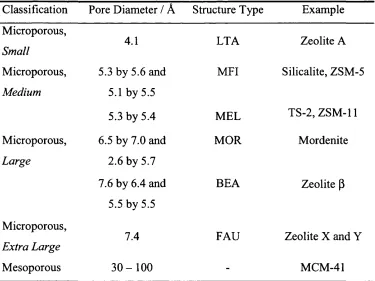
Molecular sieves in general can be characterised in terms o f their pore size, as
shown in table 1.2.
Classification Pore Diameter / Â Structure Type Example
Microporous,
Small
4.1 LTA Zeolite A
Microporous, 5.3 by 5.6 and MFI Silicalite, ZSM-5
Medium 5.1 by 5.5
5.3 by 5.4 MEL TS-2, ZSM-11
Microporous, 6.5 by 7.0 and MOR Mordenite
Large 2.6 by 5.7
7.6 by 6.4 and BEA Zeolite P
5.5 by 5.5
Microporous,
Extra Large 7.4 FAU Zeolite X and Y
Mesoporous 3 0 - 1 0 0 - MCM-41
The reader will note the three-letter code in the structure type column in table 1.2. This code is assigned by the International Zeolite Committee (IZC) and describes
a characteristic and specific topology or arrangement o f primary building units.
The IZC code is only applied to crystalline frameworks, which by definition have
regular repeat units. However, the term molecular sieve has been applied to any
ordered, porous structure that can selectively absorb molecules on the basis o f size
and shape. MCM-41, developed by Mobil does indeed fit this remit, but its pore
walls are not crystalline
MCM-41 consists o f an amorphous silica framework with a regular array
of uniform pores running in one dimension. The pores are much larger than any
natural or synthetic zeolite, around 30Â to 100Â in diameter, and thus the material
is termed mesoporous. It has been postulated that the large diameter o f the
channels could allow for applications in the highly lucrative production o f
pharmaceuticals or fine chemicals, where bulkier substrates are generally a
requirement. The large inner channels are lined with hydroxyl groups, a feature
which has proven to be particular useful for the grafting o f redox transition
metals, such as titanium onto the surface walls, figure 1.3.
Figure 1.3 Ti grafted onto mesoporous MCM-41.
Probably one o f the most notable advancements in molecular sieve chemistry
since the field was first created, is the introduction o f metals into the frameworks;
1.4 In c o rp o ra tio n o f m eta ls
The use o f zeolites has dramatically increased due to the incorporation o f
elements other than silicon and aluminium into the frameworks. Pure aluminium
and silicon oxides are catalytically virtually inert. Siliceous solids can be
functionalised for catalysis applications by incorporation o f variable oxidation
state metals. The metals can either be incorporated into the silica frameworks or
grafted onto the surface silanols o f mesoporous silicas, post-synthesis. The
position o f transition metals incorporated into molecular sieves depends on the
particular silica framework and they can either directly substitute for Si in
tetrahedral positions or can reside in extra-framework sites.
1.4.1 Fram ew ork substitution
Direct framework substitution o f metals into molecular sieves is extensive. Ti^^
C r^ \ M n -\ F e^\ Co’\ C u ^\ As’*, Zr“*, Ge"* and Sn"* have all
been incorporated into microporous zeolites Probably the most reported
example o f direct framework incorporation o f transition metals into zeolites is
Titanium Silicalite-1 (TS-1), where a small ratio o f Si ions in the zeolite silicalite
are directly substituted for Ti.
Figure 1.4 TS-1. A small amount o f Ti is substituted directly into the silica
The inclusion o f Ti into silicalite confers catalytic activity for the oxidation o f
phenol with 100% selectivity and desired product yields. The pure silica material
is by way o f contrast, completely catalytically inert.
1.4.2 Extra-framework metal exchange
A feature o f many zeolites, and one that gives rise to many unique properties, is
the presence o f A1 in the framework. The different formal valancies o f Si
(tetravalent) and A1 (trivalent) produce an overall negative charge for each A1
incorporated into the framework which are typically balanced by extra-framework
alkali, alkaline earth or rare earth metal cations. Exchange o f these metal ions can
readily occur, either with protons resulting in a Bronsted acidic material, or with
transition metals such as Ni^"^ Co^^ and Cr^"^, resulting (in the most part) in
active catalysts for a variety o f organic transformations. Ni exchanged zeolite Y,
figure 1.5, is an active catalyst for the trimérisation o f acetylene to benzene
and is prepared by direct ion exchange o f Na or Li zeolite Y by treatment with
aqueous NiNOg. However, the resultant material is inert, so far as the
trimérisation o f acetylene to benzene is concerned and activation requires
prolonged exposure to e.g. N2 gas saturated with acetylene. The acetylene draws
the Ni ions out o f the space-restricted double six-rings shown in figure 1.5 into the
13Â diameter Faujasite supercages where reaction can take place. Na exchanged
zeolite Y is also used in industry for hydrocarbon cracking, where heavy
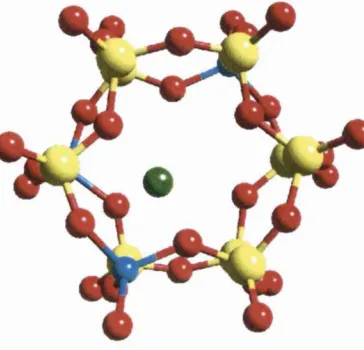
Figure 1.5 Double six-ring o f Nickel exchanged zeolite Y. Si is yellow, O is red.
•2+ •
Al is turquoise and Ni“ is green.
Focus is now turned to the reactivity o f molecular sieves. Molecular
sieves play an important role in ion exchange and gas separation but by far the
most lucrative industrial application is in heterogeneous catalysis.
1.5 C a ta ly sis
A catalyst lowers the activation energy o f a reaction (often by providing an
alternative pathway that avoids the slow, rate-determining step o f the uncatalysed
reaction) and results in a higher reaction rate at the same temperature A
homogeneous catalyst is a catalyst that is in the same phase as the reaction
mixture and a heterogeneous catalyst is in a different phase, e.g. a solid-state
catalyst for the reaction o f gases. Heterogeneous catalysis normally depends on at
least one reactant being absorbed (usually chemisorbed) and modified to a form in
which it readily undergoes reaction. There are two fundamental considerations in
zeolite catalysis: the first is the basic reaction mechanism, and the second is the
way in which the reaction is controlled due to the space constraints o f the porous
framework. There are two general reaction mechanisms that molecular sieves can
1.5.1 Acid-Base Catalysis
The inherent catalytic activity o f aluminosilicates is attributable to the presence of
acidic sites due to aluminium ions on their internal surfaces i.e. the Al^^ charge
balancing protons can be donated to a base. These acidic protons can be o f Lewis
or Bronsted acid character and are generally accepted to be firmly bonded to the
lone pair o f the bridging oxygen species, figure 1.6.
' V X '
Figure 1.6 Acidic sites in zeolites
The acid strength and number o f acid centres can be adjusted in a controlled
manner during synthesis and/or by subsequent ion exchange or de-alumination.
The acid-base catalysis o f zeolites has been the focus o f many publications and
the reader is directed to references for further information. Acid-base
reactions are not, however, the only type o f catalysis that molecular sieves engage
in. The presence o f transition metals has extended the catalytic potential o f
molecular sieves to redox catalysis, an area o f science that this thesis is concerned
with.
1.5.2 Redox Catalysis
The catalytic properties o f redox molecular sieves are greatly dependent on the
individual nature o f the metal site, the structure and the sorption properties o f the
molecular sieve. In Ti- and V substituted zeolites, which have similar
compositions and structural features, their catalytic properties are quite different
due to distinct redox sites under analogous conditions. Aside from the dimensions
major effect on the course o f the reaction. To date, redox molecular sieves have
been applied to the epoxidation of double bonds, the hydroxylation o f aromatic
and aliphatic C-H bonds and the oxidation o f O, N and S functionalities.
In section 1.3 the grafting o f transition metals onto the pore walls o f
mesoporous MCM-41 was discussed. This synthetic technique allows for the
tailored incorporation o f ligands with the metal (in framework substituted
molecular sieves, calcination o f the material, necessary as part o f the synthesis
removes any metal ligands present). This is o f importance as the choice of
ligands can accelerate catalysis substantially
As noted earlier, it is not only the chemical composition o f molecular
sieves that dictates catalytic activity. An equally important factor in directing the
course o f catalysis is the geometry and topology o f the porous framework. This is
known as shape-selectivity.
1.6 Shape Selectivity
Shape selectivity makes it possible to orient molecular transformations in a
direction other than would be taken if there were no steric constraints Mobil
research workers mentioned the role o f shape selectivity in catalysis for the first
time at the beginning o f the 1960s. Since then, four main categories o f shape
selectivity have been identified and described in the literature:
1. Reactant shape selectivity.
When only a fraction o f the reactants can easily reach the active sites of
2. Product shape selectivity.
Only products small enough in relation to the pore size can easily diffuse
out o f the zeolite structure.
3. Transition state selectivity.
When the space available in the pores o f the zeolite strongly inhibits or
prevents the formation o f the reaction intermediate or transition species that
precedes that o f a product.
Reactant Product
4. Molecular traffic control.
This phenomenon can occur in a zeolite that has at least two different sized
channels in its pore system. The reactants may circulate preferentially in one
class o f pores, while the products tend to diffuse through another.
A number o f factors have been outlined that need to be considered when
investigating one o f the most industrially relevant areas o f solid-state chemistry,
molecular sieve catalysis. As with most catalytic systems there is a lack of
information regarding the mechanisms o f reactions, which is the focus o f this
thesis. Theoretical methods have become a fundamental tool in the search for the
reaction mechanisms o f many systems, a technique that we have indeed employed
to gain insight into the catalytic activity o f molecular sieves. However, before I
turn to chapter 2, which discusses molecular modelling techniques, a number of
experimental methods that have been applied to the study o f molecular sieves are
1.7 Experimental Techniques
X-ray diffraction is the primary tool used by the chemist to investigate the
structure o f complex inorganic materials. Unfortunately X-rays suffer from the
fact that the intensity o f scattering is proportional to the atomic number o f the
scattering atoms. Thus, light nuclei in the presence o f heavy nuclei, e.g. H and
similar nuclei e.g. A1 and Si, cannot be easily distinguished. X-ray diffraction
will thus give averaged structures over Al-O-Si and Si-O-Si units and therefore,
other techniques that give information on short-range order, such as X-ray
absorption spectroscopy (EXAFS and XANES) neutron diffraction and/or nuclear
magnetic resonance spectroscopy, NMR, are required.
1.7.1 EXAFS
EXAFS (Extended X-ray Absorption Fine Structure), one such local environment
analysis technique, has been applied to the problem o f defect/active-site
characterisation in molecular sieves. Indeed in Chapter 4, EXAFS analysis o f a Ti
grafted molecular sieve is able to confirm the structure o f oxygen-donating
species in Ti molecular sieve redox catalysts, predicted to exist by quantum
mechanical calculations A brief description o f EXAFS now follows.
When the energy o f a beam o f X-rays passing through a solid becomes
greater than the binding energy o f a core electron in a specific atom, the electron
is emitted from the core to a continuum state. At this point there is a sharp
increase in the observed absorption coefficient known as the absorption edge. As
the photon energy increases, the absorption coefficient becomes oscillatory due to
interference between the outgoing electron wave and the same wave after it is
backscattered from the surrounding atoms. The region o f oscillatory behaviour is
known as the EXAFS region. The oscillatory behaviour o f the measured
absorption contains information about the local structure around the excited atom
and is dependent upon the type o f backscattering atom and its distance from the
absorbing centre is then performed by fitting a calculated EXAFS spectrum o f a
3D model to the data observed.
1.7.2 Neutron Diffraction
X-ray diffraction and X-ray absorption spectroscopy have been successfully used
to give detailed and quantitative information about the heavy atoms in molecular
sieve catalysts. However, if one requires information regarding the light atoms in
a system, neutron diffraction is an essential technique. Although neutron
diffraction is not a method used often in zeolite chemistry, in combination with
quantum mechanical studies it has been used to good effect in revealing the
geometrical change undergone by acetylene as it binds to a Ni exchanged zeolite
Y catalyst (Ni zeolite Y is an efficient catalyst for the trimérisation o f acetylene
to benzene).
1.7.3 Other Experimental Techniques
Infra-red and Raman vibrational spectroscopies have also been used extensively to
probe the local structure o f molecular sieves and magic angle spinning (MAS)
nuclear magnetic resonance (NMR) has had a major impact on zeolite chemistry.
NMR depends on the local environment o f the nucleus in question and the
coordination o f Si in molecular sieves can be efficiently probed using this
technique However, the inherent difficulty o f probing molecular sieves by
experimental techniques, especially with regard to reaction mechanisms (femto
second pulsed laser spectroscopy is the only techique that can directly examine
mechanisms and even then it only yields vibrational information rather than actual
geometries), means that computational techniques are a fundamental tool in the
1.8 Summary
Almost the whole o f the modem chemical industry depends on the development,
selection and application o f catalysts. The discovery o f microporous and
mesoporous molecular sieves has revolutionised the field o f heterogeneous
catalysis. Numerous reactions o f potential interest, hitherto not feasible because
o f low activity, selectivity and/or the service life o f the catalyst can now be
commercially explored using molecular sieves. The inclusion o f metals into
crystalline aluminosilicates is o f huge industrial and academic interest as the
search for new molecular sieves, greater reactivity and insight into reaction
mechanisms continues.
O f growing importance is the science o f stereoselective zeolite catalysts,
which are capable o f producing an enantiomeric excess o f a given species from a
prochiral precursor Chirality is clearly o f enormous relevance in the quest for
catalysts for use in the pharmaceutical and fine chemical industry. Focus is
already on Ti substituted molecular sieves, as they are known stereoselective
catalysts for the epoxidation o f alkenes, with retention o f the alkene double bond
configuration.
In this chapter the industrial importance o f molecular sieves, in particular
transition metal doped frameworks has been outlined, especially with regard to
heterogeneous catalysis. However, the understanding o f catalytic mechanisms is
still poor and the aim o f this thesis is to employ computational techniques to
enhance our understanding o f one o f the most commercially and academically
important catalytic systems, titanium substituted molecular sieves. An appraisal
o f modem computational modelling techniques and its application to molecular
1.9 References
(1) Kerr, G. T. Scientific American 1989, July, 82.
(2) Arends, I. W. C. E.; Sheldon, R. A.; Wallau, M.; Schuchardt, U.
Angew. Chem. Int. Ed. Engl. 1997, 36, 1144-1163.
(3) Schoonover, M. W.; Cohn, M. J. Topics in Catalysis 2 0 0 0 ,13,
367-372.
(4) Meier, W. M.; Olson, D. H. Atlas o f Zeolite Structure Types', 4th
ed., 1996.
(5) Wilson, S. T.; Lok, B. M.; Messina, C. A.; Cannon, T. R.;
Flanigen, E. M. J. Am. Chem. Soc. 1 9 8 2 ,104, 1146.
(6) Catlow, C. R. A. In Modelling o f Structure and Reactivity in
Zeolites', Catlow, C. R. A., Ed.; Academic Press: London, 1991.
(7) Price, G. D.; Wood, I. G.; Akporiaye, D. E. In Modelling o f
Structure and Reactivity o f Zeolites', Catlow, C. R. A., Ed.; Academic Press Ltd:
London, 1991.
(8) Beck, J. J. Am. Chem. Soc. 1 9 9 2 ,114, 10834.
(9) Kresge, C.; Leonowicz, M.; Roth, W.; Vartuli, J.; Beck, J. Nature
1992, 55P, 710.
(10) Bellussi, G.; Rigutto, M. S. Stud. Surf. Sci. Catal. 1994, 85,
177-213.
(11) Kumar, R.; Pais, G. C. G.; Pandey, B.; Kumar, P. J. Chem. Soc.,
Chem. Commun., 1995, 1315-1316.
(12) Corma, A.; Navarro, M. T.; Pariente, J. P. J. Chem. Soc., Chem.
Commun., 1994, 147-148.
(13) Corma, A.; Navarro, M. T.; Pariente, J. P.; Sanchez, F. Stud. Surf.
Sci. Catal. 1994, 84, 69-75.
(14) Franke, O.; Rathousky, J.; Schulzekloff, G.; Starek, J.; Zukal, A.
Stud. Surf. Sci. Catal. 1994, 84, 77-84.
(15) Maschmeyer, T.; Rey, F.; Sankar, G.; Thomas, J. M. Nature 1995,
378, 159-162.
(16) Tanev, P. T.; Chibwe, M.; Pinnavaia, T. J. Nature 1994, 368,
(17) Tuel, A.; Taarit, B. J. Chem. Soc., Chem. Commun. 1994,
1667-1668.
(18) Tuel, A. Zeolites 1995, 75, 236-242.
(19) Zahedi-Niaki, M. H.; Kapoor, M. H.; Kaliaguine, S. J. Catal. 1998,
777,231-239.
(20) Zicovich-Wilson, C. M.; Corma, A. J. Phys. Chem. B 2 0 0 0 ,104,
4134-4140.
(21) Ouden, C. J. J. d.; Jackson, R. A.; Catlow, C. R. A.; Post, M. F. M.
P. Phys. Chem. B. 1990, 94, 5286 - 5290.
(22) Dooryhee, E.; Catlow, C. R. A.; Couves, J. W.; Maddox, P. J.;
Thomas, J. M.; Greaves, G. N.; Steel, A. T.; Townsend, R. P. J. Phys. Chem.
1991, 95, 4 5 1 4 -4 5 2 1.
(23) Thomas, J. M.; Williams, C.; Rayment, T. J. Chem. Soc., Faraday
Trans. 84, 2915 -2931.
(24) George, A. R.; Catlow, C. R. A.; Thomas, J. M. Catal. Lett. 1991,
8, 1 9 3 -2 0 0.
(25) Pierloot, K.; Delabie, A.; Ribbing, C.; Verberckmoes, A. A.;
Schoonheydt, R. A. J. Phys. Chem. B 1 9 9 8 ,102, 10789 - 10798.
(26) Pichat, P.; Vedrine, J. C.; Gallezot, P.; Imelik, B. J. Catal. 1974,
32, 190.
(27) Maddox, P. J.; Stachviski, J.; Thomas, J. M. Catal. Lett. 1988, 7,
191.
(28) George, A. R.; Catlow, C. R. A.; Thomas, J. M. J. Chem. Soc.,
Faraday Trans. 1995, 91, 3975.
(29) Atkins, P. W. Physical Chemistry', Oxford University Press:
Oxford, 1992.
(30) Whan, D. A.„ 532.
(31) Karge, H. Stud. Surf. Sci. Catal. 1991, 65, 133.
(32) Holderich, W.; Hesse, M.; Naumann, F. Angew. Chem. Int. Ed.
Engl. 1988, 2 7 ,226-246.
(33) Berrisford, D. J.; Bolm, C.; Sharpless, K. B. Angew. Chem. Int. Ed.
(34) Csicsery, S. M. Chemistry in Britain 1985, May, 473-477.
(35) Barker, C. M.; D.Gleeson; Sankar, G.; Kaltsoyannis, N.; Catlow,
C. R. A.; Thomas, J. M. Accepted in Phys. Chem. Chem. Phys. 2001.
(36) Sankar, G.; Thomas, J. M.; Catlow, C. R. A.; Barker, C. M.;
Glesson, D.; Kaltsoyannis, N. J. Phys. Chem. B 2 0 0 1 ,105, 9028 - 9030.
(37) Turner, J. F. C.; Benmore, C. J.; Barker, C. M.; Kaltsoyannis, N.;
Thomas, J. M.; David, W. I. P.; Catlow, C. R. A. J. Phys. Chem. B 2 0 0 0 ,104,
7570-7573.
(38) Cheetham, A.; Day, P. Solid State Chemistry: Techniques', Oxford
Science Publications: Oxford, 1987.
(39) Thomas, J. M.; Klinowski, J.; Anderson, M. W. J. Chem. Soc.,
Faraday Trans. 11986, 82, 2851.
Chapter 2
Molecular Modelling
2.1 Introduction
One o f the fundamental goals o f theoretical chemistry is to accurately model and
predict macroscopic properties o f matter on a microscopic scale. Broadly
speaking, this equates to determining the energy o f particles, a molecule, atom or
ion at a given geometry, temperature, pressure at an instance o f time. Two
distinct yet complementary methodologies are typically at the disposal o f the
computational chemist who wishes to elucidate physical or electronic properties
o f molecules, namely, classical mechanics and quantum mechanics
Before describing the theoretical basis o f these techniques, it is worth
outlining the problems that can now be addressed to microporous and mesoporous
inorganic materials. In order to address the accuracy o f a given theoretical model,
one must reproduce the physical properties o f known molecular sieves. Given
satisfactory correlation with experiment and provided the model is transferable,
one can predict known zeolite structures and propose new, stable molecular sieves
that have yet to be synthesised. Indeed notable successes o f predictive modelling
• Experimental confirmation ^ o f the existence o f a new stable phase o f zeolite
P, type C, initially proposed and supported by theoretical work
• Negative thermal expansion in purely siliceous zeolite Y, predicted by Parker
et al. ^ using free-energy minimisation methods and confirmed by
experimental methods ^.
• Prediction o f a new chabasite template by de novo design which was
confirmed through successful synthesis o f the said zeolite.
One can use classical mechanical based methods to reproduce structures and
vibrational properties o f microporous and mesoporous materials, simulate gas
separation processes and to chart the pathways o f sorbed molecules within
molecular sieve pores. However, quantum mechanical techniques are the primary
method for modelling reactivity o f sorbed molecules (which clearly involves
charge transfer and the breakage and/or formation o f bonds), usually in catalysis
Catalysis is an area that is notoriously difficult to gain insight into via experiment,
see section 1.7. Some o f the key points relevant to classical and quantum
mechanical approaches are now outlined.
2.2 Classical Mechanics
One o f the simplest views one can have o f a chemical system is o f a collection o f
solid spheres (the atoms) held together by springs (the bonds). This is obviously a
gross simplification since molecules are more accurately described as a collection
o f atomic nuclei surrounded by an electron cloud. For ionic systems the concept
o f the covalent bond is, o f course, redundant, however the idea o f atoms being
essentially solid spherical entities is still valid. In fact it is possible to represent a
partially covalent system such as a zeolite using a purely ionic approach
supplemented by appropriate covalent terms
In modelling a chemical system, one seeks the geometrical arrangements
o f atoms that correspond to stable molecules, and the energy o f that particular
configuration. In classical mechanics, the electronic motions are ignored and the
Quantum mechanics, discussed later in this chapter, does include electrons in the
description o f the system but this is a more computationally demanding method.
Classical mechanics is thus often used to perform calculations on systems
containing a significant number o f atoms and large-length scales. Ignoring
electrons does seem a little drastic but when used for appropriate problems the
method work exceptionally well, with in some cases answers that are as accurate
as even the highest level quantum mechanical calculation, in a fraction o f the
computer time.
For molecules, the simple interatomic potential model can be extended to
the ‘molecular mechanics’ strategy in which, the total energy, E j o t , o f a molecule
is constructed from a number o f individual component energy terms as shown in
equation 2.1.
^ T O T = ^ s t r + ^ h e n d + ^ to r s + ^ v c lw + ^ e l
2.1
Each o f these terms has a particular functional form that describes a physical
process such as bond stretching or bond bending. The validity o f this description
o f the total energy depends on a number o f assumptions; the most important being
that the individual energy terms are independent o f each other and that they are
transferable from one molecule to another.
For convenience the energy terms are often subdivided into two classes,
bonded and non-bonded. In some simple molecular mechanics calculations,
notably conformational analysis, the bonded energy terms are assumed to be
constant and only the effect o f the non-bonded terms are taken into account. The
component terms are described as follows:
Bonded terms
• Estr The energy penalty incurred when bonds are distorted from their
ideal (equilibrium) values.
• Ebend The energy penalty incurred when distorting bond angles away
from their ideal values.
Non-bonded terms
• Eyciw The van der W aal’s energy.
• Eel The energy arising from Coulombic interactions.
Equation 2.1 is the form o f a simple force field. Some force fields also include
additional (cross) terms that take into account the fact that these individual terms
are not strictly independent. For instance, as a bond angle decreases the
corresponding bond lengths increase slightly.
The above terms constitute an equation that is analytically differentiable,
so that standard numerical optimisation techniques can be used to minimise the
energy o f the system. Each o f the terms are calculated as follows:
2.2.1 Bond stretching
E „ ,= Y ^ K X d - d ,Y
2.2
Ks is the force constant for bond stretching.
do is the equilibrium bond length for a given pair o f atoms.
d is the actual bond length.
Z Signifies that this equation is summed for all bonds in the molecule.
This simple harmonic form is often inadequate, particularly when bonds deviate
significantly from the equilibrium distance. A more accurate representation is the
Morse potential:
D^{l - exp[- -ùf» ) F
2.3
De is the bond dissociation energy.
c is a constant.
The value o f this function approaches the value o f bond dissociation energy as the
2.2.2 Angle bending
2.4
This form o f the equation is again harmonic in nature.
Kq is the angle deformation constant.
0 0 is the equilibrium bond angle
0 is the actual angle
2.2.3 Torsion angle
This term describes the deviation in energy upon rotation about a given bond, and
is essential to differentiate between cis and trans conformations. For example a
torsional term would be used between each carbon atom in a benzene ring in order
to insure planarity.
2.5
The form o f the equation is that o f a Fourier series.
Vn is a constant, which determines the rotational barrier around a given bond.
0) is the torsional angle.
2.2.4 Van der Waals Interactions
The van der Waals interaction is essentially composed o f two parts and is shown
E
Figure 2.1 : Van der Waals energy as a function bond distance, r.
The potential energy curve above shows two distinct regions: repulsion at short
distances with a longer-ranged attractive part. The short-range repulsion
originates from the electron clouds overlapping unfavourably. The longer ranged
attractive section arises from the instantaneous static polarisation o f neighbouring
electron clouds, the London forces.
A number o f expressions have been used to account for the van der Waals
(VDW) attraction or repulsion between atoms. A common form is the Lennard-
Jones potential.
E = y —
2.6
r is the distance between the two atoms.
A and B are parameters that depend on the nature o f the two atoms.
An alternative, but equivalent equation is:
/ / \ 6
ym 1 y - 2 —
r
J
VV / V /
Km is the minimum energy distance.
E is the depth o f the well at
2.2.5 Electrostatics
4 . = I
-zr
2.8
Qi and Q2 are the charges on the two atoms.
R is the distance between the atoms.
£ is the dielectric constant o f the medium between the two charges.
The dependence o f the energy as the inverse o f distance between the charges
means the Eei term converges very slowly as a function o f distance, particularly in
solids. This term causes more problems than any other in the energy equation.
2.2.6 Other terms
Numerous other terms can also be added to the basic equation. These can deal
with solvent effects, cross terms, constraints from NMR experiments etc. The
form o f the energy equation makes such additions quite easy. The form o f the
force field outlined above is sufficient for most purposes as it can deal with both
geometric and thermodynamic properties. It is usually sufficient for reproducing
spectroscopic data as the equations ignore any couplings between the terms. A
simple example o f coupling is when a bond angle is compressed. As the two
extreme atoms move together so there is a corresponding increase in the two bond
lengths in order to compensate for the energy increase due to van der Waals
repulsion.
2.2.7 Parameterisation
The forcefield consists o f a number o f simple functions, with relatively few
parameters, but determining the optimal values for the parameters is one o f the
CFF91 embodied in the Cerius^ visualisation package, which was derived by
carrying out large numbers o f quantum mechanical calculations on varied organic
and inorganic molecules, and a fitting procedure was used to determine the
optimum values.
Typically an atom is ‘typed’ by recognising the chemical environment o f
the atom. For example, an oxygen atom double bonded to a carbon atom in a
ketone is somewhat different from that o f an oxygen atom in the water molecule.
This typing procedure obviously seeks to generalise the properties o f an atom or
molecule, and this is both the strength and the weakness o f this approach.
Atomistic modelling techniques have proved extremely valuable in the
prediction o f crystal structure. For example, lattice energy minimisation
calculations demonstrated that the monoclinic phase o f the zeolite silicalite was
the minimum energy form both orthorhombic and monoclinic symmetries had
been observed by experiment. Furthermore molecular mechanics has been used to
good effect in determining the optimum positions o f cations in zeolites. Among
the zeolites that have been studied in this way are Ni Mordenite Ni zeolite Y
K zeolite X and Sr zeolite A Molecular mechanics simulations can also
assist in determining the location o f organic moieties absorbed in zeolite channels
The reader is directed to the articles o f Catlow for further information on the
application o f molecular mechanics in the field o f zeolites
However, the molecular mechanics approach is weakest when there is any
form o f charge transfer or when the chemical environment o f the atom deviates
significantly from that which the forcefield has been parameterised upon. For this
reason, it is often imperative, as in the study o f catalytic processes within porous
materials, to use electronic structure methods based upon quantum mechanics to
2.3 Quantum Mechanics
The powerful equations o f classical physics break down when considering
systems at the atomic level because electrons display both particle and wave
characteristics. To model electronic effects the analogous quantum mechanical
expression o f Newton’s second law, the Schrodinger equation, can be employed.
The time-dependent Schrodinger equation is shown below.
H Y (r,t) =
o t
2.9
Here the dual particle-wave nature o f an electron is interpreted by a wave
function, Y which is related to the total energy o f the system. It is from the
wavefunction that various properties o f an electron can be derived. The electron
is travelling through space given by a position vector r and at time /. Planck’s
constant divided by 2k is denoted by &. H is the Hamiltonian operator, which
will be discussed later in this section.
In reality the majority o f problems and subsequently the Schrodinger
equation can be simplified firstly, by separating Y into a spatial function, \|/ and a
time function, T
Y (r,t) = Y(r)T(t)
2.10
and secondly, by incorporating the resultant equation (2.10) into equation 2.9 to
yield the familiar time-independent Schrodinger equation:
H Y (r) = E Y (r)
2.11
The Hamiltonian operator H o f an # particle system comprises both kinetic and
potential energy terms:
where the kinetic energy component is defined as:
2.13
The potential energy component is a simple coulomb repulsion between pairs o f
charged entities:
47C£o ^ Vy
2.14
The time-independent Schrodinger equation, 2.11 is an example o f an eigenvalue
equation, where a linear operator, i.e. the Hamiltonian operator acts on a function
to give the function back again.
The Schrodinger equation is so complex that it can only be solved exactly
for the hydrogen atom and thus many approximations have to be employed to
extend its use to real and interesting systems. The first and most important is the
Bom-Oppenheimer approximation.
2.3.1 Born-Oppenheimer approximation
The Schrodinger equation is so complex that it can only be solved exactly for the
hydrogen atom. However in 1927, Bom and Oppenheimer showed that, to a
very good approximation, the motions o f the nuclei and the electrons in a system
could be considered separately. It states that, as the masses o f the nuclei are so
much greater than the masses o f the electrons, the electrons can adjust almost
instantaneously to any changes in the positions o f the nuclei. The electronic
wavefunction then only depends on the positions o f the nuclei and not on their
momenta. With this approximation two separate Schrodinger equations can be
written. The first describes the electronic motion, where Eei is the electronic
energy.
The second describes the motion o f the nuclei on the potential energy surface.
The total energy E-p, therefore, is defined as,
E . = E „ , +--- ^
^ 47ceo|/?| - /?2|
2.16
where the nuclei are fixed at positions and R2 for the purpose o f calculating the
electronic wavefunction, £0 is the vacuum permitivity and e is the charge o f an
electron.
Solution o f the electronic wave-equation at various points on the potential
energy surface is required in order to describe phenomena such as electronic
transitions, electron and proton transfer processes and bond breakage and
formation. Using this approximation it is possible to solve the equation exactly
for the simplest o f molecular species, and isotopically equivalent species such
as HD^. For the majority o f chemical phenomena the Bom-Oppenheimer
approximation is a useful one, but breaks down for heavy atoms where relativistic
interactions must be considered
For polyelectronic systems, an exact solution to the Schrodinger equation
cannot be found because the interactions between electrons can not be accounted
for exactly. An electron can have either a or p spin ("spin up" or "spin down").
These two states are characterised by the spin quantum number m§^ that can take
the value +1/2 or -1/2. Spin is incorporated into the solutions o f the Schrodinger
equation by describing each one-electron wavefunction as the product o f a spatial
part and a spin part. In accordance with the Pauli exclusion principle each spatial
orbital can contain two electrons with paired spins. Since these electrons are
indistinguishable they can be exchanged with no change in electron density.
Since the electron density is equal to the square o f the wavefunction the
wavefunction must either not change when there is an exchange in electron
density or change sign. For electrons, the sign o f the wavefunction must change
2.3.2 Slater determinants
A Slater determinant is an elegant expression for the orbital wavefunction that
satisfies the antisymmetry principle. The many-electron wave function, \j/ can be
defined as:
X l(% ) %2(^v) •••
2.17
Where N is the number o f electrons and %i(x) is the orthonormal one-electron
functions containing spin orbital terms where x contains the three spatial
coordinates and the spin coordinate. Inspection o f equation 2.17 shows that
exchanging any two rows o f a determinant (a process that corresponds to
exchanging two electrons) changes the sign o f the determinant and therefore leads
directly to the antisymmetry property.
The othonormal one-electron functions %i(x), can be represented by, for
example Gaussian type orbitals or Slater type orbitals (section 2.3.4), and the
variation theorem is a mechanism for assessing whether one wavefunction is more
correct than the other. The theorem states that the energy o f an approximate
wavefunction is always too high. Thus, the lower the energy the better the
wavefunction.
2.3.3 Self Consistent Fields (SCF)
SCF formally includes the effect o f electron repulsion by assuming that each
electron moves in an average field due to the nuclei and the remaining electrons.
For example, in a two-electron atom, the potential, V, experienced by a single
4%Eo 1^ - '*21 4%Eo J |r, - ^21
2.18
where, Vj is the position o f the elj , is the position o f the other electron, el2, (j)y is
the orbital occupied by elj , R is the position o f the nucleus and Ze is the total
electron charge. Equation 2.18 can be formally written as a one-electron
eigenvalue equation for el2, where ^ 2 is the orbital occupied by el2.
2.19
Equation 2.19 shows that an iterative scheme is required to determine both by and
(j)2 since (j)y must be known in order to calculate (t)^. This expression does not take
into account spin or antisymmetry, however, an eigenvalue equation which
incorporates the variational principle can be defined as:
2.20
where, e/ are the orbital energies and h is known as the Hartree-Fock operator,
defined in terms o f the electron density. The form o f all the orbitals is varied
simultaneously in order to attain the lowest possible energy. Each SCF orbital can
be written as a linear combination of fixed atomic orbitals ? 92» — (LG AO).
2.21
9;^ represents k atomic orbitals, is the LCAO expansion coefficient and \|/mo is
the molecular orbital. These orbitals are known as basis functions and from n
basis functions, n LCAO functions are generated. Because the basis functions do
not change during the iterative cycles it is usual to calculate all the integrals at the
Given an appropriate form o f the many-electron wavefunction, a method
o f determining the coefficients in the LCAO expansion is required. This can be
achieved using perturbation theory but it is more common to use variational
procedures based on the wavefunction, such as Hartree Fock theory (section
2.3.5), or the charge density, i.e., Kohn-Sham density functional theory (section
2.3.7).
2.3.4 Basis sets
Two common forms are used to define a basis set. Slater type orbitals (STOs) and
Gaussian type orbitals (GTOs). STOs have the general form:
r e
2.22
where r is an instantaneous electron position, ^ is a parameter determining the
radial extent o f the orbital and n is the principle quantum number. These orbitals
may be combined in a linear fashion, for example to form double ^ functions.
However, use o f these functions is limited because one has to resort to numerical
(as opposed to analytical) integration o f these equations in practical applications.
Gaussian type orbitals (GTOs), suggested by Boys have the advantage
that they can be solved analytically, thereby being less computationally expensive.
They have the form:
2.23
where a-\-b-\-c = l - \ where / is the angular quantum number. Both equations
2.22 and 2.23 refer to the radial part o f the orbital only and have to be multiplied
by an angular part (the spherical harmonics).
Like STOs, the primitive Gaussians may be combined in order to form a
linear set and increase the degrees o f freedom. Gaussian orbitals are widely used
is underestimated, charge density at the nucleus is underestimated and spin
density at the nucleus is underestimated.
The simplest type o f basis set is a minimal basis set where each atom is
represented by a single orbital o f each type as in descriptive organic chemistry.
Thus a carbon atom would need 2 s-orbitals and 1 p-orbital o f each type. The
basis functions would normally be a linear combination o f primitive Gaussian
functions, known as a contracted Gaussian. A double Ç basis set comprises
exactly double the number o f functions than a minimal basis set. A polarization
function is an atomic orbital with angular momentum quantum number higher
than the maximum necessary to describe the ground state o f the neutral atom.
Thus, a d-orbital for carbon is a polarization function. They are required to
accurately describe the electron density in a molecule, where the symmetry is
much lower than in an atom and to describe the response o f the electron density to
an external field. For an excellent discussion o f basis sets the reader is directed to
reference
2.3.5 Hartree-Fock theory (HF)
Hartree-Fock theory is concerned with finding a single determinant
wavefunction that is the best approximation to the ground state o f the system
described by the Hamiltonian. The Hamiltonian is defined as:
+ % —
2.24
i> j ^ij
where is a one electron Hartree-Fock operator for the electron moving in a
field o f nuclear charge (Z^), r,y denotes the distance between electrons i and j and
riA is the electron-nucleus distance.
1 nuclei
^ A ' l A
An estimate o f the energy o f the system described by a normalised antisymmetry
wavefunction can therefore be define as,
£ = |\j/ * H\]fdx
2.26
It can be shown that E , i.e. the variational principle. Determination o f the
energy o f the system is achieved by finding a set o f spin orbitals that minimises
the electronic energy, in accordance with the variational principle. Total spin is
accounted for by the form o f the wavefunction, not by spin dependencies in the
Hamiltonian. Varying the molecular orbitals under orthonormality constraints
leads to an expression for the variation in the energy o f the system, which when
set to zero leads to a set o f Hartree Fock equations, which the best molecular
orbitals must satisfy.
h / i =E,v,
2.27
The Hartree Fock molecular orbitals are denoted e/ and the / is the Fock operator.
In all but the simplest o f cases numerical solution o f the Hartree-Fock
equations is extremely difficult and approximations for the best description o f
molecular orbitals are introduced. One widely used approach is to use LCAO,
equation 2.21. The problem o f finding the best LCAO molecular orbitals is then
one o f varying the coefficients until the energy reaches a minimum (equation
2.28), with the only constraint being that the atomic orbitals must remain
orthonormal. The energy is minimised when the following matrix equation is
satisfied:
Fc = eSc
2.28
The Hamiltonian matrix F has elements [H).. = j((), *H^jdx , the overlap matrix S
matrix o f expansion coefficients. These equations were simultaneously proposed
by Roothan and Hall and form the basis o f modem Hartree-Fock quantum
chemistry procedures. Because the wavefunction and energies depend on the
matrices S and F, the Roothan-Hall equations are usually solved iteratively.
2.3.5.1 Open shell systems
Discussion so far has been limited to closed shell systems, i.e. where the ground
state o f an atom or molecule contains no unpaired electrons. However, there are
obviously many systems whose ground state electronic configuration contains
unpaired electrons and these cases are typically treated by two main methods.
The first is a simple extension to closed shell SCF theory, where some o f the
orbitals are singly occupied with all spins parallel, known as restricted Hartree
Fock (RHF). It is possible to treat certain more general electronic states o f atoms
and molecules by the RHF technique. The most common method for describing
the ground state o f a system with unpaired electrons, however, is unrestricted
Hartree-Fock theory (UHF). This method permits the spatial distributions o f
electrons with a and p spins to vary independently. Formally the UHF
wavefunction can be written as a sum o f different spin states.
^ U H F ~ ^ 2 s + \ ^ 2 s + \ ^2^+3^^2.9+3
"^-2.29
where s = ^ (n « -n p ) with n ^ and np being the number o f a-spin and p-spin
electrons. Thus, if np = na + U the UHF wavefunction will contain contributions
from a doublet, a quartet etc., and the highest contribution will have multiplicity
H a + np + U The UHF technique is widely used for investigating open-shell
species. However, one o f the problems o f UHF is that it is not strictly variational
an therefore, in principle, calculated energies can be lower than true energies. The
UHF has the added disadvantage that the wave function is normally not an
eigenfunction o f the operator, where the operator evaluates the value o f the