Risk Analysis and Strategic Evaluation of Procurement Process in
Construction
Sharayu P. Pawar
1, Dr. M.N.Bajad
2, Prof. Mr. R.D. Shinde
31
PG Student (Construction Management), RMD Sinhgad College of Engineering, Warje, Pune, Maharashtra, India.
2Associate Professor, Department of civil engineering, Sinhgad College of Engineering, Vadgaon, Pune- 411041,
Maharashtra, India.
3
Head of the Department of Civil Engineering, RMD Sinhgad College of Engineering, Warje, Pune- 411052,
Maharashtra, India.
---***---Abstract -
Procurement process is one of the componentsthat bring construction projects into existence. Each project possesses a number of different variables that will determine the choice of procurement providing the most advantageous route. The selection of the procurement route may have repercussions on the operation of the building throughout its life. Therefore it is necessary to correctly decide the procurement, which is based on issues surrounding the main priorities of the clients such as completion of building on time, in budget and to the given quality. In order to ensure that the project can be completed successfully, the client must select the most appropriate contractor. It is important to adopt an approach that will include all the criteria that are important in selecting a contractor. But while doing procurement in construction industry various risks may occur such as financial risks, legal risks, risks during transportation etc. At present study a decision making tree is developed to select appropriate method to analyse procurement risk. At present, the risk analysis has become the important part of procurement. The present study gives the different aspects of procurement in construction industry by using the comparison of the methods namely RII and IMPI. The study also shows the reasons behind the delay and risks in procurement.
Key Words
:
(Risk factors in procurement, Relative Importance Index, Importance Index, Decision Making Tree, Degree of severity, Comparison of RII and IMPI, Delay and risk factors.
1. INTRODUCTION:
Procurement process is one of the components that bring construction projects into existence.Procurement is defined as the process which creates, manages and fulfils construction contracts. The keys for a successful project outcome are the findings of a procurement strategy which helps to identify and set up key project objectives. These strategies reflects aspects of risk, and helps to find out that how the process will be managed. For the constructions to be unique and exclusive clients have to face the various types of the risks during constructions. These risks include the completion of the project on the time i.e., delivering the project on given time, delay due to transportation or delay due to any litigation these factors costs more than the
client’s budget. All these risks affects on the client’s business. Therefore, a procurement strategy should be developed that balances risk against the project objectives that are to be found out at an early stage. Risk management is a key component of project management because unmanaged or unmitigated risks are one of the primary causes of project failure. Risk management is an important concept that mainly aims at identifying, quantifying, mitigating and reviewing of events that may have an adverse impact on the organization. There is a strong connection between the amount of risk managed during the project and the level of success of the projectas more successful projects use more risk management. Also the earlier that risk management was used in a project, the more successful it was. Risks identified here will not only help the production of the necessary project products, but will increase the chance of overall project success. A significant risk that is not identified and mitigated will become a real problem at some point during the project life cycle. Proper risk management will reduce not only the probability of an event occurring, but also the degree of its impact.
2. LITERATURE REVIEW:
Anup Wilfred et al (2015)1 have studied that the major
causes of delay in Indian Construction Industry. A case study is also conducted in the Karnataka region of India to further research the major causes of delay in this region. This study is quite useful to the stakeholders take measures to reduce the occurrence of these delays.
Desai Megha et.al (2013) 2 have studied the causes of delay
in residential construction projects in India. The paper focuses on delays that are caused in the residential constructions and are analysed using the two methods viz. Relative Index and Importance Index.
Hardik Lokhandwala, et.al (2015)3 have studied the causes
of delay in constructions. The paper focuses on delays that are caused in the residential constructions and are analysed using the two methods i.e., Relative Index and Importance Index.
Marzouk et.al (2012)4 have distributed 33 questionnaires
contractors organization in Egypt. Frequency Index, Severity Index and Importance Index were calculated by using the information collected from this survey and the top 10 delay causes were determined. Statistical analysis was done using analysis of variance ANOVA method to test delay causes. Meet Patel et.al (2016)5 have studied about the factors that
affects the residential constructions. Various factors are finalised and reviews of various contractors are taken and are analysed on basis of relative index technique and importance index technique.
Tarun Patel, et.al (2016)6 have studied about the factors that
affects construction projects during handling of the material. So the study is based on how to reduce the overall project cost. The outcome of this paper may provide a platform for all construction industry stakeholders to appreciate the most critical factors in material procurement management in construction industry.
3. RESEARCH METHODOLOGY:
In traditional approach clients were used to select the supplier with the lowest bid. This led to taking the increased risk in procurement in most of the cases. The involvement of the contractor and supplier plays an important role in successful completion of any project. Hence the present work addresses calculating the reasons behind the delays and risks in construction procurement. A basic concept of risk was taken for calculating the risk. A questionnaire was design and developed and theopinion of the experts were taken as the basis for development of the data which can provide the chances of occurrence of events i.e., factors and there reasons behind the risk occurrence. The two standard methods named Relative Importance Index (RII) and Importance Index Technique (IMPI) were used for determination of risk and delays in projects.
4. DATA COLLECTION:
A preliminary questionnaires survey was employed to get a general overview of the characteristics of procurement strategy implemented. A Criteria is defined that a personnel take into consideration while selecting procurement method and understand the process in selecting supplier. The exact risk mitigation procedure is to be found out from the comparison of two methods namely, RII and IMPI. Following steps were involved to find out procurement risk:
1. Literature search from various journals, previous research and relevant data available on supplier contract selection.
2. Study of events occurring at construction site due to poor procurement process.
3. Factors affecting the supplier selection process. 4. Preparation of questionnaire using the factors
affecting procurement process. 5. Conduct the questionnaire survey.
6. Analysis of questionnaire using RII and IMPI methods.
7. Calculation of different scenario with lowest impact to highest impact.
8. Evaluate risk ranks by RII and IMPI methods. 9. Conclusion from the comparison.
4.1 Finalization of Factors:
Study of different events and their consequences i.e., probable factors affecting the construction project are determined. For this various type of factors are responsible. The different type of factors were finalized for procurement risk which are as follow:
1. Communication between supplier and contractor. 2. Deviation in the scope of the project.
3. Political and social factor. 4. Project funding.
5. Assess available to project site. 6. Technical capability of contractor. 7. Technical capability of supplier. 8. Financial capability of supplier.
9. Involvement of contractor in actual procurement process.
10. Strike in market.
11. Influence of availability of material, equipment in market.
12. Transport facility available.
13. Recession period in project duration. 14. Inflation in cost of resources.
15. Methods of litigation used for project
5. DATA ANALYSIS:
5.1 Decision Making Tree:
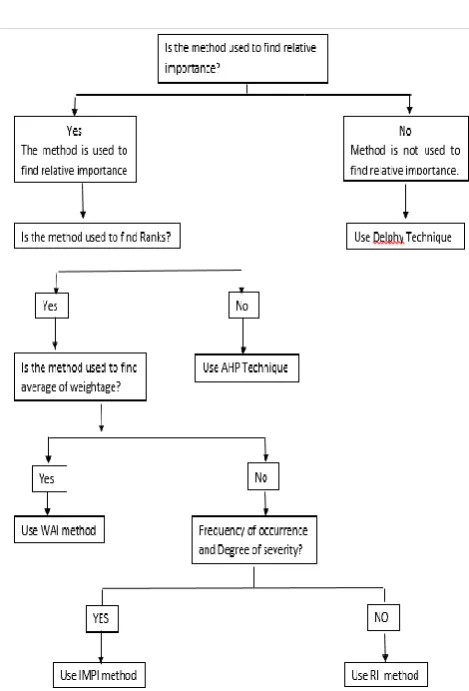
Fig. 1- Decision making tree which supports risk analysis
Hence, by using the above tool we can compare the two methods namely, Relative Importance Index and Importance Index Technique.
5.2 Relative Importance Index Technique (RII):
This technique is used to determine the relative importance of the various causes and effects of delays. The method is adopted in this study within various groups (i.e. project engineers, proprietor and site supervisor, designers, surveyors). The four-point scale ranged from 1 (very little degree affect) to 5 (very high degree affect) is adopted and transformed to relative importance indices (RII) for each factor as follows:
RII = ΣW / (A*N)
Where,
W = Weighting to each factor (from 1 to 4) A = Highest weight (i.e. 5 here)
N = Total number of respondents.
Higher the value of RII, more important was the reason of delays. [Tarun Patel, Hiren Rathod et.al 2016]
5.3 Importance Index Technique (IMPI):
In this technique, two factors are important based on which the importance index is to be identified and those factors are Frequency of occurrence and degree of severity. Frequency of occurrence and degree of severity were both divided on a four-point scale. Frequency of occurrence is classified as follows: always, often, sometimes and rarely (on 4 to 1 point scale). Similarly, degree of severity was classified as follows: extreme, great, moderate and little (on 4 to 1 point scale) [Tarun Patel, Hiren Rathod et.al 2016].
1) Frequency index: This formula is used to rank causes of delay based on frequency of occurrence as identified by the participants.
(F.I.) (%) = Σ a (n/N) * 100/4
Where,
a = Constant signifying weighting for each response (from 1 to 4 )
n = Frequency of the responses N = Total number of responses.
2) Severity index: This formula is used to rank causes of delay based on severity as indicated by the participants
.
S.I. (%) = Σ a (n/N) * 100/4
Where,
a = Constant signifying weighting for each response (from 1 to 4 )
n = Frequency of the responses N = Total number of responses.
3) Importance index: The importance index of each cause is calculated as follows:
IMPI (%) = [F.I. * S.I.] /100
6. RESULTS AND DISCUSSIONS:
The results are found on the basis of comparision of two methods for procurement risk analysis. With the help of the decision making tree the two methods namely RII and IMPI methods are selected to find out the procurement risk analysis in construction Industry.
Table I: Ranks of risks in procurement process using RII method
Sr.
No Risk Factor ∑W RII Rank
A
Communication between supplier and contractor
procurement process.
125 0.5 7
B
The deviation in the scope of the project in
procurement process. 123 0.492 9
C
The political or social factors influence the
procurement process. 107 0.428 12
D
Project funding influence the
procurement process. 147 0.588 5
E
Assess to the project site influence the
procurement process. 134 0.536 6
F
The technical capability of supplier in the
procurement process. 170 0.68 4
G
The Technical
capability of contractor
in procurement 214 0.856 1
H
The financial capability of contractor in the
procurement. 209 0.836 2
I
The involvement of contractor in
procurement process influences the procurement.
186 0.744 3
J Litigation process in
the procurement. 124 0.496 8
K Strike in market in the procurement process 113 0.452 11
L
Availability of material in the market in the
procurement process 88 0.352 15
M The transport facility to project site in the
procurement. 99 0.396 13
N The recession in the market in the
procurement process. 98 0.392 14 O The inflation in
material rate in the
procurement process. 114 0.456 10
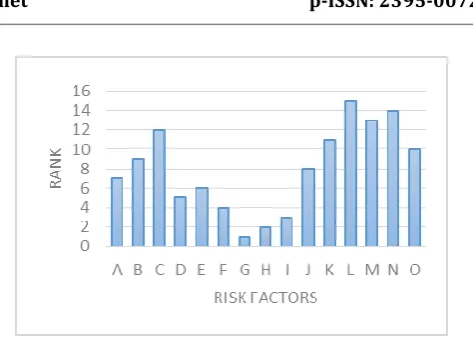
The following graph shows the risk values or ranks by using the above analysis of RII method:
Chart 1 Risk values using RII method
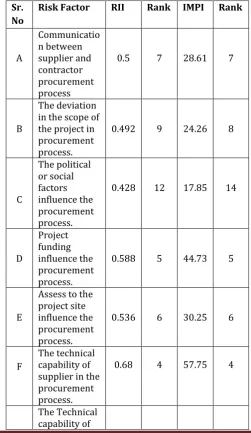
The following table shows findings of various ranks by using IMPI method:
Table II: Ranks of risks in procurement process using IMPI method
Sr.
No Risk Factor F.I. S.I. IMPI
(%) Rank
A
Communicatio n between supplier and contractor procurement process
54.5 52.5 28.61 7
B
The deviation in the scope of the project in procurement process.
49.5 49 24.26 8
C
The political or social factors influence the procurement process.
42.5 42 7.85 14
D
Project funding influence the procurement process.
63 71 44.73 5
E
Assess to the project site influence the procurement process.
55 55 30.25 6
F
The technical capability of supplier in the procurement
process. 75 77 57.75 4
The Technical
G contractor in procurement
H
The financial capability of contractor in the
procurement.
81.5 81.5 66.42 2
I
The
involvement of contractor in
procurement process influences the procurement.
78.5 76.5 60.05 3
J
Litigation process in the
procurement 40.5 45 18.23 13
K
Strike in market in the procurement
process 53 40 21.20 10
L
Availability of material in the market in the procurement process
43.5 43.5 18.92 12
M
The transport facility to project site in the
procurement.
47 43.5 20.45 11
N
The recession in the market in the procurement process.
45.5 49.5 22.52 9
O
The inflation in material rate in the procurement process.
42.5 40 17 15
Thus, the above table I shows the various ranks of risks in procurement process using IMPI method.
The following chart II shows the risk values or ranks by using the above analysis of IMPI method:
Chart II- Risk values using IMPI method
[image:5.595.306.558.356.790.2]The following table shows findings of various ranks by comparing RII and IMPI method:
Table III: Comparison of RII and IMPI method
Sr. No
Risk Factor RII Rank IMPI Rank
A
Communicatio n between supplier and contractor procurement process
0.5 7 28.61 7
B
The deviation in the scope of the project in procurement process.
0.492 9 24.26 8
C
The political or social factors influence the procurement process.
0.428 12 17.85 14
D
Project funding influence the procurement process.
0.588 5 44.73 5
E
Assess to the project site influence the procurement process.
0.536 6 30.25 6
F
The technical capability of supplier in the procurement process.
0.68 4 57.75 4
G contractor in
procurement 0.856 1 66.83 1
H
The financial capability of contractor in the
procurement
0.836 2 66.42 2
I The
involvement of contractor in
procurement process influences the procurement
0.744 3 60.05 3
J
Litigation process in the
procurement 0.496 8 18.23 13
K
Strike in market in the procurement process
0.452 11 21.20 10
L
Availability of material in the market in the
procurement process
0.352 15 18.92 12
M
The transport facility to project site in the
procurement
0.788 13 20.45 11
N
The recession in the market in the procurement process.
0.396 14 22.52 9
O
The inflation in material rate in the procurement process.
0.456 10 17 15
Thus, the above table III shows the comparison of various ranks of risks in procurement process using RII and IMPI method.
The following graph shows the risk values or ranks by using comparison of RII and IMPI method:
0 5 10 15 20
A B C D E F G H I J K L M N O
Comparison of RII & IMPI
RII IMPI
Chart-III Comparison of ranks of RII and IMPI method
7.
CONCLUSION:
The ranking by both the methods is not getting differ very much, so we can consider preference of risk by any of these method. So from the above analysis we can conclude that the major reasons behind the delays and risks in procurement are project funding for procurement, technical capability of contractor, technical capability of supplier, financial capability of supplier, involvement of contractor in actual procurement process. So, we have to take precautions to avoid these types of risks during procurement. So while doing any project the selection of contractor and supplier are the important factors. The proper selection of contractor and supplier may reduce the other risks like project funding, deviation in the scope of project, etc. So taking precautions of these risks will reduce the delays in project also.
8. ACKNOWLEDGEMENT:
We attribute the success of project stage one primarily to our guide Prof.Rahul Shinde for the efforts taken by him to guide throughout completion of project and for encouraging us through the tough as well as easier phase in an expert manner with full attention. We also acknowledge the support given by Prof. Rahul Shinde, Head of Civil Engineering Department and Dr.C.B.Bangal Principal of providing the necessary facilities and infrastructure for the seminar.
We would like to take this opportunity to express our gratitude to all those who have in various ways helped in successfully developing the seminar report from its initial stage to its completion stage.
9. REFERENCES:
1) Anup Wilfred, “a methodology to identify the delays and rank its causative factors in Indian construction industry”, International Research Journal of Engineering and Technology (IRJET), Volume: 02 Issue: 03 | June-2015.
2) Desai Megha, Rajiv Bhatt, “Critical Causes of Delay in Residential Construction Projects: Case Study of Central Gujarat Region of India “(Volume-4 Issue-4, Year of Publication: 2013
3) Hardik Lokhandwala et.al, “Ranking of the Causes of Delay for Private Sector Industrial Construction Projects in Indian Context”, Volume 2,Issue 5, May -2015
4) M. Marzouk and T. El-Rasas, ‘Analyzing delay causes in Egyptian construction projects’, Journal of Advanced Research, vol. 5, no. 1, pp. 49-55, 2014. 5) Meet Patel “ Factors affecting on contractor’s
bidding strategy in large scale residential construction” Volume 3,Issue 5,May -2016