http://dx.doi.org/10.4236/cc.2014.31003
How to cite this paper: Lerner, D.A., Balaceanu-Stolnici, C., Weinberg, J. and Patron, L. (2015) Computational Study of the Molecular Complexes between 5-HTP with ATP and DHEA. Potential New Drug Resulting from This Complexation. Compu-tational Chemistry, 3, 18-22. http://dx.doi.org/10.4236/cc.2014.31003
Computational Study of the Molecular
Complexes between 5-HTP with ATP and
DHEA. Potential New Drug Resulting
from This Complexation
Dan A. Lerner
1, Constantin Balaceanu-Stolnici
2, Josette Weinberg
3*, Luminita Patron
31Institut Charles Gerhardt Montpellier, Montpellier, France 2Ecological University of Bucharest, Bucharest, Romania 3Institute of Physical Chemistry, Bucharest, Romania
Email: *[email protected]
Received 20 December 2014; accepted 10 January 2015; published 16 January 2015
Copyright © 2015 by authors and Scientific Research Publishing Inc.
This work is licensed under the Creative Commons Attribution International License (CC BY).
http://creativecommons.org/licenses/by/4.0/
Abstract
Extending the potential interest in new drugs resulting from the association of biologically impor- tant molecules in stable complexes, the present study shows that this concept previously imple-mented in the case of two components could be a meaningful and promising one in the case of three components. The choice was made here to show that the quantum chemical modeling of a tripartite complex with DHEA (DEHYDRO-EPIANDROSTERONE) in a ternary association with 5-hydro- xytryptophan (5-HTP) and adenosine triphosphate acid (ATP) could have a sizable stability.
Keywords
5-HTP, ATP, DHEA, Density Functional Theory (DFT)
1. Introduction
In the previous decade, literature references have emphasized the fact that DHEA is the active form of a steroidal hormone, with very desirable physiological and beneficial health properties in animals and humans. Furthermore, the advances made in various areas of chemistry with the help of the supramolecular paradigm emphasize the importance of a theoretical analysis of intermolecular interactions in relevant associations of weakly bound bio- logically active molecules. The present paper targets such a goal by characterizing DHEA, generated in the
prarenal glands and in the brain, in a ternary association with 5-hydroxytryptophan (5-HTP) and adenosine tri- phosphate acid (ATP). 5-HTP is the precursor of the neurotransmitter serotonin (which became very popular for the following single reason: people felt better when they used it) while ATP is the major source of energy in the human organism. The existence of such a complex association could constitute a new and interesting drug. The concept of potential new drugs resulting from supramolecular associations was previously exposed by the au-thors in the case of two components drugs and is extended here [1]-[4]. Molecular parameters of DHEA 5-HTP and ATP and of their putative three-component complex, including its heat of formation, have been computed in an ab initio study involving DFT calculations. The aim of this study is to emphasize the possible existence of a complex between DHEA, 5-HTP and ATP that may have the properties of a new important drug.
2. Methods
The initial geometry input for 5-HTP, ATP and DHEA was obtained from a molecular mechanics calculation (MM+ force field) [5]. The resulting molecular geometries were optimized without any constraints. Next, ab in-itio calculations were carried out using the Gaussian 09 program [6]. The geometries of ATP, 5-HTP and DHEA, and of their complex were optimized at the 3-21G* level, starting from an INDO guess. A stationary point was found. At this stage, a refinement was carried out by a single point calculation at the B3LYP/6-31G* level [7]. The structure of the molecules under consideration is presented in Scheme 1.
3. Results and Discussion
3.1. Structure and Bonding in the Molecular Units and Their Intermolecular Complex
The formation of the ATP-5-HTP-DHEA complex is analyzed in terms of geometry, charge and energy parame-ters. The different nature of the overall molecular constitution of the three biomolecules, ATP, DHEA and 5-HTP which possess essentially a planar π-conjugated core, practically precludes a significant association of the π-π stacking type. The strongest association forces involve hydrogen bonds. There are of course several possible patterns for hydrogen bonding (O-H···O, O-H···N, involving the various heteroatom combinations). The su-pramolecular association presented here is the optimal one due to the supplementary stabilization resulting from the alignment of the dipoles on the molecular constituents (Table 1).
In this complex 5-HTP is not interacting directly with ATP as in a binary complex previously described. Ano- ther difference for the two complexes is the fact that the association energy of the tripartite complex is very high at this computational level compared to that of the binary complex. This is in favor of the possible existence of such a complex. For instance, the fact that DHEA is sandwiched between ATP and 5-HTP is interesting as DHEA is the most hydrophobic of the 3 components and it would be shielded from contact with water. Of course, this modeling corresponds to data obtained at 0 degree K in the vacuum and the presence of water as a
solvent would heavily perturb the structure. However, as ATP disodium salt for instance is not very water so-luble (50 mg∙L−1), and furthermore 5-HTP is only slightly soluble while DHEA is hardly soluble (63.5 mg∙L−1 at 25˚C), the tripartite association could resist its immersion in water or in a buffer.
In the body, absorption of 5-HTP occurs by an active transport process. 5-Hydroxytryptophan is decarbox-ylated to serotonin (5-hydroxytryptamine or 5-HT) by the enzymearomatic-L-amino-acid decarboxylase with the help of vitamin B6 [7]. This reaction occurs both in nervous tissue and in the liver [7]. The psychoac-tive action of 5-HTP is derived from its increase in production of serotonin in central nervous system tissue
[7].
The bonding associations O(47)···H(102) from DHEA-ATP and O(25)···H(67) from 5-HTP-DHEA reveal abond length in the expected range for the given type, 1.5284 Å and 2.84369 Å respectively. The geometry of the complexis further characterized by the O47···H102-N100 angle and O111···H74-C27 angle values (155.669˚ and 157.52˚ respectively). DFT results can be credited with a higher confidence in the quantitative respects be- cause of their partial treatment of correlation effects. On the other hand, it is acknowledged that the regular DFT functionals face intrinsic problems in the long-range regime [1].
It is seen inTable 2 that atom O111 from ATP acquires the largest negative charge in B3LYP calculations. A larger positive increase of the charge is noted for the hydrogen from the bridge hydrogen with DHEA, H67. The effect of such an association would then result in an activation of ATP and DHEA induced by that electronic dis- tribution change. The effect of such charge displacements in the complex would then result in some activation of ATP and DHEA, and in their activity. In which case, a new drug could be obtained.
3.2. Frontier Molecular Orbitals
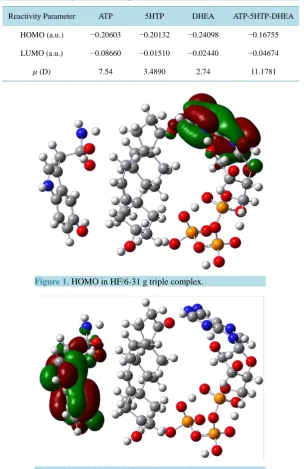
The frontier molecular orbitals (FMO) are the highest molecular orbitals (HOMO) and the lowest-lying unoccu- pied molecular orbitals (LUMO) [8]-[10]. The FMOs play an important role in modeling spectra and chemical reactions [10]. Here the HOMO is localized on the adenine part of the adenosine molecule belonging to ATP and on the carbonyl oxygen of DHEA whereas the LUMO is delocalized on almost the whole 5-HTP molecule (Ta- ble 3 and Figure 1,Figure 2).
– 0.12081 3.286eV
HOMO LUMO au
E E = − = −
Since the HOMO-LUMO energy separation of the complex may be considered a simple indicator of kinetic stability it can be said that the supramolecular complex which has: EHOMO− ELUMO = 3.286 eV, appears to pos-sess a low kinetic stability and a high chemical reactivity [11]. The dipole moment value is appearing as a result of the formation of the complex (Table 3).
[image:3.595.87.536.522.558.2]In this complex 5-HTP is not interacting directly with ATP as in a binary complex previously described. Ano- ther difference for the two complexes is the fact that the association energy of the tripartite complex is very
Table 1. Stabilization energy of the molecules and of the complex at the B3LYP/6-31G* level.
Results ATP 5HTP DHEA ATP-5HTP-DHEA ΔEassoc = EABC − EA − EB − EC (a.u.)
Total Energy (a.u.) −2665.5171 −761.3439 −891.282 −4320.6621 −2.5191
Table 2. Total atomic charge on selected atoms in the molecular components and in the association complex, from a DFT Mulliken population (B3LYP) analysis.
Atom Frag
ATP Complex Var.
∆Q Atom DHEA Frag. Complex Var.
∆Q Atom 5HTP Frag Complex Var.
∆Q
H102 0.351 0.407 0.056 O47 −0.421 −0.516 −0.095 O25 −0.560 −0.335 −0.225
O111 −0.375 −0.703 −0.328 H74 0.147 0.166 +0.019 O22 −0.635 −0.659 −0.024
H63 0.132 0.186 +0.054
H67 0.113 0.208 +0.095
[image:3.595.88.540.596.716.2]Table 3. Reactivity parameters computed at the B3LYP/6-31G* level.
Reactivity Parameter ATP 5HTP DHEA ATP-5HTP-DHEA
HOMO (a.u.) −0.20603 −0.20132 −0.24098 −0.16755
LUMO (a.u.) −0.08660 −0.01510 −0.02440 −0.04674
µ (D) 7.54 3.4890 2.74 11.1781
Figure 1. HOMO in HF/6-31 g triple complex.
Figure 2. LUMO in HF/6-31 g triple complex.
high at this computational level compared to that of the binary complex. This is in favor of the possible exis- tence of such a complex. Of course, this modeling corresponds to data obtained at 0 degree K and the presence of water as a solvent would heavily perturb the structure.
4. Conclusions
• From these B3LYP calculations, an association complex involving ATP, 5-HTP and DHEA, would have a large stabilization energy.
References
[1] Lerner, D.A., Weinberg, J. and Balaceanu-Stolnici, C. (2002) Ab Initio and Semiempirical Molecular Orbital Calcula- tions on DHEA I. The Electronic Structure. Revue Roumaine de Chimie, 47, 893-899.
[2] Lerner, D.A., Weinberg, J., Cimpoesu, F. and Balaceanu-Stolnici, C. (2006) Theoretical Study of DHEA: Comparative HF and DFT Calculations of the Electronic Properties of a Complex between DHEA and Serotonin. Journal of Mole-cular Modeling, 12, 146-151. http://dx.doi.org/10.1007/s00894-005-0007-9
[3] Weinberg, J., Cimpoesu, F. and Lerner, D.A. (2009) The Association of Dehydro-Epiandrosterone and Adenosine Tri-phosphate Acid: A DFT Study of Interactions between Prototypic Biologically Active Molecules. Journal of Molecular Structure THEOCHEM, 912, 32-37. http://dx.doi.org/10.1016/j.theochem.2009.04.040
[4] Weinberg, J. and Lerner, D.A. (2013) Theoretical Study of 5-HTP. Potential New Drug Resulting from the Complexa-tion of 5-HTP with ATP. Journal of Computational Chemistry, 1, 1-4. http://dx.doi.org/10.4236/cc.2013.11001 [5] Allinger, N.L. (1977) Conformational Analysis. 130. MM2. A Hydrocarbon Force Field Utilizing V1 and V2 Torsional
Terms. Journal of the American Chemical Society, 99, 8127-8134. http://dx.doi.org/10.1021/ja00467a001
[6] Frisch, M.J., Trucks, G.W., Schlegel, H.B., Scuseria, G.E., Robb, M.A., Cheeseman, J.R., Scalmani, G., Barone, V., Mennucci, B., Petersson, G.A., Nakatsuji, H., Caricato, M., Li, X., Hratchian, H.P., Izmaylov, A.F., Bloino, J., Zheng, G., Sonnenberg, J.L., Hada, M., Ehara, M., Toyota, K., Fukuda, R., Hasegawa, J., Ishida, M., Nakajima, T., Honda, Y., Kitao, O., Nakai, H., Vreven, T., Montgomery Jr., J.A., Peralta, J.E., Ogliaro, F., Bearpark, M., Heyd, J.J., Brothers, E., Kudin, K.N., Staroverov, V.N., Kobayashi, R., Normand, J., Raghavachari, K., Rendell, A., Burant, J.C., Iyengar, S.S., Tomasi, J., Cossi, M., Rega, N., Millam, J.M., Klene, M., Knox, J.E., Cross, J.B., Bakken, V., Adamo, C., Jaramillo, J., Gomperts, R., Stratmann, R.E., Yazyev, O., Austin, A.J., Cammi, R., Pomelli, C., Ochterski, J.W., Martin, R.L., Mo-rokuma, K., Zakrzewski, V.G., Voth, G.A., Salvador, P., Dannenberg, J.J., Dapprich, S., Daniels, A.D., Farkas, O., Foresman, J.B., Ortiz, J.V., Cioslowski, J. and Fox, D.J. (2009) Gaussian 09, Revision A.1. Gaussian, Inc., Walling- ford.
[7] (a) Cramer, C.J. (2002) Essentials of Computational Chemistry. Theories and Models. Wiley, New York.
(b) Rahman, M.K., Nagatsu, T., Sakurai, T., Hori, S., Abe, M. and Matsuda, M. (1982) Effect of Pyrizdoxal Phosphate Deficiency on Aromatic L-Amino Acid Decarboxylase Activity with L-DOPA and L-5-Hydroxytryptophan as Sub-strates in Rats. The Japanese Journal of Pharmcology, 32, 803-811. http://dx.doi.org/10.1254/jjp.32.803
(c) Bouchard, S., Bousquet, C. and Roberge, A.G. (1981) Characteristics of Dihydroxyphenylalanine/5-Hydroxytryptophan Decarboxylase Activity in Brain and Liver of Cat. Journal of Neurochemistry, 37, 781-787.
(d) 5-HTP: Uses, Side Effects, Interactions and Warnings—WebMD. Archived from the Original on 16 November 2009.
[8] Fukui, K., Yonezawa, T. and Nagata, C. (1954) An Investigation into the Reactivity of Isotetralin. Bulletin of the Che- mical Society of Japan, 27, 423. http://dx.doi.org/10.1246/bcsj.27.423
[9] Fukui, K., Yonezawa, T. and Nagata, C. (1957) Interrelations of Quantum-Mechanical Quantities Concerning Chemical Reactivity of Conjugated Molecules. The Journal of Chemical Physics, 26, 831.
http://dx.doi.org/10.1063/1.1743416
[10] Fleming, I. (1976) Frontier Orbitals and Organic Chemical Reactions. Wiley, London.