How to cite this paper: de Paiva Cunha, Â.C.P., de Lima, K.C., Maranhão, O.B.V., de Oliveira Macedo, A.G., da Cunha, A.F. and Miguel, J.A.M. (2014) Quality of Life after Orthodontic Therapy from the Perspective of CS-OIDP. Open Access Library Journal, 1: e1150. http://dx.doi.org/10.4236/oalib.1101150
Quality of Life after Orthodontic Therapy
from the Perspective of CS-OIDP
Ângela Cristina Pinto de Paiva Cunha
1, Kenio Costa de Lima
1,
Olga Benário Vieira Maranhão
1, Ana Gláucia de Oliveira Macedo
2,
Anderson Farias da Cunha
2, José Augusto Mendes Miguel
31Department of Dentistry, Federal University of Rio Grande do Norte, Natal, Brazil
2Rehabilitation Hospital of Craniofacial Anomalies of São Paulo University (HRAC-USP), Bauru, Brazil 3State University of Rio de Janeiro, Rio de Janeiro, Brazil
Email: [email protected], [email protected], [email protected],
Received 20 October 2014; revised 25 November 2014; accepted 16 December 2014
Copyright © 2014 by authors and OALib.
This work is licensed under the Creative Commons Attribution International License (CC BY).
http://creativecommons.org/licenses/by/4.0/
Abstract
Objective: The aim of this study was to assess the impact of occlusal problems on quality of life in 288 patients who had undergone fixed orthodontic therapy, as well as to investigate the factors associated with this impact. Material and Methods: The orthodontic treatment needed by the IOTN index and the adequacy of treatment through the PAR index were evaluated in models. The impact on quality of life was assessed using the CS-OIDP index. For data analysis, we used the Mann- Whitney and Kruskal-Wallis test for a confidence level of 95%. Results: The impact of malocclu- sion on quality of life was low, being present in 29.2% of cases. Performances of smiling, emo- tional state, and cleanliness of the mouth were the most affected. Factors related to the impact were the kind of service of the treatment performed, the need for orthodontic treatment, type of problem that motivated the treatment, and current age at the end of treatment. Conclusions: De- spite the low impact, it was strengthened the hypothesis that patients undergoing orthodontic therapy had an improved quality of life.
Keywords
Quality of Life, Malocclusion, PAR, IOTN, CS-OIDP
Subject Areas: Dentistry, Epidemiology
1. Introduction
OALibJ | DOI:10.4236/oalib.1101150 2 December 2014 | Volume 1 | e1150
treatment, as well as causing social impact by interfering in the quality of life of individuals. The dentofacial disharmony may negatively influence people’s lives in relation to psychosocial factors [1]. The demand for di- rect orthodontic treatment is high, strengthening the hypothesis that these problems have significant social im- pact in a general context [2]. The main reason for the demand of orthodontic treatment has been the improve- ment in the dentofacial appearance, more than the need for proper correction [3].
More recently, the incorporation of subjective measures to assess the impact of occlusal problems in people’s lives has been observed, thus the need perceived by individuals [4]. This new approach by Chaves (1986) meets the above, which refers to the search for a criteria of related treatment needed from the point of view of the ad- justment of the individual in society [5].
The literature theoretically suggests that orthodontic treatment promotes many psychosocial benefits [5]-[8]. However, the assessment of changes of pre or post orthodontic and/or orthosurgical treatment is based on tradi- tional clinical measures, but it is the perception of the individual which is the central link of any need and satis- faction of treatment [9] [10].
In recent decades, several instruments for the assessment of quality of life related to oral health life were de- veloped. The oral impact on daily performance (OIDP) is a type of specific OHRQoL measure of the group (Oral Health-Related Quality of Life), which seeks to relate these oral problems to quality of life [10]-[12]. When used to evaluate an oral health problem, it can be referred to as a specific condition of oral impact on daily performance (CS-OIDP) modified by Locker in 1988 for its use in Odontology [10]. Another positive fac-tor of the CS-OIDP is that it also assesses the intensity and/or extent of the impact [13] [14].
Based on this, the study aimed to assess the impact of occlusal problems on quality of life in adults who have undergone fixed orthodontic therapy, as well as to investigate the factors associated with this impact, taking into consideration reports of a negative impact on quality of life of individuals.
2. Materials and Methods
This study is characterized as an exploratory, observational, and cross-sectional study which evaluated 288 adults undergoing fixed orthodontic therapy, aged between 18 - 70 years, and treated both in public and private facilities in Natal, RN, Brazil. The study population was selected from graduate courses offered by the Academy of Dentistry of Rio Grande do Norte and the Brazilian Dental Association of Rio Grande do Norte—ABO/RN, and private offices that make up the cases were treated in private hospitals. The present study was approved by the Ethics Committee (CEP) of the Federal University of Rio Grande do Norte (Brazil).
Prior to analysis of study models, a calibration of the examiners was held in order to ensure uniformity of in- terpretation, understanding, and application of the occlusal index: IOTN (Index of Treatment Need) which is used to classify the severity of orthodontic treated cases, and PAR (Peer Assessment Rating) used to balance the level of orthodontic treated cases in different institutions of the study. For this purpose, the first step consisted of the study of criteria for data collection from study models, through discussion of articles and explanation of each occlusal index. The second phase consisted of a pilot study whose objective was to provide examiners with the establishment of criteria for analysis and measurement of occlusal indices; which was made using 30 selected models with several cases of malocclusion.
After this phase, there was an inter-calibration. This calibration was also performed in this pilot study assess- ing 30 study models. Thus, an acceptable standard of kappa value equal to or greater than 0.80 was considered in each of the indices evaluated. Therefore, the lowest kappa value obtained in this step was greater than 0.86 for all variables studied.
The independent variables were divided into two groups: socio-economic demographic variables (type of ser- vice, age, gender, current age, and age at end of treatment) and the independent orthodontic variables (satisfac- tory use of retainer, time of use of retainer, undergoing speech therapy, main problems reported, IOTN-DHC, IOTN-AC, initial PAR, final PAR, difference between initial and final PAR). IOTN-DHC was used as a com- ponent of dental health, whereas the IOTN-AC was used as an aestetic component.
The initial categorization of the need for orthodontic treatment was obtained through the IOTN (Index of Treatment Need) index and quality of 20 cases treated in private and public networks were investigated with the PAR index, through the improvement rate of post-orthodontic therapy [15].
OALibJ | DOI:10.4236/oalib.1101150 3 December 2014 | Volume 1 | e1150
formance and analysed if the correction of maloclusion has impacted or not in the quality of life of the patients. This impact was collected through the analysis of eight daily performances, these being: eating, speaking, clean- ing the mouth, relaxing, smiling, studying, emotional status, and social contact. Performances as frequency and severity of the impact range was not considered in this study. If no impact was reported, the score of zero was assigned. The impact score for each of the eight performances was estimated by multiplying the score of the corresponding frequency and their respective severity. The total score for the OIDP attributed to malocclusion was the sum of the scores of the eight performances (in a range from 0 to 72), multiplied by 100 and divided by 72.
Initially, a descriptive analysis of all variables was performed at the expense of measures of absolute and rela- tive frequency and statistical indices that summarize the data. For data analysis, aiming to relate factors associ- ated with the CS-OIDP, we used the Mann-Whitney and Kruskal-Wallis test for a confidence level of 95%.
3. Results
The characterization results of the sample is according to theTable 1.
The impact of malocclusion on quality of life was low with an average of 2.56 and a standard deviation of 6.55, but was still present in 29.2% of patients, despite orthodontic treatment being performed. In this study, any higher minimum impact than zero was considered. The performances of smiling, emotional state, and cleanly- ness of the mouth (10.4%, 10.4% and 10.1%, respectively) were the most affected (Figure 1).
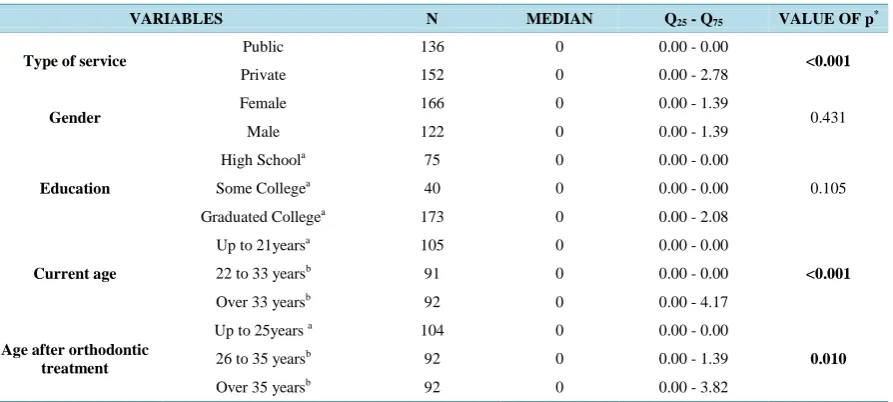
Making an association between the type of service and the CS-OIDP index, patients in the private health sec-tor reported more impact than undergoing treatment in public services. Another aspect observed in this study was that the older the patient was, the more likely the individual revealed an impact on quality of life, as indi- viduals under age 21 years, both in the current age and the age after completion of orthodontic therapy had smaller values of CS-OIDP (Table 2).
Independent variables related to orthodontic therapy, as the main problems that caused the patient to seek or- thodontic therapy, conducting additional speech therapy, whether or not retainer used satisfactorily according to
Table 1. Descriptive analysis of the independent variables.
VARIABLES N %
Services Public 136 47.2
Private 152 52.8
Gender Female 166 57.6
Male 122 42.4
Level of Education
Average 75 26.0
College Not Completed 40 13.9
Graduated College 173 60.1
Main Problems
Bad tooth positioning 152 52.8
Space between teeth 93 32.3
Deformity of the mouth and face 22 7.6
Others 21 7.3
Speech Therapy Yes 89 30.9
No 199 69.1
Satisfactory Use of Retainer
Yes 256 88.9
No 32 11.1
VARIABLES MEAN STANDARDDEVIATION
Current Age 31.50 10.41
Final Age Post-Treatment 28.83 10.94
OALibJ | DOI:10.4236/oalib.1101150 4 December 2014 | Volume 1 | e1150 Figure 1.Variables that most impacted after orthodontic treatment.
Table 2. Mid table Q25 - Q75 CS-OIDP regarding socio-economic demographic independent variables.
VARIABLES N MEDIAN Q25 - Q75 VALUE OF p*
Type of service Public 136 0 0.00 - 0.00 <0.001
Private 152 0 0.00 - 2.78
Gender Female 166 0 0.00 - 1.39 0.431
Male 122 0 0.00 - 1.39
Education
High Schoola 75 0 0.00 - 0.00
0.105
Some Collegea 40 0 0.00 - 0.00
Graduated Collegea 173 0 0.00 - 2.08
Current age
Up to 21yearsa 105 0 0.00 - 0.00
<0.001
22 to 33 yearsb 91 0 0.00 - 0.00
Over 33 yearsb 92 0 0.00 - 4.17
Age after orthodontic treatment
Up to 25years a 104 0 0.00 - 0.00
0.010
26 to 35 yearsb 92 0 0.00 - 1.39
Over 35 yearsb 92 0 0.00 - 3.82
*
p value overall, a, b: post-tests with Mann-Whitney and Bonferroni correction.
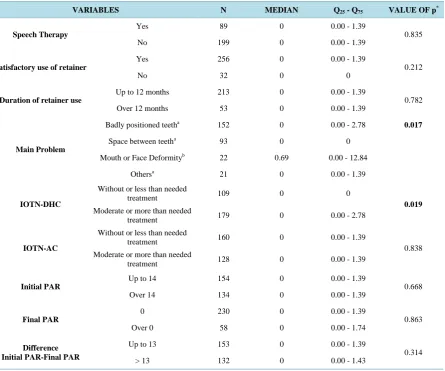
self-patient assessment and time of use of this retainer not significantly associated with oral impacts on daily performances. Regarding the need for early orthodontic treatment, there was only a significant association with IOTN-DHC, thus not having IOTN-AC (Table 3).
Therefore, the factors related to the impact were the kind of service in which the treatment was performed, the need for orthodontic treatment, the type of problem that motivated treatment, and current age and age at the end of treatment.
4. Discussion
[image:4.595.94.541.319.520.2]OALibJ | DOI:10.4236/oalib.1101150 5 December 2014 | Volume 1 | e1150 Table 3. Table median Q25 - Q75 CS-OIDP in relation to orthodontic independent variables.
VARIABLES N MEDIAN Q25 - Q75 VALUE OF p*
Speech Therapy
Yes 89 0 0.00 - 1.39
0.835
No 199 0 0.00 - 1.39
Satisfactory use of retainer
Yes 256 0 0.00 - 1.39
0.212
No 32 0 0
Duration of retainer use
Up to 12 months 213 0 0.00 - 1.39
0.782
Over 12 months 53 0 0.00 - 1.39
Main Problem
Badly positioned teetha 152 0 0.00 - 2.78 0.017
Space between teetha 93 0 0
Mouth or Face Deformityb 22 0.69 0.00 - 12.84
Othersa 21 0 0.00 - 1.39
IOTN-DHC
Without or less than needed
treatment 109 0 0
0.019
Moderate or more than needed
treatment 179 0 0.00 - 2.78
IOTN-AC
Without or less than needed
treatment 160 0 0.00 - 1.39
0.838 Moderate or more than needed
treatment 128 0 0.00 - 1.39
Initial PAR
Up to 14 154 0 0.00 - 1.39
0.668
Over 14 134 0 0.00 - 1.39
Final PAR
0 230 0 0.00 - 1.39
0.863
Over 0 58 0 0.00 - 1.74
Difference Initial PAR-Final PAR
Up to 13 153 0 0.00 - 1.39
0.314
> 13 132 0 0.00 - 1.43
*
p value overall, a, b: post-tests with Mann-Whitney and Bonferroni correction.
According to Sheiham (2000), the use of socio-dental indicators, offers important advantages for the planning and provision of dental services, and the main thing is the shift in emphasis from purely biological aspects to psychological and social aspects [19].
Thus, taking into account that untreated malocclusion reflects this physical, psychological, and social impact on daily life, patients who possessed moderate or high need for orthodontic treatment at the beginning of ortho- dontic therapy (p = 0.019), observed through the IOTN-DHC, also showed to have the greater impact on qual- ity of life than those with little need for treatment. This corroborates studies which found that those patients who rated themselves as aesthetically bad were far more likely to have a negative effect on quality of life than those who were satisfied with their aesthetics [20] [21]. These same findings were also reported by studies evaluating the association of severe need for orthodontic treatment through the IOTN, with quality of life [21]-[24].
In evaluating current research, the impact of socio-dental malocclusions in children or adolescents, only some evaluate the prevalence of this impact [22] [24]. In the present study, the sample consisted of individuals aged 18 - 70 years who underwent corrective orthodontic therapy in public and private services. The post-orthodontic therapy impact was low, averaging 2.56, assuming that the score of zero indicates no impact, but still present in 29.2% of patients. The prevalence of this impact, in the study by Soares and Lima (2011) was the highest, 55.3%, and also when compared to other studies, Barnábe et al., 2007; Gherunpong et al., 2006; Marques et al., 2005; Peres et al., 2009, who found a lower prevalence, 21.2% 24.6%, 20.3% and 27%, and 36.4%, respectively
OALibJ | DOI:10.4236/oalib.1101150 6 December 2014 | Volume 1 | e1150
low but this post-orthodontic treatment can be justified because it was punctuated by adults older than 33 years (p < 0.001), and especially those submitted to private therapy (p < 0.001), assuming that this group are more critical of their appearance in relation to adolescents or patients treated in public services and therefore stressed greater impact on quality of life even without severe occlusal alteration present. Shafiulla et al. (2009) empha-sized that from the stage of adolescence, the concern with dental appearance increased [30].
There were no significant differences between genders nor with regard to degree of education among them, and also there was no significant influence between them or the results found by CS-OIDP. Therefore, not with-standing the current study, there has been a gender balance and in some studies it was observed that females re-port having a greater impact of their malocclusion on quality of life, which affirms to women being much more critical of their self-image and its impact on aesthetics [22] [23] [31] [32].
When individually evaluating the performance that affects the quality of life, Smiling (10.4%) and emotional state (10.4%) were the highest scores, but little difference with clean mouth (10.1%), reinforcing the idea of the association of the impact factor on aesthetics and corroborating studies have also reported the smile as the per-formance that is the most bothersome [32] [33].
Regarding orthodontic independent variables, it was observed that individuals who scored the bad tooth posi-tion as the main factor that led to the search for orthodontic therapy, but the factor that showed a significant comparison was deformity of the mouth and face (p = 0.017), which also indicates the greater importance of aesthetic factor.
Findings in this regard are supported by the study of Bernabé et al. (2007), which found that changes with emphasis on the anterior segment had a major negative impact on quality of life [26]. Based on this hypothesis, several studies have reported that dentofacial aesthetics play an important role in both social interaction as well as the psychosocial well-being, where the dental appearance has greater importance than when it is a measured aspect of the functional amendment itself [21] [28] [31]. Because of these findings, and the report of Shaffiula et al. (2009), it is justified to argue that the quest for orthodontic treatment is influenced primarily by the desire to look attractive in search of improved self-esteem [30].
Given these analyzes, it is valuable to realize that dental aesthetics has great influence on the demand for dental services, as the cosmetic change interferes with both social and psychological aspects, especially in the age range studied, where the adult is inserted in the social environment in a more active way.
Following this context that involves adults, we sought to further evaluate the quality of the treated cases (PAR), and whether or not the speech therapy, as well as the proper use of a retainer after orthodontic treatment would influence the results, but no significant relationship was found in this study.
Therefore, it is necessary that further studies are conducted, especially on adults, so that they can increasingly scientifically support the impact of malocclusion on quality of life of adults. Regardless of the social class to which the individual belongs, they also have the right to improve their oral health, to improve their self-esteem, and their psychosocial aspect, which also justifies the expansion of dental care, promoting improvement of oral health of the entire population of an egalitarian and universal society.
5. Conclusion
It was observed that for the patient to not experience any impact on quality of life, there would have to be no complaints present in the 9 evaluated performances, according to the analysis of the CS-OIDP, and the low im-pact presented strengthens the hypothesis that patients undergoing orthodontic therapy have an improved quality of life.
References
[1] Andrade, E.O., Gouveia, V.V., D’Ávila, R.L., et al. (2012) Index of Health Development: Conceptualization and Ref-lections on Its Need. Revista da Associação Médica Brasileira, 4, 413-421.
http://dx.doi.org/10.1016/S0104-4230(12)70222-1
[2] Proffit, W.R., Fields, H.W. and Moray, L.J. (1998) Prevalence of Malocclusion and Orthodontic Treatment Need in the United States: Estimates from the NHANES III Survey. International Journal of Adult Orthodontics and Orthognathic Surgery, 2, 97-106.
[3] British Dental Association. Memorandum on Orthodontic Services (1954) British Dental Association.
OALibJ | DOI:10.4236/oalib.1101150 7 December 2014 | Volume 1 | e1150
(OHQoL) among Adolescents Seeking Orthodontic Treatment. Journal of Contemporary Dental Practice, 3, 294-298.
http://dx.doi.org/10.5005/jp-journals-10024-1140
[5] Albino, J., Cunat, J.J., Fox, R.N., Lewis, E.A., Slakter, M.J. and Tedesco, L.A. (1981) Variables Discriminating Indi-viduals Who Seek Orthodontic Treatment. Journal of Dental Research, 9, 1661-1667.
http://dx.doi.org/10.1177/00220345810600090501
[6] Birkeland, K., Boe, O. and Wisth, P. (1996) Orthodontic Concern among 11-Year-Old Children and Their Parents Compared with Orthodontic Treatment Need Assessed by IOTN. American Journal of Orthodontics and Dentofacial Orthopedics, 2, 197-205. http://dx.doi.org/10.1016/S0889-5406(96)70109-9
[7] Kyiak, H.A. and Reichmuth, M. (2002) Body Image Issues in Dental Medicine. In: Cash, T.F. and Pruzinsky, T., Eds., Body Image: A Handbook of Theory, Research and Clinical Practice, Guilford Publications, New York, 342-350. [8] Klages, U., Bruckner, A. and Zentner, A. (2004) Dental Aesthetics, Self-Awareness, and Oral Health-Related Quality
of Life in Young Adults. European Journal of Orthodontics, 26, 507-514. http://dx.doi.org/10.1093/ejo/26.5.507
[9] Oliveira, C.M. and Sheiham, A. (2004) Orthodontic Treatment and Its Impact in Oral Health-Related Quality of Life in Brazilian Adolescents. Journal of Orthodontics, 31, 20-27. http://dx.doi.org/10.1179/146531204225011364
[10] Bowling, A. (2005) Measuring Health: A Review of Quality of Life Measurement Scales. 3rd Edition, Open University Press, England.
[11] Locker, D. (1988) Measuring Oral Health: A Conceptual Framework. Community Dental Health, 5, 3-18. [12] Locker, D. (2004) Oral Health and Quality of Life. Oral Health & Preventive Dentistry, 2, 247-253.
[13] Daniels, C. and Richmond, S. (2000) The Development of the Index of Complexity, Outcome and Need (ICON). Brit-ish Journal of Orthodontics, 27, 149-162. http://dx.doi.org/10.1093/ortho/27.2.149
[14] DeGuzman, L., Bahiraei, D., Vig, K.W., Weyant, R.J. and O’Brien, K. (1995) The Validation of the Peer Assessment Rating Index for Malocclusion Severity and Treatment Difficulty. American Journal of Orthodontics and Dentofacial Orthopedics, 107, 172-176. http://dx.doi.org/10.1016/S0889-5406(95)70133-8
[15] Richmond, S., Shaw, W.C., Roberts, C.T. and Andrews, M. (1992) The PAR Index (Peer Assessment Rating): Me-thods to Determine Outcome of Orthodontic Treatment in Terms of Improvement and Standards. The European Jour-nal of Orthodontics, 14, 180-187. http://dx.doi.org/10.1093/ejo/14.3.180
[16] Liu, Z., Mcgrath, C. and Hägg, U. (2009) The Impact of Malocclusion/Orthodontic Treatment Need on the Quality of Life: A Systematic Review. Angle Orthodontist, 79, 585-591.
[17] De Paula Júnior, D.F., Santos, N.C., Da Silva, E.T., Nunes, M.F. and Leles, C.R. (2009) Psychosocial Impact of Dental Esthetics on Quality of Life in Adolescents. Angle Orthodontist, 79, 1188-1193.
http://dx.doi.org/10.2319/082608-452R.1
[18] Feu, D., Oliveira, B.H., Sales, H.X. and Miguel, J.A.M. (2010) Oral Health-Related Quality of Life and Orthodontic Treatment Seeking. American Journal of Orthodontics and Dentofacial Orthopedics, 138, 152-159.
http://dx.doi.org/10.1016/j.ajodo.2008.09.033
[19] Sheiham, A. (2000) A determinação da necessidade de tratamento odontológico: Uma abordagem social. In: Pinto, V.G., Ed., Saúde bucal coletiva, Santos.
[20] Feu, D., Oliveira, B.H., Sales, H.X. and Miguel, J.A.M. (2008) Más-Oclusões e seu impacto na qualidade de vida de adolescentes que buscam tratamento ortodôntico. Ortodontia SPO, 41, 355-365.
[21] Feu, D., Oliveira, B.H., Sales, H.X. and Miguel, J.A.M. (2010) Oral Health-Quality of Life and Orthodontic Treatment Seeking. American Journal of Orthodontics and Dentofacial Orthopedics, 138, 152-159.
http://dx.doi.org/10.1016/j.ajodo.2008.09.033
[22] Bernabé, E., Tsakos, G., Oliveira, C.M. and Sheiham, A. (2008) Impacts on Daily Performances Attributed to Maloc-clusions Using the Condition-Specific Feature of the Oral Impacts on Daily Performances Index. Angle Orthodontist,
78, 241-247. http://dx.doi.org/10.2319/030307-111.1
[23] Bernabé, E., Krisdapong, S., Sheiham, A. and Tsakos, G. (2009) Comparison of the Discriminative Ability of the Ge-neric and Condition-Specific Forms on the Child-OIDP Index: A Study on Children with Different Types of Normative Dental Treatment Needs. Community Dentistry and Oral Epidemiology, 37, 155-162.
http://dx.doi.org/10.1111/j.1600-0528.2008.00456.x
[24] Haag, U., Zhang, M. and McGrath, C. (2007) Who Knows More about the Impact of Malocclusion on Children’s Quality of Life, Mothers or Fathers? The European Journal of Orthodontics, 29, 180-185.
http://dx.doi.org/10.1093/ejo/cjl058
OALibJ | DOI:10.4236/oalib.1101150 8 December 2014 | Volume 1 | e1150
Anterior Occlusal Traits in Brazilian Adolescents. European Journal of Oral Sciences, 115, 473-478.
http://dx.doi.org/10.1111/j.1600-0722.2007.00486.x
[27] Gherunpong, S., Tsakos, G. and Sheiham, A. (2006) A Socio-Dental Approach to Assessing Children’s Orthodontic Need. The European Journal of Orthodontics, 28, 393-399. http://dx.doi.org/10.1093/ejo/cji114
[28] Marques, L.S., Barbosa, C.C., Ramos-Jorge, M.L. and Paiva, S.M. (2005) Prevalência da maloclusão e necessidade de tratamento ortodôntico em escolares de 10 a 14 anos de idade em Belo Horizonte, Minas Gerais, Brasil: Enfoque Psicossocial. Cadernos de Saúde Pública, 21, 1099-1106. http://dx.doi.org/10.1590/S0102-311X2005000400012
[29] Peres, K.G., Peres, M.A., Araujo, C.L., Menezes, A.M. and Hallal, P.C. (2009) Social and Dental Status along the Life Course and Oral Health Impacts in Adolescents: A Population Based-Birth Cohort. Health and Quality of Life Out-comes, 7, 95. http://dx.doi.org/10.1186/1477-7525-7-95
[30] Shafiulla, M.D., Chandu, G.N. and Shivakumar, K.M. (2009) Prevalence of Malocclusion and Orthodontic Treatment Needs among Middle and High School Children of Davangere City, India by Using Dental Aesthetic Index. Journal of Indian Society of Pedodontics and Preventive Dentistry, 27, 211-218. http://dx.doi.org/10.4103/0970-4388.57655
[31] Leles, C.R., Paula Júnior, D.F., Santos, N.C.M., Silva, E.T. and Nunes, M.F. (2009) Psychosocial Impact of Dental Esthetics on Quality of Life in Adolescents. The Angle Orthodontist, 79, 1188-1193.
http://dx.doi.org/10.2319/082608-452R.1
[32] Rusanen, J., Lahti, S., Tolvanen, M. and Pirttiniemi, P. (2010) Quality of Life in Patients Severe Malocclusion before Treatment. The European Journal of Orthodontics, 32, 43-48. http://dx.doi.org/10.1093/ejo/cjp065