The Obstacles of using Computerized Interactive
Learning in the Teaching of Mathematics from the
Teachers' Perspective at UNRWA Schools in Gaza Strip
Governorates
Abed El-Kareem M. Farajallah,
PhD, Assistant professor of curriculum and math, Al Aqsa University-Gaza
Palestine, Gaza Strip, Nussirat Al Aqsa University-Gaza
Salem E. Al arjani, MPH
BA, MPH, MOH, PNA Palestine, Gaza Strip, Rafah Al Quds Open University –Middle area
ABSTRACT
The study aimed to identifying the obstacles of using the computerized interactive learning in teaching mathematics from the teachers' perspective at UNRWA schools in Gaza Strip governorates. The study sample consisted of (50) teachers who taught mathematics using the Computerized Interactive Learning for the first and second grades at UNRWA schools, and their selection was according to stratified random sample. The study adopted the analytical – descriptive approach, where, the researchers used a verified version of obstacles questionnaire (46 item) containing four dimensions (obstacles related to administration; obstacles related to infrastructure and equipment; obstacles related to teachers; and obstacles related to students). The study results revealed that the obstacles related to infrastructure and equipment came in the first arrangement with ratio scale (78.53%); followed by obstacles related to administration with ratio scale (78.49%); then obstacles related to the teachers themselves with ratio scale (74.35%); and finally by obstacles related to the students with ratio scale (73.83%). However, there were no statistical differences between the average degree of "the obstacles of using the computerized interactive learning in mathematics teaching from the perspective of the teachers of mathematics at UNRWA school related to gender. But, the study found there were statistical differences between the average degree of "the obstacles of using the computerized interactive learning in mathematics teaching from the perspective of the teachers of mathematics at UNRWA school related to training courses in favor of who take the training course.
General Terms
Computer, Mathematics
Keywords
Computerized interactive learning, mathematics
1.
INTRODUCTION
The Basic phases of the school considered one of the most important phases of education in human life, as it is the core of the growing capacity of the pupil, and the blooming his/her talents, and influencing the direction and composition easily; because this stage is aimed to provide the students with the necessary basics of knowledge, skills and appropriate attitudes, to adapt to their environments, whether these environments; commercial, agricultural, or scientific.
Among the materials that taught at the Basic School is the mathematics, one of the basic material at that point that the student must acquire the concepts and skills; because of the importance of the mathematics in the development of the ability to think, and formulation of the basic individual skills in his daily life, and became of the most important to the mathematics culture to raise the individual responsibility to achieve the best mathematics education and creates thinkers and productive generation who able to meet the future requirements.
In spite of the importance of mathematics in the early stages of the learning process, it is still the difficult subject to be taught and most of the pupils suffer from its difficulty and consider it as a boring subject in which most of the students neglect its study, so in this situation the pupils demonstrate their reluctance to learn, and led to weakening in the achievement in that subject affects the student's attitude negatively, as well as on the composition of negative attitudes towards mathematics, and the consequent implications for the future, and getting this problem serious when they appear in the first phase as a tributary or the basic building block in the levels of later education (Nsir, 2010).
In this regard there is an increasing interest in the field of mathematics learning disabilities by parents, teachers, researchers and those on behalf of the t educational process; they search for the most appropriate way and strategies to overcome these difficulties. Where the pupils in need for an appropriate learning environment to teach them the basic skills they need through educational strategies that formulated for best education and learning and also according to their developmental stages.
In the light of technological development, which haunts us today, the use of computers in education become a necessity that we couldn't ignore it at all, and the role of the teacher changed from traditional aspect to a professional role that associated with technological development, so the teacher must be advanced educationally, academically, and technologically (Al Hila, 2000). For this there were a great concern for emerging the technology in the education programs.
The idea of the computerized interactive learning is to transform the textbook into a computerized program interactively walk according to the student's ability and speed, by analyzing the lesson to the software include the provision of skills and information in the form of educational games by a student, and allow him to learn through trial and error; include animation and sound to attract the student to deal with mutually instead of working, as one-sided and motivated to progress more quickly and support the desire to continuous learning and interactive, which starts from easy to difficult. Furthermore, it include a record of each student in which you can identify the number of attempts that failed them, which allow the teacher to monitor student progress, and to identify the strengths and strengthen weaknesses and ruminate them, it helps to spread the concept of self-learning to gain knowledge rather than receive, and this is consistent with advanced scientific method that best suits this age (Abu Hashish and Mortaga, 2010).
The program of the computerized interactive learning is based on innovative technologies like games, and computerized educational activities belonging to the Palestinian Platform, which aimed to produce a programmed educational material, that displayed in an interesting manner and logical sequence, taking into account the clarity of the title, instructions, guidance, and the achieved educational goals, exercises, examples, educational activities, questions and exercises; and to provide immediate feedback and reinforcement, as well as for the necessary clarification of the lesson such as images, shapes and graphics, so exercised by the learner self-direction and supervision of the teacher (Saleh, 2010).
However, the interactive learning has many advantages one of the most important is raising the motivation, that contribute to the use of computerized educational tutorials is the increasing positive interaction, and increase the active exchange between the student and the computer, the computer provides the information (content), and the student gives a response, building on the response of the student identifies a computer course work, in addition to individualized instruction, and taking into account individual differences among learners, they also provide feedback when needed, including a positive impact on the effectiveness of the lesson (Saleh, 2010). fortunately, it help in the disappearance of the negative elements from the hearts of many students; such as fear, dread, shame, and hesitation, the student shall have full freedom to interact with the device, it raises the learner for active participation in the lesson, and evoke energies in order to continue to work with the program, and to overcome the boredom or monotony that may affect the learner in the traditional education, on the other hand offers these programs pictures and sound effects that will attract the attention of the student, and this is in furtherance of the response of the learner, which makes it more effectively, and achieve their goals to the fullest.
The computerized educational program has proved in many educational situations, and through access to many of the literature has been rated advantage of computer education in the learning processes, according to the strategy elements, which should be carried out by the teacher or the computer program, and these elements: guidance, presentation, practice, testing, retention, and transfer (Abu Khetwa & Mohammed, 2009).
1.1 Problem statement
The problem of the study stem from the attitudes of the directors of education department at UNRWA recently by focusing on education using computers through developing plans and programs that aimed to using the technology in teaching and providing the schools with the laboratories for this purpose, and qualifying the teachers in the field of the information technology inside the classrooms to achieve the best results. Furthermore, through extensive revision and interviews done by the researchers they found there were several obstacles face the mathematics teachers when using the interactive learning; so the idea of the study became to investigate these obstacles that face the mathematics teachers at UNRWA schools, and due to limited studies that addressed this topic in Palestine, the study try to answer the main question: "What are the obstacles of using the
computerized interactive learning in teaching
mathematics from the teachers' perspective at UNRWA schools in Gaza Strip governorates".
The following sub -questions derived from the main question: 1.1.1 What are the degree of the obstacles of using the computerized interactive learning in teaching the mathematics from the teachers' perspective at UNRWA schools in Gaza governorates related to (administration, infrastructure, basic equipment, teachers, and students)?.
1.1.2 Are there any differences between the degrees of the obstacles of using the computerized interactive learning in teaching the mathematics from the teachers' perspective at UNRWA schools in Gaza governorates related to (sex and training courses)?.
1.1.3 What are the strategies to overcome the obstacles of using the computerized interactive learning?
1.2 Study hypothesis
1.1.4 There are no statistical differences at ( α≤0.05) between the average estimates of the obstacles of using the computerized interactive learning in teaching the mathematics from the teachers' perspective at UNRWA schools in Gaza governorates according to gender (male or female).
1.1.5 There are no statistical differences at ( α≤0.05) between the average estimates of the obstacles of using the computerized interactive learning in teaching the mathematics from the teachers' perspective at UNRWA schools in Gaza governorates according to training course (take or did not take).
1.3 Study objectives
This study seeks to achieve the following objectives:
1.3.1 To identify the obstacles of using the computerized interactive learning in teaching the mathematics from the teachers' perspective at UNRWA schools in Gaza governorates related to (male or female).
1.3.2 To identify the effect of each of (sex and training course) on the degree of the obstacles of using the computerized interactive learning in teaching the mathematics from the teachers' perspective at UNRWA schools in Gaza governorates.
1.4 Significance of the study
1.3.4 The current study address an important and vital topic, to detect the obstacles that limit the use of computerized interactive learning in the teaching of mathematics.
1.3.5 It help the decision –makers, by demonstrating to them strengths and promotion of the computerized interactive learning, also it make diagnostic level for the future education process and help them to overcome the obstacles by providing them with the significant results and findings.
1.5 Study limitation
The study limited to the following areas: 1.51 Subject limit:
The obstacles of using the computerized interactive learning in teaching the mathematics from the teachers' perspective at UNRWA schools in Gaza governorates
1.5.2 Place of the study:
UNRWA schools In Gaza governorates
1.5.3 People: Simple random sample of teachers who teach mathematics using a computerized interactive learning. 1.5.4 Time limit: The study was implemented in the second semester of the 2010-2011 academic year.
1.6 Study definition
1.6.1 Obstacles:
Sum of the factors that limit the individual use of the internet or its presence lead to negative effects whether these factors physical, technical or human (Shaheen, 2005). Any factors which adversely affect the e-learning by teachers, and students (Mohammad et al, 2006).
It's the factors that its presence lead to negative effects on implementing process of e-learning which lead to reduce the use of electronic media (Domi and Boshnag, 2008).
1.6.2 Computerized interactive learning:
The computerized interactive learning program based on computerized educational games, which aims to produce programmed educational material that displayed in an interesting manner with logical sequence, taking into account the clarity of the title and instructions with guidance and targeted educational goals, and provide immediate feedback and reinforcement as well as the necessary clarification of the lessons using images, shapes, graphics, and exercised self-learner (Nsir, 2010).
1.6.3 Operational definition of Computerized interactive learning:
The factors that prevent the use of computerized interactive learning in the teaching of the mathematics in an effective manner, and its existence leads to negative effects on the use of computers.
2.
LITERATURE REVIEW
2.1
Theoretical framework:
Interactive learning:
Almost every field of inquiry today is beset with dichotomous controversies. In biology it is nature versus nurture and culture. If research on interactive learning can be regarded as a field, then it too has its controversies. Some view it as a branch of science or technology and others regard it as more akin to a type of craft or even art (Clark & Estes, 1998). Nonetheless, any skepticism concerning learning sciences and educational technology does not preclude a strong commitment to development research and evaluation as necessary, but insufficient, methods for collecting information to guide the decisions that must be made when designing (crafting) interactive learning environments.
What is the intrinsic definition of interactive learning? Faced by a history of failed technology-based innovations e.g.,
- programmed instruction,
- teaching machines, and
- computer-assisted instruction), the latest buzzwords for interactive learning e.g.,
- interactive multimedia,
attract both enthusiasm (Perelman, 1992) and serious skepticism (Postman, 1995). Ultimately, all learning is interactive in the sense that learners interact with:
- content to process,
- tasks to accomplish, and/or
- problems to solve. Interactive learning approaches:
There are two major approaches to using interactive learning systems and programs in education.
- First, people can learn “from” interactive learning systems and programs, and
- second, they can learn “with” interactive learning tools. Learning “from” interactive learning systems is often referred to in terms such as computer based instruction (CBI) or integrated learning systems (ILS).
The foundation for the use of interactive learning systems as “tutors” (the “from” approach) is “educational
communications theory,” or the deliberate and intentional act of communicating content to students with the assumption that they will learn something “from” these communications. The instructional processes inherent in the “from” approach to using interactive learning systems can be reduced to four simple steps:
1) exposing learners to messages encoded in media and delivered via an interactive technology, 2) assuming that learners perceive and encode these
3) requiring a response to indicate that messages have been received, and
4) providing feedback as to the adequacy of the response.
The findings concerning the impact of interactive learning systems and programs can be summed up as:
1. Computers as tutors
• have positive effects on learning as measured by standardized achievement tests,
• are more motivating for students,
• are accepted by more teachers than other technologies, and
• are widely supported by administrators, parents, politicians, and the public in general. 2. Students are able to complete a given set of
educational objectives in less time with CBI than needed in more traditional approaches.
3. Limited research and evaluation studies indicate that integrated learning systems (ILS) are effective forms of CBI which are quite likely to play an even larger role in classrooms in the foreseeable future. 4. Intelligent tutoring systems have not had significant
impact on mainstream education because of technical difficulties inherent in building student models and facilitating human-like
communications.
5. Overall, the differences found between interactive learning systems as tutors and human teachers have been modest and inconsistent. It appears that the larger value of these systems as tutors rests in their capacity to:
motivate students,
increase equity of access, and
reduce the time needed to accomplish a given set of objectives.
The foundation for the use of interactive learning systems as “cognitive tools” (the “with” approach) is “cognitive psychology.” Computer-based cognitive tools have been intentionally adapted or developed to function as intellectual partners to enable and facilitate critical thinking and higher order learning.
Examples of cognitive tools include: databases,
spreadsheets, semantic networks, expert systems,
communications software such as teleconferencing programs,
on-line collaborative knowledge construction environments,
multimedia/ hypermedia construction software, and computer programming languages.
In the cognitive tools approach, interactive tools are given directly to learners to use for representing and expressing what they know (Jonassen & Reeves, 1996). Learners themselves function as designers, using software programs as tools for analyzing the world, accessing and interpreting information, organizing their personal knowledge, and representing what they know to others.
The basic principles that guide the use of interactive software programs as cognitive tools for teaching and learning are:
1. Cognitive tools will have their greatest effectiveness when they are applied within constructivist learning environments.
2. Cognitive tools empower learners to design their own representations of knowledge rather than absorbing representations preconceived by others. 3. Cognitive tools can be used to support the deep
reflective thinking that is necessary for meaningful learning.
4. Cognitive tools have two kinds of important cognitive effects, those which are
with the technology in terms of intellectual partnerships and
of the technology in terms of the cognitive residue that remains after the tools are used.
5. Cognitive tools enable mindful, challenging learning rather than the effortless learning promised but rarely realized by other instructional
innovations.
6. The source of the tasks or problems to which cognitive tools are applied should be learners, guided by teachers and other resources in the learning environment.
7. Ideally, tasks or problems for the application of cognitive tools will be situated in realistic contexts with results that are personally meaningful for learners.
8. Using multimedia construction programs as cognitive tools engages many skills in learners such as:
project management skills, research skills,
organization and representation skills, presentation skills, and
reflection skills.
9. Research concerning the effectiveness of constructivist learning environments such as microworlds, classroom-based learning environments, and virtual, collaborative environments show positive results across a wide range of indicators.
Clark (1994) concluded that media and technology could be used to make
learning more efficient (enable students to learn faster),
more equitable (increase access for those with special needs).
It was recommended that we move away from the questions about whether technologies impact learning to questions concerning the ways can we use the capabilities of interactive technology to influence learning
for particular students with specific tasks and in distinct contexts.
Kozma recognized that although interactive technologies may be essentially delivery vehicles for pedagogical dimensions, some vehicles are better at enabling specific instructional designs than others. Both perspectives are important ideas. It is evident that the instructional methods students experience and the tasks they perform matter most in learning. In addition, the search for unique learning effects from particular interactive technologies appears ultimately futile since fifty years of media and technology comparison studies have indicated no significant differences in most instances. Whatever differences are found can usually be explained by differences in
instructional design, novelty effects, or other factors.
However, even though technologies may lack unique instructional effects, some educational objectives are more easily achieved with interactive learning than in other ways. Revealing effective implementations of interactive learning for:
various types of learners ; discrete learning objectives; and content
is an important goal for educational researchers and evaluators.
Tanner (1998) reminds us that educational research should be focused on the mission of enhancing educational opportunities and outcomes. As noted in the previous section, research reveals that students learn both from and with interactive learning technology. Computer-based instruction and integrated learning systems have been demonstrated to be effective and efficient tutors, and there is considerable evidence that learners develop:
critical thinking skills as authors, designers, and constructors of multimedia or as
active participants in constructivist learning environments.
Previous studies
Study of (Mojgan et al, 2009) that aimed to identify the factors affecting the use information and communication technologies by teachers and their application in the education process. The study used a descriptive approach. The results found that the support of the school administration for the teachers contribute to the best technology application in the classroom and integrate the local community in the education process. Furthermore, the study found that the teachers need additional time to plan lessons using the technology and
revealed some obstacles such as lack of appropriate educational software, inability to provide laptops to teachers at schools and homes.
Study of (Robyn & Lynda 2009) aimed to identify perceptions of mathematics teachers about potential obstacles, and helping factors to the use of technology in teaching. The study sample consisted of (92) teachers from secondary schools in Australia. The results of the study showed variation in the teachers' responses, but there was agreement on the obstacles that prevent the use of technology in teaching, although there was an overall positive attitude towards the use of technology in teaching mathematics. The study emphasized the need for professional development for educational leaders and to address the obstacles that prevent employing the technology in the educational process.
Study of (Anderson, 2008) that aimed to determine the most prominent challenges in the course of teaching using e-learning in Sri Lanka. The study consisted of (1887) person, the data have been collected between (2004-2007). The study included the students and teachers point of view, where the quantitative approach taken to determine the most important factor, followed by a qualitative analysis to explain the reason for the importance of these factors, the study identified seven major challenges in the following dimensions: students' help, flexibility, the activities of teaching and learning, inputs, infrastructure and connectivity with network computer, confidence, academic quality for students , the topics taught earlier, local factors (language) and trends.
Study of (Domi and Alchenaq, 2008) aimed to identify the most important problems and constraints faced by teachers and students during the implementation of the e-learning of the physics. The study sample consisted of (28) teacher who taught computerized physics for the first grade, and (118) student. The study used the following tools to achieve the study objectives: questionnaire of the obstacles faced by teachers in e-learning, and another questionnaire for the students determining the obstacles faced by students in e-learning; interviews for teachers and students. The study found that the main problems and obstacles faced by teachers in implementation of e-learning including: the lack of internet service in the school; the insufficient number of computers to the number of students; technical problems that appear in the computers and the Internet; computer lab not equipped enough; the students do not have a computer in the house, and the lack of technicians to computer labs, and the large number of students per class.
Study of (Ghulam, 2007) aimed to identify the reality of using e-learning techniques in King Abdul Aziz University-Jeddah. The study was a descriptive analytical, and consisted of stratified random sample from the faculty members ( 112) and students (1387) the study sample also consisted of faculty members, administrators, and technicians in the field of e-learning. The study found that lack of qualified staff to deal with modern technologies as one of highest obstacles that affect the success of e-learning process; lack of computers in the halls linked to the internet; lack of funding to support the e-learning; lack of specialists.
highest obstacles were financial, followed by the obstacles in the field of technology, and the obstacles that were highly unusual in the beliefs of faculty about the quality of e-learning and interests motivation of the student.
Study of (Digangi, 2007) aimed to identify the needs of technical and training for students of Arizona State University to assist in the decision to provide all students with portable computers. The study used the questionnaire as a tool to collect information by placing on the Internet so that all students of the university and the research sample to check out. The study found that (60%) of respondents agreed with providing the students with computers, since it will lead to achieve success and excellence at the university.
Study of (Khuza'a & Jawarneh, 2006) aimed to identify the obstacles for effective employment of information technology in Jordanian schools by analyzing the perceptions of teachers. The sample consisted of (61) teachers who use information technology through intentional interview for these teachers. The results found that the obstacles for effective employment for information technology were: shortage of computers and equipment; weakness of effective training program; lack of students acquiring effective skills and competences; lack of sufficient time for teachers to prepare for employment of information technology.
Study of Al Otaibi 2006) aimed to detect the obstacles to e-learning in the kingdom of Saudi Arabia. The study sample consisted of (420) education leader in Riyadh region. The study results showed that there were many obstacles for e-learning as lack of mechanisms for e-e-learning; more burden required from the teacher; lack of incentives, and intensity of courses; incompatibility of the curriculum with rapid development of the program; lack of readiness of the IT infrastructure; large number of students per class; shortage of human resource; high financial cost for these programs. There were significant differences in e-learning barriers due to gender, experience, and qualification for the females. Study of Mohammed et al (2006) aimed to identify the obstacles to the use of e-learning from the students' perspective of Al hashemia university. The study sample consisted of (600) students from the undergraduate level. The instruments consisted of a questionnaire formed of (39) paragraph. The results showed that all the paragraphs of the tool formed obstacles for e-learning. There are significant differences attributable to the College for the benefit of science faculties. The results showed the presence of statistically significant differences to the variable of experience in the Internet for the benefit of the owners of the experience of the few areas I and II and the tool as a whole. Study of Al Amry 2003) aimed to identify the reality of using computer education in higher government schools in Jordan. The sample consisted of (405) student and (210) teacher . the results showed that: low quality of available devices in schools; lack of maintenance; force of teachers to rely on a few devices ; difficulty to assess the performance of the students; and routine procedures.
Study of Nadaff (2002) aimed to identify the reality of computer education and the internet in private secondary schools in Jordan and to identify the obstacles faced by the teachers in gthe computer use. The study consisted of (81) teacher. The study results found that: lack of availability of good software; lack of in-service training courses; attention to the propaganda more than practice; large number of content due to computer; and lack of harmony with the instruction.
3.
STUDY METHOD
Study procedures:
First: study design:
The study used a descriptive analytical method, which tries to describe the study subject; analyze their data; describe the statement of the relationship between its components; the point of views ; the processes of the phenomena, and the
effects caused by.
Second: sample and sampling:
The study sample is consisted of all teachers who teach mathematics using computerized interactive learning first and second grades at Gaza provinces, and their numbered (150) teachers in the second semester of the academic year (2010 - 2011) , according to statistics of the Planning Department of UNRWA at Gaza governorates.
Third: the study sample:
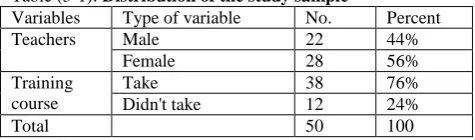
The researchers selected a stratified random sample of (50) teachers who are teaching mathematics using the Computerized Interactive Learning for the first and second grades. The following table demonstrates the sample distribution (3-1).
Table (3-1): Distribution of the study sample
Variables Type of variable No. Percent
Teachers Male 22 44%
Female 28 56%
Training course
Take 38 76%
Didn't take 12 24%
Total 50 100
Fourth: Study instrument|:
To achieve the objective of the study in identifying " the obstacles of using the computerized interactive learning in teaching of the mathematics from the teachers' perspective at UNRWA schools in Gaza governorates related to (administration, infrastructure, basic equipment, teachers, and students)" the study used questionnaire formulated of (46) items distributed in four dimensions ( (1) obstacles related to administration; (2) obstacles related to infrastructure and basic equipment; (3) obstacles related to teachers; and (4) obstacles related to students).
In the "state-like" version, respondents rate the degree to which they face the obstacles using the computerized interactive learning in teaching mathematics. Ratings are made on a 5-point Likert-type scale that ranges from "very large obstacles" (5); "large obstacles" (4); "moderate obstacles" (3); "small obstacles" (2); and very small" (1). Fifth: statistical analysis:
[image:6.595.310.548.342.412.2]Table (3-2): Criterion of the Likert scale that used
Mean Ratio scale
Obstacle degree
from To From To
1 1.79 0% 19.9% Very small
1.80 2.59 20% 39.9% Small
2.60 3.39 40% 59.9% Moderate
3.40 4.19 60% 79.9% Large
4.20 5 80% 100% Very large
4.
STUDY RESULTS: DISCUSSION AND
INTERPRETATION:
The following results were achieved according to the study questions:
1. The results of the first question: What are the degree of the obstacles of using the computerized interactive learning in teaching mathematics from the teachers' perspective at UNRWA schools in Gaza governorates related to (administration, infrastructure, basic equipment, teachers, and students)?.
To answer the question; the mean, standard deviation, and ratio scale were calculated for each dimension of the obstacles questionnaire as demonstrated in the following table:
Table (4-1): Ratio scale for the study sample according to obstacles.
Obstacles Dimension
Mean St.D Ratio scale
Obstacl es degree
1. Administration 3.924 0.465 %78.4 Large 2
2. Infrastructure
& equipment 3.927 0.873 %78.5
Large 1
3. Teachers 3.718 0.728 %74.3 Large 3
4. Students 3.692 0.496 %73.8 Large 4
Total 3.828 0.525 %76.5 Large
As shown in the previous table (4-1) that the obstacles related to infrastructure and equipment came in the first arrangement with ratio scale (78.53%); followed by obstacles related to administration with ratio scale (78.49%); then obstacles related to the teachers themselves with ratio scale (74.35%); and finally by obstacles related to the students with ratio scale (73.83%). While the total score of the obstacles questionnaire was (76.57%). It was clearly noted from the previous findings that the obstacles of using the computerized interactive learning by teachers of mathematics were large, so it consistent with the results of several studies in this field. So this is an indicator for increasing the importance of the computerized interactive learning in the education process.
2. The result of second question: Are there any differences between the degrees of the obstacles of using the computerized interactive learning in teaching the mathematics from the teachers' perspective at UNRWA schools in Gaza governorates related to (sex and training courses)?.
First hypothesis:
To answer the question we test the following hypothesis: There are no statistical differences at ( α≤0.05) between the average estimates of the obstacles of using the computerized interactive learning in teaching the mathematics from the teachers' perspective at UNRWA schools in Gaza governorates according to gender (male or female).
In order to test the sex difference according to the obstacles of using the computerized interactive learning in mathematics teaching, we performed t-independent test.
Table (4-2): t-independent test to examine the obstacles according to sex.
Obstacles Dimension
Sex No. Mean St.d t-value
Sig.
1. Administration M 22 3.94 0.42 0.187 0.852 F 28 3.91 0.50
2. Infrastructure & equipment
M 22 3.99 0.89 0.441 0.661 F 28 3.88 0.87
3. Teachers M 22 3.57 0.73
-1.244 0.220 F 28 3.83 0.72
4. Students M 22 3.67 0.42
-0.265 0.792 F 28 3.71 0.55
Total M 22 3.82 0.49
-0.119 0.906
F 28 3.84 0.56
As shown in the previous table (4-2) the calculated value of (T) in the four dimensions (obstacles related to administration; obstacles related to infrastructure and equipment; obstacles related to teachers; and obstacles related to students) equal (0.187, 0.441, 1.244, 0.265, 0.119 ) respectively which is smaller than the tabulated (T) that equal (1.98) at point of DF (48) and significance level (α≤0.05). this indicate that there were no statistical differences between the average degree of "the obstacles of using the computerized interactive learning in mathematics teaching from the perspective of the teachers of mathematics at UNRWA school related to gender. Because they face the same circumstances and confirmed to the UNRWA school regulations and programs.
Second hypothesis:
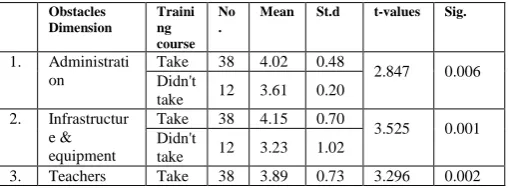
There are no statistical differences at ( α≤0.05) between the average estimates of the obstacles of using the computerized interactive learning in teaching the mathematics from the teachers' perspective at UNRWA schools in Gaza governorates according to training course (take or did not take). In order to test the training courses difference according to the obstacles of using the computerized interactive learning in mathematics teaching, we performed t-independent test.
Table (4-3): t-independent test to examine the obstacles according to training course.
Obstacles Dimension
Traini ng course
No .
Mean St.d t-values Sig.
1. Administrati on
Take 38 4.02 0.48
2.847 0.006 Didn't
take 12 3.61 0.20 2. Infrastructur
e & equipment
Take 38 4.15 0.70
3.525 0.001 Didn't
take 12 3.23 1.02
[image:7.595.48.286.90.176.2] [image:7.595.47.286.393.516.2] [image:7.595.311.566.672.766.2]Didn't
take 12 3.17 0.38 4. Students Take 38 3.78 0.54
2.295 0.026 Didn't
take 12 3.42 0.11 Total Take 38 3.97 0.50
3.797 0.000 Didn't
Take 12 3.38 0.33
As shown in the previous table (4-3) the calculated value of (T) in the four dimensions (obstacles related to administration; obstacles related to infrastructure and equipment; obstacles related to teachers; and obstacles related to students) and total questionnaire equal (2.847, 3.525, 3.296, 2.295, 3.797 ) respectively which is larger than the tabulated (T) that equal (1.98) at point of DF (48) and significance level (α≤0.05). this indicate that there were statistical differences between the average degree of "the obstacles of using the computerized interactive learning in mathematics teaching from the perspective of the teachers of mathematics at UNRWA school related to training courses in favor of who take the training course.
The researchers attribute this result to the ability of the teachers who have more training courses in the use of computers and computerized interactive learning to reduce the obstacles that may face them during their use of teaching
through computerized interactive learning.
The training courses considered as real director for the teachers in the classroom to implement teaching using computerized interactive learning to control the classroom; teaching students the content of teaching; dealing with cases of low motivation of students towards this type of education; human connection between teacher and student; and the design of educational materials and production.
3. Presenting the results of the third question "What are the strategies to overcome the obstacles of using the computerized interactive learning?" in the light of the study results:
Firstly, for the administration:
1.
Decrease the teachers quorum, and the assigned burdens.2.
Providing incentives provisions whether financially or morally for the teachers who provide computerized interactive learning.3.
Providing training courses for those using the computerized interactive learning.4.
Providing helping teachers to support teachers who provide computerized interactive learning.5.
Providing computer technician for each department using computerized interactive learning.6.
Promoting the culture of computerized interactive learning through workshops, and study days and other activities.7.
Increase the financial provisions for teachers who provide computerized interactive learning.Secondly, infrastructure and equipment:
1. Providing generators inside schools that use computerized interactive learning.
2. Providing suitable desks for the students. 3. Increasing the computer labs inside the schools. 4. Up-to-date follow up for the used computers.
5. Providing alternative computers for those failed during work.
6. Providing good ventilation and lighting inside the classroom.
7. Designing the academic material according to the newest curriculum.
Thirdly, for the teachers:
1. Selection of highly qualified teachers for providing teaching through computerized interactive learning. 2. Working to increase the motivation for the teachers. 3. Making positive attitudes for teachers about
computerized interactive learning through workshops.
4. Working to enable the teachers to use the computerized interactive learning and producing subjects using computer program.
5. Making training course for the teachers on how to use the computerized interactive learning. 6. Instruct the teachers to attend training courses on
the computerized training courses.
7. Promotion of peer guide for the teachers through mutual visit.
Fourthly, for the students:
1. Making positive attitudes among students about computerized interactive learning.
2. Making integration between low achievement students and regular students, since they learn from their peers as they learn from their teachers. 3. Providing for each student a computer in his home,
to act freely on the computerized interactive learning.
4. Providing computer teacher to instruct the students on who to use it effectively.
5. Providing additional computerized program according to the students needs that develop their thinking skills.
6. Holding meetings with the students parents to clarify the importance of the computerized interactive learning.
5.
RECOMMENDATIONS
1. Increase the attention to infrastructure and equipment to create an appropriate conditions for teaching.
2. Hold training courses for mathematics teachers on how to use the computers on the interactive learning and computerized programs.
3. Providing incentives provisions for the teachers who use the computerized interactive learning.
4. Providing incentives provisions for the students who participate in the computerized interactive learning. 5. High light the importance of the computerized
interactive learning through workshops and study days.
6. Use the computerized interactive learning in various levels at schools.
7. Enabling prospective students who will be a teacher on how to use the computerized interactive learning.
6. RESEARCH SUGGESTIONS
Inthe light of the study resultswe can provide the following suggestions:
2. Making studies on the impact of using computerized interactive learning on the students achievement at different academic levels.
3. Examine the role of the teachers and students attitudes toward the use of the computerized interactive learning.
7. REFERENCES
[1] Abdel Fattah, Ezz 2008. An introduction for descriptive and inferential statistics using SPSS, Khawarezm library, Jeddah, KSA
[2] Abu hashish, B., and Zaki, M. 2010. Attitudes of managers and teachers of UNRWA schools and about computerized interactive learning programs in Gaza governorates, paper presented to the Conference on Education Technology and learning technology in the period of October 27 to 28.
[3] Abu khatwa, A., and Abdel Atti, M. 2009. Digital e-learning , theory and design, First edition, Dar Al Jamea'a Al jadida for publication, Alexandria, Egypt. [4] Al Amry, M. 2003. The reality of the using the
educational computer in the basic government schools North High Jordan from the viewpoint of teachers and students, "Unpublished MA Thesis, Yarmouk University, Irbid: Jordan.
[5] Al Hila, M. 2000. Educational technology between theory and application. Dar Al Massira for publication, Amman, Jordan.
[6] Al Otibi, N. 2006. The obstacles of e-learning in the Saudi ministry of education from education leaders perspectives, unpublished master thesis, Mo'ta University, Jordan.
[7] Anderson. A. 2008. Seven major challenges for e-learning in developing countries: Case study EBIT, Sri lanka. International Journal of Educaton and
Development using ICT, 4, 3. Retrieved from:http://www.ijedict.dec.uwi.edu//
[8] Clark, R. E. 1994. Media will never influence learning. Educational Technology Research and Development, 42(2), 21-29.
[9] Clark, R. E., & Estes, F. 1998. Technology or craft: What are we doing? Educational Technology, 38(5), 5-11.
[10]Conna, B. 2007. An Investigation of Incorporating online Courses in public high school curricula Retrieved from: http://www.proquset.umi.com.
[11]Digangi , N. 2007. The online Learner : Characteristics and pedagogical implications . Contemporary Issues in Technology and Teacher Education , 7 (3. )
[12]Domi, H. & Al Chenag, G. 2008. Obstacles of e-learning in physics from the viewpoint of teachers and students ", Journal of Educational and Psychological Sciences, Vol 8, Issue 2.
[13]Foster, D., & Conford T. 1992. Evaluation of Health Information systems: Issues, Models and Case studies, Bhatnagar, S.C. & Odedra M. (eds.), Social Implications of computers in Developing Countries. McGraw-Hill. 304-309.
[14]Genter, C. 2003. Modern learning technology. Dar Al Ketab Al jameay, first edition, UAE.
[15]Ghulam, K. 2007. "Obstacles to e-learning in Saudi universities: Application in King Abdul Aziz University in Jeddah. KSA.
[16]Jonassen, D. H., & Reeves, T. C. 1996. Learning with technology: Using computers as cognitive tools. In D. H. Jonassen (Ed.), Handbook of research for educational communications and technology (pp. 693-719). New York: Macmillan.
[17]Khazaleh, T. and Jawarneh. T. 2006. Barriers to effective information technology integration in Joudanian school as perceived by in-service teachers, Jordan Jounal of Educational Sciences, 2. 4: 281-292.
[18]Kozma, R. B. 1994. Will media influence learning? Reframing the debate. Educational Technology Research and Development, 42(2), 7-19.
[19]Mohammad, J., Al Shikh, A., Atia, A. 2006. Obstacles of the use e-learning from the viewpoint of the
Hashemite University Students ", Journal of Educational and Psychological Sciences, Vol 7, p (4) .184-206. [20]Mojgan S. 2009. Factors affecting teachers use of ICT ,
international journal of instruction , vo12,no1 , jan 2009
.
[21]Naddaf, Sh. 2002. The reality of the educational computer and Internet in private secondary schools in Jordan, from the viewpoint of teachers ", unpublished Master Thesis, Yarmouk University, Irbid: Jordan. [22]Nsir, S. 2010. "The impact of using the computerized
interactive learning on the achievementn of first grade students with learning difficulties in mathematics," unpublished Ph.D. thesis, University of World U.S.: Gaza.
[23]Perelman, L. J. 1992. School’s out: Hyperlearning, the new technology, and the end of education. New York: William Morrow.
[24]Postman, N. 1995. The end of education: Redefining the value of school. New York: Alfred Knopf.
[25]Robyn P. & Lynda B. 2009. perceptions that may affect teachers intention to use technology in secondary school mathematics classes , educational studies math journal, vo171,no3,2009 , p.p. 299-317.
[26]Saleh, N. 2010. The effect of using computerized educational programs, lessons in learning the Arabic language on the achievement of the first primary grade students in the schools of Nablus ", Unpublished Master Thesis, Faculty of Graduate Studies, An Najah National University: Palestine.
[27]Shaheen, M. 2005. Motivations and barriers of Internet use by workers in Al-Quds Open University "Al-Quds Open University Journal of Research and Studies, No. 6 [28]Tanner, D. 1998. The social consequences of bad