Estimation of the Reliability Measures of a Three –
Component System with Human Errors and Common
Cause Failures
B. R. Sreedhar
Assistant Professor Dept. Of Mathematics
Chaitanya Bharathi Institute of Technology
Hyderabad, India
K.Pushpanjali
Professor Department Of StatisticsSri Krishnadevaraya University Anantapur, A.P., India
G. Y. Sagar
Associate Professor Dept. Of Mathematics
T R R Engineering College, Hyderabad, India.
Y. R. Reddy
Teaching Assistant Department Of Or&Sqc Rayalaseema University,
Kurnool, India
ABSTRACT
The present paper discusses the problem of estimating the reliability measures of a three-component identical system when the system is affected by Common Cause Shock (CCS) failures as well as human errors. The maximum likelihood estimators of the reliability measures like reliability function and mean time between failures of the present model are obtained. The performances of the proposed estimates have been developed in terms of mean square error, using simulated data.
General Terms
Three-component identical system, Reliability measures, Reliability estimates, Maximum likelihood estimation.
Keywords
M L estimation, CCS failures, Human errors, Reliability function, MTBF, Monte-Carlo Simulation.
1.
INTRODUCTION
In modern industries very high reliability systems are needed but it is universally accepted that computers cannot achieve the intended reliability in operating systems, application programs, control programs or commercial systems such as space shuttle, nuclear power plant control, etc., without employing redundancy. Further, there are other factors such as Common Cause Shock (CCS) failures and human errors etc. which could cause the whole system to fail. Therefore, the interest lies in assessing and estimating system performance measures like Reliability function, Mean time between failures (MTBF) etc. in the presence of the above said failures. However estimation methods and techniques were available for estimating the parameters and reliability of the system in the literature. Sagar et al [6] derived the reliability measures of a three component identical system with CCS failures and human errors. Billinton and Allan [2] discussed the role of Common cause failures in reliability modeling. Atwood [1] used the BFR model for Common cause failures in the area of nuclear power plants. Chari et al [3] derived the reliability measures of a two component identical system under the influence of CCS failures. Ritika wason [5] studied the traditional software reliability estimation. Reddy [4] derived reliability measures in the presence of lethal and non-lethal CCS failures of a two component non-identical system.
In this paper, we have tried to evaluate the estimation approach which could give formal estimation procedure of the reliability measures with specific reference to CCS failures as well as human errors. In this connection, we considered three-component identical system with CCS failures as well as human errors and the M L estimation approach is proposed to estimate the reliability measures of the present model.
Therefore, the purpose of this paper is not only to estimate the reliability measures but also to report on the results of our simulation study and to resolve differences among other existing studies of system reliability.
2.
NOTATIONS
λi, λc & λh : rate of individual, CCS failures and human
errors respectively
p1, p2 & p3 : chance of individual, CCS failures and human
errors respectively µ0 and µ1 : repair rates
) (t chs
R : reliability function for series system with CCS failures as well as human errors
) (
ˆ t
chs
R : M L estimate of reliability function for series system with CCS failures as well as human errors
) (t chp
R : reliability function for parallel system with CCS failures as well as human errors )
(
ˆ t
chp
R : M L estimate of reliability function for parallel system with CCS failures as well as human errors
) (T chs
E : expected time of failure for series system (MTTF/MTBF) with CCS failures as well as human errors
) (
ˆ T
chs
E : M L estimate of expected mean time of failure for series system with CCS failures as well as human errors
) (T chp
E : expected time of failure for parallel system
(MTTF/MTBF) with CCS failures as well as human errors
) (
ˆ T
chp
E : M L estimate of expected mean time of failure for parallel system with CCS failures as well as human errors
w & y ,
CCS failures and human errors respectively z : sample mean of service time of the components
wˆ & yˆ ,
xˆ : sample estimates of individual failure rate, CCS failure rate and human errors respectively
zˆ : sample estimate of service time of the components
n : sample size
N : number of simulated samples M S E : mean square error
3.
ASSUMPTIONS
(i) The system consists of three s-independent and identical components.
(ii) The system is affected by individual, CCS failures and human errors
(iii) The arrival stream of individual failures, CCS failures and human errors from a Poisson process with arrival rates λi, λc & λh respectively. The
chance of such failures are p1, p2 & p3 such that
p1+p2+p3 = 1.
(iv) The times between individual failures, CCS failures and human errors follow an exponential distribution.
(v) The individual failures, CCS failures and human errors occurs independent of each other.
(vi) The failed components are repaired singly and repair times follow an exponential distribution with rate of repair „µ‟.
4.
THE MODEL
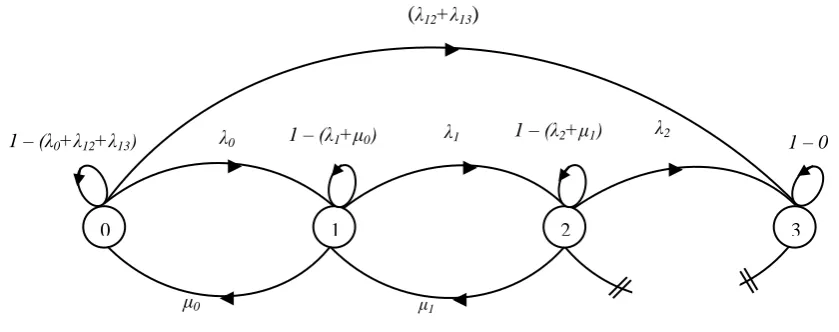
Keeping in view of the above assumptions, we formulate a Markov model to obtain the reliability function and MTBF of the system under the influence of individual, common cause shock failures as well as human errors. The Markovian graph is given in Fig. (4.1) and the quantities appear in Fig. (4.1) are to be read as
λ0 = 3λi p1 ; λ1 = 2λi p1 ; λ2 = λi p1 ; λ12 = λc p2 ; λ13 = λh p3 ;
μ0 = μ ; μ1 = 2μ
The differential equations associated with the system states are
p'0 = – (3λi p1 + λc p2 + λh p3) p0 (t) + p1 (t) μ
p'1 = (3λi p1) p0 (t) – (2λi p1 + μ) p1 (t) + 2μ p2 (t)
p'2 = (2λi p1) p1 (t) – (λi p1 + 2μ) p2 (t)
p'3 = (λc p2 + λh p3) p0 (t) + (λi p1) p2 (t) (1)
Using the Laplace transformation, the set of equations in (1) can be solve with the help of the initial conditions given at t = 0, p0 (t) = 1 and p1 (t) = p2 (t) = p3 (t) = 0 and the solution
is
p0 (t) = [(12 + 1 K + L) / (1 – 2) (1 – 3)] exp (1t)
– [(2 2
+ 2 K + L) / (1 – 2) (2 – 3)] exp (2t)
+ [(32 + 3 K + L) / (1 – 3) (2 – 3)] exp (3t) (2)
p1 (t) = [(3i p1) (1 + i p1 + 2) / (1 – 2) (1 – 3)] exp (1t)
– [(3i p1) (2 + i p1 + 2) / (1 – 2) (2 – 3)] exp (2t)
+[(3i p1) (3 + i p1 + 2) / (1 – 3) (2 – 3)] exp (3t)
(3) p2 (t) = [6(i p1)
2
/ (1 – 2) (1 – 3)] exp (1t)
– [6(i p1)2 / (1 – 2) (2 – 3)] exp (2t)
+[6(i p1)2 / (1 – 3) (2 – 3)] exp (3t) (4)
p3 (t) = 1 – [ p0 (t) + p1 (t) + p2 (t) ] (5)
Where
K = (3i p1 + 3)
L = (2(i p1)2 + i p1 + 22) (6)
1 = – sin(α) – S1/3
2 = sin (π/3+α) – S1/3
3 = sin (– π/3+α) – S1/3 (7)
Here
= (2/3) (S1 2
–3S2) 1/2
α = sin-1
(– 4q/3)/3 q = S3 – (S1S2)/3 +2 S1
3
/27 and S1, S2 & S3 are defined as follows
S1 = (6i p1 + h p3 + c p2 + 3)
S2 = [11(i p1)2 + 3h p3i p1 + 3cp2i p1 + 7i p1 + 3hp3 + 3cp2 + 2
2
] S3 = [6(i p1)3 + 2(i p1)2 h p3 + 2(i p1)2 c p2
+ 2c p22 + i p1 h p3 + i p1 c p2 + 2h p32 ]
1, 2and 3are always negative ,
i ≥ 0, p1, p2 & p3
(0, 1)(
λ12+λ13)
1 – 0
1 – (λ1+μ0) 1 – (λ2+μ1) λ2
1 – (λ0+λ12+λ13)
μ1
μ0 ◄ ◄
► ►
►
►
0
0
2
0
1
0
3
[image:2.595.95.515.301.467.2]λ0 λ1
5.
MAXIMUM LIKELIHOOD (M L)
ESTIMATION OF THE RELIABILITY
MEASURES
This section discusses the Maximum likelihood estimation approach for estimating the reliability measures of three component identical series and parallel systems in the presence of individual, CCS failures as well as human errors.
Let x1,x2,...xn be a sample of „n‟ number of times between individual failures which will obey exponential law.
Let y1,y2,...yn be a sample of „n‟ number of times
between CCS failures which follow exponential as well. Let w1,w2,...wn be a sample of „n‟ number of times between human errors which follow exponential as well.
Let z1,z2,...zn be a sample of „n‟ number of times
repair of the components with exponential population law.
z w y
xˆ,ˆ,ˆ&ˆ are the maximum likelihood estimates of individual failure rate (λi), CCS failure rate (λc), human errors
rate (λh) and repair rate „µ‟ of the system respectively.
Where,
x xˆ1
;
y yˆ1
;
w wˆ 1
;
z zˆ1 and
n x x i
;
n y y i
;
n w w i
;
n z z i
are the sample estimates of the rate of individual failure times, rate of CCS failure times, rate of human error times and rate of repair times of the components respectively.
5.1
Estimation of the Reliability function –
Series system
The reliability function for series system is obtained as )
(t chs
R = p0 (t)
=R1 exp (1 t ) – R2 exp (2 t ) + R3 exp (3t) (8)
Where
R1 = ( 12 + 1K + L ) / (1 – 2)( 1 – 3)
R2 = ( 2 2
+ 2K + L ) / (1 – 2)( 2 – 3)
R3 = ( 32 + 3K + L ) / (1 – 3)( 2 – 3)
K, L and 1, 2,3 are given in (6) & (7) respectively.
The reliability expression given in (8) agrees with the result already developed by sagar et al [6]. For series system, we do not consider repairs, i.e µ0 = µ1 = 0 in the model. Therefore, the
successful operation is shown by state „0‟ of the model. By substituting 1, 2 and 3as seen in (8), it can be simplified to
) (t chs
R = exp [– (3λi p1 + λc p2 + λh p3) t ] (9)
Therefore, the maximum likelihood estimation of the reliability function for series system is given by
)) ˆ ˆ ˆ 3 ( exp( ) ( ˆ 3 2 1 yp wp
p x t
Rchs (10)
Where xˆ,yˆ&wˆare the samples estimates given in “section 5”.
5.2
Estimation of the Reliability function –
Parallel system
The reliability function for parallel system is obtained as
) (t
Rchp = p0 (t) + p1 (t) + p2 (t)
= J1 exp (1 t ) – J2 exp (2 t ) + J3 exp (3t) (11)
Where,
J1 = [(12 + 1K + L) + (3i p1) (1 + i p1 + 2) + 6(i p1)2 ] /
(1 – 2) (1 – 3)
J2 = [(22 + 2 K + L) + (3i p1) (2 + i p1 + 2) + 6(i p1)2 ] /
(1 – 2) (2 – 3)
J3 = [(3 2
+ 3 K + L) + (3i p1) (3 + i p1 + 2) + 6(i p1) 2
] / (1 – 3) (2 – 3)
K, L, and 1,2, 3 are given in (6) and (7) respectively.
The reliability expression given in (11) agrees with the result already developed by Sagar et al [6]. Therefore, the maximum likelihood estimate of the reliability function for parallel system is given by
) exp( ) exp( ) exp( ) ( ˆ 3 ' 3 2 ' 2 1 '
1 Dt J Dt J Dt
J t
Rchp
(12)
Where,
1 3
2 3
2 1 1 3 1 1 ' 3 2 3 ' 3 3 2 2 1 2 1 1 2 1 1 ' 2 2 2 ' 2 3 1 2 1 2 1 1 1 1 1 ' 1 2 1 ' 1 ˆ 6 ˆ 2 ˆ ˆ 3 ˆ 6 ˆ 2 ˆ ˆ 3 ˆ 6 ˆ 2 ˆ ˆ 3 D D D D p x z p x D p x L K D D J D D D D p x z p x D p x L K D D J D D D D p x z p x D p x L K D D J
2 1 2 1 ' 1 ' ˆ 2 ˆ ˆ ˆ 2 ˆ 3 ˆ 3 z z p x p x L z p x K (13)
/3
/3 sin 3 / 3 / sin 3 / sin ' 1 ' 3 ' 1 ' 2 ' 1 ' 1 S D D S D D S D D (14)
Where,
1/2' 2 2 ' 1 3 3 / 2
S S
D
sin1 4 '/ 3
3' D q
3 2
1'3 27' 2 ' 1 ' 3 ' S S S S
q
xp wp yp z
S1'6ˆ 1ˆ 3ˆ 23ˆ
1 3 1 2 1 3 2 2
2 1 '
2 11xˆp 3xˆpwˆp 3xˆpyˆp 7xˆpzˆ 3wˆpzˆ 3yˆpzˆ 2ˆz
S
2 3 2 1 3 1 2 2 2 2 1 3 2 1 3 1 ' 3 ˆ ˆ 2 ˆ ˆ ˆ ˆ ˆ ˆ ˆ ˆ 2 ˆ ˆ 2 ˆ ˆ 2 ˆ 6 z p w z p y p x z p w p x z p y p y p x p w p x p x S5.3
Estimation of the MTBF function –
Series system
The mean time between failure function for series system is obtain as
0
).
(
)
(
T
R
t
dt
E
chs chsUsing the result in (9), the expression reduces to
) (T chs
E = 1 / (3λi p1 + λc p2 + λh p3) (15)
The above expression given in (15) agrees with the result already developed by Sagar et al [6]. Therefore, the maximum likelihood estimate of mean time between failures function for series system is given by
3
ˆ
1ˆ
2ˆ
3
1
)
(
ˆ
p
w
p
y
p
x
T
E
chs
(16)Where xˆ,yˆ&wˆare sample estimates given in “section 5”.
5.4
Estimation of the MTBF function –
Parallel system
The mean time between failure function for parallel system is obtained as
0
).
(
)
(
T
R
t
dt
E
chp chpUsing the result in (11), the expression reduces to
)
(
T
E
chp = – [(6i p1µ + 9(i p1)2 + L) /(1 2 3 )] (17)Where L and 1 2 3 are given in (6) & (7) respectively.
The above expression given in (17) agrees with the result already developed by Sagar et al [6]. Therefore, the maximum likelihood estimate of mean time between failure function for parallel system is given by
1 2 3
' 2 1 1
ˆ
9
ˆ
ˆ
6
)
(
ˆ
D
D
D
L
p
x
z
p
x
T
E
chp
(18)Where L' and D1, D2, D3 are given in (13) and (14)
respectively.
6.
SIMULATION STUDY
In the present work, the M L estimates of reliability and MTBF (both series and parallel systems) were not identified with exact or analytical form of probability density function since they are complex functions of sample information. Hence an attempt is made to develop empirical evidence of M L estimation approach by Monte-Carlo Simulation using an appropriate computer package for validity of results.
For a range of specified values of the rates of individual (λi),
CCS failures (λc), human errors (λh) and service rate (µ) and
for the samples of sizes n=5(5)30 were simulated in each case
with N=10,000(20,000)90,000 in order to evolve Mean Square Error (MSE) in each case. For large samples M L estimators are undisputedly better since they are CAN estimators. Interestingly, our simulation study shows that the M L estimate is still reasonably good giving near accurate estimate even for a sample size as low as five (i.e n=5). This shows that M L approach and estimators are quite useful in estimating reliability indices.
[image:4.595.319.540.255.595.2]6.1
Numerical Illustration
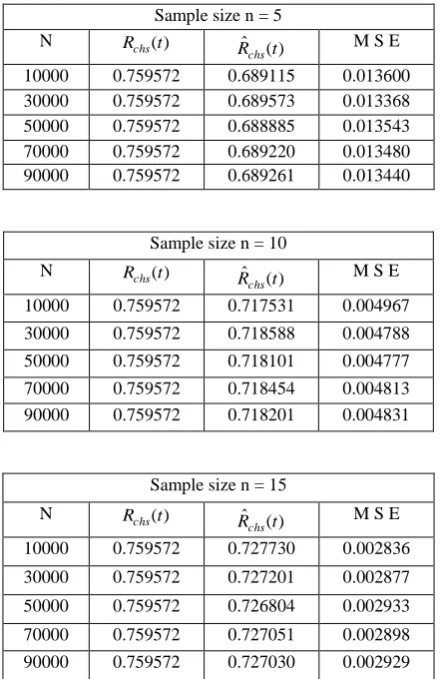
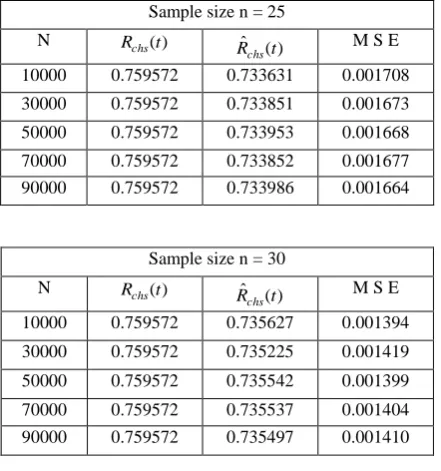
Table 6.1
Reliability function for three component identical Series system with i = 0.1; c = 0.2; h = 0.3; p1 = 0.5; p2 = 0.25;
p3 = 0.25; t = 1
Sample size n = 5
N Rchs(t) Rˆ (t)
chs M S E
10000 0.759572 0.689115 0.013600
30000 0.759572 0.689573 0.013368
50000 0.759572 0.688885 0.013543
70000 0.759572 0.689220 0.013480
90000 0.759572 0.689261 0.013440
Sample size n = 10 N Rchs(t) Rˆ (t)
chs M S E
10000 0.759572 0.717531 0.004967
30000 0.759572 0.718588 0.004788
50000 0.759572 0.718101 0.004777
70000 0.759572 0.718454 0.004813
90000 0.759572 0.718201 0.004831
Sample size n = 15
N Rchs(t) Rˆ (t)
chs M S E
10000 0.759572 0.727730 0.002836
30000 0.759572 0.727201 0.002877
50000 0.759572 0.726804 0.002933
70000 0.759572 0.727051 0.002898
90000 0.759572 0.727030 0.002929
Sample size n = 20
N Rchs(t) Rˆchs(t) M S E
10000 0.759572 0.731413 0.002082
30000 0.759572 0.731192 0.002126
50000 0.759572 0.731460 0.002097
70000 0.759572 0.731542 0.002108
Sample size n = 25
N Rchs(t) Rˆ (t)
chs
M S E
10000 0.759572 0.733631 0.001708
30000 0.759572 0.733851 0.001673
50000 0.759572 0.733953 0.001668
70000 0.759572 0.733852 0.001677
90000 0.759572 0.733986 0.001664
Sample size n = 30
N Rchs(t) Rˆ (t)
chs M S E
10000 0.759572 0.735627 0.001394
30000 0.759572 0.735225 0.001419
50000 0.759572 0.735542 0.001399
70000 0.759572 0.735537 0.001404
90000 0.759572 0.735497 0.001410
Table 6.2
Reliability function for three component identical Parallel system with i = 0.1; c = 0.2; h = 0.3; p1 = 0.5; p2 = 0.25;
p3 = 0.25; µ = 0.5; t = 1
Sample size n = 5
N Rchp(t) Rˆ (t)
chp
M S E
10000 0.887175 0.849740 0.004932
30000 0.887175 0.850022 0.004915
50000 0.887175 0.850103 0.004870
70000 0.887175 0.850430 0.004762
90000 0.887175 0.849990 0.004864
Sample size n = 10
N Rchp(t) Rˆ (t)
chp M S E
10000 0.887175 0.865974 0.001597
30000 0.887175 0.865919 0.001601
50000 0.887175 0.865943 0.001606
70000 0.887175 0.865985 0.001584
90000 0.887175 0.865867 0.001597
Sample size n = 15
N Rchp(t) Rˆchp(t) M S E
10000 0.887175 0.870512 0.000914
30000 0.887175 0.870614 0.000928
50000 0.887175 0.870613 0.000941
70000 0.887175 0.870641 0.000932
90000 0.887175 0.870702 0.000934
Sample size n = 20
N Rchp(t) Rˆ (t)
chp M S E
10000 0.887175 0.873056 0.000657
30000 0.887175 0.873026 0.000662
50000 0.887175 0.872856 0.000667
70000 0.887175 0.872931 0.000667
90000 0.887175 0.872983 0.000655
Sample size n = 25
N Rchp(t) Rˆ (t)
chp M S E
10000 0.887175 0.874175 0.000522
30000 0.887175 0.874230 0.000523
50000 0.887175 0.874086 0.000527
70000 0.887175 0.874210 0.000521
90000 0.887175 0.874168 0.000519
Sample size n = 30
N Rchp(t) Rˆ (t)
chp M S E
10000 0.887175 0.875058 0.000436
30000 0.887175 0.875115 0.000430
50000 0.887175 0.875075 0.000435
70000 0.887175 0.874990 0.000438
[image:5.595.319.538.68.428.2]90000 0.887175 0.874957 0.000438
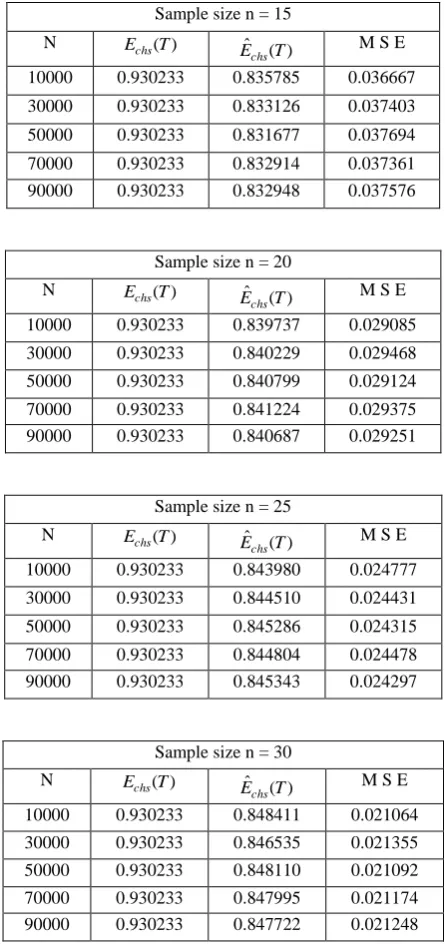
Table 6.3
Simulation results for Mean Time Between Failures function Series System with i = 0.5; c = 0.6; h = 0.7; p1 = 0.5;
p2 = 0.25; p3 = 0.25
Sample size n = 5
N Echs(T) Eˆchs(T) M S E
10000 0.930233 0.775375 0.100702
30000 0.930233 0.774135 0.098398
50000 0.930233 0.772012 0.099046
70000 0.930233 0.773719 0.099438
90000 0.930233 0.773195 0.099385
Sample size n = 10
N Echs(T) Eˆ (T)
chs
M S E
10000 0.930233 0.815011 0.053551
30000 0.930233 0.818934 0.053011
50000 0.930233 0.817060 0.052856
70000 0.930233 0.818580 0.053243
[image:5.595.58.279.72.308.2]Sample size n = 15
N Echs(T) Eˆchs(T) M S E
10000 0.930233 0.835785 0.036667
30000 0.930233 0.833126 0.037403
50000 0.930233 0.831677 0.037694
70000 0.930233 0.832914 0.037361
90000 0.930233 0.832948 0.037576
Sample size n = 20
N Echs(T) Eˆchs(T) M S E
10000 0.930233 0.839737 0.029085
30000 0.930233 0.840229 0.029468
50000 0.930233 0.840799 0.029124
70000 0.930233 0.841224 0.029375
90000 0.930233 0.840687 0.029251
Sample size n = 25
N Echs(T) Eˆchs(T) M S E
10000 0.930233 0.843980 0.024777
30000 0.930233 0.844510 0.024431
50000 0.930233 0.845286 0.024315
70000 0.930233 0.844804 0.024478
90000 0.930233 0.845343 0.024297
Sample size n = 30
N Echs(T) Eˆchs(T) M S E
10000 0.930233 0.848411 0.021064
30000 0.930233 0.846535 0.021355
50000 0.930233 0.848110 0.021092
70000 0.930233 0.847995 0.021174
[image:6.595.55.278.71.544.2]90000 0.930233 0.847722 0.021248
Table 6.4
Simulation results for Mean Time Between Failures function Parallel System with i = 0.5; c = 1.5; h = 2; p1 = 0.5;
p2 = 0.25; p3 = 0.25; µ= 5
Sample size n = 5
N Echp(T) Eˆ (T)
chp M S E
10000 1.169361 1.020356 0.178590
30000 1.169361 1.024095 0.180666
50000 1.169361 1.021380 0.179231
70000 1.169361 1.023405 0.178946
90000 1.169361 1.021091 0.180232
Sample size n = 10
N Echp(T) Eˆ (T)
chp M S E
10000 1.169361 1.052237 0.093493
30000 1.169361 1.050642 0.093152
50000 1.169361 1.051699 0.093652
70000 1.169361 1.051567 0.093196
90000 1.169361 1.050292 0.093135
Sample size n = 15
N Echp(T) Eˆchp(T) M S E
10000 1.169361 1.059674 0.063832
30000 1.169361 1.060975 0.063887
50000 1.169361 1.061927 0.064016
70000 1.169361 1.061602 0.064046
90000 1.169361 1.062657 0.064234
Sample size n = 20
N Echp(T) Eˆ (T)
chp M S E
10000 1.169361 1.069577 0.049401
30000 1.169361 1.068467 0.049425
50000 1.169361 1.067072 0.049651
70000 1.169361 1.067911 0.049747
90000 1.169361 1.068214 0.049237
Sample size n = 25
N Echp(T) Eˆchp(T) M S E
10000 1.169361 1.070323 0.040910
30000 1.169361 1.070973 0.041083
50000 1.169361 1.069865 0.041186
70000 1.169361 1.070826 0.040923
90000 1.169361 1.070431 0.040869
Sample size n = 30
N Echp(T) Eˆ (T)
chp M S E
10000 1.169361 1.072988 0.035464
30000 1.169361 1.073722 0.035274
50000 1.169361 1.073574 0.035206
70000 1.169361 1.072761 0.035357
90000 1.169361 1.072214 0.035439
7.
CONCLUSIONS
square error is almost zero with sample sizes „n‟ tending to large i.e 20 and above.
Therefore, the M L estimators are generally hard to beat consistently, even in small samples and our simulation results showed a strong preference for the M L estimation method for situations arising in practical reliability analysis.
8.
REFERENCES
[1] Atwood, C. L. (1986) “The binomial failure rate common cause model” in Technometrics, vol: 28, pp. 139-147.
[2] Billinton, R & Allan, R. N (1983) “Reliability Evaluation of Engineering Systems; Concepts and Techniques”, Plenum Press, New York.
[3] Chari, A. A., Sastry, M. P and Madhusudhana Verma, S. (1991) “Reliability analysis in the presence of common
cause shock failures”, Micro-Electronics and reliability,31, pp.15-19.
[4] Reddy, Y. R. (2003) “Reliability analysis for two unit non-identical system with CCS failures”, Ph.D thesis, S.K.University, Anantapur.
[5] Ritika Wason, Ahmed. P and Qasim Rafiq, M. (2012), “New paradigm for software reliability estimation”, International journal of computer application, vol.44, No.14, pp. 39-44.