A Hybrid Modified Particle Swarm Optimization for
Heterogeneous Radio Access Technology (RAT)
Selection
J.Preethi
Assistant Professor, Department of Computer Science and Engineering
Anna University of Technology, Coimbatore, India
S.Palaniswami
Principal,
Government College of Engineering, Bargur India
ABSTRAC
Next Generation wireless networks are heterogeneous in nature where a variety of Radio Access Technologies (RATs) coexist in the same coverage area. It is important to select the most appropriate Radio Access Network (RAN) according to the requested service of each user. Hence, this paper proposes a Hybrid Modified Particle Swarm Optimization (PSO) algorithm to select the best access network among Wireless Wide Area Network (WWAN) and Wireless Local Area Network (WLAN). Particle Swarm Optimization is a global optimization algorithm, is known to effectively solve large scale nonlinear optimization problems. A variant of PSO called as Modified PSO is used in this paper where a constriction coefficient (
) has been introduced in the velocity update equation and this factor improves the convergence of the particle over time and this optimization algorithm has been hybridized with multi-objective decision making algorithm and weighing function to achieve better solutions. The performance of the proposed algorithm is evaluated using 1000 datasets. From the simulation study, it is found that the proposed approach gives higher user satisfaction ratio compared with the other approaches.General Terms
Particle Swarm Optimization, Heterogeneous Wireless Networks.
Keywords
Fuzzy logic controller, Multi Objective decision making algorithm, weighing function, Modified Particle swarm optimization and best access selection.
1.
INTRODUCTION
Over the recent years, there is a massive development in the field of wireless mobile telecommunication systems. The wireless transmission has progressed through 1G, 2G, 2.5G and 3G to increase the radio system capacities and per user data rates, to support IP-based data, voice and multimedia services and at the same time to improve interoperability and QoS [1]. Future mobile networks will not consist of single access network like Wireless Local Area Network (WLAN), the Universal Mobile Telecommunication Systems (UMTS) and the Global System for Mobile Telecommunication (GSM)/Enhanced Data rate for GSM Evolution (EDGE) Radio Access Network (GERAN) but it will consist of different Radio Access Technologies (RATs) coexist in the same coverage area. This necessitates the user to select the best access technology among them [2].
A number of RAT selection algorithms are available for initial RAT selection and vertical Handover. A good review of RAT selection algorithms is presented in [3] and [4].
In Random based RAT selection, when a new call or vertical handover arrives, any of the available RATs will be selected randomly. In Load balancing based RAT selection, the main objective is to uniformly distribute the load among the available RATs in heterogeneous wireless networks [5]. In policy based RAT selection, it allocates users to the RAT based on some specific rules specified by the network [6]. Service class based RAT admits calls into particular RAT based on class of service such as voice, video streaming, real time video, web browsing and so on. [7]. Service cost based RAT admits incoming call into the least expensive RAT in order to reduce the service cost incurred by the users.
Path loss based RAT selection algorithm makes call admission algorithm based on path loss measurements taken in the cells of each RAT [8]. Network layer based RAT selection algorithm admits calls into a particular layer. If the layer cannot accommodate the call, this algorithm tries to admit the call into the next layer. These algorithms are very simple but can lead to highly unbalanced network load. Network layer based RAT selection algorithm is explained in [9].Inutility based RAT selection algorithms [10], incoming calls are admitted into a particular RAT based on some utility or cost function derived from a number of criteria.
In Mobile based RAT selection algorithm [11], the mobile terminal measurements from different radio access technology is used for the initial RAT selection. This algorithm uses Particle Swarm Optimization, Fuzzy logic controller, Genetic Algorithm and decision making algorithm for the selection of RAT. The fuzzy neural mechanism is used in [12] and [13] for the selection of best RAT among UMTS, GERAN and WLAN. Thus many RAT selection algorithms are available for the selection of RAT.
Swarm Optimization, Chapter V presents the proposed RAT selection model Chapter VI gives the Results and discussions and Chapter VII presents the conclusion.
2.
HETEROGENEOUS RADIO ACCESS
TECHNOLOGY
Next Generation Wireless Network (NGWN) will be heterogeneous where different radio access technologies coexist. Such a network will consist of a number of wireless networks and will form the fourth generation (4G) or next generation of wireless networks. However, each access network provides different levels of QoS, in terms of bandwidth, mobility, coverage area and cost to the mobile users. Radio Access Network (RAN) refers to the mobile access network that is built over a single radio access technology.
In a heterogeneous network, the main functionality is the RAT selection corresponds to the selection of which RAT, the requested service should be allocated. After the initial RAT selection, vertical handover procedure is used for switching from one RAN to another. The RAT selection is carried out using different criteria like Local RRM, Operator Preferences, User‟s Preferences, Load conditions, Service type, Service Cost, Interference Conditions and so on. Thus selecting the appropriate RAT and cell become a complex problem due to the number of variables involved in the decision process.
3.
OVERVIEW OF PARTICLE SWARM
OPTIMIZATION
The Particle Swarm Optimization (PSO) first introduced by Kennedy and Eberhart [14] and [15].
The basic idea of PSO is as follows: the population is called a swarm and the individuals (i.e. the search points) are called particles. Each particle represents a possible solution to the optimization task at hand. Each particle moves during each iteration with an adaptable velocity within the search space, and retains a memory of the best position it ever encountered. In the global version of the PSO, the particle is attracted towards the location of the best fitness achieved so far by the particle itself and by the location of the best fitness achieved so far across the whole swarm A particle has the following information to make a suitable change in its position and velocity:
A global best that is known to all and immediately updated when a new best position is found by any particle in the swarm (gbest).
The local best, which is the best solution that the particle has seen (pbest).
Velocity update equation (1) is given by
) , ( * 2 * 2 ) , ( * 1 * 1 1 n ition Currentpos n best G r C n ition Currentpos n best P r C n V n V (1)
Using (2), a certain velocity that gradually gets close to pbests and gbest can be calculated. The current position (searching point in the solution space) can be modified by the following equation:
1
1
Currentpos
ition
n
V
n
n
ition
Currentpos
(2)Where
Vn+1: Velocity of particle at n+1 th iteration
Vn : Velocity of particle at nth iteration C1: acceleration factor related to pbest C2: acceleration factor related to gbest r1: random number between 0 and 1 r2: random number between 0 and 1 Gbest, n: gbest position of swarm Pbest, n: pbest position of particle
Current Positionn+1: position of particle at n+1th iteration Current Positionn: position of particle at nth iteration
4.
MODIFIED
PARTICLE
SWARM
OPTIMIZATION
The PSO has been used in this work to optimize the probability of selection of satisfied users. However, like GA [16], PSO has no evolution operators such as crossover and mutation. In PSO, the potential solutions, called particles, fly through the problem space by following the current optimum particles. Compared to GA, the advantages of PSO are that PSO is easy to implement and there are few parameters to adjust. PSO has been successfully applied in many areas like function optimization, artificial neural network training, fuzzy system control, and other areas where GA can be applied. Several algorithms related to PSO has been proposed in the literature [17- 20]. A variant of PSO called as Modified PSO [21] is used in this paper where a constriction coefficient (
) has been introduced in the velocity update equation and this factor improves the convergence of the particle over time and this optimization algorithm has been hybridized with multi-objective decision making algorithm and weighing function to achieve better solutions. This factor is multiplied with the whole right hand side of the velocity update equation.The Modified Velocity update equation (3) is obtained by
} ) , ( * 2 * 2 ) , ( * 1 * 1 { * 1 n ition Currentpos n best G r C n ition Currentpos n best P r C n V n V (3)
Where the constriction coefficient is given in (4)
C
C
C
2
4
2
2
, C1+ C2= C >4.0 (4)Here C1 and C2 are the acceleration coefficients and the values are taken as 2 for easy convergence.
5.
PROPOSED
RAT
SELECTION
MODEL
Technology Selection” that uses the mobile terminal measurements from different radio access technologies.
The input parameters considered in [11] are received signal strength, cost of the radio access technology, and speed of the mobile terminal and QoS like Delay and bit rate. The input parameters are optimized using fuzzy logic controllers, genetic algorithm, particle swarm optimization and multi criteria decision making algorithm for decision making of RAT. The authors Mohammed and Aladdin in [22] proposed the access network selection based on Fuzzy logic and Genetic algorithm. The authors designed a general multicriteria software assistant that can consider user, operator and the QoS view points.
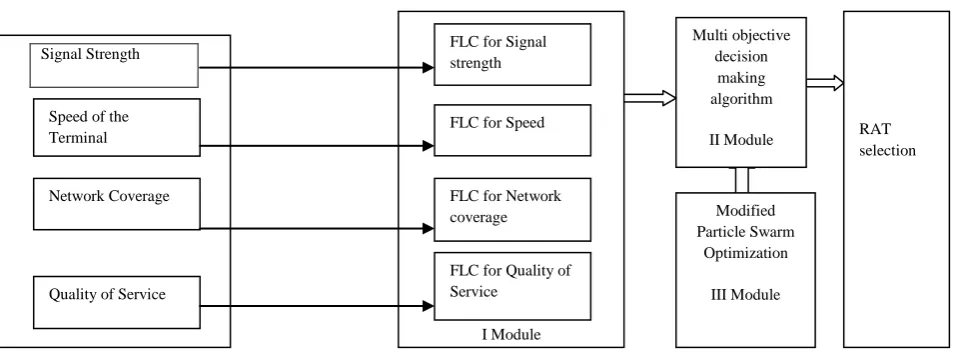
In the proposed work, the input parameters considered for selection are signal strength, speed of the mobile terminal, network coverage of two access networks and Quality of Service parameters. In this work, network coverage of both networks is considered for the selection of best RAT. This paper uses fuzzy logic controllers and multi-objective decision making algorithm employing weighting function and modified Particle Swarm Optimization algorithm for the selection of RAT. The proposed framework is explained in Fig 1. In this diagram, the input parameters of WWAN and WLAN are fed into the fuzzy logic controllers. The output of the individual fuzzy logic controllers are then fed into the multi objective decision making algorithm to decide the best Radio access technology network among WWAN and WLAN. For simplicity, the framework has been divided into three modules. The modules are summarized as follows:
Fuzzy logic controller based Heterogeneous RAT selection (Section 5.1)
Multi Objective Decision making algorithm (Section 5.2)
Hybrid Modified Particle Swarm Optimization (Section 5.3)
5.1
Fuzzy
Logic
Controller
based
Heterogeneous RAT selection
The first component of the proposed work consists of four fuzzy logic controllers. This section explains the Fuzzy logic (FL) based subsystem of four input variables.
The first FL based subsystem is for received signal strength of two networks WWAN and WLAN. The concepts of Fuzzy logic controller are explained in [23], [24] and [25]. The input variables are obtained by measuring the reception signal level of access networks. Here mamdami inference system is considered for the fuzzy controller and centroid method is used for defuzzification. The inputs to this subsystem are SL1 and SL2 where SL1 gives the received signal strength of WWAN and SL2 gives the received signal strength of WLAN and two outputs which are SLC1 and SLC2 where SLC1 describes the probability of acceptance for the new user in the WWAN network and SLC2 to describe the probability of acceptance for the new user in the WLAN network. The input variable SL1 starts with the lowest level (-105 dBm) ends with (-70 dBm). The input variable SL2 has the range (-105 dBm to -60 dBm). The variables SL1 and SL2 have 3 fuzzy sets namely low, medium and high. The outputs from this subsystem SLC1 and SLC2 have 4 fuzzy sets namely: Y (Yes), PY (Probably Yes), PN (Probably No) and N (No). By using 9 fuzzy rules, crisp quantities are fuzzified and again defuzzified as crisp values.
[image:3.595.65.543.113.290.2]The second FL based subsystem is the speed of the mobile terminal. The input variable results are obtained by measuring the speed of the terminal carried by the user at the point of required service. The speed of the mobile terminal decides the selection of WWAN or WLAN. The linguistic variable speed has 3 fuzzy sets: low, medium and high. The range of this variable is set between 0 to 10 km/h. This system has one input (TV) and two outputs (TVC1 and TVC2) related to the access networks of WWAN and WLAN. The inputs are fed into the fuzzy controller and outputs are obtained. When the speed of the mobile terminal is low, then the probability of selection of WLAN will be higher and when the speed is high, then the probability of selection of WWAN will be larger. The third FL based subsystem is the network coverage of two networks. This system has two inputs NetworkCoverage-WWAN and NetworkCoverage-WLAN where NetworkCoverage-WWAN describes the network coverage of WWAN and NetworkCoverage-WLAN describes the network coverage of WLAN and has two outputs TSC1 and TSC2
Fig 1. The proposed architecture of RAT selection
I Module Signal Strength
Quality of Service Speed of the Terminal
Network Coverage
FLC for Signal strength
FLC for Speed
FLC for Network coverage
Multi objective decision
making algorithm
II Module RAT selection
FLC for Quality of Service
Modified Particle Swarm
Optimization
which represents the probability of selection of WWAN and WLAN. The input variable NetworkCoverage-WWAN and NetworkCoverage-WLAN have the range between 0 and 10. The input variables have 3 fuzzy sets: bad, medium and good and output variable have 4 fuzzy sets namely Y (Yes), PY (Probably Yes), PN (Probably No) and N (No). When the network coverage of WWAN is good and network coverage of WLAN is bad then the probability of selection of WWAN will be larger and when the network coverage of WLAN is good and network coverage of WWAN is bad then the probability of selection of WLAN will be larger.
The fourth FL based subsystem is the quality of service. Quality of Service depends on the two parameters packet delay and packet bit rate. This system has two inputs (QoS1 and QoS2) where QoS1 describes the delay of packets and QoS2 describes the packet bit rate and it has two outputs namely (QoSC1 and QoSC2) which represents the probability of selection of WWAN and WLAN. The delay ranges between 0 to 1000ms and bit rate ranges between 0 to 350 kb/s. By decreasing the value of delay and by reducing the value of bit rate, the probability of selection of WWAN will be larger. It is also concluded that by increasing the value of delay and by increasing the value of bit rate, the probability of selection of WLAN will be larger.
The outputs from four FL based subsystems are fed into the multi-objective decision making algorithm.
5.2
Multi
Objective
Decision
Making
Algorithm
The second component explains the multi objective decision making algorithm for selection of the best RAT. In Multi Objective decision making problems, all alternatives available to the system are evaluated according to a number of criteria. Each criterion will induce particular ordering of the alternatives [26]. The algorithm proposed here uses the model proposed by Mohammed and Aladdin in [21]. In general, Multi objective decision making algorithm is implemented where different alternatives and criteria exists. In this work, the outputs of four FL based subsystems are SLC1, SLC2, TVC1, TVC2, TSC1, TSC2, QoSC1 and QoSC2. These variables are evaluated using weighing function. The weighing function (Xj) as given in (5) is obtained by summing the outputs of individual FL based components and dividing it by the total number of input parameters.
m
i m
ij a j X
1
, j=1, 2, .n (5)
Where aij represents the output values from four FL based subsystems and the value „m‟ represents the total number of input parameters.
5.3
Implementation of Hybrid Modified
Particle Swarm Optimization
The section 5.3.1 illustrates about the proposed hybrid modified PSO for the selection of RAT.
5.3.1
Hybrid MPSO
The basic concepts, variants and applications are clearly explained in [27]. The Modified PSO uses the concept explained in [20] and gives better optimization result than the general PSO. Acceleration constants C1 and C2 in equation (3) control the movement of each particle towards its
individual and global best position respectively. When the acceleration coefficients are taken as smaller values which lead to the limitation of the movement of the particles and when higher values are considered, which will lead to the explosion of the particles. Hence, in general, the two acceleration constants C1 and C2 are considered as 2. The constriction factor improves the convergence of the particle over time. The modified PSO has been hybridized with the multi objective decision making algorithm and weighing function to achieve better solutions.
Algorithm: The Proposed Hybrid Modified Particle Swarm Optimization: (SLC1, SLC2, TVC1,
TVC2, TSC1, TSC2, QoSC1, and QoSC2):
The main objective of this algorithm is to perform the best selection of access network and to maximize the percentage of the satisfied users. It is important to design a suitable decision making algorithm for the selection of best access network among WWAN and WLAN. In this algorithm, a new weighing function is introduced and Modified Particle Swarm Optimization is used for the maximizing the percentage of satisfied users. This algorithm takes as input argument the outputs from four fuzzy logic controllers and gives the probability of selection of satisfied users (SS).The proposed multi-objective decision making algorithm employing Weighing function and Modified Particle Swarm Optimization algorithm is as follows
Step1: Input the results obtained from the evaluation of input variables through fuzzy logic systems for the given input criteria: SLC1, SLC2, TVC1, TVC2, TSC1, TSC2, QoSC1 and QoSC2.
Step2: Select the number of particles, generations, tuning accelerating coefficients C1, C2 and random numbers r1, r2, and constriction factor (
) to start the optimal solution searching.Step3: Initialize the particle position with the parameters SLC1, SLC2, TVC1, TVC2, TSC1, TSC2, QoSC1 and QoSC2.
Step4: Evaluate the Weighing function
The weighing function Net1 as given in (6) is got by summing the outputs of WWAN selection of 4 fuzzy logic controllers and dividing it by the total number of input parameters. Let the total number of input parameters be „m‟.
m
QoSC
TSC
TVC
SLC
Net
1
1
1
1
1
(6)Similarly, the weighing function Net2 for WLAN as given in equation (7) is got by summing the outputs of WLAN selection of 4 fuzzy logic controllers and dividing it by the total number of input parameters.
m
QoSC
TSC
TVC
SLC
Net
2
2
2
2
2
(7)2
1
1
Net
Net
Z
(8)Else
1
2
Net
Net
Z
(9)End
If Z1 > 1 then the no. of satisfied users (
) in (10) as given below is taken as the objective function for the particle swarm optimization.1
(10)Step5: Select particles individual best value for each generation. Select the particles global best value, i.e. particle near to the target among all the particles is obtained by comparing all the individual best values.
Step6: Update particle individual best (p best), global best (g best), in the modified velocity equation (3) and obtain the new velocity.
Step7: Update new velocity value from (2) and obtain the new position of the particle
Step8: Find the optimal solution by the updated new velocity and position.
Step9: Stop the process when computation is done for all the number of users and the value (
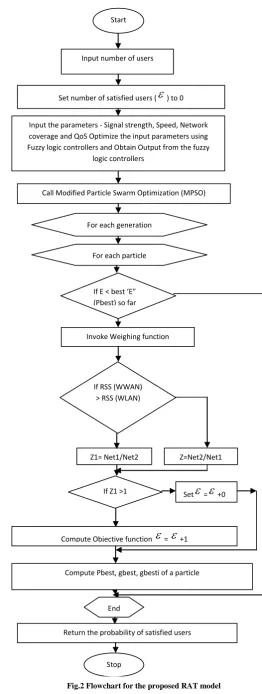
) gives the percentage of satisfied users (Pu).The flowchart for the proposed system is given in Fig.2.
6.
RESULTS AND DISCUSSIONS
This section presents the details of the simulation carried out on the datasets randomly created to demonstrate the proposed work for the selection of the radio access network. This work is developed in MATLAB environment. The details of the simulation and the performance of the proposed system are presented here. Two access points considered for selection which are WLAN and WWAN. Users have to select the best access network between these two networks. A dataset consisting of 1000 users each having the signal strength, speed and network coverage of these networks and Quality of Service is considered. This work was carried out in Intel core Duo processors with 2.26 GHz speed and 2GB RAM.
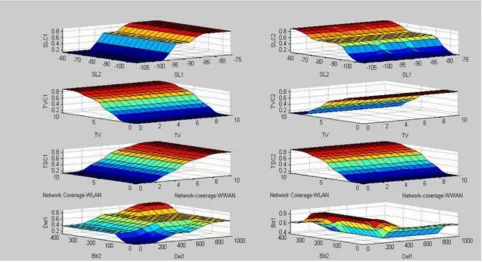
The Fig 3 shows the outputs obtained from the first module. This is the graph obtained from the 4 fuzzy logic controllers signal strength, speed of the mobile terminal, network coverage of the networks and QoS. In Fig 3, the first two graphs concludes that when the value of SL1 (signal strength of WWAN) is increased, the probability of selection of WWAN is larger and when the value of SL2 is increased, the probability of selection of WLAN is larger. The next two graphs concludes that by increasing the speed of the mobile terminal, WWAN network is selected and by the decreasing the speed, WLAN network is selected. The next two graphs concludes that by increasing the network coverage of WWAN, the probability of selection of WWAN is higher and by increasing the network coverage of WLAN, the probability of selection of WLAN is higher. The last two graphs says that by decreasing the delay and by decreasing the bit rate, the probability of selection of WLAN is larger and by increasing the value of delay and by increasing the value of bit rate, the probability of selection of WWAN is larger.
Start
Input number of users
Input the parameters - Signal strength, Speed, Network coverage and QoS Optimize the input parameters using Fuzzy logic controllers and Obtain Output from the fuzzy
logic controllers
Call Modified Particle Swarm Optimization (MPSO)
Invoke Weighing function
If RSS (WWAN) > RSS (WLAN)
Z1= Net1/Net2 Z=Net2/Net1
If Z1 >1
Compute Objective function
=
+1Stop
Set number of satisfied users (
) to 0Compute Pbest, gbest, gbesti of a particle
Update new velocity and new position
Return the probability of satisfied users For each generation
For each particle
If E < best ‘E” (Pbest) so far
Set
=
+0 [image:5.595.308.571.66.762.2]End
Fig.2 Flowchart for the proposed RAT model
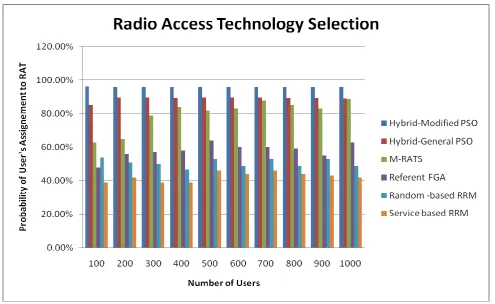
This section also discusses about the simulation results and compares the performance of the proposed work with other five different algorithms. Fig.4 shows the comparison of the proposed algorithm with others. In this, the first algorithm is Hybrid-General PSO in [23] where general PSO has been hybridized with multi objective decision making algorithm and the second algorithm is M-RATS (Mobile based Radio Access Technology Selection) as proposed by the authors Aleksandar and Janevski where Particle swarm optimization, genetic algorithm and multi criteria decision making algorithm is used for the selection of RAT. The third algorithm is referent FGA and fourth algorithm is random based RRM where the users are assigned randomly to the two networks and fifth algorithm is service-based RRM.
Fig.4 shows Pu values. The horizontal axis shows the number of users while vertical axis shows the Pu values. From this chart, it is understood that there is great improvement in the number of the satisfied users in the proposed solution can be seen.
With less number of users (e.g. 100 or 200 users) in the scenario, the proposed work shows better behavior from well known algorithms including Referent FGA, Random based RRM; Service based RRM and M-RATs. The results pertaining to the probability of assignment of users to the best RAT was between 95% and 97% for all the number of users. Thus, by using the proposed multi-objective decision making algorithm for heterogeneous networks, best RAT can be selected for the user. The performance comparison of the proposed approach for Radio Access Technology Selection is given in Table I.
From table I, it can be seen that the proposed method gives higher user satisfaction ratio than other existing methods. Here Service based RRM have user satisfaction ratio between 39% and 42%, Random based RRM have user satisfaction ratio between 49% and 54%, Referent FGA have ratio between 48% and 63%, MRATs have user satisfaction ratio between 63% and 89%, Hybrid General PSO have ratio between 85% and 89%. Among all these methods, the proposed method have user satisfaction ratio between 95% and 96%.
Method Percentage of Satisfied
Users
Service based RRM 39%-42% Random -based RRM 49%-54%
Referent FGA 48%-63%
M-RATs 63%-89%
Hybrid General PSO 85 % to 89 %
[image:6.595.57.541.384.646.2]Hybrid Modified PSO 95% to 96%
Fig 3. Outputs from four FL based Subsystems
TABLE I
7.
CONCLUSION
In heterogeneous wireless networks, different RATs coexist in the same coverage area. The goal is to select the most suitable RAT for each user. In this paper, a multi objective decision making algorithm employing weighing function and Modified Particle swarm optimization based on fuzzy controller has been developed and applied to Radio access Technology selection. The proposed work has been compared against other well known algorithms. From the results, it is observed that the proposed work gives better results than the other algorithms. The future work in this area is to determine the best access technology among the available RATs by giving priority levels among the different classes of calls namely new calls, horizontal handoff calls and vertical handoff calls in heterogeneous wireless networks.
8.
REFERENCES
[1] Iti, S.M, Wireless Communications and Networks, 3G and Beyond, Tata McGraw Hill Education Private Limited, 2010.
[2] Marques, R. L. Aguiar, C. Garcia, J. I. Moreno, C. Beaujean, E. Melin, and M. Liebsch, “An IP-based QoS architecture for 4G operator scenarios”, in the IEEE Trans. Wireless Commun., vol. 10, no. 3, pp. 54–62, Jun. 2003
[3] Abdallah ALSabbagh, Robin Braun, Mehran Abolhasan, “A Comprehensive Survey on RAT Selection Algorithms for Heterogeneous Networks”, World Academy of Science, Engineering and Technology, 2011, pp. 141-145.
[4] Falowo, O.E. and H.A. Chana, “Joint call admission control algorithms: Requirements, approaches and design
considerations”, Computer Communications, vol.31, no.6, April 2008, pp.1200-1217.
[5] A.Tolli and P.Hakalin, “Adaptive Load Balancing between Multiple Cell layers”, IEEE 56th Vehicular Technology Conference (VTC 2002) Vancouver, Canada, September 24-28, Vol 3, 2002, pp.1691-1695. [6] J.Perez-Romero, O.Sallent and R.Agusti, “Policy-based
Initial RAT selection algorithms in Heterogeneous Networks”, The 7th IFIP International Conference on Mobile and Wireless Communications Networks (MWCN 2005), Marrakech, Morocco, September 19-21, 2005.
[7] W.Zhang, “Performance of Real-time and Data traffic in Heterogeneous Overlay Wireless Networks”, 19th International Teletraffic Congress (ITC 19), Beijing, China, August - September 2, 2005.
[8] Perez-Romero, J., O. Sallent and R. Agusti, “Enhanced Radio Access Technology Selection exploiting Path loss information”, in the Proceedings of the 17th annual IEEE Symposium on Personal, Indoor and Mobile Radio Communication, (PIMRC ‟06).
[9] R.B.Ali, S.Pierre, “An Efficient predictive admission control policy for heterogeneous wireless bandwidth allocation in next generation mobile networks”, in the Proceeding of the 2006 international conference on Wireless communications and mobile computing (IWCMC‟06), Vancouver, Canada, July3-6, 2006. [10]O.Ormond, J.Murphy, G.Muntean, “Utility –based
[image:7.595.52.548.68.372.2]Intelligent network selection in beyond 3G systems”, IEEE International Conference on communications (ICC 2006), Istanbul, Turkey, June 11-15.
[11]Aleksandar Tudzarov and Toni Janevski, “Efficient Radio Access Technology Selection for the Next Generation Wireless Networks” in the International Journal of Research and Reviews in Next Generation Networks, Vol. 1, No. 1, March 2011.
[12]L. Giupponi, R. Agustí, J. Pérez-Romero, and O. Sallent, “A novel approach for joint radio resource management based on fuzzy neural methodology,” in IEEE Transactions on Vehicular Technology, vol.57, No.3, May 2008.
[13]R. Agustí, O. Sallent, J. Pérez-Romero, and L. Giupponi, “A fuzzy neural based approach for joint radio resource management in a beyond 3G framework,” in Proc. 1st Int. Conf. Quality Service Heterogeneous Wired/Wireless Netw., Dallas, TX, Oct. 2004, pp. 216– 224.
[14]Kenedy, J., Eberhart R.C, “Particle Swarm Optimization” in the Proceedings of IEEE Int. Conf. Neural Network, Volume 4, 1995, pp. 1942-1948. [15]Shi, Y., Eberhart, R.C. “Empirical study of particle
swarm optimization”, in the Proceeding of IEEE Congress on Evol. Computation, 1995, pp.1945-1950. [16]S.N.Sivanandam and S.N.Deepa, “Principles of Soft
Computing”, Wiley-India, Second Edition, 2011.
[17]R. Eberhart and Y. Shi, “Comparing inertia weights and constriction factors in particle swarm optimization,” in Proc. IEEE Congress Evol. Comput., Jul. 2000, vol. 1, pp. 84–88.
[18]F. Bergh and A. Engelbrecht, “A cooperative approach to particle swarm optimization,” IEEE Trans. Evol. Comput., vol. 8, no. 3, pp.225–239, Jun. 2004.
[19]Y. Shi and R. Eberhart, “A modified particle swarm optimizer,” in Proc. IEEE World Congr. Comput. Intell., pp. 69–73, May 1998.
[20]R. Eberhart, Y. Shi, and J. Kennedy, Swarm Intelligence. San Mateo, CA: Morgan Kaufmann, 2001.
[21]M. Clerc and J. Kennedy, “The particle swarm-explosion, stability, and convergence in a multidimensional complex space,” IEEE Trans. Evol. Comput., vol. 6, no. 1, pp. 58–73, Feb. 2002.
[22]Mohammed Alkhawlani and Aladdin Ayesh, “Access Network Selection based on Fuzzy logic and Genetic Algorithms”, Advances in Artificial Intelligence., Volume 8, Issue 1, January 2008.
[23]T.Ross, “Fuzzy logic with Engineering Application” (Tata McGraw hill, 1995)
[24]T.Takagi and M.Sugeno, “Fuzzy identification of systems and its applications to modeling and control”, IEEE Trans. Syst. Man cybern. 15 (1985) 116-132. [25]S.Yuhui, E.Russell and C.Yaobin, “Implementation of
evolutionary fuzzy systems”, IEEE Trans. Fuzzy Syst. Vol. 7, No.2, April 1999, pp. 109-119.
[26] P.M.L. Chan, Y.F.Hu and R.E.Sheriff, “Implementation of Fuzzy Multiple Objective Decision Making Algorithm in a Heterogeneous Mobile Environment”, Wireless Communications and Networking Conference, WCNC2002, IEEE, 332 – 336, 2002.
[27]Yamille del Valle, Ganesh Kumar Venayagamoorthy, Salman Mohagheghi, Jean-Carlos Hernandez, Ronald G.Harley, “Particle Swarm Optimization: Basic Concepts, Variants and Applications in Power Systems”, in the IEEE Transactions on Evolutionary Computation, Volume 12, No.2, April 2008.