A generic framework for the development
of standardised learning objects within the
discipline of construction management
Ahmed, V, Aouad, GF and Pathmeswaran, R
Title
A generic framework for the development of standardised learning objects
within the discipline of construction management
Authors
Ahmed, V, Aouad, GF and Pathmeswaran, R
Type
Article
URL
This version is available at: http://usir.salford.ac.uk/554/
Published Date
2007
USIR is a digital collection of the research output of the University of Salford. Where copyright
permits, full text material held in the repository is made freely available online and can be read,
downloaded and copied for noncommercial private study or research purposes. Please check the
manuscript for any further copyright restrictions.
A Generic Framework for the Development of Standardised
Learning Objects within the Discipline of Construction
Management
Vian Ahmed, Raju Pathmeswaran & Ghassan Aouad: University of Salford, UK
Abstract
E-learning has occurred in the academic world in different forms since the early 1990s. Its use varies from interactive multimedia tools and simulation environments to static resources within learning management systems. E-learning tools and environments are no longer criticised for their lack of use in higher education in general and within the construction domain in particular. The main criticism, however, is that of reinventing the wheel in order to create new learning environments that cater for different educational needs. Therefore, sharing educational content has become the focus of current research, taking e-learning into a whole new era of developments. This era is enabled by the emergence of new
technologies (online and wireless) and the development of educational standards, such as SCORM (Sharable Content Object Reference Model) and LOM (Learning Object Metadata) for example. Accordingly, the broad definition of the construction domain and the interlocking nature of subjects taught within this domain, makes the concept of sharing content most appealing.
This paper proposes a framework developed to describe the various steps required in order to enable the application of e-learning metadata standards and ontology for sharable learning objects to serve the construction discipline. The paper further describes the application of the proposed framework to a case study for developing an online environment for learning objects that are standardised, sharable, transparent and that cater for the needs of learners, educators and curricula developers in Construction Management. Based on the framework, a learning objects repository is developed incorporating educational and web standards. The repository manages objects as well as metadata using ontology and offers a set of services such as storing, retrieving and searching of learning objects using Semantic Web
technologies. Thus, it increases the reusability, sharability and interoperability of learning objects.
Introduction
According to Khan (2001), e-learning can be viewed as an innovative approach for delivering a well designed, learner-centred, interactive, and facilitated learning environment to anyone, anywhere, anytime by utilising the attributes and resources of various digital technologies along with other forms of learning materials suited for an open, flexible, and distributed learning environment.
The instruction methods used within construction education rely on traditional methods such as exposing students to applied science courses (Park et al., 2003). These traditional
teaching methods, however, are often not fully capable of providing students with all the skills necessary to solve the real world problems encountered in construction, or conveying
complex engineering knowledge effectively. The curricula, however, often conveys fragmented knowledge in a series of courses.
Ideally, visits to construction sites or site training would constantly complement the more conventional classroom instructional tools. However, there are various complicating issues that make it impossible to rely on the construction sites. Firstly, the instructor cannot control the availability of a project at the necessary stage of completion. Secondly, visits of larger groups to construction sites may not be welcome, involve risk, and are impractical. The high cost of site training is a further impediment to its extensive use for construction education. The implementation of e-learning into construction education had a slow start, but is catching up with other fields. During the 1990s a number of UK initiatives were launched to support the development and integration of e-learning within higher education. This process can be summarised in three phases: Phase 1 (1992 -1996) formed the era of stand alone
applications; Phase 2 (1996 -1998) the generic ‘online’ application phase; while Phase 3 (1998 - Present) moved towards Web-based and Wireless Mobile learning. Presently a major focus is in web-based learning (e-learning) and this is slowly and steadily moving towards mobile learning (m-learning) (Noessel, 2003) even though the cost of its implementation is a bit of a hindrance (Traxler, 2003).
The Joint Information System Committee (JISC) also funded a number of similar initiatives to look into e-learning standards to bridge content and systems. Since then, the development of e-learning tools for construction education has been continuously growing. Their
development, however, is costly and time consuming and they soon become out of date. This is mainly because of the fast changes in the technology and their incompatibility with new systems or platforms, and as a result of available instructional software being locally effective but globally fragmentary (Molyneux, 2002).
extended by substituting or plugging in new components. Although the component-based solutions developed to date are useful, they are inadequate for those building component-based interactive learning environments in which the components must respond to the meaning of the content as well as its form and representation. Construction educators and technologists must take the lead in promoting computer literacy in their curriculum and continue to develop new courses, delivery styles and software applications through continued research activities (Berryman et al., 2004).
On the other hand, educational software has been developed with the potential for online learning as complete packages, commercially prepared and disseminated. However, they lack cohesion as an organised collection because every software application is vertically engineered to comply within its specific domain. This makes their reusability and sharing more difficult and can lead to maintenance and deployment difficulties as restrictive platform requirements accumulate over time. This paper develops an understanding of
standardisation of e-learning and related concepts which underpins the theory behind developing an online environment for sharable learning objects, with a particular focus on a case study for sharable learning objects in Construction Management.
Learning Objects
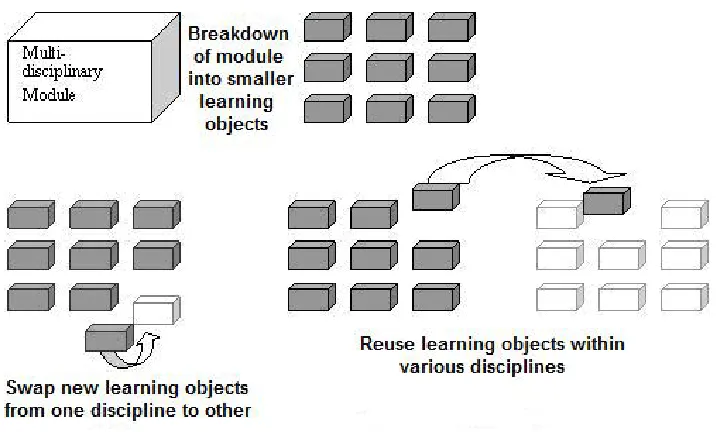
The aim of creating learning objects is to achieve the goal of maximum reusability, leveraging the high cost of production of quality materials without sacrificing the learning meaning. The concept of a learning object emerges from the need to introduce and elaborate e-learning content with pedagogical aspects in a way that can be reused in different learning scenarios. The Institute of Electrical and Electronic Engineering (IEEE) Learning Technology Standards Committee (LTSC) defines learning objects as “any entity, digital or non-digital, which can be used, re-used or referenced during technology supported learning” (LOM, 2003). It also suggests that a learning object can be of a multimedia content, instructional content, learning objectives, instructional software and software tools, persons, organisations, or events referenced during technology supported learning. Although the LTSC definition is too broad to actually define a learning object, Wiley (2000) defines a learning object as “any digital resource that can be reused to support learning”. This definition includes anything that can be delivered across the network on demand, be it large or small. Figure 1 below
Figure 1 The concept of sharable learning objects
However, in order to be able to exchange, share and integrate learning objects within different learning environments in general, and for the construction discipline in particular, it is important to develop an understanding of learning standards for sharable learning objects. The following section describes the educational learning standards currently available and identifies the most suitable standards that can be adopted to develop the sharable learning objects repository for construction education.
E-Learning Standards
The development of e-learning content is often expensive and time consuming. Curriculum developers tend to reinvent the wheel as they find it difficult to locate the learning materials to reuse within the e-learning systems. Learners often face problems in discovering learning materials they need. Learning content developed for a learning management system may only be used within the system itself. Therefore, learning content needs to be interoperable with different learning environments and produced in a standardised way to maximise its reusability. Since many learning materials and learning management systems lack interoperability with other systems, there is a need for standards to be used in e-learning. Ahmed and Shaik (2004) argue that standardisation using learning standards is the ultimate solution to achieve interoperability in e-learning. Learning standards provide standardised data structures and communication protocols for learning materials and learning
standards that exist for these purposes which can be classified into some general categories for the delivery of e-learning objects. This paper is focused on the understanding of metadata standards and their integration within a learning objects repository for sharing content. Learning Object Metadata is referred to as the labelling of learning objects so that they can be identified via search engines (Qin and Hernandez, 2004).
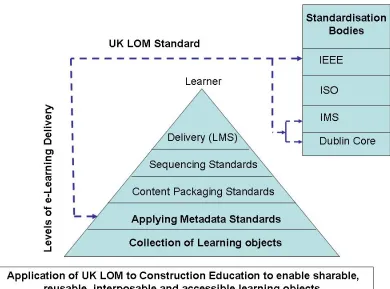
Figure 2 shows the stages for the delivery of learning objects to Learning Management Systems (LMS) so that objects can be accessed and managed by educators to meet the needs. There are a number of standardisation bodies that are in the process of creating metadata standards; for example, the IEEE Learning Technology Standards Committee produced a standard called Learning Object Metadata standard (LOM, 2003). The Dublin Core Metadata Initiative also developed a different metadata standard with less elements compared to IEEE LOM. The Dublin Core Metadata Initiative is widely used by libraries, publishers and government organisations. The IMS Global Learning Consortium and the Advanced Distributed Learning Initiative (ADL) have adopted IEEE LOM as their metadata standard. ADL’s SCORM (Sharable Content Object Reference Model) specification uses IEEE LOM standard for packaging learning objects as deliverable content (LOM, 2003).
Figure 2 E-Learning standards
educational content within construction. The paper will also propose a metadata framework that will be validated through its application to a construction project management module.
Towards The Development of an Online Repository for Learning
Objects
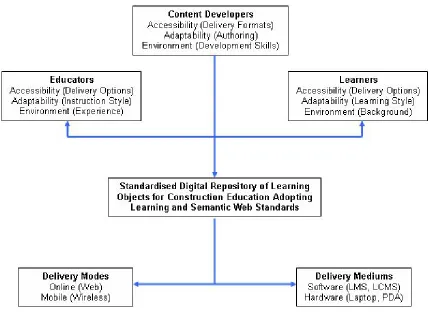
[image:7.612.91.529.228.540.2]The aim of the online learning repository is to develop an environment for learning objects that are interoperable, transparent and sharable by the community of educators and learners within the construction discipline and to be accessible anywhere, any time. Figure 3 shows a conceptual framework that describes the rationale behind the research.
Figure 3 Conceptual framework
Based on the above, there are three main challenges that face such developments to produce learning objects that are:
• Intelligent by developing ‘relational metadata’,
• Accessible through various learning environments via content packaging, and
• Dynamic using ontologies and the semantic web concepts.
Stage 1: Developing a metadata framework which integrates the most suitable metadata as well as proposed pedagogical and construction metadata elements which can be applied to a multimedia of learning objects.
Stage 2: To apply a content packaging standard that packages learning objects so they can be posted to and retrieved from various learning management systems such as Blackboard and WebCT and delivered via mobile technologies.
[image:8.612.98.517.263.528.2]Stage 3: To identify the ontology (i.e. a common vocabulary of terms and concepts) for construction education and to develop a semantic web environment that will increase sharability of objects within construction domains.
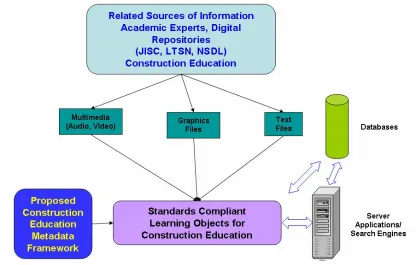
Figure 4 shows the methodological framework for the development of the proposed online Learning Object repository.
Figure 4 Methodological framework for developing the online learning objects repository
The main focus of this paper is on Stage 1 of the methodological steps highlighted above, which forms the initial steps towards developing an online repository using the Semantic Web concepts.
Metadata for the Online Repository of Learning Objects
Adopting UK LOM standard
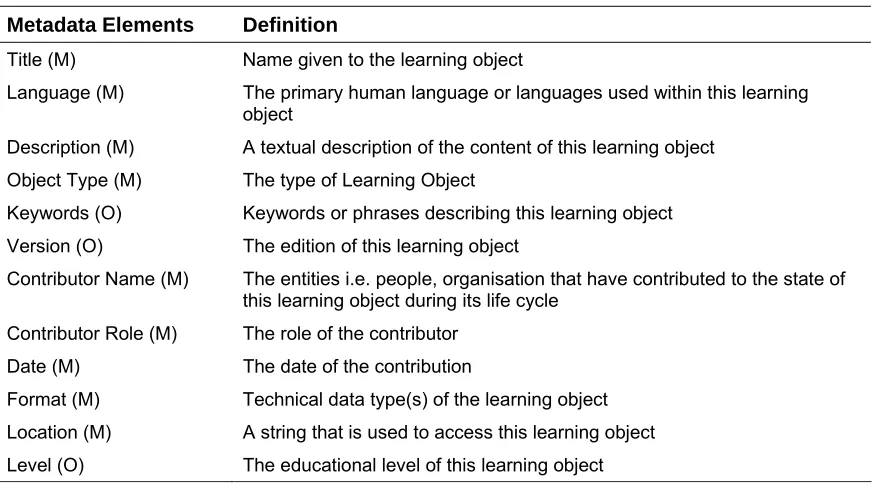
2004). Therefore to develop an online repository of learning objects, the UK LOM metadata elements (of which 44 are optional and 42 are mandatory) were studied. Not all these elements, however, are found essential to identify learning objects via the search engine within the online repository. Therefore, in order to identify the most relevant metadata elements that can be generically used, a pilot survey was conducted. Twenty participants took part in this survey, giving different rankings to the most relevant elements. The most relevant of these elements can be seen in Table 1. The table also shows the definition of each element as originally identified by IEEE LOM.
Table 1 Most relevant metadata elements identified by a pilot survey
Metadata Elements Definition
Title (M) Name given to the learning object
Language (M) The primary human language or languages used within this learning object
Description (M) A textual description of the content of this learning object Object Type (M) The type of Learning Object
Keywords (O) Keywords or phrases describing this learning object Version (O) The edition of this learning object
Contributor Name (M) The entities i.e. people, organisation that have contributed to the state of this learning object during its life cycle
Contributor Role (M) The role of the contributor Date (M) The date of the contribution
Format (M) Technical data type(s) of the learning object Location (M) A string that is used to access this learning object Level (O) The educational level of this learning object
The application of this metadata is applied to the “Case Study for Construction Project Management” as described later in the paper.
Defining Metadata for Construction
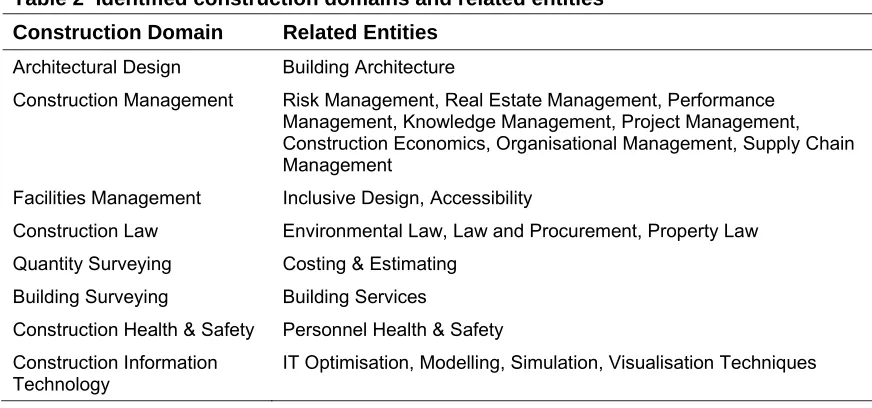
In order to define the metadata tagging for the construction discipline, it is important to define the construction domains and to do so, an extensive literature review was carried out.
Table 2 Identified construction domains and related entities
Construction Domain Related Entities
Architectural Design Building Architecture
Construction Management Risk Management, Real Estate Management, Performance Management, Knowledge Management, Project Management, Construction Economics, Organisational Management, Supply Chain Management
Facilities Management Inclusive Design, Accessibility
Construction Law Environmental Law, Law and Procurement, Property Law Quantity Surveying Costing & Estimating
Building Surveying Building Services
Construction Health & Safety Personnel Health & Safety Construction Information
Technology IT Optimisation, Modelling, Simulation, Visualisation Techniques
The literature also revealed that there is no metadata that defines construction domains in order to make searchable learning objects construction specific. Therefore the above domain metadata will be integrated within the online repository to demonstrate how the construction related learning objects can be standardised.
Defining Pedagogical Metadata
The pedagogical metadata was captured from a standard ‘Module Specification Form’ which follows the QAA guidelines for curricula development as shown in Table 3 with their
description. The table also shows learning styles as an additional metadata, which has been a subject of academic debate for some time (Ahmed, 2000).
Table 3 Pedagogical metadata
Pedagogical Metadata Description
Learning Outcomes Expressed in terms of what the learners will be able to do once they have studied the content of a particular object
Pre-requisites Prior knowledge needed to learn existing content Learning Objectives Defines what the object seeks to achieve Learning Styles Variety of content to match learners’ needs
[image:10.612.90.524.484.585.2]Based on these results, column four of Table 4 shows that the elements with ‘important’ have been considered as mandatory ‘M’, and the ‘relevant’ and unimportant responses are
[image:11.612.88.491.132.233.2]considered as optional ‘O’.
Table 4 Responses for pedagogical elements
Pedagogical Elements
Reponses Frequency Integrating Metadata
Learning Outcomes Important 83% M
Prerequisites Relevant 65% O
Learning Objectives Not important 77% O
Learning Styles Important 67% M
Such metadata will be integrated within the online repository to form the pedagogical aspects of learning objects.
Defining Metadata for Learning Styles
According to Kolb (1984), Honey & Mumford (1982) and Riding & Cheema (1991), individuals have different learning styles which are dictated by a number of factors, including their social interaction, academic and work experience. As a result Ahmed (2000) addressed the need for considering an individual’s learning styles when delivering learning content. Based on such findings, the learning objects are addressed by their suitability to match various learning styles. Riding and Sadler-Smith’s learning style analysis (Riding and Sadler-Smith, 1997) address two types of learners; those who are “verbalisers” (i.e. they learn best from abstract
[image:11.612.85.522.486.541.2]concepts), and those who are “imagers” (i.e. they learn best from visual content) as shown in Table 5. These styles were found to be a simple and easy way of associating learning styles to suit learner’s preferences and are used as metadata for the learning objects.
Table 5 Proposed learning styles metadata
Learning Style Metadata Explanation
Verbaliser To suit those who learn best from abstract concepts Imager To suit those who learn best from visual content
This learning style metadata will be integrated within the learning objects to demonstrate the most suitable mode of delivery for end users.
Defining the types of Learning Objects
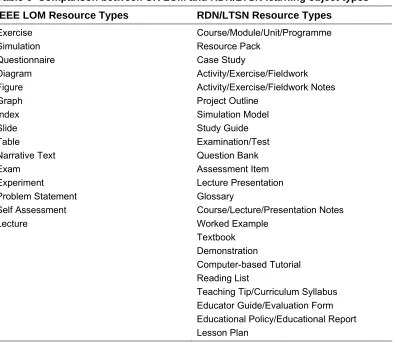
A range of UK and European learning object type vocabularies are compared in order to find a suitable vocabulary for the online learning objects repository. A comparison between the IEEE LOM and RDN/LTSN (Learning and Teaching Support Network, 2003) learning object types was made and summarised in Table 6.
Table 6 Comparison between UK LOM and RDN/LTSN learning object types
IEEE LOM Resource Types RDN/LTSN Resource Types
Exercise Simulation Questionnaire Diagram Figure Graph Index Slide Table Narrative Text Exam Experiment Problem Statement Self Assessment Lecture Course/Module/Unit/Programme Resource Pack Case Study Activity/Exercise/Fieldwork Activity/Exercise/Fieldwork Notes Project Outline Simulation Model Study Guide Examination/Test Question Bank Assessment Item Lecture Presentation Glossary Course/Lecture/Presentation Notes Worked Example Textbook Demonstration Computer-based Tutorial Reading List
Teaching Tip/Curriculum Syllabus Educator Guide/Evaluation Form Educational Policy/Educational Report Lesson Plan
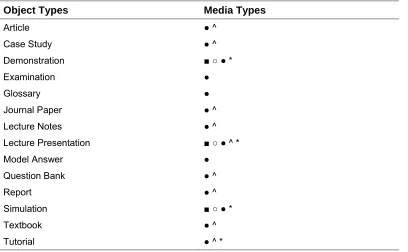
These definitions were tested via a pilot survey which was distributed to a sample of twenty people in order to establish the most common definitions that end users’ identify with. The results of this survey revealed that the object types that are shown in Table 7 are most recognised.
Table 7 Learning objects and their media
Object Types Media Types
Article ● ^
Case Study ● ^
Demonstration ■○● *
Examination ●
Glossary ●
Journal Paper ● ^
Lecture Notes ● ^
Lecture Presentation ■○● ^ *
Model Answer ●
Question Bank ● ^
Report ● ^
Simulation ■○● *
Textbook ● ^
Tutorial ● ^ *
The findings from this section are integrated to produce a generic framework for developing metadata in construction education.
The study of UK LOM metadata standard, metadata for construction and the pedagogical metadata has led to the development of a generic framework for the integration of metadata for construction education as shown in Figure 5 below.
Figure 5 Proposed metadata for construction education learning objects
This framework will be adopted to develop the metadata for a learning object repository that can be used for sharing and exchanging learning objects that are transparent and
interoperable. To validate and test this framework, the following section identifies
[image:13.612.93.526.452.597.2]Management as a module taught within this programme of study to share and exchange learning objects.
Learning Objects for Construction Management – A Case Study
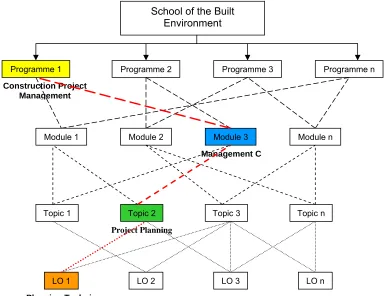
Figure 6 Programme structure
This section shows the output of mapping the metadata framework for the development of the online digital repository which forms stage 1 of the development of the online
environment.
The following steps demonstrate how the metadata, developed as a part of the generic framework, is integrated within the online environment whereby end users will be able to follow these steps to submit and retrieve learning objects.
Step 1
Figure 7a shows how the learning object types identified earlier in this paper are integrated within the environment. It lists all the learning object types as a drop down menu so that the end users can select the appropriate type of their learning object. When they make a choice, the system will take them to the next step.
Planning Technique
Project Planning
Management C Construction Project
Management
School of the Built Environment
Programme 1 Programme 2 Programme 3 Programme n
Module n Module 3
Module 2 Module 1
Topic n Topic 3
Topic 2 Topic 1
LO n LO 3
Figure 7a Integration of learning object types
Step 2
[image:16.612.90.479.464.562.2]Figure 7b shows how the pedagogical metadata such as ‘Learning Styles’ is integrated within the system. The Learning Object types are associated with Learning Styles that suit the needs of various learners. This will enable the end users to select an object that suits their learning style as an optional choice.
Figure 7b Integration of Learning Styles
When the learning style is selected the system will take the user to the next step in order to select an appropriate programme, module and topic to identify the Learning Object required.
Step 3
Figure 7c Integration of Programme Structure
After choosing the pedagogical and structure details of the learning object, the system will take users to the next step where the learning object is labelled using the proposed metadata.
[image:17.612.95.461.372.683.2]Step 4
Figure 7d demonstrates various construction domains as a result of integrating construction metadata in the interface. This enables end users to select the appropriate domain according to their learning object. For the purpose of this case study the construction management domain is selected.
Step 5
[image:18.612.89.522.146.364.2]In this step, the learning object will be labelled using the metadata proposed earlier. Table 8 shows an example of metadata built into an object to complete the metadata form shown in Figure 7d, and presented as raw data.
Table 8 Example metadata
Metadata elements Example
Title (M) Bar Charts
Language (M) English
Description (M) An example of Bar Charts used for project planning. Object Type (M) Demonstration
Keywords (O) Bar Chart, planning methods, planning techniques
Version (O) 1.0
Contributor Role (M) None
Creator (M) R.McCaffer and F.Harris
Date (M) 21/03/2006
Format (M) PP Presentation
Location (M) http://elearning.sobe.salford.ac.uk/learningobjects/barchart.ppt
Construction Domain Construction Management
The labelling of the above metadata onto a learning object is done using a form template as shown in Figure 7e. It demonstrates the direct entries to the interface using the same
Figure 7e Screenshot of the interface demonstrating Metadata Input Form
This paper covers the approach adopted to select the metadata standard for construction education learning objects. It demonstrated the approaches we used to identify the relevant metadata from UK LOM standard and to propose pedagogical and construction metadata. We finally demonstrated how the proposed metadata framework for construction education is integrated within the online environment that we are developing.
Based on the findings discussed in this paper, the metadata for the online repository has been produced. The second research challenge lies in the development of a relational metadata to make the learning objects dynamic, using the semantic web concepts.
Summary of Findings and Future Research
the learning process according to their individual needs. The learning objects will be
References
Ahmed, V. (2000). The effectiveness of computer aided learning in construction.
Unpublished PhD thesis, Loughborough University.
Ahmed, V. & Shaik, A. (2004). Learning objects: A new approach to e-learning in construction. Presented at: International Engineering Education Conference, Wolverhampton, UK, June.
Berryman, C. W., Fischer, B. & Wentz, T. (2004). Distance Education with Internet2
Audio/Video Technology. The International Journal of Construction Education and Research, 1 (1), 45-60.
El-Saddik, A., Fischer, S. & Steinmetz, R. (2000). ITBeankit: An educational middleware framework for bridging software technology and education. In Bourdeau, J. & Heller, R.
Proceedings of ED-MEDIA 2000 World Conference on Education Multimedia, Hypermedia and Telecommunications, held in Montreal, Canada. pp. 1323-1324.
Honey, P. & Mumford, A. (1992). The Manual of Learning Styles. Maidenhead: Peter Honey
Publications.
Khan, B. H. (2001). Web Based Training. Englewood Cliffs, NJ: Educational Technology
Publications.
Kolb, D. A. (1984). Experiential Learning: Experience as the source of learning and development. Englewood Cliffs, NJ: Prentice-Hall.
Koper, R. (2004). Use of the semantic web to solve some basic problems in education.
Journal of Interactive Media in Education, Special Issue on the Educational Semantic Web
(online). URL: www-jime.open.ac.uk/2004/1/
Learning and Teaching Support Network. (2003). RDN/LTSN LOM Application Profile. URL:
http://www.rdn.ac.uk/publications/rdn-ltsn/types/.
LOM. (2003). Learning Object Metadata (online). URL: http://ltsc.ieee.org/wg12/.
Molyneux, S. (2002). The Future of e-Learning. Learning Lab Journal, 1 (3), 4-5 (online).
URL: http://www.learninglab.org.uk/Journals/LearningLabJournal_vol1_issue3.pdf
Noessel, C. (2003). Mobile learning as service offering with near-term technologies. In:
Proceedings of the 2nd annual MLEARN conference, MLEARN 2003, held at Inmarsat, London, 117-126 (online). URL: http://www.lsda.org.uk/events/mlearn2003/
Park, M., Chan,S. & Ingawale-Verma,Y. (2003). Three success factors for simulation based construction education. Journal of Construction Education, 8 (2), 101-114.
Qin, J. & Hernandez, N. (2004). Ontological representation of learning objects: Building interoperable vocabulary and structures. In Feldman, S. I. et al. Proceedings of the 13th International Conference on World Wide Web, WWW 2004, New York: ACM Press, 348-349. Riding, R. & Cheema, I. (1991). Cognitive styles – an overview and integration. Educational
Riding, R. & Sadler-Smith, E. (1997). Cognitive style and learning strategies: Some implications for training design. International Journal of Training and Development,1,
199-208.
Traxler, J. (2003). Mobile learning as service offering with near-term technologies. In:
Proceedings of the 2nd annual MLEARN conference, MLEARN 2003,held at Inmarsat, London, 183-188 (online). URL: http://www.lsda.org.uk/events/mlearn2003/
UK LOM. (2004). UK Learning Object Metadata Core Draft v2.0. URL:
http://zope.cetis.ac.uk/profiles/uklomcore
Wiley, D. A. (2000). Connecting learning objects to instructional design theory: A definition, a metaphor, and a taxonomy. In Wiley, D. A. (Ed.). The instructional use of learning objects