Conditional Resolving Parameters on Enhanced Hypercube Networks
∗
Bharati Rajan
Albert William
Indra Rajasingh
Department of Mathematics
Department of Mathematics
Department of Mathematics
Loyola College
Loyola College
Loyola College
Chennai, India
Chennai, India
Chennai, India
S. Prabhu
Department of Mathematics
Loyola College
Chennai, India
Abstract
Given a graphG= (V, E), a setW ⊂V is a resolving set if for each pair of distinct vertices u, v ∈ V(G) there is a vertexw ∈ W such thatd(u, w) 6= d(v, w). A resolv-ing set containresolv-ing a minimum number of vertices is called a
minimum resolving set or abasis for G. The cardinality of a minimum resolving set is called thedimension of Gand is denoted bydim(G). A resolving setW is said to be a
one sizeresolving set if the size of the subgraph induced by
W is one, and aone-factor resolving set ifW induces iso-lated edges (one regular graph). The minimum cardinality of these sets denotedor(G) andonef(G) are called one size and one factor resolving numbers respectively. In this pa-per we investigate these resolving parameters for enhanced hypercube networks.
Keywords: Resolving set, basis, one size resolving set, one factor resolving set, and enhanced hypercube networks
1
INTRODUCTION
A query at a vertexvdiscovers or verifies all edges and non-edges whose endpoints have different distance from
v.In the network verification problem [1], the graph is known in advance and the goal is to compute a mini-mum number of queries that verify all edges and non-edges. This problem has previously been studied as the problem of placing landmarks in graphs or determining the metric dimension of a graph [8]. Thus, a graph-theoretic interpretation of this problem is to provide representations for the vertices of a graph in such a way that distinct vertices have distinct representations. This is the subject of the papers [5, 21, 22].
For an ordered setW ={w1, w2...wk}of vertices and
a vertexv in a connected graphG, the code or repre-∗This research is supported by The Major Research Project-No. F. 38-120/2009(SR) of the University Grants Commission, New Delhi, India.
sentation ofvwith respect toW is thek-vector
CW(v) = (d(v, w1), d(v, w2)...d(v, wk))
whered(x, y) is the distance between the verticesxand
y. The set W is a resolving set for G if distinct ver-tices ofGhave distinct codes with respect toW. The minimum cardinality of a resolving set for G is called the resolving number or dimension and is denoted by
dim(G).
2
AN OVERVIEW OF THE
PA-PER
The concept of resolvability in graphs has previously appeared in literature. Slater [21, 22] introduced this concept, under the namelocating sets, motivated by its application to the placement of a minimum number of sonar detecting devices in a network so that the position of every vertex in the network can be uniquely deter-mined in terms of its distance from the set of devices. He referred to a minimum resolving set as a reference set and called the cardinality of a minimum resolving set as thelocation number. Independently, Harary and Melter [5] discovered this concept, but used the term metric dimension, rather than location number. Later, Khuller et al. [8] also discovered these concepts inde-pendently and used the term metric dimension. These concepts were rediscovered by Chartrand et al. [2] and also by Johnson [7] while attempting to develop a ca-pability of large data sets of chemical graphs.
It was noted in [4] that determining the metric di-mension of a graph isNP-complete. It has been proved that the metric dimension problem is NP-hard [8] for general graphs. Manuel et al. [12] have shown that the problem remainsNP-complete for bipartite graphs. There are many applications of resolving sets to prob-lems of network discovery and verification [1], pattern recognition, image processing and robot navigation [8], geometrical routing protocols [10], connected joins in
1111 1101
0111 0101
1011 1001
0011 0001
1010 1000
0010 0000
1110 1100
[image:2.595.75.271.84.173.2]0111 0100
Figure 1: An enhanced hypercubeQ4,2with binary rep-resentation
graphs [20], coin weighing problems [23]. This problem has been studied for trees multi-dimensional grids [8], Petersen graphs [14], torus networks [11], Benes net-works [12], honeycomb netnet-works [13], enhanced hyper-cubes [15] and Illiac networks [18].
Many resolving parameters are formed by combin-ing resolvcombin-ing property with another common graph-theoretic property such as being connected, indepen-dent, or acyclic. The generic nature of conditional re-solvability in graphs provides various ways of defining new resolving parameters by considering different con-ditions. A resolving set W of G is connected if the subgraph induced byW is a nontrivial connected sub-graph of G. The minimum cardinality of a connected resolving set is called connected resolving number and it is denoted bycr(G) [19]. A resolving setW is said to be a one size resolving set [9] if the size ofW is one, a one factor resolving set [17] ifW induces isolated edges, and a path resolving set [17] if W induces a path. In this paper we show the existence of aone sizeand aone factor resolving set in an enhanced hypercube network.
3
TOPOLOGICAL
PROPER-TIES OF ENHANCED
HY-PERCUBE NETWORKS
The hypercube has received considerable attention mainly due to its regular structure, small diameter, and good connection with a relatively small node degree [25]. The hypercube is a very popular, versatile and vertex-transitive interconnection network [3]. When the dimension of hypercube increases, the cardinality of its vertex set increases exponentially. Many variations of the hypercube have been suggested to improve the per-formance. One of the variations is the enhancement [24] of the hypercube with same number of vertices. The en-hanced hypercubes are much more attractive than the normal hypercubes due to their potentially nice topo-logical properties.
Let Qr denote the graph of the r-dimensional
hy-percube, r ≥ 1. The vertex set is given by V(Qr) =
{(x0x1...xr−1) : xi = 0 or 1}. Two vertices
(x0x1...xr−1) and (y0y1...yr−1) of Qr are adjacent if and only if they differ exactly in one position. Qr is
x
x’
x’
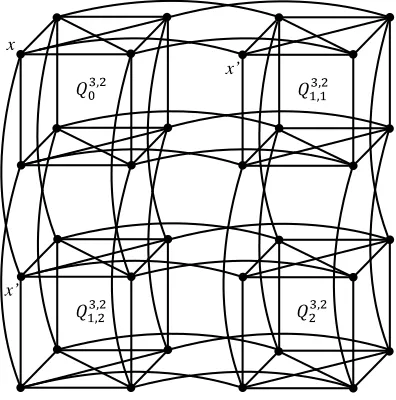
Figure 2: Four copies ofQ3,2 inQ5,2
r-regular, bipartite, has 2rvertices andr2r−1edges and diameterr. It is hamiltonian ifr≥2 and Eulerian ifr
is even [25].
The enhanced hypercube Qr,k,0 ≤ k ≤ r −1,
is a graph with vertex set V(Qr,k) = V(Qr) and edge setE(Qr,k) =E(Qr)∪ {x0x1...xk−2xk−1xk...xr−1,
x0x1...xk−2xk−1xk...xr−1)}. The edges of Qr in Qr,k are called thehypercube edges and the remaining edges are calledcomplementary edges or skips [24]. See Fig-ure 1. The enhanced hypercube,Qr,k,0≤k≤r−1 is
[image:2.595.324.522.85.285.2](r+ 1)-regular with 2rvertices and (r+ 1)2r−1edges. It is bipartite if and only ifr andkhave the same parity [6, 24].
4
ONE
SIZE
RESOLVING
NUMBER
In this section we determine a bound for the one size resolving number of enhanced hypercube networks.
Definition 4.1. A setW ofGis a one size resolving set if the size of subgraph induced byW is one and distinct vertices ofGhave distinct codes with respect toW. The minimum cardinality of a one size resolving set in Gis the one size resolving number and is denoted byor(G). A one size resolving set of cardinalityor(G) is called an or-set of G. If G is a connected graph of order n
containing an or-set, then it is clear that 2≤or(G)≤
n−1.
We now proceed to identify a one size resolving set in an enhanced hypercube network Qr,2. It is clear that there are four copies ofQr−2,2inQr,2. We denote them asQr−2,2
0 ,Q
r−2,2 1,1 ,Q
r−2,2 1,2 andQ
r−2,2
2 . Figure 2 exhibits the four copies ofQ3,2 in Q5,2. Letx∈V(Qr−2,2
0 ). A vertexx′∈V(Qr−2,2
1,1 ) orV(Q
r−2,2
1,2 ) is called animage of x if d(x, x′) = 1. Note that vertices in Qr−2,2
P P’
Figure 3: Image of a pathP
distance 1 fromxare not considered as images of x. If
x′ is the image ofxin Qr−2,2
1,1 then xis called the pre-image of x′. Let P = u0u1...un be a path in Qr−2,2
0 .
Then the path P′ = u′
0u′1...u′n where u′i is the image
of ui in Q r−2,2 1,1 (Q
r−2,2
1,2 ) is called the image of P in
Qr1−,12,2(Q
r−2,2
1,2 ) andP is called the pre-image ofP′. See Figure 3. We use the following result of B. Rajan et al. [15].
Lemma 4.1. [15] Let x ∈ V(Qr−2,2
0 ) and let x′ ∈
V(Qr−2,2
1,1 ) be the image ofx. Let w be any vertex in
Qr0−2,2. Thend(x′, w) = 1 +d(x, w). Lemma 4.2. Let x∈V(Qr−2,2
0 ). Let x′1∈V(Q
r−2,2 1,1 ) and x′
2 ∈V(Q
r−2,2
1,2 )be the images of x. Then x′1 and
x′
2 are equidistant from every vertex of Q
r−2,2
0 .
Proof. Since the shortest paths fromx′
1 and x′2 to any vertex ofQr0−2,2pass throughx, the conclusion follows.
Theorem 4.1. Let G = Qr,2, then or(G) ≤ r−1,
r >3.
Proof. We prove the theorem by induction onr.
Base Case:
Let G = Q4,2 and W
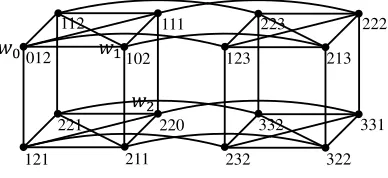
1 = {w0, w1, w2}, where w0 = 0001, w1 = 0011 and w2 = 0110. It follows from the definition of hypercube edges thatw0is adjacent to w1 and that w2 is non-adjacent to w0 and w1. It is easy to check that W1 is a resolving set for Q4,2. Figure 4 shows the distinct codes of vertices inQ4,2,with respect to W1={w0, w1, w2}. ThusW1 is a one size resolving set for G. Now assume that the result is true for the enhanced hypercubeQr−1,2.LetW
1={w0, w1...wr−3} where w0 = 0000...01
| {z } (r−1)−bit
and wi = x0x1...xr−i−2xr−i−1
...xr−2, 1 ≤ i ≤ r−3, xs = 0, 0 ≤ s ≤ r−2 be
a one size resolving set for Qr−1,2. Here w
0w1 ∈ E. Since andwk+1 andwj, 0 ≤j ≤k,1 ≤k≤r−4
dif-fer in two bits they are not adjacent in Qr−1,2. This justifies the fact that the size of W1 is one. More-over W1 ⊂ V(Q0r−2,2). Divide Qr,2 into four copies of
Qr−2,2 0 , Q
r−2,2 1,1 , Q
r−2,2 1,2 andQ
r−2,2
2 . There exist vertices
x∈Qr1−,12,2 and y∈Q
r−2,2
1,2 having the same code with respect to every vertex ofQr−2,2
0 and in particular with
322 232
211 121
213 123
102 012
222 223
111 112
331 332
220 221
Figure 4: One size resolving set inQ4,2
respect to every vertex ofW1.HenceW1cannot resolve
xandy. We exhibit a resolving set forQr,2.We claim thatW is a resolving set forQr,2.DefineW ={u
0, ui:
1 ≤ i ≤ r −3} ∪ {x0x1x2x3...00
| {z }
r−bit
} where u0 = 0w0
andui= 0wi,1≤i≤r−3. Now defineW ={ui: 0≤
i≤r−2}whereu0= 0w0=x0x1...xr−2xr−1
| {z }
r−bit
andui=
0wi,1 ≤ i ≤r−3 and ur−2 = x0x1x2x3...xr−1
| {z }
r−bit
set is
obtained by appending a 0 to each element of W1 and including the additional vertex x0x1x2x3...00
| {z }
r−bit
. Hence
W ={w0, w1...wr−2}where w0=x0x1...xr−2xr−1
| {z }
r−bit
and
wi = x0x1...xr−i−1xr−i...xr−1, where 1 ≤ i ≤ r−2,
xs= 0,0≤s≤r−1.Clearly the size of W is one. We
claim thatW is a resolving set ofQr,2.
Case 1: x, y∈V(Qr−2,2
0 ) orV(Q
r−2,2
1,1 ) or V(Q
r−2,2 1,2 ) SinceW1⊂V(Qr0−2,2) and sinceQ
r−2,2
0 ∪Q
r−2,2 1,1 and
Qr0−2,2∪Q
r−2,2
1,2 are isomorphic toQr−1,2,by induction hypothesis W1 resolves x and y. The same argument applies to the following cases.
a) x∈V(Q0r−2,2) andy∈V(Q
r−2,2 1,1 ) b) x∈V(Qr−2,2
0 ) andy∈V(Q
r−2,2 1,2 ) Case 2: x∈V(Qr−2,2
1,1 ) andy∈V(Q
r−2,2 1,2 )
We need to prove that d(x, w) 6= d(y, w) for some
w in W = {w0, w1, w2...wr−3} ∪{wr−2}. Let x′, y′ ∈
V(Qr0−2,2) be the images ofxand yrespectively. Case 2.1: x′=y′
In this cased(y, wr−2) =d(y, y′) +d(y′, wr−2) = 1 +
d(x′, wr
−2) = 1 + 1 +d(x, wr−2)6=d(x, wr−2). Case 2.2: x′6=y′ andx′, y′ ∈V(Qr−2,2
0 )
Nowx′ andy′ are resolved by some win W1. Hence
d(x′, w)6=d(y′, w) and consequentlyd(x, w)6=d(y, w).
Case 3: x∈V(Q0r−2,2) andy∈V(Q
r−2,2
2 )
[image:3.595.76.274.86.173.2]Case 4: x, y∈V(Qr−2,2
2 )
As before let x′ and y′ be the images of x and
y respectively. There are two possibilities x′, y′ ∈
V(Qr1−,12,2) or V(Q
r−2,2
1,2 ). Then d(x′, w) 6= d(y′, w) for somew∈W1by Case 1.
Case 5: x∈V(Qr−2,2
1,1 ) andy∈V(Q
r−2,2
2 )
Letx′∈V(Qr−2,2
0 ) andy′ ∈V(Q
r−2,2
1,2 ) be the images ofxandy respectively. SinceQ0r−2,2∪Q1,2r−2,2 is re-solved byW1, there exist aw∈W1such thatd(x′, w)6=
d(y′, w). This implies thatd(x, w)6=d(y, w).
5
ONE FACTOR RESOLVING
NUMBER
In this section we determine a bound for the one factor resolving number of enhanced hypercube networks.
Definition 5.1. A setW ofGis a one factor resolving set forGifG[W]≅tK2, for some integert. The
min-imumt for whichG[W]≅tK2 is called the one factor
resolving number of G and it is denoted by onef(G). This parameteronef(G)reduces to the one size resolv-ing number,or(G) when the size of G[W]is one.
Theorem 5.1. Let G=Qr,2,then onef(G) ≤ r−1 2
,
wherer odd andr >3.
Proof. We prove the theorem by induc-tion on r. Now assume that the result is true for the hypercube Qr−2,2. Let W
1 =
{{(x0x1...xr−2i−3...xr−3),(x0x1...xr−2i−4xr−2i−3...xr−3)},
0 ≤ i ≤ r−5
2 } be a one factor resolv-ing set where wj and wj+1 are adjacent, 0 ≤ j ≤ r−5, j even. Clearly W1 ⊂ V(Qr0−2,2) Divide Qr,2 into eight copies of Qr−3,2, namely
Qr−3,2 0 , Q
r−3,2 1,1 , Q
r−3,2 1,2 , Q
r−3,2 1,3 , Q
r−3,2 2,1 , Q
r−3,2 2,2 , Q
r−3,2 2,3 andQr−3,2
3 .
Now each of Qr0−3,2 ∪ Q
r−3,2 1,1 , Q
r−3,2
0 ∪ Q
r−3,2 1,2 and Qr−3,2
0 ∪ Q
r−3,2
1,3 is isomorphic to Qr−2,2. Since
W1 ⊂ V(Qr0−3,2), W1 resolves the above sub-cubes by assumption. Now there exist vertices
x ∈ Qr−3,2
1,1 , y ∈ Q
r−3,2
1,2 and z ∈ Q
r−3,2
1,3 having the same code with respect to every vertex of Qr0−3,2 and in particular with respect to every vertex of W1. Similarly there exist vertices one each inQr2−,13,2, Q
r−3,2 2,2 and Qr−3,2
2,3 having the same code with respect to
W1. So we need to augment W1. If a cube is re-solved by some W1 ⊂ V(Qr0−3,2) then the s-neighbor cube is also resolved by the same resolving set W1 where 1 ≤ s ≤ 3. Therefore it is enough to resolve
Qr1−,13,2, Q
r−3,2 1,2 , Q
r−3,2
1,3 . Let wr−3 ∈ V(Qr1−,13,2). Now W1 ∪ {wr−3} ⊂ V(Qr0−3,2 ∪ Q
r−3,2
1,1 ). This means that there are vertices one in each of
Qr−3,2 1,2 ∪ Q
r−3,2
2,1 and Q
r−3,2 1,3 ∪ Q
r−3,2
2,2 having same
code as they are at distance 1 from Qr−3,2
0 ∪Q
r−3,2 1,1 . Now choose wr−2 ∈ V(Q1r−,23,2 ∪ Q
r−3,2
2,1 ) prefer-ably wr−2 ∈ V(Qr2,−13,2) so that wr−2 and
wr−3 are adjacent. Therefore the augmented
W = {w0, w1...wr−2}, more precisely W = {{(x0x1...xr−2i−1...xr−1),(x0x1...xr−2i−2xr−2i−1...xr−1)}, 0≤i≤r−3
2 } is a one factor resolving set.
6
CONCLUSION
In this paper we have discussed two different resolv-ing parameters namely the one size resolvresolv-ing number and one factor resolving number for enhanced hyper-cube networks. These resolving parameters for Benes and Butterflies are under investigation.
References
[1] Z. Beerliova, F. Eberhard, T. Erlebach, A. Hall , M. Hoffman, M. Mihal´ak, Network discovery and verification, IEEE Journal on selected areas in communications, Vol. 24, no. 12 (2006) 2168-2181.
[2] G. Chartrand, L. Eroh, M A. Johnson, O.R. Oellermann, Resolvability in Graphs and the Metric Dimension of a Graph, Discrete Appl. Math., Vol. 105 (2000) 99-113.
[3] S.A. Chodum, V. Sunitha, Augmented Cubes, Networks, Vol. 40, no. 2 (2002) 71-84.
[4] M. R. Garey, D.S. Johnson, Computers and In-tractability: A Guide to the Theory of NP-Completeness, Freeman, New York, 1979.
[5] F. Harary, R.A. Melter, On the Metric Dimen-sion of a Graph, Ars Combin., Vol. 2 (1976) 191-195.
[6] L. Hongmei, The Structural Features of En-hanced Hypercube Networks, Fifth Interna-tional Conference on Natural Computation, Vol. 1 (2009) 345-348.
[7] M.A. Johnson, Structure-Activity Maps for Vi-sualizing the Graph Variables Arising in Drug Design, J.Biopharm. Statist., Vol. 3 (1993) 203-236.
[8] S. Khuller, B. Ragavachari, A. Rosenfield, Land-marks in Graphs, Discrete Appl. Math., Vol. 70, no.3 (1996) 217-229.
[10] K. Liu, N. Abu-Ghazaleh, Virtual Coordinate Backtracking for Void Traversal in Geographic Routing, Networking and Internet Architecture, 2006.
[11] P. Manuel, B. Rajan, I. Rajasingh, M. Chris Monica, Landmarks in Torus Networks, Journal of Discrete Mathematical Sciences & Cryptog-raphy, Vol. 9, no. 2 (2006) 263-271.
[12] P. Manuel, M.I. Abd-El-Barr, I. Rajasingh, B. Rajan, An Efficient Representation of Benes Networks and its Applications, Journal of Dis-crete Algorithms, Vol. 6, no. 1 (2008) 11-19.
[13] P. Manuel, B. Rajan, I. Rajasingh, M. Chris Monica, On Minimum Metric Dimension of Hon-eycomb Networks, Journal of Discrete Algo-rithms, Vol. 6, no. 1 (2008) 20-27.
[14] B. Rajan, I. Rajasingh, J.A. Cynthia , P. Manuel, On Minimum Metric Dimension, Pro-ceedings of the Indonesia-Japan Conference on Combinatorial Geometry and Graph Theory, September 13-16, 2003, Bandung, Indonesia.
[15] B. Rajan, I. Rajasingh, M. Chris Monica, P. Manuel, Metric Dimension of Enhanced Hyper-cube Networks, The Journal of Combinatorial Mathematics and Combinatorial Computation, Vol. 67 (2008) 5-15.
[16] B. Rajan, S.K. Thomas, M. Chris Monica, Con-ditional Resolvability of Honeycomb and Hexag-onal Networks, Mathematics in Computer Sci-ence, Vol. 5, no. 1 (2011) 89-99.
[17] Bharati Rajan, Sonia K. Thomas and Chris Monica M, One-factor Resolvability of Grid de-rived Networks, Journal of Combinatorial Math-ematics and Combinatorial Computing, Vol. 79, (2011) 77-89.
[18] B. Rajan, I. Rajasingh, P. Venugopal, M. Chris Monica, Minimum Metric Dimension of Illiac Networks, Ars Combin., (Accepted).
[19] V. Saenpholphat, P. Zhang, Conditional Resolv-ability of Graphs: A Survey, IJMMS, Vol. 38 (2003) 1997-2017.
[20] A. Seb¨o, E. Tannier, On Metric Generators of Graphs, Mathematics of Operational Research, Vol. 29, no. 2 (2004) 383-393.
[21] P.J. Slater, Leaves of Trees, Congress. Numer., Vol. 14 (1975) 549-559.
[22] P.J. Slater, Dominating and Reference Sets in a Graph, J. Math. Phys. Sci. Vol. 22, no. 14 (1988) 445-455.
[23] S. S¨oderberg, H.S. Shapiro, A Combinatory De-tection Problem, Amer. Math. Monthly, Vol. 70 (1963) 1066-1070.
[24] N.F. Tzeng, S. Wei., Enhanced Hypercubes, IEEE Transactions on computers., Vol. 40, no. 3 (1991) 284-294.