Munich Personal RePEc Archive
Economic Instruments For Improved
Water Resources Management In Egypt
McCauley, David and Anderson, Robert and Bowen, Richard
and Elassiouty, Ibrahim and Mahdy, Elsayed and Soliman,
Ibrahim
United States Agency for International Development/Egypt,
nternational Resources Group, Ltd, Winrock International, Harvard
Institute for International Development, Center for Naval Analysis
Corporation;
30 April 2002
Online at
https://mpra.ub.uni-muenchen.de/40581/
Contract No. PCE-I-00-96-00002-00
ECONOMIC INSTRUMENTS FOR IMPROVED
WATER RESOURCES MANAGEMENT IN EGYPT
Prepared by
EPIQ Water Policy Reform Activity Agricultural Policy Reform Program
Market-Based Incentives Team:
Dr. David S. McCauley (Senior Water Resource Economist, Task Manager) Dr. Robert Anderson (Environmental Economics Consultant)
Dr. Richard Bowen (Water Economics Consultant)) Dr. Ibrahim Elassiouty (EPIQ Water Management Specialist) Dr. Elsayed Mahdy (EPIQ Senior Water Resources Economist) Prof. Dr. Ibrahim Soliman (Agricultural Economics Consultant)
Eng. Hisham Shehab (WPAU Civil Engineer)
April 2002
Prepared for
United States Agency for International Development/Egypt
Environmental Policy and Institutional Strengthening Indefinite Quantity (EPIQ) Contract Partners: International Resources Group, Ltd.; Winrock International;
and Harvard Institute for International Development
Subcontractors: PADCO; Management Systems International; and Development Alternatives, Inc. Collaborating Institutions: Center for Naval Analysis Corporation; Conservation International; KNB Engineering and
Acknowledgments
This report was prepared by a team assembled under the auspices of the EPIQ Water Policy Reform Program (EPIQ/WRRP), a joint activity of the Ministry of Water Resources and Irrigation (MWRI) and the United States Agency for International Development Egypt Mission (USAID/Egypt). It is carried out under the umbrella of the Agricultural Policy Reform Program (APRP), a program of cooperation between the Government of Egypt and USAID/Egypt. Implementation of EPIQ/WPRP is the joint responsibility of Winrock International, International Resources Group (IRG), and Nile Consultants through the Environmental Policy and Institutional Strengthening Indefinite Quantity (EPIQ) Contract, for which IRG serves as the lead organization.
The work of the Market-Based Incentives (MBI) Team began in late August 2001 and two previous progress reports have been prepared.∗ The team was comprised of the following individuals: Dr. David McCauley (EPIQ/WPRP Senior Water Resource Economist, Task Manager); Dr. Robert Anderson (EPIQ/WPRP Environmental Economist); Dr. Richard Bowen (EPIQ/WPRP Water Economist); Dr. Ibrahim Elassouty (EPIQ Water Management Specialist), Dr. Elsayed Mahdy (EPIQ/WPRP Senior Water Resources Economist); Eng. Hisham Shehab (WPAU Civil Engineer); and Dr. Ibrahim Soliman (Agricultural Economics Consultant).
The EPIQ/WPRP MBI Team is greatly appreciative of all those who contributed to this report. Numerous officials, experts and farmers were interviewed by the team to gain an understanding of the potential applications of MBIs to improving water resources management in the country. Important inputs were received from a large number of MWRI staff, including especially Eng. Gamil Mahmoud, Chairman of the MWRI/WPRP Steering Committee and Head of the MWRI Water Policy Advisory Unit. The Team also gratefully acknowledges the guidance received from the EPIQ/WPRP and environmental program managers at USAID, especially Mr. Alan Davis, Dr. Wadie Fahim Mankarious, Dr. Ross Hagan and Dr. Nadine Y. El-Hakim. Finally, the entire effort has been carried out under the able direction of Mr. Andrew Tczap, EPIQ/WPRP Chief of Party.
While desiring to give due credit to all those who have made this study possible, the team also would like to make clear that the views expressed herein are their own and do not represent those of the Government of Egypt or USAID. The MBI Team also takes full responsibility for any remaining weaknesses or inaccuracies in the report, and it looks forward to receiving the reactions of interested readers.
∗David McCauley, September 2001.
Exploring the Potential of Applying Economic Instruments to Water Resources Management in Egypt, EPIQ/WPRP; and David McCauley, November 2001.
List of Abbreviations and Acronyms
AGOSD Alexandria General Organization for Sanitary Drainage APRP Agricultural Policy Reform Program
AWGA Alexandria Water General Authority BCM Billion Cubic Meters
C&C Command and Control DRI Drainage Research Institute
EEAA Egyptian Environmental Affairs Agency EEPP Egyptian Environmental Policy Program EHD Environmental Health Department
EMOHC Environmental Monitoring and Occupational Health Center
EPIQ Environmental Policies & Institutional Strengthening Indefinite Quantity Contract GARPAD General Authority for Rehabilitation Projects and Agricultural Development GDP Gross Domestic Product
GOE Government of Egypt
GOFI General Organization for Industrialization
GOGCWS General Organization for Greater Cairo Water Supply GOSD General Organization for Sanitary Drainage in Cairo
HAD High Aswan Dam
IAS Irrigation Advisory Service IIP Irrigation Improvement Project IMT Irrigation Management Transfer IRG International Resources Group, Ltd. M&E Monitoring and Evaluation
MALR Ministry of Agriculture and Land Reclamation MCM Million Cubic Meters
MHNCPU Ministry of Housing, New Communities and Public Utilities MHP Ministry of Health and Population
MIMW Ministry of Industry and Mineral Wealth MOSEA Ministry of State for Environmental Affairs MWRI Ministry of Water Resources and Irrigation
NAWQAM National Water Quality and Availability Management Project NOPWASD National Organization for Potable Water and Sanitary Drainage NRI Nile Research Institute
NVDA New Valley Development Authority NWQCU National Water Quality Conservation Unit NWRC National Water Research Center
O&M Operation and Maintenance PSU Policy Support Unit (of EEPP) RIGW Research Institute for Ground Water
SWREI Soil, Water and Environmental Research Institute USAID United States Agency for International Development WPAU Water Policy Advisory Unit
TABLE OF CONTENTS
ACKNOWLEDGMENTS ... I
LIST OF ABBREVIATIONS AND ACRONYMS... II
EXECUTIVE SUMMARY... 1
1 INTRODUCTION ... 1
1.1 OVERVIEW... 1
1.2 BACKGROUND, PURPOSE AND SCOPE... 2
1.3 ORGANIZATION OF THE REPORT... 3
2 WATER MANAGEMENT INSTITUTIONS AND POLICIES ... 4
2.1 INTRODUCTION... 4
2.2 KEY GOVERNMENT INSTITUTIONS CHARGED WITH WATER MANAGEMENT... 4
2.3 LEGAL FRAMEWORK FOR WATER MANAGEMENT... 8
2.3 PRINCIPAL WATER MANAGEMENT POLICIES AND PROGRAMS... 9
2.3.1 Nile Irrigation Management ... 9
2.3.2 Nile Basin Drainage and Groundwater... 11
2.3.3 Mega Projects ... 12
2.3.4 Western Desert Groundwater ... 13
3 PRINCIPAL WATER MANAGEMENT CHALLENGES... 16
3.1 MANAGING WATER SUPPLIES... 16
3.1.1 Threat of Water Shortage ... 16
3.1.2 Service Delivery Problems in Municipal Water Supply Systems ... 18
3.1.3 Irrigation Service Delivery Challenges... 21
3.1.4 Insufficient Irrigation System Upkeep ... 22
3.1.5 High On-farm Water Use... 22
3.1.6 Inadequate Farmer Contributions to Irrigation System Upkeep ... 23
3.1.7 Weak Attention to In-stream Flows ... 25
3.1.8 Non-renewable Groundwater Management in the Western Desert ... 26
3.1.9 Subsidies Affecting Water Quantity... 27
3.1.10 Rainfall Capture and Flash Flood Protection ... 27
3.1.11 Negative Consequences of Rising Water Tables ... 27
3.1.12 Institutional Constraints to Water Quantity Management ... 28
3.2 WATER QUALITY MANAGEMENT CHALLENGES... 28
3.2.1 Overview ... 28
3.2.2 Lake Nasser Pollution ... 29
3.2.3 Nile River Water Quality from Aswan to Cairo ... 30
Law 48 Limits & Recorded Discharge Levels (exceeded standards in bold)... 30
3.2.4 Water Pollution in the Delta from Cairo to the Sea... 31
3.2.5 Pollution of Lakes... 34
3.2.6 Groundwater Contamination ... 35
3.3 INSTITUTIONAL AND POLICY ISSUES AFFECTING WATER QUALITY MANAGEMENT... 35
3.3.1 Institutional Constraints ... 35
3.3.2 Budgetary Considerations ... 36
3.4 SUMMARY OF KEY WATER MANAGEMENT CHALLENGES... 37
4 ALTERNATIVE ECONOMIC INCENTIVES FOR IMPROVING WATER RESOURCES MANAGEMENT... 39
4.1 OVERVIEW... 39
4.2 MBIS FOR WATER QUANTITY MANAGEMENT... 39
4.2.1 Area-based Irrigation Service Charges... 39
4.2.2 Volumetric Service Charges ... 40
4.2.3 Formal and Informal Water Markets–Water Rights and Use Permits ... 40
4.2.4 Charges for Groundwater Use... 41
4.2.5 Subsidies, Tax Reductions or Fees on Inputs... 41
4.2.6 Effluent Fees ... 42
4.2.7 Priority Water Users ... 42
4.2.8 Financing Wastewater Treatment ... 42
4.2.9 Tradable Permits... 43
4.2.10 Damage Charges or Fines ... 43
4.2.11 Voluntary Agreements ... 44
4.2.12 Performance Bonds ... 45
4.2.13 Public Information Disclosure... 45
5 EVALUATING ALTERNATIVE POLICY INSTRUMENTS ... 46
5.1 CRITERIA FOR EVALUATING INSTRUMENTS... 46
5.2 SCREENING PROCESS... 46
5.3 APPLICATION OF THE EVALUATION PROCESS... 48
5.3.1 Instruments with a Primary Goal of Improved Water Quantity Management ... 48
5.3.2 Instruments with the Primary Goal of Improved Water Quality Management ... 55
6 CONCLUSIONS AND RECOMMENDATIONS ... 62
6.1 SUMMARY OF INSTRUMENTS EVALUATED... 62
6.1.1 Overview ... 62
6.1.2 Most Promising Water Quantity Management Instruments ... 62
6.1.3 Most Promising Water Quality Management Instruments ... 64
6.1.4 General Lessons Learned ... 64
6.2 RECOMMENDED NEXT STEPS... 65
REFERENCES ... 67
Annex A Report by Robert Anderson on: International Experiences with Economic Instruments for Managing Water Quality and Water Quantity
Annex B Report by Ibrahim Soliman on: Identifying and Prioritizing the Causes of Irrigation Water Use and Allocation Inefficiencies
LIST OF FIGURES
Figure 1 Distribution the Nubian Aquifer in Egypt
Figure 2 Water Tariffs in the Middle East and North Africa
LIST OF TABLES
Table 1 Increases in Irrigated Land per the 1997 Water Management Plan
Table 2 Water Balance Scenarios for 2000 and 2017 with Alternative Assumption
Table 3 Annual Releases from Lake Naser, 1990-2000
Table 4 Municipal Potable Water Systems in Egypt, Rate, and Customer Base
Table 5 Comparison of Farmer Attitudes about Water, 1998-2001
Table 6 Comparison of Farmer Attitudes about Cost Sharing, 1998-2001
Table 7 Costs of Environmental Degradation in Egypt
Table 8 Discharge of Nile River Industries Out of Compliance with Law 48
Table 9 Mixing Stations for Drainage Water Reuse in Nile Delta and Fayoum
Table 10 Summary of Egyptian Water Management Challenges
EXECUTIVE SUMMARY
Egypt seems to be on the brink of a new era in water management. The Ministry of Water Resources and Irrigation (MWRI) has recognized the need for a different operational mode that is “water conservation oriented, decentralized, environmentally sensitive, private sector oriented, equitable and operationally efficient” (MWRI, 2001). Four approaches to positive change have been identified:
• expanded use of economic instruments: creating incentives and disincentives for water management to protect its quality and allocate and use it more efficiently. • public-private partnerships: institutionalizing the role of water user associations,
expanding private participation in environmental protection, and identifying mechanisms to ensure appropriate benefits for participating private sector partners.
• institutional adjustment: decentralizing decision making, institutionalizing environmental protection at MWRI, restructuring organizational structures to better reflect the changed role of MWRI, improving personnel policies and procedures, building capacity, and defining a more central role for MWRI in macro-level decision making regarding uses of the Nile River.
• public awareness and stakeholder participation: encouraging active stakeholder participation at all stages of policy formulation, implementation and assessment, and improving awareness of water resources and associated environmental issues in the public at large and in MWRI itself.
In response to the first of these four steps, it was decided that a broad-based review would be undertaken of the potential applicability of economic incentives to improved water resources management. The focus of this resulting study was on market-based instruments (MBI’s) as complements to traditional command and control measures for managing water quantity and quality.
Prior to evaluating potential water MBIs, it was felt necessary to identify the water management problems that need to be addressed through policy adjustments. Key water management challenges noted are listed below:
Water Management Challenges Identified
Water Quantity Water Quality
Threat of water shortages By Location:
Service delivery in municipal water supply Lake Nasser pollution
Irrigation service delivery challenges Nile River pollution above Cairo Insufficient irrigation system upkeep Water pollution in the Nile Delta High on-farm water use Pollution of lakes
Low user contribution to irrigation system upkeep Groundwater contamination Weak attention to in-stream flows By Impact:
Nonrenewable groundwater management Adverse effects on human health Subsidies affecting water use efficiency Reduced agricultural productivity Rainfall capture and flash flood protection Threats to aquatic ecosystems
Screening Process
A two-step screening process was developed and utilized to evaluate the likely success of alternative market-based instruments in response to one or more of water management challenges. The instruments were screened on the basis of economic efficiency and equity and other economic factors relating to the nature of the instrument itself (see below). They also were evaluated on the basis of criteria that considered the specific social, cultural, political and institutional context in which the instrument will be applied. The criteria are given below in summary:
Criteria Intrinsic to the Instrument Contextual Criteria
Economic efficiency or cost-saving potential Political acceptability
Environmental or resource management effectiveness Social and cultural acceptability Distributive/equity effects Geography and existing infrastructure Revenue raising potential Legal framework
Institutional capacity Administrative ease of implementation Technological change and innovation Experience from other nations
The screening process resulted in a preliminary list of economic instruments that then were presented at a concluding workshop for additional scrutiny. These were classified, respectively, as those primarily aimed at improving water quantity versus quality management.
Instruments with a Primary Goal of Improved Water Quantity Management:
Area-based Irrigation Charges for Smallholder Agriculture. Water service charges could be assessed on individual farms using the existing agricultural land tax or charges based on irrigated feddans. This would raise revenues that could be used to improve the delivery system and also might be structured to encourage water conservation.
Priority Water Delivery for Smallholder Agriculture. Water user associations (WUAs) formed at the branch canal or district level, could pay a fee for guaranteed supply of irrigation water akin to an insurance policy. This would encourage greater cost sharing by farmers and introduce limited conservation incentives.
Creating a Market for Irrigation Improvement and Management Transfer Programs.
Areas such as mesqas within branch canals where WUAs have been established would be selected for further irrigation system upgrades on the basis of their willingness to accept faster and less subsidized repayment terms. This would allow the IIP, DIP and IMT programs to be extended more quickly to other areas, including those in greatest need of poverty alleviation.
farms for operation and maintenance as well as system improvements and provide incentives for more efficient use of water.
Tradable Groundwater Extraction Rights. Transferable rights for groundwater in the Western Desert could be used to create incentives for this water’s allocation to the highest valued uses and for self-monitoring of groundwater pumping. The deep groundwater for the Nubian Aquifer is largely a non-renewable resource, and this could provide a means for the transition from continuous free-flowing wells to controlled pumping to the end of the wells’ economic life.
Increased Tariffs for Urban and Industrial Water Service. Urban water rates would be increased to fund system O&M, rehabilitation and expansion in order to improve service and reduce leakage. Other objectives in tariff design would be to favor the poor and to ensure that basics needs are met. Industrial users with flat (unmetered) or low tariffs would be assessed a higher rate.
Groundwater Extraction Charges. Industries that pump groundwater could be assessed an extraction charge. With respect to Western Desert groundwater, extraction charges for irrigators and others would encourage conservation and prolong the economic pumping of the aquifer as well as raise revenue for system O&M. Extraction charges are an alternative to area-based charges or tradable extraction rights.
Subsidy for Imported Water Meters. Tariffs on imported water meters could be lowered or eliminated to bring higher quality meters into the marketplace. Their use would improve the basis for accurate accounting of water service charges.
Subsidized water conserving equipment Tariffs on water conserving technologies in urban and agricultural uses could be reduced to encourage their adoption.
Reduced Subsidy on Fuel. A gradual reduction in the subsidy on fuel, whose price is about half the world price, would increase the cost of pumping water for irrigation and encourage greater water use efficiency.
Instruments with the Primary Goal of Improved Water Quality Management:
Increased User Fees for Wastewater Treatment. Cost-sharing from users could be increased to enhance the ability of government entities to fund system rehabilitation and expansion to achieve improved service and reduced water pollution.
Subsidized Wastewater Treatment Facilities. Construction of wastewater treatment facilities would continue to be subsidized by the government with the primary objective of further expanding the collection and treatment of wastewater.
Increased Industrial Discharge Fees. Fees for industrial discharges could be increased to raise revenues and to encourage firms to reduce pollution.
Tradable Effluent Discharge Permits. Maximum discharges could be established for various types of discharges and tradable permits allocated among dischargers to lower compliance costs for achieving specified goals.
Voluntary Agreements for Environmental Improvements. Various options exist for the introduction of voluntary agreements between the Government and individual enterprises, municipalities, industry associations, community groups and other entities to encourage them to reduce their polluting behavior to below levels required by current law.
Subsidized Rural Sanitation. Technical assistance and possibly subsidized sanitation technologies could be provided to rural communities to encourage small-scale environmentally acceptable ways of disposing of household sewage in areas that are unlikely to be served by sewage treatment plants.
Environmental Damage Charges and Fines. Charges and fines could be assessed in relation to the amount of environmental damage caused with the objective of internalizing these costs and thereby positively affecting behavior.
Environmental Performance Bonds. Natural resource damage liability could be legally formalized for harm to national waters (surface and groundwater) to internalize these costs and positively affect environmental management behavior.
Public Environmental Information Disclosure. Greater disclosure of environmental information could be required—including data from EIAs and water monitoring efforts— to reduce uncertainty regarding releases of pollution and to empower agents in the labor, capital and product markets so that they may indirectly affect corporate decisions regarding the release of water pollution.
Most Promising Instruments
This study explored the applicability of economic instruments to help address Egypt’s current water management challenges. It resulted in an initial evaluation of twenty instruments that seemed most promising. Screening criteria were developed and applied to assess the merits of each, and direction also was received from nearly 60 participants who attended the study’s concluding Workshop on Economic Incentives for Water Resources Management.
Summary Evaluation of Economic Instruments for Water Resources Management Economic Instruments
Considered
Evaluation of the Instrument
Water Quantity
Principal Problems Addressed by the Instrument Warrants study & action Deserves further study Not presently applicable
Area-based Irrigation Charges for Smallholder Agriculture
Irrigation service delivery
Low farmer payment for upkeep
X
Priority Water Delivery for SmallholderAgriculture
Threat of water shortages
Irrigation service delivery
X
Create Market for Irrigation Improvement and Management Transfer Programs
Irrigation service delivery
High on-farm water use
X
Volumetric Charges Aside from Toshka Threat of water shortages
Irrigation service delivery
X
Transferable Groundwater ExtractionRights
Non-renewable groundwater use
Subsidies affecting efficient use
X
Groundwater Extraction Charges Non-renewable groundwater useSubsidies affecting efficient use
X
Increased Urban and Industrial WaterService Tariffs
Service delivery in water supply
Subsidies affecting efficient use
X
Subsidized Urban Water Meters Threat of water shortagesService delivery in water supply
X
Subsidized Water-Conserving Equipment High on-farm water useRising water tables
X
Reduced Subsidy on Fuel High on-farm water useSubsidies affecting efficient use
X
Water Quality
Increased User Fees for Wastewater Treatment
Pollution of river, canals and aquatic systems of Nile Delta
X
Increased Subsidies for WastewaterTreatment Facilities
Pollution of river, canals and aquatic systems of Nile Delta
X
Subsidized Pollution Control Equipment Pollution of river, canals andaquatic systems of Nile Delta
X
Increased Industrial Discharge Fees Adverse impacts of industrialpollution throughout country
X
Tradable Effluent Discharge Permits Adverse impacts of industrialpollution throughout country
X
Voluntary Agreements for Environmental Improvements
Potentially address wide range of water quality problems
X
Subsidized Rural Sanitation Rural surface and groundwaterpollution plus offsite impacts
X
Environmental Damage Charges and Fines Potentially address wide rangeof water quality problems
X
Environmental Performance Bonds Potentially address wide rangeof water quality problems
X
Public Environmental Information Disclosure
Those water quantity management measures deemed of highest priority for follow-up analysis and possible policy action were:
Groundwater Extraction Charges –More immediately promising than area-based charges for surface irrigation water service or tradable extraction rights for groundwater, groundwater extraction charges were judged as holding potential to help create incentives for water conservation by both industries as well as farmers and also to raise revenues. It was noted at the workshop that new regulations are already in development to introduce extraction charges as tools for groundwater management in the Western Desert.
Tariff Reductions for Imported Water Meters and Water Conserving Equipment – The reduction of protective import tariffs on both water meters and water-conserving equipment was identified as meriting careful further analysis and possible policy action.
Other Measures Deserving Further Analysis – Though not chosen as the most immediately attractive instruments, several other measures were identified as warranting careful further analysis. These include: area-based irrigation service charges; volumetric water delivery charges for large agricultural enterprises; and increased user fees for the supply of urban and industrial water services.
Likewise, the most promising policy measures identified to address water quality problems were:
Increased User Fees for Wastewater Treatment – In response to an unquestionable need for better handling of organic wastes from both urban and rural settlements coupled with chronic revenue shortages for such investments, further increases in wastewater user fees were recommended for strong consideration.
Increased Subsidies to Finance Wastewater Treatment Facilities – As a potential corollary to enhanced revenues from higher service fees (and possible partial privatization), consideration of increased government subsidies for wastewater treatment system development—common in many countries—also was deemed to merit careful further analysis.
Subsidized Rural Sanitation –Groundwater contamination has been observed from leaking septic fields and the dumping of waste from rural cesspits into canals. It was considered timely for the government to explore provision of technical assistance and possibly subsidized sanitation technologies to rural communities to encourage small-scale environmentally acceptable ways of disposing of household sewage in areas unlikely to be served by sewage treatment plants.
Voluntary Agreements for Environmental Improvements – Various voluntary agreement options—such as enhanced self-monitoring of effluent discharges by industry—hold promise for introducing positive new relationships between the Government and individual enterprises, municipalities, industry associations, community groups and/or other entities to encourage less polluting behavior.
Public Environmental Information Disclosure – Greater disclosure of environmental information—perhaps starting with public dissemination of data from environmental impact assessments and ambient environmental quality data collected by various agencies—can be used to hold those damaging the environment more accountable to the public and their financiers.
General Lessons Learned
It is noteworthy that none of the twenty instruments examined were completely rejected by either the screening process applied or the majority of participants at the concluding workshop. While serious reservations were raised about the political feasibility of several measures, only three out of the twenty were tagged as not currently applicable. This shows a fairly wide acceptance—at least among government water management officials—of the usefulness of this type of policy tool. This result should not be too surprising, given that Egypt has in recent years been gaining increasing experience with a range of MBIs applied to environmental and natural resources management challenges. It also bodes well for the further development of such approaches.
The participants who reviewed the twenty potential policy measures clearly were more comfortable with applying MBIs to water quality as opposed to water quantity challenges. While there is no definitive means for determining the reasons for such a preference, there are at least two plausible explanations. First, interviews during the study and discussions at the workshop made it plain that water pollution is widely recognized as a serious and growing problem facing the country. Water management professionals, therefore, are eager to find new ways to address this burgeoning challenge. Second, most of the water professionals attending the workshop were water quantity as opposed to water quality experts. This largely mirrors the degree to which these topics are covered within MWRI, but it may well be that water quantity professionals felt easier about recommending that MBIs be applied outside of their immediate areas of responsibility. Moreover, water quality problems increasingly affect the quantity of water that is available because of extensive reuse of irrigation water.
Recommended Next Steps
A certain degree of momentum now has been created at MWRI with respect to knowledge of and openness to the use of MBIs, and this should be maintained. At least three areas for follow-up work in a next phase of work on this subject seem advisable.
Integrating MBIs with other policy measures. The first priority should be to further refine the problem analysis presented in this report and to begin the process of blending this new understanding of MBIs into the mix of policy options available to the government to address its highest priorities for water resources management. It may well be that the best choices for policy responses will involve some mix of regulatory and market-based instruments, but this policy analysis must be done with respect to specific problems that need to be solved. A more thorough inventory of current policies and regulations relating to water—beyond the cursory legal and institutional review presented in this report—also would be a useful precursor to this exercise. This should yield a fuller understanding of regulatory options to be considered alongside the new range of MBIs identified in this report—again in the context of specific water management challenges to be addressed. As the “future visioning” exercise at MWRI continues to define and refine approaches to deal with the emerging new generation of water management challenges, the potential application of MBIs certainly needs to be incorporated into the policy dialogue.
Public acceptability. A recurrent objection to the wider application of MBIs in the water sector heard during the study and at the closing workshop relates to public acceptability. Assuming that the sample of water professionals represented by the study’s workshop participants is generally representative of these professionals in Egypt, then their receptivity to the use of MBIs shows that such measures are acceptable to the officials who would be responsible for their implementation. What about the public? Strictly in the context of analyses to find appropriate policy responses to a specific water management challenge, it would be very useful to have real data on questions of public acceptability in contrast to largely anecdotal concerns that often are raised. Prior to the implementation of any MBI, careful study should be undertaken of both the ability and willingness to pay by those expected to bear the burden of new economic incentive measures. Public acceptability also should be tested from the standpoint of social and cultural suitability as well as administrative feasibility. This is particularly important in cases where legitimate equity concerns have been raised.
1 Introduction
1.1 Overview1
The Ministry of Water Resources and Irrigation (MWRI) is the primary government agency charged with the management of water resources in Egypt. Beginning in mid-2001, and with assistance from the USAID-supported EPIQ/WPRP, the MWRI embarked on a wide-ranging policy, program and institutional review aimed at developing a “future vision” of water management for the country. This Ministry-wide exercise was undertaken “to consider changes in policy orientation and to prepare an action plan consistent with Egypt’s long-term needs and MWRI’s own institutional mandate” (MWRI, 2001).
The desire to develop new approaches to water management in the country is in acknowledgement of high population growth coupled with shifts in the structure of the economy that are causing increased municipal, industrial and tourism water demands relative to agriculture—all placing ever greater and new strains on limited water supplies. Special attention has been given to “supply stretching” measures to: deal with deteriorating water quality (which is diminishing the available usable supply); and further increase the efficiency of water allocation and utilization. A draft “MWRI Future Vision Statement” has emerged that emphasizes “a future operational mode that is water conservation oriented, decentralized, environmentally sensitive, private sector oriented, equitable and operationally efficient” (MWRI, 2001). Four approaches to positive change have been identified:
• Expanded use of economic instruments. Assessing the use of economic incentives and disincentives for water management to protect its quality and allocate and use it more efficiently.
• Public-private partnerships. Institutionalizing and expanding water user associations to achieve irrigation management transfer, to expand private participation in environmental protection, and to identify mechanisms to ensure appropriate benefits for participating private sector partners.
• Institutional adjustments. Decentralizing decision making and institutionalizing environmental protection at MWRI to affect an organizational restructuring that will better reflect the changed role of MWRI, result in improved personnel policies and procedures, build capacity, and define a more central role for MWRI in macro-level decision making regarding uses of the Nile River.
• Public awareness and stakeholder participation. Encouraging active stakeholder participation at all stages of policy formulation, implementation and assessment, to improve awareness of water resources and associated environmental issues in the public at large and in MWRI itself.
1
Box 1. Environmental and Natural Resources Management Policy Measures
Command & Control Instruments:
Rationing water Crop restrictions
Enforcement of pollution standards and penalties Technology mandates
Mixed Instruments:
Pollutant discharge concentration limits Management of delivery systems by WUAs Public awareness or education programs
Voluntary measures to conserve water or pollute less
Market-based Instruments:
User fees and service charges Input and output charges
Subsidies (for inputs, capital or behavior) Pollutant discharge fees
Resource extraction charges
Tradable rights (to resources or to pollute) Liability for environmental harms
Deposit/refund and performance bonding Disclosure of pollutant releases
1.2 Background, Purpose and Scope
This report presents the findings of a study that was primarily initiated in response to the first action item given above calling for increased attention to the potential application of economic incentives for improved water resources management in the country.
Interest in economic instruments2 for improving water management is not new in Egypt. A variety of studies have been conducted over the past decade examining the potential for MBIs to address both water quantity and quality issues (see this report’s list of references). With respect to water quantity management, notable USAID-supported analyses were conducted in the early 1990s by the Irrigation Support Program for Asia and the Near East (ISPAN) and a follow-on set of analyses in the mid-1990s
by the International Irrigation Management Institute. Both studies dealt with the cost allocation of irrigation structures and canal systems and calculations to justify an irrigation service fee capable of recovering the costs of operating and maintaining the national irrigation system while simultaneously introducing incentives for more efficient use of irrigation water.
In response to growing water quality management concerns, attention has been paid by the World Bank and the Danish aid agency (DANIDA)—in cooperation with the Egyptian Environmental Affairs Agency (EEAA)—to MBI possibilities for pollution control. EPIQ/WPRP has been working for several years with MWRI to identify policies and practices for optimal drainage water reuse. The Dutch assistance program (APP) to MWRI recently has laid plans for the establishment of a Water Quality Unit at the Ministry. A study is currently underway by the USAID-supported Egyptian
2
Environmental Policy Program (EEPP) Policy Support Unit (EEPP/PSU) on “using economic instruments as environmental management tools” (but it has specifically avoided giving much attention to water quality issues due to EEAA’s lack of focus on this subject and the anticipation that EPIQ/WPRP would examine this topic).
The Government of Egypt has a range of policy options available to meet its water management objectives, of which MBIs are but a subset. Some examples of various policy instruments are presented in Box 1.
As will be observed in this report, there already is a growing list of MBI applications in Egypt—used in the water sector and addressing other natural resources and environmental management concerns. It is hoped that the review of potential MBIs as options for improving water quantity and quality management in the country will both inform the water policy dialogue and lead to the wider and more effective use of such instruments.
1.3 Organization of the Report
The report begins with a review of the policies and institutions governing water management in the country. Government agencies with water management responsibilities are described as is the legal basis for their mandates, and Chapter 2 also broadly reviews current water management policies.
This introduction is followed by an overview of water management challenges currently facing the country and covering both quantity to quality issues. Some readers very familiar with the Egyptian water sector may find Chapter 3 somewhat elementary, but the authors have been encouraged to retain this background review of water problems for those who are less well versed in the subject. It provides a necessary basis for understanding why policy reform may be necessary and the underlying demand for information on the possible application of MBIs to the water sector.
A general description of MBIs considered by the study is then presented in Chapter 4. Again, those familiar with the range of economic incentives employed in water management around the world may wish to skip parts of this section, but it lays the groundwork for the assessment of alternative policy measures.
Chapter 5 introduces and then applies a screening process for evaluating the pros and cons of alternative MBIs applied to solving water management problems. In all, twenty policy measures (10 each for water quantity and quality) are evaluated on the basis of their acceptability, efficiency, equitability, implementability and other criteria.
2 Water Management Institutions and Policies
2.1 Introduction
Prior to assessing the relative merits of alternative policy measures, it is necessary to have a firm understanding of the legislation, rules and regulations already in place. While a thorough review of Egyptian water law and policy is well beyond the scope of this study, this chapter briefly reviews the key institutions involved in various aspects of water management as well as the basic legal underpinnings of their mandates. It goes on to summarize some of the key elements of current water policy as the basis for a review of water management challenges facing the country as well as of new policy approaches that might be considered.
2.2 Key Government Institutions Charged with Water Management3
Ministry of Water Resources and Irrigation. The Ministry of Water Resources and Irrigation (MWRI) is the lead government body responsible for water resources management in the country. As such, it is charged with the regulation and distribution of water resources throughout Egypt as well as with the management of its quality. The ministry’s most important responsibility is for management of the waters of the Nile River that flow through Egypt. Since completion of the High Aswan Dam (HAD) in 1968, the Nile has been managed for the multiple uses of irrigation, transportation, power generation, urban and industrial use, and in-stream uses (supporting navigation, fisheries and coastal ecosystem health). MWRI also is responsible for management of water outside the Nile basin—principally the deep groundwater resources in the Western Desert. The current organizational structure of MWRI is given below:
3
MWRI has sole legal responsibility for water resources planning and management. With respect to water quality, it issues licenses to commercial, industrial, and tourist establishments for the discharge of liquid waste into inland waterways. According to Law 48/1982, industrial waste must receive treatment to the level of prescribed pollution standards before being discharged into inland water bodies, however this provision is often violated. MWRI is responsible for providing water of suitable quality to all users. To accomplish this goal, the Ministry must insure that appropriate measures are taken to protect water quality.
MWRI also handles surface water and groundwater quality monitoring through the National Water Research Center (NWRC), which operates under its authority. Within the NWRC, water monitoring activities are implemented by three bodies:
• Drainage Research Institute (DRI). With respect to water quality, the DRI is responsible for monitoring the quantity and quality of drainage water in the Nile system. One of DRI's responsibilities is to provide MWRI with data on the availability of drainage water for reuse in irrigation, mainly for land reclamation projects. In this context, DRI has prepared guidelines for drainage water reuse.
• Nile Research Institute (NRI). NRI is responsible for protecting and developing the Nile River in a sustainable manner by (1) monitoring water quality in the river channels; (2) assisting in the enforcement of pollution control laws affecting the Nile system; (3) evaluating and assessing impacts of new developments and interventions on water quality; and (4) operating and maintaining a database on water quality of the Nile. The monitoring network of the NRI has 34 stations along the Nile and 60 observation stations at key discharge sites.
• Research Institute for Ground Water (RIGW). The RIGW carries out field investigations of groundwater throughout Egypt. Initially responsible mainly for groundwater development, RIGW now is charged with monitoring groundwater resources in order to assure their sustainable use by agricultural, domestic and industrial users. RIGW has approximately 500 wells for observing irrigation water abstraction and plans to install about 150 observation wells for drinking water.
Through its Soils, Water and Environmental Research Institute (SWERI), the MALR also is responsible for performing research on the sustainable development in the agricultural sector. In this capacity, SWERI has several responsibilities regarding water quality management: establishing policies for fertilizer use, classifying water resources and soils; and monitoring soil and water quality for agricultural uses. SWERI has a modern laboratory for physical, chemical and biological analysis of soil and water.
Ministry of State for Environmental Affairs (MOSEA). After MWRI, MOSEA is the most important government body for the management of the country’s water quality. Through the subsidiary Egyptian Environmental Affairs Agency (EEAA) and in coordination with the Ministry of Health and Population (see below), MOSEA is responsible for inspections regarding compliance with environmental and occupational health and safety regulations. Among the approximately 700 EEAA employees are 18 inspectors supplemented by a handful of additional inspectors in each of 8 local offices in the governorates, and they are charged with the oversight of compliance with all environmental and workplace standards. If inspectors find a problem, their options range from assessing a citation and levying a fine on the spot to granting a probationary period of 60-90 days to correct the problem before re-inspection. If the problem has not been corrected after the probationary period, a request is filed with the Ministry of Interior to write a citation. Governors and the State Minister for Environment can shut down severe polluters, however it is relatively easy for facilities to obtain a court order to reopen based on concerns over job loss and adverse economic impact (Khaled Fahmy, Monitoring, Verification and Evaluation Unit for EEAA, personal communication October 2001).
Facilities are chosen for inspection based on a master plan prepared by MOSEA but also in response to governors' requests and citizen complaints. There are approximately 23,000 industrial establishments in Egypt, however only about 400-500 are major polluters. In 2000, approximately 235 of these were inspected, but thousands of smaller establishments are inspected rarely, if at all (Fahmy).
In most new industrial cities (e.g., 10th of Ramadan, 6th of October, and Sadat City) industries already are generally meeting discharge standards, and compliance is improving elsewhere. Along the Nile, for example, all industries now at least have effluent discharge facilities (per. comm., Samia Galal Saad).
Ministry of Health and Population (MHP). MHP has a central role in water quality management, particularly with respect to standard setting for: quality of potable water sources (the Nile and canals); drain waters that can be mixed with fresh water; industrial and sewage treatment plant discharge; and wastes discharged from river vessels.
Since 1998, the EMOHC has monitored Nile River and main canal waters in cooperation with the Egyptian Environmental Affairs Agency.
Ministry of Industry and Mineral Wealth (MIMW). MIMW is responsible for overseeing the licensing and operation of firms in Egypt. Within the Ministry, the General Organization for Industrialization (GOFI) supervises pollution control activities, as well as safety and health issues. GOFI does not perform any inspections or verify whether industries are in compliance with license requirements. The Environmental Management Department within the Ministry is in charge of providing advice to industrial firms regarding compliance with a 1982 ministerial decree that all industrial facilities must install and operate water pollution control equipment in conformance with Law 48. According to Law 93/1962 and its Amending Decree 9/1989, industrial wastewater must receive pretreatment before discharge to public sewer systems.
Ministry of Housing, New Communities and Public Utilities (MHNCPU). MHNCPU is responsible for planning and developing water supplies and wastewater treatment facilities. MHNCPU and its affiliate agencies oversee construction of sewers and wastewater treatment facilities throughout Egypt. The regional wastewater authorities and other bodies affiliated with MHNCPU that are responsible for both water and wastewater treatment include:
• The National Organization for Potable Water and Sanitary Drainage (NOPWASD); • The General Organization for Sanitary Drainage in Cairo (GOSD)
• General Organization for Greater Cairo Water Supply (GOGCWS • The Alexandria General Organization for Sanitary Drainage (AGOSD) • The Alexandria Water General Authority (AWGA)
• The Suez Canal Authority; and
• A number of private companies for wastewater treatment in Damietta, Kafr El Sheikh and Beheira.
NOPWASD is responsible for the potable water and wastewater treatment systems outside of Cairo and Alexandria. These government organizations get their water from the Nile and from groundwater. In addition, groundwater-based systems are operated by various city councils. Water sources in industry vary according to the nature of the industrial activity. Food and pharmaceutical industries, for example, require clean water, so they either tap municipal supplies or make use of their own groundwater wells. Other industries may use Nile or canal water directly for cooling or washing purposes.
Ministry of Scientific Research. The Ministry of Scientific Research is responsible for monitoring a small number of water and wastewater treatment plants in the Greater Cairo area and a handful of pumping stations. The primary purpose of these activities is to assure environmental protection from industrial wastes and the protection of potable water.
and releases at the HAD. The ministry also operates two thermal power plants that draw water from the Nile for cooling.
Ministry of Transportation and Ministry of Tourism. These two Ministries are stakeholders interested in maintaining “in-stream flows” of the Nile River to provide sufficient depth for commercial and recreational navigation as well as for aesthetic purposes. The River Transport Authority of the Ministry of Transport manages navigation activities along the course of the Nile River below the Aswan Dam and on main canals in coordination with MWRI.
Ministry of Interior. In coordination with technical agencies and the courts, the Ministry of Interior is charged with enforcing laws and with the collection of fines, including some relating to water extraction, pollution or other impacts.
2.3 Legal Framework for Water Management
MWRI derives its legal mandate as the lead governmental body for the water sector from Law 12/1984 on Water Management (primarily dealing with water for agriculture) and Law 48/1982 on Protection of the Nile River and its Waterways from Pollution. The Ministry of State for Environmental Affairs and its subsidiary body the EEAA also exert considerable influence over water quality management through authorities vested through Law 4/1994 on Environmental Protection. The principal laws governing water management include:
• Water Quantity Resources Management. Law 12/1984 and its supplementary Law 213/1994 provide the basic legal structure for water quantity issues. The basic law defines the use and management of the public and private sector irrigation and drainage network structures, including main canals, feeders, drains and tile drains. It also provides legal direction for the use and maintenance of public and private canals and specifies arrangements for cost recovery in irrigation and drainage works. In addition to Nile surface water delivery, the law also regulates:
• groundwater and drainage water; • protection against flooding; • navigation; and
• coastal protection.
• Nature Protection. Law 102/1983 delineates nature protection areas, forbids actions that lead to destruction of the natural environment, including marine and freshwater, and proscribes fines and penalties for violators. Under this Law, the Government can pursue damage assessments for harms to the environment.
• Wastewater Discharges into the Sewerage System. Law 93/1962 establishes standards for wastewater discharge into the sewer system.
• Regulation of Water Resources and Treatment of Wastewater. Law 27/1978 regulates public sources of drinking water. It instructs and empowers the MHP to set standards for potable water.
the MHP in monitoring the quality of effluents discharged into the Nile River (and its associated drainage system, lakes and groundwater) to ensure that water quality standards are met. Industrial establishments are required to obtain pollution discharge licenses. A bond is required with the license application and a fee of L.E. 0.1 (one piastre) per cubic meter of effluent is levied according to Article 82 of the implementing regulations. Under this Law, the MHP has the obligation to carry out periodic sampling and analysis of wastewater and waste discharge from establishments that are licensed to discharge to waterways.
• Environmental Protection Law. Law 4/1994 delineates the roles and responsibilities of EEAA, including its financing through the Environmental Protection Fund. The Law authorizes use of incentives for managing the environment and supports the provisions of Law 48 regarding the management of water resources.
2.3 Principal Water Management Policies and Programs
2.3.1 Nile Irrigation Management
[image:25.612.84.519.415.656.2]Most recent water policy analysis and practice has been directed primarily toward achieving increases in the effective supply of irrigation water and associated expansions of irrigated lands (see Box 2 for a brief history of water plans since 1977). The current operating policy framework dates from 1997, when a Horizontal Expansion Plan was put forward. As shown in Table 1 below, this plan envisions an increase in irrigated lands of some 3.4 million feddan over a 20-year period.
Table 1. Increases in Irrigated Land per the 1997 Water Management Plan
Water Source Area Served
(million feddan)
Location
1.20 To be reclaimed from previous plans 0.55 Sheikh Zayed Canal (Toshka) 0.50 Southern Egypt
0.05 West Delta Surface water and reuse of
agricultural drainage water
2.30 Subtotal for Surface Irrigation & Reuse
0.50 Western oases, east of Owainat & Darb El-Arbeen 0.10 Sinai
Groundwater in the Western Desert and Sinai
0.60 Subtotal for Groundwater
Treated sewage water from Greater Cairo and
Alexandria 0.25
Greater Cairo: areas between Ismailiya & Suez Desert Roads and each side of Cairo-Alex Desert Road to the southern boundaries of Sadat City; Greenbelt contouring Southern Borg El-Arab City Water available after
completion of the Joungli Canal Project
0.25 Middle Sinai
TOTAL 3.40 Increase in Area Cultivated Nationally
To meet the irrigated area expansion plans, savings have been projected to come from existing uses of Nile waters.
Improved cropping patterns with limited use of high water-consuming crops and introduction of short age varieties of crops have been projected to save 3 BCM. Irrigation improvement projects, including land leveling, improvements of surface irrigation in old lands, and use of drip and sprinkler irrigation in new lands, orchards and vegetable fields have been projected to save a further 4 BCM. Reduced losses in domestic water use are projected to save 1 BCM.
Most of the responsibility for implementing the Horizontal Expansion Plan undertaken by the Government falls to the Irrigation Department under MWRI, which operates and
maintains irrigation systems throughout Egypt. This Department includes the following departments/sectors:
• Reservoirs and Grand Barrages • Horizontal Expansion and Projects • Irrigation
• Groundwater
• Irrigation Improvement • Nile Protection
• Financial and Administrative Affairs
The Irrigation Sector is divided into a Central Directorate for Canal Maintenance and a Central Directorate for Water Distribution. Water is managed by a hierarchical structure of administrative units:
• 23 Irrigation Directorates: 250,000–500,000 feddan each
• 64 Irrigation Inspectorates: 100,000–200,000 feddan each (2-3 per Directorate) • 202 Irrigation Districts: 30,000–70,000 feddan each (3-5 per Inspectorate).
Each District Office is headed by a District Engineer responsible for operation and maintenance of the secondary level branch canals, which serve approximately 5,000-10,000 feddans on average.
Box 2. Recent Evolution of Egyptian Water Policy
1977–Horizontal Expansion Policy: An ambitious plan to increase national cultivated area by about 2.80 million feddan from 1997 to 2000, of which 0.50 million feddan were to utilize deep groundwater in the New Valley.
1981–National Water Master Plan (NWMP): To implement the 1977 policy, the NWMP took a 20-year planning horizon and evaluated alternatives for water supply augmentation and water conservation in agriculture, municipal use and industry. 1982–Water Policies to Implement the NWMP: MWRI reset its water policy according to the results of the NMWP based on a goal of making 11.7 BCM of extra water available to satisfy future water demands.
1994–Horizontal Expansion Policy: An agreed comprehensive and ambitious plan of horizontal expansion to 2025 that set total targeted agricultural expansions through 2000 at 2.2 million feddan,
comprising: 1.7 million feddan irrigated with Nile water, agricultural drainage, and the groundwater aquifer of the Nile Valley and Nile Delta; 0.3 million feddan using deep groundwater water; and 0.2 million feddan using treated waste water. An additional 1.0 million feddan were to be developed during 2000-2025.
1997–Draft Water Resources Strategy of Egypt to 2017: Based on a water balance analysis examining all sources in 1995/1996 and totaling approximately 73 BCM—with 61 BCM used in agriculture and 12 BCM in other sectors—the strategy lays out plans for meeting alternative 2017 water demand scenarios, the maximum being 97.8 BCM.
Farmers are responsible for the operation and maintenance of mesqas, the tertiary canals from which farmers draw water for irrigation. Mesqas are considered to be privately owned. The traditional Below Grade System (BGS) of irrigation canals delivers water below the level of the farmers’ fields, requiring farmers to lift water onto their fields. Farmers primarily use pumps, although the traditional saqia is still used, mostly in Middle and Upper Egypt. Informal farmers’ organizations have developed along some
mesqas for maintenance and to resolve problems.
Formal mesqa Water User Associations (WUAs) are being encouraged through the Irrigation Improvement Program (IIP). A pilot program assisted by EPIQ/WPRP also is helping to build WUAs at the branch canal level, and it has now become government policy to extend this approach to the entire Nile Delta. Branch canal WUAs have been organized in four pilot sites, but neither the planned improvements nor the full transfer of management has yet occurred. In other branch canals, Water Boards are being established on a pilot basis. Water Boards are modeled after the Dutch system of organizing stakeholders to coordinate and manage water resources within the Boards jurisdiction.
The IIP program funds a package of improvements to the delivery system and on-farm facilities in order to improve agricultural productivity and irrigation efficiency. The package includes renovation and improvement of branch and distributary canals, downstream water level control, conversion from rotational flow to continuous flow,
mesqa improvements, and water management technical assistance through the Irrigation Advisory Service. In old lands, the mesqas are raised and pumps installed so that water is delivered to farm plots by gravity flow. In some new lands, pressurized pipelines deliver water underground to the field for use in drip and sprinkler irrigation. WUAs are established and given the responsibility for maintaining the mesqa and managing for an equitable distribution of water from head to tail reaches.
The WUAs are also responsible for collecting payments needed to pay for the IIP improvements. Law 12/1984 establishes the terms for repayment: a 3-year grace period; zero interest payments; 10 percent administrative charge; and 20 years of constant annual payments. Even in the absence of inflation (an heroic assumption), this constitutes at least a 32 percent subsidy on the capital provided for these investments. The MWRI has authority to place repayments into a special fund to cover the costs of additional improvement projects.
Supplementary Law 213/1994 provides the legal foundation for involvement of landowners at the mesqa and farm level for improving irrigation systems and establishes a fund to finance improved mesqas in Irrigation Improvement Project areas. Law 213 presently provides for WUAs above the mesqa level only on new lands. Proposed Revised Law 12/1984 would allow for WUAs at the branch and district canal levels.
A significant proportion of Nile Valley and Delta lands are experiencing waterlogging problems, and MWRI has a Tile Drainage Improvement program to address this issue. Drainage Collector User Associations (CUAs), the counterpart of mesqa WUAs, are being established to maintain the on-farm underground drains. Fees payed by participants in this program are collected by the Ministry of Finance and are remitted to the State Treasury.
Conjunctive use of groundwater and drain water as a supplement to surface irrigation is common in the Nile Valley and Basin (see the next section for a discussion of drainage water use for irrigation). To sink a well, a permit must be obtained from MWRI, and wells are prohibited in areas improved under Irrigation Improvement Program.
Law 20/1953 specifies fees that owners of private pumps may charge and confers upon irrigation engineers the powers to enforce the regulations on all water-lifting machines. This law was enacted due to concerns that private well owners were overcharging farmers for irrigation water (APRP Report No. 48).
2.3.3 Mega Projects
There are two large horizontal expansion projects underway that utilize Nile waters that are not returned to the Basin. The purpose of these so-called “mega projects” is to increase agricultural production, improve national income distribution, and generate employment opportunities in the project areas.
• North Sinai Agricultural Development Project. This mega-project envisions cultivation of 620,000 feddan on both sides of the Suez Canal. The source of water will be fresh Nile water mixed with drainage water at a 1:1 ratio and delivered via the El Salam Canal. When completed in 2002 or 2003, the project will utilize a total of 4.45 BCM of Nile and drainage water.
• South Valley Development Project (3 components)
Toshka Project: Water will be lifted via a pumping station on the left bank of Lake Nasser, 200 km south of the High Aswan Dam, into the 70 km Shiekh Zayed Canal, which will deliver water by gravity flow into four branch canals. The pumping stations are expected to be operational in October 2002. The first branch of the canal is devoted to the reclamation of 100,000 feddan allocated to a principal investor, who is expected to complete full reclamation by 2010 (ArabNews.com, 9/27/2000). Large investors are being recruited to implement the other three branch canal reclamation areas.
New Valley Groundwater: Areas to be irrigated are in East Owainat, Darb El Arbien and the key oases (Kharga, Dakhla, Farafra, Baharia and Siewa) totaling about 500,000 feddan. This is discussed further in the section that follows.
2.3.4 Western Desert Groundwater 4
[image:29.612.57.567.266.638.2]The major natural resource in the Western Desert is deep groundwater from the Nubian Sandstone Aquifer. This is a vast aquifer underlying parts of Egypt, Chad, Libya and Sudan as depicted in Figure 1. The aquifer was formed over 8,000 years ago, is considered non-renewable, and much of it is under artesian pressure.
FIGURE 1
4
Prior to 1960 the water supplied by springs was supplemented by construction of shallow wells with depths of 50-70 meters. After 1960, wells between 300-1200 meters in depth were drilled to provide water for proposed large scale irrigated agriculture and new settlements in the New Valley. Groundwater extraction increased from 273 MCM to 950 MCM from 1960 to 1997 (APRP, 1999a).
The Government has established the following development objectives for the Western Desert:
• Settling population away from the overcrowded Nile Valley and Delta.
• Maximizing the use of existing natural resources in the isolated, vast desert areas. • Connecting these areas to the rest of the country.
• Creating new job opportunities for unemployed youth.
The General Authority for Rehabilitation Projects and Agricultural Development (GARPAD) of the Ministry of Agriculture and Land Reclamation (MALR) was responsible for reclamation plans until 1994. GARPAD instituted a policy that the area which the well can irrigate is determined by the production rate the well can efficiently maintain over its economic life (20-25 years). Wells should be designed to accommodate the future required and expected pumping levels over the economic life of the well. The newly reclaimed lands were then offered to small farmers, graduates, cooperatives and investors.
The New Valley Water Resources Department under MWRI was created by Presidential Decree in 1994 with the responsibility for planning, operation, maintenance, management and monitoring of groundwater resources in the Western Desert. Since 1997, MWRI also has had the overall responsibility for issuing well drilling and use permits.
GARPAD is still responsible for design and implementation of desert reclamation schemes which are transferred to the private sector. Since 1997, the Government has encouraged private sector participation in different development sectors, such as land reclamation and mining activities in the Western Desert. A total of 235,000 feddan were allocated to be reclaimed by the private sector.
The New Valley Development Authority (NVDA) of the Ministry of Housing, New Communities and Public Utilities (MHNCPU) is responsible for the planning and construction of drinking water facilities, but design and construction of drinking water wells in Western Desert settlements is carried out by the Research Institute for Groundwater (RIGW) of the NWRC financed by NVDA. MWRI is responsible for operation and maintenance of wells, well pumps, and the main irrigation and drainage networks and for replacement of wells in the old reclaimed areas tenured to graduates and small farmers (5-7 feddan).
• Free-flowing well discharge will be adjusted monthly to match crop irrigation requirements within the command area of each particular well, with the maximum discharge not exceeding the well’s design future pumping rate.
• Nighttime well flow will be stored on the land surface, either in the existing canals or new storage facilities, and daytime well flow will be controlled.
• MWRI will establish a program of continuous groundwater monitoring for all wells (private and public).
• Operating criteria will be defined for transition from free-flowing to pumped conditions of the wells.
• MWRI will continue the program for establishment of water user organizations in accordance with Law 213.
• No growth of unofficial irrigation will be allowed.
• A working group with members from MWRI, MALR, and MHNCPU, chaired by the representatives of MWRI, will be established to provide continuing review of issues/conditions and policies for managing the groundwater resources in the Western Desert.
3 Principal Water Management Challenges
3.1 Managing Water Supplies
3.1.1 Threat of Water Shortage
A looming water shortage represents perhaps the greatest medium-term water management challenge currently facing the country. Agricultural water demand is projected to remain roughly steady in the Nile Delta and to expand in the new lands even as municipal, industrial and other uses continue to increase. The ambitious plans for North Sinai and Southern Egypt will extract up to 10 BCM of Nile Basin water. This represents almost 20 percent of Egypt’s internationally negotiated share of the annual storage releases from Lake Nasser. None of this water will return to the Nile Basin for reuse (though there may be some limited reuse of drainage water within the mega-projects). The International Water Management Institute (IWMI) has classified all countries based on the degree of their likely water scarcity in 2025, and Egypt was placed in the group of countries likely to experience absolute water scarcity (Seckler, et al., 1998).
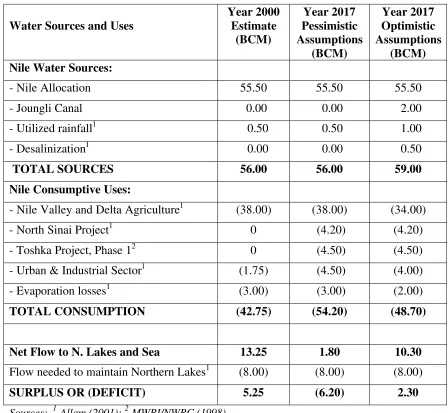
To grasp the impact of shifting demands on the Nile’s water resources, Table 2 presents water budgets estimated for 2000 and 2017, using pessimistic and optimistic assumptions (Allam, 2001). Both sets of assumptions include implementation of the entire 1997 3.4 million feddan horizontal expansion plan. Assumptions are:
Source Pessimistic Optimistic
Joungli Canal Not completed Completion of Phase 2 Rainfall used in agriculture No change Increase via water harvesting Desalinization No change Develop 0.5 BCM capacity Irrigation efficiency No change Major improvements Urban and industrial use High population growth Low population growth System evaporation losses No change Reduction of 1 BCM
Major plans for increasing irrigation efficiency in Nile-fed agriculture include: • Restriction of rice and sugar cane cultivation to a limited area
• Conversion of irrigation in new lands, orchards and vegetable fields to modern systems (drip & sprinkler)
• Improvement of surface irrigation in old lands • Encouragement of night irrigation and land leveling